Search Results for 'arc euro'

Search Results for 'arc euro'

Home Forums Search Search Results for 'arc euro'

Viewing 25 results - 1 through 25 (of 4,842 total)
  • Author
    Search Results
  • #850372

    In reply to: Sourcing ball oilers

    peak4
    Participant
      @peak4
      On Howard Lewis Said:

      Arc Euro used to supply, but they have now closed.

      YEARS ago, Warco supplied me with a few, which satisfied the immediate need.

      So try WARCO, Chester or maybe RDG for sources of supply.

      Presumably, you are looking for 6 mm or 8 mm oilers. In this day and age, METRic is all that you are likely to be able to get.

      Howard

      There’s both metric and imperial available on eBay from the like of RDG & http://www.ebay.co.uk/str/pneumaticstools

      Bill

      #850368

      In reply to: Sourcing ball oilers

      Howard Lewis
      Participant
        @howardlewis46836

        Arc Euro used to supply, but they have now closed.

        YEARS ago, Warco supplied me with a few, which satisfied the immediate need.

        So try WARCO, Chester or maybe RDG for sources of supply.

        Presumably, you are looking for 6 mm or 8 mm oilers. In this day and age, METRic is all that you are likely to be able to get.

        Howard

        #848344
        JA
        Participant
          @ja

          Tome Feteira files are the best files I have used. Arc Eurotrade stocked them but, as everyone knows, has ceased trading. Does anyone know of another UK stockist of these files other than the Gibbs Group which appears to supply the oil industry and not like small private customers?

          JA


          #848285
          Jim Guthrie
          Participant
            @jimguthrie82658

            Just a note on what happened to me a month or so ago.  With pretty well the same setup as you having purchased the KX1 from Arc Euro with the bundled Cut2D.

            I was cutting with a 2mm slot drill and all was well.  I then had to change to a 0.5mm slot drill to finish off some small details and I started to get intermittent limit switch operation.   After a bit of consternation,  the cause dawned on me.

            I normally work with a 18mm spoil-board on the table but in this case I had opted to work with the workpiece clamped directly to the table.   I use an ER25 collet to hold my cutters.  With the longer 2mm cutter in use,   there was no problem,  but with the shorter 0.5mm cutter,  the machine was hitting the Z limit switch when lowering to do its cutting.

            This was hidden from me since I use an auto height setter which is about 25mm tall,  so auto height setting with the shorter cutter was no problem.

            I don’t know how you are holding your cutters,  but if you are using an ER style collet,  then there’s no way shorter cutters can get anywhere near the table surface.


            Jim.

            Steve Withnell
            Participant
              @stevewithnell34426

              My setup is as shipped by ArcEuroTrade some years back.    Dell desktop running XPSP3 and the locked down version of Mach 3 that came on the disk.   Vectric Cut2D has coped with everything I’ve done so far, which has been fairly wide ranging.   This set up has never missed a beat so far.

              This week I set out to do a very simple job, a small instrument panel ten 5mm holes for LED’s and then engrave the LED function underneath.

              The engraving job triggers an emergency stop from a false limit switch detection at random intervals.    I discovered that the software debounce settings ‘as shipped’ was set to 0,  and this has never been an issue.   Anyway I’ve upped that to 6mS and the fault remains, sooner or later the engraving job triggers a false limit switch detection.

              I’ve waggled all the drag lines to the switches with the machine running and I can’t force this problem.

              Next step will be to put some decoupling caps on the inputs to the Mach3 PCB,  but I don’t have a schematic or annotated photo of the USB version of the Mach3 control board.

              I understand this issue is well documented in this and other forums, but my searches don’t pull anything close.

              Any ideas please?

              #848193
              Robert Atkinson 2
              Participant
                @robertatkinson2

                I also have a SX1LP (from the much missed Arc Euro trade) and am very happy with it. Fixed dovetail column, high speed so good for small cutters but will still run a insert face mill, a quill feed and a long table I can get most of a 19″ electronics rack panel on. I mostly do “electronic” projects an it’s ideal for that. The only small niggle is a bit more Z travel would be nice when drilling diecast boxes. Using an ER16 collet instead of the rather large jacobs type chuck helps with that.

                Robert.

                #847804
                Pete
                Participant
                  @pete41194

                  As far as the best advise I might be able to provide about buying and fitting a quick change tool post and holders. Warco should be able to recommend exactly what will work with your new lathe and I’d check with them first. If you were to buy elsewhere, then it would be best to measure your lathe to obtain the distance between the lathe head stocks center line and the top of your top slide. I believe there’s a loose industry and dimensional standard that possibly not all of the manufacture’s follow. That might be even more true for the cheaper Asian copies. In that case, try and obtain the basic drawing dimensions of whatever tool post and tool holders your buying. This link to the Aloris website shows what I mean. https://aceronline.net/acergroup/pictures_for_ebay/aloris_p3.pdf It’s a bit complex, but those dimensions provide measurements to be used to determine the tool shank size your planning on using does fit the tool holder slot and still allows enough vertical adjustment of the tool holders to set the tool tip on the lathes center line within its range of adjustment.

                  I’d also fully expect to have to machine a new stud that’s firmly attached to the top slide and is properly sized to fit the new tool post bore. It’s possible to maybe likely that may require a stepped stud depending on the mechanical design your lathe uses. There’s actually quite a few different designs of quick change tool posts and tool holders, some can be far too expensive such as the European Tripan or Swiss made Multi Fix. But in general and if what your thinking of buying is one of the Asian generic copies of the U.S. Aloris. There’s two basic designs these tool posts use to clamp and lock the tool holders each time there changed. A piston type or wedge design. Either can work well enough, arguably the wedge design might be a bit more rigid. Although the wedge lock will usually costs a bit more.

                  I’d also agree about not buying the tool post and a kit of 4-5 various types of tool holders. You might never use some, or they may not perform well. Those sets with knurling or cut off tools are built down to meet a price point and you may want or need better.

                  #846100
                  petro1head
                  Participant
                    @petro1head

                    Not needed anything for a while but now need some index tips.

                    since Arc closed who are you using?

                    #846083

                    In reply to: Sieg SX2PG Mill

                    JasonB
                    Moderator
                      @jasonb

                      Axminster (who do sell milling machines) would be your best bet. They don’t list them on their site like ARC did and don’t carry as many but should be able to help.

                      There are also european stockists if Axi can’t help or have a long wait due to ordering in from Sieg.

                      #846081

                      In reply to: Sieg SX2PG Mill

                      Mark Salzedo 1
                      Participant
                        @marksalzedo1

                        Many thanks for the heads-up. I wonder what happened to all the spares that Arc Euro had in stock?

                        #846071
                        Mark Salzedo 1
                        Participant
                          @marksalzedo1

                          Does anyone know who now stocks spare parts for the Arc Euro Trade SX2PG Milling Machine?

                          Many thanks,

                          Mark

                          #846010

                          In reply to: ER 11 collet supplier?

                          Nick Hulme
                          Participant
                            @nickhulme30114
                            On rodrenshaw Said:

                            Hi all

                            Last year, or was it the year before, I bought some ER 11 collets from Arc Euro.

                            Now I would like to buy some more sizes, can anyone suggest a suitable UK supplier who can supply some of similar standard so I can fill in the gaps in my “set”?   I don’t need the most accurate and expensive kind just something reasonable.

                            Thanks

                            Rod

                            EW Equipment in Stockport or APT Tooling in Glasgow, both offer a great service and excellent products at good prices

                            #845202
                            rodrenshaw
                            Participant
                              @rodrenshaw

                              Hi all

                              Last year, or was it the year before, I bought some ER 11 collets from Arc Euro.

                              Now I would like to buy some more sizes, can anyone suggest a suitable UK supplier who can supply some of similar standard so I can fill in the gaps in my “set”?   I don’t need the most accurate and expensive kind just something reasonable.

                              Thanks

                              Rod

                              #844843
                              Nicholas Farr
                              Participant
                                @nicholasfarr14254

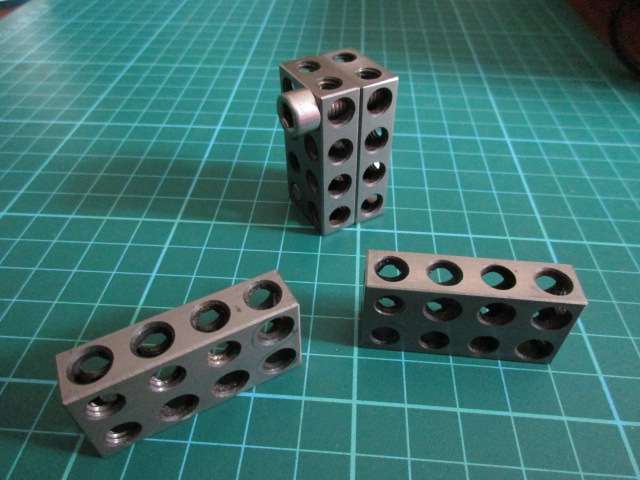
                                Hi, those blocks on page 17 are undoubtedly 10-20-40 metric blocks that Arc Euro sold, and I have six of them, along with six 15-30-60, and two 20-40-80 ones, and can be bolted together.

                                003

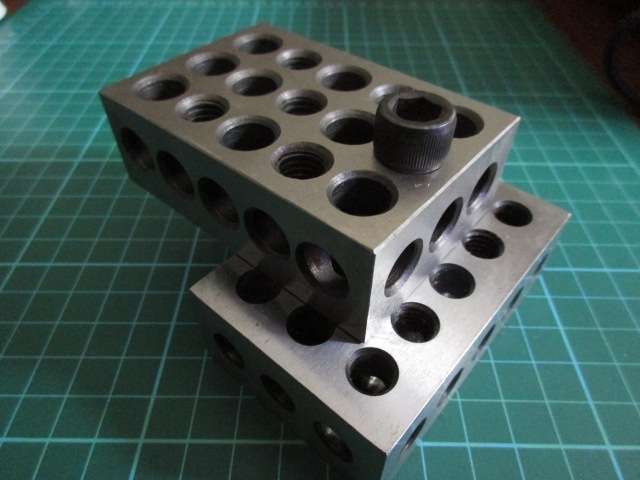
                                Like JasonB says, the normal imperial 1-2-3 blocks don’t allow the bolts that fit the threads, to pass through the plain holes, however, I got a pair of 1″-2″-3″ blocks from Chester UK, about 16 months ago that do allow the bolts to pass through all the plain holes, and the photo below shows one of them bolted to a normal 1-2-3 block, and they have the same five threaded holes as my imperial ones have.

                                002

                                Regards Nick.

                                #844337
                                JasonB
                                Moderator
                                  @jasonb

                                  The article on the mill that was on the ARC site is the one the OP is using.

                                  They can all still be found on the net

                                  https://web.archive.org/web/20220308232853/https://www.arceurotrade.co.uk/Catalogue/Projects-Articles

                                  The central keyway was used to drive the two speed plastic gear but is not needed on the later brushless motor machines that drive the spindle directly.

                                  #844331
                                  southernchap
                                  Participant
                                    @southernchap

                                    Such a shame that Arc Euro Trade is no longer going.  They had good PDF guides to disassembly and bearing changes on the SEIG machines (both lathes and mills).

                                    Sadly with their website gone, their guides are no longer available.

                                    #841853
                                    howardb
                                    Participant
                                      @howardb
                                      On Russell Eberhardt Said:
                                      On Diogenes Said:


                                      The biggest bugbear I can see is how the authorities will respond to the problems of policing ‘mail order’ engineering..

                                      Probably my introducing taxes.  France has just imposed a €2 “Taxe sur les petits colis” (TPC) on non-EU, low-value (under €150) parcels, targeting Chinese e-commerce like Shein and Temu. This mandatory, temporary, and separate administrative fee applies to each item category, not just the package, with an additional €8 fee for non-compliant shipments.  I’m sure others will follow.

                                      Russell

                                      Unfortunately, the aforementioned tax is not an EU wide tax, it is down to individual countries tax decisions.

                                      In the case of Italy who was first,  the tax has been bypassed as Shein and others just now fly cargo to Poland which has no “EU import from non EU” tax, and Shein ship from there to the rest of the EU by post or carrier.


                                      “However, Italy made a critical miscalculation: the €2 tax applies only to parcels entering Italy, not the entire European Union. Once goods clear customs anywhere in the EU’s borderless Schengen zone, they can move freely to any member state without additional checks. This created obvious arbitrage opportunity where logistics companies simply land cargo planes in neighboring countries, clear customs there, then truck parcels to Italian addresses—avoiding Italy’s €2 fee entirely while adding minimal transportation costs”


                                      How Italy’s Tax Disaster Drove Shein Shipments to Poland


                                      #838392
                                      Pete
                                      Participant
                                        @pete41194

                                        I don’t know of how much use this might be to you Mike since it’s more guessing than anything else. But I can probably add a few thoughts as well. However I have real doubts your lathe was something home made unless the one who did so had the training, experience and access to a very well equipped shop. Many parts and details are well thought out, designed and machined, I’m guessing it’s most likely from a fairly small and low volume manufacturer. That added counter weight balance on the tail stock hand crank as just one example. And what you said about that single tooth dog clutch on the lead screw. I also think I’d agree with Tony’s approximate date of manufacturer. Depending on the exact date and country of origin, there could be many logical reasons behind using V shaped lead screw threads and using the more proper ACME in other areas. While it looks old enough, that may not even be the original lead screw. Incorrect machine tool part substitutions and replacements are made all the time by mostly non professionals.

                                        True Ornamental or Rose Engine lathes were generally in the 10″ – 14″ range for maximum part diameter. That certainly doesn’t mean something meant and sized for maybe watch making didn’t adopt some of the same ideas as well for your lathe. But unlike the Rose Engine lathes, if it was capable or possible of that type of work, there’s no easy way or enough room to mount the Rosettes between the bearings in the usual position. Single rosettes could of course have been used and just attached to the rear of the spindle. How it’s been assembled today or if other accessories were even available to allow head stock rocking / pumping are impossible to say now.

                                        I think it might also be a bit too small to do the usual Guilloche patterned watch dials using what are called straight line bars as well as having additional accessories since that’s normally done on a lathe using the head stock for dividing and work holding. Sometimes an additional single slide is bolted to a lathe faceplate to do straight line or even Ornamental Turning. But maybe it could have those accessories available? Most Guilloche work was done on more dedicated, larger and much heavier straight line machines, but lathes were also used as well. Those extra tapped holes in the top of the cross slide were put in for a reason. But they don’t seem to have been done to a high standard either, so ?????

                                        And it’s only one of other possible reasons. The extra stud positions on the head stock might have been to produce what are known as long lead (pronounced leed) grooves or threads and even long lead multi start grooves or threads along a shaft. Some of that can be strictly for ornamental purposes, but its also done for some mechanical reasons as well. Any modern level wind fishing reel as one example where it might be used today. Again this all depends on what the lathe was intended for. But in case you don’t know, long leads like that would have never been possible under the usual spindle power even with a proper back gear. Geared that way, back driving the lathe spindle rotation with a very slow rotation of the lead screw hand crank would be done instead. Given the gear ratios involved, lathes other than a very few specialty designed one’s aren’t designed to handle the loads for thread pitches coarser than the lathes lead screw pitch.That drive could be done using only hand cranking, or some lathes had the ability to use power from a separate belt. Long before electric motors were invented, powered and belt driven longitudinal and cross feeds while a bit rare weren’t exactly unknown. Yours doesn’t have those pulleys mounted of course, but there’s no way to say they also weren’t another option. It’s also not impossible your lathe when new was intended to be powered using a foot treadle drive like old sewing machines were. I think that might be much more likely than not.

                                        In original condition, or with optional accessories if the manufacturer even offered them. It may well have also had or could use what’s called an overhead drive with another and much longer belt. The lathes head stock drive belt in that case would have been disconnected and instead that longer belt used and powering the overhead drive. A second belt running back down would then be used to power what we would call a milling head or with today’s CNC, Live Tooling on the lathes cross slide. Even small grinding heads were available. If it was ever offered with anything like that? Then it would have looked a bit like some of the pictures in this link for the much larger Ornamental lathes. https://www.lathes.co.uk/evans/ But the exact same idea was also used on lots of Jeweler and watch making sized lathes as well. I think some watch and jewelers sized lathe users still use it today.

                                        If the screws aren’t too tight that it risks breaking them, removing some to double check there threads per inch or metric equivalent, and if those thread counts and diameters do match up with known imperial or metric standards might provide a bit more information. The imperial divisions on the feed screws aren’t necessarily a 100% indicator of where it might have been manufactured. Even more so if that particular model was ever destined for export elsewhere? You’d still need accurate thread gauges to properly identify the fastening screw threads or thread flank angles though. Who knows, those might even be 55 degree BSW, BSF or BA. And even that wouldn’t mean it’s from any British manufacturer. After those standardized threads were invented, those sizes, pitches and even 55 degree thread angles were also used by many on the continent for quite a while as well. Afaik and as just another example, companies such as Holtzaffel while producing there earlier Ornamental Lathes didn’t use standardized thread pitches or diameters until much later. Yours probably does given its guessed at approximate date of manufacture, but it’s something I’d still want to verify to be sure of. And not impossible it was originally manufactured somewhere in Eastern Europe.

                                        Those slotted and deep headed screws I’ve always read were fairly specialized and certainly not used very often on more ordinary items even back then. Doubtful a home lathe builder would use them, but again not quite impossible I suppose. Some of yours do show the use of the incorrect screwdriver tip type of damage. The modern tapered tip junk screwdrivers available today are exactly why those screw slots got damaged. If you want to prevent any more of that? The proper driver tip shape needs to be parallel ground or machined, fill the full slot length, depth and with minimal clearance for each screw slot width. Very close to what could be called a slip fit clearance in fact. I’ve had to machine a few of those screwdriver tips myself. Unhardened tips will work almost as well as the hardened which aren’t available anymore that I could find that fit the screw head sizes I was working on. There is a second type with much larger diameters and shorter head depths, usually called Cheese Head Screws. The older South Bend lathes used those in some areas.

                                        Are there any of what might look like a trade mark stamping usually located somewhere on the lathe bed? Most seem to do so on the front, rear, or top of the lathe bed around the tail stock area where it would see the least wear. It might look like a single stamped logo design of what the manufacturer used to identify there products with their own trade mark stamp. If so, some companies even added there initials inside the logo. It certainly doesn’t cover them all, but if there is anything like a trademark stamp, Google images can be searched and sometimes find what your trying to identify.

                                        And with what seems to be only sleeve type bearings by your description, and little to no reserve that oil cups would provide. I’d be very particular about almost constant oiling of them. And be real careful about the rpm your driving the spindle at. In general and with only gravity oil feed, 600 – about a maximum of 900 rpm might be pushing it. There’s a few and extremely high cost lathes made today that still use the same type of bearings for proper engineering and ultimate accuracy reasons that are fully capable of very high rpms. But they also use temperature controlled oil recycling and a continuous flow of high pressure lubrication. I think someone else already mentioned that older lathes had this design of spindle bearings because the high carbon cutting tools in use at that time couldn’t tolerate or use higher rpms anyway.

                                        Your 9/16ths X 20 TPI spindle thread is small. Yes it’s a much larger lathe, but the 6″ swing Atlas lathes I believe used a 1″ X 8 TPI spindle thread, and were well known to quite easily bend the spindle if any excessively heavy cuts were attempted, or worse a lathe crash happened.They easily bent because of the small cross section left after the spindles Morse Taper and through hole were bored.

                                        With that head stock design there’s no shimming or what would be thought of as a more conventional type of adjustment design for the spindle to bearing clearance. That is a bit strange. If it isn’t home made? Then I’d bet the spindle cone is extremely hard and the same for what might be separate hardened cast iron sleeve bearings. The only real adjustment is that end play nut that also pulls the spindle cone into the bearing cone to take up any wear. And with what appears to be open oiling ports in the head stock, If it were me, I’d think about removing the spindle for what I’d bet is a long overdue cleaning and check for any scoring on the spindle cone and bearings. Kept clean and adequately oiled, it’s a good proven design, if there not, they can be a tough and expensive to repair design. Some lathes like a few of the least expensive and earlier South Bend lathes used a very hard spindle cone, but running in just the soft cast iron the head stock was cast from. Those are really involved and without the right equipment, expensive to repair.

                                        I also suspect the knob on that lead screw hand crank is original and the others made of brass were one or more previous owners additions since they don’t seem to match each other in length or proper shape. Almost for sure the 4 way tool post was something home made as well. Those parts and added tapped holes do give it an air of something home made, but what’s there and what seem to be the original parts indicate to me it was more probable something commercially made.

                                        With a lathe of that age and no known manufacturer yet, it’s literally impossible to say what amount of poorly thought out modifications it may have gone through. Damaged and lost parts have also added to the issues and with multiple previous owner modifications done as well. No gibs or side to side tail stock adjustment doesn’t seem quite logical against what the more probable original design might have been. But one thought, if some previous owner added head and tail stock raising blocks? That could be one reason the tail stock can’t now be adjusted? That also may have needed modifications to the slides or gibs being removed that might have once been there? Right now you have what seems to be a combination of OEM, armature part additions, modifications, and now it seems quite a few lost parts. Still worth having and I would have bought it as well. Depending on what you want, it could turn out to be a large project though.

                                        If it was a lathe built in Europe? This forum https://www.usinages.com/forums/ is I believe French language only, but Google translate can usually work well enough. You’d have to join to post anything, but afaik it’s probably the largest European based forum I know of. If your lathe can even be identified today, your best chance might be there?


                                        #837289
                                        Sonic Escape
                                        Participant
                                          @sonicescape38234

                                          I just got a new belt for my lathe and I have some problems with it. I understand how to adjust the two pulleys in order to keep the belt from falling off. But I don’t understand why it is wobbling like this. Could it be a defect of the belt?

                                          The old belt doesn’t wobble like that. So that means the new one is bad or I’m missing something?

                                          I bought the belt here. I got the cheapest one, the one for 11.2 euros. Because I was stingy. But is it normal for it to be so bad?


                                          #837013
                                          Nigel Graham 2
                                          Participant
                                            @nigelgraham2

                                            I can see one source of worry immediately… Does the length of the gib, for example, have to be to 2 decimal places? (I doubt it!). Why not 113mm?


                                            My thought irrespective of any machine, is as far as possible:

                                            – keep the dimensions consistent with the original: if it is made to inches, use inches (decimals for anything machined); if metric use mm.

                                            – keep the threads consistent with the manufacturer’s chosen standards.

                                            There is nothing to stop the builder converting the units if necessary, usually to suit his own facilities, but at least the manufactured dimensions in either standard are likely to be round numbers.

                                            While mixing fasteners leads to awkward use and servicing.

                                            For example, the commercially-made rear tool-post on my ML7 has two 1/4″ or 5/16″ BSF T-bolts in its projecting foot, and a 17mm A/F nut on its central column. I have not measured the column thread, which should be M10 for that nut. The fixed-steady clamp stud is about the same size but uses a BS or AF spanner. I would not expect such needless inconsistency on commercially-made accessories for the same machine.


                                            Sometimes you might not have much choice as the range of readily-available BA and BS thread fittings diminishes. I used M6 cap-screws screws on an accessory I made for my Harrison L5 lathe; but in such cases it is best to be consistent across the accessory itself as far as possible.

                                            Similarly, the set of small-thread T-nuts I made for my Myford VMC mill has M6 threads; easy to equip and compatible with an Arc-Euro M6 clamp-set that neatly fits the BCA jig-borer table. The full-diameter, commercial clamp set that fits the mill uses 3/8″UNC nuts, fitting T-slots of odd width neither one thing nor the other; the machine itself uses BSW / BSF.


                                            Really, the original question is rather academic. When we make accessories to our design we measure the relevant parts of the machine anyway; if we use a published design that’s been done for us. You don’t need know the headstock sizes to make something to clamp to the saddle.

                                            Besides, I very much doubt any machine-tool manufacturers publish full sets of detailed, dimensioned drawings of their products: the most will be enough outline dimensions to aid installation and use, and exploded parts-diagrams.


                                            Perhaps the moral is that you’ll not please everyone every time!

                                            Just be thankful we’re not calling for all those umpteen-sixtyfourths from random data-edges as we see on some of the older model-design drawings.


                                            #836874
                                            howardb
                                            Participant
                                              @howardb
                                              On John Haine Said:

                                              I have a S7 but can’t see any need for a set of engineering drawings. The main dimensions of interest are for interfacing accessories, usually to the spindle nose or carriage, and they can be measured in a trice. Likewise individual parts. Interesting that everyone leaped into the debate about dimensions and threads without answering the initial question!

                                              Mind you, I suspect that Myford might like an accurate and detailed CAD model!  I wonder what state the “original” drawings are in?
                                              Edited By John Haine on 16/09/2023 10:36:15

                                              As most Myford owners know, Myford Limited is associated with RDG Tools.

                                              I had cause to call them about 5-6 years ago to inquire about the centres of the mounting holes on the back of the bed, normally used for the taper turning attachment etc, I was making a mounting plate for ArcEuro’s digital scale for the Z axis carriage travel.

                                              The helpful chap I spoke to said that might be difficult, I asked “can’t you just have a look at the drawings” he said we haven’t got the drawings we didn’t buy them as part of the Myford sale.

                                              Whether that has changed nowadays I have no idea.

                                              #836798
                                              Pete
                                              Participant
                                                @pete41194

                                                This is a bit lengthy to properly explain.

                                                I don’t automatically trust an accuracy specification for any tool or gauge. You have to start from a known base line and work from there. Better would be to first start with checking your test bar by measuring along it’s length with a very good micrometer while checking for any variations in it’s diameter.  Then indicating it in a pair of V blocks while checking for straightness would be the first checks I’d do. If it does measure as being parallel, then rotating it in a pair of V blocks and indicating at various points to locate any areas of inaccuracy in its straightness and how much out that may be. Yes in an ideal world we wouldn’t have to check, I’ve also found in a brand new set of “certified” as accurate to low millionths of an inch gauge blocks there were two identical blocks that were marked and measured the exact same size. Mistakes or even defects can turn up with even the best manufacturing and quality control no matter what the supposed guarantee of accuracy might be.

                                                Morse taper test bars no matter how well made and accurate they may or may not be also depend on an almost perfect condition female taper. Any previous internal damage, rusting, or even the slightest speck of missed dust or contamination makes the test results while using one just about worthless. Frankly and in my opinion, most hobbyist’s don’t or aren’t willing to look after those high precision head and tail stock tapers as well as they should. And at one time I was certainly no different. I’m also not against using those test bars, I have them myself. But I’m very careful to check any Morse Taper there being used in first.

                                                In one way or another, the worlds machine tool manufacturing industry still use the same methods and procedures developed by a Dr. Georg Schlesinger that can be found in this PDF. https://pearl-hifi.com/06_Lit_Archive/14_Books_Tech_Papers/Schlesinger_Georg/Testing_Machine_Tools.pdf

                                                And despite what some seem to assume is correct, the better built lathes even when brand new are not aligned to face parts perfectly flat for a couple of very good reasons. Properly set up, its desirable to always have them face very slightly concave and never convex. That way two mating part surfaces joined face to face will sit flat and not rock. And a lathe first set up to face dead flat from new would begin to wear towards facing convex as the cross slide ways start to inevitably wear. Secondly and on the better lathes, there’s usually some misalignment purposely added to attempt to compensate for possible large work piece weights and cutting forces. In general, those would show the head stock and also the lathes tail stock to be pointing up and also towards the operator by approximately .001″ over about a 12″ length of extended test bar. Not all lathes are set up this way, but in general the more expensive ones would be. The cheaper and more hobby level lathes today might be anything but correctly aligned unless they do come with a certificate of accuracy. Even then I still verify those numbers myself.

                                                Afaik there’s two different methods used that vary between manufacturers to force a lathe to face concave. Some miss-align the head stock, while some bias the cross slide way surface grinding and / or scraping to do the same. Without exact details to fully prove it, I believe that cross slide bias may be more of a North American method, and very slightly twisting the head stock towards the operator is more of an European method. Although I suspect that isn’t universally true in all cases. Only my personal opinion, but for a few reasons I think the European method is still the better choice.

                                                However it’s done, that introduced concave facing alignment isn’t very much. From memory and depending on the grade specification of the lathe, around .001″ for something like a tool room lathe -.002″ maximum for something like a more general purpose lathe over about a 24″ part diameter. Which doesn’t help us with our much smaller swing lathes. Since a lathe cuts on both the front and rear of the part as it’s facing, that 24″ diameter face is in reality a 12″ facing cut. So the misalignment to face concave is only around .000083″ – .00017″ per inch of cross slide travel. At those numbers it’s getting fairly hard for what most of us might have available to even measure it.

                                                Impossible it’s something new as without question others would have come up with the same method and long before I was even born. Although I’ve not yet seen it mentioned anywhere else. But I did figure out a way that our smaller swing lathes can be checked, and a bit easier to verify by doubling those very small numbers.

                                                You’ll need either a lathe face plate or a short and fairly thick metal disc that’s just about the largest diameter your lathe can swing. How and what you manage to use for the test cuts is up to what you have available and how much effort your willing to put into this. Secondly at least a .0001″ or it’s metric equivalent reading dial or dial test indicator. Your cross slide gib should be properly adjusted to allow a smooth but shake free travel. On a highly worn lathe that’s also going to have a direct effect on your measurements. Your lathes head stock bearings should also be in good condition and correctly adjusted for there specified radial clearances and end play amount.

                                                Make a clean up facing cut across that face plate or disc. Now make a fine and steady facing cut maybe a few thou deep across the whole face with the very best surface finish you can manage. Then withdraw the cross slide back towards you. I’ll use a clock face and it’s numbers for explanation purposes. Looking from the tail stock end of the lathe at the object you just faced, 9 o’clock would be the left edge of the face plate or disc, and 3 o’clock would be the right side or furthest away from the operator during normal lathe operation. Set up and zero the indicators dial at 90 degrees to the part face about to be measured, and in the case of something like a face plate, just past it’s center hole. Slowly and gently move the cross slide inwards with the indicator tip traveling towards the 3 o’clock position on your face plate or part disc.

                                                What that does will then show double the measurement of what the cutting tool removed to produce either a concave, dead flat, or convex facing cut. If you set up your indicator to travel the same path the cutting tool did, it will tell you nothing of importance since the indicator tip is then duplicating the exact same path the cutting tip did. With those measurements, then make your head stock adjustments accordingly until it will produce that concave facing cut within the above numbers. It takes almost as long to explain the how to as it does to do it.

                                                This is also a very good example of never touching a lathes head stock unless you do fully understand what your doing and what the actual alignment numbers ought to be first. However the test method I’ve detailed can still be used to verify any new or used lathe. But it still won’t tell you everything, worn cross slide ways could easily indicate the head stock is out when in fact that wear should be the item to be addressed first. So some proper judgement about the lathes condition and amount of wear needs to be used as well.

                                                That Dumbell or I’d assume the Two Collar test method was what was meant is simpler, but part deflection can also affect the test numbers. And with highly worn or a less than perfectly straight lathe bed, it also won’t tell you everything about the head stocks alignment. Doing a very large facing cut on a face plate or disc will at least provide direct measurements of an issue or misalignment with either the head stocks position on the ways, or an indicator of an undesirable amount wear on the cross slide way surfaces. It then depends on the lathe condition itself for what needs addressing. Lathes are fairly simple machine tools, but there alignments aren’t because theirs so many individual parts directly related to there measurable accuracy for any parts being produced on them.


                                                #834778

                                                In reply to: Diesel Fuel

                                                SillyOldDuffer
                                                Moderator
                                                  @sillyoldduffer
                                                  On JA Said:

                                                  When I started at my last job, in 1978, I attanded an in office talk on emissions:

                                                  Smoke: It has neither mass nor volume. ..,

                                                  That’s an unusual definition of smoke!  Who was the source?  Not citicising! Although engineering tries to standardise terms, history is against us.  For fun, how many different technical definitions of “thread” are there?  “Smoke” is also likely to have multiple meanings.

                                                  Chemists define smoke as an aerosol of fine particles (less than ⌀1μm) mixed with combustion products, mainly gases and vaporised hydrocarbons.   The gases typically include Carbon Dioxide, Carbon Monoxide, Nitrogen Oxides, Cyanides, and maybe a whiff of Dioxin!  All the constituents of smoke have mass and volume, which can be measured.

                                                  The “neither mass nor volume” confusion may be that the mass and volume of smoke is much the same as air, so not obvious.   The key point is that Smoke is far from harmless/   Small quantities trigger asthma attacks, and cause minor damage to lung tissue that can be infected (Bronchitis etc), and sometimes spark cancerous changes.  Smoke inhalation is the most likely cause of death in fires.

                                                  The enquiry into the Grenfell fire revealed shocking shortcomings in UK Building and Fire Regulations, the latter being badly out of date. Resulted in this paper:  ” Research and analysis Fire safety: Smoke and toxicity“.  Published 22 December 2025, not nearly 50 years ago, and I suggest is more trustworthy than JA’s version.


                                                  On howardb Said:

                                                  EU emissions standards.

                                                  Comparing Euro 6d level emissions of petrol and diesel engines of passenger cars.

                                                  Units grams/km

                                                  Petrol  CO 1.0

                                                  Diesel  CO 1.0

                                                  Petrol Nox   0.060

                                                  Diesel Nox   0.080

                                                  Petrol particulates 0.0045

                                                  Diesel particulates 0.0045


                                                  There is no cognisant reason to blame Euro 6d level diesel engines for excessive pollution.


                                                  Not sure what Howard’s table is.  Are they emission targets measured steady-state in a lab?  Well-known problem with steady-state lab results, because cars on the road are far from steady-state. This table summarises real-world Urban Cycle performance from various sources.   As the numbers are much less rosy than those in Howard’s table, there is cognisant reason to blame diesel engines for excessive pollution!

                                                  Screenshot From 2026-01-29 08-40-54

                                                  Real-road and lab test numbers both show petrol engines produce more CO₂ than diesels.  As CO₂ is causing climate change, a major threat to humanity in the mid and long term, UK government encouraged drivers to go diesel, only to discover a major problem a few years later.  Trouble is diesel’s produce much higher levels of particulates and Nitrous Oxides than petrol engines, and these bery obviously reached dangerous levels in town centres and confined spaces.  About turn!

                                                  Though IC engines have been considerably improved over the last 40 years, electric is the best answer to local toxicity and global warming at the moment.  I think all that can be done to improve IC engines has been done, such as:

                                                  • cleaner combustion. Fuel-injection, improved mixing in the cylinder, plus sensor enabled timing and other tweaks provided by microcontroller based engine management units
                                                  • Removing Lead from petrol.
                                                  • Catalytic Converters on petrol exhausts turn toxic Carbon Monoxide into Carbon Monoxide, consume unburned fuel and soot, and reduce some Nitrous Oxides too.
                                                  • Much better particulate filters on diesels, but effectiveness depends on how the vehicle is driven and maintained.   Room for improvement maybe, but not obvious how.

                                                  I’m not against diesels used sensitively, and big diesels are less damaging than small ones (more time and space in big cylinders to complete combustion).  Railways, long-distance road-haulage, agriculture, heavy earth-moving, and maritime.  Allowing thousands of small diesels to chug and queue in busy town centres is harmful.   They have to go…

                                                  Dave


                                                  #834535
                                                  Hugh Stewart-Smith 1
                                                  Participant
                                                    @hughstewart-smith1
                                                    On Howard Lewis Said:

                                                    The pressures on importers are not just commercial.

                                                    Arc Euro closed because the owner wished to retire, and no other company was prepared to take on the business.

                                                    Howard, in the early 2000’s we at Amadeal placed an order with Sieg for several of their C3 lathes. They proved to be popular selling very quickly, and so followed up with a full container of assorted mills and lathes. Unfortunately pressure was put on the Sieg company not to supply us. No names, no pack drill!

                                                    At that time we were trading successfully with Real Bull and did so for a few years. With limited range we found Weiss who have a much greater product range and who have become our main supplier.

                                                    Incidentally, The CEO Michael Wei of Weiss on one of his visits to our warehouse in East London let slip that Warco stopped buying from them as we had become a customer of theirs.

                                                    Hugh                                                                                                                                  Amadeal Ltd


                                                    #834309
                                                    Howard Lewis
                                                    Participant
                                                      @howardlewis46836

                                                      The pressures on importers are not just commercial.

                                                      Arc Euro closed because the owner wished to retire, and no other company was prepared to take on the business.

                                                      That was bad news for many of us.

                                                      the pricing package has a lot to do with sales volumes.

                                                      Arc Euro sold may items that were, ostensibly, the same as those on offer from other suppliers.

                                                      The obvious case were the machines, Arc offered the most basic package at a low price, with a 12 month hobby use warranty. Axminster offered ostensibly the same machines, in a different colour scheme, with a longer warranty; at a higher price.

                                                      On the face of it you can buy similar machines, from the same manufacturer, from other U K Importers, (and elsewhere in the world)  The package, and the price will be different, as will the support provided.

                                                      All suppliers have to make a profit, to survive, and need to offer a package and price combination that customers want and are willing to afford.

                                                      What you ultimately get is your decision, partly based on what you are prepared to pay.

                                                      Hopefully, the configuration of Axminster will continue to provide the same quality of product, and back up, as before, if not better.

                                                      Time will tell.

                                                      Howard


                                                    Viewing 25 results - 1 through 25 (of 4,842 total)

                                                    Latest Replies

                                                    Home Forums Search Search Results for 'arc euro'

                                                    Viewing 25 topics - 1 through 25 (of 25 total)
                                                    Viewing 25 topics - 1 through 25 (of 25 total)

                                                    View full reply list.