Plug in Solar

Plug in Solar

Home Forums The Tea Room Plug in Solar

Viewing 19 posts - 76 through 94 (of 94 total)
  • Author
    Posts
  • #856483
    Mark Rand
    Participant
      @markrand96270

      “Don’t let perfect be the enemy of good”.

      #856571
      howardb
      Participant
        @howardb
        On Fulmen Said:

        Is it even possible to run a local power source without disconnecting the grid? It goes both ways, you know. Unless the break is between you and the grid you’ll be trying to power all of your neighbors appliances as well. Right?

        Yes – a good point.

        What you are saying is-

        What happens when the plug-in solar panel output via the inverter to the house wiring, which itself needs to electronically see a 50 hz 230 volt signal from the mains power to synch it’s frequency with the mains power, and to keep it’s safety circuit on, exceeds the power being taken by the house circuits?

        How do the little electrons know which way to go?

        The inverter output cannot power the house appliances as they are not taking the power, so presumably the power goes back down the mains to power up your neighbour’s appliances.

        I cannot see a sensible answer to this, taking into consideration the information we have available to us at this time.

        When I connect my generator to the house during a power outage, I have a manual switch that operates in two modes-

        ” mains to house – generator off” or “mains to house off- generator on to house”

        Its a break before make switch so no possible duality.


        #856600
        Vic
        Participant
          @vic
          On Robert Atkinson 2 Said:

          Doesn’t matter how many people bought them if they are not installed and working efficiently.

          Robert.

          Have you got a source for suggesting they are a waste of time? I ask because there are lots of articles now opposing your view.

          https://eu.fossibot.com/blogs/news/balcony-solar-boom-in-europe-why-1m-german-households-already-have-one


          #856613
          Robert Atkinson 2
          Participant
            @robertatkinson2
            On Vic Said:
            On Robert Atkinson 2 Said:

            Doesn’t matter how many people bought them if they are not installed and working efficiently.

            Robert.

            Have you got a source for suggesting they are a waste of time? I ask because there are lots of articles now opposing your view.

            https://eu.fossibot.com/blogs/news/balcony-solar-boom-in-europe-why-1m-german-households-already-have-one


            When the inverter (or any other source or energy) is synchronised in phase and frequency with the mains and it’s voltage is slightly above the supply current will flow into the mains network starting at the socket on the wall. The inverter controls the output voltage and thus current so the power introduced  into the mains is equal to that available from the panels (up to the power limit of the inverter / regulation).
            Where the current goes depends on load impedances, mainly resistances. Taking a simple example, if the inverter is plugged into the same twin outlet as your kettle. There is the resistance of the cable between the outlet and the consumer unit (fuse box, CU) and the resistance of the kettle when its on. Kettle off all the current will flow to the CU. If there are no other loads on the house the inverter output will rise until the voltage is higher than the mains at that point. The current than flows into the greater power network and other loads. Any current flowing into the network will reduce the rate recorded by tour electricity meter.

            If the kettle is on (I’m assuming the 800W max inverter at full output and 3kW kettle) the kettle impedance will absorb all the power without the voltage at the socket being higher the the mains voltage at the CU. Thus no power flows into the mains. This is because the voltage drop across the wiring between CU and outlet caused by the current needed to “make up” the 2.2kW is enough to prevent current flow thus virtually all the solar generated power goes into the kettle.

            Only when the total load in the house is less than the solar output will current flow into the greater electrical network. This is why there is a limit to the total power in these systems to prevent issues with excessive power being fed into the network.

            Robert.

            #856618
            Robert Atkinson 2
            Participant
              @robertatkinson2
              On Vic Said:
              On Robert Atkinson 2 Said:

              Doesn’t matter how many people bought them if they are not installed and working efficiently.

              Robert.

              Have you got a source for suggesting they are a waste of time? I ask because there are lots of articles now opposing your view.

              https://eu.fossibot.com/blogs/news/balcony-solar-boom-in-europe-why-1m-german-households-already-have-one


              Wow, you are so defensive.  I never said they were a waste of time.

              I was referring to the use of sales statistics to infer the usage and efficiency of such systems.
              Are the installed properly if at all? Are they all in positions that get reasonable solar exposure?

              Linking to opinions by “influencers” getting benefit from sales and commercial sites selling solar systems does not help credibility. The latest link is to benefits of “balcony solar” systems form a company who does not sell them
              One “benefit” they state is:
              “Emergency Power Supply During Unexpected Blackouts
              Standard balcony solar setups will shut down completely if the public power grid goes out, meaning they cannot help you during a power cut. However, advanced storage units have a dedicated off-grid backup mode. Systems like the FBP1200 can detect a power outage and switch over to internal battery power in just 1 millisecond. This ensures your fridge, Wi-Fi, and laptops keep running seamlessly, even if the rest of the street goes dark. ”

              The balcony solar system concept and approvals do not allow for storage or back-up. They are supposed to simple and low cost.

              Robert.

              #856672
              Macolm
              Participant
                @macolm

                To add to what Robert said, there will be a specification for the panel regulator. Simplistically this will demand a constant voltage up to some output (the 800 watts) and limited at that level thereafter. So the “voltage” is adjusted to achieve that. In practice to achieve stability, the limit is likely to be gradual, the output starting to roll-off before reaching the power limit.

                Unfortunately the contribution mid winter from solar is near negligible, yet these panels will be well rewarded to produce excess power when there is little need for it. But we do enjoy our sky-high UK electricity bills.

                #857717
                Vic
                Participant
                  @vic

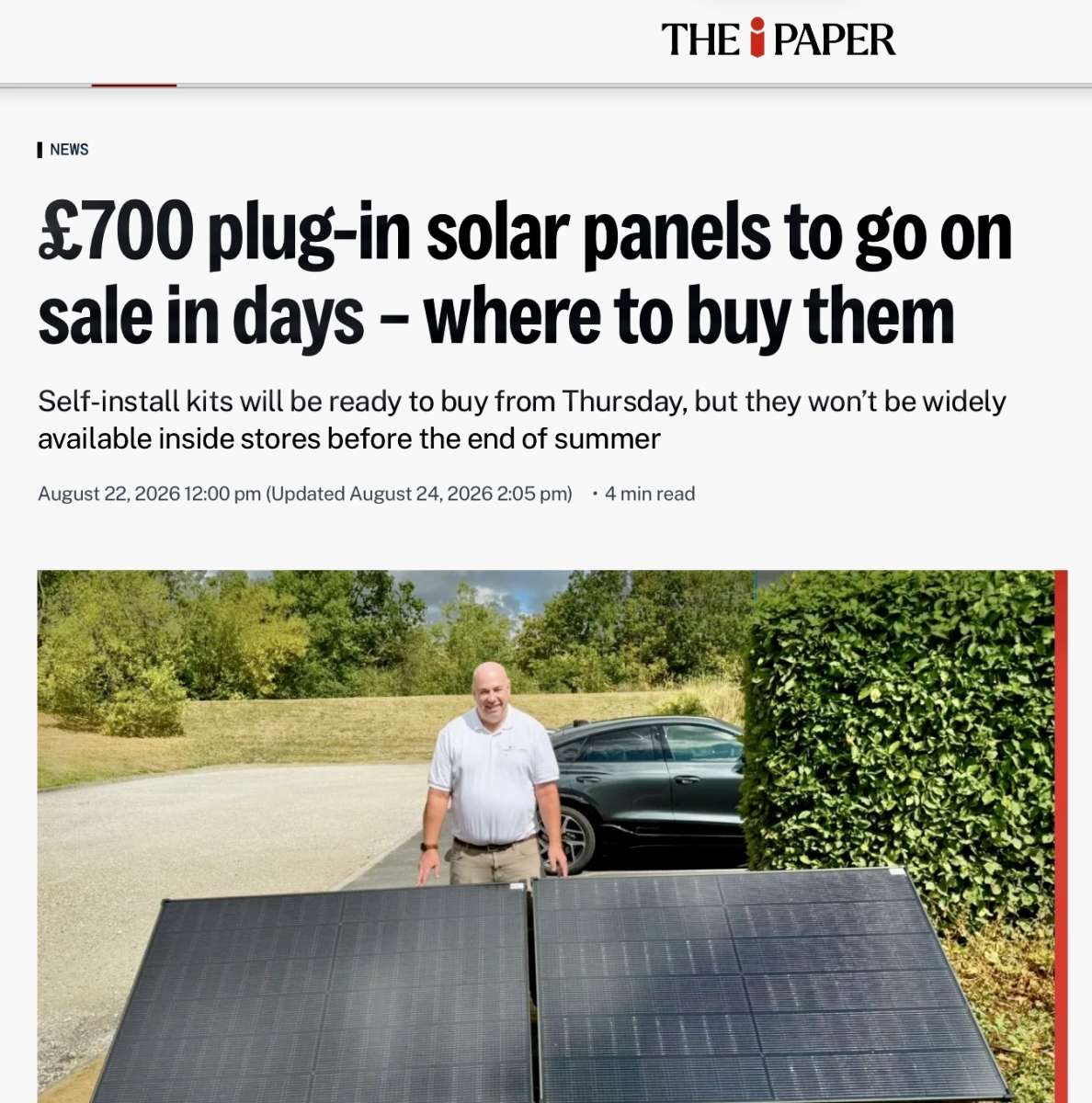
                  IMG_2499

                  #857728
                  Michael Gilligan
                  Participant
                    @michaelgilligan61133

                    Don’t understand why, but your link appears to be dead

                    Try this one instead:

                    MichaelG.

                    #857734
                    Michael Gilligan
                    Participant
                      @michaelgilligan61133

                      That’s no  better (:

                      Marble Jason can work his magic

                      MichaelG.

                      #857760
                      not done it yet
                      Participant
                        @notdoneityet

                        Excess generation can be absorbed in-house for water heating by using a solar diverter.  Useful all year round, particularly if generally using electrical water heating.  Only 800W adds up over several hours… Every little bit helps but the payback may be somewhat extended.

                        Maybe a bit better if used on the grid, if replacing gas water heating but IMO better to use it than send it to the grid unless being paid rather more than the cost of gas.  It has saved me a fair amount over the years. I’ve not used gas for domestic water heating for some time – it is cheaper to heat my water needs by electricity these days.

                        #857822
                        Robert Atkinson 2
                        Participant
                          @robertatkinson2

                          To answer NDIY first:
                          These systems are NOT intended to feed power back into the network for an number of reasons including grid stability. That is one of the reasons why they are limited to one 800W system per circuit.

                          Some actual legislation that make plug in solar legal links:
                          https://www.legislation.gov.uk/uksi/2026/848/made (plugs and sockets regulations)
                          https://assets.publishing.service.gov.uk/media/6a60a03c47af652afa0c89f5/plug-in-solar-final-_interim-product-specification.pdf

                          Noting that BS7671 (Requirements for electrical installations) is NOT legislation despite what IET want you to think. There is a change in Amendment 4 to allow it.

                          Basically you can have one system* less than 800W. battery storage is not allowed. and the equipment has to meet the UK product specification.
                          Of particular note they cannot use a standard 13A plug to connect to the system:

                          “The inverter should be designed to isolate the output if the grid frequency lock is lost according
                          to Clause 6.2.3.3 preventing hazardous voltages from being present at accessible plug pins. In
                          event of failure of the circuit providing this primary contact protection, additional contact protection shall be achieved by one of the following measures:
                          • A mechanical solution employing a locking mechanism, protective covers or enclosures,
                          shutter system or equivalent means preventing access to plug pins or other live parts unless the power output from the inverter has first been disconnected.
                          • An electromechanical solution providing automatic disconnection or separation of hazardous voltages during insertion or withdrawal of the plug. This must operate independently of the main method of anti-islanding as described in Clause 6.2.3.3.3. This shall remove any dangerous voltages from the contacts within 2 seconds ofdisconnection.”

                          Effectively this means some kind of cover over the live and neutral pins or a electrical cutout in the plug.
                          In any case the plug must be to to the latest edition of BS1362:
                          “2.—(1) Regulation 8 of the Plugs and Sockets etc. (Safety) Regulations 1994(3) is amended as follows.

                          (2) After paragraph (3) insert—

                          “(3A) Notwithstanding the provisions of paragraphs (1) and (2), a type of standard plug intended to be fitted to or supplied for use with a plug-in microgenerator may be approved by a notified body if when determining an application for approval, the notified body is satisfied that—

                          (a)plugs of that type do not conform to BS 1363 because BS 1363 contains a provision which prohibits or restricts the use of the plug for the connection of an electricity-generating device to a socket-outlet;

                          (b)except in respect of that prohibition or restriction, plugs of that type conform to BS 1363;

                          (c)plugs of that type comply with the Plug-in Solar Device Interim Product Specification; and

                          (d)by means of inspection or testing of samples of plugs of that type, the manufacturer of the plug may reasonably be expected to ensure that normal production and design of the plug will result in plugs of that type corresponding with the samples.”.”

                          Note the need for the plugs to be approved by a notified body.
                          It is not allowed to use a unit designed for use in europe or elsewhere and simply change the plug to a standard 13A one.

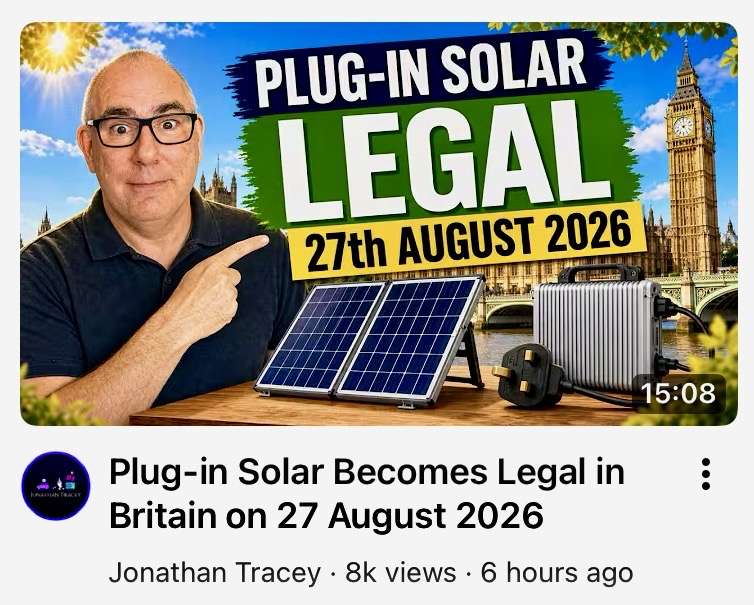
                          I would not pay too much attention to the Jonathan Tracy youtube like posted above. In one of his other videos https://www.youtube.com/watch?v=HN_hZwU17ro he plugs in an illegal home madea system. Not an authoritative source. For a start he says the legal units will connect using “a standard British 3 pin plug” when clearly they cannot.

                          Not allowed on wooden balconies. Proper attachment no cable ties or bungee cords etc.

                          Robert.

                          *product spec says one per circuit (ring main or radial) but GB network connection requirements
                          restrict this to one per household until corresponding amendments to Engineering Recommendation G98 are implemented.


                          #857837
                          not done it yet
                          Participant
                            @notdoneityet

                            <p style=”text-align: left;”>Question(s) for robert atkinson2:  Are these systems designed only to produce enough energy, as being used in the property and no more?   If that is not the case, exactly where should any excess power be directed, if not to the grid?</p>

                            #857840
                            John Haine
                            Participant
                              @johnhaine32865

                              They generate an alternating voltage in phase with the main supply and at a slightly higher voltage.  They don’t supply *any* power at all until a current is drawn and then only supply the maximum of which they are capable.  It’s not as if any excess power has nowhere to go! Your question is like asking where the excess power from a battery goes.

                              #857844
                              Robert Atkinson 2
                              Participant
                                @robertatkinson2

                                The intent is that all the power from a plug-in solar system is used by the household it is installed in, not exported to the grid. Practice may be different.

                                John is not quite right. The micro-inverters are constant power devices. They will increase their output voltage (within limits) until all the power supplied by the solar cells is injected into the house wiring up to a maximum of 800W.
                                If the solar cells are producing 500W and there is more than 500W being consumed by the household (TV, fridge, everything else) all the power will be used in the house and you will use 500W less from your supplier. and not be charged for it. If the household load is 100W then 400W will go to the electricity network and you will not be charged for the 100W you are using. You don’t get anything for the 400W going to the grid but the supplier will charge someone else for it.
                                If you considered to houses sharing a long supply cable to the nearest transformer if the second house had no solar and a > 400W load they would use all the excess from the first’s solar and be charged by the electricity company for it…

                                Robert.

                                #857862
                                Russell Eberhardt
                                Participant
                                  @russelleberhardt48058
                                  On JasonB Said:

                                  Further down the page they give a more realistic 340W per panel. maybe a (deliberate) typo?

                                  Still not realistic.  The best commercial panels at present seem to be 25% efficient or less.  Here, in the south of France, the highest solar radiation my weather station has recorded at midday in June has been 900 W/m2 so to get 340W the best panel would have to be 1.5 m2.  In December here the maximum incident radiation was about 300W.

                                  Russell

                                  #857870
                                  Robert Atkinson 2
                                  Participant
                                    @robertatkinson2

                                    The UK scheme allows for a maximum solar panel rated output of 2000W but only 800W of actual output can be used. They recommend a maximum rating of 960W. You are also limited to a maximum of 4 panels (two strings of two). The system has to be supplied as a complete kit with ready made leads etc. No mixing and matching panels and inverters.

                                    Robert.

                                    #857915
                                    not done it yet
                                    Participant
                                      @notdoneityet

                                      Thanks Robert.  It is quite clear that your previous comments/replies were attempted obfuscation.  Excess power would go back to the grid.  Thank you.  I actually knew that, of course.

                                      Let’s look at a house already endowed with solar panels.  Is there any reason why that house should not take advantage of a balcony system – as long as the allowed limit of power sent to the grid (generally 3.68kW) is not exceeded?

                                      I’m charging a battery bank with the solar DC, for later use, either at battery voltage or via an inverter.  BESS, whether the power is derived from DC solar, or cheap-rate night tariff is immaterial to me.  Both work out better than gas, but solar, after installation, costs nothing to run.

                                      #857918
                                      Robert Atkinson 2
                                      Participant
                                        @robertatkinson2

                                        I was not obfuscating anything. I’m not particularly pro or anti solar power. I’ve helped people with “renewable energy” to a small extent since the 80’s. More recently I’ve been professionally involved in solar and hydrogen systems despite my main job being aerospace.

                                        I’ve no idea about adding plug-in to an existing solar installation. I think it would be down to your electricity supplier and local planning.

                                        Robert.

                                        #857929
                                        not done it yet
                                        Participant
                                          @notdoneityet

                                          I don’t think that.  Generally, no planning consent required and if already feeding the grid from a solar system, one should already have notified the DNO (not the supplier)?  Then, if not exceeding the usual 3.68kW (allowed from most domestic systems) as long as the installed system is to the rules, from where the leccy is generated is of no consequence to anyone.

                                          There are already countless users buying cheap and selling back to their supplier at a higher rate during peak periods.  Same with solar as the BESS doesn’t care whether it has been charged with solar DC or AC derived current.

                                        Viewing 19 posts - 76 through 94 (of 94 total)
                                        • Please log in to reply to this topic. Registering is free and easy using the links on the menu at the top of this page.

                                        Latest Replies

                                        Home Forums The Tea Room Topics

                                        Viewing 25 topics - 1 through 25 (of 25 total)
                                        Viewing 25 topics - 1 through 25 (of 25 total)

                                        View full reply list.