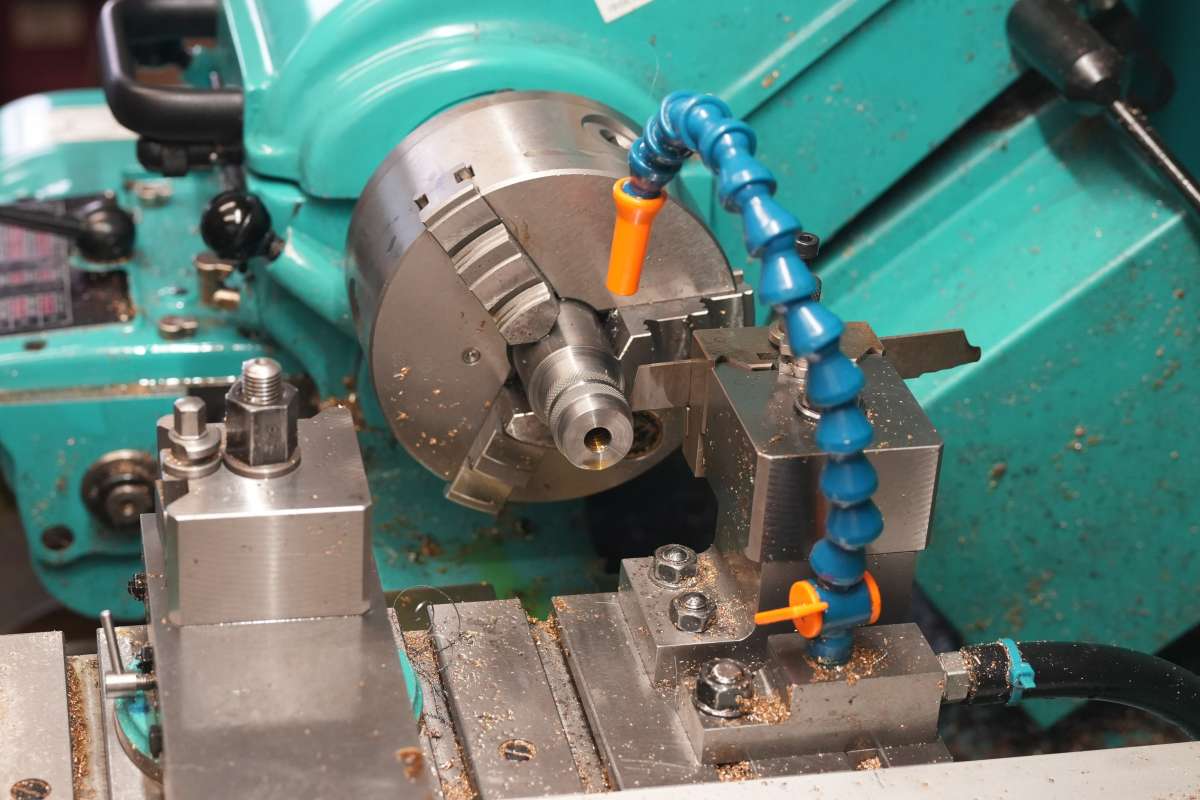
Lathe coolant applicators

Lathe coolant applicators

Home Forums Manual machine tools Lathe coolant applicators

Viewing 25 posts - 1 through 25 (of 30 total)
  • Author
    Posts
  • #854481
    lucerne
    Participant
      @lucerne

      So I’ve got a Boxford pump for my CUD and now I’d like to plumb it in.

      Whats the best current bet for the coolant applicator / tap? Theres a bewildering selection of nozzles and applicators on amazon and the like, misters, magentic bases, multiple heads….what do I need for simple DIY machining operations, mostly aluminium?


      Thanks Neil

      #854519
      bernard towers
      Participant
        @bernardtowers37738

        Mostly aluminium WD40 or kerosene. can be gravity fed from small tank on the wall (mine are ex screenwasher tanks). For the rest I use neatcut in the same manner. hypodermic needles help to control the amount(with a tap) attach to a piece of locline

        #854776
        Chris Crew
        Participant
          @chriscrew66644

          There’s a Boxford coolant fitting on Ebay at the moment. Price looks a little high IMO but there is a ‘make offer’ on the item.

          #854781
          DC31k
          Participant
            @dc31k

            You do not say what volume (flow rate) of coolant you require nor how often you wil use it.

            To use a standard centrifugal pump needs a reservoir. The pump must then fill its cavity and delivery pipework before anything emerges from the squirter. Then the coolant has to cover every available surface of the lathe before finding its way back to the reservoir.

            Coolant not in circulation goes bad – modern synthetics are much better than older potions, but come with a premium price tag.

            Hence, if you are only using it once a week, for 20 minutes, a flood coolant system using the pump you have may not be a good idea. A much smaller arranement, a total loss system, (the ex-washer bottle above) might suit you better.

            Long and short a coolant system needs management.. It is not like a DRO, fit and forget.


            #854783
            Andrew Crow
            Participant
              @andrewcrow91475

              I tend to use surplus spray bottles from the domestic department or a small garden spray. Not necessarily the best applicator,sometimes better for drilling. But, as mentioned above water soluble coolant does go “off” if not constantly used.
              Andy.

              #854789
              JA
              Participant
                @ja

                DSC01172

                Oil fed from a conventional centrifugal pump arrangement and recirculated to tank. I only use CORA B neat cutting oil.

                JA

                CORA B does not go bad and this is a fit and forget system. To be honest the actual cutting oil also contains the lubricating oil and cleaning white spirit from the lathe.

                #854794
                Julie Ann
                Participant
                  @julieann

                  I use Castrol Hysol XF soluble coolant on my lathes, mills and grinders. It sits for months without going off. Obviously the water part evaporates over time, so occasionally I top up with tap water and check the concentration with a refractometer.

                  Julie

                  #854796
                  Clive Foster
                  Participant
                    @clivefoster55965

                    Not a lover of flood coolant in teh home shop due to the mess and splash. Frankly we don’t work our tooling hard enough to need it.

                    I bought used Bjur misters way back which work well enough but were finickity due to old age. Ended up opening the nozzle a bit for less mist and something more like very enthusiastic micro-drop.

                    If you have low pressure air and something to make a reservoir, repurposed disposable gas canister perhaps,  consider taking a punt on one of the cheap import “mister” boxes off E-Bay for under £20. I’m mimbling over one for my bandsaw right now. But I need to plumb in proper low pressure air system round the shop to get to the saw. I’d not expect totally wonderful results but I’ve little doubt that something good enough could easily be produced using the bough parts as a starter.

                    In my experience you don’t need much lubricant to make a major difference to cut quality so long as your metal removal rate isn’t high enough for true cooling to be needed. Regular blue chip producers probably do need real cooling.

                    Clive

                    #854802
                    lucerne
                    Participant
                      @lucerne

                      Thanks for all the replies. Food for thought, especially considering the potential low level of usage and the coolant going off.

                      I’ll do some more research.

                      #854807
                      Martin Johnson 1
                      Participant
                        @martinjohnson1

                        I am an occasional blue chip merchant so keep coolant in the lathe and mill.  After many cases of a synthetic water soluble gunk going “off”, I now use an older style suds compund.  HOWEVER, the game changer was fitting aquarium bubbler systems to the sumps.  Keeping the coolant aerated stops anoxic microbes eating the ingredients in the coolant and making a smelly rust inducing mess.

                        Martin

                        #854863
                        Charles Lamont
                        Participant
                          @charleslamont71117

                          I don’t much like soluble oil, and as the workshop adjoins the kitchen, I would not be thanked for the industrial pong.

                          I use Morris’s Cora B neat cutting oil, cut 50/50 with paraffin. Pumps are definitely one day, but for now it is a washing-up liquid bottle fitted with a spout.

                          #854871
                          alecs
                          Participant
                            @alecs

                            <p style=”text-align: left;”>With today’s carbide tooling I have never found the need for suds on these small lathes such as Myford or Boxford. Blue chips are fine.</p>
                            I use mineral oil out of a squirt oil can for screwcutting. It works better for this than suds at back gear speeds.

                            #854874
                            howardb
                            Participant
                              @howardb

                              “I don’t much like soluble oil, and as the workshop adjoins the kitchen, I would not be thanked for the industrial pong.

                              I use Morris’s Cora B neat cutting oil, cut 50/50 with paraffin. Pumps are definitely one day, but for now it is a washing-up liquid bottle fitted with a spout”

                              Likewise- I use chainsaw bar oil as cutting oil from a washing-up-liquid bottle or an oil can,
                              Soluble oil/water mix stinks, as it always used to, and for what we use it for it, the water content promotes rust on the machine.

                              You need to remember why soluble oil/water mix was used, it was to
                              take the heat away from the workpiece and the tooling, and give the tooling a longer life.

                              Production machines didn’t fully cool down between shifts, so the water in the mix tended to evaporate, leaving the oil behind which inhibited corrosion.

                              Hobby machines don’t get that hot, so no need to use water/oil mix.

                              #854973
                              Martin Johnson 1
                              Participant
                                @martinjohnson1

                                Well you can decide not to bother with coolant.  You can also end up with fits that don’t fit when the components cool down.

                                Your choice.

                                Martin

                                #855047
                                Howard Lewis
                                Participant
                                  @howardlewis46836

                                  Most of our work is done dry, since:

                                  Most of us don’t have a pumped coolant system, (Although that is about to change for the OP)

                                  We don’t work out machines hard or fast enough, in many cases, to justify flood cooling, (Plus the faff of arranging a resrvoir and the means of returning the fluid there, after it comes off the job (And nott too much over us and the rest of the shop)

                                  Flood cooling is mostly there to cool the tool, lubrication is a secondary consideration, most of the time.

                                  I use a drip feed of soluble oil when parting off. This is syphon drip fed from a bottle on a shelf above the lathe to a home made tap /jet, carried on a small magnet placed on the cross slide.

                                  Somewhere there is an aquarium pump waiting to be fitted for flood cooling (It has been waiting many years; so it won’t happen)

                                  Howard

                                  #855074
                                  alecs
                                  Participant
                                    @alecs
                                    On Martin Johnson 1 Said:

                                    Well you can decide not to bother with coolant.  You can also end up with fits that don’t fit when the components cool down.

                                    Your choice.

                                    Martin

                                    Or you can let the job cool down before measuring if fit is critical. A wet rag or blast of compressed air can speed things up.

                                    Or allow one British Standard Smidge when measuring hot. A bit of practice will tell you which size BSS to use.

                                    For me, most of my work is sub 1″ diameter so thermal expansion is minimal anyway.  With my hobby lathes limitation of 100 thou DOC, heat is not so great that the mass of the chuck won’t soak it up in short order.

                                    #855100
                                    Clive Foster
                                    Participant
                                      @clivefoster55965
                                      On Martin Johnson 1 Said:

                                      Well you can decide not to bother with coolant.  You can also end up with fits that don’t fit when the components cool down.

                                      Your choice.

                                      Martin

                                      True but, I think, something of a straw man argument in the home shop.

                                      Firstly most folk will take care to reduce cut and, possibly, speed to minimise heating. We don’t have production engineering time pressures forcing heavy, maximum load cuts with blue chips flyings pumping heat into the part. Indeed most Model Engineering work is on components too small for maximum load cutting and the amount of metal to be removed is small enough that the time difference between one heavy cut and three lighter ones is irrelevant.

                                      Secondly even the small levels of lubrication considerably reduce friction between chip and tool so it things don’t get as hot as the chip comes off. Ideally much of the heat generated by cutting should come off in the chip rather than remaining in the workpiece so keeping the chip cool is a great help in drawing heat away. Modern carbide et al inserts working in their sweet spot can be remarkably good at this sort of thing.

                                      Hafta say that even though my Smart & Brown 1024 and Pratt & Whitney B 12 x 30 are well up to hefty cuts I generally come down in 50 thou / 1 mm cuts because its rare that I ever have to remove enough material for industrial proper cuts to be worth the hassle of dodging blue hot chips. For ordinary work to ± 1 thou, ± 0.02 mm tolerances I just come straight down in the same increments. Finishing cuts of 25 thou / 0.5 mm or less are only indulged in when ± 0.5 or 0.2 thou / ± 0.01 or 0.005 mm are needed.

                                      I’m sure Julie will agree that one of the major advantages of industrial hefty machines is the ability to come straight down to size on the dial without cut’n try.

                                      Interference fits are tricky at the best of times. I suspect very few Model Engineers / Home Shop folk are able to reliably hit anything close to the putative parallel interference fit on the drawing. For starters most haven’t got the kit to reliably measure the small dimensional differences between bore and part to the required accuracy. I’ll bet most Model Engineer parallel interference fits are of the “well it didn’t drop through and I didn’t need a big hammer” variety. Whether made hot or cold.

                                      But so long as it works who cares what Inspector Meticulous thinks.

                                      Loctite is wonderful.

                                      In my view the self gauging taper method is the only way of getting reliable, repeatable, levels of interference fit using sensibly affordable Model Engineer / Home Workshop equipment.

                                      Clive

                                      #855130
                                      Howard Lewis
                                      Participant
                                        @howardlewis46836

                                        Well said Clive.

                                        As hobbyists, most of us cannot aspore to the equipment in use in industry. We are trying to produce a very small number of parts with an interference fit.

                                        Even in industry aothough the traget might be a 0.001″ intereference, tolerances will mean that some combinations will be 0.0002″ while others will be 0.0008″

                                        Both will priduce the desired result.

                                        Our measuring equipment may not be of the same quality as used in industry, so 0.0001″ either way may not be not be consistently achieveble. And if the end result is what is wanted; does it really matter?

                                        The difference used to be exemplified by Great Western locomotives where parts were interchangeable betwen locomotives, which ran fairly quietly, while some of their contempories were characterised by their “clanking” when in motion. The difference between working in thous rather than 64ths

                                        Howard

                                        #855144
                                        Martin Johnson 1
                                        Participant
                                          @martinjohnson1

                                          While I agree with much of what Clive says, some of us have been engineering, both ameteur and professional, for long enough so that watching dry 10 thou cuts and piddling feeds nibble off metal lost it’s appeal long ago.  Some of us might also be working in larger scales where significant metal might need moving in minimum time.

                                          So, as I said, there are horses for courses and “It’s your choice”.  Mercifully, model engineering is still (I hope) a very broad church.

                                          Martin

                                          #855234
                                          Clive Foster
                                          Participant
                                            @clivefoster55965

                                            Martin

                                            Agreed Horses for Courses is the universal rule.

                                            Also agreed that many self taught ME / Home Shop folk don’t realise what their machines can do.

                                            My second lathe was a Pools Special and 18 year old (?) me was 15 thou cut guy. Then I put it up for sale and the guy considering it bought an expert friend. Expert asked to try it. Took about a 20 thou cut on a bit of mild steel muttered “should do better than that”, asked to touch up the installed tool on the grinder and promptly took a cut about 4 times as deep as I used “just like that”. The purchase was approved!

                                            Back when I was driving SouthBends, 9″ and Heavy 10, which are more typical of ME / Home Shop machines I found 50 thou cuts to give reliable results bringing pretty much any ordinary material down to size. But working down on the dials the last cut needed to be set to 10 thou (ish) to hold the ± 1 thou tolerance. The machines, and often a small workpiece, just weren’t quite stiff enough to reliably clean up in tolerance under heavier cuts despite taking clean chips and leaving a good finish when coming down.

                                            Took me quite a while to graduate from cut’n measure, wasting vast time trying to correct for cut to cut variations when working down to size in a few passes, to just trusting the dials whilst arranging the last cut to be light enough for the machine to clean up accurately but deep enough to be a real cut. Scraping a thou or so is horrendously unreliable unless the tool is razor sharp.

                                            Reckon pretty much all but the very smallest ME lathes in good order would be happy and reliable with the sort of cuts I used on the SouthBends. When it comes to getting a job done in OK time replacing cut’n measure with simply working to the dials with an always reliable technique is the first big win.

                                            It’s nice to have the kit and set-up to go hard, deep and fast aided by plenty of coolant. I have it but, as mentioned above, it’s rare that the gain seems worth the effort.

                                            Clive

                                            #855237
                                            JA
                                            Participant
                                              @ja

                                              In the company I worked for most of my life, where interchangeability was everything, manufacturing always considered tolerance as their allowance and strove to machine to just below the minimum metal removed, for example an outside dimension of 1.000″ +/- 0.010 would be 1.008″. This gave them an allowance of 0.018″ if they messed up. I should add that +/-0.010″ (+/-0.025mm) was the open, maximum, tolerance met.

                                              I am surprised that most model machinists haven’t a clue about tolerances. Surely this is an article for the magazine.

                                              JA

                                              #855398
                                              lucerne
                                              Participant
                                                @lucerne

                                                Thanks for all the replies and insights. TBH at my skill level and anticipated outputs its probably not worth the effort to set it up at this stage and possibly never. I may well set up a simpler drip system as noted if I feel the need. Anyway, as per my other info requests on here, the lathe is now operational and all the covers secured in place…just need to find the time to learn how to use it…😊

                                                #855795
                                                Adam Harris
                                                Participant
                                                  @adamharris13683

                                                  For anyone interested I have a 25litre drum of Morris Supercut 9000 emulsion coolant about 7/8 full that I would sell very cheaply – it has been sitting around for more than 10 years and does not smell at all. I think when it was new it might have been a greenish colour undiluted, it is now a light brown colour undiluted. It goes a very long way as you dilute it between 10 and 20 parts water to 1 part concentrate.  I like it but I have never needed to refresh my very large coolant tank on the Emcomat as it sits unused most of the time while coolant still smells fine and on my other machines I use a manual squirt of cutting oil

                                                  #855804
                                                  Julie Ann
                                                  Participant
                                                    @julieann

                                                    As a general rule water soluble coolant provides good cooling properties (due to the water) but poor lubrication. On the other hand neat cutting oils provide excellent lubrication but poor cooling. That is one reason you often see neat cutting oils used on slow, high pressure, shearing operations, such as Sunderland gear planers. Dribbling on coolant or cutting oil is ineffectual; the first doesn’t cool much and the second just creates a sticky mess.

                                                    In my workshop I use coolant as follows; I’ve never used neat cutting oil, only soluble coolant. On all machines, with all tooling, I run brass, cast iron and plastics dry.

                                                    On the centre lathe I run carbide tooling dry, chips are normally blue or yellow. I use flood coolant for drilling with HSS and always for parting off, even with carbide parting tools.

                                                    On the vertical mill I no longer use coolant, although the machine is equipped with flood coolant capability. I run cutters fast, so coolant gets flung everywhere. Plus I don’t have a drip tray for the vertical mill so the floor gets slippery.

                                                    For the horizontal mill, which does have a drip tray, I run carbide insert cutters dry, getting blue/yellow chips. I run a lot of HSS cutters on the horizontal mill and always use flood coolant with them. If there isn’t steam rising it means I am pussy footing on feeds and speeds.

                                                    On the repetition lathe I always run flood coolant as it exclusively uses HSS tooling. The lathe has a spray bar over the spindle rather than a single outlet pipe.

                                                    I always run flood coolant on the CNC mill, primarily to wash away swarf rather than cooling.

                                                    Coolant is always run on the cylindrical grinder, it seems to help prevent loading of the wheel and of course when working to tenths even a bit of heat in the workpiece is bad.

                                                    In summary, using coolant is personal choice but if one is going to use it then go for flood coolant.

                                                    Julie

                                                    #855818
                                                    Charles Lamont
                                                    Participant
                                                      @charleslamont71117

                                                      As I mostly use HSS tooling I use cutting oil, where appropriate for the material, and in order of importance, for: surface finish, tool life, cooling, and speed. These things are of course interconnected.

                                                    Viewing 25 posts - 1 through 25 (of 30 total)
                                                    • Please log in to reply to this topic. Registering is free and easy using the links on the menu at the top of this page.

                                                    Latest Replies

                                                    Home Forums Manual machine tools Topics

                                                    Viewing 25 topics - 1 through 25 (of 25 total)
                                                    Viewing 25 topics - 1 through 25 (of 25 total)

                                                    View full reply list.