I've had a CJ18 for the past 9 years, bought it second hand from someone who bought it new from amadeal a year before that (he used it to make parts for his life size dalek, then sold it on)
Sure i sometimes wish i had a bigger lathe with more features like power cross feed, screw cutting gearbox and all that, but this little lathes done all i needed really.
Things i've had fail / go wrong on it,
About a year after i got it i started having problems with it cutting out, refusing to start etc,
I traced this all to the interlock board (amadeal call's it a filter board) that is in the base of the controller box, this makes you start the lathe by turning the speed knob to zero every time… very very annoying,
It also provides motor braking, and operates the inhibit function on the speed controller, which shuts power to the motor if you disconnect the motor whilst running… which you do when you operate the direction switch (something you shouldn't do on any running lathe anyway)
I was told by a few people that those boards can be a pain, and some needed to replace theirs every year or so!! So i bypassed mine, had to keep it in the lathe tho as it also provides power for the speed readout, so that's all it does on my lathe now.
i can get braking and inhibit functions back using a relay and a resistor, i just need to get round to it.
The high – low gear broke about 5 years ago, i lost low speed, it's a set of plastic gears in the headstock, needing the spindle removing to change, so i lived with only high speed for years,
When i finally bought a replacement set of gears, i got the upgraded metal ones,
And at the same time i bought a pair of angular contact bearings to replace the standard ball bearings that the spindle runs in
I figured as i had to pull the spindle and the bearings to get to the gears, i'd do the bearing upgrade at the same time, i got the bearings from arc euro trade (but watch out as most other parts are not interchangable between the seig and reel bull lathes as i found out recently)
When the lathe was put into storage for a year, the person carrying it from the car tripped and the cross slide leadscrews handle got snapped off, to fix this i needing a new leadscrew… so i ordered one from arc as it was cheaper… but it's not the right one, same thread by different on the area that goes through the bearing block / dial and that.
And i had the motor drive pulley come apart and damage itself, again i bought a replacement from arc as it was cheaper than amadeal, but it was not suitable for my lathe (9.5mm hole with keyway, where as the correct part has a 8.5mm hole and a key that's part of the plastic molding)
I've stripped the lathe down a few times and done some fettling to it, there is a great article on how to do this… using a seig version, but as you are just stripping, cleaning and fettling then adjusting it's relevent to most mini lathes:
Martin
I have a CJ18a mini lathe from Amadeal (see my earlier post on the 1/7/20).
I did a bit of research online before I bought it on the different ones available. Being a beginner, I didn’t want to spend too much in case I decided it was not for me. At the time it was one of the cheapest and had a better spec than others (for the price).
I have been happy with it and with the service from Amadeal. If you search on this forum you will find a thread from last year from someone who wasn’t happy with the service they received when the ( larger) lathe they had had for 11 months failed. A few people who had had no dealings with Amadeal jumped in to criticise the company, which I thought was unfair.
From my first contact with them before I bought the lathe, I have always got through to them by phone and had a response by email the same day, so even though they are a small setup, I would recommend them.
One thing to bear in mind though if you are thinking of a larger lathe, they don’t include extras like additional chucks or steadies. Warco include these in the price of their larger lathes.
In my view, the Machine Mart lathes are not good value for money.
Stuart
Edited By Stuart Smith 5 on 02/01/2021 12:48:42
Thanks Stuart…thanks for that and I'm reading loads already…they seem to have been about for a while so they look positive…I keep scrolling through Ebay and seeing things that look great but then like you say miss a couple of items…I see what you mean about the accessories with warco but then I can see arc euro and amadeal have starter sets and then Chester hobby have a set with accessories…good job I can drive a spreadsheet…lol…
Thanks again…
I had a CJ18 from Amadeal that ran fine but required a fair bit of fettling, but all relatively minor stuff and probably no more than would have been required for similar lathes in that class.
They replaced a 4 Jaw chuck with faulty jaws that I had had for over a year (but not used), so have been content with their support.
Thanks Martin…I've picked up some books and one details the fine tuning most need…still researching but Amadeal are close to me but I've also looked at Warco…Arc Euro…and Chester so far…not forgetting machine mart and axminster…thanks again…
If you look at the mills on the arc Euro site, they show the foorprint of each which is a most important aspect of buying for a limited space.
Still not there yet, so is this the deal then….
1) Purchase from an OMP or similar registered for tax purposes in the UK, the OMP very kindly collects the taxes for HMRC on all purchases originating Ex UK….. captures majority of sales and drop shippers etc without involvement of Border Farce.
2) Purchase from trader Ex UK… (including the likes of Ali, Bang, Gear, Light, etc, because I can just see the likes of Jack Ma begging to be an unpaid tax collector for HMRC), then Border Farce or shipper may become involved as goods cross the border and calculate tax on item or items only where declared value + handling etc is >£135, because otherwise they would have employ the whole country in processing every single piece of foreign mail with a declared value.
Presumably if you purchase items from Europe, they will be sold net of sending country VAT but chargeable at UK rates at the border (if above £135) plus any charges the shipping company wishes to apply.
Remember what the nice man said – 'no non tariff barriers to trade…' Waaahhaaahhaa!
Welcome!
You have come to a good place, lots of expertise , help and advice on here, on all manner of subjects.
I am assuming that you are a newbie. If not, accept my apologies for teaching granny to suck eggs.
I have never owned a ML4, but have had dealings with a couple, getting one up and running again
There are folk on here who are more knowledgeable than I on the Myford ML 1, 2, 3 and 4 lathes.
The Lathes UK website is good for history and info on these lathes
The Serial number is usually on the bed, below the Headstock, and that can guide as to the year of manufacture., between the late 30s and mid 1940s.
The Tailstock is 1 MT. You can get drill chucks and arbors from suppliers such as Arc Euro Trade.
As you will already know, the Saddle handle turned clockwise runs the Saddle towards the Tailstock, unlike most lathes. Tumbler Reverse was an optional extra, so not all have this feature.
The Top and Cross Slide Leadscrews are 12 tpi, and each of the 80 division on the dials are not an exact thousandth of an inch, (0.00104 Actually )
The early ML4s had a 7/8 BSW (7/8 x 9 tpi ) thread on the mandrel, and later on this changed to 7/8 x 12 tp. I believe that some of the very latest had the 1.125 x 12 tpi thread, but not the 1.250 register, used on the 7 Series.
For what my advice is worth, I would not disturb the Headstock bearings, but cutb off the worn belt and use link belting such as Nu Twist.
Hopefully, you will have a complete set of change wheels. They should run from 20T to 65T in 5T increments
It would be worth acquiring some extras, so that you have three 20T wheels and an extra 60T.
With these, you would be able to set up a fine feed using a 20:60/20:65/20:60 train which will move the Saddle towards the Headstock in the "normal" way with a feed rate of 0.00427"/rev. You might need to make up another stud to carry one of the compound gears, and do a little fettling of the slot in the banjo to allow all the gears to mesh. To get a correct
Gears from the later ML7 Series can be used, but since yours are driven / compounded by means of 3/32 pins. The 7 Series gears will need to be drilled partway through for the pins (7 Series gears have keyways, but are the same 20DP and 14.5 Pressure Angle, and 5/8" bore. )
The threads are Whitworth form, some (such as the grubscrews ) are 1/4 BSF, while some, such as that securing the banjo, are 5/16 BSW. The locknut for the Tailstock adjustment (across the bed ) is 1/4 BSW.
Being an old machine, it is not suitable for high speeds, so carbide tools are not needed. High Speed Steel is probably an advance on what was used when the machine was first launched
So, if you do not have one, you are in the market for a bench grinder, and learning how to grind tools.
It may be a useful learning exercise to make a Centre Height Gauge. You will,become more familiar with the lathe, and gain confidence. the gauge will make tool setting much easier.
To cut properly, the cutting edge of the tool needs to be on the centreline of the work.
How to grind a tool?
"The Amateur's Lathe by L H Sparey, "The Amateur's Workshop" by Ian Bradley will be useful books.
A set of Zeus charts will be most valuable And a very useful reference book is Tubal Cain's "Model Engineers Handbook"
All there will be money well spent, and a source of useful information in the days ahead,
Riding one or more of my hobby horses, I would avoid using the "boat" type tool holder. If used, by tipping up, to set the tool to centre height, it changes the top rake, which may not be a good thing to do. My preference is to grind the top rake, if you want or need it, into the tool and to keep the holder horizontal, shimming to set at centre height.
My other hobby horse is to use a Tangential Turning tool. There have been at least two designs published in MEW to take 1/8" square toolbits, which would suit the ML4 You can buy a more sophisticated version, see the adverts on the side bar. For these, you will need a Centre Height gauge to set the tool. Sharpening is easy since there is only one face to grind, and the grinding jig is simple. Whichever, the tool works well.
HTH
Howard FAT fingers AGAIN!
Edited By Howard Lewis on 01/01/2021 14:43:31
Thank you all Gents – especially Alan for asking in the first place!
A lot of useful pointers for me too.
My ML7 sometimes misbehaves on long power-feed cuts even at very fine pitch; and its finishing-cut control is dodgy, both most likely caused by wear.
Adjustment on the shears had not occurred to me, but something I ought look at on my ML7, in conjunction with studying the manual. Maybe a New Year's Day task after ending 2010 by ruining what I had been trying so carefully to make as accurately as possible. (By milling though, not turning.)
I am considering fitting the ARC-Euro modification Swarf Mostly suggests. I think Hemingway supply a similar one – I want to cross both companies' palms with embossed plastic anyway. I wonder if they also stock legible versions of the dials.
'.
My lathe has suffered from unwitting use in the past. Most seriously, the seller had bolted it to a heavy timber bench, which might have been OK if the chip-tray had not been a rough cast-iron " sauce-boat " of unknown original purpose, lacking any machined facings. The bed is also badly notched from hacksawing rather than parting-off work-pieces.
And a happy new year to you too Arthur.
Following the predictable habit of not dropping a line of conversation I note that some DRO are almost as cheap as calipers, so almost a no-brainer for someone who is not an experienced machinist and finds dials difficult to read. (That would be me for instance.)
If you can find the code for the insert, it will help. You can search for the insert code, and probably pick up a lot of sources and manufacturers. If you succeed, you would be safest buying from a supplier based in your country, should any problems arise.
Warco do not appear to sell anything similar.
Take a look at Arc Euro Trade site. They sell GTN inserts in 2.2 and 3 mm widths, which might be suitable.
Their MGMN inserts are double ended and are either TiN or AlTiN coated, but only come in 2 mm widths. They might be too long for your holder. (These are used in the MGEH holders )
HTH
Howard.
I have a arc euro three insert face mill cutter and using on a SX3 mill.I have been taking .5mm cuts and with new inserts and the head wags side to side at 400 rpm.Is the cut to deep and the feed to fast.I find that my flycutter at 75mm sweep at.5mm and 400rpm creates barely a murmer at the head ,can someone put me right.Feed for both was 1" per minute.
Frank
Hi there, Alan and Brian,
Alan, I suggest that you investigate the cross-slide handle and scale. Excess clearance there could give at least some of the 'perpendicular' back-lash of which you complain. Lock the cross-slide and then examine how much free angular movement there is in the handle & screw.
Look up under the bracket attached to the front end of the cross-slide and find a way to hold the shank of the feed-screw without graunching it. Then turn the cross-slide handle counter-clockwise to loosen it. From memory, the scale and the handle act as nut & lock-nut. They need to be adjusted so the handle & screw can together turn freely but with minimum slack. Again from memory, I believe there is a fibre washer in there, simple but effective.
If you don't have the Myford User Instructions booklet, have you down-loaded the parts lists and exploded diagrams from the Myford web-site?
Also, have a look at the modifications to fit thrust bearings in that part of the machine, see Arc Euro web-site.
Another possibility is wear in the cross-slide feed-screw and/or nut. Again, you can explore this by locking the cross-slide and waggling the handle. You might need to remove the top-slide to see what's going on.
Do, please, come back and tell us how you get on – it's very frustrating to make suggestions and never to hear the conclusion!
Best regards,
Swarf, Mostly!
Edited By Swarf, Mostly! on 29/12/2020 19:15:45
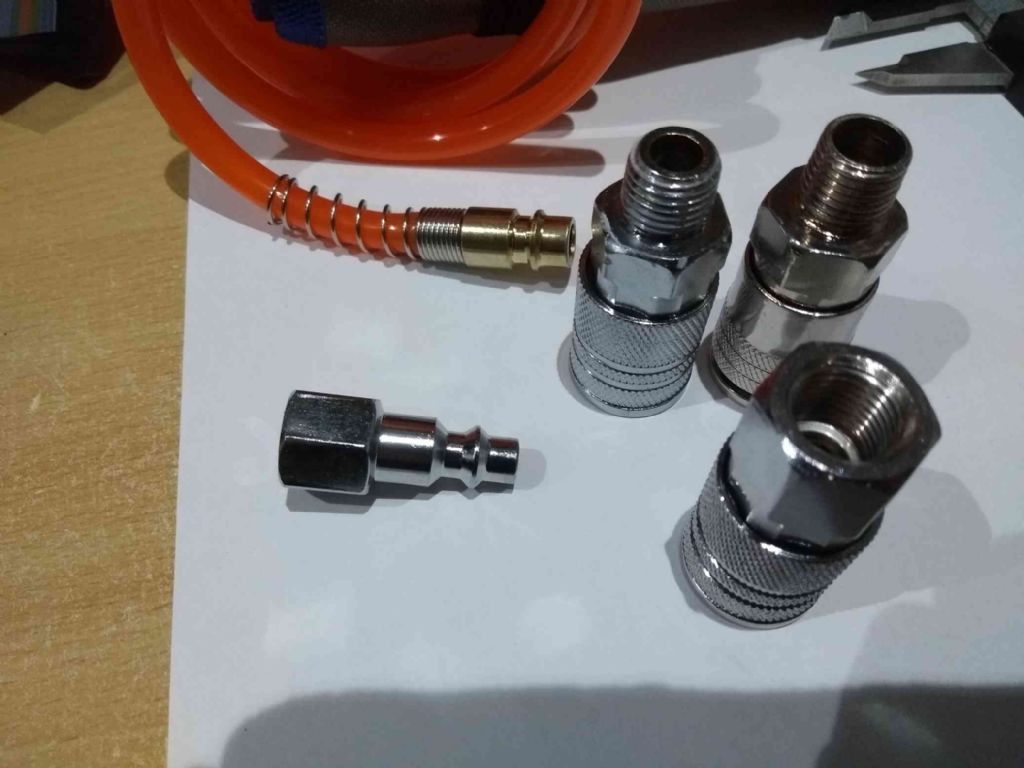
Your tube is likely a Chinese 'looks like a Euro connector' copy. If the connector does not freely swivel on the tube it will knacker anything you plug it into fairly quickly or the tube will twist up badly.
From the same seller alleged maker Dandlionsky you can have this Euro set, except the connectors look nothing like your Euro set by the same maker.
Be prepared to change the connectors on every air tool you buy, I do, but then I buy PCL and connectors bought in the last century still fit todays connectors.
This is not going well.
I ended up buying this. Mainly because I thought it was the right thing, but more that I could get it the next day (bless, Amazon, bless).
I have one bit of bad news and one bit of half bad news.
The bad news is that the connectors from the tool kit I got do not work with the allegedly Euro set purchased from Amazon.
The tool kit connectors are exemplified by the one on the tube. The kit connector is exemplified but the male connector at bottom left. They are quite different.
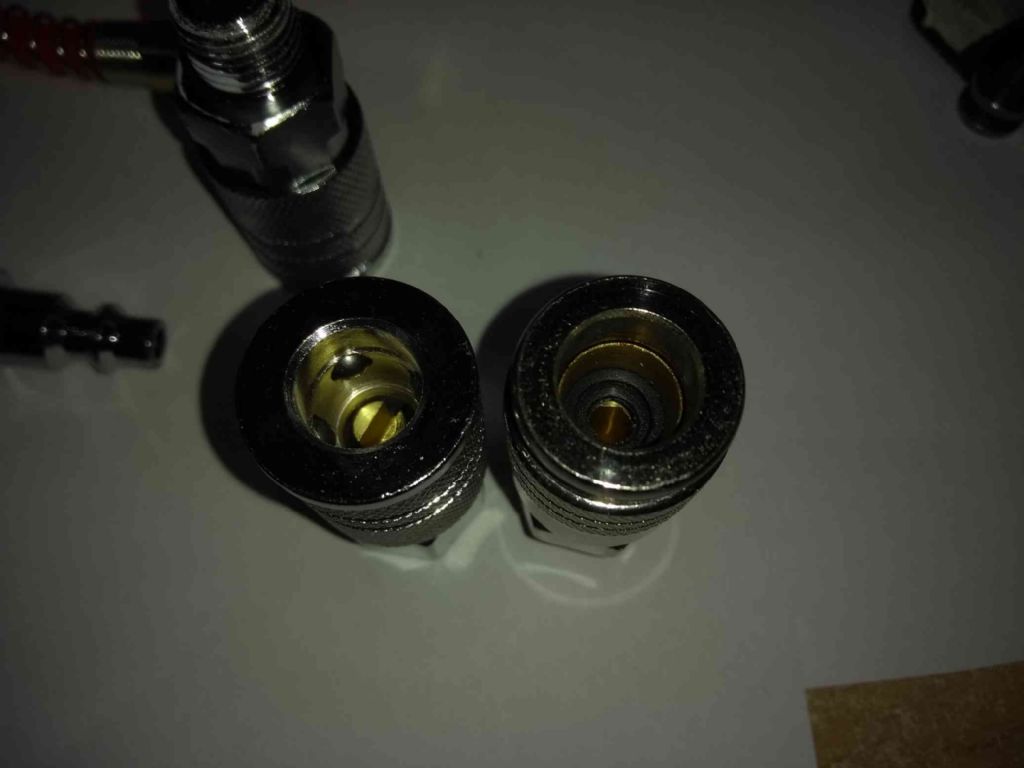
the picture below shows the innards of the Euro connector and the one on the compressor.
Quite different!
The half bad news is that the screw thread on euro connectors sort of matches the thread on the compressor. Sort of because it only screws in part way. Certainly less than the existing connectors. Which makes me think that the female thread is also tapered. And I'm not sure I can (Per a comment above) reliably use a non tapered male with a tapered female.
I'm stuck for what to do next. I don't know what the two mystery connectors are (the one on the tube and the one on the compressor connector). I've also struggled to find any male tapered connectors on Amazon (at least without paying a substantial price -and amazon includes BSP in searches for BSPT it would seem).
So. If anyone knows what the actual connector is on the compressor I can attempt to find a convertor. If anyone can recommend a supplier of BSPT connectors (at a reasonable price) I can replace the current connectors.
I'm still a bit stuck with what sort of tools to get. The ones I have already (as per the connector on the tube) or the Euro ones which Lidl/Aldi will provide cheap tooling for.
I really am stuck here, so any input would be appreciated.
Iain
Antiquariat-am-St-Vith in Mönchengladbach, Germany, has an English-language copy. 88 Euro, say around 100/110 with carriage to UK, but you would have to 'sort that' with them.
Unfortunately I cannot link you to the relevant catalogue page, so you will have to do a search yourself from the main page to which I have provided a link.
They also list on ABE and price in £, so you can order from there too if you prefer.
Regards,
Phil
Edited By Weary on 27/12/2020 19:07:26
I assume Ron is talking about these?
I have similar milling cutters (different inserts though) and I use them often.
Thor
Without backlash it would be impossible to move one part relative to another, so must allow for the backlash.
So if you put on a cut of 0.02 mm but overshoot to 0.025, all is not lost.
Withdraw the tool by 1.00 mm. Advance to Zero. Having taken out backlash, you wind in a further 0.02 to where you want to be.
Without taking out the backlash, accurate, or consistent results are impossible.
As a newbie you will learn a lot from books on model engineering.
"The Amateur's Lathe" by L H Sparey..
Neil Wyatt and Dave Fenner have each written books on the mini lathe.
Ian Bradley's "The Amateur's Workshop" covers general techniques
A set of Zeus charts is useful, for many things, plus Tubal Cain's "Model Engineers Handbook " a frequently consulted reference book, on many things.
The mini lathe is a hobby machine designed and built to balance cost versus accuracy and durability.
It lacks the power, accuracy or features of an Industrial Tool Room lathe, or costs as much!
Similar, if not identical machines are available from suppliers specific to the model engineering trade, such as Arc EuroTrade, Chester, Warco, Amadeal, or SPG – to name a few. These are more likely to be able give advice, as well as many on here, than Machine Mart, where knowledge may well vary from branch to branch.
The above suppliers may provide advice and help even if they did not supply the machine.
Where are you located?
Find a model engineering club local to you, and join. Again, advice, help and, Covid permitting, even face to face demonstration, may be possible.
Within its limitations, the mini lathe is capable of good work. Careful adjustment and skill can produce outstanding results.
Do not expect a 3 jaw chuck to hold anything without some run out (eccentricity ) There are very few 3 jaw chucks without run out, Many in good condition ( even brand new  
may yet show run out of the order of 0.10 mm A worn or damaged chuck may be even worse, I know of one very old chuck showing nearly 1 mm run out.
Diameters that will,be concentric to each other, as long as they are cut without disturbing anything between cuts.
The taper that you found could be from a variety of things.
1 ) How far was the material into the chuck jaws? For what you are checking, it needs to be gripped by the full length of the jaws. This assumes that the jaws are clean, both where they grip the workpiece, and where they touch the scroll inside the chuck.
2 ) Is the chuck clamped accurately to the flange on the mandrel? The flange and the register on the back of the chuck must be clean, and free from any burrs. If the chuck is misaligned, you will have problems.
3 ) Are the bearings in the Headstock worn or lost their preload? If YES to either of these questions, as a newbie, this is not work that you should undertake without finding out the correct way to check and then rectify the problem.
For this you really need expert attention.
4 ) Were you trying to reduce from 25 to 20 mm in one cut? 2.5 mm in one cut is heavy work. (My handbook says that 0.010" – 0.0025 mm is a roughing cut, although many take far deeper cuts without damage) Lacking the handbook, get one.
For your checks, a cut of 0.05 mm might be more suitable, since it will cause smaller deflections in the machine. Also, your feed rate needs to be slow. Forcing the tool will cause deflections.
Using changewheels and Leadscrew for the feed, a 20:80/20:80 train should produce a feed rate of 0.0937 mm per rev.
5 ) Is the cutting tool sharp? Don't expect good results from blunt / chipped tools.
6 ) Is the tool mounted with the cutting edge is on the centre line of the Headstock?
Quick check; face across the end of a short piece held firmly in the chuck. Off centre the tool will leave a pip near the centre of the work.
A tool above centre will rub rather than cutting properly. A tool, below centre will have the wrong effective angles to cut properly.
Both will need extra pressure to cut, if at all..
7 ) The gibs on the Cross Slide may be slack, allowing movement. Until this is minimised, consistent results are unlikely. The saddle should be located by the Vee bedway, but if there is vertical movement accuracy will be impaired, so that is another adjustment to optimise.
With a second hand machine, you cannot be certain what use / abuse / misadjustment has taken place.
(I bought a secondhand lawnmower. Worked far better once the blade had been fitted the right way up! )
Hence the machine needs to checked over, and excess play removed.
8 ) If you were turning between centres, one of the centres could be "out" and need cleaning up, or the Tailstock could be misaligned.
Easy to rectify, but needs measuring equipment to do as accurately as possible,.
9 
Disaster scenario, AFTER you have checked all the foregoing, it is possible, but unlikely that the Headstock is out of line with the bed. Again extra knowledge and measuring equipment is needed to confirm and correct it.
Sorry to ramble on on such length, trying to cover as many options as possible.
Howard
Further useful context and advice – again much appreciated. The more insight I get before driving a purchase or me inevitably blowing something up can only be a good thing! ![]()
ArcEuroTrade seems to come up quite frequently, so will have a bit more of a look at what they stock..
Thanks Chaps!
Toby
While I cannot disagree with the advice you have been given I have to admit I have modified it in my own purchases.
I have a mini lathe, the Sieg SC3 from ArcEurotrade and one of their smallest milling machines. These were both purchased from ArcEurotrade and the service I had was great – even when the fault was due to my ignorance! They are just outside Leicester and if that is close to your part of the Midlands could be a useful place to visit when that becomes possible again.
The size of these machines was determined by the space available in my garage with washing machine, tumble drier, bike, camping equipment etc etc.
I had the option of buying ex industrial machinery, but just no space or a small traditional lathe like a Myford, but unfortunately I do not have the experience to inspect or renovate one as necessary, nor the money to buy one with a guarantee from a dealer (up to 8- 10 times the price of a mini lathe)
Regarding the advice against cheap tools – if it breaks or does not do the job fair enough – but there are many that are adequate (I don't say excellent) but which will see me out – and the convenience of having tools there waiting has to be taken into account – for example a set of reasonable drills is not as good as a set of the best – but it is better than no drills at all if you are still saving up. I suppose I still have a cheap set of drills, but those I use have been replaced with better and those I don't use – well if I don't use them they can be as cheap as they like!
IMHO the soundest advice above is the part where you are warned you may need to replace equipment as you come to use it and your needs change.
My miniature workshop does what I want it to, particularly when I also have access to larger machinery at my model engineering society when necessary.
Edited By Nick Clarke 3 on 23/12/2020 21:22:59
You won't get 150mm + travel on the Y axis of a mini mill – the Sieg SX2P (£811) sold by Arc Eurotrade has 145mm travel & you have to go to the SX2.7 to get 180mm travel (£1370-£1470 depending on table size).
My ex-industrial Denford Triac 200 (which cost me £100 without the original drives, servo motors & Heidenhain control) only has 150mm Y travel, so it will be unable to mill around the periphery of a 150mm component.
Not sure you could get better than 0.1mm accuracy without changing to ballscrews. Relatively cheap ballscrews & support bearings are available from China via the likes of Ebay, but you will probably have to do some machining of the base machine's castings to get them to fit. As the Triac was built as a CNC machine, it already has ballscrews & angular contact support bearings all round – one less job for me to do !
I have 3 off 2.2Nm stepper motors (around £35 each) 5.6A digital stepper drives (£13 each) and a 48v 12.5A PSU (£23) . If I hadn't already bought these, I would probably go the closed loop stepper route (and may yet do so & move the other parts on) at around £90 an axis. I already have a suitable inverter for the spindle drive & intend (initially at least) to control it with an Arduino Uno (around £5) running GRBL (free) fed by Universal G Code Sender (free) on a laptop (already owned).
Nigel B.
Being a fully paid up Luddite, and TIGHT, my list would start.
Buy cheap, buy at least twice, for many things.
A cheap Tap broken in a workpiece can be expensive!
But we all have to balance cost against value for money, especially where the tool is likely to be used for only one job. (Odd ball Taps / Dies or gear cutters Don't ask! )
Assuming that you already have a sturdy bench ) a good vice. Costly but worth it. Have seen cast Iron vices broken by using as a press We ALL do it. Record if you can afford it, industrial quality and take a LOT of wearing out!
A 6" Bench grinder (The wheels will almost certainly need dressing to true them to reduce vibration ) Will be invaluable when you want to sharpen drills / grind lathe tools.
Bench Drill press. Cheap ones are barely, if at all, better than a good pistol drill in a matching bench drilling attachment. Was not impressed by a £50 three speed one. That got little use and found a new owner
Buy good quality drills, cheap ones wear out quicker, and may be less accurate than the more expensive makes..
Ditto for Taps and Dies. You are likely to make up quite a variety of types, eventually.
Once you have a lathe, you will never want to be without one! Unless you want to turn tele legs for motor cycles, you may be able to cope quite well with a mini lathe.
They will swing 180 mm and have centre distance of 400 mm. Don't need a lot of bench space, and are extremely useful. Lots of accessories available, when your requirements expand, and moderately priced.
And the change gears allow thread cutting (If you choose so to do instead of using Taps and Dies for sizes up to 12 – 13 mm ) and fine power feeds. Cross feed will need t you to learn how to turn a handwheel slowly and steadily.
Buy from one the normal Model Engineering suppliers, such as Arc EuroTrade, Warco, Chester, Axminster, SPG, etc. In that way you will get service and spares back up if it is needed.
Have to admit to not being a fan of Machine Mart. Never impressed by their back up, but that may have been our local store.
Every machine has its limitations, but it is amazing what can be done by making best use of the features!
You will need measuring equipment. Initially, you could probably cope using a LIDL / ALDI 6"/150 mm digital You can spend a lot more if you wish by buying more professional instruments.vernier, but £10 can be a good starting point.
Eventually you will probably find a need for dial gauges (Plunger and Finger types ) and magnetic stand for them.
Certainly when you fit a 4 jaw indepenent chuck to the lathe. (Holds work that cannot be held accurately in a 3 jaw , or when it needs to be accurately centred )
Hope that all this rambling is of some help
Howard
FWIW, it seems that a 4 Jaw independent chuck, from Machine Mart is expensive. There are other ways of fitting such a beast to the lathe, and other places to buy one, at lower cost. You will eventually find the need for one!
See other threads on here, and search suppliers such as Arc Euro, Warco, Chester, Chronos for their offerings. But you will need to make / machine a backplate to suit, or you MIGHT get away with adding three extra holes to the flange on the machine.
Although it will cost a little space, a backplate may be the better route.
Since you say that you are new to lathe ownership, don't be afraid to ask questions and for advice.
Where are you located ? Once the shackles are off, in UK anyway, it may be possible for someone to visit and advise / demonstrate face to face.
At that same happy time, if possible find and join a local Model Engineering club. There you will find others who will, at various times, support, enthuse, advise, demonstrate or dissuade you (Select as required! )
You now have equipment to do all sorts of things that were out of reach /impossible. You will be able repair worn /damaged items, possibly to a better state than before they came into your hands. And you will, be able to items for a specific purpose, so that previously impossible tasks become run of the mill (Possibly literally )
You are starting along a learning curve: seek advice from the more experienced, it will be readily available.
Some books will be invaluable aids in teaching basic principles and providing data. I have my favourites which are interrogated fairly regularly, for data and inspiration.
Good luck!
Howard
Thanks Howard. I'm in Norfolk, we've just found out we are going in to Tier 4 after Christmas day so who knows when the shackles will be off!!
I will be looking in to sourcing a 4 jaw independent chuck so will take your advice and look for genuine Clarke alternatives. Although I don't have any lathe experience I do have plenty of metal fabrication experience so I'm not afraid to make adapters etc once I hone my lathe skills.
I have been reading Neil Wyatts lathework for beginners book which I have found useful.
I appreciate your reply.
Many thanks
Stu
FWIW, it seems that a 4 Jaw independent chuck, from Machine Mart is expensive. There are other ways of fitting such a beast to the lathe, and other places to buy one, at lower cost. You will eventually find the need for one!
See other threads on here, and search suppliers such as Arc Euro, Warco, Chester, Chronos for their offerings. But you will need to make / machine a backplate to suit, or you MIGHT get away with adding three extra holes to the flange on the machine.
Although it will cost a little space, a backplate may be the better route.
Since you say that you are new to lathe ownership, don't be afraid to ask questions and for advice.
Where are you located ? Once the shackles are off, in UK anyway, it may be possible for someone to visit and advise / demonstrate face to face.
At that same happy time, if possible find and join a local Model Engineering club. There you will find others who will, at various times, support, enthuse, advise, demonstrate or dissuade you (Select as required! )
You now have equipment to do all sorts of things that were out of reach /impossible. You will be able repair worn /damaged items, possibly to a better state than before they came into your hands. And you will, be able to items for a specific purpose, so that previously impossible tasks become run of the mill (Possibly literally )
You are starting along a learning curve: seek advice from the more experienced, it will be readily available.
Some books will be invaluable aids in teaching basic principles and providing data. I have my favourites which are interrogated fairly regularly, for data and inspiration.
Good luck!
Howard
**SHIPPING UPDATE** 21 December 2020
As DPD and DHL road courier service into Europe has been suspended, we are temporarily shipping all EU orders by the air courier services offered by DHL and Fedex, for non-machine orders received by close of business on 23rd December 2020 (Please see opening post).
Ketan at ARC.
Edited By Ketan Swali on 21/12/2020 12:04:15
Edited By Ketan Swali on 21/12/2020 12:04:48
My perception of the above must be where you live, in the last six weeks I've ordered from several sources including a small open crank engine from China, due to arrive in January, I've now had it a week, various items from Arc Euro ordered last Sunday and received it Tuesday via postman, I use the tracking they all offer and invariably, particularly Amazon, can watch the van truddle towards me on the computer so I can be at the door when it arrives, nothing is arriving late.
Martin P
Joe
I would go for the arbor from Arceuro, the cost is low and the product will have a warranty, there are a dozen suppliers selling for the similar cost and a few at 5 times the cost.
Emgee
Started by: tomcnc
in: CNC machines, Home builds, Conversions, ELS, automation, software, etc tools
tomcnc
Started by: Nigel Graham 2
in: General Questions
Michael Gilligan
Started by:
Michael Gilligan
in: Electronics in the Workshop
Michael Gilligan
Started by:
[email protected]
in: General Questions
Started by:
Dell
in: Workshop Tools and Tooling
Dell
Started by: alecs
in: Website Questions, Comments, and Suggestions
JasonB
Started by: peter allen 1
in: General Questions
duncan webster 1
Started by:
Julie Ann
in: 3D Printers and 3D Printing
Julie Ann
Started by: ksw
in: General Questions
Bill Phinn
Started by: paul_go
in: General Questions
paul_go
Started by: Jon Gibbs
in: Workshop Tools and Tooling
ega
Started by: Peter Simpson 3
in: Beginners questions
ega
Started by:
Robert Atkinson 2
in: Clocks and Scientific Instruments
John Haine
Started by: glinscott
in: Stationary engines
Journeyman
Started by:
dean clarke 2
in: I/C Engines
dean clarke 2
Started by: Trevor Wood 6
in: Beginners questions
Nigel Graham 2
Started by:
JasonB
in: The Tea Room
Speedy Builder5
Started by: Speedy Builder5
in: Workshop Techniques
Roderick Jenkins
Started by:
Michael Gilligan
in: Materials
renardiere7
Started by: vgvikram171
in: Introduce Yourself – New members start here!
vgvikram171
Started by: timdotd
in: Workshop Techniques
timdotd
Started by:
JA
in: Workshop Tools and Tooling
JA
Started by:
Vic
in: The Tea Room
Macolm
Started by: old mart
in: Workshop Tools and Tooling
Steve101
Started by:
Neil Wyatt
in: 3D Printers and 3D Printing
Mark Rand