Just to add , if you go down the Chinese route then expect to spend a bit of time correcting the awful engineering that they produce.
From the cheapest to the most expensive arc euro offerings like Seig. Or is it Sieg. Conventional threads & very poor castings. Most members will play hell with me as they have them , but the truth is you cannot beat the good old British or American machines. Plus some others from Countries that make good quality machinery.
All the arguments will be , i have a R8 taper. So what the Mt2 is sufficient for anything a hobbiest will want to do.
Very rare to find , but still plenty around if you just bide your time & keep looking. Remember that most of the Cast iron that China uses is the scrap that the rest of the world throw away.
Basically they Smelt the iron & skim off as much of the slag they can & then use what is left. You end up with a nice finish with a few bubbles showing. It is pretty poor & very pourous.
The mad thing is that companies like Clarke machine mart & Sealey all use this rubbish & rebrand it as like it is so good. I recently bought a 150mm bench grinder by Sealey. Looked very nice & then suddenly the body decided to split in half. I now have 2 great jubilee clips holding it together until i can find a new machine.
Steve.
That's a horror story. A real hand grenade waiting to happen. I would not continue using it with jubiliee clips holding it together. Theres a lot of energy in those two grinding wheels spinning around. If the whole thing flies apart could be catastrophic.
Disappointing that reputable in-country suppliers have now stooped to selling such dangerous rubbish.
Hi Alex , there is usually a plate somewhere on the back on machines to say what oils to use , but ii can tell you that in our shop at work where we had 4 Colchesters two Triumph 2000 and two Master 2500 lathes the boss always used Shell Tellus 68 oil in the headstocks and none of them ever gave trouble in the 15 yrs i was there , a lot of makes do similar spec oils like for example the Esso Nuto series , ARC Eurotrade sell Rock Oil 32 and 68 machine oils but only in 1 litre bottles i think , i am going to get some 68 myself to put in my Harrison L5 headstock , my boss usually got the 25 litre oil cans from Cromwell Tools as he had a trade account with them.
regards Geoff
Edited By Kettrinboy on 23/02/2016 08:40:18
So do I assume from this I could use. Shell Tellus S2 VX 68 would be fine for the gearbox AND the ways?
That is what I said first of all, Adjust so it lines up.
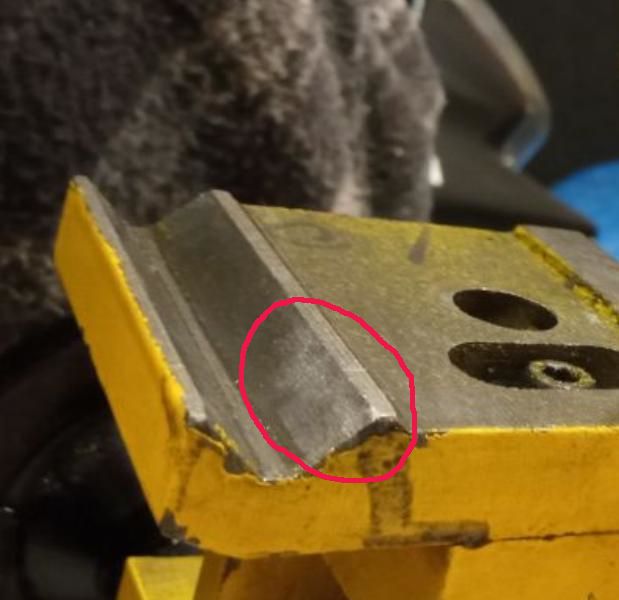
Narrow edge of that clamp should be at the front, see parts diagram
Edited By JasonB on 18/12/2020 12:20:07
In line with Jason's suggestion, is this part of the 'V' ok?
Might be a trick of the light.
However, try testing the 'V' and other bearing surfaces for straightness with the edge of a steel-rule, a sheet of cardboard to stop glare escaping over the top and a bright torch. Lay the rule edgeways along the suspect surface and shine the light on the reverse side, looking for light escaping underneath. The flat running edge can be inspected by holding the rule and tail-stock up against a window or strip light, but a shield and torch help seeing if anything is amiss in the 'V'. I'm wondering if the V is misshapen, and can't sit evenly on the bed prism.
Another way of highlighting poor fit is to lightly smear the V with Engineering Blue and press the tail-stock into position against the bed. The greasy Blue film is displaced from the high contact points and ideally there aren't any! Practice first: engineering blue isn't that easy to use. Once diagnosis is certain, high-spots can be removed with abrasive or a scraper. Don't rush to remove metal – ask advice first. (Didn't go well last time I tried…)
Dave
Just to add , if you go down the Chinese route then expect to spend a bit of time correcting the awful engineering that they produce.
From the cheapest to the most expensive arc euro offerings like Seig. Or is it Sieg. Conventional threads & very poor castings. Most members will play hell with me as they have them , but the truth is you cannot beat the good old British or American machines. Plus some others from Countries that make good quality machinery.
All the arguments will be , i have a R8 taper. So what the Mt2 is sufficient for anything a hobbiest will want to do.
Very rare to find , but still plenty around if you just bide your time & keep looking. Remember that most of the Cast iron that China uses is the scrap that the rest of the world throw away.
Basically they Smelt the iron & skim off as much of the slag they can & then use what is left. You end up with a nice finish with a few bubbles showing. It is pretty poor & very pourous.
The mad thing is that companies like Clarke machine mart & Sealey all use this rubbish & rebrand it as like it is so good. I recently bought a 150mm bench grinder by Sealey. Looked very nice & then suddenly the body decided to split in half. I now have 2 great jubilee clips holding it together until i can find a new machine.
Steve.
Welcome, and congratulations on your new acquisition. You are unlikely to regret it, and a whole new world of things that can be done will open up for you!
If the lathe does not have the manual with it, try to find one. It is pretty basic, but one rule to observe always, is never to start or stop the lathe with the speed control set to anything other than ZERO.
Otherwise, you are liable to damage the control board! (Expensive )
The manual will tell you haw to operate the machine, with guidance on depth of cut and, when the need arises, how to set up the change gears.
The Tailstock looks to be out of alignment. If you try to drill with it like that, best case you will get oversize holes.
Worst case you will break the drill! (Always start a drill with either a Centre Drill or a Spotting Drill )
As Jason says, find the capscrews and adjust them to bring the two centres into alignment.
When they look to be OK, trap a thin piece of steel between then, so that it is horizontal.
When it lies exactly square across the lathe, the centres are aligned. If it is at an angle, adjust the two capscrews until it is. Lock the two capscrews against each other so that the steel is still square across the lathe.
Eventually, you will be able to make up, or buy, and alignment bar and set the Tailstock with the bar between centres with a dial indicator.
You can buy cutting tools, and drill chucks, and suitable arbors from any of the usual suppliers, such as Arc EuroTrade, Warco, Chester, Axminster, RDG, Chronos etc.
As a newbie, I would suggest starting with High Speed Steel tools, which you can regrind to sharpen them.
The above suppliers will be able to supply in sets, if that is your wish, or you can buy individually.
This puts a bench grinder on the shopping list for the future.
FWIW, buy the largest that will fit your mini lathe, (Possibly 10 mm square? )and still need only a little shimming to bring up to centre height, NOT above. This will maximise rigidity.
It would be a good learning exercise to make yourself a Centre Height Gauge, and will provide you with experience and a tool which will save time and messing about setting up tools in the future.
A bit late for Santa to bring you some books, but the basic principles are set out in L H Sparey's "The Amateur's Lathe". Other useful books will be "The Amateur's Workshop" by Ian Bradley.
Neil Wyatt and David Fenner have both written books specifically about the mini lathe.
Another good reference book to mbuy is Tubal Cain's "Model Engineer's Handbook"
Before too long, you will need measuring equipment. Probably the first will be a calliper. Nowadays, most choose a digital one. A calliper will usually cover a range from 0 to 150 mm (0 – 6" in old money) and can changed from Metric to Imperial at the press of a button.
Dial or Vernier callipers, will be graduated in either or Metric or Imperial units, but do not have batteries that go flat at inconvenient times!
If you want, you can buy Micrometers, later.
Eventually you will find a need for Dial Indicators. (Certainly, if you have a four jaw chuck with the lathe.
3 Jaw chucks are ideal for holding round or hexagonal material. but for square, or irregular shapes, the 4 Jaw independant comes into its own. It also allows work to be brought on centre more accurately that most 3 jaw chucks can.
"Finger" types often have smaller graduations , but a shorter range, than Plunger types. (Typically 0.0005" graduations vs 0.001" for Plunger types ) Choose which sort of dimensions you will work in, probably Metrric, if your lathe is Metric, rather than Imperial.
You will need a base on which to mount the Indicator, and although a Scribing Block will do for some jobs, a Magnetic Base will probably be more useful. The ones with an adjustable linkage tend to be less rigid than those with this facility. For measurement, rigidity is essential to maximise accuracy, although the adjustable type make setting quicker and easier.
Then you will find a need for taps and Dies to produce external and internal threads.
Probably a Metric set would be a good starting point. Whitworth, BSF or Unified are only likely to be needed if you get involved in restoring older Cars, Motorcycles or machines.
Finally, ask questions on here, some VERY expert and skilled folk who will help you.
Find a Model Engineering Club near you and join. There you will find like minded enthusiasts who will answer questions face to face and even demonstrate how to do jobs.
End of long ramble.
Howard
A couple of online printed ones to add to your review list:
https://archive.org/details/in.ernet.dli.2015.4765
https://archive.org/details/GTDFactsAboutTapsAndTapping
This site is also good:
https://www.threadcheck.com/the-three-wire-method-of-measuring-pitch-diameter/technicalinfo/
(available as download https://www.threadcheck.com/technical-documents/thread-measuring-wire-formulas.pdf)
https://everbright.com.tw/userdir/56_c.pdf (metric wires for Whitworth form threads)
https://dx.doi.org/10.6028/nbs.lcirc.23r1923 (old, but comprehensive)
The very best source on this is an old Van Keuren catalogue, but you have to buy a paper copy as none are online yet.
For specific thread measurements, drill blanks (available from the likes of Zoro Tools) make serviceable measuring wires. If you did not know already, ArcEuro sell a set of wires.
The 'special sauce' words to go into Google are "whitworth three wire thread measurement".
I'm not usually one for this type of thread but,
Arc€urotrade have absolutely astonished me, this time.
Following Ketan's recent thread regarding Euro sales, I thought
I would also slip in a small order before the dreaded date.
Just to add to his workload, if you follow me ![]()
![]()
I placed the order on Saturday afternoon, and it's arrived this morning
(Wednesday)….!
I live in deep rural France.
Well done ARC.
ATB,
Daniel
Lets' step back, or rather, vertically upwards, first….. Finding INT30 tooling at reasonable prices!
"Ours" – ARC Euro, RDG etc. – stock mainly R8 and Morse taper fittings, but ARC has some INT30 and INT40, ER-collet chucks explained below.
Cutwel might sell INT-taper holders, though not listed on their web-site – most of their stock has other types of spindle tapers, mainly for modern NC machines with tool auto-changers.
Please if someone else can suggest a suitable dealer, do so!
I would be wary of e-Bay because you want decent-quality tooling and you've no idea what you are actually buying on such sites. If you have to search second-hand, as well as advertising here you could do worse than – as I have done – try Home and Workshop Machinery, and G&M Tools. Both firms advertise in ME, and though second-hand most of their stock is ex-industrial, college, etc.
…..
Right, now step back down the spindle and shank, to the cutter.
There are three basic ways to hold a milling-cutter: 1) collet-chuck for screwed-shank cutter, 2) plain-shank direct collet, 3) plain-shank side-holding.
1) Of the screwed-shank collet-chucks the best-known is probably the Clarkson 'Autolock' but I think other, similar makes are/were available. The difficulty is finding collets for these and you would probably have to think second-hand.
The Autolock style chuck has a cylindrical body whose blind bore has a large central point that locates the centre-drilling in the top of the cutter. The tool is screwed into a collet of the right shank size, then this assembly is screwed into the chuck body by a special "nut" with tangs that drive the flats on the collet. As it is tightened the collet's coned inwards end is pushed into a taper that closes it tightly onto the cutter shank.
The beauty of this system is its repeatability of setting and the positive location and gripping.
Its disadvantage is the depth of the chuck below the spindle, limiting space for taller work-pieces and set-ups.
'
2) The Plain-shank direct collet come in two forms, and they can hold screwed-shank cutters with some provisos because the thread is slightly smaller over its crests than the shank diameter.
– a) A long, split unit pulled into the spindle by the draw-bar, tightening onto the cutter shank by its taper engaging the spindle taper. Type vary. The Morse collet is tapered for its full length. R8 collets have a short taper at the nose end only. I don't know if there is an INT-n version.
Their advantage is in holding the cutter is held as closely as possible to the spindle nose, maximising rigidity and work-height range.
Disadvantage – I have had cutters slip in such a collet, but that may be a result of wear. Slip, part from being bad for the collet, can make the tool retreat. Worse though, and I have had this happen, it can make the cutter think it is a self-acting drill and plough down into the work.
'
– b). The ER-collet. This is a short, multlple-split cone held in a matching chuck by a closing-nut. The chuck shank is pulled into the spindle by the draw-bar, but the tool is gripped separately, by the collet. The collets are through-bored so can also be used with a suitable nose-piece, as precision work-holders on the lathe (NB – good-quality material with decent surface finish, only).
Their size ranges are designated by numbers – I've not managed to establish the number's meanings, but as a guide, an ER32 chuck's collets range from 3mm to 20mm diameter capacity.
The ER collet-chucks are compact but do reduce the day-light a bit. A big advantage is that a lot of tooling is easily-available to use these collets as work-holders.
Note that the ER collet does not just post itself into the chuck but is held via an eccentric washer, so there is a simple but definite procedure to using them. They are tightened and loosed by a special spanner that should be supplied , or certainly bought, with the chuck. And use that, not makeshifts giving the results so sadly shown on so many much-used machines and accessories!
ARC does list ER32 and ER40 collet-chucks with INT-n shanks.
'
3) Plain-shank side-holding. ARC calls it just an " End-mill Holder ", but not in INT-n sizes. It is a simple body with a grub-screw to engage the flat on the cutter, and shank to fit the spindle. It used to be possible to buy a miniature version with a screwed shank to hold in an 'Autolock'-pattern chuck, for the very small, short-shank cutters often described as " throw-away " in industry, due to the difficulty and cost of re-sharpening. I am not sure of the wisdom of holding such cutters in an ER collet, which is really intended to hold over its full length.
'
So… let's sum up.
All your cutters can be held by any of the above but if you cannot find an 'Autolock' pattern chuck and its collets the ER system is probably next best and very versatile.
Though I suggest not using an ER collet for a cutter shank shorter than itself, no doubt someone will come here and say, " I do! No problem ! " . He may be right, but I prefer to play safe with expensive tooling.
You could turn a simple grub-screwed holder from ground-finished steel for the smallest cutters, to hold in a larger ER collet. Ream the bore.
Once the EU and the UK Gov see the effect this has on small business like ARC, they'll remove all these new regulations. ![]()
![]()
They'd never risk their people losing all they'd worked for just so Gov's could spite one another over Brexit. ![]()
Lol… Yes there will be effects, but they are likely to be limited, as far as ARC is concerned, positive and negative. I wish negotiators on both sides well. My concern are only the couriers. I will be trying out different ones over the coming months.. DPD (French Post owned – crap at dealing with problems when parcels go walkabout in Europe), DHL (German Post owned, but more expensive – and pro-active on service when things go wrong), Parcelforce (maybe – but what service? when things go wrong).
I see that certain changes are necessary. I for one am FOR the changes to the VAT regulations, be they for import into the UK from 1st January, or for the EU from *1st July. They are long overdue.
If UK and EU traders are expected to obey the law, so should Amazon, eBay, Banggood, and all the Chinese traders who trade through them. Regardless of the outcome of Brexit talks, the next challenge will be how HMRC or their European counterparts are likely to enforce the changes… if they are able to. I know that such traders outside the UK and EU will already be looking at loopholes to beat the system. With an increasing number of such Chinese traders setting up shop in Hamburg port, I feel sad for the traditional German businesses similar to us, who already are suffering.
Ketan at ARC
* If ARC manages to still have customers left in EU after the first six months of next year, hopefully there will be an easy way for ARC to VAT register for the EU collective states by 1st July, rather than register in each state of the EU. Lets wait and see.
Edited By Ketan Swali on 11/12/2020 15:54:47
companies such as ARC losing its Euro trade is just small collateral damage to the ideologues of both the UK and the EU – unless some sense is seen in next few days I suspect it will be several damaging years before sense is restored and after a greater loss than Arc’s lost business.
Did voters have this sort of hoop jumping in mind 4 years ago?
Dave
The general public might not have, but businesses trading with Europe who did not wear rose tinted glasses did, or should have ![]()
What I failed to take into account was the way the couriers would react. I could say many less than complementary things about them, I could join the conspiracy band wagon, but at the end of the day, businesses like us – on both sides of the channel – have to find a way to work with the system, whatever the outcome.
Ketan at ARC
…
But if it is a significant business, rent a wharehouse in Boulogne (or wherever) I am sure that other small businesses will get wise & shared arrangements can be set up., import the goods to there & send them from there to the EU customers. The bookwork can be handled from the Uk by computer. Profits can come back to Uk so that foriegn tax is limited. All you need in Boulogne is a manager and a couple of parcel packers.
Is it really so hard, once the initial problems are sorted & of course there has to be a will to develop a business opportunity. …
You are probably right Sam. Where there is a will, there is a way.
At present I am content with my lot. Lets see how things develop over time.
Ketan at ARC
Sam's solution is a way ahead, but it's purpose is to circumvent the imposition of trade barriers resulting from a political decision. It's damage limitation with overheads, not an improved way of trading with Europe!
Did voters have this sort of hoop jumping in mind 4 years ago? My impression is they wanted simplicity, less bureaucracy, more local control, conservative methods, and more opportunity. A bright new dawn and sunlit uplands.
Interesting times – this is history in the making. I had to study the French Revolution, Congress of Vienna, the Corn Laws and Gladstone (but not Bismarck – perhaps I was asleep). I wonder what the youth of 2170 will make of our goings on?
Dave
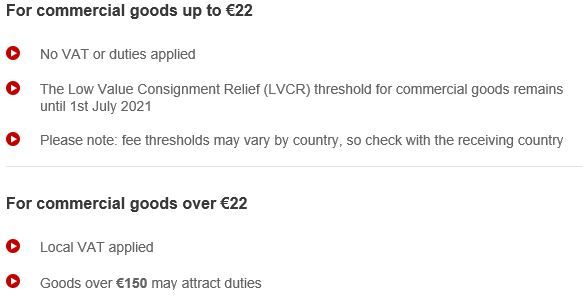
58.55 10% import duty (assuming no deal and WTO rules apply)
To the best of my knowledge, the import duty % will be based on country of origin (i.e. manufacture) of goods. Not sure at present, but unless EU decides to take the U.S. tarriff route/action against China, it could be less than or around 2%, rather than 10%. Also, to re-confirm, the duty element will only apply to goods value (inc. carriage) over 150 euros.
Ketan at ARC
At present we are uncertain if a solution for reduction in courier costs and delays can be found. If and when this happens, we will provide our customers with an update.
For now, we can only apologise for the inconvenience. We are very much aware that this development will make ARC less competitive for consideration by our E.U. customers.
Ketan at ARC.
It seems to be a deliberate design to engineer business environment in such a way that only Chinese goods are competitive.
Large number of various engineering goods from Ali and Banggood are now distributed from Germany at the same price you can buy them from China, so Chinese and German businesses have certainly found their way around a taxman.
But Western manufacturing gone down the drain.
Hi Martin,
It is a case of swings and roundabouts. Examples:
Ketan at ARC
…
But if it is a significant business, rent a wharehouse in Boulogne (or wherever) I am sure that other small businesses will get wise & shared arrangements can be set up., import the goods to there & send them from there to the EU customers. The bookwork can be handled from the Uk by computer. Profits can come back to Uk so that foriegn tax is limited. All you need in Boulogne is a manager and a couple of parcel packers.
…
Certainly possible, but is it worth doing? European Warehouses and staff cost money; computer systems cost money; managing the profits, tax and regulations cost money. More complicated and costly than not having a border unless it's done on a large scale. Necessary to stay on the ball too. Governments constantly seek to seal tax loopholes: not paying attention to the latest rules can suddenly make a company liable in several countries.
The approach favours the big boys rather than small business : the sort of multi-national that sells Chinese goods in the UK, pays tax in Eire, banks in Lichtenstein, is registered in Switzerland and no-one knows who the owners are! Another issue when companies go international in this way is they don't look to return profits anywhere in particular. Why should they? There is no 'home' in a global economy. Isle of Man, Seychelles, Panama, Canary Islands – loads of tax-exempt places to bank foreign profits.
We're moving from a situation in which UK trade was almost seamless to something else. Change is coming. Glad I'm retired and don't have to sort it out! It's a toughie.
Dave
UK traders will be at a disadvantage when compared to Chinese traders. I do not know how they manage to deliver at such low postage rates,
Mr Trump was trying to put a stop to that
The Chinese postal system is subsidised by western countries postal charges
And I believe that this was the outcome. We wait and see who will implement the outcome, and how.
Ketan at ARC.
Hi Chris B and Dave B,
You guys are on the right track. Here is a snippit from Parcelforces communication:
According to U.K. HMRC the low value duty and vat free incentive for orders below £15.00 entering into the U.K. will be abolished at the end of this year. You can read more here on GOV.UK website. This topic was discussed earlier on a different thread, and Michael Gilligan had provided this or similar link I believe.
Ketan at ARC.
Some of our customers in Europe may be aware that there are transit delays for orders shipped from U.K. into Europe.
Keeping this in mind, we request our European customers to place their orders through or website by 23rd December 2020. All such orders will be processed and dispatched on 24th December 2020. This will hopefully allow our couriers – DHL to enter the European Union by road service, before the 31st of December 2020.
ARC will stop – suspend selling into Europe from close of business on 23rd December 2020. ARC will re-start taking orders for selling into Europe on or around 5th January 2021.
With effect from 1st January 2021, new customs rules will apply for goods entering into Europe.
The good news for our E.U. customers will be that they will not have to pay U.K. VAT with effect from 1st January 2021. That is the only good news. The bad news at present is as follows:
1. Our couriers will have to make an export entry to leave the U.K., and they will have to make an import entry in the destination country. At present, the couriers will charge us and all U.K. exporters a fee for making an export entry of between £2.50 to £4.50. They will charge the importer between £11.50 to £13.00 to make an import entry in the country of destination.
2. There will be a delay in export from the U.K. for around two to three days while the couriers prepare and lodge export entries with U.K. customs for all the consignments which are loaded in specific road trailers. After this procedure is completed the trailer will be allowed to enter the channel tunnel or get on a ferry into Europe.
3. From 5th January 2021, the shipping charges stated on our website for shipping into E.U. destinations will include U.K. export entry charges (between £2.50 to £4.50) in addition to the road freight charges.
4. Once the goods reach their destination, depending on the couriers administration system in the country of import, they will contact the importer to ask them to pay the import entry charge (between £11.50 to £13.00) and taxes – duty (for goods above a certain value) and local VAT in the destination E.U. state. Once this is paid, the goods will be delivered to the importer. So, once again, this will cause delay.
At ARC,we believe that these costs are too high for most small value orders. These costs will be on top of the courier road freight costs which will also be increasing by 4.9% across all courier which we currently use.
At present we are uncertain if a solution for reduction in courier costs and delays can be found. If and when this happens, we will provide our customers with an update.
For now, we can only apologise for the inconvenience. We are very much aware that this development will make ARC less competitive for consideration by our E.U. customers.
Ketan at ARC.
I use GLR Kennions quite a bit and must say that their service is excellent, the same thing goes for Arc Eurotrade, I placed an order late last night and got a notification that it is being delivered tomorrow, long may both of these companies prosper!
The new set-up uses one of THESE and a 0.01mm DTI.
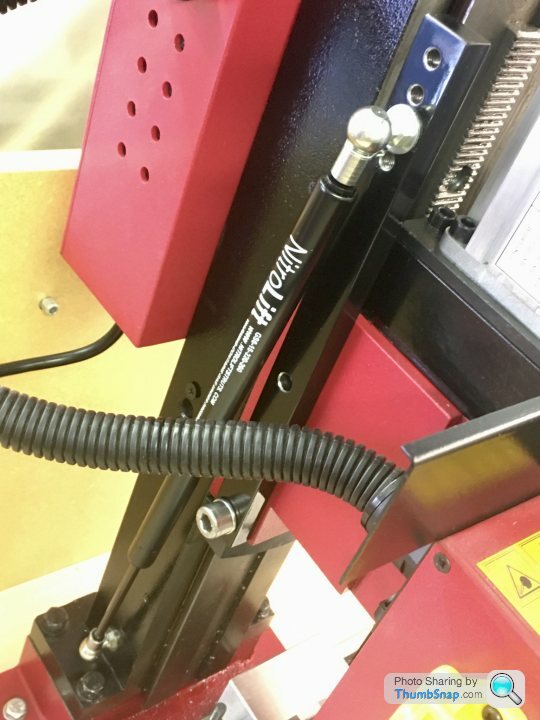
FYI this is how my strut is mounted:
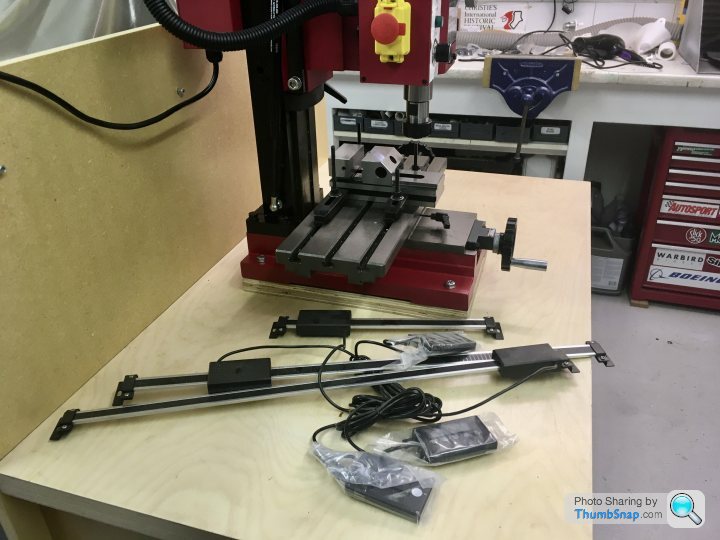
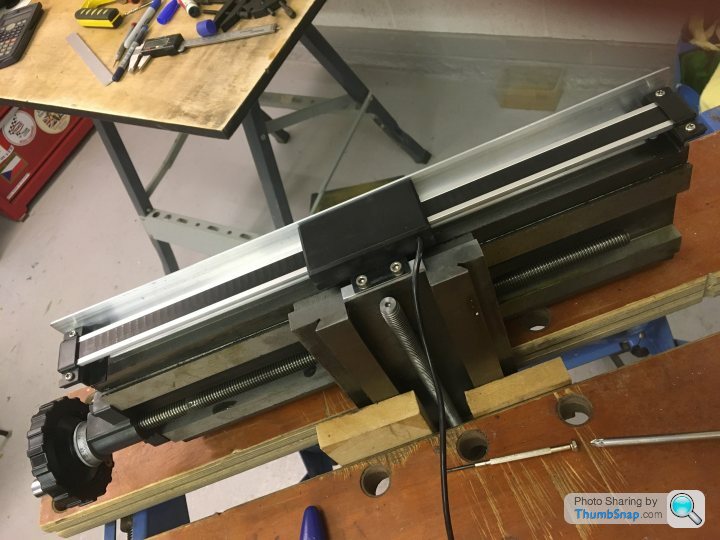
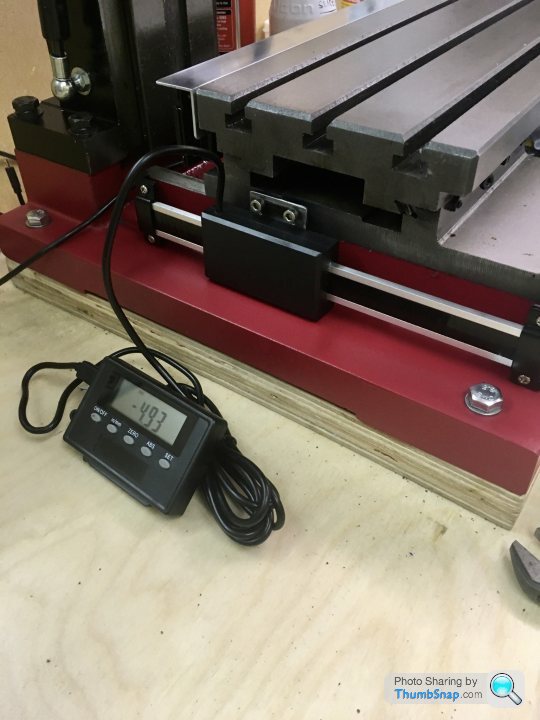
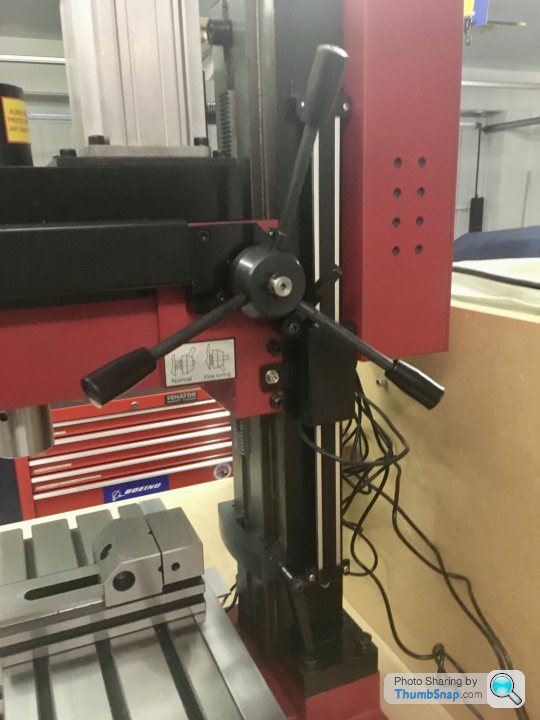
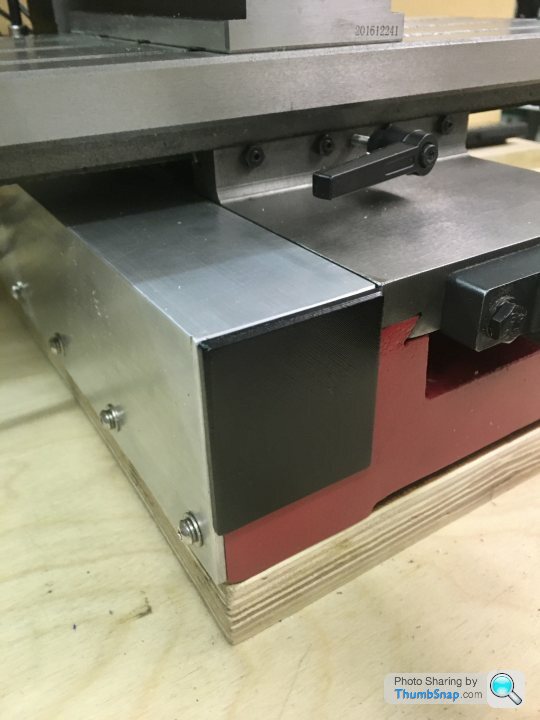
And the DROs I fitted, I got them from Arc Euro:
X:
Y:
Z:
And some aluminium covers and 3D printed end caps:
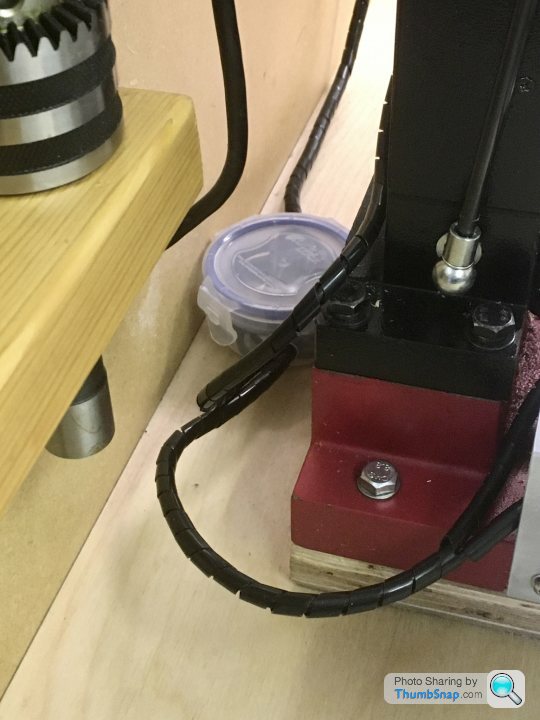
Readouts were mounted to some MDF, and I used an ancient Eastman Kodak camera ball and socket mount so I can position them for best viewing angle. Tidied the excess cables with spiral wrap and a plastic tub:
Touch wood, since fitting them back in April, they've worked perfectly. The nice thing was I could accurately drill all the stud PCD's on the Stuart 10V using x/y co-ordinates rather than needing a rotary table.
Excellent photos, will make fitting my DRO scales much easier. Did you have to trim the scales? Is that X-axis scale on brackets because it's slightly longer than the table it's attached to ?
FYI this is how my strut is mounted:
And the DROs I fitted, I got them from Arc Euro:
X:
Y:
Z:
And some aluminium covers and 3D printed end caps:
Readouts were mounted to some MDF, and I used an ancient Eastman Kodak camera ball and socket mount so I can position them for best viewing angle. Tidied the excess cables with spiral wrap and a plastic tub:
Touch wood, since fitting them back in April, they've worked perfectly. The nice thing was I could accurately drill all the stud PCD's on the Stuart 10V using x/y co-ordinates rather than needing a rotary table.
Emily,
As it appears to be a combination lathe/mill, you could do a lot worse than getting your husband one – or both – of the new books by Jason Bellamy and Neil Wyatt, sold by ArcEurotrade. See the advert just to the right of your original post, Lathework and/or Milling
I'm sure he will find them of immense value. Only downside I can see is that you'll probably get an ARC catalogue included in the parcel and that's where the spending REALLY starts!
John
Edited By John Hinkley on 05/12/2020 20:02:51
I have ordered a 125mm ER32 collet chuck from ARC **LINK** for my WM280 lathe. I did not get a backplate as I could not find one which fits on the spindle nose – so I will have to make one. From what I gathered reading some of the related posts the backplate is normally made from cast iron, some make it from steel.
I have a couple of weight plates I rarely used for their intended purpose which I was contemplating using for a backplate. They are cast iron and about the right dimensions I think. Is this a good idea?
Another question is about machining the backplate register. Some say tight tolerance for the fit of the chuck on the backplate, others say loose. For a collet chuck I would prefer to have minimal runout.
Chris
Started by: tomcnc
in: CNC machines, Home builds, Conversions, ELS, automation, software, etc tools
tomcnc
Started by: Nigel Graham 2
in: General Questions
Michael Gilligan
Started by:
Michael Gilligan
in: Electronics in the Workshop
Michael Gilligan
Started by:
[email protected]
in: General Questions
Started by:
Dell
in: Workshop Tools and Tooling
Dell
Started by: alecs
in: Website Questions, Comments, and Suggestions
JasonB
Started by: peter allen 1
in: General Questions
duncan webster 1
Started by:
Julie Ann
in: 3D Printers and 3D Printing
Julie Ann
Started by: ksw
in: General Questions
Bill Phinn
Started by: paul_go
in: General Questions
paul_go
Started by: Jon Gibbs
in: Workshop Tools and Tooling
ega
Started by: Peter Simpson 3
in: Beginners questions
ega
Started by:
Robert Atkinson 2
in: Clocks and Scientific Instruments
John Haine
Started by: glinscott
in: Stationary engines
Journeyman
Started by:
dean clarke 2
in: I/C Engines
dean clarke 2
Started by: Trevor Wood 6
in: Beginners questions
Nigel Graham 2
Started by:
JasonB
in: The Tea Room
Speedy Builder5
Started by: Speedy Builder5
in: Workshop Techniques
Roderick Jenkins
Started by:
Michael Gilligan
in: Materials
renardiere7
Started by: vgvikram171
in: Introduce Yourself – New members start here!
vgvikram171
Started by: timdotd
in: Workshop Techniques
timdotd
Started by:
JA
in: Workshop Tools and Tooling
JA
Started by:
Vic
in: The Tea Room
Macolm
Started by: old mart
in: Workshop Tools and Tooling
Steve101
Started by:
Neil Wyatt
in: 3D Printers and 3D Printing
Mark Rand