I don't know what mill you have but unless it's a Bridgeport-size one, a 6" vice is going to be too big. When I bought my Warco VMC mill, I ordered the large SG versatile vice from ArcEuroTrade. The courier warned me it was heavy when he delivered it. He wasn't wrong – I had difficulty lifting it onto the table. A quick 'phone call and a half-day trip to Leicestershire later and I had the 100mm mounted. Much better.
Googling the Accu vice throws up one from Axminster Tools, but that one has a rotating base. I suggest that this will rarely, if ever, be used and will seriously decrease headroom above the vice. I'd advise a purchase from Arc – you won't be disappointed.
John
It is indeed Bridgeport size, check Colin's albums
I don't know what mill you have but unless it's a Bridgeport-size one, a 6" vice is going to be too big. When I bought my Warco VMC mill, I ordered the large SG versatile vice from ArcEuroTrade. The courier warned me it was heavy when he delivered it. He wasn't wrong – I had difficulty lifting it onto the table. A quick 'phone call and a half-day trip to Leicestershire later and I had the 100mm mounted. Much better.
Googling the Accu vice throws up one from Axminster Tools, but that one has a rotating base. I suggest that this will rarely, if ever, be used and will seriously decrease headroom above the vice. I'd advise a purchase from Arc – you won't be disappointed.
John
ARC euro or tracy tools, reasonable quality and excellent delivery, ask any one on here ! Noel.
Those three taps in your photo are "serial taps" you have to put the single groove through first, then the two groove and finally the plain shank to get a fully formed thread. see here
Edited By JasonB on 03/04/2022 10:05:58
Thank you. I was tapping a thin piece of ebony, 6mm, and went straight for the no groove.
Edited By pgrbff on 03/04/2022 10:12:05
Those three taps in your photo are "serial taps" you have to put the single groove through first, then the two groove and finally the plain shank to get a fully formed thread. see here
Edited By JasonB on 03/04/2022 10:05:58
Brushes.
Take them along to a local motor repair shop. They might be able to find you suitable replacements, intended as spares for something like a pistol drill.
Send the dimensions of the brushes to Ketan at Arc Euro. They might have something suitable in stock.
If the tool dug in with only a 0.002" cut, something is seriously wrong.
1 ) Rigidity of tool [post / Cross Slide
2 ) Tool not on centre height (Lack of rigidity could give the same effect
3 ) Grossly excessive feed rate
4 ) Possible excess top rake on the tool., I do a lot of work with Zero Top Rake. (The parting tool in the rear tool post is one such example. ).
If it were me, I would seriously explore ways of reverting to a four way tool post, if possible. This should be more rigid than a QCTP, because of fewer interfaces and reduced overhang.
You could make a four way post by laminating suitable pieces of plate (I made a four way indexing rear toolpost for my lathe (Take a look at my albums for a couple of pictures )
Like me, you may not be able to locate each position by a spring loaded pawl, I used a long dowel to do the job!
Howard
Had to look up Foucault Lens Testing, not sure how it could be applied in this case.
Not thinking it through, my first reaction to Michael's microscope suggestion is there's a practical difficulty. How could a bulky microscope's objective lens get close enough to focus on the area of interest?
Of kiwi's amplifying suggestions, I think it would have to be purely optical because any mechanical arrangement is likely to spoil a delicate measurement. Friction, flexing, and the weight of the lever all count against it. Bouncing a laser on to a distant wall off a lightweight plane mirror glued to the probe should work.
Alternatively, could Joe use Jo-blocks? (Ho ho, ged it?) The method is a variant of what Joe has already tried with a micrometer, except Gauge Blocks are more accurate. Necessary to take multiple readings to average out the multitude of errors. As Joe has found, a micrometer doesn't have the necessary resolution, and it's screw thread is much more accurately made than the lead-screws found on machines.
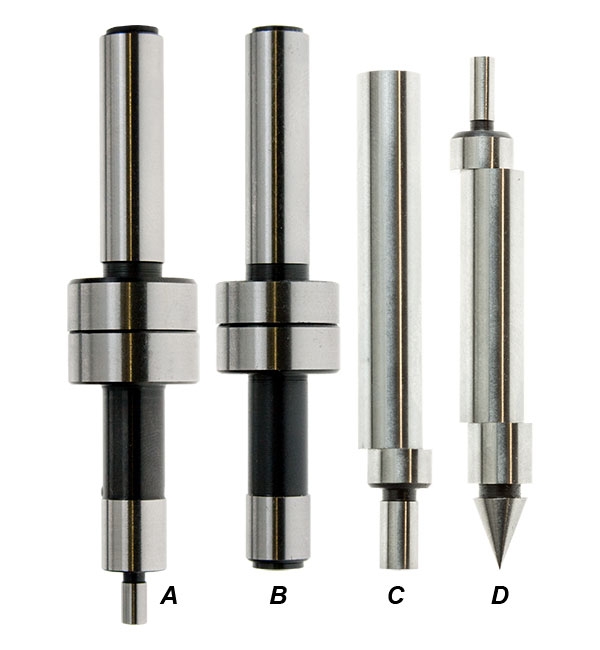
For practical purposes, maybe all Joe needs to do is show that his electronic edge finder does a better job than the alternatives. Should be possible to measure the thickness of a cigarette paper and detect when a spinning cutter knocks it off. I guess a 2D mechanical edge finder is of similar accuracy, photo linked from ArcEuro's website:
Another thought. Use the edge finder to repeatedly detect a fixed corner, and then move the mill 10mm in X and Y to lightly dot a blued surface with a sharp needle point. The dispersion of the dots is a measure of repeatability, which depends on the accuracy of the edge finder and the lead-screws. The edge finder only needs to be more accurate than the lead-screws.
Does this make sense? Rude comments welcome!
Dave
Welcome to the forum David.
I dislike the word 'quality' in engineering because it's meaningless without a specification. Cutting metal is a science. Professional tool catalogues don't mention quality at all. Cutters are chosen to optimise an economic work-rate. A huge range of cutters are available to meet production needs from inexpensive disposables to extremely costly items made to cope with difficult materials. Professionals try to define Value for Money and Fit for Purpose. They don't waste cash on expensive tools or buy brands recommended by a bloke on the internet!
At home metal cutting is more art than science and many Model Engineers are self-taught: I still wish we would avoid the 'Q' word.
Four things cause machining bother: the material, machine, cutter, and operator error:
Tools didn't stay sharp long when I was learning – poor technique. I could have wasted a lot of money ruining expensive cutters! Instead, I practised on mid-range and found they last when used properly. I start with RPM = 10000/tool diameter in mm (about right for mild-steel), cut-depth a bit under 20% of tool diameter, and feed-rate increased until the machine is heard working moderately hard, not labouring.
HSS is often coated with a layer of extra-hard material to keep them sharp about 15% longer. Aluminium tends to stick to the coating, so uncoated is a better choice for it. I use TiN coated HSS for everything, but take care aluminium doesn't stick to the cutter because it wastes time.
Not much of the above depends on 'quality'. More to do with the operator understanding how his particular machine relates to the materials he works with and the required finish and accuracy. Rather than buy expensive high-performance tools that aren't needed, I buy mid-range and go up market only if they're not good enough.
In the good old days, cheap tools were rubbish and it paid apprentice craftsmen to buy the best they could afford and make it last. Not how the modern world works. Now tools are expected to do a job for a reasonable amount of time, and are then replaced. What's meant by a 'reasonable amount of time' is specified, allowing cheaper tools to be used when long lasting tools aren't necessary. Or money to be begged/ borrowed/stolen when only the best will do! How long your tools should last needs thought. A sad feature of the forum is relatives selling off workshops full of tools that lasted longer than the late lamented Model Engineer.
How best to self-teach is tricky. I like books and magazines – not for everyone. Much of the Workshop Practice Series is excellent except modern stuff like carbide and DROs are missing. Jason Ballamy's book is up-to-date. I've found the forum excellent because it allows question and answer.
Be wary of Internet videos. Often an inglorious mix of good and bad in the same clip, together with product placement, misunderstandings and duff opinions.
Dave
Dave, one of the things I'll be getting is an ER32 collet set, … I'm looking at getting one from a reputable brand as I'll be using them for a good long while trying to get accurate results. Any recommendations as to a good supplier? I'd be happy to pay more for something made here in the UK if the quality warrants it.
… And to be fair to Warco, they have been very good so far. I emailed that my oiling can was leaking from the plunger late afternoon, and I had a new working one in the post 2 days later.
Unfortunately I don't know of anyone making ER collets in the UK. They were invented by Rego-Fix, who still make them if you want the real thing. Two UK Stockists, Brunner and MA Ford. Both seem to be price on application, as sign the sellers don't like dealing with hobbyists who faint when told the price and Minimum Order Quantity!
Beware of buying the best, for example industrial collets are likely to have been expensively balanced to run at 30,000 rpm in a CNC machine, waste of money buying them for a hobby machine that tops out at 2500rpm! They're also made of superior steel designed to resist corrosion and multiple automatic tool changes in production machines running flat out 24×7. Again, waste of money on a hobby lathe, because we just don't work out kit that hard.
My unbranded Metric Set and chuck came from Warco, all good. I added a set of ArcEuroTrade Imperial collets later also all good.
On the subject of Quality Assurance, the hobby market is different. Doing full QA at the factory adds significantly to the cost, maybe costing more to conform all is OK than to make it. So below a certain price, the tactic is to let the customer find subtle faults, and the supplier simply replaces the odd duds. This is what Warco did with your oil-can.
Although irritating when inexpensive tools go wrong, most of us get acceptable performance most of the time for reasonable money. Industry can't afford to mess around replacing even a small percentage of defective tools because time is money. They're happy to cough up for reliability in a way hobbyists rarely are! Expect industrial tooling to be at least 3x more expensive, often more.
I avoid buying cheap 'bargain' tools off the web, and I avoid buying the best available to industry. Too-cheap and Too-Expensive are both unwelcome in my workshop. Overspending is a dreadful sin in professional engineering because money wasted on unnecessary features is always better spent on something else.
Boils down to value-for-money, which in my case is met by mid-range tooling. I don't expect to get industrial specification kit for hobby tool money, nor do I need it. I especially don't expect industrial performance from the lowest price products available from the Far East.
Starting out I worried about too much about 'quality': in practice, the sort of tools sold by ArcEuroTrade and similar work well enough for me. (I'm neither amazed by their excellence or disappointed by their cheapness.) If a tool doesn't do what I need, I might move up market, but it's rarely necessary.
But take your personal preferences into account. Tools are just tools in my book, but many get pleasure from using 'good' tools, or are rapidly frustrated by minor imperfections. If that's you, spend the money on high-end new and start looking for second-hand in good nick. Beware second-hand ER collets on the web: used for production they're disposable, dumped when worn out or damaged. Even the best tools are reduced to scrap by hard work…
Dave
I think I can draw the following conclusions:
…
– Drilling with a collet should be better still, but limited in drill sizes
– Turning a holder to the exact size of the drill will get you the best accuracy, but will probably hit the point of diminishing returns.
…
Collets are probably better than turning your own holders because manufacturers have better kit and Quality Assurance than we do! Unless you go too cheap or get a defective one.
Collets usually have excellent concentricity but only a tiny grip range. In many systems you need a 6mm collet for a 6mm drill, and the number of collets needed to cover all the common imperial and metric sizes is scary.
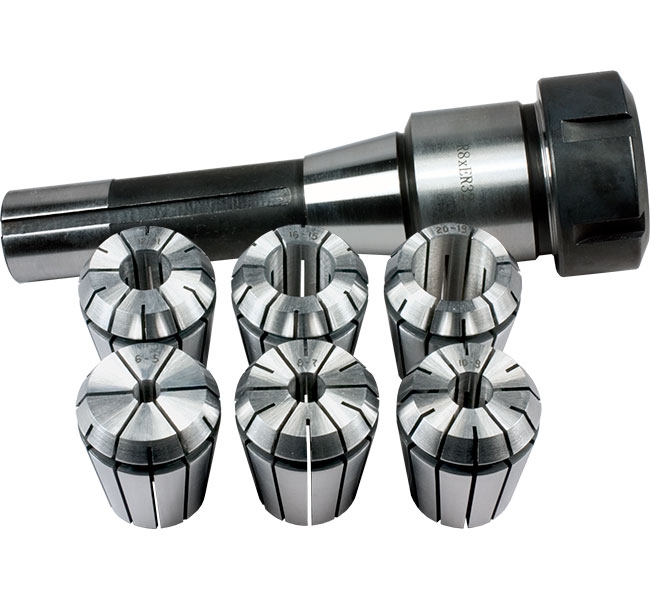
Good news! A relatively new collet system, ER, has collets that squeeze down a full millimetre much reducing the number of collets needed. The picture below is from ArcEuroTrade, other suppliers available. There's a collet chuck which plugs into the mill (be sure to get the right taper for the machine R8, MT etc), and then a set of individual collets. The most popular hobby size is ER32, covering 1mm to 20mm. ER40 does larger sizes, ER25 smaller. ER collets are used to hold drills and milling cutters (including threaded shanks), plus wobblers, in a mill, and are also suitable for holding work accurately in a lathe. (For which another chuck may be needed.) Have a look at Warco's offerings for prices and what's available.

When buying collet chucks, prefer the type with ball-bearing nuts which are easier to tighten than the plain type. (They like to be tight!) Ball bearing nuts can be bought separately and retrofitted.
I only fit a drill chuck to my mill when drilling lots of different sized holes all in one session, which is rate. The drill chuck allows faster tool changing, which is worth it when drills are being constantly swapped. Otherwise collets are somewhat slower but you get lower run-out and much better resetability.
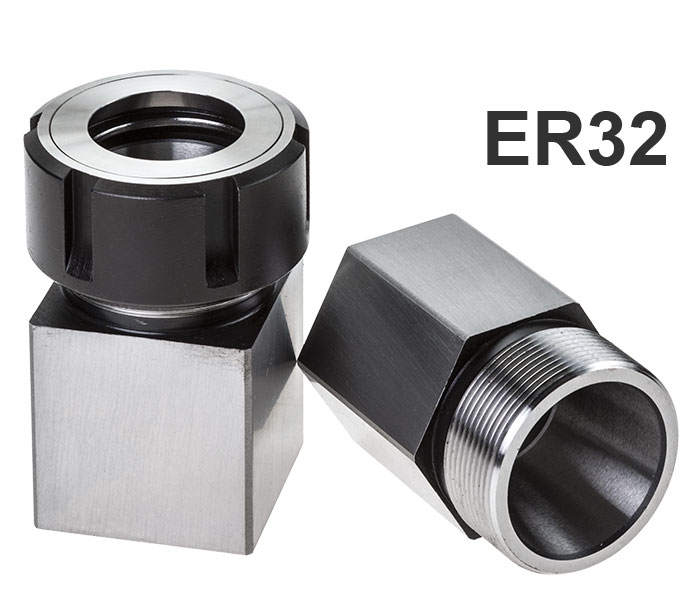
ArcEuro sell Stevenson Collet Blocks, which are a handy work-holding accessory, if you already have ER:
Dave
You can get an idea of what gears you require by measuring the OD of the mating gear, and counting the teeth, as well as the other dimensions..
The gears are likely to be Module, so Diameter in mm / (Tooth Count + 2) i= Module.
EXAMPLE
OD = 27.5 mm / (20+2 ) = 1.25 (Module ) for a 20 tooth 1.25 Mod gear.
The answer may well be 1.5, 1.25 or 1.
You could look at other importers to see if they import a similar machine (Possibly only in a different paint scheme) who could supply a replacement.
Likely places, once you have measured the gears, and knowing the tooth count of the damaged gear, might be Chester, Axminster Arc Euro, SPG, Amadeal etc.
Bear in mind that some machines, although superficially identical, may differ in detail. Depending on the manufacturer,, the keyway, for instance may differ, (Say 4 mm against 3 mm),
If all else fails and only the bore is different, you might have to bore out and bush a close approximation to get the machine running again.
Ultimately, you could approach someone like HPC, or Davall or Reliance gears, but their gears are likely to be costly and need modification to fit your machine.
The only other advice that I can give is not to work the machine quite so hard in future
The plastic gears are the weak point in the drive train and fail safe to protect other components, akin to a shear pin..
These are hobby machines, not industrial machines designed to be worked hard 8 hours every day!
Howard
Posted by David-Clark 1 18/03/2022 08:46:06
Notable moment in Model Engineers’ Workshop, yhe CBC Tool and Cuter
Grinder, I think a world first.
So, self taught is good.
Hi David,
Sorry to hear of your past and present problems.
I am in the self taught camp as well.
It is now nearly 14 years since the Cnc cutter grinder article was published
in MEW ,i wonder if any others have been made ,there seem to be
plenty of similar setups working in the same way on You tube now, but back
then i don't know , most likely as you said " I think a world first".
I seem to remember there were some dissenting voices on this
when you published this same statement when you left as editor, naturally
there was no alternative methods proposed by these folk other than chop of
the end of a cutter with an angle grinder and spend nearly £1000
on an Arc euro grinder.
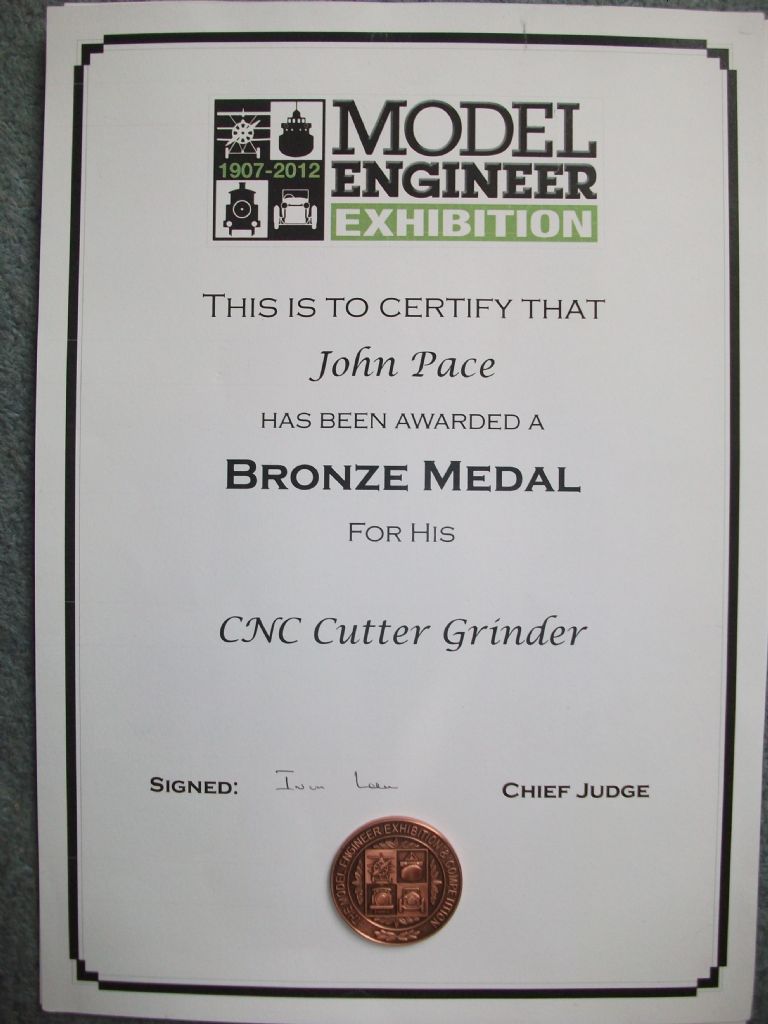
Here is the certificate and bronze medal that i was awarded thanks to you
for encouraging me to enter this machine in the 2012 Model engineer exhibition.
Sadly the magazine no longer seems to have had any proper machine
type builds since you left it is all short and repeated subjects,the
300 anniversary issue was i thought very poor the last straw for me
was the skeleton on a bicycle two issues later on was
enough for me to chuck in the subscription for this magazine that i had
for many years.
John
I am delighted to pay credit to both ArcEurotrade and the Post Office once again for excellent service. I purchased a device from Arc a week or so ago. I fitted it yesterday and encountered a problem which could not have been seen as the device was packed in an oil bag and box. I phoned Arc yesterday afternoon and explained the problem. A replacement part arrived today. It slotted straight in and I am up and running.
To my mind that is excellent service from both Arc and indeed the PO who delivered it. I am delighted to acknowledge such service once again. I have no link with either Arc nor the PO but I am a very satisfied customer.
hi guys it was me … i don't know what if anything is wrong so help me understand i have the correct drill set … here is the set i ordered …… https://www.rdgtools.co.uk/acatalog/Presto-09501M25—M25-COBALT-DRILL-SET-1MM—13MM-IN-0.5MM-28299.html#SID=207
i bought them from RDG but the set that came are these .. i found them on Ebay, are they the same and if so look at the price difference ….
why the big price difference and why the different case they are in ? are they the same bits ? thanks guys …
Ah ha! The RDG set are 'Heavy Duty' drills, which are for punching through hard materials. The cutting edge is like a masonry drill, with a shallow angle to reduce wear, and the flutes are extra thick which increases friction as holes deepen. Good for difficult materials like Stainless and hardened steel. They don't cut as well on Mild Steel, Aluminium and Brass as ordinary drills, like the Presto jobber set on ebay.
You'd think buying an expensive heavy duty drill from a reputable maker would guarantee wonderful drilling, but the drills aren't ideal for the alloys we normally machine. Not really a waste of money though because sooner or later it will be necessary to drill an awkward material – then they'll do the job.
I buy mid-price HSS drills from ArcEuro, Tracy Tools and others and they generally work well on usual metals. I avoid cheap DIY store and internet drills because quite often they're for woodwork or just too cheap. I rarely buy 'good' brand-name drills because although they stay sharp longer, I don't do enough drilling to justify the cash. Owning tools that will last longer than I do doesn't seem sensible when the money can be better spent on other tools. For example, I bought two sets of mid-range drills, and keep one specially for Brass which likes sharp. Once a drill has been used on steel, it's spoiled for Brass, but drills eventually too blunt for Brass still cut steel OK.
Dave
Years ago I used a cleaning solution from ArcEuroTrade. Wipe it on, leave it a bit and wash of with water.
…
I clocked the spindle and found that with moderate (finger) pressure – certainly no more radial force than I would expect to be exerted by a tool – the spindle was deflecting up to 0.02mm from one extreme to the other.
I don't know whether this amount of play is just expectable 'spring' or indicative of the early onset of bearing wear and the cause of my problems – so the opinion of old hands would be welcome.
That is too much movement for a spindle with roller or ball bearings under moderate finger pressure. The better way to test it is to clock spindle movement at the headstock while yanking as hard as you can on the end of a 12" long piece of stout bar or pipe held in the chuck. That way you find out how much slack you really have in the bearings. It will be more than light finger pressure at the spindle itself has shown.
The good news is, your bearings are easily adjustable for preload. Usually they run with a very light preload and zero slack, so you should get no measureable movement at the spindle. Adjustment is usually a simple threaded collar on the far left hand end of the spindle. See your manual or the ArcEurotrade website for details.
As it is a new (ish) lathe, it is pretty normal to tighten things like bearings and gib strips after a bit of use and things have bedded in. If the bearings continue to need frequent adjustment in the long run, replacement with better quality roller bearings from Timken or SKF or Naachi etc would be one way to fix it. Never use cheap Chinese bearings. But the Seig owners on here have not reported bearing problems in the past so I am pretty sure you will just need some adjustment, not replacement.
Edited By Hopper on 10/03/2022 04:50:18
According to the book, should be a 51102 (15x28X9) ball thrust bearing – try ArcEurotrade;
Arc Euro – Thrust Ball Bearings
Buy a new 3×18 metric taper pin.
Bob's your uncle.
See what it's like with the proper bearing in it, hopefully normal action will be restored…
Edited By DiogenesII on 09/03/2022 21:32:46
But I'm guessing you're not in Italy?
All couriers here charge 5% or minimum 18 euro for handling fees. The post office, which is divided up into different businesses, charge a minimum of 9 euro, but SDA, still the post office, are classed as a courier.
VAT is calculated at 22% of the total cost including shipping.
I did look at Amazon.jp as you pay the VAT etc upfront and it's delivered by DHL within 4 days but the costs always came out more or less the same, and most of the taps for sale seemed to be Chinese anyway.
Things are still changing. Everything went mad after Brexit. I'm still waiting for a Parcelforce parcel sent on the 25th November. Tracking stopped early January and I just asked Paypal for my money back.
I did find them when I was searching.
Normally I'll buy used UK manufactured as I probably will only use them once. But buying from China is the same as buying from the UK. I still have to pay extortionate handling charges, often 18 euro or £15, plus VAT.
The 2 taps I bought from the UK which weigh a few grams, cost £10 standard airmail. I know businesses have to make money but the postage cost was probably close to a fiver.
You don't need special drills for aluminium half decent HSS will be fine. As you are going to be clamping things down to it I would go with more engagement and drill 8.5mm and tap with either a spiral flute or spiral point tap. Split point stub length should not even need punching or a ctr drill to start, something like these and one drill bit will do all your holes and more without need to sharpen.. Use a little paraffin to lubricate.
I've a couple of 1o and 12mm steel plates that I use a machining plate so your 16mm ali should be a similar strength
Background: On 12th of February this year the way our website works was updated. When a person visits our site, it checks the IP location of the customer. If the customer is from one of the 27 EU states, it automatically quotes prices in Euros, and quotes carriage, handling,duties and taxes to their destination delivery address for B2C customers.
We have done this to try and bring back customers lost post Brexit, due to uncertainty over costs which a customer would face once their goods arrived in their country.
So far, indications are that the new changes are working.
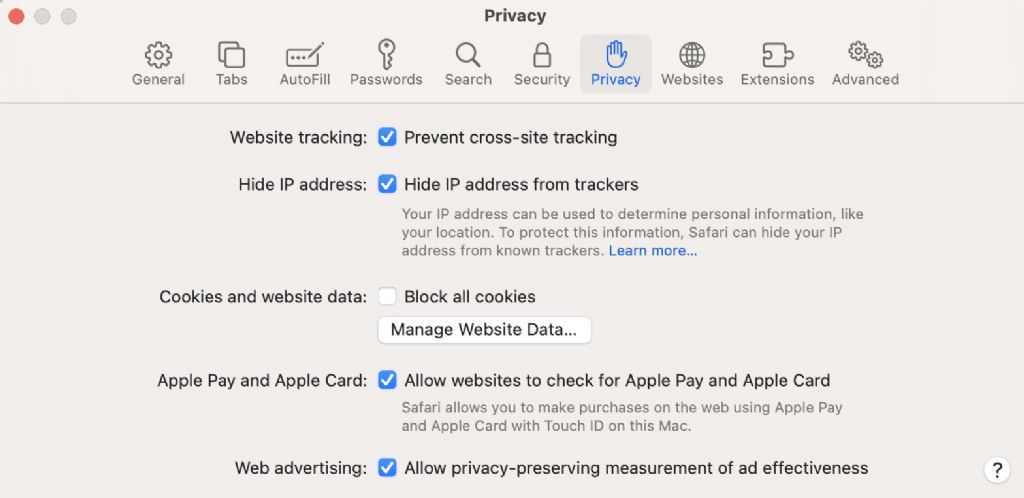
Above is the positive aspect of this development. However, we are now seeing some new issues arise. For this I seek assistance from Apple Mac – Safari browser, Plusnet, and VPN users.
Apple Mac – Safari browser users : Around 25% of people who visit our site use Safari. I am unable to check which version of Safari they use. Some customers who use Safari have contacted us with different issues:
So if you are an Apple Mac user, and if you are willing to assist, could I please request you to see if you are able to visit our site on your old or new version of Safari to see if you come across any of the above issues?, and if so, does clearing the HISTORY, or unticking the said box temporarily (if you are willing to do so) on the latest version of Safari cure the problem, or using Google or Firefox cures the problem?. If not, please details version of Safari being used, with box ticked/unticked.
Depending on the response publicly (or by PM), I will be able to understand how big the problem is, and if there is a need for us to consider adding a pop-up at the beginning for Apple and/or VPN users, or do nothing and hope that the issue will resolve over time.
Plusnet users – Two customers who use Plusnet were simply unable to get onto our site. Trying to get on resulted in an application runtime error:
I am unsure if this is due to Plusnet blocking our site for some reason or something else.
So if you are a Plusnet user, and if you are willing to assist, could I please request you to see if you are able to visit our site? If not, could you please advise if you are a Windows or Apple user, along with details of which browser you are using. If you do have a problem, please see if removing cookie history cures the problem too… in most cases it cures the problem, but if you still have an issue, and if you are using Plusnet, it would be good to know.
VPN users – If you are based in the U.K., and if you are using a VPN, and if you have an option to use U.K. as the VPN location country, could I please request you to set it as U.K. when visiting our site for reasons mentioned above.
Finally, if you are experiencing the above difficulties when visiting our site, I apologies for any inconvenience. My team and I will try to resolve the issues and in the mean time, in case of difficulty, as an alternative solution to placing an order through our site, you are always welcome to call us to place your orders over the phone (U.K. only).
Thank you,
Ketan at ARC
Update for Kenneth and other EU customers (27 states):
On 12th February we updated our site to deal with EU customers, be it IOSS or above duties and taxes paid to destination country.
All prices have been quoted for EU customers in Euros for a while now. However, from 12th February, all handling, courier/carriage, destination country duties/taxes to the 27 EU states will be added and collected at the checkout. This is to make sure that such order reach EU customers faster as all customs formalities and payments will be completed by us in advance on EU customers behalf.
We are aware that such costs for low value orders are still high. We are regularly reviewing this with our carriers with hope that the logistical costs for low value orders could reduce over time.
This procedure will be applied to all EU orders, EXCLUDING orders for machines which weigh over 70kgs., and EXCLUDING business to business (B2B) orders. Updated terms can be found here on our site.
https://www.arceurotrade.co.uk/projects/Info/eu-terms-2022.html
Quite a few orders have come through post change, and we are happy with the initial response from EU customers. Thank you for your custom.
Ketan at ARC
Started by: Buffer
in: General Questions
Michael Gilligan
Started by: lucerne
in: Manual machine tools
Andrew Crow
Started by:
duncan webster 1
in: Electronics in the Workshop
Joseph Noci 1
Started by: COLIN MARTIN 2
in: Materials
alecs
Started by: Bill Dawes
in: General Questions
Bill Phinn
Started by:
Michael Gilligan
in: Clocks and Scientific Instruments
duncan webster 1
Started by: Bill Phinn
in: Workshop Tools and Tooling
Bill Phinn
Started by: Phil Whitley
in: The Tea Room
Phil Whitley
Started by: Bill Dawes
in: General Questions
Dave Halford
Started by: SteveP
in: I/C Engines
SteveP
Started by:
JasonB
in: The Tea Room
JasonB
Started by: Alan Ambrose
in: Manual machine tools
Adam Harris
Started by:
David George 1
in: CAD – Technical drawing & design
Mark Rand
Started by: Chris Crew
in: The Tea Room
Chris Crew
Started by: Dougie Swan
in: General Questions
Ian P
Started by: James A
in: Manual machine tools
Andy Stopford
Started by: Andrew Tinsley
in: Workshop Tools and Tooling
Clive Foster
Started by:
dee
in: Related Hobbies including Vehicle Restoration
duncan webster 1
Started by: Harry Broadbent
in: Model Engineer & Workshop
vintagengineer
Started by: Tony Ray
in: Workshop Tools and Tooling
bernard towers
Started by:
dean clarke 2
in: I/C Engines
dean clarke 2
Started by: jimalm
in: Electronics in the Workshop
Vic
Started by:
Neil Wyatt
in: Manual machine tools
Howard Lewis
Started by: Roger Harvey
in: Workshop Tools and Tooling
ega
Started by: Andrew Tinsley
in: Workshop Tools and Tooling
Andrew Tinsley