Search Results for 'zan'

Search Results for 'zan'

Home Forums Search Search Results for 'zan'

Viewing 25 results - 176 through 200 (of 557 total)
  • Author
    Search Results
  • #551576
    Oldiron
    Participant
      @oldiron
      Posted by Zan on 26/06/2021 23:47:18:

      What speeds and feeds are you using?

      Stated in the post.

      regards

      #548198
      mgj
      Participant
        @mgj

        Jason – no. Mine doesn't have that zero on it.

        Zan, Thank you – I have a ground test bar.

        I suspect a large ball bearing race would be a good external check.

        #548181
        Zan
        Participant
          @zan

          So so easy to find out. Just Chuck a piece of very round material. Tighten with each socket in turn noting the dti deflection. Remove bar, rotate it a bit and repeat.
          it won’t take you long to find the best socket with the minimum eccentricity which can then be marker with an E for external. Repeat for internal with a suitable blank, and mark the socket I for internal.

          if you want a more accurate test, repeat with different dia stock before marking.

           Not much faff, it will only take 5 mins

          Edited By Zan on 03/06/2021 14:35:25

          #547296

          In reply to: Injector LBSC type

          Nigel Graham 2
          Participant
            @nigelgraham2

            You are right: the slot of parting does cut into the cone itself. It provides the water's escape to the non-return valve that helps the injector to start.

            The overflow valve is theoretically not needed but in practice was found very early on to make an injector self re-starting after temporary perturbations in the water flow to it. It also helps us by showing water is reaching the device at the start, and allowing running cold water through it if a slight steam leak has heated it.

            Some full-size injectors have the combining cone split lengthways with one half hinged to act as a flap-valve, or use a sliding cone, but they do the same thing as that little ball-valve. I don't know the design Zan cites: is the overflow gap the annulus between the combining cone outlet and delivery cone inlet?

            '

            The drawing as shown offers alternatives: cut the cone into two parts or have two slots separated by narrow bridges that keep the cone in one piece. The latter needs that waist turning in the already very fragile cone.

            If I was to make an injector to that design I think I would match the two slots with a shallow annular groove in the body instead, with a compensating weeny thickening on the exterior.

            '

            As Jon says, LBSC used terms like 'bare' and ticket thicknesses – and the adjective 'weeny' – to help 'the common man'; but I have always read 'bare' to mean 'as close as you can make it but not over'. In his era most model-engineers, including presumably him, had far more basic workshop equipment than we think the norm now.

            #547250

            In reply to: Injector LBSC type

            Zan
            Participant
              @zan

              All my jubilee injectors have only one cone in the centre and they work fine , in place of both the small centre ones. In addition it should be noted they also supply a lot of the trade.


               PS. what  is 1/32” bare? It’s not on my ruler or micrometer. Is it -5 thou?  -10 thou? or whatever. so why not just give the actual dimension

              Edited By Zan on 26/05/2021 18:16:37

              #544302

              In reply to: Lathe run out

              Zan
              Participant
                @zan

                “not bad for a rusty old bar of 1" cold rolled.” So did you run the dti all along the bar at the front and on the top? Bet it won’t be held true in the Chuck and it will probably be bent accounting for the difference and this bar even if short  will not be held true due to the rust and  rolling tolerance, it’s not an accurate material 

                is the runout you quote on the rotating bar?
                As said above you need tailstock support and a travelling steady

                have you done the standard bobbin turning test to check for any bed twist?

                have you done the between centres test to check the tailstock position?

                moving the headstock will not be easy due I think it being sat on the v ways on the bed

                tread slowly!


                Edited By Zan on 10/05/2021 19:01:31

                #543587

                In reply to: I dropped it

                DMB
                Participant
                  @dmb

                  Zane,

                  My late Great Uncle was a watch repairer and I still have his old bench somewhere down in my cellar. It has a small strip of wood around the edges forming a wall to stop items being fed to the gremlins. Essential as he was disabled and probably impossible for him to scrabble around on the floor. Never met him personally as he snuffed it the year I was born, over 70 years ago! Also get/make a magnetic pickup or a 3 prong claw on springs device, probably Proops flog that sort of thing and it will grab all non magnetic items. Bigger/heavier items could be dealt with by a common litter picker/helping hand. I have in the past just used a thin section 2ft steel bar with a magnet stuck by it's own power to the bottom or business end. BTW, I also have an extending tube device with a mirror on the end, complete with led light. Have used all these devices in anger over the years, with emphasis on anger and frustration! And much bad language. Hope above suggestions prove helpful.

                  John

                  #543494
                  Michael Gilligan
                  Participant
                    @michaelgilligan61133

                    This is about making ER … but the general methodology should read-across

                    **LINK**

                    https://www.fingers-welt.de/info/Drehen/16erSpannzangen%20C8.pdf

                    MichaelG.

                    Bob Stevenson
                    Participant
                      @bobstevenson13909

                      john smith 47…..seveeral points to make;

                      1) Yes those are the 'eze-lap' hones,…I have used the red one for 40 years

                      2) There is no 'special technique' to sharpening other than the two crucial factors namely keeping the blade at the right angle to the abrasive,…using small light circular motions.

                      3) Sharpening is NOT a dark art!……the final iteem in sharpening which is overlooked by many is to 'pinch' the edge between thumb and forefinger and pull off of blade…..if your fingers detect an 'edge' one side then you have NOT properly sharpened the blade but truned the blade edge….always test for this and carefully remove by light honing/stropping etc.

                      4) remember that many disposable blades are actually laminated so frequent resharpening quickly goes thru into softer laminations making the blade more or less useless and needing to be changed

                      5) Softer metals including most stainless steels are poor at both holding and edge and being easy to sharpen because of te3cdancy to 'roll the edge ' easily.

                      6) for fine cutting you need to use a smooth stone to give a keen and smooth cutting edge,..so, better sharpening kit than for common pocket and workshop knives………for very fine edges such as razors you need a razor stone used with soft soap as a lubricant,…then careful strop on leather impregnated with a very fine abrasive such as Autosol etc

                      7) Zan is correct that you should not be able to see the cutting edge on fine cutting blades….use a glass to examine the edge………fine blades work by separating the work smoothly…..if a rough stone is used it results in a 'saw' type edge which rips the workpiece

                      8) I resharpen my S&W no. 10 & no.11 blades a couple of times using red eze-lap, then fit new blade. For larger blades I use a 'DMT' diamond sharpener, which is similar to eze-lap but much larger.

                      9) keeping diamond hones/laps clean is essential……my new red eze-lap is definately more aggressive than my 40 year old one despite frequent and careful cleaning although diamond hones are not supposed to wear.

                      John Smith 47
                      Participant
                        @johnsmith47

                        So to those of you who like to sharpen a scalpel blade with some kind of diamond hone (e.g. @Zan, @Bob Stevenson…)

                        1. In practice, how many times can you sharpen a scalpel blade?

                        2. Are you using little sticks like this?

                        Or more like a big double-sided 'stone' like this?

                        3. Is there a special technique? How long do these hones last?

                        Personally I've not had much luck with diamond hones on knives (I've not tried scalpel blades). They seem to wear out on me and stop working. But maybe my technique is wrong (e.g. I am pressing too hard or moving the steel too fast…??&nbsp.

                        I am all too aware that sharpening sharpening is something of a dark art, because at a microscopic scale, sometimes you aren't removing material, you are just bending the point back up, and possibly serrating it. But a slicing action – with lost of sideways movement obviously works slightly differently purely vertical chopping action. 

                        Having spent some of my mis-spent youth overseas on an Island in the North Atlantic filleting fish I can tell you that I wasn't very good as sharpening filleting knives, but that the old boys seem to have this magical touch.
                        But whether this magic is required for scalpel blades I know not.

                        J

                        Edited By John Smith 47 on 29/04/2021 11:54:08

                        #542027

                        In reply to: Milling Feed Speeds.

                        SillyOldDuffer
                        Moderator
                          @sillyoldduffer
                          Posted by Zan on 27/04/2021 19:06:00:

                          Sod, interesting. … the rpm=. 10000/ cutter dia gives 1666 rpm, the presto data for slot drills gives 1592 rpm – very close. – with a feed of 0.023 mm per rev but only 73 mm/min . So your figures give a very good speed basis
                          for a 10 mm cutter, yours, = 1000 rpm, presto 955 Feed 92mm/min So your easy calculation is sound, but gives a speed just a bit too high

                          rpm = 10000 / cutter dia(mm) is more scientific than it looks. The approximation works thus:

                          Cutting speed = Circumference x rpm

                          ∴ Cutting speed = π x diameter x rpm

                          RPM = Cutting Speed / π x diameter

                          The magic! It happens that a sensible a sensible cutting speed for for mild steel is about 30 metres per minute, so in millimetres:

                          RPM = 30 * 1000 / π x diameter

                          RPM = 30000 / 3.14 x diameter

                          By making π = 3, the sum simplifies via

                          RPM = 30000 / 3 x diameter

                          to:

                          RPM = 10000 / diameter

                          This is 'good enough' for most purposes.

                          Next stage is to notice from the graph mentioned above that Aluminium cuts about 4x faster than mild-steel, Brass about 2x faster, Cast Iron, Medium Carbon Steel & Bronze about 20% slower, and harder steels cut at about 1/3rd the speed of mild-steel. Again, applying the correction for other metals as a multiplier produces an RPM reasonably close to the book answer.

                          Much easier to remember than to look up surface feet per minute and plough through the maths properly especially as practical cutting speeds depend so much on the machine and it's condition. As the working range of cutting speeds is bigger than the mathematical error caused by the approximation, 10000/dia is a quick off the cuff way of getting close without a lot of faff.

                          Dave plowing throu

                          Edited By SillyOldDuffer on 28/04/2021 11:48:17

                          Bob Stevenson
                          Participant
                            @bobstevenson13909

                            Zan…….plus 1………on my second red eze-lap after 40years!….nobody on this site should be without one!!


                            ……….did’nt know about the 1200 one either, but will order one today!


                            I’ve not read the topic but I use Swan & Morton no.3 scalpel and touch up the current blade on the red eze-lap two or three times before changing to new blade………

                            Edited By Bob Stevenson on 28/04/2021 09:39:58

                            Pete.
                            Participant
                              @pete-2
                              Posted by John Smith 47 on 27/04/2021 17:44:48:

                              I don't know about 'proper' but I am using a cheap "Self Healing Cutting Mat A3" that I got from HobbyCraft

                              https://www.hobbycraft.co.uk/self-healing-cutting-mat-a3/572007-1000?_br_psugg_q=cutting+mats

                              Interesting idea to sharpen the surgical blades… but either way I am disappointed to learn that there don't seem to be any harder material available. Can't one buy them made out of anything more durable?
                              e.g. Boron Nitride, Tungsten Carbide, Cermet… or even micro-diamonds for G*d's sakes

                              OK a bit of further googling has revealed
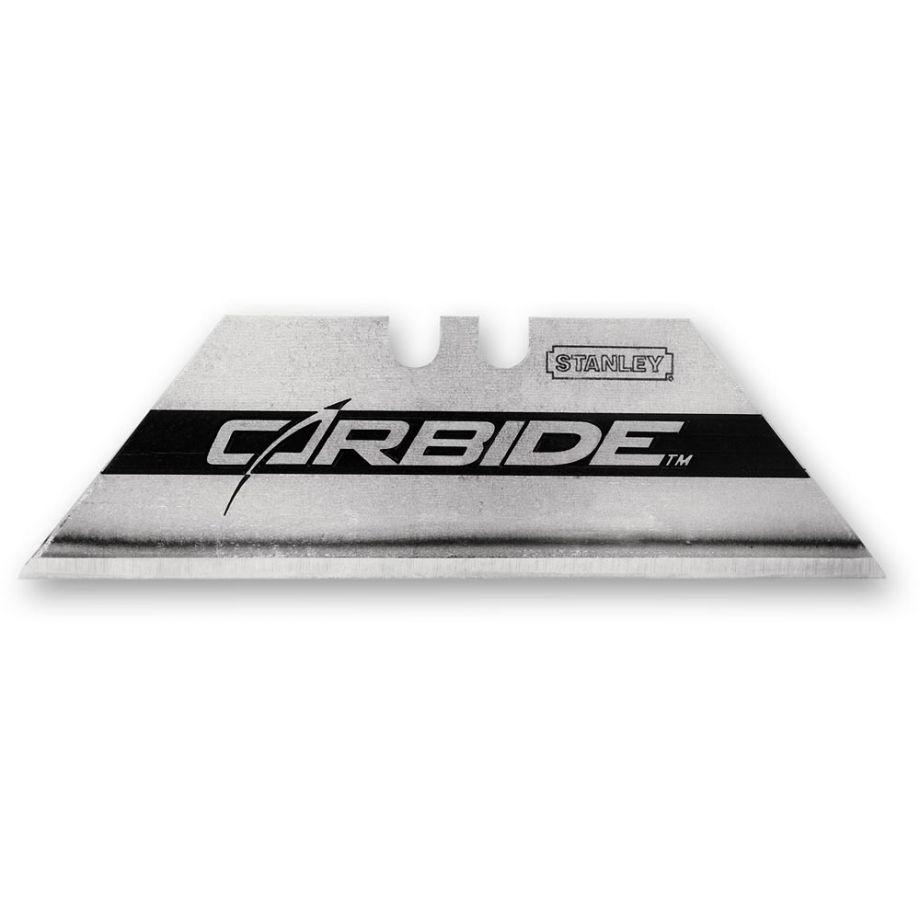
                              "Carbide Stanley Blades"


                              e.g. https://www.axminstertools.com/stanley-carbide-knife-blades-pack-of-10-136403

                              Have any of you tried them?

                              @Zan – But if I'm going to stop and sharpen them what would I need to buy? What exactly do you mean by a "very fine diamond hone"? How do you use them – is it time consuming? How long do they last?

                              @V8Eng – What exactly do you mean by "a rotary cutter"? What do they cost/where do you get them from (in UK)?

                              I've used those Stanley carbide blades, they're very good, though I've never used them repeatedly on the same material enough to give real analysis on how much better they are compared to normal Stanley blades, which are also good.

                              I would say they hold up a bit better than scalpel blades though.

                              Zan
                              Participant
                                @zan

                                Eze lap diamond hones. Availiable from many places on line  I used the red 600 grit, had it a long topime didn’t know if it was still available but just found out it is and about the superfine at 1200 grit  …..must get one!

                                Any cutting tool including kitchen knives which reflect light and the edges shine are blunt it’s the easiest and most common test Nothing as sophisticated as a samurai sword All edges are rather same, including milling cutters and lathe tools. Esp hs

                                Edited By Zan on 28/04/2021 00:22:02

                                Edited By Zan on 28/04/2021 00:25:34

                                #541927

                                In reply to: Milling Feed Speeds.

                                Zan
                                Participant
                                  @zan

                                  Sod, interesting. Your depth of cut seems a bit shy, but the rpm=. 10000/ cutter dia gives 1666 rpm, the presto data for slot drills gives 1592 rpm – very close. – with a feed of 0.023 mm per rev but only 73 mm/min . So your figures give a very good speed basis
                                  for a 10 mm cutter, yours, = 1000 rpm, presto 955 Feed 92mm/min So your easy calculation is sound, but gives a speed just a bit too high

                                  the recommended depth of cut is 1/2 diameter (slot drill diameter for end mill) but that of course depends on your machine. No probs in my Bridgeport, but too much for my Sieg sx2+ cnc conversion

                                  my numbers refer to an HSS cutter, for carbide, the numbers would be  3988 rpm   With 0.038 cut per tooth  = 285  mm/min.   So it seems the op quoted numbers are a quite a bit on the high side! As I also have seen from the vendor

                                  Edited By Zan on 27/04/2021 19:26:29

                                  Edited By Zan on 27/04/2021 19:30:32

                                  John Smith 47
                                  Participant
                                    @johnsmith47

                                    I don't know about 'proper' but I am using a cheap "Self Healing Cutting Mat A3" that I got from HobbyCraft

                                    https://www.hobbycraft.co.uk/self-healing-cutting-mat-a3/572007-1000?_br_psugg_q=cutting+mats

                                    Interesting idea to sharpen the surgical blades… but either way I am disappointed to learn that there don't seem to be any harder material available. Can't one buy them made out of anything more durable?
                                    e.g. Boron Nitride, Tungsten Carbide, Cermet… or even micro-diamonds for G*d's sakes

                                    OK a bit of further googling has revealed
                                    "Carbide Stanley Blades"


                                    e.g. https://www.axminstertools.com/stanley-carbide-knife-blades-pack-of-10-136403

                                    Have any of you tried them?

                                    @Zan – But if I'm going to stop and sharpen them what would I need to buy? What exactly do you mean by a "very fine diamond hone"? How do you use them – is it time consuming? How long do they last?

                                    @V8Eng – What exactly do you mean by "a rotary cutter"? What do they cost/where do you get them from (in UK)?

                                    #541881
                                    Zan
                                    Participant
                                      @zan

                                      8e04841c-83dc-4002-86ab-7bcde086b530.jpeg
                                       

                                      Grrrrr.  my photos are always upside down. After uploading No good. Deleted it from album, I rotated this upside down in my library and re uploaded it …. still upside down! How do I solve this?

                                      Back to the subject.

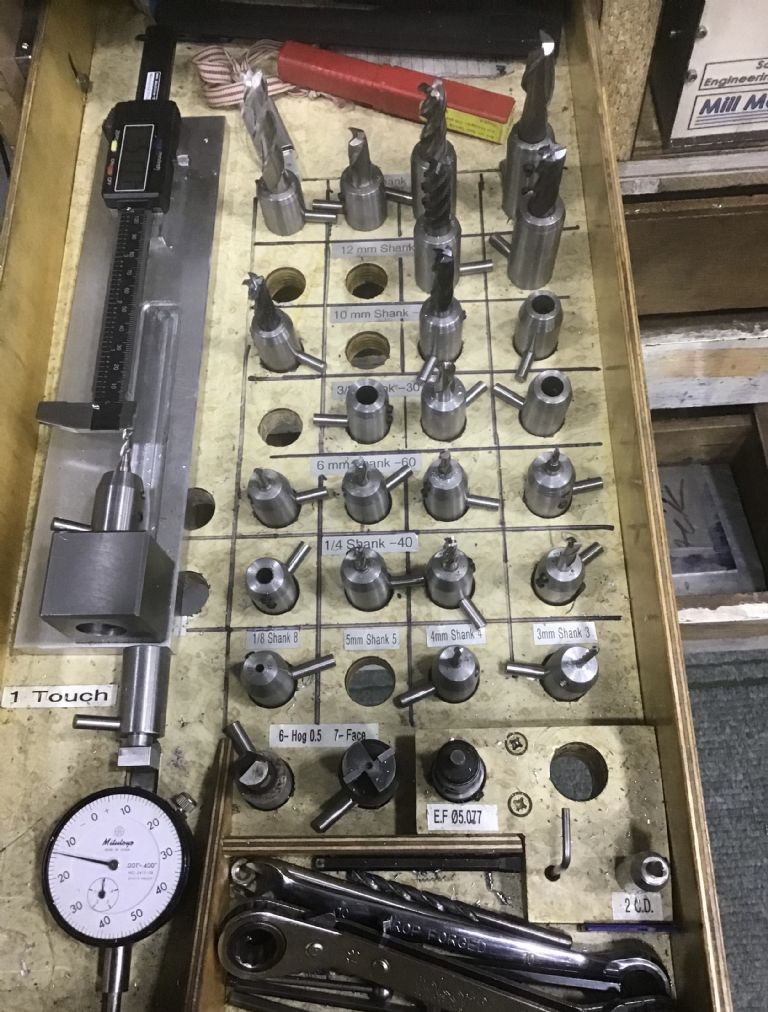
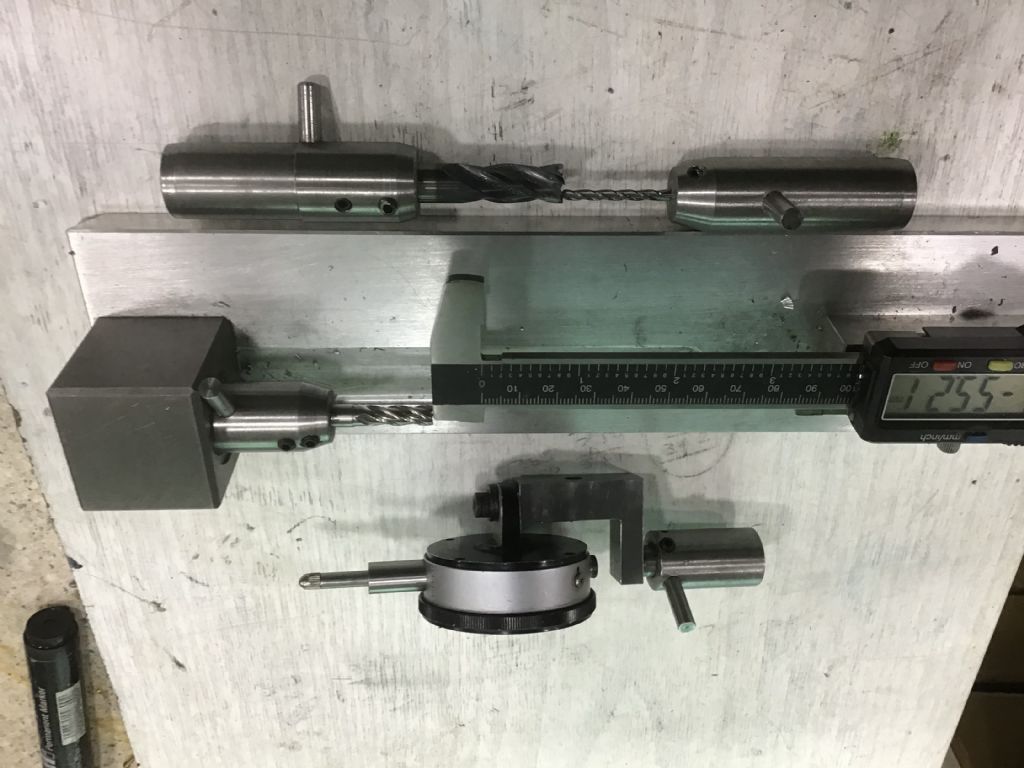
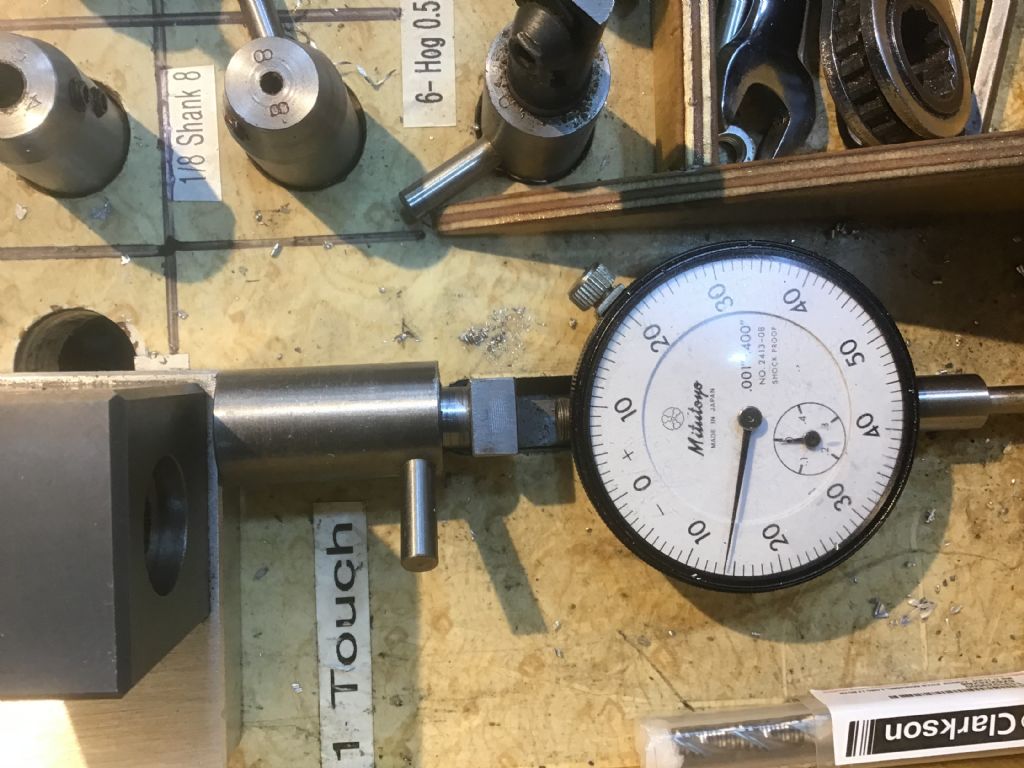
                                      The setting jig is a cheap calliper cut down and bolted onto a secured packing block to bring it to centre height. The tool is fitted (after zero in the caliper against the block) into an accurately machine 3/4 inch diameter hole in the cast-iron block. The offset is those directly shown on the calliper. In Mach 3 the setting tool is listed as being 115 long and is designated as Tool number one in the listing. To use insert the setting tool and jog down until the dial reads zero then simply the z axis. The tool shown in the photo is simply put into the appropriate position in the Mach 3 tool table and set up as being a length of 55.21mm as seen in the photo this enables it to be permanently set to a length and does not need checking again it is a very simple and robust system and is based on the Tormach method

                                      The   top photo shows my full tool drawer I did make it for 1/2} and 12 mm tools, but experience has shown these are very rarely used, and I intend to experiment with converting these to 6 mm and smaller, which is the range most often used, and at the moment my spare holder is getting too much use!

                                      In  the tool table, a 6 mm carbide cutter is found as tool no. 60  listed as  “6 slot cab 6A “  The 6 a refers to the tool position in the drawer   Drills start at tool 100 so a 2 ba tapping drill [4.1 mm) is tool no 141    While  a 10 mm is listed from tool 10 , 8 mm from tool 80 etc  the 70’ s are used for special use   A printout in a grid enables values to be recorded in pencil to allow changes and be used in the office

                                      this system makes it easy to switch between the desktop in the office where Fusion 360 sits and the off line  workshop 

                                      92d8bb92-f5ab-437d-8196-3c276dcc7f4b.jpeg  

                                      Edited By Zan on 27/04/2021 15:42:58

                                      #541869
                                      Zan
                                      Participant
                                        @zan

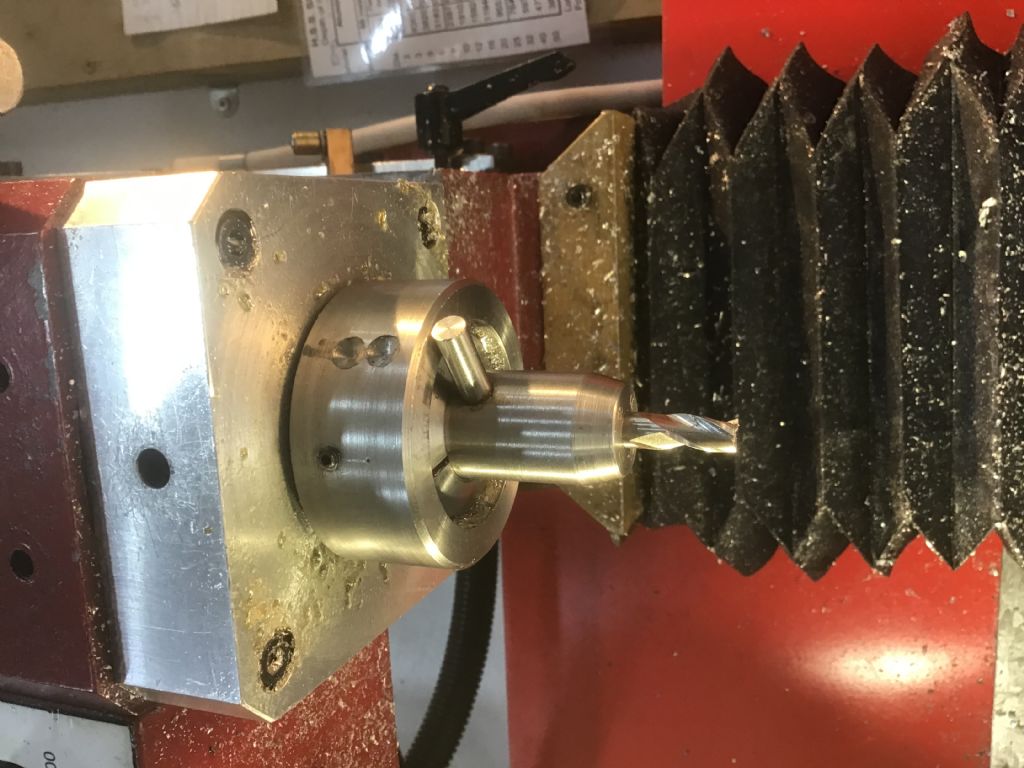
                                        For my cnc mill I use a 3/4” silver steel slug very carefully centred in a collet, then drilled and reamed fir the cutter

                                        the cutter is locked in place, then put into the R8 collet in the mill and tested to find the best position for minimal eccentricity tested on the Miller shank. Usually, there is less than 0.5 thou error. The holder at the very front is marked and removed from the machine for fitting a 7/32” silver steel pin pressed into a part reamed holedrilled at the front position . This controls the tool extension for adding into Mach 3 and thus the cutter orientation is always in the same position.

                                        0771fc09-5631-489a-b841-0813b391ca05.jpeg
                                         The pin locates onto a collar machined in situ on the spindle, used as the R8 collet does not have a flat face  the drilling seen indicate where to locate the pin  on the spindle collar 

                                        the height is set using the dti device which is set to exactly 115 mm  using a setting jig   I’ll add a photo later of this in action  

                                        my sx2+ Miller runs at 3400 max speed  due to changing things in the conversion, al detailed in a long series in ME about 4 years back  I haven’t noticed any vibration problems 


                                        369b6496-7ffe-4a43-a93c-2917dab55034.jpeg

                                        Edited By Zan on 27/04/2021 14:58:07

                                        #541861

                                        In reply to: Boiler barrel

                                        Zan
                                        Participant
                                          @zan

                                          Paul So u would need a barrel at the diameter of the smoke of size meaning a reduction of size and water capacity at the firebox cleading  would still need to be tapered for correct appearance and possible problems with top feeds ad s valves

                                          I understood the taper was about improving water circulation and reducing the diameter of the smoke box to allow even a short chimney to be within the loading gauge. Plus various other thermal issues

                                          edit…l blasted autocorrect!


                                          Edited By Zan on 27/04/2021 14:20:31

                                          Zan
                                          Participant
                                            @zan

                                            Use a diamond hone to resharpen

                                            They last for ever. I did this at school teaching A level graphic design. Saved me hundreds of blades a year. Even better  is at home where an Arkansas whet stone or leather workers type of lap ( leather strip charged with 4000 grit) to polish. Had one blade in for years

                                            Ps do you use a self healing cutting mat?

                                            edit…typo


                                            Edited By Zan on 27/04/2021 14:10:05

                                            Edited By Zan on 27/04/2021 14:10:53

                                            #541496
                                            SillyOldDuffer
                                            Moderator
                                              @sillyoldduffer
                                              Posted by Zan on 25/04/2021 10:02:35:

                                              Interesting link. So key points are

                                              pull rather than push


                                              hold close to the grinder as possible to the disc and

                                              regarding low speed. I found this

                                              “Since wear is cumulative over time, at lower speeds contact time during each revolution of the cut-off wheel is longer and thus wear is higher, resulting in shorter life.”
                                              And a more powerful grinder reduces wear probably due to reduced speed during cutting when using the weaker machine

                                              +1. I saw that too and the full quote may be helpful:

                                              'On average a 1250W tools delivers 30% longer life than an 800W tool. On a 1700W right angled grinder 90% longer life can be expected compared with the same wheel on an 800W tool.The theory explains. The power of a tool is an indication of how well the tool stays on speed under load. Low power tools will turn slower compared to a high power tools under the same conditions. Since wear is cumulative over time, at lower speeds contact time during each revolution of the cut-off wheel is longer and thus wear is higher, resulting in shorter life.'

                                              I think the idea running a tool slower to reduce wear is reasonable but needs looking at in the round. RPM is easy to measure and imagine, so perhaps we focus on it rather than power and torque, when the latter are actually more significant.

                                              I may be misremembering the rule of thumb for steel, but I seem to recall 'one cubic inch of metal removed per minute by one horsepower' as being broadly true of all cutting methods, whether drill, single-point, or grinding. The metal is held together by a certain energy which has to be exceeded to break it apart. RPM is only relevant in so far as energy is delivered effectively: a fine-toothed saw cuts best removing small quantities at high-speed low-torque, whereas a large-toothed saw is happier at slow speed, high-torque. The energy needed is about the same in both cases, and the motor has to deliver it. Unfortunately motors are imperfect, with power, torque and rpm curves giving differently constructed motors of the same 'power' distinctly different characteristics. Thus a single-phase motor has low torque at low speed, while a stepper motor has high-torque at zero rpm. The way my machine delivers a particular rpm may not be the same as yours. Could be all bets are off.

                                              As edge life is determined by how well the cutter material withstands heat, running a tool slowly could extend life by allowing it more time to cool-off. Unfortunately, if slowing down means the tool rubs rather than cuts, then the motor's energy heats the cutter up rather than removing metal, and causes rapid wear. So it's not just about rpm. Bad news if rpm drops because the motor can't deliver enough energy, good news if the rpm is matched to the material and the motor's ability to put energy into cutting. It's the match that matters, a combination of rpm, torque and power balanced between keeping the cutter cool and maximising metal removal, which depends on what it is. Of RPM, it's easy enough to identify too fast and too slow, but hard to decide the optimum. Several other factors have to be considered too. As Michael's link mentions: 'how well the tool stays on speed under load' is one of them.

                                              The paper highlights just how variable the performance of a simple tool can be on the job. Lab results reveal why tools and materials behave as they do giving solid information about starting points and adjustments, but the real world is always more complicated. Theory is far better than guesswork, but it's always worth experimenting for best results in the workshop. Don't draw general conclusions though. Workshops are poor laboratories because results often depend on local conditions. Results are only valid if others can replicate them.

                                              Dave


                                              Edited By SillyOldDuffer on 25/04/2021 11:40:02

                                              #541480
                                              Michael Gilligan
                                              Participant
                                                @michaelgilligan61133
                                                Posted by Zan on 25/04/2021 10:02:35:

                                                .

                                                regarding low speed. I found this

                                                .

                                                .

                                                Yes, that conclusion is why I posted the link … But the differences in speed discussed in that note are trivial compared with what John Smith 47 is contemplating.

                                                So … How far can we extrapolate the findings of the 3M investigation ?

                                                MichaelG.

                                                #540423
                                                Zan
                                                Participant
                                                  @zan

                                                  Ah so you don’t actually “drill” in the cam bit but use a virtual large milling tool in the triangular pocket which is too big to get into the corners ( which is used to fool the cam). I think the rest machining is designed to take out missing parts which the bigger.  Cutters can’t get into not used that yet, so many complex things in 360.  Not seen or used the “from previous “ more investigation,
                                                  thanks for that explanation. I’ll look at it on the desktop later
                                                  Thanks


                                                  ps keep your exploits coming!

                                                  Edited By Zan on 18/04/2021 19:43:33

                                                  #540359
                                                  JasonB
                                                  Moderator
                                                    @jasonb

                                                    Hi Zan, The correct waty to do it would be to draw as separate part that is the shape of what comes off the lathe and mill/drill and use that when you are doing the setup by selecting "from solid" rather than box or cylinder but as I do it a bit differently.

                                                    This is the part as it was ready to put on the CNC, the OD and sides have been machines, the width of the hub has been machined and the 6 holes drilled

                                                    Part as imported into F360

                                                    fw1.jpg

                                                    So the setup I used was a fixed size cylinder dimensioned as the actual finished turned size. I then did an adaptive cut to emulate the turning of the raised hub with 0.5mm radial stock left but zero axial stock left as I had machined the side of the rim to finished size.

                                                    fw2.jpg

                                                    I then did another adaptive cut selecting a large diameter cutter and left some radial and axial stock, by playing about with cutter/stock you can get a hole about the size you have actually drilled.

                                                    fw3.jpg

                                                    From there I did the actual adaptive cut I intended to use making sure to select "from Previous" in the ticked "rest machining" section of the geometry. I used a 6mm cutter for this 1mm max load, 4mm max stepdown 0.8mm fine stepdown.

                                                    Then the finishing cut was all done using scallop marking the turned surfaces as ones to be avoided.

                                                    When you come to do the post process you don't do it for the first two but just start with the 6mm adaptive and it thinks the earlier two have been done on the CNC not separately.

                                                    It takes longer to explain than actually do. Hopefully if you click here it will open up my CAM file in F360 so you can run the simulation and look at the various paths. There are two setups as the other side of the flywheel is slightly different so one setup for each side.

                                                    #540318
                                                    Zan
                                                    Participant
                                                      @zan

                                                      Hi Jason, I’m trying to do a small flywheel in 360 3” dia. I see in your video that the cutter goes round edges of the drilled holes and does not air cut . The cam cannot see these holes and thinks it’s a solid material so will try to cur them, not a problem nut all adds to the machining time. This would be easy in the ventricles 2d (which I now no longer use. Having to manually create contours) by just adding another circle on the face of the stock
                                                      as it’s impossible to add a hole in the blank in the design model where there’s no material, so there’s no hole edge to pick up how did you convince the cam to go round your holes???

                                                      Next Now that steep and shallow has gone from the free 360 version, what’s the best 3D cutting type. This is the first 3D Iv attempted, and all the path options in 360 seem to be very similar I have seen you using scallop, and contour I think so which is the best, I did see the discussion with regard to matching the tee piece

                                                      ps I did actually add a tube feature with a very thin wall , this seemed to work, but it’s very crude and I was wondering how you produced this bit of magic! The trouble with 360 is the bewildering no of options which can be confusing when it’s only used about once a week. It always seems to take so long to create the 3D design and cam strategy

                                                      thanks. Graham

                                                      Edited By Zan on 18/04/2021 10:26:56

                                                    Viewing 25 results - 176 through 200 (of 557 total)

                                                    Latest Replies

                                                    Home Forums Search Search Results for 'zan'

                                                    Viewing 25 topics - 1 through 25 (of 25 total)
                                                    Viewing 25 topics - 1 through 25 (of 25 total)

                                                    View full reply list.