Michael Gilligan
@michaelgilligan61133
Posted by Ady1 on 21/09/2021 23:11:31:
It's been no booze fags or petrol for years with vouchers
.
Last time I used a Waitrose voucher … my ‘basket’ included six bottles of decent Sherry
Not only did they honour the voucher, but they also honoured the bulk-buy offer … so I got one bottle free, and the discount.
Noting Duncan’s recent jibe on another thread: I don’t do much general shopping at Waitrose, but I do like a bargain [it tastes even better].
MichaelG.
.
Manzanilla Pastrana … if anyone is interested
Edited By Michael Gilligan on 22/09/2021 00:20:26
Zan
@zan
The Warco machine was too big for me, there just wasn’t the space for it, when I converted mine but it lis also a very capable machine and significantly heavier build but many of my details could be simply modified to fit this machine but the spindle max speed is a bit on the low side, I sped mine up to 3400 and that’s only just fast enough, you tend to use smaller cutters and leave the machine on its own ( or at least that’s the theory, as they are so fascinating to watch),!
Added. with a 3 k budget the Warco machine is too expensive
Edited By Zan on 16/09/2021 14:06:09
Zan
@zan
I covered the conversion of my sieg sx2p in ME 17 parts from 18 aug 18 To 22 nov 19. It covered problems I had with the basic machine , which we’re not difficult to fix , (the machine is very capable], mechanical conversion, adding ball screws, electronics using cnc for you components (Mostly simple point to point wiring), commissioning and examples of use
where are you based? Send me a pm if you like.
I think the problem with the Denford is the small envelope esp in the z axis. There are not many choices availiable for finished machines, I would not touch the emco machine because it has a m3 taper tarter than the R8 in the sieg. The other alternative is the tormach, 770 for a bigger machine or the 440 for something smaller. the problem with this is the cost of importing, although I understand there is a U.K. dealer being set up. I didn’t have the room for the 770, but do now alert the workshop was almost doubled in size. It takes a lot of z height when say drilling when you have sub tables and vices to consider.
Edited By Zan on 16/09/2021 14:05:00
Michael Gilligan
@michaelgilligan61133
Posted by Zan on 15/09/2021 13:22:18:
It may be only 1 watt, but I bet there’s a lot more than 100 mil televisions alone on standby at the moment Perhaps a lot more. Just work that out.
.
Sorry but that’s irrelevant to my observation of the 2010 poster
MichaelG.
Mick B1
@mickb1
Posted by Zan on 12/09/2021 14:07:04:
Soft jaws! Soft jaws and I repeat again!
….
Edited By Zan on 12/09/2021 14:07:41
Yes! Buy some! You'll never regret it.
Zan
@zan
Soft jaws! Soft jaws and I repeat again!
Or rough turn a top hat bush and slit it lengthwise a with a 1/16 saw.
Fill cut with brass strip,
Mount in Chuck carefully matking the position of jaw 1
bore to fit the castellated spigot
remove brass strip refit to marked jaw and forget your problems
this method will give far more accurate results than er chucks top hat bush needed for axial location. Perhaps long winded, but it will give the sort of results you cherish
Edited By Zan on 12/09/2021 14:07:41
DMB
@dmb
I had a double oven and grill by Hotpoint, fitted just 2.5 years ago with new kitchen. Main oven started smoking so knowing that the make is an 'also ran', if I got parts replaced under warranty, how long would I wait and how long would they last? I decided to make use of my Which? mags and selected a highly recommended Zanussi, delivered installed and tested by a local retailer who took away the busted one for free, normally charge £18. Very happy with the much better quality version.
Zan
@zan
Rocol mts 1000 I think is the correct stuff, but I ran out a long while ago. It’s a graphite grease supplied in a tube. Can’t find any now So grease I think will be ok but not on the main leadscrew, that would enable too much dross to bond onto it and spear the half nuts
Edited By Zan on 28/08/2021 11:44:11
Martin Kyte
@martinkyte99762
Posted by Zan on 15/08/2021 10:06:21:
You beat me! The cutter is locked when it hits the work piece causing it to rotate more slowly than the holder, thus screwing the collet taper out and locking against the cutter shank thus stopping further rpm drag
Yes if it's too loose but it still cannot move axially if it's up against the male centre in the body.
regards Martin
Zan
@zan
Stevi. , o had one like that, but the arms were too weak with little metal either sine of the adjusting screw. They bent in use when the screw was tightened. Useless went in the bin. Got a really decent one engineer built, from a secondhand stall at donny
Edit. The poor autotype……
Edited By Zan on 05/08/2021 21:23:55
Zan
@zan
Thanks Jason. Got it. That was very quick!
thread closed
Edited By Zan on 02/08/2021 19:28:00
Zan
@zan
Try some “Time saver lapping compound “ expensive, but outstanding performance and it’s non embedding so will not cause any long term problems. Google it
Edited By Zan on 29/07/2021 18:09:14
Ramon Wilson
@ramonwilson3
Doc,
All I have written above is based on my own experience both at home and at work and is one of caution and definitely not 'you are going about this the wrong way' as such.
Obviously others have used this form of clamping with success but personally I would not go about it as you have it so far. If you feel happy with following the instructions or Jasons and Zan's thoughts then follow that conviction.
I am not saying it will go wrong, only that it might and if it does it's too late.
If you decide to bolt it to a plate and rely on the bolts to take the forces you really still need to clamp the cylinder otherwise all your cutting forces will transmit through the JB weld adhesion and four 10 ba bolts. Much as I advocate JB weld, and, if it has bonded well, it probably will I would not rely on it in this specific situation.
Ramon
Dr_GMJN
@dr_gmjn
Posted by Zan on 27/07/2021 09:03:04:
Edit…..perhaps you should rely on the position of the feet holes as you seem to have positioned these very accurately setting these parallel to the lathe axis, then just centering at the headstock end
Hmmm yes perhaps it was a mistake to tap the bed holes. There is little room for adjustment within the milled pockets, even with clearance holes for the studs, and I’ve now got a disconnect between them and the cylinder axis, which itself needs to be a best fit to the flange O/Ds. So yes, I will put some short bar (or drill shanks) into the holes and check they are aligned (using a dial gauge) with the lathe bed before boring.
The instructions are a bit vague on all this anyway. It just says (after boring and machining the feet/holes) to assemble the pistons/cross heads, align on the bed and pop through to drill and tap “if you’ve not already done so”. It also mentions drilling and tapping the holes much earlier – when modding the beds – with no mention of cylinder lateral angular alignment at all.
This is why I did it as a have done – having a DRO on a mill seemed to make all alignments for the holes very easy, and enabled me to use the beds as a jig for feet fitting, whereas the instructions seem to assume no mill is available, and I doubt DROs were a thing back then (at least for the amateur).
I think the checks I did before bonding the feet are hopefully good enough, although no way will the wooden plug centre marks be within 0.010” – it was estimated by eye with a pointer.
And to Jason’s point: yes, the instructions show nothing but a piece of steel angle as a saddle clamp, with just two studs holding it down. That’s why I thought my initial method with flat steel, paper packing and four studs might be ok. The number of sliding interfaces did always concern me though.
Dr_GMJN
@dr_gmjn
Posted by Zan on 27/07/2021 09:43:17:
Ah. Your beginner status shows again, but Iv been following your posts and your level of skill is impressive!
t bar, a very long t nut with tapped holes for the studs. Mine for the S7 are 4,2 and 1 inch long with holes tapped every .5” or so they spread the load and minimise the risk of damage. Also be careful the x slide is not bent when the clamps are tightened too much. I’ll provide a sketch of the clamping outlined above if you didn’t fully get it
Thanks Zan – yes I understand. I get the basics, and am happy to take time to get things right, but sometimes something just seems a bit wrong and advice is very welcome.
Dr_GMJN
@dr_gmjn
Posted by Zan on 27/07/2021 09:13:14:
The problem with a strap clamp like yours is that all the down force could be on a single pimple point on the valve face, thus you only have in effect one clamping point with a very high force on it. This makes them a bit of a problem compared to 4 clamps . Do be certain to use t bars not t nuts or there is a real risk of breaking the t slot in the cross slide, there wupill be considerable force on them
Edited By Zan on 27/07/2021 09:14:38
Thanks Zan, what's a T-Bar?
Zan
@zan
The problem with a strap clamp like yours is that all the down force could be on a single pimple point on the valve face, thus you only have in effect one clamping point with a very high force on it. This makes them a bit of a problem compared to 4 clamps . Do be certain to use t bars not t nuts or there is a real risk of breaking the t slot in the cross slide, there wupill be considerable force on them
Edited By Zan on 27/07/2021 09:14:38
Zan
@zan
How about a short turned plug in the feet, then clamp each down with a long stud stud, clamp bar sat on packing
then add additional clamp bars to the same stud but longer bars going outside the lower clamps, so you now have 8 clamps using 4 studs There would be room in the centre for a strap clamp as well
it has the additional benefit of making the clamp positions wider on the casting thus removing the tendency of twisting
with regards to the feet fixings, I think it’s a mistake to tap the holes in the base. The wood plug cantering is very inaccurate and could easily be 10 thou out at each end, thus the bore is angled relative to your base fixings. The easy way is to spot through accurate fitting using plugs in the finished cylinder with reamed holes and a straight bit of silver steel as a pointer. Set this up on the bed, clamp in exact position then tap the base holes. You may find that to correctly align the cylinder ot will need some small rotation so the feet holes will need to be pulled over to allow this . I hope not
Edit…..perhaps you should rely on the position of the feet holes as you seem to have positioned these very accurately setting these parallel to the lathe axis, then just centering at the headstock end
Edited By Zan on 27/07/2021 09:04:08
Edited By Zan on 27/07/2021 09:08:09
JasonB
@jasonb
Zan, see this thread from Friday. It is being dealt with.
Both available on this site just numbers are the wrong way round.
Emgee
@emgee
Zan
Perhaps someone on the iO group will clarify the details.
The reason behind my note on the picture is that the gear driving pin is held in the indexing end and as the gear is at the rear of the engine No.1 cylinder is at the prop end so must be as shown.
Emgee
Edited By Emgee on 24/07/2021 14:56:44
Emgee
@emgee
Zan
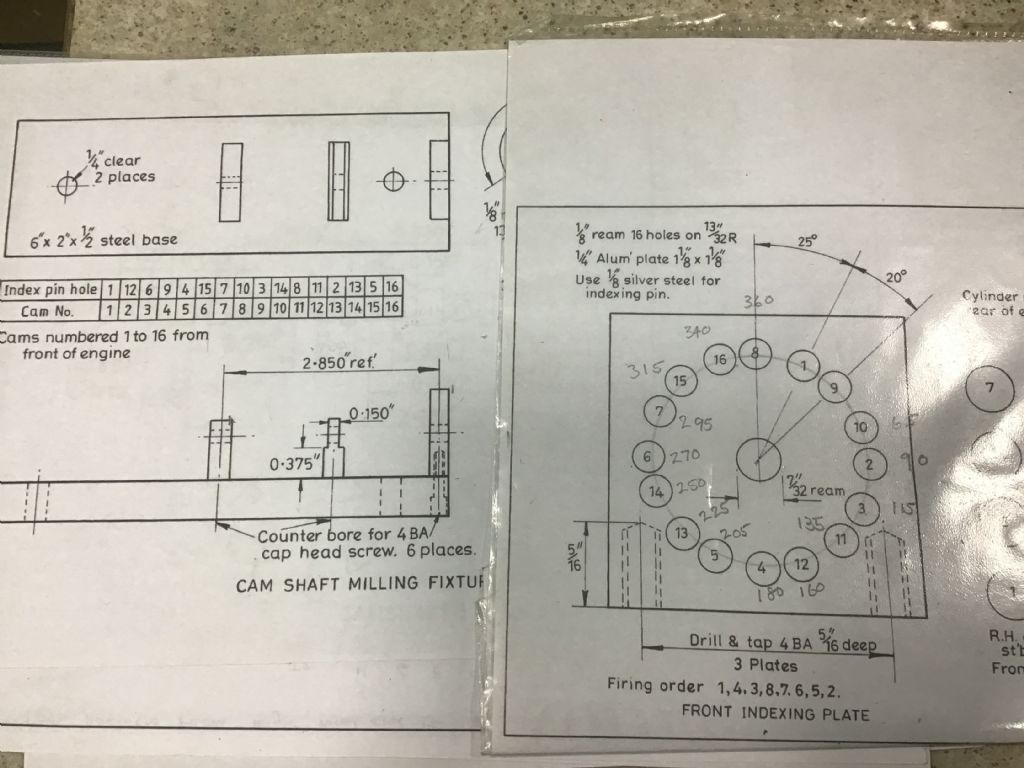
The 3 plates were clamped as one when drilled and reamed to make sure the bearing bores were aligned, all indexing was done at the front as detailed by Eric in the write-up.
Emgee
Emgee
@emgee
Zan
Are you a member of the Whittle V8 engine build group on iO ?
If not advise you join at the following link, lots of info on that group from people who have completed the build.
**LINK**
Emgee
See note on my picture, cannot confirm this is correct though.
Edited By Emgee on 23/07/2021 14:19:16
Zan
@zan
I’m at the stage of preparing to make the camshaft, but need to make the machining fixture and a travelling steady, Iv had the casting for 20 years…. Here’s the problem
The photo shows the drawings. Whittle does not fully explain in his notes about the fixture. (Me July 95 #82) The indexing wheel is fixed to the back of the camshaft , his photos of machining it show this at the right on the Miller. However the drawing states only the “ front indexing plate” so is this a view on the END of the fixture OR the view from the Front of the engine/camshaft. I think it’s the former but if I am wrong the engine will run backwards or not at all
Any guidance from anybody who has actually got the engine running would be much appreciated.
Edited By Zan on 23/07/2021 12:35:14
Graham Meek
@grahammeek88282
Posted by Emgee on 22/07/2021 13:45:18:
All of the Emco 5 cnc lathes I have or had needed the small end of the MT2 arbor reducing in diameter to fully enter the spindle, seems they were built to accept a shorter length taper.
Emgee
Hi Emgee,
It is funny you should say that, as I spent ages getting a set of No 2 Morse Collets that did not disappear into the spindle. Those I have of Eastern origin, which I use on my 2/3 rds Quorn, all go in too far. While a set I bought made in the USA, and are years old, do not.
I must therefore urge Geoff on the side of caution if going down this route. The problem could be overcome by using a sub-plate screwed to the spindle nose and bored through No 2 Morse. This would ensure maximum concentricity and it would not need to be the entire length of the Morse taper. Just sufficiently long enough for the working portion of the collet.
This approach could be extended to suit other collets, provided the collet draw tube will enter the Compact 5 Spindle.
Regards
Gray,
Emgee
@emgee
All of the Emco 5 cnc lathes I have or had needed the small end of the MT2 arbor reducing in diameter to fully enter the spindle, seems they were built to accept a shorter length taper.
Emgee


 Michael Gilligan
 Zan
Zan Mick B1
 DMB
DMB Martin Kyte
 Ramon Wilson
 Dr_GMJN
 JasonB
 Emgee
Emgee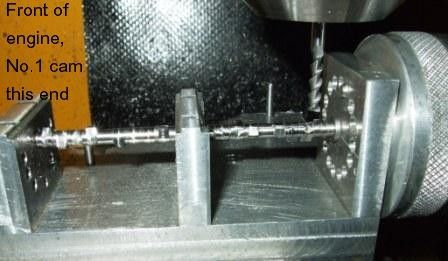
 Graham Meek
 starjump
  Greensands
  noel shelley
 Andrew Tinsley
  Huub
Huub Grizzly bear
  Mark Easingwood
 Bill Phinn
  COLIN MARTIN 2
  Michael Gilligan
  old mart
 James A
  Emanuel Hernandez
 bjcolyer
  bernard towers
 Pixel_Porpoise
  Roderick Jenkins
 larry phelan 1
  mgnbuk
 Carl Farrington
  JA
JA Barry Smith 4
  tatler
  JasonB
 chris1984
  David Senior
 Nigel Graham 2
  mfengine1
  Turbine Guy
  duncan webster 1
  Martin Johnson 1
 Dave Wootton
 Sonic Escape
  Andy Stopford