Matt
I don't think you will get an optical type scale that will fit in the space available.
I have a WM16 and fitted this type from Arceurotrade (I had already fitted them to the X & Y axiis):
I used the 150mm one and cut it to fit.. The display that comes with them is no better than the one already fitted to the mill, but you can mount it in a better place.
I actually replaced the displays with an Android tablet using the TouchDRO app (https://www.touchdro.com/) and a homemade interface circuit.
Photos are in my album 'Mill DRO'.
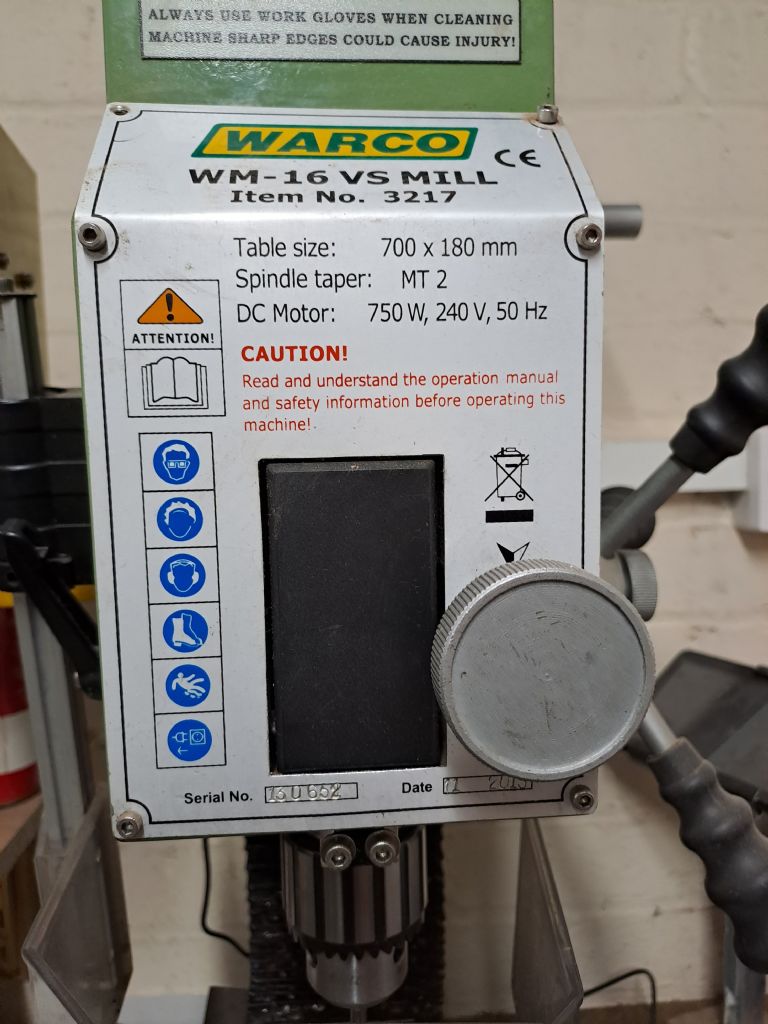
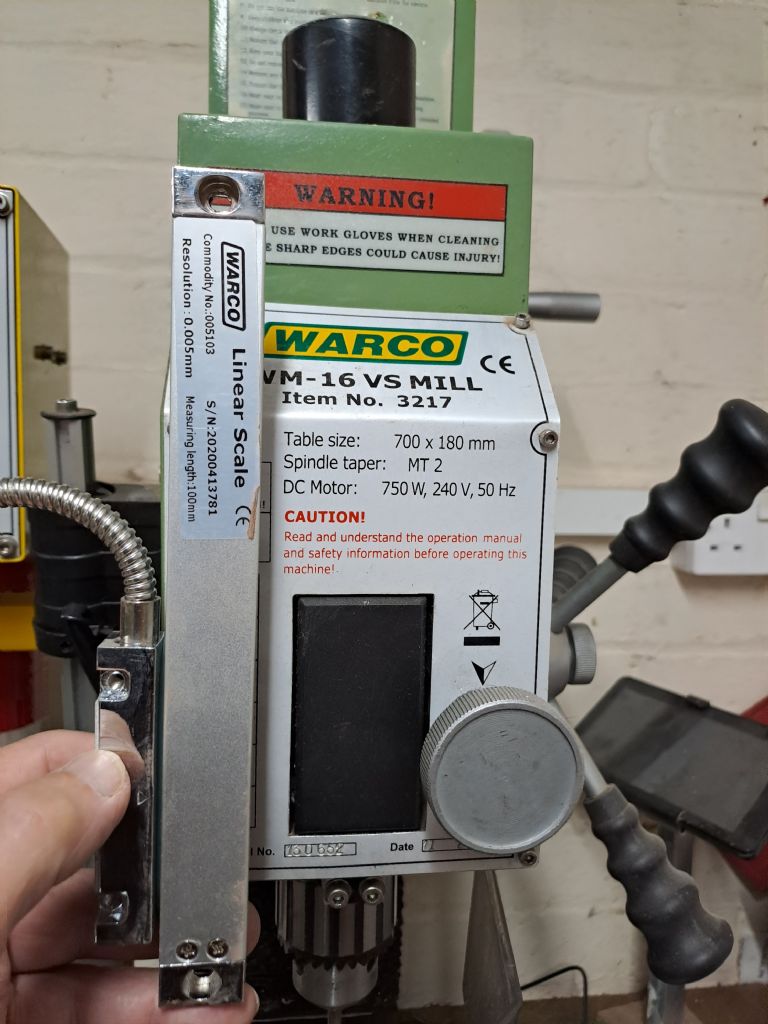
If you want an optical scale to match an existing DRO system, I have taken a couple of photos of the smallest one that Warco do (100mm travel). You could make up some brackets to mount it in front of the existing readout.
Stuart
Edited By Stuart Smith 5 on 22/05/2023 00:10:22
Wayne,
If you have a grand spare the Arc Seig mill bundle will start you off. Anything cheaper is a toy and will disappoint.
Less spendy are the secondhand belt drive round column type mentioned by Clive that look similar to the current Warco Major WM50. They were made in 3 sizes back in the day when Warco sold all three, they called them Economy (1/2hp), Minor (1hp) and Major (2hp). The Major was and still is enormous for a bench mill needing 1sqM of space and has been sold under various names. This is an Axminster version
The Minor is probably the best size, your problem will be fetching it yourself and making sure it has all the handwheels intact.
How much space do you have? And what do you want to do with it?
General rule with machine tools is bigger is better unless specialising in small work. It's because big machines can usually do small work, albeit uncomfortably, but small ones can't do big.
Anyway, assuming you're after a mill that will sit on a bench, there are various options.
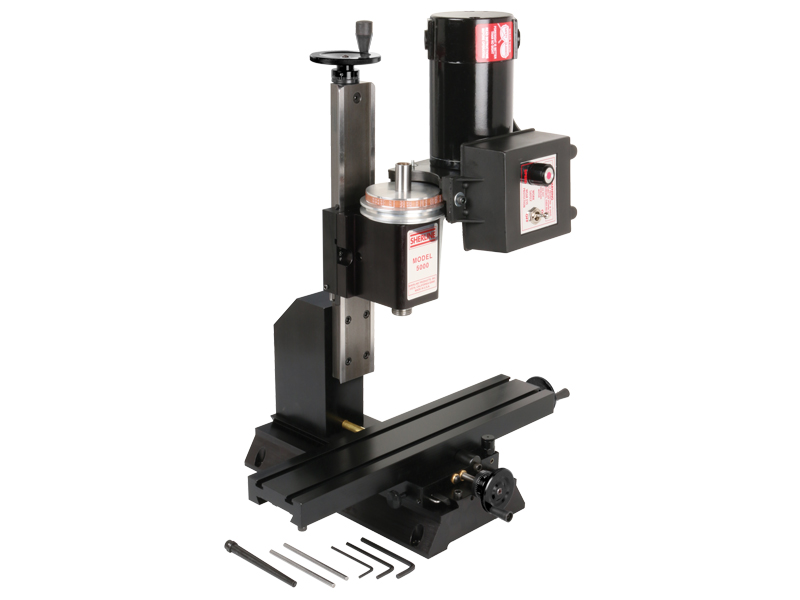
One of the many attractions of clockmaking is that the equipment doesn't take much space, and is clean and quiet enough to be done indoors: box-room, or under the stairs etc, Same applies to small-stuff hobbies like jewellery, model-railways, and makers adding modest metalwork to 3D printed items. The Sherline Mill is popular for this scale of work:

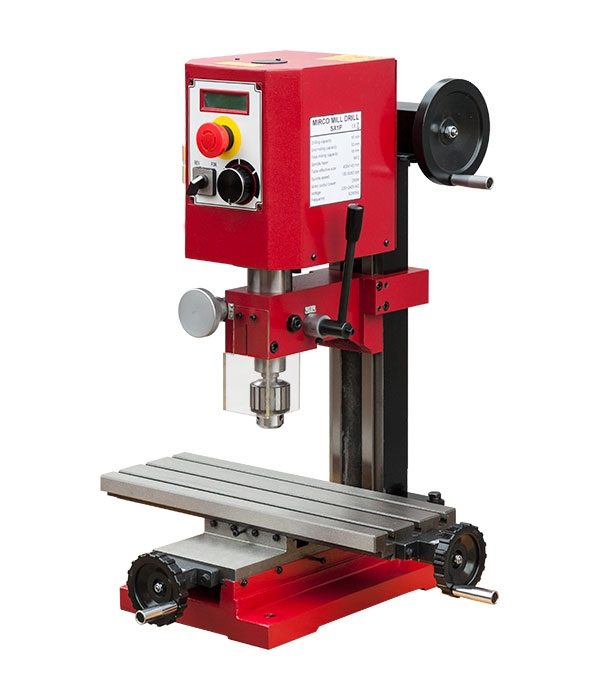
Or, bit bigger, a Far Eastern micro-mill, this example is sold by ArcEuro, an SX1LP, weight 50kg:

The micro-mill is first in a series of similar machines, each bigger and more capable. From Warco, the WM12 (weight 54kg), WM14(60kg), WM16(113kg), and WM18 (220kg) Of these, I think the biggest I would put on a bench is the WM14. A WM18 is much too big.
Although the WM12 and SX1LP are similar, there are reasons for preferring one over the other. For instance, the SX does high RPM with a less powerful motor. This may be exactly what's wanted on a small milling machine. Small cutters work best at high-rpm, so with a 2mm diameter drill in the chuck, an SX should do better than a WM12. However, if the mill routinely tackles larger work (still small), I'd expect the WM12 to win, because it's more powerful motor can also manage the lower rpm needed. With a 6mm drill in the chuck, the WM12 has the advantage. Both machines will do the job, but they're not identical.
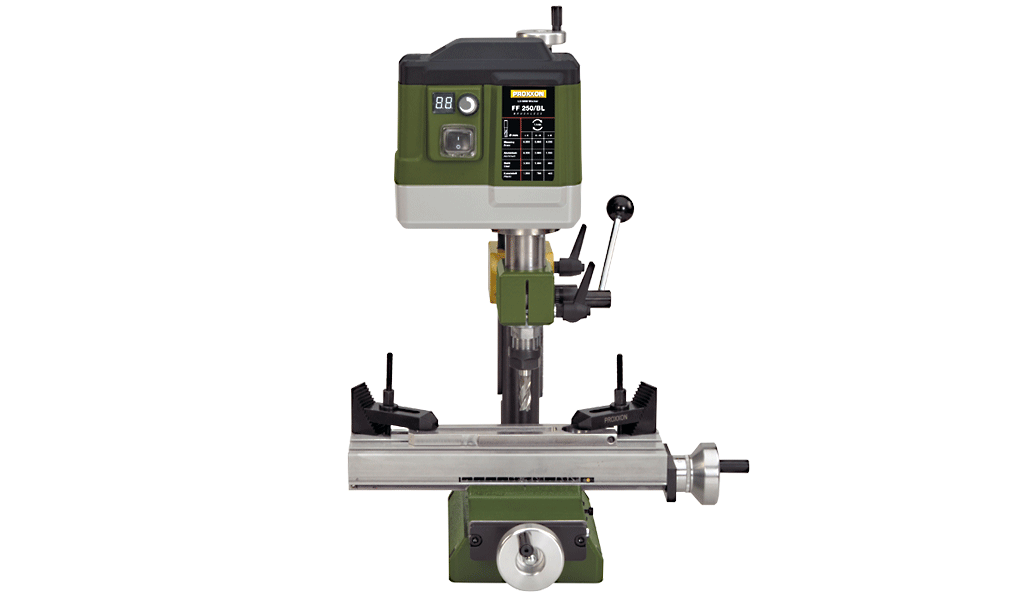
Proxxon sell a micromill too:

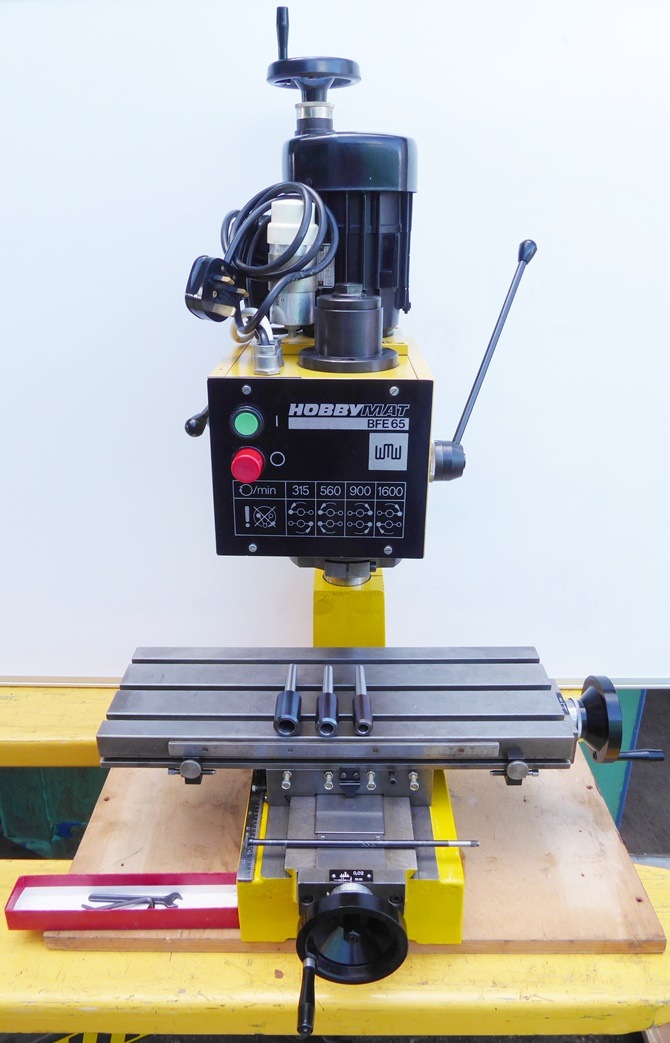
There are second-hand possibilities too, but with these condition is everything. This example is a Hobbymat:

Ought to say affordable small milling machines get mixed reviews. I suspect the problem is they have to be operated carefully within their limitations. They're not powerful or rigid, so anything remotely heavy handed will cause trouble ranging from low accuracy, to cooked electronics and burnt out motors via stripped gears! Patient delicate cutting rather than showers of red-hot swarf!
Can you say more about what the mill is for? Clocks and motor-bikes are very different.
Dave
I have a Mini Mill, it doesn't take up much space. A larger and heavier bench milling machine means you can handle larger work and take heavier cuts. Get a milling machine as large and heavy as you can find space for.
Have a look at Arc or Warco to get info on various machines. I upgraded from the Mini Mill to a larger machine.
Thor
David Heath, 1
Look at the Arc Euro Trade website, for a replacement motor, and other spares..
The CL300 is a mini latrhe made by Sieg, whichi was sold. by Arc as the C2 or C3 (Depending on the centre distance ) They can probably supply other spares, and will give you good advice, which might be lacking from Machine Mart in my experience.
The same lathe, in adifferent colour scheme may be available from Chester Hobby Store, or from Axmister.
Howard
You can also get these:
Despite the stuff about being for non-ferrous metals they actually perform very well on steel, especially the free-cutting variety,
The rake geometry limits depth of cut to about 1mm, but you can take very fine (0.01mm) finishing cuts. They work well at high and low speeds.
They will withstand cast iron but wear quite fast.
I use them all the time.
My workshop is in an internal garage that is shared with camping equipment, freezer, washer and dryer so I had similar space issues.
My Sieg SC3 lathe purchased from Arc Euro a few years ago has been ideal for the smaller space I have at my disposal and has always sat happily on a drawer cabinet so I have storage space underneath it and unlike more traditional lathes has not demanded a matched stand to maintain alignment which would probably be less space efficient.
Regarding your comment about a milling machine I have a Seig SX1L from the same sellers and while it is adequate within its capacity, said capacity is not that great – but it is the largest machine I have space for. I am fortunate in that I have access to larger milling machine through my club and on reflection not buying the SX1L would have given me more bench space that is now at a premium. It is convenient to have your own equipment though!
I think I should heartily recommend from direct personal experience the Seig Lathe as a starting place and see if a vertical slide will do any milling you require – and joining a club with a workshop with larger tooling available is never a bad idea.
Nick
PS I have just remembered that the local Man's Space here in Birmingham has a larger mill and lathe which could be an option but in the end I decided not to join – the model engineering club has a track (my main interest is locos) and also is considerably cheaper.
Many thanks both. I've dug out some brass shim stock (assuming that will be OK), and will try to attack the mill with a torque wrench in the next few days.
I spent a bit of time adjusting the wedged gibs and got the X and Y axes to a good point (just a little drag, but still moving smoothly).
I also managed to get the Z axis gib wedge sufficiently tight, but only by removing the bottom gib screw. Removing the wedge I see it's 180mm long (the same height as the head); so there's not a lot of adjustment with the gib screws fitted. Interestingly I see Arc's spare part (https://www.arceurotrade.co.uk/Catalogue/Machine-Spares/SX27-Mill-Spares-All/SX27-Mill-Spares/SX271-68-Z-Axis-Gib) is 240mm long; so that does reinforce Jason's earlier comment about them needing to be trimmed down to fit. Looks as though the one I have needs about 10mm taken off the bottom and I think it'll snug up with both gib screws fitted.
ARC ones are all 150mm x 5 x incremnt.
Warco are smaller at 100mm long and only go upto 24mm tall which woyld leave you a bit short if wanting to hold shallow work in say a 100mm vice as the jaws on them are typically 38mm high.
I edited my post to include the correct set, so comparing Arc 100mm to Warco 100mm
…
Wouldn't surprise me if they were identical from the same factory, or from different continents. Parallels aren't difficult to make and they're not protected by a patent. Anyone can produce them. Though I own a set for convenience, I've milled a few of my own to get just the right size.
My bought set were made on a grinding machine. These are very common in industry worldwide, and accurate when adjusted correctly. However:
For this class of item, it's cheaper for everyone to let the customer to detect errors and let the retailer refund or replace. Refund/replace is always a nuisance, extra difficult if the seller is abroad, and the system breaks if the customer buys from a dodgy supplier.
It also winds customers up, particularly those convinced inexpensive tools should be just as good as their top-of-the-range equivalents. In the real world, the cost difference can't be ignored: there's a reason top-of-the-range tools are expensive. It's the cost of ensuring they really do meet a specification, so a 'time is money' customer doesn't waste time sorting out even a percentage of iffy tools.
My set happened to come from Warco, and all the parallels are correct. I didn't expect Warco to guarantee the set would be acceptable on delivery, but I bought confident that they would replace or refund if there was a problem. And in practice, buying from Warco, only one purchase has ever gone wrong, and they replaced the item. Arc Euro have never fouled up, I think because Ketan knows his stuff and puts extra care into purchasing. I don't expect perfection from ArcEuro either, but in the event a dud arrived I'm sure they would refund or replace. Tracy Tools haven't dropped the ball yet either. I've bought successfully from several other UK vendors, but not often enough to find out how well they perform when a purchase goes wrong!
My experience at Shows and buying cheap off the internet has been less happy. Internet 'bargains' I see as a gamble, and I usually win. No tears if the 'bargain' turns out to be anything but, I knew it was a risk.
All my worst junk came from shows. At these, the distance buying regulations don't apply because purchasers can check the actual item. For example, I bought a box of cheap carbide inserts and found later they were rejects. Not a complete waste of money because they all had at least one correct edge, but I kicked myself! My fault – the box had a clear plastic lid, and all I had to do was look.
There's no law that show bought stuff is always rubbish, my best bargain purchases all came from shows. And this is true of all purchases, the buyer always has to apply due diligence and manage expectations.
Dave
Edited By SillyOldDuffer on 15/05/2023 08:55:17
Thanks, excellent answer.
Is it ok to stack them. Ie a 20mm high one with a 5mm high one
ARC ones are all 150mm x 5 x incremnt.
Warco are smaller at 100mm long and only go upto 24mm tall which woyld leave you a bit short if wanting to hold shallow work in say a 100mm vice as the jaws on them are typically 38mm high.
I edited my post to include the correct set, so comparing Arc 100mm to Warco 100mm
…
Wouldn't surprise me if they were identical from the same factory, or from different continents. Parallels aren't difficult to make and they're not protected by a patent. Anyone can produce them. Though I own a set for convenience, I've milled a few of my own to get just the right size.
My bought set were made on a grinding machine. These are very common in industry worldwide, and accurate when adjusted correctly. However:
For this class of item, it's cheaper for everyone to let the customer to detect errors and let the retailer refund or replace. Refund/replace is always a nuisance, extra difficult if the seller is abroad, and the system breaks if the customer buys from a dodgy supplier.
It also winds customers up, particularly those convinced inexpensive tools should be just as good as their top-of-the-range equivalents. In the real world, the cost difference can't be ignored: there's a reason top-of-the-range tools are expensive. It's the cost of ensuring they really do meet a specification, so a 'time is money' customer doesn't waste time sorting out even a percentage of iffy tools.
My set happened to come from Warco, and all the parallels are correct. I didn't expect Warco to guarantee the set would be acceptable on delivery, but I bought confident that they would replace or refund if there was a problem. And in practice, buying from Warco, only one purchase has ever gone wrong, and they replaced the item. Arc Euro have never fouled up, I think because Ketan knows his stuff and puts extra care into purchasing. I don't expect perfection from ArcEuro either, but in the event a dud arrived I'm sure they would refund or replace. Tracy Tools haven't dropped the ball yet either. I've bought successfully from several other UK vendors, but not often enough to find out how well they perform when a purchase goes wrong!
My experience at Shows and buying cheap off the internet has been less happy. Internet 'bargains' I see as a gamble, and I usually win. No tears if the 'bargain' turns out to be anything but, I knew it was a risk.
All my worst junk came from shows. At these, the distance buying regulations don't apply because purchasers can check the actual item. For example, I bought a box of cheap carbide inserts and found later they were rejects. Not a complete waste of money because they all had at least one correct edge, but I kicked myself! My fault – the box had a clear plastic lid, and all I had to do was look.
There's no law that show bought stuff is always rubbish, my best bargain purchases all came from shows. And this is true of all purchases, the buyer always has to apply due diligence and manage expectations.
Dave
Edited By SillyOldDuffer on 15/05/2023 08:55:17
ARC ones are all 150mm x 5 x incremnt.
Warco are smaller at 100mm long and only go upto 24mm tall which woyld leave you a bit short if wanting to hold shallow work in say a 100mm vice as the jaws on them are typically 38mm high.
I edited my post to include the correct set, so comparing Arc 100mm to Warco 100mm
My vice jaws are 100mm long by 32mm high. So in fact neither set would suit as the 20 pair set only goes to 24mm and the 14 pair set goes to 50mm which seems waste
This is the vice I use, the 100mm one
Edited By petro1head on 15/05/2023 07:17:46
Thanks guys
In my orgional post i linked to two sets that look very similar, one from Warco and the other from Arc. To me they look the same, am i missing something?
Edit, the set from Arc was the wrong link, this is the set i was looking at Here
Edited By petro1head on 15/05/2023 06:50:31
Further to my posting on this thread the day before yesterday concerning the time taken for postal deliveries, I ordered some items from Arceurotrade early yesterday afternoon and they arrived through my door by 1330 today. I am amazed at how quickly the package arrived, firstly congratulations to Ketan and his staff in turning round the order so quickly and secondly full marks to Royal Mail for an exceptional service. In respect of the main thread of this posting and the removal of free postage from Arc when over a set spend I have no problems with that , businesses are under a lot of pressure nowadays, costs seem to be for ever increasing. Dave W
Or get a set of Stevenson Collet Blocks? No octagonal option though…
Just to complete this tale, in case anyone searches for it in the future.
It now seems to be working OK and gives repeatable readings to a couple of tenths.
The sliding ring, with the tenths vernier, is on a ball race somehow attached to the main thimble;.
It locates in a groove along the main body's tubular thimble housing, via an internal plastic washer with two opposed lugs, which is able to be expanded with a small hooked tool, in my case a dental probe.
This allows one to take up any rotational slack on the sliding ring.
As mentioned above, the main thimble is on a double start thread with a 100 thou pitch, so one full rotation moves 1/10", i.e. four times as fast to adjust as a conventional imperial micrometer, which is 25 thou per turn.
When re-assembling, it seems to be pot luck as to whether the mic reads zero or 50 thou out; if the latter, just unscrew again until you feel the thread jump to the other half.
The main outer sleeve of the thimble, with the 100 graduations slides on the inner threaded part to allow alignment with the 10 divisions on the main body.
It's adjusted by screwing in a threaded plug down the end of the thimble.
I made an adjuster/plug out of brass hex, 7mmx 0.5mm pitch external, and drilled/tapped M4 threaded internal, so I could use a spare Allen screw I had in stock; I dropped a small ball bearing down the hole to act as a point contact.
With suitable padding and a small G clamp, the outer thimble sleeve could be slid inwards slightly too far, and then adjusted back to the correct position with the threaded plug.
The fine adjustment is the inner sleeve on the main body which rotates with a conventional micrometer C spanner.
It seems the imperial ones are no loner made and quite sought after.
Metric are still available, but the price is a bit scary, at about €500
https://trabiss.nl/shop/tesa-etalon-microrapid-226-micrometer/
See also this pdf for comparison with the TesaMaster, which seem to be priced as POA, so also probably beyond most of us new.
https://kyocera-unimerco-assets.com/api/DataSheets/TESA_C4_en.pdf
Bill
Id you can measure any of the changewheels, you should be able to calculate the Module (This assumes that the lathe is of fairly recent manufacture.
Neasure the OD in mm, and count the teeth.
(Tooth Count +2 ) X Module = OD Thus a 40T Mod 1.5 gear would be 42 x 1.5 = 63 mm OD.
The chances are that someone else, like Chester, Axminster, Arc Euro, or Amadeal might be able to supply a set of changewheels.
One of the gear specialists, such as Davall, or Reliance could supply, in more than one material, Probably Ny;lon, brass or steel, and would require bushing or boring to suit your lathe.i, (You would have to sepify the tooth count and Module ) but at a price
Howard
Edited By Howard Lewis on 09/05/2023 12:48:30
If you do buy new, what about more “big greens”, i.e. your Warco GH1322 that you talked about last year? Did that ever get going again?
*If your department do end up selling off the Boxfords, can I be in with a shout?
Big Green is doing well. To be perfectly honest, for a twenty year old machine, with the exception of a little backlash (no more than I would expect and far less than the far older Boxfords) I really have nothing to complain about. I never did get the change gears that I asked about last year, the only supplier I could find wouldn't sell to us because they were in the process of shutting down and wouldn't or couldn't process payment. The gears themselves are quite expensive from Warco, but I hold out hope that I'll be able to convince those in charge to purchase a set.
Our service engineer was about 30 I would say, although the guy we had last year (in his 40's I would guess) expressed much the same opinion. I appreciate it's a diversive topic about which people are rightly passionate, but I apologise for rattling any cages, it was not my intention.
My continued thanks for the wealth of infomation coming out here. I will definitely follow up on the possibility of having these lathes refurbished, that would be a good solution, although I wouldn't be surprised if it transpires that it is an expensive option.
It appears from following up on everyone's leads that there are a wealth of options for new lathes in the £3k-£8k bracket. Many are definitely or probably Chinese in origin (for whatever that matters) but others such as Cormak and Ajax seem to hail from Europe (again, if that matters).
I think on reflection that a gearhead lathe would indeed be preferable to a variable speed, I can see how the urge to twiddle a speed knob might be irresistible but I've yet to see any student show any interest in, let alone fiddle with the selectors on the Warco or the Harrisons in the other workshop.
Yes it is, but remember these are specialist products widely used in industry for a miriad of different tasks. For the very general use you seem to be looking for just choose a basic thread lock. See any supplier website* for simple suggestions.
Also note there are numerous generic versions which are often cheaper and do the job. Don't get bogged down with data specs or you'll get thoroughly confused.
*e.g. search for 'adhesives' on the ARC Eurotrade website
Edited By Mike Hurley on 08/05/2023 11:18:02
I recommend the ARC Euro "versatile" vices Jason shows above. The 100mm suits my WM16 fine, although maybe a little on the tall side for a WM14. While some of the other ARC machine vices are lower, some need custom made clamps to utilize their full potential.
I am thinking ahead as much as I can. Just put an order in for some cutters for the Farm boy as well as one for the rob roy later on. (they did not have the size I wanted)
With the farm boy I need to round over some of the edges on the Ali parts of the build, would it be possible to use a wood router bit for this operation I have some HSS ones as well as TCT tipped ones.
If this is possible it will save having to order from a different company yet again.
It just seems as when ordering bits and pieces I have to order from many different companies instead of ordering from just one.
I know Arceuro have a metric cutter which would do the job so if push comes to shove I will order that one but that will be yet another postage cost just for a small item. I do try to reduce postage and bulk things together.
Edited By Dalboy on 06/05/2023 11:15:31
The following might be of interest. Backplate fitting
This is downloadable pdf article from a trusted source (Arc Eurotrade) who show this on their website page that features backplates and is a article from a back issue of MEW.
Hope it helps, Mike
Hello Mick H and others following this thread,
Had an interesting response from André Santos- Tomé Fèteira this afternoon, which I would like to share:
—————-
Nice to see that people still like to discuss about files. Let me see if I can help :
Ketan, no definitive answer but I think this could help your friends at the forum
————————–
Ketan at ARC.
Tristan,
I would suggest that you employ the services of a time served 'machine tool fitter', to recondition your existing machines. Would you suggest that your service engineer fits the bill?. By this I mean does he have the required skill or can he recommend an appropriate person/company who you can visit personally to verify and perform due diligence to ascertain that they posses required skills. i.e. visit their workshop to check how they recondition old Boxfords.
If you can manage the above, you maintain consistency in the way you train your students, and the students who are already using the Boxford can continue to carry on doing things as they have been trained.
ARC is a distributor of SIEG machines, but for education enquires we direct to AXMINSTER due to various reasons mentioned below:
A. Axminster are used to education requirements. If you decide to consider the SIEG SC4 lathe from them, consider buying the Lathework for Beginners link from ARC. In USA, there are a growing number of schools and collages installing the SC4 machines in their workshop – supplied by Little Machine Shop, who in turn purchase this book from us for supply to the schools/students. The technics in the book are universal, but the book has been written for a model brushless motor machine, and the machine used for this purpose is an SC4.
B. ARC, along with many schools and collages have (in my opinion) limited understanding of Health & Safety requirements… for example placement of E-Stop button / e-stop switches, central E-Stop mushrooms, correct guarding for machines. We have only supplied lathes to one school in Harrogate, and that was only after assessing all the risks with evidence of appropriate safety issues being addressed. The installation of all the lathes was successful. However, we refused to supply milling machines to the school in question, based on my own risk assessment for the machines they were intending to buy.
C. Most of the hobby machines we sell are ideal for the 'single user' environment. When there are more than one user using the same machine, there can be a basket of good, bad and ugly operators, resulting in correct use/abuse of machines. Here the level of after sales service combined with regular maintenance required goes up exponentially. This is usually reflected in the high price an education order would entail, combined with the school having a good maintenance program in place. This is outside the scope of ARCs business model.
Regardless of who you buy from, school/collage orders always carry a high price tag. Cost is not in the machine – it is always in the after sales maintenance program.
ARC is happy to supply products other than machines to schools and collages.
Ketan at ARC.
Edited By Ketan Swali on 03/05/2023 15:29:12
Started by: Andrew Tinsley
in: Workshop Tools and Tooling
Andrew Tinsley
Started by: Alan Ambrose
in: Manual machine tools
Michael Gilligan
Started by: Bill Dawes
in: General Questions
vintagengineer
Started by: Harry Broadbent
in: Model Engineer & Workshop
vintagengineer
Started by:
David George 1
in: CAD – Technical drawing & design
JasonB
Started by: James A
in: Manual machine tools
Dave Halford
Started by: Chris Crew
in: The Tea Room
Neil Wyatt
Started by:
dee
in: Related Hobbies including Vehicle Restoration
Robert Atkinson 2
Started by: Bill Dawes
in: General Questions
Dalboy
Started by:
Michael Gilligan
in: Clocks and Scientific Instruments
Kiwi Bloke
Started by: Tony Ray
in: Workshop Tools and Tooling
bernard towers
Started by: lucerne
in: Manual machine tools
bernard towers
Started by: COLIN MARTIN 2
in: Materials
fredjscipione
Started by:
dean clarke 2
in: I/C Engines
dean clarke 2
Started by: jimalm
in: Electronics in the Workshop
Vic
Started by:
duncan webster 1
in: Electronics in the Workshop
duncan webster 1
Started by:
Neil Wyatt
in: Manual machine tools
Howard Lewis
Started by:
JasonB
in: The Tea Room
jaCK Hobson
Started by: Roger Harvey
in: Workshop Tools and Tooling
ega
Started by: Andrew Tinsley
in: Workshop Tools and Tooling
Andrew Tinsley
Started by: Dalboy
in: General Questions
Graham Meek
Started by: Peter Simpson 3
in: Beginners questions
Peter Simpson 3
Started by: activeviii
in: General Questions
lukeama123
Started by: Nick Welburn
in: Work In Progress and completed items
Dave Halford
Started by:
Neil Wyatt
in: 3D Printers and 3D Printing
timdotd