I suppose you could sum this up with a question – how often do you lubricate the wheel bearings on your everyday car? . They are packed with grease on assembly, the car is driven until play/noise is detected then the bearings are replaced.
About 200,000 miles and 26 years on my last Toyota sedan without looking at the wheel bearings before I traded it in. Good quality taper bearings in good grease run "forever".
But Chinese bearings are of a widely varying quality and so is their grease. If you replace with SKF, FAG or Timken and use good quality clean wheel bearing grease you should get your 200,000 miles out of your lathe.
The ArcEuroTrade website has a couple articles on changing bearings on mini lathes that might be applicable to yours as they all seem much of a muchness. (Well to this uninitiated outside observer anyway.)
Edited By Hopper on 11/05/2021 10:54:52
Hello William,
I've had a look for my vertical slide but cannot see anything exactly the same. I guess the Chinese factories tend to do one-off production runs and maybe this particular version has now been superceded.
My table is 6.5" x 4" and has a vertical travel of about 3". It is very heavy. It also has vertical slots and came with vice 'jaws' that ran in them (and which always slip when tightened). However the slots do work OK to hold a small vice. The nearest I can find are the 5" x 4" slides that Arc Euro & Warco sell – although they are now about twice the price that I paid if I recall correctly. I remember lugging it back from a show but not the vendor I'm afraid.
Here's another photo – It's being used on my EW to hold a Taig ER16 milling head – something I sometimes still do in the winter, when I'm staying inside.
Regards,
IanT
This from ** Arc ** might be of use
John
I've got one of these M&Ws too, and sometimes find similar difficulties reading it.
The Lidl electronic thing I have has comparable resolution but requires zeroing first on a true flat surface that isn't always to hand. It also eats batteries, even when supposedly switched off.
ArcEuro, and others on the Bay and elsewhere, are advertising vernier protractors that appear very nicely made with a 2' resolution:-
I think these are Chinese and look identical to each other, but are showing a truly astonishing variety of prices across the net. Looks like from about £22 to about £132 for what seems to be the same product!
Anybody got a qualified opinion of these as an alternative to the classic M&W ?
Edited By Mick B1 on 10/05/2021 11:16:31
Thanks to Ruissell's pointers, I looked at https://www.arceurotrade.co.uk/machineguides/Super-X1L-Mill-Dismantling-and-Reassembly-Guide.pdf https://www.arceurotrade.co.uk/machineguides/Super-X1L-Mill-Dismantling-and-Reassembly-Guide.pdf I shall try unbolting the bracket from the bed rather than sliding the column back off of its rotation bolt. The Warco variant I have has a rather different mounting arrangement for the column – the Sieg one in the document above and Neil's article looks like a much more sensible engineering proposition with a proper pivot but there is enough commonality to give me some ideas.
Adrian
Or Arc EuroTrade do HSS Tin Coated?
I have some ArcEuro cutters and they're good value.
My advice is not to worry too much. Any cutter will do provided it's in good nick. Just avoid very cheap.
What's unpredictable is whether or not milling on a lathe will allow decent cuts to be taken. Rubbing murders edged tools by causing rapid wear, and lathes set up to mill are at a severe disadvantage. Lack of power and especially rigidity force the operator to take light cuts, which are likely to rub. Although expensive cutters thus misused will last longer than cheap ones, it could be false economy. Save money by ruining cheap tools rather than expensive ones?
Best to understand milling on a lathe has multiple restrictions, including the possibility cutters won't last long. The advantage of milling on a lathe is it can be faster and more accurate than doing the same job with a file, but apart from that it's third-rate all round. Useful up to a point, but no further. Works reasonably on small objects but I found it so frustrating and limiting in practice I immediately started saving for a mill. Milling machines are truly wonderful in comparison because all the lathe imposed restrictions vanish.
The old guys often milled on their lathes and much good work was done. But it was only because most didn't have the space or money for a proper milling machine. It wasn't because lathe milling is a first-class way of munching metal.
Please let us know how you get on. Much depends on what you're doing and Mick's experience is more positive than mine.
Dave
Or Arc EuroTrade do HSS Tin Coated?
When in the geometry part of the scallop setup click avoid surfaces, I did this anyway to top, sides and ends but also added one of the curved surfaces so there was just the one left that it could machine. Simply marking the top surface as one to avoid will get it doing one side and then the other rather than going back and forth over the top as though it's machining it but there is no metal to come off as you have found out..
That nice man Ketan at ARC may sell you a set if you ask nicely and cross his palm with silver. I don't use them that much but the tallest pair is just right in the 80mm vice when you want to hold a minimal amount in the jaws. Also handy for thin items less than the usual 1/8" thickness of most other parallels as they squash down, just watch where they are if drilling through.
J
PS you do know that the profile as drawn is not quite symmetrical
When I did some milling on my Taig Lathe, I held the Milling Cutters in a collet. Have you investigated fitting a collet chuck to your lathe? ARCEurotrade (no connection – usual disclaimer) have some in their catalogue; one may be a direct fit on your lathe.
I appreciate it will take a long time, but have you considered cutting the plate with a hacksaw (or an electric jigsaw)
I have been looking at EN25 Collets and a Collet Chuck but thought about getting it later. P.S. Sorry about the link, it sure why it came out like that, I thought I had embedded it.
When I did some milling on my Taig Lathe, I held the Milling Cutters in a collet. Have you investigated fitting a collet chuck to your lathe? ARCEurotrade (no connection – usual disclaimer) have some in their catalogue; one may be a direct fit on your lathe.
I appreciate it will take a long time, but have you considered cutting the plate with a hacksaw (or an electric jigsaw)
Now living in Crete….dont take it to heart about the charges……..
If you can find anyone to deliver to Greece let alone the islands your lucky…..
these parcel firms add a further €20-40 euros extra to the bill for "difficult area's"….
in our nearest big town there's a busy DHL office……
I asked if I could collect direct from the office but the same extra charges still apply……..!!!!!!
Never bother buying anything from France as I hate the place……
that really leaves Germany and frankly they are not interested……
so where poss I buy within Greece……I got a large parcel from N/Greece contaning fork lift chains etc etc….
about 20kgs….it was delivered to Crete in 3 days for the sum of 12euros by a Greek courier firm…..
and the best bit
I was asked to pay the courier the full billing amount in cash….€240…(this is quite normal here)….they dont like credit cards….the firm I used is an international fork lift / plant parts company……!!!!!!!!!!
this has happend on other courier deliveries……
as we dont have a proper address we give the local bar as the delivery address and our mobile number……
(your mb/number is always used as part of your address, here it goes on the next line under your name)…….
we get a phone call from the driver about an hour before del……and we meet at a set time at the bar……SIMPLES….
to add…….
it's almost impossible to buy any machine tools other than from the mainland……
you can add at least 50% to any drill's grinders or circ/saw etc etc….to any UK costed tooling
all steels and alloys and wood are roughly 5 times the price of the mianland….
I know a builder guy that finds it cheaper to get the ferry to Athens, load up his lorry with timber and then get back home…….as an example 40m2 of a decent but pine decking boards was €800……..mmmm……
but I guess thats the price of living on an island in the SUN…..hahaha…..
Return to the UK, to quote …………"I'd rather eat wasps"…you guy's dont know how lucky you are……
Until those at the top are affected personally by the freight charges nothing will happen…..
we are all just a meal ticket and cannon fodder…..for those above……..
Thank you. But have you tried milling mild steel?
I have. It works.
If expect to be chewing away metal at a rate of knots then you will be disappointed. My jobs on steel have been mainly making pretty small fixings for the (similarly diminutive) Cowells lathe or making fine adjusting cuts to refine the fit of work done on bigger machines. Size-wise they vary but they are all small – think around 1/2 inch or less on each side.
I've mainly used the Proxxon cutters and they got the job done on steel with an excellent surface finish but more experienced contributors here have said that these cutters have a geometry better suited to non ferrous. More recently have bought an Arc Euro stub sized cutter which ought to be better suited to steel. I have only used this on brass so far so I can't report back on its performance on steel.
My most recent job was drilling a couple of 1/8 inch holes through some 5/8 aluminium. I'd had previous experience of the nasty noise that 3mm or 1/8 drills make when used at 5000 RPM in the MF70. I had thought that the noise was coming from the (usually pretty thin) workpiece but even with a 5/8 block I got the same awful screech. I switched to a stub length drill (maybe 2.8mm) for the first few mm of the hole and this ran tolerably quietly. I then went back to the 1/8 (standard length) drill and made sure that I stuffed it into the pre drilled hole as quickly as possible. Once it was a few mm deep the screeching didn't happen. My theory then is that the screeching happens because of resonance in the drill itself and my experience is that any standard length drill much over 2.5mm will protest in this way when used at 5000 RPM.
Must try harder, Arc list MT2, M10, B16 here
I must be going nuts. I looked under sleeves & adaptors. Doh. Many thanks all. I will go on Arc site now & order.
Steve.
Hi Steve,
Arc does list MT2 arbor with M10 drawbar thread and B16 for the chuck – 040-020-00800.
Thor
(My old hands type too slow)
Edited By Thor on 04/05/2021 18:26:46
Must try harder, Arc list MT2, M10, B16 here
Hi Baldric.
The Bridgeport is a substantial machine well suited to hobbing of these
gears ,the weak point will most probably be the rotary table side of things.
If you look at proper hobbing machines they are massive in comparison
to the items they produce ,at 14 Dp and 111 tooth count the minimum centre height
needed would be about 4.100 inches,the Vertex rotary and clones are 4.000 inches
from the centre to the vertical mounting base so would need to be on
a raised support ,the vertical mounting face is only 3.000x 6.000 inches by
comparison the fabricated hobbing unit that i have the base is 3/4 thick steel
9.000 x 8.000 inches in size.
The other end of your gear size range at 15 tooth ,with a 2.500 inch diameter cutter
you would be at about 150 rpm , with the Vertex table at 90 to 1 the stepper
motor input to the table at 1:1 would have to run at 900 rpm,i don't know
if that is possible ,my own hobbing unit has only a 5:1 reduction between
the stepper motor and the work shaft but i mainly cut small gears and have
hobs from 0.3 mod to 1.25 mod and 20 DP and sometimes cut as few as
5 teeth ,so at times the cutter speed could be around 400 rpm.
There is some more information on my own hobbing setup in
MEW 193.
Aliexpress have 14 DP hobs in 20 deg PA and 14.5 deg PA around
the £40 to £45 mark , both are 22 mm bore 50 mm long 55mm
diameter, Arc euro used to sell these but no more.
I think that it is fair to say that the hobbing unit you require would need to be
tailored very much to suit the type of gears that you would wish to make.
With cutters of about 2.500 inches in diameter the gear blank must stand
far enough forward to clear any rotating part of the rotary table and for the
cutter to cut past the face of the gear blank.From that point of view the
Vertex table would be a poor choice as the body depth is 2.000 inches
and the bearing surfaces are contained within this, a 4 inch chuck mounted
on the table would be a total of 4.000 inches away from the table body
add on the extra 1.250 to the gear blank for cutter clearance you have
5.250 inches overhang on a total supporting bearing contained
within 2.000 inches.
As for the Elliot 5" universal dividing head i have no knowledge of this
unit but you will be able to make your own decisions on this.
John
As it happens I have a friend who has been looking at this lathe during last week and asked me for info since I had a Chinese mini-lathe for 10 years and grew to like it a lot, making much of my first clock on it as well as lots of other items.
The current Warco version (mine was Chester 'Conquest) has several imporovements but leaves some of the meaninful 'design faults' unchanged……..I was more interested in turning stuff rather than making lathe improvements but during my time with it I did constantly have to bear in mind a few 'cons' in order to get the best out of it….
One of the main drawbacks with the mini-lathe is the poor top slide design which is both too flimsy and too thick…..I had to adjust the gib screws weekly at least and eventually did not really use the top slide except for the odd small taper etc. The 'Conquest' version was supplied with a specially thin QCTP very similar to this one from ARC….https://www.arceurotrade.co.uk/Catalogue/Machines-Accessories/Lathe-Accessories/Tool-Posts/SC4-Quick-Change-Tool-Post-Set………It worked reasonably well for me but would probably not please a purist one bit!
I see that the Warco version now has a handwheel on the leadscrew so one might be able to remove the top slide and replace with a block for most turning to good advantage. I think that Warco are a bit 'naughty' suggesting that this lathe has extras and kit since mini-lathes, including this one, never have much with them apart for a 3 jaw chuck….spanner and screw drivers etc are nice but easy to find in ones workshop, unlike 4 jaw, rests, faceplate etc.which are not supplied.
The other minor improvement that made a big difference to my machine was replacing the famous rubber feet with metal discs about 100mm in diameter…this reduced the rocking at high speeds considerably. There used to be much criticism of the plastic change wheels now changed to steel but I cut several tricky threads quite successfully using the plastic variety.
I almost always drill from ER32 collets, and never thought it might be wrong. ER collets are a tool holding system, more accurate than a chuck, and collet grip has to be firmer because the forces on a milling cutter are more severe than those on a twist drill. The big 'no-no' is milling with a drill-chuck. That's asking for trouble, because drill-chucks don't handle sideways forces well.
Grip shouldn't be a problem provided the collet is tightened enough. 'Enough' may be more than expected because the ER spec calls for surprisingly high torque, which I doubt I actually ever reach. Helps to use the type of ER nut fitted with a ball bearing like this example.
On the downside, using collets to hold drills likely means buying more collets than necessary for just milling, where often owning just a few cutter diameters will do. Drilling may require gripping a wider range of diameters and although ER collets collapse up to a millimetre, I prefer not to squeeze them that much. So I have a full set of metric collets supplemented with a few Imperial collets to cover the bigger gaps.
For drilling small holes (<2mm) , I use a straight shank micro-chuck held in a 1/2" ER32 collet,. It's very convenient.
My main reason for switching from ER32 to a drill-chuck is speed. When a job calls for many holes of different diameters to be drilled all at the same time, it's quicker to use a drill-chuck rather than repeatedly change collets. A keyless chuck would be even better for this than my Jacobs, but I've not spent the dosh because there's not enough call for fast drill-changing in my workshop.
That's just me. My advice on this sort of question is to do what suits you best in your workshop!
Dave
Re Tidying up. I'm happy to confess errors of all types apart from one. My workshop is so untidy I refuse to publish photographs of it. The images in my Albums are carefully posed to hide the disgrace.
Couple of exceptions: I keep machines clean and always do a proper tidy before starting new projects. Otherwise…
Edited By SillyOldDuffer on 02/05/2021 10:05:46
An interesting article on Lime Trees Here
https://www.permaculture.co.uk/multiple-uses-of-lime-trees-tilia
Particularly the comment about how indestructible they may be and the flavour of ground young under-ripe fruit and flowers. I was aware of lime flower tea, popular in parts of europe. I have lime trees on my property so may have a play this year.
The coxed pair rowers are intriguing but a few searches haven't thrown up anything meaningful. Perhaps something akin to the watermen's Doggets coat and badge history (that is an annual apprentice race on the Thames – worth loking up) but how that would relate to steel working eludes me.
pgk
I hope everyone is well.
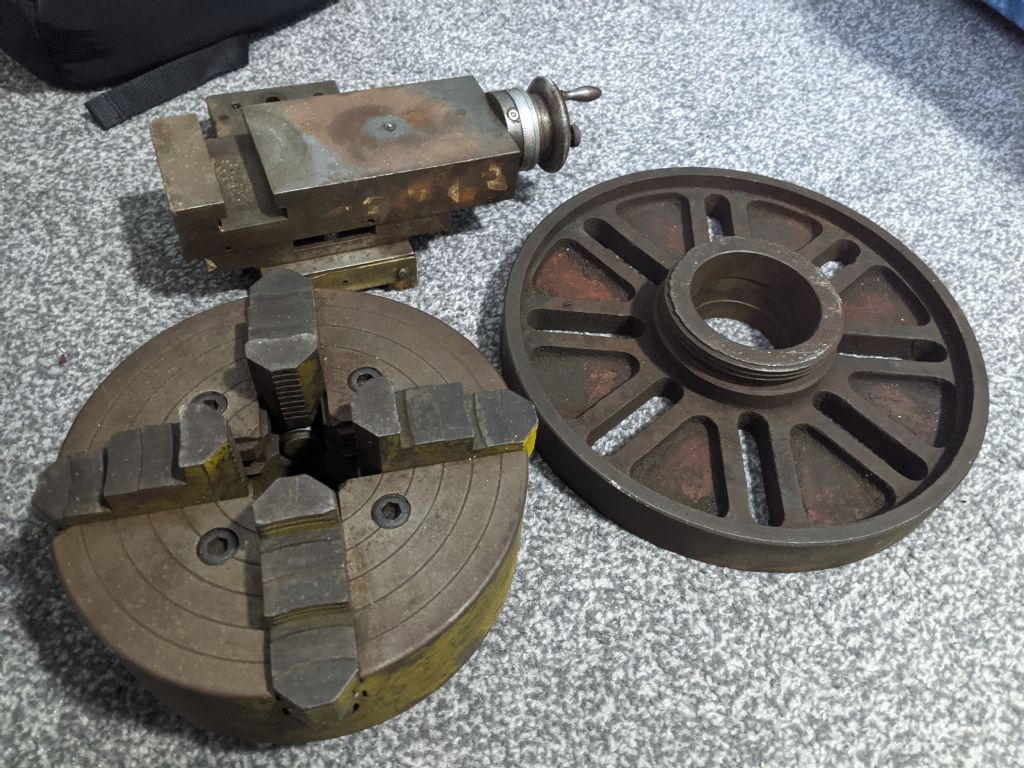
I seem to have acquired a few new toys. I saw these pop up in Grimsby and the seller offered to deliver them to Hull for a very reasonable price. Not extremely cheap, but I'm very happy.
Now I won't have to cut up my 4-way tool post in order to attach a QCTP. Hopefully, there will be a fun build making the T bar to go in the slot and making the mounting post(depending on if the QCTP comes with one) I'm considering this one. Alongside this being a nice upgrade for the lathe, my topslide is quite worn and is easy to turn at one end, and very difficult to turn at the other, so this should be an all-around improvement. I'll take the best parts from each and put them together.
I didn't really need the 8 Inch 4 jaw, but it's not often I see them come up, and for the price, it was worth it. The faceplate may come in handy at some point as well. Plus it'll be fun to clean and paint them both.
I did pop home for easter as I was allowed, however, the lathe did not get touched as I was busy making wooden things! I suspect it is still leaking so this will be addressed at some point in the summer.
Part 5 "I want that last 10mm of Y axis travel"
I bought a 100mm vice to use on my mill, just a cheapie of course but not just any cheap vice.. it's a
"Versatile-Milling-Vice-with-swivel-base-and-a-self-aligning-spherical-segment " ![]()
Yeah, i got sucked in with the sales patter on this one, it's a bog standard cheapie chinese swivel vice with a ball bearing in the moving jaw to lead screw connection, complete with a slightly mis-milled hold down slot and painted with a 6 inch brush by a blind man it seems:

But apart from that it seems a good vice and i paid a fair price for it, don't get me wrong, I've spent just over £500 with Arc Euro Trade for bits for this mill and will continue to shop there.
They were very helpful when i forgot part of an online order i made, i couldn't use the phone for speech to phone in the other bits, so they let me do another online order, combined them and took off the postage on both orders i made as in total it went over the £75 for free postage limit. ![]()
Like most people i guess, the first thing i did was take the swivel part off likely never to be fitted again,
But rather than chuck the swivel base under the bench and forget it even exists, i made a 3D printed wall holder for it, just to remind me i have the swivelling part to use if i ever need to,
3D Printable 100mm Swivel Vice Base Wall Mount
This was one of the harder to design 3D parts, it's not just hollow inside, it follows the bases curves and angles, and has a tee slot protrusion to keep it fairly straight (i always like to get plenty of wiggle room in 3D printed parts, it's not exactly printable at micron accuracy what with shrinkage and layer lines and all that.

Continued in next post due to character limit for whole post….
Edited By Gazz on 30/04/2021 17:08:37
Edited By Gazz on 30/04/2021 17:10:54
Edited By Gazz on 30/04/2021 17:12:29
Edited By Gazz on 30/04/2021 17:14:14
I wouldn't muck about! The easiest way is on the mill with a boring bar and boring head, and boring heads are so useful. No problem clamping the disc to the table with a spacer underneath and then centring the mill.
Otherwise not too difficult to do an a lathe; the hard part is centring the disc on the faceplate.
Others suggest clamping with sacrificial MDF underneath, I might try bolting the MDF to the faceplate and supergluing the disc to the MDF. Don't overdo the glue because the MDF has to be removed later. Acetone as a solvent works too slowly my experience, and heat is better. I'd just warm the Aluminium disc up with a blow-lamp, or pop it in the kitchen oven : not too hot – about 150°C for a few minutes should do it.
I wouldn't worry about the time taken by boring unless speed was of the essence. Boring is accurate rather than quick, but it's not dreadful slow.
Dave
Edited By SillyOldDuffer on 30/04/2021 11:08:28
usually it’s because you seem to want a Rolls Royce but only pay Robin Reliant prices or some other unicorn fantasy. You might be better to sub contract your machining, you won’t get new toys to play with, but your device could be finished. That would however mean properly specifying what you actually want and I’m not sure you know this.
Dave
I'm not sure, John's toughest requirement in my eyes were the seemingly ridiculous weight/space restrictions for metal working equipment, the space restriction being absolutely none, I got the impression he was willing to spend good money for the piece of equipment that would meet his requirements.
In this thread John, everyone has suggested things that could be made to work, to make parts of what you want, a shear could work, but it wouldn't grind you 45° edges, a table saw type machine like the proxon with an abrasive cut off disc could cut your metal, but it wouldn't grind your 45° edges accurately.
A small milling machine is the obvious thing that could achieve your goals, a hss slitting disc, a small abrasive disc for cutting your parts, you could mount small grinding wheels combined with a tilting vice to finish your edges at desired angles, it would do pretty much everything you need.
The new model sieg x1 sold by Arc euro advertising at the top of this page, has a fixed column, 4 screws, as I said to you in another thread, this machine weighs 50kg, if you remove these 4 screws you could meet your requirement of being able to move two 25kg parts from the dining room table to the side cabinet when not in use, I believe this was your requirement, it costs about £600, is in stock from a UK supplier.
Sherlines are nice machines and they seem to punch well above their weight considering their small size.
It's frankly unbelievable that their presence in the UK and Europe is almost non existent! The market over here is very strong.
Quite well-known in the UK with a good reputation, and there's a dealer too. Unfortunately the machines are Price on Application, which often signals high cost and long delays over here.
As a general rule importing anything from the USA is expensive and what's delightfully affordable in New York causes British purchasers to blow a gasket when they see the price over here. Quite a good way of buying american gear is to take a holiday in the US and bring it back as hand-luggage.
Another problem might be more competition. Europeans have reasonable access to second-hand watchmaking lathes and – for serious players – Cowells can be bought new. Also Taig/Peatol and Chinese micro-lathes.
Perhaps the biggest problem is UK lathe buyers have bigger machines for general work and don't have room for a little one as well. Many of us have cramped workshops because land is so expensive.
Whatever the reason, it's not because Sherline kit is considered unreliable or inaccurate. Just relatively pricey, small, and a little awkward to buy. I think of buying a Sherline once or twice a year because my other machines make intricate work harder than it should be. Don't do enough delicate turning to justify it though. Maybe one day…
Dave
Dave,
I have manual Sherline lathe and mill, both bought from Mill Hill Supplies of Basildon Essex (Kevin). MH are the main UK importers. I'm a novice engineer but researched long and hard to find machines that are compact and competent – which as I mostly machine brass and aluminium they are.
Importing from the USA is not actually a hassle nor does it take a long time. Simply contact DPP engineering in California – Sherline's main global exporter. You can get them at [email protected]. They will then list a part on eBay where you can purchase it using the eBay international delivery system. This reduces shipping costs because DPP ship it to eBay in the USA who ship it with containerload of stuff to the UK, from where it is delivered to you. The price on eBay estimates all taxes which are confirmed on purchase. Nice and simple.
DPP tend to under promise on delivery, bought DRO for both machines and they arrived within 7-10 days. Bought a rotary table with similar experience.
People often misunderstand US pricing; the price on the label, online or in shops, is without tax. Tax varies by state so this has become the normal way to quote. So the goods are shipped free of US tax, but of course you pay import duties and VAT etc in the UK. eBay manages this all seamlessly.
Stuart
Sherlines are nice machines and they seem to punch well above their weight considering their small size.
It's frankly unbelievable that their presence in the UK and Europe is almost non existent! The market over here is very strong.
Quite well-known in the UK with a good reputation, and there's a dealer too. …
Dave
Though I am aware of Millhill, Well known is not words I would use to describe them.
It's basically one obscure website with no online shop to pretty much serve the whole of Europe? …
I said Sherline are well-known in the UK, not the dealer!
Maybe more would sell in Europe if they were marketed better, maybe not. There must be a danger Sherline sales are lost here because beginners see alternatives widely advertised while Sherline gear is harder to find. It's what I meant by Sherline in the UK being 'a little awkward to buy'.
My feeling though is it's not Sherline's qualities or lack of advertising that make them relatively scarce over here, it's the combination of price point and a relatively limited market for that size of lathe. If an importer could get the UK price down to £600 or less, I'm sure more would sell, but I doubt it would be a flood. Is it profitable?
Sherline's policy may be relevant too: their advice to prospective new dealers is: 'Word-of-mouth is still the largest source of new Sherline customers', and, perhaps more off-putting to potential trading partners, 'Please note that we do not accept wholesale accounts.' (Their emphasis.) I'm wary of criticising commercial arrangements because without seeing the Business Plan, it's impossible to know if they've got it right or not. Could be Sherline and their UK dealer have already optimised profitability, maybe they should think again. Ketan Swali would have a clearer understanding of the commercial considerations than me! I just know they're not always easy.
I'd be delighted if Sherline were easier and cheaper to buy in the UK. I've thought of buying one several times, but it's a fair amount of money to spend on a scale of work I rarely do.
Dave
Started by: john fletcher 1
in: General Questions
john fletcher 1
Started by:
JasonB
in: The Tea Room
jaCK Hobson
Started by: Kiwi Bloke
in: Materials
Chris Crew
Started by: Graeme Seed
in: Workshop Tools and Tooling
Graeme Seed
Started by: Bill Phinn
in: Workshop Tools and Tooling
Bill Phinn
Started by: fingerscrossed
in: Manual machine tools
Graham Meek
Started by: lucerne
in: Manual machine tools
lucerne
Started by:
Michael Gilligan
in: The Tea Room
Michael Gilligan
Started by:
dean clarke 2
in: I/C Engines
KEITH BEAUMONT
Started by: COLIN MARTIN 2
in: Materials
alecs
Started by: grizmaster
in: Introduce Yourself – New members start here!
noel shelley
Started by: Dunc
in: General Questions
JasonB
Started by: Mike Cooke
in: General Questions
Mike Cooke
Started by: Speedy Builder5
in: Materials
Speedy Builder5
Started by: Trevor Gale
in: Model Engineer & Workshop
JasonB
Started by: Harry Broadbent
in: Model Engineer & Workshop
Bazyle
Started by: Bill Phinn
in: Workshop Tools and Tooling
old mart
Started by: ron vale 3
in: Stationary engines
Weary
Started by:
ray1580
in: Introduce Yourself – New members start here!
Howard Lewis
Started by: wilfried54
in: Introduce Yourself – New members start here!
Howard Lewis
Started by: Werner Schleidt
in: Traction engines
Werner Schleidt
Started by: Chris Crew
in: The Tea Room
Bill Phinn
Started by: Bill Dawes
in: General Questions
Nigel Graham 2
Started by: Buffer
in: General Questions
Vic
Started by: Dougie Swan
in: General Questions
Dougie Swan