Bill
Using anything but the correct size material for a single size collet will strain the collet and hence damage it.
When you examine ER collets, most have two numbers engraved on them such "10 – 9"
Only when you get down to 3 mm or so does the range decreases to 0.5 mm
At least those are the markings on my ER32, 25 and 20 collets.
The Arc Eurotrade catalogue No 11 says
"This provides a good grip and some variation in the sizes that may be used in a single collet.(Upto 1mm ) Smaller sizes are best used to grip cutters (or work ) with shanks up to 0.5 mm below the nominal size"below the nominal size"
Howard
Edited By Howard Lewis on 30/10/2021 21:06:31
… I’m in the process of buying a collet holder and collets for my EMCO FB2 mill. …
I have heard that when using ER type collets the cutter could move in the collet if too large a z load were applied, …
Lots of nice things said about the FB2 but as milling machines go it's a tiddler. ER Collets are designed for much more powerful machines, perhaps 10kW at 20000rpm. In principle, ER collets have no chance of slipping on a small mill.
In practice, operator error causes trouble:
ER collets are great. Just keep an eye on the operator. He might buy rubbish, or wreck good ones!
Dave
I am surprised that no one has mentioned the ball bearing style collet nuts available for ER series collet chucks from the likes of ArcEurotrade. I have bought these as replacements for both ER25 and 32 versions of mine and they greatly reduce the torque required to adequately grip the cutter or work piece. I have never had a cutter "walk" out of a chuck, but perhaps I don't push my machines as hard as others do.
John
Whats the opinion on the machining and materials quality of the Indian Enfields?
Depends in part on the age of the bike – the later ones got better in most regards.
Do you want to ride more or fettle more ?
If you mainly want to ride, then go for a later Unit Construction Engine (UCE) Classic or Bullet model. These only went out of production last year, as they didn't meet the Euro 5 requirements that came in this year. Earlier carbed bikes go for £2.5 – 3 K, while the later fuel injected versions are £3.5 – 4.5K. Prices seem to be holding firm, as there will not be a replacement for the 500 that was sold here (the Indian home market prefers the 350 version that we didn't get). Rated at 27hp, the UCE 500s keep up with modern traffic & mine is returning around 90mpg. Handling is OK, thought the ride is firm. Disc front brake better than the older models TLS drum.
The all new 350 replacement for the UCE platform started coming in this Summer & starts from under £4k new with a 3 year warranty. If 20hp suits your requirements (about the same as an original British 350, but with modern reliability & refinement), they are getting very positive reviews. Build quality looks to be a lot better than the outgoing UCE 500.
I have a 2016 Classic 500 EFI bought used this Summer and find it very pleasant to ride, but with much lower fettling requirement than the earlier 4 speed iron barrelled models (I have had both 350 & 500 versions of those in the past). I have test ride on the 350 Meteor booked for Friday, though style-wise I would prefer the replacement for the Classic that is coming in next year.
If you mainly want to fettle, the pre-unit bikes do require a lot more of that but can still be fun. Both mine were pretty reliable (the 350 had an appetite for rectifier / regulator modules but I was never left stranded) and oil-tight. Finish needs constant work to keep looking good – chrome is thin & the polished castings fur up if left. They have a number of weak points, many of which were engineered out with the UCE replacement. Aftermarket parts to address some of these weak points that were readily available when the bikes were current seem less available (an pricier) now. Parts prices are a lot higher than when they were current, though, and they have been out of production since 2006. Finding an un-molested one seems to be getting difficult, as they attract the "customising" crowd, and prices are strong at the moment – I didn't see much under £2K when I was looking. While they all look much the same there were many changes made over time, so you would need to research what you were buying. Hitchcocks Motorcycles are the major RE parts supplier.
Nigel B.
I want to give power tapping a few metric on my ML7 a go whereby a machine tap is held in the tailstock.
To do so will require the tap to be held in a tailstock collet. I already own the Myford patent collets (those using a 1 1/8" Whit closing ring). Annoyingly I can't see these workign on the taslktock becuase any required adaper would constrict the 2MT bore.
So if I need to source another collet design,simplcity and cost, woudl plain 2MT collets suffice:
https://www.arceurotrade.co.uk/Catalogue/Collets/Morse-Taper-Collets/MT2-Collets-Metric-Sizes
If so can I use M10 studding with a washer and nut at far end of tailstock barrel for the drawbar?
Posted by Nathan Adamson on 20/10/2021 10:45:52:
I assume it’s the control board, I’ve also read that these have torque issues with earlier control boards.
Does anyone know
a) Was there a specific list of serial numbers for the dud controllers so I can avoid this
b) Where do I get a new board from
c) Can they be repaired and also have the torque issue fixed?
Thanks
Nathan
It all depends on the age of the machine, combined with user related issues.
The first SX3 was sent to ARC for testing over ten years ago. It had serious torque issues. During tests under a controlled environment wearing a gauntlet – not something I would suggest anyone to do – it was very easily possible to stop a running spindle at low speed. This was due to incorrect programing of a chip for torque on SX3 and SC4 lathe. ARC refused to take on said machines. They still appeared on the market trough certain official dealers, as well as unofficial dealers. So this explanation deals with some of the machines which are over 10 years old.
ARC started selling SX3 only after above problem was fixed, probably around 9 to 10 years ago. Whilst these problems were fixed, some issues appeared with control panel for a short time, which were fixed. Then came issues with the e-stop, which was a combination of E-stop switch performance in itself, as well as user related issue, whereby some users were using the e-stop to stop the machine, instead of the on/off switch. Too much use/abuse of the e-stop switch resulted in various faults developing. Unfortunately incorrect training offered by a particular distributor – promoting the incorrect use of the e-stop in the training course – also contributed to this problem.
The above machine related issues were dealt with and ironed out in the majority of cases over 7 odd years ago, and it is rare now a days for us to come across this – machine related issue. Due to its positive torque performance over time, this was one of the first machines for which ARC provided warranty around 5 years ago for hobby as well as light industrial use for an individual user. For most smaller SIEG machines, ARC provided warranty for hobby use only. The SX3 still remains one of the most popular SIEG machines in the ARC product range.
With reference to your second hand purchase, it is difficult to say if the fault you have observed results from a machine related issue or a user related issue. If it is a very old machine with the original poorly programmed board, perhaps the original user didn't know any better, or, if the machine was used/abused to deal with work beyond its capacity/capability, fault/s developed…. as was the case with Paul Lousick's SX3 to which he refers in his post… as far as we are concerned.
So, it is wrong to paint an 'underwhelming' brush on the SX3s without really knowing what is the real story with the second hand machine which you have purchased… probably at a knocked down price…. as many in your situation do.
Age of the machine is determined from the serial number. in the case of the SX3, this is to be found on top of the column casting. You will need to get on top of a stool and then look on the top. We can figure out the built age from the serial number.
Then you need to look at this page link on our site to figure out all the things you will need and ask for said parts from the SIEG distributor in Australia – if he can supply.
Nobody really knows what is the cause of your particular fault. To the best of my knowledge, the board is not repairable.
Ketan at ARC.
…b) Where do I get a new board from…
Hi Nathan
If you are in the UK give Arc Euro Trade a ring, I have always found them helpful. Although they show the boards as out of stock, they may be able to confirm which board you need and when/if they can get one.
Brian G
Thanks Brian, I am about as far away from the UK as one can get, little old New Zealand. I did email Arc Euro but they never responded
Hi Nathan,
Normally, we aim to respond to emails within 24 working hours. Your email was received at 06.49 GMT on 19 October 2021, and replied at 09.21 GMT on the same day. If the reply has gone to your spam folder, you may wish to check there. Copy of the same email has also been sent to you today by Ian.
We also received a phone call replicating the contents of your opening post, and a member of our team spoke to the person, and at the time, we presumed that person to be you. We also presumed the call to be made from within the U.K., as no indication is made in your original email that the enquiry is from NZ .
If we were wrong in our presumption, and If you fail to receive the email again, you can call and speak with Ian, after 09.00 GMT.
Now that we are aware that this requirement of control board is for NZ, we are unable to ship electrical components such as the control board to your destination, for a variety of reasons. You will need to refer to the NZ dealer or the Australian dealer for your requirements for this machine.
For other points raised in your opening post, I will respond with further posts below.
Ketan at ARC
…b) Where do I get a new board from…
Hi Nathan
If you are in the UK give Arc Euro Trade a ring, I have always found them helpful. Although they show the boards as out of stock, they may be able to confirm which board you need and when/if they can get one.
Brian G
Thanks Brian, I am about as far away from the UK as one can get, little old New Zealand. I did email Arc Euro but they never responded
…b) Where do I get a new board from…
Hi Nathan
If you are in the UK give Arc Euro Trade a ring, I have always found them helpful. Although they show the boards as out of stock, they may be able to confirm which board you need and when/if they can get one.
Brian G
Looked at the Arceurotrade one
specification…
C6-511 Cross Slide Screw Nut
can't tell if that would be any good though.
Does someone have the precise spec for the Chester one. I might just know someone who could make it.
With the existing nut and backlash, precision engineering just isn't there.
Am I right in thinking the Chester was rebadged Warco (?) in the US at one time?
Jon
That is a lot to pay for one cutter. I wonder if you could get by with a 1" diameter indexable cutter. The type I had in mind uses APHT 11 or 16 inserts.
This is what I mean. In the USA or Canada, similar products would be more likely to be in inches rather than metric.
Edited By old mart on 14/10/2021 20:14:04
If you are real newbie to machine work, it may pay to read some books to explain things.
A set of Zeus charts will often be used for reference.
For lathework, L H Spaey's "The Amateurs lathe", Ian Bradley's "The Amateurs Workshop" (deals with other workshop techniques ) then there.are books by Harold Hall and Neil Wyatt on "Lathework".
If the small Clark lathe is a mini lathe, both Neil Wyatt and David Clark (No connection to Machine Mart as far as I know) have written books on it
As an aside, you will get far more help and advice from Arc Euro Trade than Machine Mart. The difference is knowledge of the the machines and their accessories.
Harold hall has also written a book on Milling, and the Workshop Practice Series will cover similar ground and MANY other aspects of machining and benchwork.
When you find a need for a four jaw chuck, measuring instruments, and other accessories, look at the established Model Engineering Suppliers. They are more likely to stock what you want, and will know what they are taliking about to guide you in the right direction.
HTH
Howard
If you want a quality one without the stick out associated with a backplate and separate chuck then Sherline do their's with M14 x 1. Millhill Supplies are the UK agents.
Or you could buy an Emco one.
Other option is something like this backplate and a reasonable quality Indian chuck like this which may be a better make than the one you tried. Several members here have been happy with the Zither brand chucks.
A chuck made of composite materialm is an interesting concept and could have its uses.
But being heavy handed, I would prefer steel or cast iron chuck.
And backplates are available for a variety of chucks, so that you can arrive at a combination that suits your needs
I am sure that Arc Euro will help with advice as to what you need
Howard.
> As said use a saw to slice things up
Currently I would have to do that by hand. Possible but time-consuming & error-prone.
Obviously for any bulk cuttings I could outsource the cutting, and probably get it laser cut.
Btw, do you happen to know anyone in the UK who can do low-cost laser cutting of 1mm mild steel that involves lasering at 45° ?
Fwiw, since it was pretty cheap, I have now ordered that TiAlN-coated 3mm ArcEuroTrade Carbide End Mill.
Edited By John Smith 47 on 29/09/2021 23:34:00
JasonB:
1. That's interesting to learn that lubricant in small amounts can damage carbide cutters. I think that I read somewhere that lubricants can stop the heat from getting away fast enough…
2. Wrong, although they both seem much faster now, both MSC (www.mscdirect.co.uk) and ARC (www.arceurotrade.co.uk) were 100% definitely running slow. In particular their search results were both taking 20 to 30 seconds to load, whereas my own internet connection was running at full speed (60Mbps) and every other site I visited immediately before and afterwards were loading more or less instantly.
3. Yes my plan was to use this end mill:
"Axminster 4 Fluted Carbide End Mill – 3mm"
(http://www.axminstertools.com/axminster-4-fluted-carbide-end-mill-3mm-504861)
…which the manufacturers call "both solid carbide AND coated" and that the thickness of the coating is "between 4 to 6 microns". Do you think it will suffice?
Reading up on your suggested "ARC Premium TiAlN Coated Carbide End Mills" with its Micro-Grain Carbide, the TiAIN (titanium aluminium nitride) coating does sound impressive. It sounds like it can cope with high temperatures well. At just £11.74 it's pretty low cost. I might just buy one right now. I would be buying the 3mm version.
Questions:
– It only has 3 flutes. Do you think that will suffice for side milling?
– What speed should I run my Proxxon MF70 at? Choice: 5K to 20K RPM
– If I used it to slice up 1mm thick mild steel sheet, realistically how long would you expect it to last in terms of distance of cut (e.g. cm)?
Edited By John Smith 47 on 29/09/2021 15:55:01
3 flutes fine.
See **LINK** for a feeds & speeds calculator. It recommends ~10000 for a 1/8 cutter in mild steel.
I wouldn't use an end mill for that – better to buy steel strip and hack short lengths off it, use the mill to square and chamfer them.
Coolant is to cool the cutter, not lubricate it, you don't want it to slide by definition. Small amounts of oil just make a mess, stick the chips to the cutter, and don't help to keep it cool.
JasonB:
1. That's interesting to learn that lubricant in small amounts can damage carbide cutters. I think that I read somewhere that lubricants can stop the heat from getting away fast enough…
2. Wrong, although they both seem much faster now, both MSC (www.mscdirect.co.uk) and ARC (www.arceurotrade.co.uk) were 100% definitely running slow. In particular their search results were both taking 20 to 30 seconds to load, whereas my own internet connection was running at full speed (60Mbps) and every other site I visited immediately before and afterwards were loading more or less instantly.
3. Yes my plan was to use this end mill:
"Axminster 4 Fluted Carbide End Mill – 3mm"
(http://www.axminstertools.com/axminster-4-fluted-carbide-end-mill-3mm-504861)
…which the manufacturers call "both solid carbide AND coated" and that the thickness of the coating is "between 4 to 6 microns". Do you think it will suffice?
Reading up on your suggested "ARC Premium TiAlN Coated Carbide End Mills" with its Micro-Grain Carbide, the TiAIN (titanium aluminium nitride) coating does sound impressive. It sounds like it can cope with high temperatures well. At just £11.74 it's pretty low cost. I might just buy one right now. I would be buying the 3mm version.
Questions:
– It only has 3 flutes. Do you think that will suffice for side milling?
– What speed should I run my Proxxon MF70 at? Choice: 5K to 20K RPM
– If I used it to slice up 1mm thick mild steel sheet, realistically how long would you expect it to last in terms of distance of cut (e.g. cm)?
Edited By John Smith 47 on 29/09/2021 15:55:01
I would not go with what Axminster say, unless you have flood coolant you are more likely to damage the carbide cutter by applying small amounts of lubricant and in small amounts no liquid will really do much cooling. So run carbide dry.
If you are finding MSC and ARC slow to load then I would think that is a problem your end maybe with a slow connection or machine as they are both fine for me and have far more (correct) info about their cutters than what Axi have on theirs
If you use the side of a cutter then you don't need a chamfer tool, just hold it like you have been doing in the vee block and use the edge of a straight sides tool such as the 3mm dia one here which has a 3mm shank
Ditto, with a carbide mill on MS tale it slow with no coolant. Arc Eurotrade (advertise on this site) are also a good supplier for cutting tools. That "mitre" cutter you posted looks quite unsuitable, either buy a mitre cutting mill bit or mount the work at 45* (in vee block) and use an ordinary end mill. You can also mitre with the side of an ordinary countersink, the multi-tooth variety, again take it slow.
1. Out of interest, is there an actual advantage of not using coolant. Or are you saying it is just not necessary?
2. Just to get clear, do we agree that Axminster is incorrect when they say that "coolant is essential"
https://www.axminstertools.com/axminster-4-fluted-carbide-end-mill-3mm-504861
3. In this context, if no coolant, is there also no need for a lubricant too?
4. Thanks for the tips re Arc Eurotrade & MSC direct. Both websites are quite flawed (painfully slow to load, poor quality photos, search field loses your search keywords) but a wider range and prices look good.
Yes, Axminster are painfully expensive and do have a smaller selection of products on offer, but they tend to give more information about their products. If their information is incorrect, then that is a big problem for them.
5.
> That "mitre" cutter you posted looks quite unsuitable
John Haine – Are you saying that there is something wrong with THIS tool that I have been using?

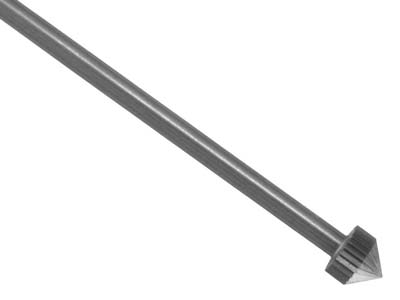
"Busch Burr Stone Setting 8.0mm"
Made from HSS
https://www.cooksongold.com/Jewellery-Tools/Busch-Burr-413-Stone-Setting-8.0mm-prcode-941-043
If so, can you suggest a specific better quality tool?
Yes, currently I can only go up to 3.2mm diam shaft which is the largest collet that came with the MF70.
Ditto, with a carbide mill on MS tale it slow with no coolant. Arc Eurotrade (advertise on this site) are also a good supplier for cutting tools. That "mitre" cutter you posted looks quite unsuitable, either buy a mitre cutting mill bit or mount the work at 45* (in vee block) and use an ordinary end mill. You can also mitre with the side of an ordinary countersink, the multi-tooth variety, again take it slow.
Hello all
After retiring a couple of years ago I bought a Sieg SC3 lathe and a Sieg SX2P mill from Arc Euro, and am happy with both. My interest is in model stationary engines.
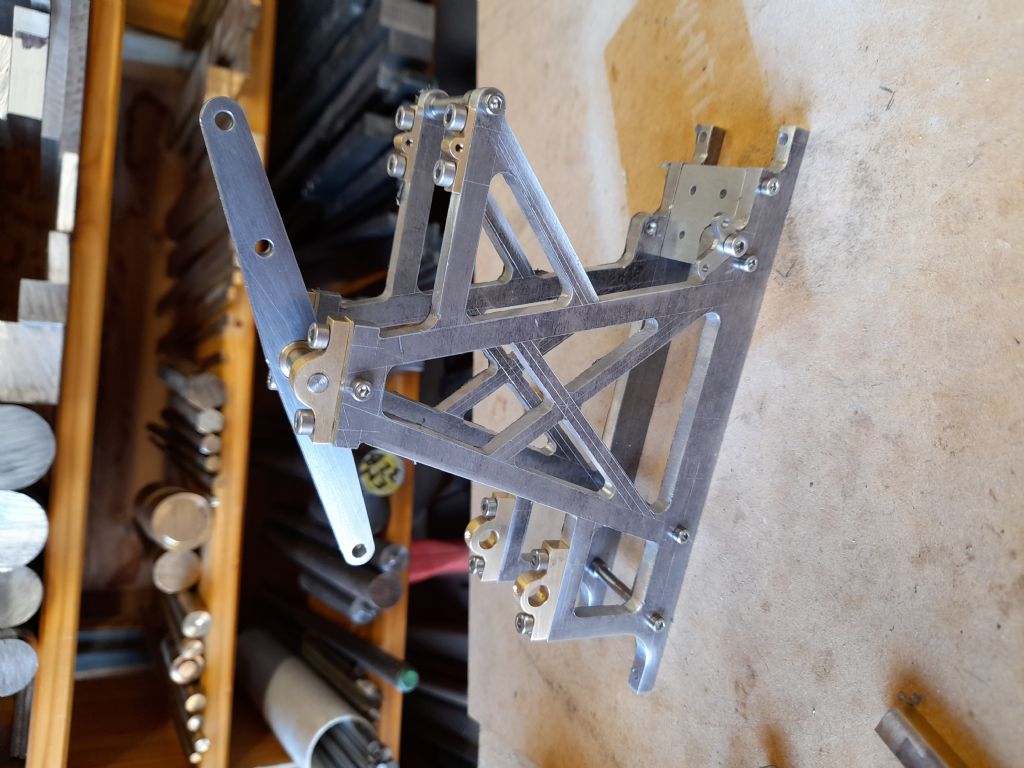
The current project is the single cylinder balance beam engine designed by Gerry Dykstra, progress so far shown in photo (sorry I don't know how to rotate it). I am now making the crankshaft but can't find the distance for the throw. Scaling off the drawing (which as a former mechanical engineer I know you should never do!) comes out at 13mm centre to centre. Can anybody confirm this?
Thanks
GeoffT
Edited By JasonB on 26/09/2021 14:52:01
Posted by brian jones 11 24/09/2021 14:41:58
ll you needed to know about CP and the Base Bitch
https://www.geartechnology.com/articles/0992/Base_Pitch_Tables/
this past post went into the problems of measuring a gear (as opposed to calcs + suck it and see)
You cant just use calipers / disc mic and measure PCD just like that
https://www.model-engineer.co.uk/forums/postings.asp?th=166048
If you have two gears meshed together you can deduce the pcd from distance between centres
then there's the eyeball method
======================================
The last 2 lines is where Brian's methods of measuring all fall down.
Whilst it is true you can deduce the PCD from the distance between
centres it is of little use if you are making a pair of gears to fit
between pre determined and existing fixed centres ,you would need to be able
to measure the gears with some accuracy before they are removed
from the machine on which they are cut.
Still we have seen from his methods of working from
posting on 13 / 9 / 2021 12:30:19
Difficult to make two gears that will mesh together from fixed centres.
Drill your centers afterwards.
—————————————
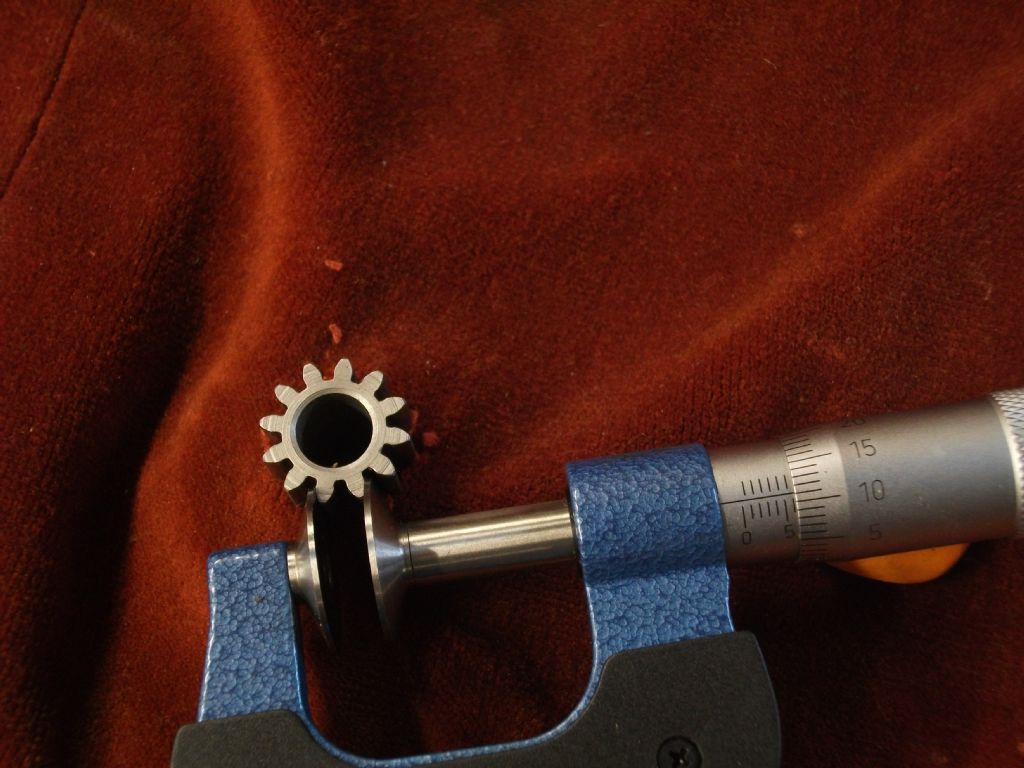
With regard to eyeballing the pressure angle , here is
a small gear the OD is 18.970 mm or .7468", the span across
2 teeth is 6.112 mm as can be best determined from the
micrometer reading.
Now is it possible to eyeball the pressure angle as suggested
by BJ 11 or will a guess do .
There are only 2 options 14.5 deg pa or 20 deg pa.
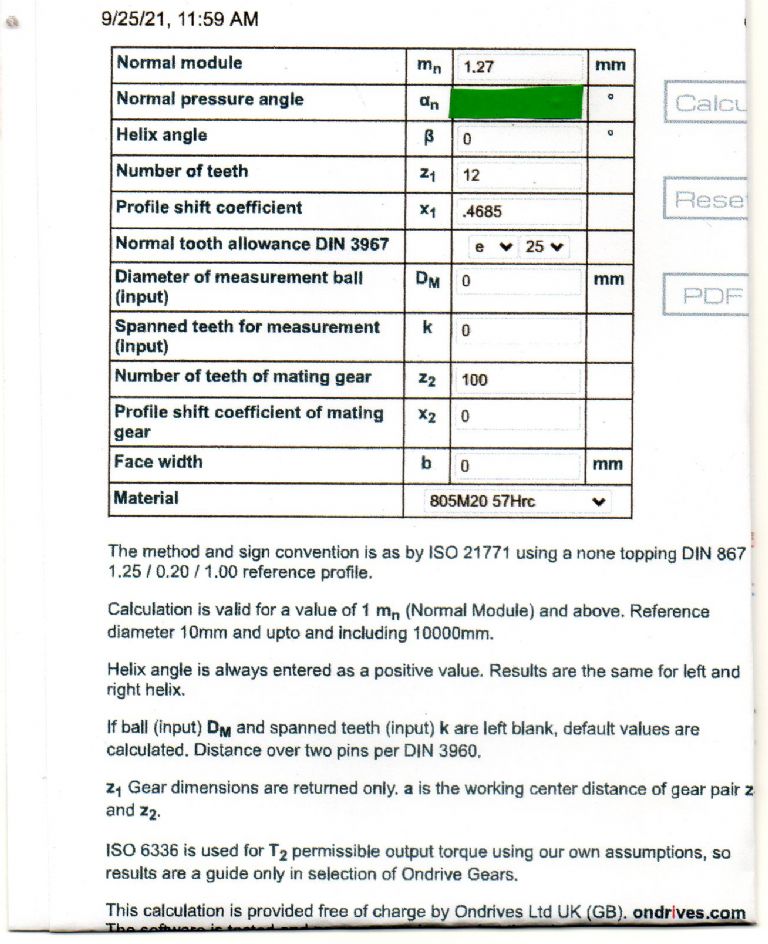
Here are the required inputs for the Ondrives gear tooth
calculator only the input for pa is missing , give it a try
and see which one of the two that it is and how close the
answer is to the micrometer reading. The results for both
are very close but one is a clear leader.
Seeing Andrew's posting 23/09/2021 21:25:25
When I started making gears I spent some time faffing about with gear verniers
I didn't find them easy to use and the results were indifferent. Now I just calculate
the theoretical values and machine to those.
———————————–
I can understand this point of view with the gear tooth calipers ,they always
seemed to me to be a hit and miss method , the span measurement seems to offer
a slightly more accurate solution ,the Ondrives also does give the measurement
across 2 pins which is likely to be the most accurate method obviously the requirement
to grind 2 suitable pins is just more to do.
Hobbing can be different to using form cutters in as much you can keep cutting in
and still retain the tooth form which you can't do with form cutters.Only one of the hob
cutters that i have has the infeed marked on ,using the general recommendation for
cut depth does not work either ,eg in Gears and gear cutting the tooth depth cut
for 20 dp is .108 inch both my 20 dp hobs need to infeed by .1115 inch
to cut to standard form.All of the hobs that Arc Euro used to sell were Topping
cut hobs and still did not conform to standard cut depths,all of this you find out
in time until it is no longer a problem ,being able to measure is just a help.
I suppose it could be time to reflect on the heading of this
thread
cutting spur gears on a mill
and on the first lines
" I have seen vids of using diving head for use with a milling form tool for cutting
a spur gear say 3" dia, 1/4" thick with say 80 teeth
OMG what a painfully slow process as you mill each one"
All of this diversion into the discussion of wind turbines etc has seen a complete
lack of gears made, maybe we will be getting on to hot air engines very soon,
should be enough of it to keep one running until the sun goes dim.
John
Just seen this from BJ: "Maureen has my secret weapon in her jaws I must get on"
Stay tuned for the next thrilling installment!.
John
Hi, thank you all for replying,
Mike Hurley, I have had contact with lathes.co.uk before, I love the site.
Neil Lickfold, it has a tapered tip.
Bikepete, thanks for the links, they are both good, the small chuck with 5C can be a good solution, but I would like to have several different ones, another question is whether to look for it used and risk buying something damaged, my problem is that if I buy in UK or USA I have the problem of customs cost, and finding it in Europe will be difficult, I have seen this page https://www.shars.com/catalogsearch/result/index/?cat=661&p=4&q=hardinge+lathe+chuck+mount+a5+4+degree+taper I do not know if any can be worth to me, greetings.
The difficulty is that the Hardinge spindle nose (a 4 degree taper with locking pin) is pretty much specific to that brand and backplates and chucks to fit are hard to find. There are some available (not cheap!) in the USA e.g.
but I've not seen them advertised in the UK or Europe – would also be interested to hear if anyone has a source!
Another option is to make one – Google Images search for "Hardinge taper drawing" will find the spindle dimensions…
A small chuck could also be mounted using the 5c spindle taper e.g.
Compared with my digital calliper, the DRO slide is fairly stiff and there is stress on the coupling to the table. I've made the coupling fairly rigid but it worries me that it can become loose. (= backlash, eventually)
The units are Shahe style from Arc Eurotrade iirc and I'm wondering if I could use some lubrication on the rails. Or, is it possible to loosen the 'grip' by reducing tension in the screws between the two halves of the slide? Lubrication could gather grot, of course.
I get the impression that several people have used these cheap DROs and I imagine it's a common concern.
Started by: wilfried54
in: Introduce Yourself – New members start here!
Bo’sun
Started by: john fletcher 1
in: General Questions
bernard towers
Started by: ron vale 3
in: Stationary engines
bernard towers
Started by: Speedy Builder5
in: Materials
John Haine
Started by: Harry Broadbent
in: Model Engineer & Workshop
alecs
Started by: lucerne
in: Manual machine tools
Martin Johnson 1
Started by: Werner Schleidt
in: Traction engines
Weary
Started by:
ray1580
in: Introduce Yourself – New members start here!
alecs
Started by: COLIN MARTIN 2
in: Materials
alecs
Started by: Chris Crew
in: The Tea Room
John Haine
Started by:
dean clarke 2
in: I/C Engines
alecs
Started by: Bill Dawes
in: General Questions
Nigel Graham 2
Started by:
JasonB
in: The Tea Room
Nigel Graham 2
Started by: Buffer
in: General Questions
Vic
Started by: Dougie Swan
in: General Questions
Dougie Swan
Started by: berwick
in: Beginners questions
Michael Gilligan
Started by: Nick Welburn
in: Work In Progress and completed items
Nick Welburn
Started by: Alan Ambrose
in: Manual machine tools
southernchap
Started by:
duncan webster 1
in: Electronics in the Workshop
John Haine
Started by:
Michael Gilligan
in: Clocks and Scientific Instruments
michael m
Started by: Bill Phinn
in: Workshop Tools and Tooling
Bill Phinn
Started by: Phil Whitley
in: The Tea Room
Phil Whitley
Started by: Bill Dawes
in: General Questions
Dave Halford
Started by: SteveP
in: I/C Engines
SteveP
Started by:
David George 1
in: CAD – Technical drawing & design
Mark Rand