Men Ifr
@menifr84251
Hi,
I need to drill a small hole (I selected 2mm) in a steel plate and aluminium plate.
I then put some 2mm rod through both to create a pivot point.
The problem is the pivot is very sloppy – the hole I drill (with Sieg equivelent x2/x3 milling machine and R8 taper) in the alloy is obviously bigger than the jobber bit I'm using.
I've measured the run-out of possible parts:
1-10mm 3 jaw chuck 0.07mm (arc euro part)
ER 16 collet holder 0.01 (ebay part)
2mm collet when fitted in holder 0.07
So I'm thinking the 2mm ER16 collet adds 0.06mm run out – the problem is with buying any of these parts I don't see a run-out specification.
Is 0.07mm normal/acceptable? I'm a bit dissapointed in the arc euro chuck but maybe all 3 jaw chucks are very poor?
Also – I can't measure the hole I drill… maybe its much further out than +0.07?
I thought maybe I can try to get some ~2.1mm rod or make some but the 2mm rod seems a reasonably tight fit in the steel so I think (but can't measure) the hole in steel is closer to the 2mm and the hole in alloy is 2.07mm or more…
Any tips or am I expecting far too much?
I thought about making a bigger hole but it would still have the same error in the size wouldn't it?
John Reese
@johnreese12848
Posted by not done it yet on 04/11/2017 06:42:51:
5C collets also fit spin-indexers , indexing fixtures, and other gadgets. To the best of my knowledge none of these things are made for ER.
Knowledge improvement time!
I believe you will find, if you look hard enough, an ER spin indexer available from ArcEuro. Named after the late John Stevenson?
It will accept both 5C and ER32 collets. Look it up, along with the square and hex indexers.
They cheated. It is a 5C indexer with a 5C/ER adapter. Actually, the 5c/ER adapter seems like it would be a great addition to my shop.
Tony Ray
@tonyray65007
ArcEurotrade sell an ER 32 collet block system. Unless you are doing a lot of precision work and need a quick loading system ER40 will do the job. I will though put in a good word for the Burnerd Super Precsion 3 jaw chuck I have. I often see ~ 1 thou repeatability when loading &unloading the same job, I mark the job and the chuck with a marker pen soI I get it loaded back in the same position. Unfortunately you are unlikely to get that performance out of the stock supplied chuck.
not done it yet
@notdoneityet
5C collets also fit spin-indexers , indexing fixtures, and other gadgets. To the best of my knowledge none of these things are made for ER.
Knowledge improvement time!
I believe you will find, if you look hard enough, an ER spin indexer available from ArcEuro. Named after the late John Stevenson?
It will accept both 5C and ER32 collets. Look it up, along with the square and hex indexers.
Ketan Swali
@ketanswali79440
Posted by XD 351 on 03/11/2017 07:44:20:
Did you try arc eurotrade ? They sell genuine sieg stuff that will fit your lathe and comes from one of the few good factories in china . I suspect you will have to make an adapter for a burnerd to fit a mini lathe .
Edited By XD 351 on 03/11/2017 07:46:37
Thanks for your kind comments. I would just like to clarify please, which I hope no one will mind…
The Chinese lathe chucks we sell are purchased through SIEG. If we have a problem, we sort it out with SIEG. In turn, they sort it out with the manufacturer. Having said this, there was a batch we had re-called, and this was posted on this forum at the time. Other then that, we get the odd faulty chuck, or a return where the customer is not happy with the chuck, even though the chuck is fine – no better or worse than the average Chinese chuck.
Having said the above, most Chinese chucks are fit for the purpose they are made for, provided they are procured through the right channels. The Zither chucks from India are better than the general Chinese ones, but you will need a plain backplate, to be turned on your mini-lathe for the register, then drilled and tapped by you to make the chuck fit. Again, one has to be careful without making presumptions that all Indian chucks are good. SHARP – Indian chucks from Chronos are also good. In all such cases, a backplate will need to be used.
Ketan at ARC.
I.M. OUTAHERE
@i-m-outahere
Did you try arc eurotrade ? They sell genuine sieg stuff that will fit your lathe and comes from one of the few good factories in china . I suspect you will have to make an adapter for a burnerd to fit a mini lathe .
Edited By XD 351 on 03/11/2017 07:46:37
JasonB
@jasonb
Mini (M type) nut should still have the off ctr hole as you can see in this sectional drawing.
The smaller internal thread dia is likely to mean you can't tilt the collet over so far to snap it in
Edited By JasonB on 02/11/2017 16:00:10
David Standing 1
@davidstanding1
And talking about ER chuck overhang, 5C is just as bad:
**LINK**
John Haine
@johnhaine32865
No question in my mind: ER40. 5C you need a collet per bar size you will use, but ER40 fits a range of 1mm for each size (though it is worth buying specials for common imperial sizes to grip properly, especially 1 inch.) Don't get a milling type chuck that fits in the headstock taper because you can't fit stock through it. You need one on a flange that fits the headstock chuck fitting. On my Super 7 I have a Myford one that screws on to the (large) bore register. I don't understand the comment above about overhang, look at the pictures of ER flange mount chucks on the Arc website.
Brian Wood
@brianwood45127
Hello Jared,
Gearing tables for BA threads in the range 0-16 BA for mini-lathes do now exist in 'Gearing of lathes for Screwcutting' published by Crowood in their metal worker series. The ISBN number is 978-1-78500-250-2 and it is available via Amazon for something like £12.50 plus postage.
Despite being the author of the book, these tables were published more on the lines of mathematical exercises to show that threads in that range could be generated to decent accuracy for either 16 tpi or 1.5 mm pitch leadscrews, using Neil Wyatt's 63 tooth wheel and the standard gear set together with 25 and 75 T wheels. The book also gives the gearing for other thread pitch series not shown in the mini-lathe handbook. The extra gears and the book are available form Arceurotrade
I would though agree with JasonB that the more practical route by far is to use split dies to create them; or use the metric equivalents instead.
Regards Brian
Andy Pugh
@andypugh44463
I have a touch-probe that fits my vertical head, but not the horizontal.
I have a coaxial indicator that fits both, but that's no good for picking up edges.
I had a brainwave at the weekend, and used the square "Stevensons Collet Blocks" from arc-eurotrade.
This turns out to be 40mm square with a nice ground and tapered hole. SO once the dial was running true I knew I was 20mm above the table and 20mm from the edge of the part being machined.
As a bonus, the fact that the bore is tapered means that the dial shows oval if you are out of square too.
Ketan Swali
@ketanswali79440
Hello everyone,
Arc Euro Trade will be closed on Wednesday 1st November 2017.
Details below:
mechman48
@mechman48
I have a set of these from Arc…
http://www.arceurotrade.co.uk/Catalogue/Cutting-Tools/Counterbores/21pc-HSS-Interchangeable-Pilot-Counterbore-Set-Metric
I have only used one so far but at least I have them, & as Tim says you can make pilots to suit your needs.
George.
petro1head
@petro1head
I bought a set of these from ARC and have started using them eventually. **LINK**
However I am a bit confused.
If you want a clearance hole for a M12 thread I would have though 12mm would be good as the thread dia is about 11.8mm?
However the pilot dia on the M12 is 13.5mm.
Is this not too big?
Muzzer
@muzzer
An edge finder is an absolute necessity for acquiring the edge of the workpiece, centres of holes etc.
In the medium term, the next semi-investment for the milling machine should be a DRO and possibly a power feed for the X axis if you have the budget.
Murray
Keith Fox
@keithfox28514
Hi, I recently bought a lathe and am now thinking of buying a mill, possibly a Sieg SX2. However, not being experienced with these, I was wondering what essential pieces of equipment that I also need to buy to go with it and I am talking about basics. I saw Arceurotrade's advert for the SC4 lathe package and was really looking for a list of essential kit like that.
Thanks for your help.
Keith
Nige
@nige81730
Finally made the trek from Aylesbury to Leicester to talk to Ketan at Arc Eurotrade and very glad I did. The decision on a milling machine has been made, the Sieg X2.7 with the R8 spindle Ketan took the time to walk me through the machine and show me loads of necessary 'stuff' about draw bars and R8 spindles and arbors. A demo of the machine running and its various facilities followed; all in all a very worthwhile visit plus a cup of tea on arrival. Much impressed as a customer. thank you Ketan
gareth evams
@garethevams43108
Some years ago, I had a vituperative quarrel with John on the uk.rec.models.engineering Usenet group, but introduced myself to John when he was on the ArcEuro trade stand at the Midlands show and we cleared the air.
John was very helpful then with my intended projects. (Under the bench today, incomplete )
Subsequently, I had many email conversations with John to do with the gear hobbing processes after I had written the Hobnail spreadsheet for Giles Parkes.
I suggested to John that he would be well situated to assist Giles' daughter with the disposal of the workshop contents and introduced them to each other, although I've had no contact with either party since. (This was because it would have been difficult for me being so far to the south in Chippenham, Wiltshire)
John's passing is a sad loss, coming so soon after Giles' passing.
JasonB
@jasonb
This is a thread to complement the one relating to "Lathework for Beginners" by our Editor Neil Wyatt and will relate to my alternating series "Milling for beginners" that will start in MEW 261 and run in alternate issues. Thanks to a sponsorship deal with Arc Euro Trade Ltd I will be introducing the mill, tooling to suit and how to use it aimed at the beginner who has little or no knowledge on the subject.
There are now two dedicated threads for the two series on the forum at http://www.model-engineer.co.uk where you will be welcome to ask further questions or even suggest topics or techniques you would like us to explore as the two series develop.
This thread is for questions about the Milling for Beginners series. Please keep it on topic, this thread is for general discussion of Milling techniques and using different accessories not issues like merits of one machine versus another. Off topic comments will be moved or deleted!
Neil and I both plan to include ‘tips and wrinkles’ that will be of interest to more experienced hobbyists as well, so we hope that this new initiative is something that all readers will enjoy.
Thanks,
Jason
Russell Eberhardt
@russelleberhardt48058
Posted by Colin LLoyd on 26/10/2017 14:46:20:
Posted by Russell Eberhardt on 26/10/2017 14:26:15:
I also fitted ball thrust bearings (ArcEuro ref B8) to the top of the threaded rods to take the weight of the print head off the stepper motors and to allow the flexible couplings to work properly.
Russell
I noticed that Neil also added these thrust bearings but didn't notice much difference – and he has removed the picture showing them – so if I wanted to add these – how do you do it?
First I extended the threaded rod by turning off the thread for a short length and loctiting a short extension piece in place. That was then skimmed to make sure it was true where it fits into the flexible coupler:
The extended threaded rod was then a good fit in the coupler so it remained co-axial, unlike fitting the threaded rod directly into the coupler when it was off centre.
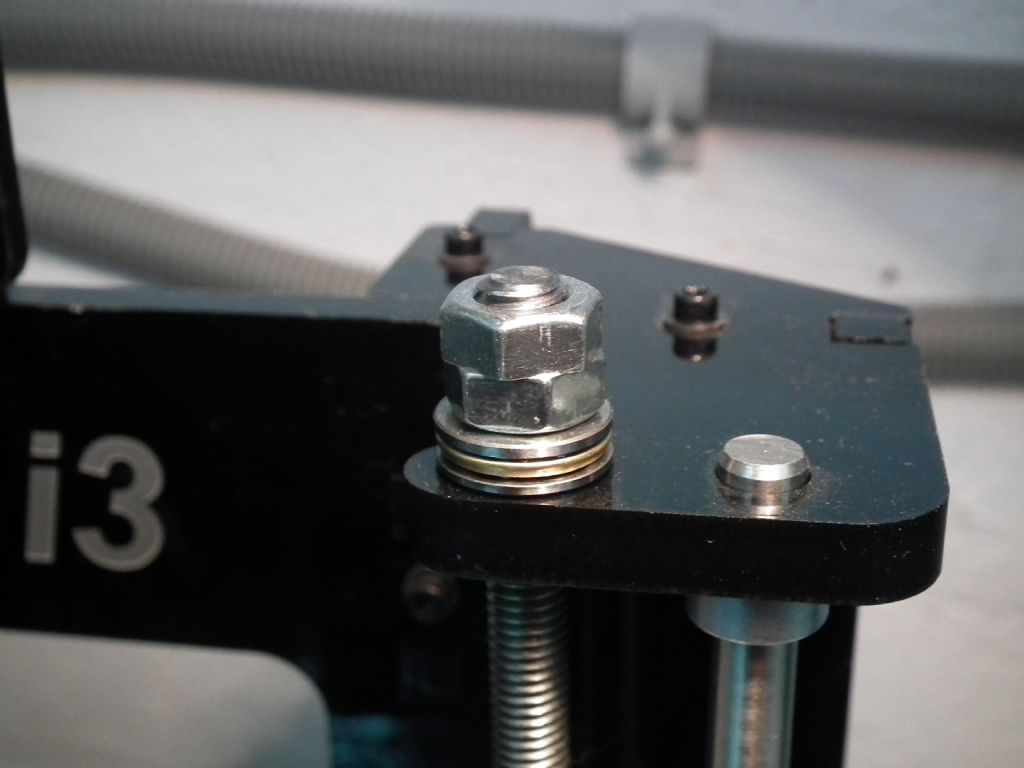
The bearings were then fitted at the top:
Russell
Edited By Russell Eberhardt on 26/10/2017 15:52:25
Colin LLoyd
@colinlloyd53450
Posted by Russell Eberhardt on 26/10/2017 14:26:15:
I also fitted ball thrust bearings (ArcEuro ref B8) to the top of the threaded rods to take the weight of the print head off the stepper motors and to allow the flexible couplings to work properly.
Russell
I noticed that Neil also added these thrust bearings but didn't notice much difference – and he has removed the picture showing them – so if I wanted to add these – how do you do it?
Russell Eberhardt
@russelleberhardt48058
Posted by Colin LLoyd on 26/10/2017 12:21:05:
I found that a simple fine emery paper sanding with the rods rotating in the lathe cured the problem. The threaded transport rods maintain the position that any slightly lower contact in the bearings might have compromised. And I see no problems in the resultant prints.
I did the same. The "smooth rods" supplied were between 7.959 and 8.012 mm. I had to put the biggest one in the lathe and polish it down a bit with very fine abrasive paper to get the bearing to slide smoothly. I had intended to replace them with proper hardened and ground shafting but that was a year ago and the bearings are still running well.
I also fitted ball thrust bearings (ArcEuro ref B8) to the top of the threaded rods to take the weight of the print head off the stepper motors and to allow the flexible couplings to work properly.
Russell
JasonB
@jasonb
Posted by Colin LLoyd on 24/10/2017 11:36:19:
Does anyone have any thoughts on the new Arceurotrade Original Stevenson's ER collet blocks (square for 4-jaw and 6-sided for 3-jaw chucks. Seems to sort of turn my lathe into a horizontal milling machine – but I already have a vertical milling machine – so can't really see where I'd use these.
If used on the lathe they can be very handy for holding thin or delicate items that may be damaged by a 4 jaw chuck for example think how you would adjust a bit of thin wall tube in the 4 jaw without distorting it or faffing about with packing to save marking the surface with the jaws
Boring 3/8" eccentric hole 2" long which left 0.010" wall on the thin side
I have started this new thread to answer Colin's question about ER blocks hence no opening post by him, just the quoted part.
Edited By JasonB on 24/10/2017 13:26:27
Colin LLoyd
@colinlloyd53450
OK you guys – I've gone out and bought a 100mm 4-jaw Independent chuck AND a 160mm faceplate for my CJ18A from those nice people at Amadeal – so I know they will both fit. It's an example of being between a rock and a hard place – and buying both creates a soft cushion to land on.
Does anyone have any thoughts on the new Arceurotrade Original Stevenson's ER collet blocks (square for 4-jaw and 6-sided for 3-jaw chucks. Seems to sort of turn my lathe into a horizontal milling machine – but I already have a vertical milling machine – so can't really see where I'd use these.
You can probably tell that I've now gained a mechanical version of GAS (Guitar Acquisition Symdrome) – I have 15 guitars (5 I made myself), 4 amps, and numerous effect pedals and other playing/recording paraphenalia – which my wife tells me is quite enough – but she doesn't go into the workshop so I can start again mechanically. I'm told there is no cure.
Martin 100
@martin100
When you see a thread with a persons name you know its almost certainly not going to be good news. I've still got archived uk.rec.models.engineering posts moved across from multiple computers dating from 2005 from John S, and first met him in person on the arceuro stand at Harrogate Show a few years later when he was demonstrating an X3 cutting gears. His input there, more recently at Doncaster regrinding the cutters last year, plus many times here and elsewhere online over the years will be sadly missed. RIP John and condolences to the rest of his family.


 Men Ifr
 John Reese
 Tony Ray
 not done it yet
 Ketan Swali
 I.M. OUTAHERE
 JasonB
 David Standing 1
 John Haine
 Brian Wood
 Andy Pugh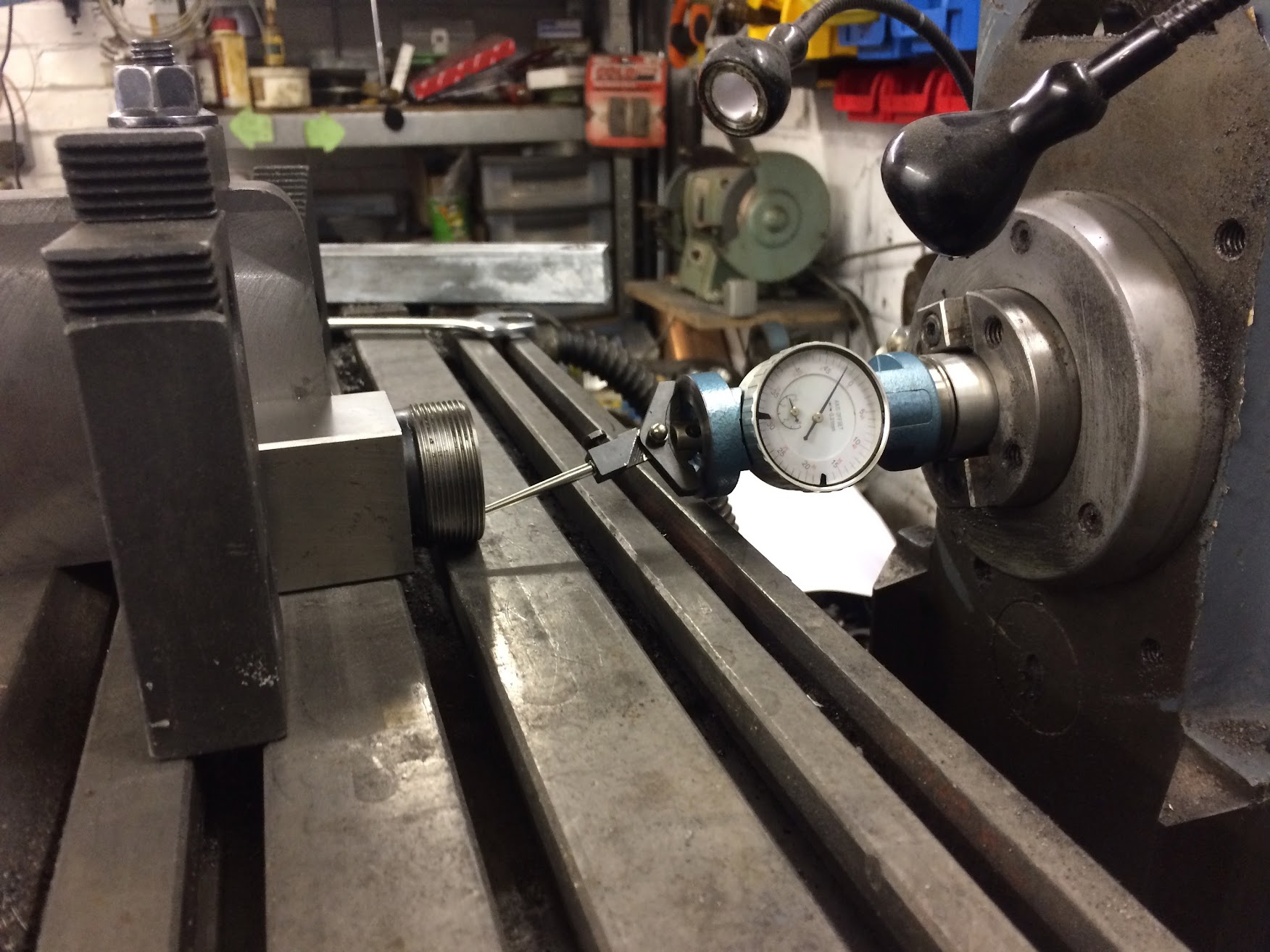

 mechman48
 petro1head
 Muzzer
 Keith Fox
 Nige
Nige Ketan took the time to walk me through the machine and show me loads of necessary 'stuff' about draw bars and R8 spindles and arbors. A demo of the machine running and its various facilities followed; all in all a very worthwhile visit plus a cup of tea on arrival. Much impressed as a customer. thank you Ketan
  gareth evams
 )
) Russell Eberhardt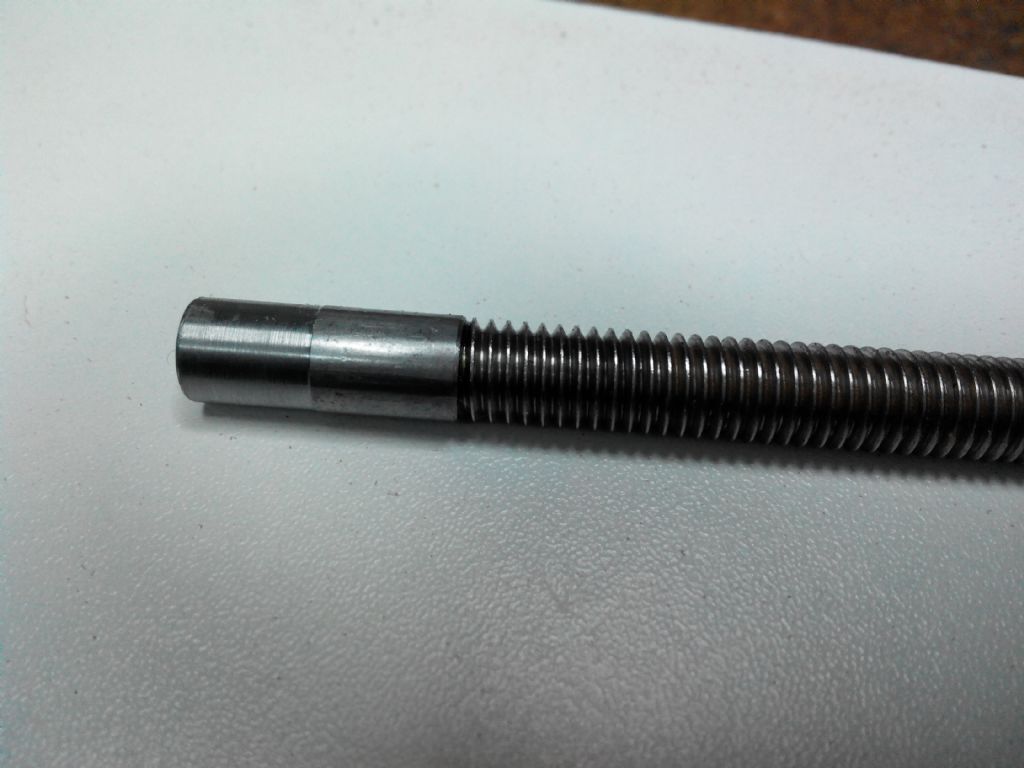
 Colin LLoyd
 Martin 100
 JasonB
 KEITH BEAUMONT
 John Purdy
 Russell Eberhardt
 tgglass
 duncan webster 1
 john fletcher 1
 Michael Gilligan
 Martin Johnson 1
 fingerscrossed
 teamricky
 Wade Beatty
 dean clarke 2
 Bill Phinn
 alecs
alecs Kiwi Bloke
 Graeme Seed
 old mart
 lucerne
 COLIN MARTIN 2
 grizmaster
 noel shelley
 Dunc
Dunc Mike Cooke
 Speedy Builder5
 Trevor Gale
 Harry Broadbent
 Bazyle
 ron vale 3
 Weary
Weary ray1580
 Howard Lewis
 wilfried54
 Werner Schleidt