Search Results for 'zan'

Search Results for 'zan'

Home Forums Search Search Results for 'zan'

Viewing 25 results - 226 through 250 (of 557 total)
  • Author
    Search Results
  • #521629

    In reply to: Unimat 3 collet holder

    Turbine Guy
    Participant
      @turbineguy
      Posted by Jouke van der Veen on 21/01/2021 20:33:49:

      Emco C5 spare parts etc. can also be bought at Emco Holz & Hobby in Austria.

      Thanks for the source. They appear to sell the collet holder I thought would be ideal for me as shown in Holz & Hobby This source could be useful for other EMCO parts.

      #519819

      In reply to: oversize ER16 collets

      Roger B
      Participant
        @rogerb61624

        These people have them, but I don't know if they can deliver to the UK at the moment.

        https://www.maschinen-werkzeuge.com/de/spannzange-er16-o-12mm.html

        #512995
        Michael Gilligan
        Participant
          @michaelgilligan61133

          Nigel wrote:

          “I've not managed to establish the number's meanings”

          .

          .

          Dimension D2 is the relevant one, Nigel

          **LINK**

          https://us.rego-fix.com/system/files/docs/2017-09/RFAG_TD_ER_Spannzangen-Masse_EN_0.pdf

          MichaelG.

          #512740
          peak4
          Participant
            @peak4

            Ketan, I appreciate this might not affect you directly as it's concerned with EU>UK imports post Brexit, rather than vice versa, (and I think regardless of a deal.)
            In a way, it seems to put UK buyers, from EU vendors, in a similar position to your EU customers.

            If I've got my head round this correctly, the UK (and I think the EU) are removing the VAT exemption for low value imports.
            At the moment in the UK, the VAT and any duties are collected by the carrier, and are due before final delivery; hence Royal Mail etc, leaving a card at the destination address detailing fees to be paid, and their admin charge for that fee collection. (Currently as we are within the EU, so long as VAT is collected at source at the appropriate rate for the vendor's country it's all OK)

            When the rules change, VAT is to be collected by the vendor (if commercial, as opposed to a private sale), and must be paid to HMRC directly by the vendor.
            In order to make this payment, the EU vendor must create an account with HMRC, for which they are charged a fee.
            I believe this applies to non UK landed goods.

            There are various press reports about this, but many are behind paywalls; This one explains the gist, and refers to some Star Trek items which is what caught my attention originally in The Times. (Paywall)
            https://toyworldmag.co.uk/post-brexit-vat-rules-set-to-cause-significant-impact-on-trading/
            https://www.thetimes.co.uk/article/its-vat-jim-but-not-as-we-know-it-william-shatner-laments-post-brexit-rules-5t26rdd6k

            Freight forwarders ebay etc. seem to be able to collect the VAT on behalf of the EU vendor, and pay to their HMRC account.

            This document seems to go some way towards explaining the situation, see para "How will the operation of VAT change after Brexit?" et seq.
            https://www.instituteforgovernment.org.uk/explainers/tax-brexit

            A small vendor may well feel that it's too expensive, or too much hassle, and thus not register with HMRC and so not be able to export into the UK.

            An example came up on another thread on here where someone was pointed to an EU seller of some collets which aren't common in the UK.
            If that vendor doesn't register with the HMRC, they won't be able to export here directly.
            Indeed, when I looked at their website, I got a warning flag stating delivery only to EU (along with a couple of other countries, Suisse and Koweit sic.)
            https://www.georgessavoie.com/en/store/collets-zugspannzangen-2/product-1.html
            [Similarly, if you look at Stefan Gotteswinter's site, he doesn't currently export his precision stones to the UK.
            I think this was due to the previous deadlines before the implementation of the withdrawal agreement]

            Bill

            Edited By peak4 on 10/12/2020 22:35:23

            Edited By peak4 on 10/12/2020 22:36:58

            #512633
            John Hinkley
            Participant
              @johnhinkley26699
              Posted by DC31k on 14/09/2020 14:37:31:

              Posted by Alexander Smith 1 on 14/09/2020 13:11:58:

              …Schaublin P9 collet …then hen's teeth are common in comparison

              M. Georges Savoie must be feeding his hens something special then:

              https://www.georgessavoie.com/en/store/collets-zugspannzangen-2/product-1.html

              They are secondhand, though. So to be fair they should be called hen's dentures!

              John

              #512051
              Grindstone Cowboy
              Participant
                @grindstonecowboy

                Hi br – it was kind of a running joke in our office to mix the punchlines up. Similarly, "look at that one-eyed cow over there" was responded to by covering one eye and saying "Where?", when the real joke should be "look at that cow over there with one eye".

                Apologies, and finally, what's white and swings through the trees?

                Tarzan the fridge.

                Rob

                #510916
                Gary Clarke 4
                Participant
                  @garyclarke4

                  Thanks All for the comments and suggestions. I think improving the ridigity is a good idea. I will lock down all the unused axises (axiii?). Zan's suspicion is likely any accurate assessment.. can climb milling be avoided by reversing the spindle or ?

                  Gary

                  #510905
                  Zan
                  Participant
                    @zan

                    What moved? The vice? Vertical slide?
                    I suspect though as already said the slides should be very securely locked.
                    i think this is mainly a backlash issue. I bet you fed in towards the centre to position the slot. I.e pushing the slide in. The normal cutting tool in turning will be forcing the slide out against the thrust bearing on the screw. Your cutter does the opposite and will pull it in away from the thrust bearing. So you are effectively suddenly giving a setup with little intrinsic rigidity a climb milling situation , and all the backlash will be taken up, thus once any inevitable snatch starts it will rapidly increase

                    perhaps a way forward is to make it a slightly elliptical slot by starting a cut at the back and feed in FPS out from the lathe centre a trace then go back, increase the depth and repeat . You will still be climb milling but the cut will be of a significantly reduced length rather than the full periphery of the cutter. Best to experiment on an unimportant bit of stock

                    Edited By Zan on 30/11/2020 18:56:47

                    #510594

                    In reply to: Radial Engine

                    Howard Lewis
                    Participant
                      @howardlewis46836

                      When 3 cylinder aero engines are mentioned, the Anzani immediately comes to mind.

                      Wasn't it a 3 cylinder that brought Louis Bleriot across the channel?

                      Howard

                      #510485

                      In reply to: Radial Engine

                      JasonB
                      Moderator
                        @jasonb

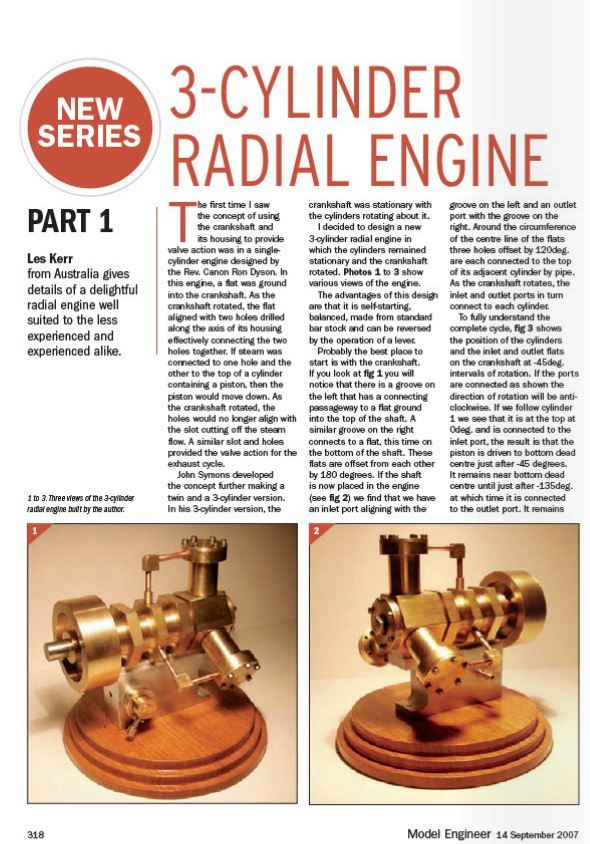
                        The Anzani and Cygnet Royal both used alloy castings for the crankcase, Les Kerr's one is a likely candidate as that uses brass hex. ME 4308, 10 & 12

                        3 cyl radial.jpg

                        #510476

                        In reply to: Radial Engine

                        John Purdy
                        Participant
                          @johnpurdy78347

                          Finley

                          Not sure if this is the one you are looking for but L.W Chenery wrote a build series in ME on the Anzani 3 cylinder aero engine of 1910 starting in Me volume 177 1997 #4022 and ran for 11 parts.

                          John

                          #509090
                          Zan
                          Participant
                            @zan

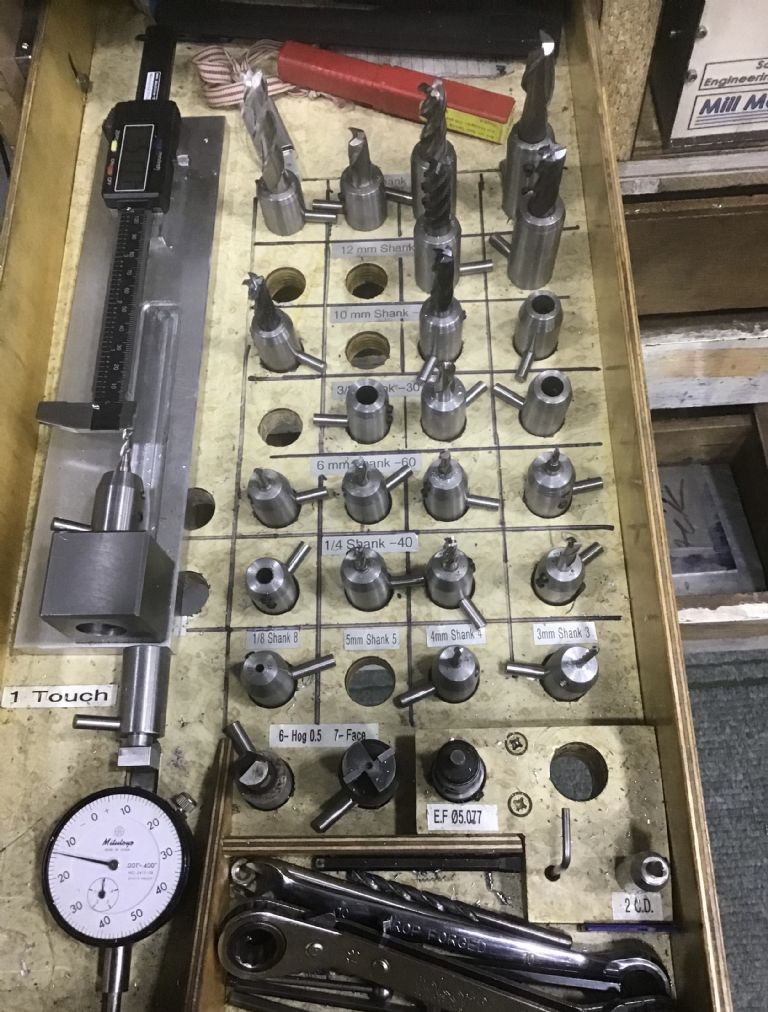
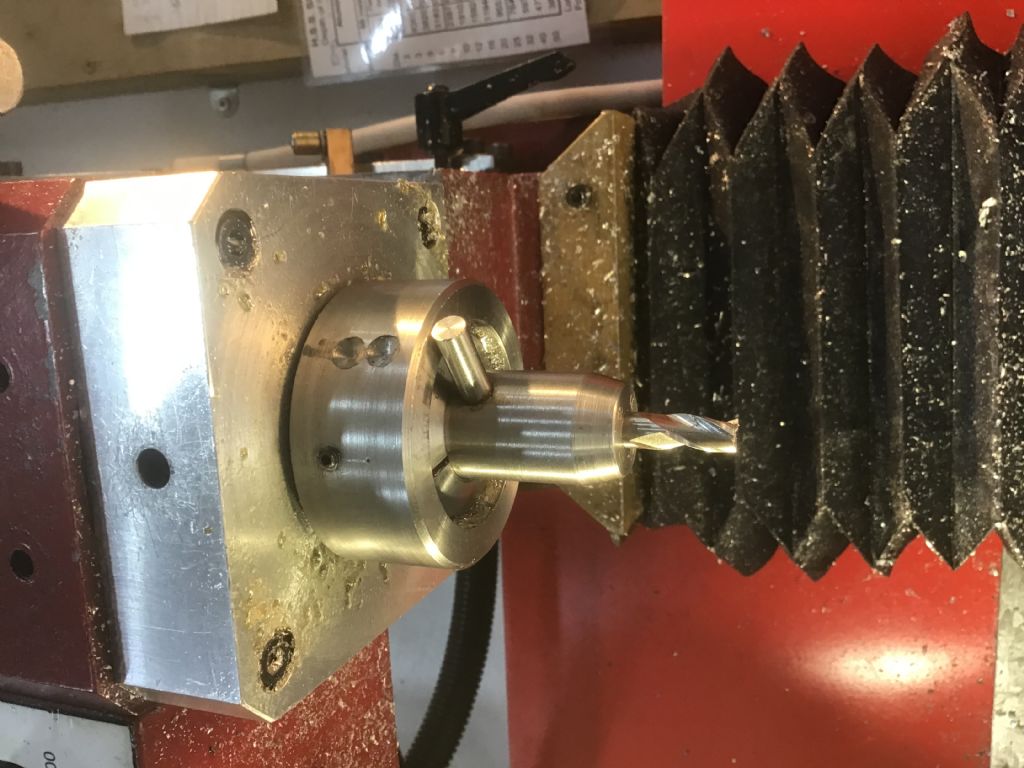
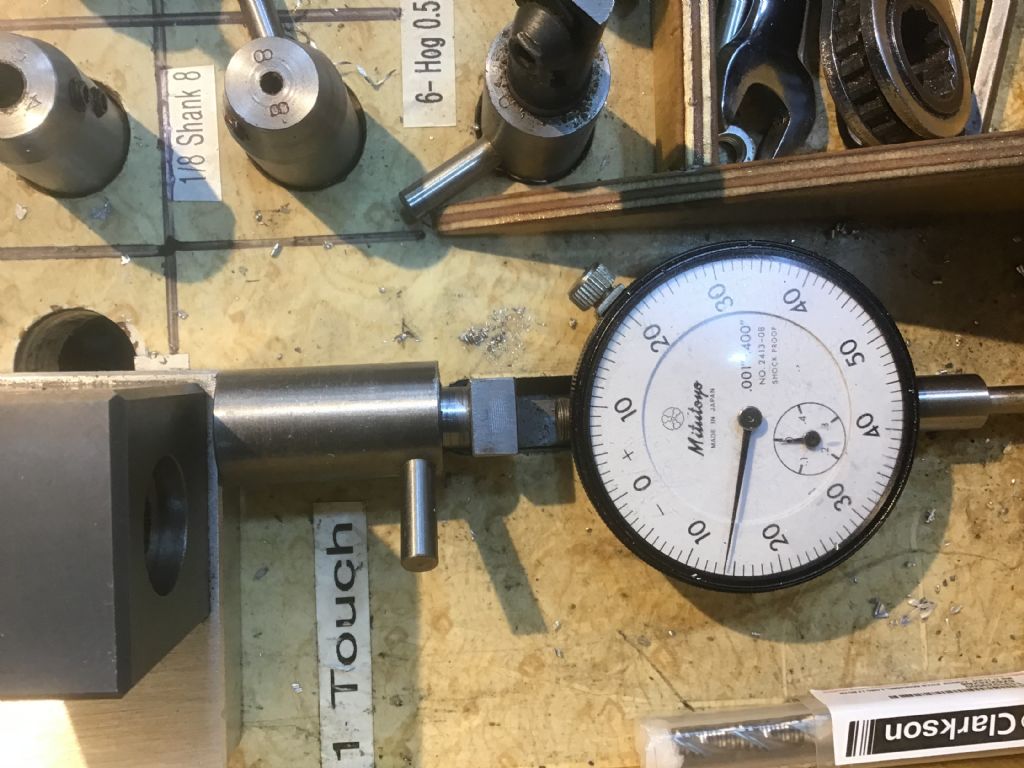
                            For my sx2 p cnc conversion I used the R8 spindle this was used with a 3/4 collet and the cutters are mounted in 3/4” silver steel chullets. They are very very carefully clocked in the 4 jaw then drilled, bored and reamed for the cutters held in place with 2×2 ba grubs. Height location is with a 5/32 silver steel bar registering against a machined ring ( in situ) on the end of the spindle. Photo 2, offsets are set off machine in a dedicated setting device seen in photo 1 . It’s highly accurate and the silver steel cost little from a specialist supplier near Harrogate

                            The advantage of this system is it is ridiculously cheap and has a very very small extension unlike many er chucks , and as Ketamine says, the sx2 is a mini mill and thus the more we can help it the better

                            The height is set with the dti device in photo 3 it has a length of 115 mm when the clock reads zero when in contact with the work

                            8e04841c-83dc-4002-86ab-7bcde086b530.jpeg

                            2369b6496-7ffe-4a43-a93c-2917dab55034.jpeg30771fc09-5631-489a-b841-0813b391ca05.jpeg

                             Sorry about the aspect ratio!
                            once the cutters are fixed in their holders the size is recorded from the setting jig in the Mach 3 tool table, and in addition into Fusion 360 which I ciponstantly use for 3D cad and cam code production.

                            The machine is very well used.   Pm me for more info

                            Edited By Zan on 21/11/2020 23:34:13

                            Edited By Zan on 21/11/2020 23:38:57

                            #508811
                            JasonB
                            Moderator
                              @jasonb

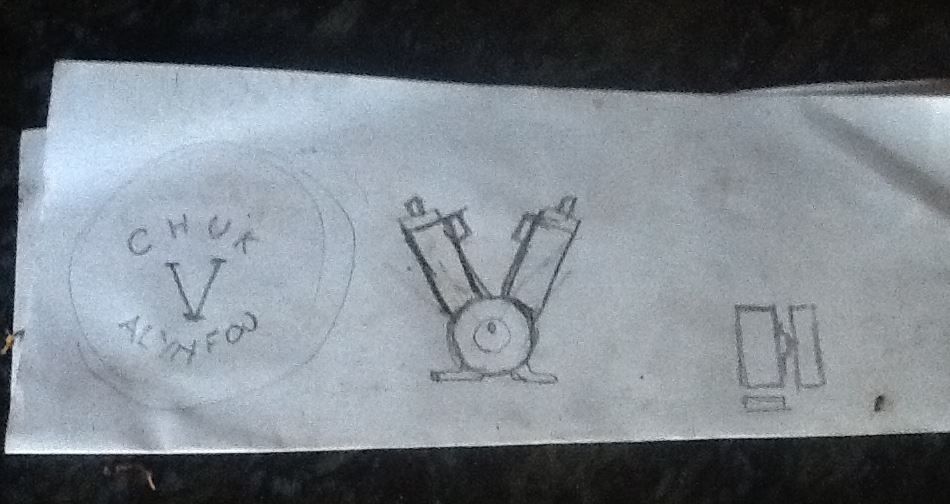
                              Regular forum followers may have seen me mention that I was working on something but could not reveal more detail at the time. However I can now say that I have been collaborating with Graham Corry of Alyn Foundry an a new engine to extend his existing "CHUK" range

                              From Graham:

                              "CHUK " V "

                              The Vee Twin, my liking for them possibly inherited? Dad drove and competed with Morgan three wheelers through the late 40's and early 50's fitted with engines from Anzani, JAP and Matchless, he loved them.

                              As a natural progression my CHUK range developed starting with a vertical then an inverted vertical and onto a horizontal. The engines were conceived on a modular basis so the same patterns and castings could be used over and over keeping production costs to a minimum. CHUK 4 ( an inverted vertical twin cylinder ) is still in part built form and will be finished when it's finished.

                              The Vacuum, flame licker/gulper engine is one of the simplest to build and equally easy to run. This was the main reason for its choice as a build project aimed at novice entry level to model engineering.

                              I mentioned the concept to Jason Ballamy whilst he was helping me with some patterns for my long term project, the Brayton Readymotor. Within a couple of days I received 3D images of my concept via email. Several more interchanges later and CHUK " V " became a reality. To see a pencil sketch become wood then metal in a fraction of the time it used to take shows the amazing power of CAD and CNC . CHUK " V " ? Well the Roman numeral for five is the letter " V " quite an obvious choice really. Whilst the concept is mine due credit must go to Jason who has virtually designed the rest of this engine.

                              The number 5 will predominate in this particular build and my choice of using Aluminium instead of good old cast Iron is based upon a chance sighting of a Stuart Turner " bottle " steam engine. I was really taken by both the shape and nicely polished surfaces. Cast Iron is still in predominance as both air cooled cylinders, pistons and heads will be made from it. The engine will also use my recently improved " rotary " valve and
                              " Chipmaster " exhausts.

                              What will follow is our documented collaboration of a new engine from the Alyn Foundry stable. Some Iron castings are still on order but the Aluminium crankcases arrived yesterday from my dear friends at Madeley Brass. Hopefully we'll see a working Vee twin vacuum engine for our efforts or perhaps a nicely polished door stop? Time will tell….

                              Now over to Jason…."

                              #507699

                              In reply to: Strange Word…

                              Sam Stones
                              Participant
                                @samstones42903

                                Aoccdrnig to a rscheearch at Cmabrigde Uinervtisy, it deosn’t mttaer in waht oredr the ltteers in a wrod are, the olny iprmoetnt tihng is taht the frist and lsat ltteer be at the rghit pclae. The rset can be a toatl mses and you can sitll raed it wouthit porbelm. Tihs is bcuseae the huamn mnid deos not raed ervey lteter by istlef, but the wrod as a wlohe.

                                I cdnuolt blveiee that I cluod aulaclty uesdnatnrd what I was rdanieg. The phaonmneal pweor of the hmuan mnid, aoccdrnig to a rscheearch at Cmabrigde Uinervtisy, it dseno't mtaetr in what oerdr the ltteres in a word are, the olny iproamtnt tihng is that the frsit and last ltteer be in the rghit pclae. The rset can be a taotl mses and you can still raed it whotuit a pboerlm. This is bcuseae the huamn mnid deos not raed ervey lteter by istlef, but the word as a wlohe. Azanmig huh?
                                Yaeh and I awlyas tghuhot slpeling was ipmorantt!

                                **LINK**

                                #507094
                                Zan
                                Participant
                                  @zan

                                  Andrew. He said……“ I have bought some second hand 2", 3" and 4" micrometers. Is there any way to check that they "zero" correctly without using a block of known size?”

                                  The only way to zero a 2” micrometer is with a 1” standard you refer to a 1” micrometer 


                                  Edited By Zan on 12/11/2020 19:45:27

                                  #506977
                                  ega
                                  Participant
                                    @ega
                                    Posted by Zan on 10/11/2020 23:19:48:

                                    If you get a new Chuck go for a 4 jaw self cantering. They give a very solid grip on material are incredibly accurate and contrary to popular belief they still grip hex material on centre. Despite the warnings above, my 125 mm has been on my well used S7 for 20 years with no ill effects

                                    Interesting suggestion and I didn't know about the hex point.

                                    I can't help feeling that a 4J SC would have to have exceptional accuracy for each jaw to bear equally on round stock. I have got one which I use for non-critical holding of cold-rolled square bar but for accuracy and grip would use the independent 4J.

                                    #506634
                                    Dave Barr
                                    Participant
                                      @davebarr43722

                                      Zan, thanks for your reply. I know swivel bases don't suit everyone but the things i do and the way i work I find them very useful. Good point about the drive and swarf I'll maybe re-site it or perhaps make a guard from acrylic sheet cheers!

                                      #505673
                                      Zan
                                      Participant
                                        @zan

                                        There’s fundamental problems with Tom’s tables in the past I have used them but i became exasperated with my copied tables until I realised the error
                                        why? His speed for a 1/4” 4 tooth endmill is 960 in steel with 1 -3/4” feed , yet for a slot drill it lists 1600 rpm and a feed of 3” min. He has the headings the wrong way round! If you follow this point then the tables are very low in cut per tooth

                                        using the 4*cs/ dia yields 1600 rpm ( cs= 100 fpm) Using a feed per tooth as recommended between 0.0005” and 0.002” this yields a feed rate of

                                        fr= rpm x no of teeth x feed per tooth

                                        = 1600*4* 0.001= 6.4 Inches per min.
                                        Tom’s numbers are at the bottom of this range, and he states the tables came from Clarksons Autolock Chuck data.
                                        with more modern spiral endmills with various coatings and the increasing use of carbide cutters in the home workshop, his tables aRe becoming outdated

                                        Edited By Zan on 06/11/2020 21:25:40

                                        #503362
                                        Zan
                                        Participant
                                          @zan

                                          Strange! Inconsistent errors. This is where slip gauges are a help

                                          1. Carefully check all the mountings fir movement also the x slide screw, thrust bearing and the nut ( unlikely but it’s for elimination while you are at it, check the gibs) check there is no movement on a dti while the x slide is being locked

                                          2 clamp a block of known size say a 321 block with a bar of flat clamped to it extend beyond say the headstock end So giving two test faces in the same plane
                                          use a dti to set it parallel then feed in to zero on tthe block with the dti then zero the x slide dial n DRO. Check on the clamped bar. After a small movement to clear with the saddle
                                          this will check the DRO and the feed screw

                                          Ha! Some similar comments while I was thinking about this n typing!

                                          Edited By Zan on 25/10/2020 09:53:17

                                          #500824

                                          In reply to: Grumpy old men

                                          Oldiron
                                          Participant
                                            @oldiron
                                            Posted by Zan on 11/10/2020 13:39:18:

                                            Tv programs with what will happen in the next part. Very annoying if it’s say part 4 of 6 drama series and it’s a critical point with the story line hanging. If it’s been watched fir this long, why do I need to know what’s next

                                            In a similar vein previews and reviews before and after adverts , is this a way of expanding material to fill the the actual time needed?

                                            Advert intervals which are not 4 mins it makes the time jump on playback trying….. Esp when sometimes it’s only 2 mins…..we never watch things live, saves hours of time a week…..

                                            I watch almost no tv these days but my wife noticed a program I might enjoy so recorded it for me. I was very miffed when the 1 hour program turned out to be 19 mins long if you cut the adverts and the prefaces and suffixes from it. regards

                                            #500713
                                            Zan
                                            Participant
                                              @zan

                                              Thanks sod and David. Yes I missed the 9-7 at 4.1 ohm I discovered that at 2 am as there was no way for this to happen in a delta connection and found the 7-9, with repeated meter readings, and thus 78&9 could only be connected as a star, after 4 sheets of attempted drawings being the only possible way it would work . However by that time my head was spinning Too much to post!
                                              I was under the impression that any star connection would not work at 240 v however after a lot of trawling with the Dahlander connections (thanks John, the actual name of the connection was a great help) I did find one reference to a star working at 240v but John’s diagram now makes this abundantly clear…

                                              it seems that it was connected in the only way it would work and actually there was no problem at all! That’s The trouble with limited understanding, it’s hard to actually pin down to a faulty motor or inverter, and which caused the problem, one ,the other, or both!

                                              However it’s very good to be absolutely sure I killed this inverter with the momentary disconnection of the motor while changing direction, although it did take a while to actually fail , the first Inverter was I think just bad luck. So now a decision, a cheap £70-90 inverter off the bay or a decent Modern vector type at £180 plus……

                                              I think the latter, as I am contemplating removing the varispeed head because of noise in a home workshop , it’s fine in a massive industrial or educational environment. But I have to use ear defenders all the time when using the machine then the inverter will provide the speed change and I’ll use a multi groove belt .  I enjoy messing about with machines, after building my first lathe as a final year project at teacher training, built a Dore west bury miller, converted a sieg sx2 to cnc and much modified my decker type tool and cutter grinder 

                                              thanks to all


                                              Edited By Zan on 11/10/2020 10:51:39

                                              #500671
                                              David Davies 8
                                              Participant
                                                @daviddavies8

                                                Zan

                                                you have readings for 7-8 & 8-9 of 4.1 ohms. You don't show one for 9-7. If this also reads 4.1 ohms this proves that there is a star point buried in the motor windings. (The value of 4.1 ohms is equal to 1.732 x 2.4 ohms).

                                                Following your link diagram taken from the motor, the low speed connection is double star, where 4,5 & 6 form the other star point and linking 1-7, 2-8 and 3-9 puts the two star configured winding sets in parallel.

                                                If I knew how to attach my sketch I would.

                                                HTH

                                                Dave

                                                #500569
                                                SillyOldDuffer
                                                Moderator
                                                  @sillyoldduffer
                                                  Posted by Zan on 10/10/2020 16:27:38:

                                                  … I have only 9 wires not 12 so which coil is where?

                                                  3 sets of two coils connected internally give 9 wires. With an ohmmeter (low resistance range of multimeter), first identify which groups of 3 wires are connected together. (A, B & C)

                                                  Then identify the centre connection A of each triplet. The resistance between the two coil ends B to C should be greater that of either coil end to the centre, AB and AC.

                                                  dahlander9.jpg

                                                  Write it all down, it's the sort of job I get wrong!

                                                  Once the ABCs are identified, John Rudd's star and delta circuits can both be made.

                                                  Dave

                                                  #500558
                                                  Zan
                                                  Participant
                                                    @zan

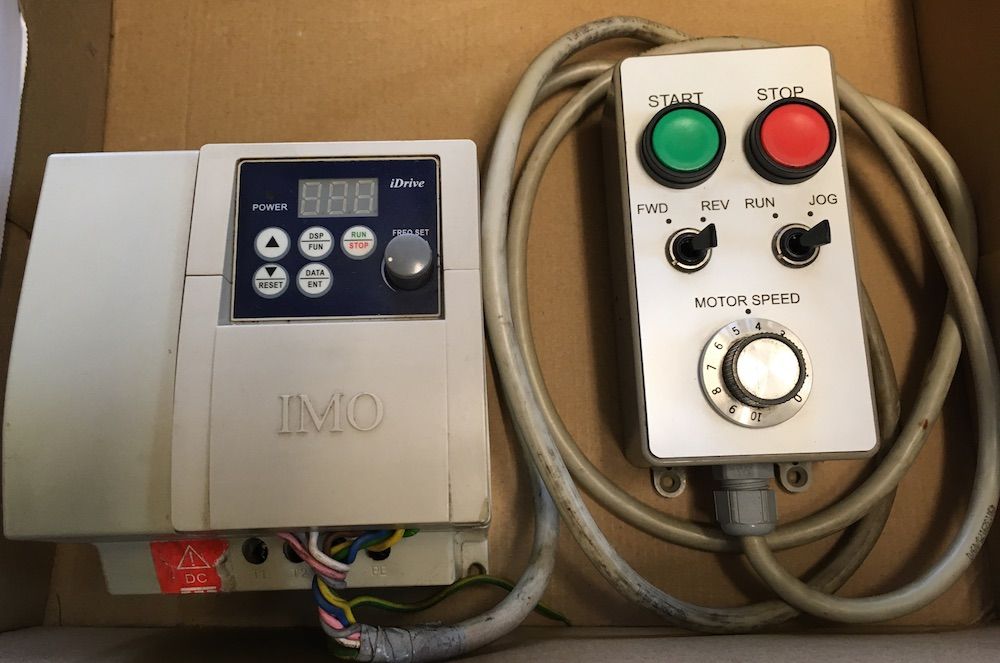
                                                    Single to 3 phase inverter problem

                                                    I converted my Bridgeport to 240v in 2005. I ripped out most of the electrics in the control box and replaced the contractors . The inverter was purchased on eBay

                                                    The motor was wired up as on the plate for low speed, which at the time I took to be 240 v (Probably not correct). The machine ran so I didn’t try any other connections. I used the varispeed on the 2JB head and ran the inverter at 50 Hz. The motor is two speed when running on 440 v 3phase and it has 9 wires.

                                                    The inverter failed in 2009 and was replaced, but when purchasing the new one I was informed the old one could be repaired, at a cost of £20 a capacitor was replaced by them and it worked! The engineer commented that it was a very old inverter. I sold it.

                                                    Now the 2009 inverter has failed Of course it was in the middle of an important job! All the ancillary electrics work ok

                                                    So some investigation was needed. It seems I wired the motor to a choc block as in fig. 1 from the motor plate as shown in fig.2. It seems that this connection as shown in Wikipedia  is a modified star as shown in fig 3. As the motor should have been wired in delta as in fig 4 it should not have run at all!..

                                                    But here is the conundrum, this diagram shows 6 coils so there should be 12 wires not 9. Some must be connected internally, or is it that I just don’t understand the workings of the two speed motor.

                                                    fig 5 shows the coil resistance at 2.4 ohms for all but 7-9 and 7-8 @ 4.1 ohms

                                                    I have tried unsuccessfully to sort out the diagram to account for this and the grey matter is spinning! I do not know what the colour coding means on the 9 motor wires

                                                    It is the inverter which has failed , I connected it to my drill motor ( 3 phase as well) and it just jigged back and forward even with u,v &w interchanged

                                                    I will probably get an upto date vector inverter rather than a straight VFD which will cost considerably more.

                                                    In February this year, I had to replace a part in the head and made the mistake of switching the rotary switsc from forward to reverse on initial testing. This I know is a big Nono the machine worked ok, but it was noticeable that for a while the motor seemed a bit hesitant to start but it has been worked hard during lockdown.

                                                    I don’t want to cook another inverter , so can anybody help with the connections please . I have viewed a lot of manuals and wiring diagrams, but none seem to match my setup.

                                                    c480fb7f-1df8-4be3-8239-83c7619db336.jpegThanks.

                                                    Edited By Zan on 10/10/2020 16:07:00

                                                    #499608

                                                    In reply to: Wanted stuart castings

                                                    Ramon Wilson
                                                    Participant
                                                      @ramonwilson3

                                                      Hi Nic,

                                                      I would support Jason here and seriously consider thinking on the lines he suggests. 'Castings' are seen by some to be essential but infact for the most part they can be dispensed with for the major part if not all of the time.

                                                      I have a good friend who could not see beyond buying castings but in the next moment complain about the general quality of them. Fabricating can produce very good results that will live up to expectaion in all but the most hard working of circumstances. If it's just to run on air or low pressure steam a fabrication will be just as serviceable.

                                                      I do this, where possible, in favour of castings for several reasons, not least the control of quality and in most part expense. The main block on this cylinder head is made from seven pieces of cast JB Welded together – it's for a working modified Stuart Double Ten working on 60psi steam in a steam launch. It should be stressed that the material does not have to be cast iron. Jason has many other examples to support this method too. This is not to say that castings do not have there place but to say that with a bit of thought there is a definite alternative.

                                                      Here's a thread where I first used this product and method to simulate castings, which may be of interest Waller engine. The engine, now several years old, exhibits no indication of how it was made and has run regularly at shows each year save this one since finishing it.

                                                      Good luck with whatever way you decide to go – making any engine is a very rewarding experience – a fact I'm sure your Grandad would be the first to agree to.

                                                      Regards – Ramon (Tug)

                                                    Viewing 25 results - 226 through 250 (of 557 total)

                                                    Latest Replies

                                                    Home Forums Search Search Results for 'zan'

                                                    Viewing 25 topics - 1 through 25 (of 25 total)
                                                    Viewing 25 topics - 1 through 25 (of 25 total)

                                                    View full reply list.