Pete Rimmer
@peterimmer30576
Posted by DC31k on 11/07/2022 06:26:31:
Posted by Pete Rimmer on 10/07/2022 22:19:45:
That's a 2.25 module gear in the picture. Being 6" long I guess you could call it an involute spline but essentially it's a long 2.25MOD involute gear.
It's a good observation on the relationship between OD, teeth and module, but that does not necessarily mean it can be called a gear nor can we infer that a gear cutter will form the tooth spaces correctly.
Splines have different geometry to gears, specifically the relationship between pitch diameter, addendum and dedendum. In particular, spline teeth are considerably shallower than gear teeth. In a way, they are roughly analogous to a stub tooth gear profile (I think Fellows had one, designated, for example, as 6/8). As for pressure angle used on splines, we would have to do further research.
There is a set of softwate called MITCalc, which offers a spline module for 14 Euros. Even if a person did not want to buy that, the documentation for that module tells you what you have to measure to identify the spline.
It's possible but I would bet my hat that it's a 20PA gear profile just going by the photos. It would take some decent measuring to find out but a simpler method would be to print the profile generated by geardxf and stand the gear on the print. It would be obvious right away.
Leo F Byrne 1
@leofbyrne1
I made a filing rest for octagonal silver and ebony violin/cello adjusters. I used mini bearings from Arceurotrade and haven’t had problems.
Leo
DC31k
@dc31k
Posted by Pete Rimmer on 10/07/2022 22:19:45:
That's a 2.25 module gear in the picture. Being 6" long I guess you could call it an involute spline but essentially it's a long 2.25MOD involute gear.
It's a good observation on the relationship between OD, teeth and module, but that does not necessarily mean it can be called a gear nor can we infer that a gear cutter will form the tooth spaces correctly.
Splines have different geometry to gears, specifically the relationship between pitch diameter, addendum and dedendum. In particular, spline teeth are considerably shallower than gear teeth. In a way, they are roughly analogous to a stub tooth gear profile (I think Fellows had one, designated, for example, as 6/8). As for pressure angle used on splines, we would have to do further research.
There is a set of softwate called MITCalc, which offers a spline module for 14 Euros. Even if a person did not want to buy that, the documentation for that module tells you what you have to measure to identify the spline.
IanT
@iant
I've used Simply Bearings, Bearing Boys and (of course) Arc Eurotrade in the past, have enjoyed excellent service and will continue to use them all.
However, I recently decided to replace the Timkin (taper roller) bearings in my Atlas MF mill after some prolonged 'mulling' (e.g. the usual indecision). Whilst I couldn't detect any obvious problems with the existing bearings, I reasoned that (after 70 odd years) they might not be in perfect condition and it would make sense to do it while the machine was in bits and the headstock easily accessible.
So I shopped around and came across Bearing Basement (in Antrim, NI) and they had the bearings I wanted at a good price discount on both 'Simply' & the 'Boys'. I was a little bit dubious (not used them before) but the bearings turned up within the week and they appear to be the real deal. The savings paid for the Oilite bearings I needed for the other parts.
Regards,
IanT
Ketan Swali
@ketanswali79440
Posted by duncan webster on 08/07/2022 20:40:13:
Anyone know where I can get eclipse type 5/16 blades from without a mortgage. The blades sold by RDG are not the same, they have flat top and bottom
ARC does similar to eclipse type, but the smallest width is 10mm rather than 5/16. Here is the link.
Ketan at ARC
Michael Horley
@michaelhorley72278
Posted by Rowan Sylvester-Bradley on 06/07/2022 11:02:09:
Is this type of parting tool satisfactory?
LINK
There seems to be nothing much (except the taper) to keep the carbide tip in place, and nothing to stop the tip being driven deeper into the tapered recess.
Thanks – Rowan
I use that one on my S7 and it works perfectly in the front or rear tool post.
DMB
@dmb
I didn't make mine, I purchased ready made holder and blade. Unfortunately I cannot remember where from but it looks like the holder shown in RDGs Myford set. It's a taper sided wedge bar that holds the tool in the correct position within the holder. As I didn't buy the set, I wonder if it wasn't RDG but another supplier. I have just looked at Arceuro and Chronos and drawn a blank. I clamp it in the QCTP on the topslde and slacken the tool post, run saddle up to stationary chuck and hold the blade against the face of the chuck to align it and tighten the tool post nut. Running the S7 at reduced speed on the VFD, generous supply of cutting oil and no trouble parting off steel. Frying pan type sound. I have a casting + drawing from Reeves for the rear parting off tool post to Geo. Thomas'design, which I will get round to making up sometime with small changes as follows. A small plate screwed to the left hand side at the bottom to act as an alignment stop against the LH side of the cross slide. A T – nut full width of base + a bit on the RH side of the base to make it quicker and much easier to fit on to the cross slide. Should then be able to just wack it on and have it aligned all in one go.
Edited By DMB on 07/07/2022 19:41:15
SillyOldDuffer
@sillyoldduffer
Posted by Huub on 06/07/2022 13:39:24:
I don't think it is a good idea to learn parting using an insert blade. You will break a lot of inserts before you know how to do it. In the end you will spend a lot of money replacing these broken inserts.
…
Good luck
Not my experience, at least with the NCIH blade holder Rowan asked about! GTN2 inserts are stubby bruisers, quite hard to break even in my clumsy paws.
The secret of parting off seems to be rigidity and a steady feed. Quite easy on a well-adjusted big fast lathe with a Gibraltar rear tool-post and auto-feed. Much harder on a small slow slightly worn lathe, fitted with blunt carbide inserts overhung on a bendy QTCP that are then fed jerkily into the job by an over-cautious human.
And of course the edge has to be straight and at the right height, RPM and feed both correct, swarf cleared from the slot immediately, the cut well lubed, and care taken the edges don't pinch the tool as it approaches the centre.
What could possibly go wrong? Everything!
Dave
Tony Pratt 1
@tonypratt1
Posted by Rowan Sylvester-Bradley on 06/07/2022 11:02:09:
Is this type of parting tool satisfactory?
LINK
There seems to be nothing much (except the taper) to keep the carbide tip in place, and nothing to stop the tip being driven deeper into the tapered recess.
Thanks – Rowan
All the parting tools I saw in industry were as per your link so yes satisfactory.
Tony
Huub
@huub
Posted by Rowan Sylvester-Bradley on 06/07/2022 11:02:09:
Is this type of parting tool satisfactory?
LINK
There seems to be nothing much (except the taper) to keep the carbide tip in place, and nothing to stop the tip being driven deeper into the tapered recess.
Thanks – Rowan
I use these insert blades on my "large" lathe and the small lathe and they are OK. The higher the blade, the more rigid it is. I use a 26 and 32 mm high blade. My inserts (SP200 from Korloy) are 2 mm wide. After the first parting job, the insert is fixated and you can (re)adjust the tool height.
On steel, I don't part off the last 0.5 mm to avoid tool tip breakage.
I use lubrication (not cooling) on all parting jobs.
I run at 800 RPM, CD 0.2 mm/rev (power feed). I would like to run faster but than the lubrication splashes around.
SillyOldDuffer
@sillyoldduffer
Self-taught beginners benefit from sets because, starting out, they don't know what they need yet! Sets are good way of learning the ropes. Although some of the tools will be rarely used, you're paying to learn, not for hardware. Sets aren't so useful when you know what you need. But always compare prices: don't assume buying individual tools is always cheaper: sets can be better value even if some of the contents are never used.
I find questions like ' What's the best value sets available and where from' difficult to answer. It assumes too much about a complicated market! Very broadly though:
- Buying cheap at exhibitions, in pub car-parks, and from the internet is risky. Plenty of genuine bargains mixed with manufacturing rejects, too cheap, and counterfeits. Consumer protection is weak buying from private sellers, fly-by-night companies, and from abroad. Most of my internet purchases have been fine, but I'm ready to take the hit when it goes wrong. If you don't mind a gamble, buying this way can be good fun.
- Buying mid-range tooling from established UK outlets is much safer because consumer protection applies and many suppliers do the decent thing without fuss. The decent thing boils down to replacing duds, or money back: there is no guarantee mid-range tools will meet your expectations! Unfortunately the extra protection costs money, which deeply upsets all Model Engineers! However, it's my preferred method of buying tools and tooling. I mostly use ArcEuro, Warco and Tracy Tools, but RDG and several others have all been satisfactory. Just avoid too cheap!
- When money is no object, top-end gear can be sourced from industrial suppliers; well-made to a specification, quality assured, reliable, hard wearing and ready to go out of the box. Most new hobbyists arrive on the scene expecting to invest in the best tools available and disappear in a puff of smoke when they see the prices. Or an ambulance! This grade of tooling is aimed at industry working against the clock to make money, where the profits cover procurements costs. The economics are completely different from hobby engineering. It can be worth Model Engineers buying the best, but the truth is we rarely need it. Second-hand is a good source, but condition is everything – worn out tools are worn out, however good they were when new.
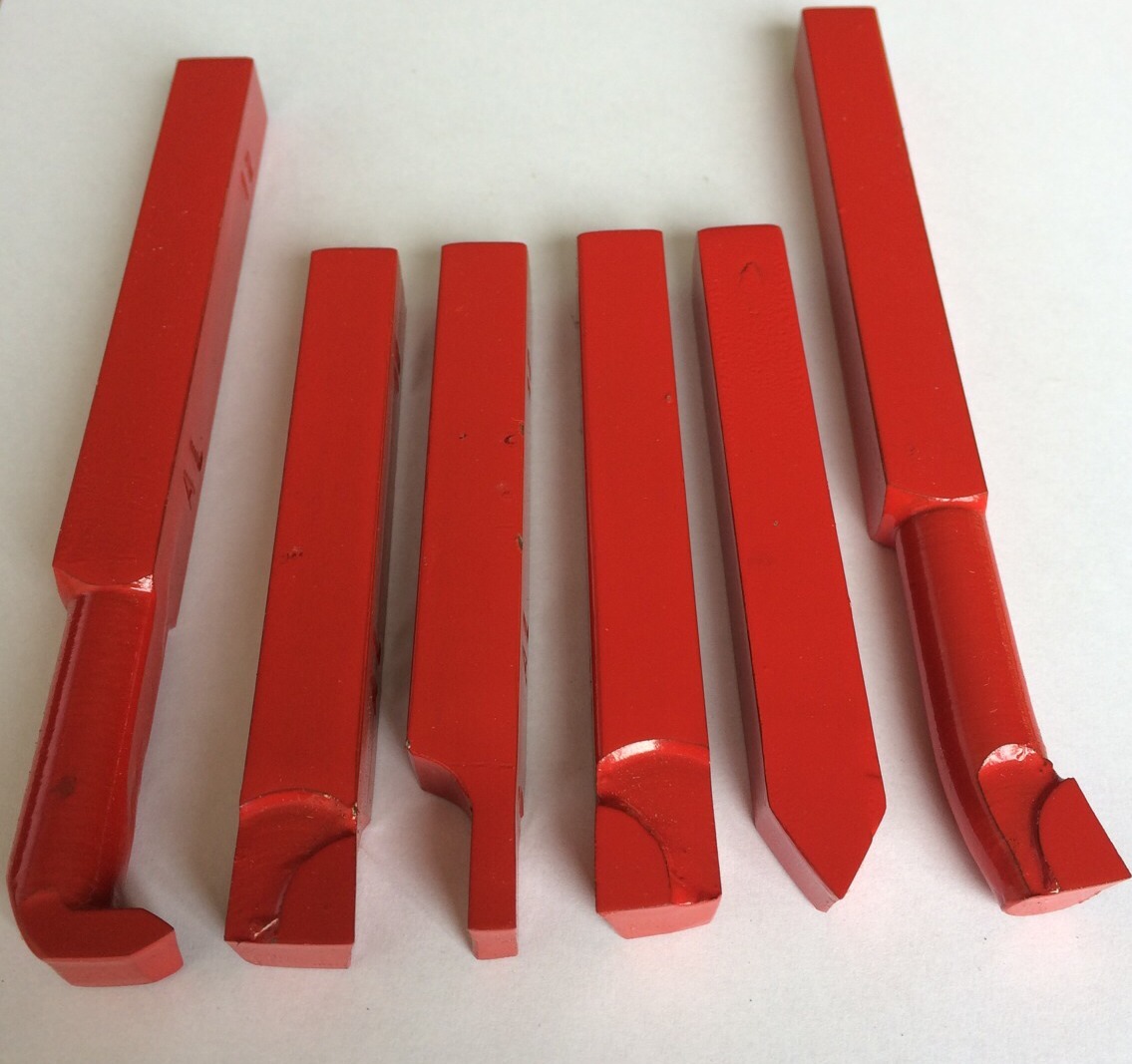
I mostly use carbide inserts with HSS as backup. Apart from home-ground form tools. my most used HSS tools came from this set, which I got years ago from Arc Euro. All used in anger apart from the 55degree threading tool. I broke the parting tool, and prefer something sturdier.
The range of inserts available is bewildering: Arc Euro sell a subset which happen to be a good match to hobby needs.
I don't recommend brazed carbide lathe sets resembling these:
They often arrive unsharpened and have to be touched up with the green grinding wheel mentioned by David George before use: bit much for a beginner I reckon. Must be useful for something, but to my mind they fall awkwardly between two stools. In my workshop they lack the massive convenience of carbide inserts and the tolerant virtues of HSS.
Dave
Rowan Sylvester-Bradley
@rowansylvester-bradley37244
Is this type of parting tool satisfactory?
LINK
There seems to be nothing much (except the taper) to keep the carbide tip in place, and nothing to stop the tip being driven deeper into the tapered recess.
Thanks – Rowan
Thor 🇳🇴
@thor
I have a set of HSS tools from ARC that has served me well for many years, they also do carbide insert tools.
Thor
Chris Murphy
@chrismurphy94983
Hi all,
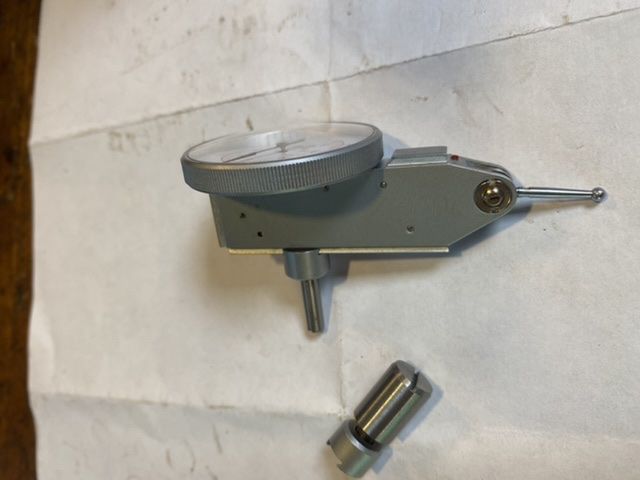
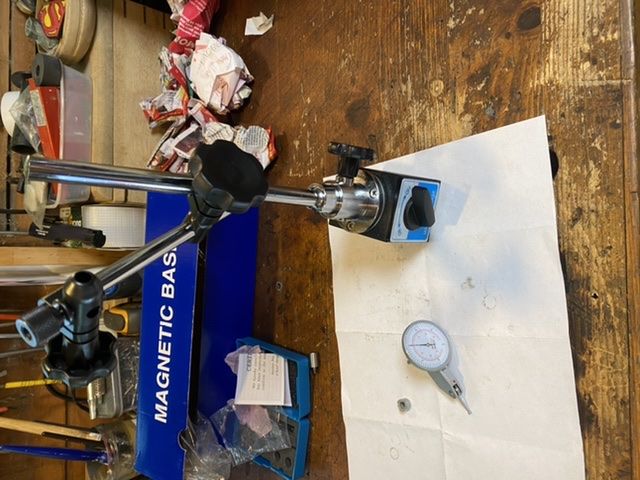
the dial indicator and stand are not compatible.
the dial spigot is 9.5mm and the stand takes an 8mm spigot.
I got this info after contacting Ian at arceurotrade, who are kindly going to send me an 8 m spigot in the post.
they were unaware of this and will have to change their website info.
thanks
chris m…..
Chris Murphy
@chrismurphy94983
I’ve tried it in all the holes all different ways,
they simply don’t fit.
I suppose I could drill the holes larger.
pill have to contact arceurotrade to sort this out.
they should tell you if they are compatible.
thanks all
JasonB
@jasonb
You have got the rod going through the wrong hole The rod should go into the hole hidden by the knurled nut. The stub on the dti can then go through either of the others depending on it's diameter.
Look at the photos on the arch site here
Edited By JasonB on 02/07/2022 15:50:30
Chris Murphy
@chrismurphy94983
Hi
i bought these items from arceurotrade and for the life of me I can’t figure how to attach it to the stand.
im thinking maybe they are not compatible.
can anyone help
thanks
chris m…..
SillyOldDuffer
@sillyoldduffer
I'm impressed by anyone who works a mill hard enough to polish the vice with an edge-finder!
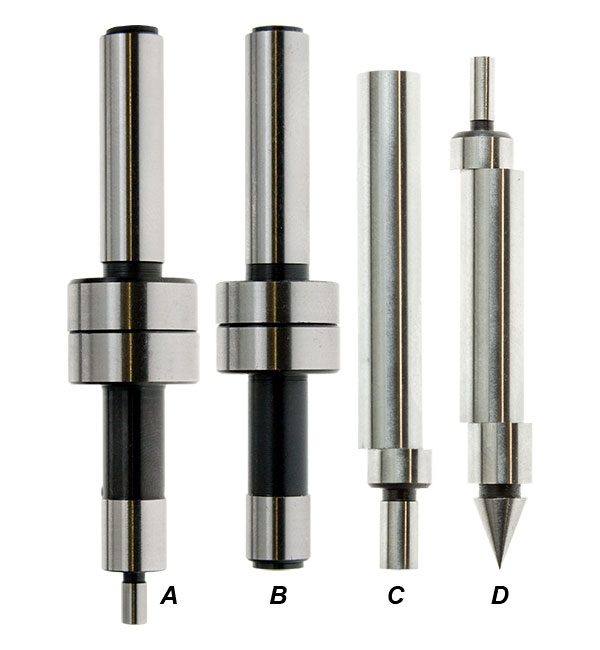
I doubt the smoothness is the cause though. Assuming the finder is one of this type, photo filched from Arc Euro:
The bottom half of the finder is free to float relative to the top except for a light spring that keeps the two halves from falling apart. When the finder is spun by the mill, the lower part is first nudged into alignment with the spindle's axis; the balance is both accurate and delicate. When the lower surface of the finder touches an edge, it flies off the axis. How far it goes is restrained by the spring.
As the spring is unlikely to change much, I suspect dirt has got inside and is restricting it's travel. On my finder the lower part can be pulled down far enough to allow in a squirt of WM40 or similar, which should dislodge any muck inside.
Dave
Speedy Builder5
@speedybuilder5
Dave Halford
@davehalford22513
Kelvin,
You imagine wrong . Sieg seem to be more protected against inadvertent overload.
You have quoted the ARC Euro Sieg SX2.7L long table price so not a direct comparison
Vic
@vic
Posted by Kelvin Jouhar on 26/06/2022 09:49:23:
I haven’t posted for a long time although I read the forum regularly. I have been building a Burrell 4” SCC traction engine from a kit supplied by Steam Traction World. I am no expert on engineering – I have a Chester Comet lathe (like an SC4) and now I am going to buy a mill. These are the candidates , which all look to me like the same machine, more or less.
Axminster SX2.7 – £2,200 – 3 year guarantee – will need to fit DRO later.
Warco WM16B with DRO – £2,170 – 1 yr guarantee.
Amadeal VM25LV with DRO – £1,730 – 1 yr guarantee.
Arc Euro Sieg SX2.7 – £1,740 -1 year guarantee – will need to fit DRO later.
The aftermarket DRO kits look to be about £425.
I am imagining that all these machines come from the same place in China, but maybe different importers handle them differently when they arrive here, or maybe have different things done before they are shipped. My reaction when someone is prepared to offer a 3-year guarantee is that they are more confident in the machine – on the other hand the Axminster IS more expensive to start with, and maybe that pays for the occasional problem…. Decisions…..Decisions…
Edited By Kelvin Jouhar on 26/06/2022 09:50:29
Given your list I’d find the extra couple of hundred beer tokens and buy my Warco VMC again. Having used several full sized millers I can’t contemplate using a machine with a head that moves up and down. The VMC was well over budget when I bought it but I’m so glad I spent the extra money. Good luck with whatever you decide.
Kelvin Jouhar
@kelvinjouhar72006
I haven’t posted for a long time although I read the forum regularly. I have been building a Burrell 4” SCC traction engine from a kit supplied by Steam Traction World. I am no expert on engineering – I have a Chester Comet lathe (like an SC4) and now I am going to buy a mill. These are the candidates , which all look to me like the same machine, more or less.
Axminster SX2.7 – £2,200 – 3 year guarantee – will need to fit DRO later.
Warco WM16B with DRO – £2,170 – 1 yr guarantee.
Amadeal VM25LV with DRO – £1,730 – 1 yr guarantee.
Arc Euro Sieg SX2.7 – £1,740 -1 year guarantee – will need to fit DRO later.
The aftermarket DRO kits look to be about £425.
I am imagining that all these machines come from the same place in China, but maybe different importers handle them differently when they arrive here, or maybe have different things done before they are shipped. My reaction when someone is prepared to offer a 3-year guarantee is that they are more confident in the machine – on the other hand the Axminster IS more expensive to start with, and maybe that pays for the occasional problem…. Decisions…..Decisions…
Edited By Kelvin Jouhar on 26/06/2022 09:50:29
DMB
@dmb
I recycle old envelopes by using the plain backs like index cards.
Each one is titled then a list, e.g.,
ME ONLINE FORUMS
ME/MEW(G-1) followed by the password
Followed by other forums
The (G-1) tells me that it's on my no. 1 Google account
So many sites needing passwords and other security info., I had to devise a way of classifying them in different lists to find details when needed. I found this works quite well. Passwords get change frequently. That fills up space so start new envelope list and shred old one.
Another list is titled ME. SUPPLIERS and lists quite a few like Arceuro, Maccmodels, The Tap & Die Co. Includes "The Nut & Bolt Store" as it's a handy local (Hove) emporium, giving their opening times.
Another list headed "Internet Traders" for miscellaneous sites like Giffgaff, Cheap Energy Club, MSE(Martin Lewis), Abebooks, Paramo(outdoor clothing), The RAC, Hove Polyclinic phone no.
Yet another is ME CLUBS for my membership info.
Several more lists, all of which helps me to find which Google or Yahoo account used to access my account and the password. Some cards like financial lack passwords and other vital info just in case of burglary. In fact most passwords have missing characters which I can remember to insert when used. Don't use social media so that much harder for scammers. Still get occasional emails and texts trying to catch me out like the recent one to pay £1.45 before parcel is delivered under threat of returning it on non-payment. As I delete it laughing and commenting well send it back then, ha,ha.
Hope the above may be of help to sort out an untidy muddle of sites and forums and which email address and keeping tabs on passwords.
John
Tony Pratt 1
@tonypratt1
Do you know what, the lathes are obviously copied from European models maybe Emco & the build quality is shocking in the extreme but they do cut metal & my Warco 290V also cuts parallel.
PS my inverted vee ways are not 90 degrees so not sure where they touch each other or what the angle is meant to be, they must rely on 'point' contact only!
Tony
Edited By Tony Pratt 1 on 20/06/2022 20:54:04
Mike Poole
@mikepoole82104
Arceurotrade have 3/8 x 7/8 bearings for about £1.50 each, skate bearings are 8x22mm and they are dirt cheap if you choose the cheapest. Wondering what was the price point you have in mind?
Mike


 Pete Rimmer
 Leo F Byrne 1
 DC31k
DC31k IanT
IanT Ketan Swali
 Michael Horley
 DMB
DMB SillyOldDuffer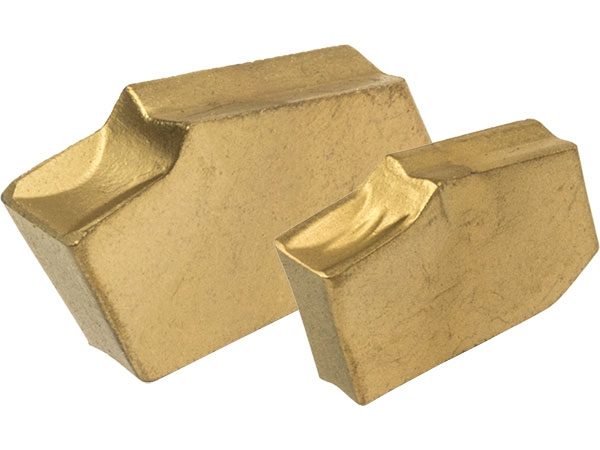
 Tony Pratt 1
 Huub
Huub
 Rowan Sylvester-Bradley
 Thor 🇳🇴
 Chris Murphy
 JasonB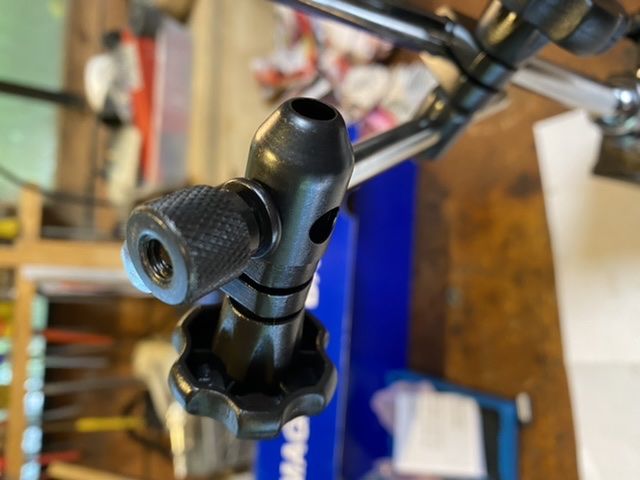
 Speedy Builder5
 Dave Halford
 . Sieg seem to be more protected against inadvertent overload.
 Vic
Vic Kelvin Jouhar
 Mike Poole
 Buffer
 Michael Gilligan
 Phil Whitley
 duncan webster 1
 Alan Wood 4
 COLIN MARTIN 2
 JasonB
 Bill Dawes
 Dave Halford
 SteveP
 Howard Lewis
 Alan Ambrose
 Adam Harris
 David George 1
 Mark Rand
 Chris Crew
 Dougie Swan
 Ian P
Ian P James A
 Andy Stopford
 Andrew Tinsley
 Clive Foster
 dee
dee Harry Broadbent
 vintagengineer
 Kiwi Bloke
 Tony Ray
 bernard towers
 lucerne
 dean clarke 2
 jimalm
 Vic
Vic Neil Wyatt
 Roger Harvey
 ega
ega Dalboy
 Graham Meek