I checked and the cost of an adept in 1933 was £4 10s which equates to £280.11 which happens to be the cost of A C0 Baby from ArcEuro.
I wonder how much it would cost to commerically produce a Super Adept these days considering the generally lower price of steel and low labour cost CNC machining.
Well, we had a truly enjoyable afternoon at Brian's place, playing with his lovely new lathe. As is usually the case, the big problem was really an accumulation of small variances. Both in equipment and operating procedures, as Brian has said.
The biggest contributor was a revolving tailstock centre that was not staying on centre. In fact, initial DTI reading revealed 0.30mm up and down movement at the large diameter of the centre itself. Hmm. A bit of exploration found a hitherto undiscovered tailstock quill clamping Allen screw on the far side of the tailstock body. Nipped that up and things improved drastically. But still there was 0.20mm up and down movement measurable at the centre.
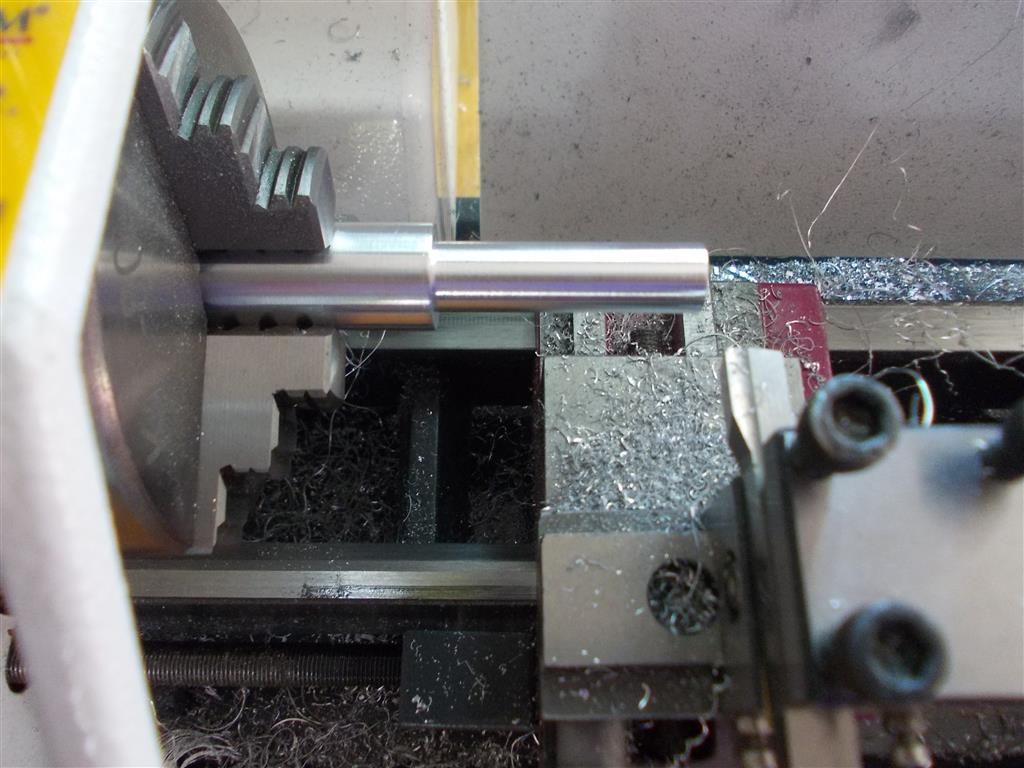
Turns out (no pun intended but all kudos accepted) the MT1 taper was a gnat's bicycle too small for the hole in the tailstock. So the taper was not seating. Instead the unmachined shoulder at the large end of the taper was hitting the tailstock quill and allowing the whole centre to flop about loose. Solution: chucked up the centre body and machined off the shoulder so the taper could seat properly. The lathe does its first ever piece of useful work and fixes its own problem. For now. DTI is showing just 0.02mm movement at the centre. Quite acceptable and about as good as you are going to get it with ball bearings that always have an internal clearance of maybe that much.
So we whiled away several pleasant hours then with a bit of tutorial on general lathe work, locking the cross slide, and so forth, and testing speeds and feeds on some sample pieces of ally and steel. All were turning quite nicely. Feed rate was measured and confirmed at 0.05mm per mm and giving a nice finish. We found the spindle high range speeds (300 to 3,000 rpm) was a bit hard to finely judge the exact rpm in the lower range. So we changed it to the low range, 150 to 1500 rpm and found much finer control over the rpm. A digital tacho would be real handy.
BUT THEN … we stopped for a cuppa and a chinwag. When we went back to the machine with a view to trying out some of the carbide toolbits etc the bloody thing was turning rough as guts again, chattering and squealing its head off. Great diagonal striations across the surface. Same pieces of material, same toolbits, same speeds and feeds. And nothing we could do seemed to make any difference.
Put the clock on the tailstock centre again, and found 0.20mm movement again. WTH?? This time it seemed the bearings had heated up and got looser. Put the dead centre in, nipped it up just so and all was good again. Problem solved!! Turning beautifully on ally and steel, and taking up to 1mm cuts on either, with both HSS and Carbide tools. Problem Solved!!!
Partly. The other part is that the headstock spindle had some measurable movement at the chuck mounting flange. No endfloat, but about 0.02mm at the flange with some gentle hand pressure on the end of a 100mm long bar grasped in the chuck. Not bad, for a spindle running on ball bearings that by nature have internal clearance. But by pushing with my fingers on the end of the 100mm long bar about as hard as I could, it was easy enough to get a reading of 0.08 or even 0.10mm at the chuck flange.
For us old duffers, that's three to four thou of spindle movement. Certainly more than I would like to see on the larger lathes I am more familiar with. But having no experience on these small lathes, with their small diameter spindles and light-on cast headstock and bed, I am not sure if this sort of movement is normal? IT could not be felt as "slop" but could have been some flexing of the spindle and bed/headstock unit? Perhaps those more experience with mini-lathes can enlighten us on that one. (Neil??)
I have seen on the ARCEurotrade site that with some of the Sieg small lathes, many owners choose to replace the standard ball bearings with angular contact bearings that can then be run with a small pre-load and therefore zero effective clearance. So perhaps the problem is the plain ball bearings? I know from experience that Chinese bearings can sometimes leave much to be desired compared with a good brand name such as SKF etc. Perhaps someone with mini lathe experience can comment on this?
So it seems that for any work more than 25mm from the chuck, the tailstock centre is essential for stability to stop the headstock spindle movement/flex etc getting out of control. So for most work, it is good enough. A fixed steady would be helpful for long jobs that can't take a centre, such as boring a long cylinder etc.
But as it stands, using the dead centre, the lathe performs beautifully for a little unit of its size and type.
The pre-ground HSS toolbits seem to work ok when fresh and sharp. The Hopper-ground toolbit likewise. There was a bit of trouble running in the high speed range and knocking the edges off, but using the low range and careful control of speed cured that. I am not sure the speed increase is linear per graduation on the control knob so care must be exercised (or digital tacho fitted!)
Overall I think Brian is pretty happy with the machine now and was turning away like a champion on the test pieces.
He is going to buy a better quality MT1 revolving centre. The one he has now is a "light duty" job. It does not have the screwed plate on the front of the body that allows large bearings, something like a 6203, to be used. It does not appear to have any bearing retainer visible, so I can only conclude that it is a solid lump with hole up the middle about the same diameter as the OD of the actual centre. IE about 16mm or so. So the bearings must be tiddlers of 16mm OD and perhaps 8 or 10mm ID. Not at all up to the job. The centre was an internet cheapie, not part of the lathe kit itself.
Hello Clive, John and Thor.
I bought my Emco Compact 7 lathe in 1982 and never opened the chuck since.
Today, after disassembling the chuck I saw that she had grease, in addition to lubrication that I put there in the volute and the jaws, in places I could not reach. So I think the chuck was lubricated at the factory with a black grease.
I found that the bevel gear has teeth slightly marked by use. The other parts of the chuck are in very good condition.
Since I have no graphite grease or dry graphite in the workshop, I used Molykote. I may have abused a little in the volute but, as access to it is easy, I will easily remove the excess grease soon.
To Clive: I couldn't found the stick trays in the supermarket. Thank you for your kind offer. It is a shame that we are so far apart...
I usually put the cutters in a plastic box having compartments after I warp them in kitchen paper towel soaked in oil. Some of them I keep in their original boxes when they have it. The last set of milling cutters I bought from Arceurotrade came in very well made boxes which are perfectly suitable for storage. It's a pity Arceurotrade doesn't sell just the boxes…
Especially for Thor: I made a mistake when I started to mount the chuck that scared me. I screwed too tight the pinion's pins and when I tried to fit the jaws, I could not do it. After correcting the blunder, apparently everything was working well in the chuck.
Today I mounted in the Emco Compact 8, for the first time, a 125mm chuck I bought from Emcomachinetools awhile ago. It's a nice Bison chuck but its size strange appears too strange…
One of these days I'll check its concentricity.
Thank you all for your help
Dias Costa
Try using some diamond honing stones to put the radius on. Arc Euro Trade sell some plastic backed ones.
I will try to answer all the questions but forgive me if I miss any. I was helping my wife with her new bicycle.
I knew somebody mentioned raising it ABOVE centre height but I was not sure where I read it. I have tried this and it DID improve the finish quite a bit. Why should this work ?
The technician never came a second time. I was hoping he would call back today but that did not happen.
I am using about 800 RPM. Increasing or reducing the speed does not seem to help the finish.
This is the same Aluminium that I have been using the whole time. It is from Norweld …not the scrap yard.
If I do not wind the tool out at the completion of a cut but wind it back along the piece (lazy !) then yes…..it does take quite a bit off on the return. Something I was surprised at. It has always been like this.
Using the centre is probably a bit worse than without a centre ; it certainly does not improve things. I do have a live centre but it is much bigger than the dead centre, making it harder to get in close on the tailstock end. I tend to only use the dead centre now.
No changes have been made to the gears.
I am not going in there for a while !
NIgel says the top tool is not suitable but this is the RH cutting tool from the Arceuro set. Does anybody agree or disagree with this assessment ? Which is the finishing tool in the set ?
Hopper : I have tried both ends of the tool.
The movement I was getting was definitely in the carriage and there was a LOT of it….you couldn't miss it. You could see the tool moving up and down as you took a cut. All movement is gone now after I tightened up the adjustment screws underneath. It took me many goes but there is now no movement at all when I try to rock the carriage by hand. This is why I am surprised that I am still having problems as I was sure this was the cause.
NOTE : I prefer kerosene to WD40 but I will try both.
Edited By Brian John on 15/09/2015 14:03:53
Edited By Brian John on 15/09/2015 14:05:19
Hello All,
Previously I posted about ER collet blocks in a 4 jaw independant chuck, and was having problems with the workpiece being parrallel to the spindle axis.
Well, having decided that they are not really designed for such a purpose I purchased a ER 40 collet chuck ,and hear is the outcome. Machined a new Rohm D1-5 backplate fitted the chuck grabbed a centerless ground bar 16mm dia 150mm long in a collet , elephants foot on the end of the Mitutoyo and runout at 100mm from the chuck face 0.019mm moved saddle towards the chuck by 75mm new reading 0.012 . Tried the same again with a Tungsten Carbide ground bar 20 mm dia and 200mm in length and readings at the bar end 0.015mm move 125mm toward the chuck new readig 0.011mm removed both bars, tried again and more or less the same readings, so great repeatability. Also tried a Rohm 20mm collet and results ever so slightly better. So im super chuffed with the chuck and is without doubt the best 49 pound iv'e spent in a long while.
The chuck came from Arc euro [ of which iv'e no connection, other than being a very, very happy chappy ]
If you are able to visit Hopper again it may be worth putting the lathe in the boot and taking it with you. Let him have a go on it and see if he can get a decent cut where you can't. At least that would eliminate user inexperiance as a cause of your poor finish.
This might be a good idea Brian. I have seen ARCEurotrade's web postings on fettling these little lathes and it would not be to hard to go through and give it a bit of a sort out. I've got all the gear we would need in my shed. If nothing else, we could give it a quick check over and measure up the bed, spindle play etc to ascertain if there is a problem with the machine, and see if it can be made to behave itself with a more experienced hand on it. Happy to help out if you want. (And satisfy my own curiosity about these Chinese lathes!).
But best to wait until the company's tech has visited you again. Give me a call if you want to come out again sometime and bring the lathe with.
Edited By Hopper on 12/09/2015 00:48:32
1. The technician who repaired the lathe the first time is going to come out and have a look at it on Monday.
2. It is possible that the lathe has sustained some damage in transit however I would have thought that this would have shown up earlier. Things were going well for a few days.
3. The tool height is correct ie. in line with the tip of the dead centre. When facing off the end of a bar I am not left with a knob of metal in the centre.
4. Even the unused LH cutting tool from the Arceuro set is giving the same result so I doubt that the problem is the RH cutting tool. The carbide tips are even worse.
5. Results are worse on auto feed. I thought auto feed would eliminate operator error.
6. The Sherline machines are very nice and versatile lathes but they are not cheap, especially now with the Australian dollar falling like a stone.
We are getting seriously off topic here, so Neil permitting………!
"John's" sensible posting above suggests providing LD50s to give "some idea" of toxicity. That bit needs qualification I'm afraid.
LD50 is the dose which kills 50% of animals receiving the substance. "Dose" is critical, it means the amount taken in and not the exposure concentration killing 50% of animals – for that we need the LC50 value and there aren't too many of them published. Most if not all LD and LC50 values are derived for mice and rats. Their relevance to humans is questionable. Apart from WWI data and a few other accidental exposures there are very few chemicals with LC50 data for humans.
LD or LC50 values tell you nothing about chronic effects such as carcinogenicity, solvent neuropathy, lung damage etc.. Yes – sodium nitrite does produce carcinogenic nitrosamines (implicated in bladder cancer) when in contact with amines but we humans are "full of" of amines as amino acids and other compounds.
What's the relevance of all this for engineering operations?
Simply, risk = hazard x exposure.
Hazard is intrinsic toxicity of a substance so reduce exposure and you reduce risk. Carry out an operation outside and wear proper protective equipment and your exposure is reduced. Do the job infrequently and your overall exposure is reduced. Old tar-based cutting oils, fluxes, grindstone grit, mineral acids and solvent vapours are some of the hazards model engineers face. Thankfully exposure to them is usually low and intermittent.
I've got several books from the 1st half of the 20thC advocating use of all sorts of chemicals which were then freely available, including Prussic acid (hydrogen cyanide) for plating in the home workshop. No doubt many users of the recipes lived long and happy lives but sensible precautions today to reduce risk are always worthwhile as "John" and others advise.
Hi I'm considering buying a ER40 collet chuck from Arc euro any one used one what is your opinion of the chuck. Are they worth the outlay.
John : I can tell you now that this lathe will not take a 1.0mm cut on aluminium. It seems to struggle with 0.3mm but I will experiment more tomorrow.
Peter : looks like their translator got confused in compiling the catalogue !
Bayzle : I will not be finding any 4 jaw chucks to fit this lathe in Australia. I doubt that this lathe is a big seller here. Most people seem to go for the Sieg machines as you can get a 7 X 12 for the same price as this small lathe.
Yes, I agree that the junior hacksaw blades seem to be just as hard as the larger ones.
I went to Hopper's place today (Thank you Peter) and he was able to cut a longer angle tool to get in closer to the dead centre. The Arceuro tools are good high quality steel and if there is a problem in the cutting then the problem is with me 
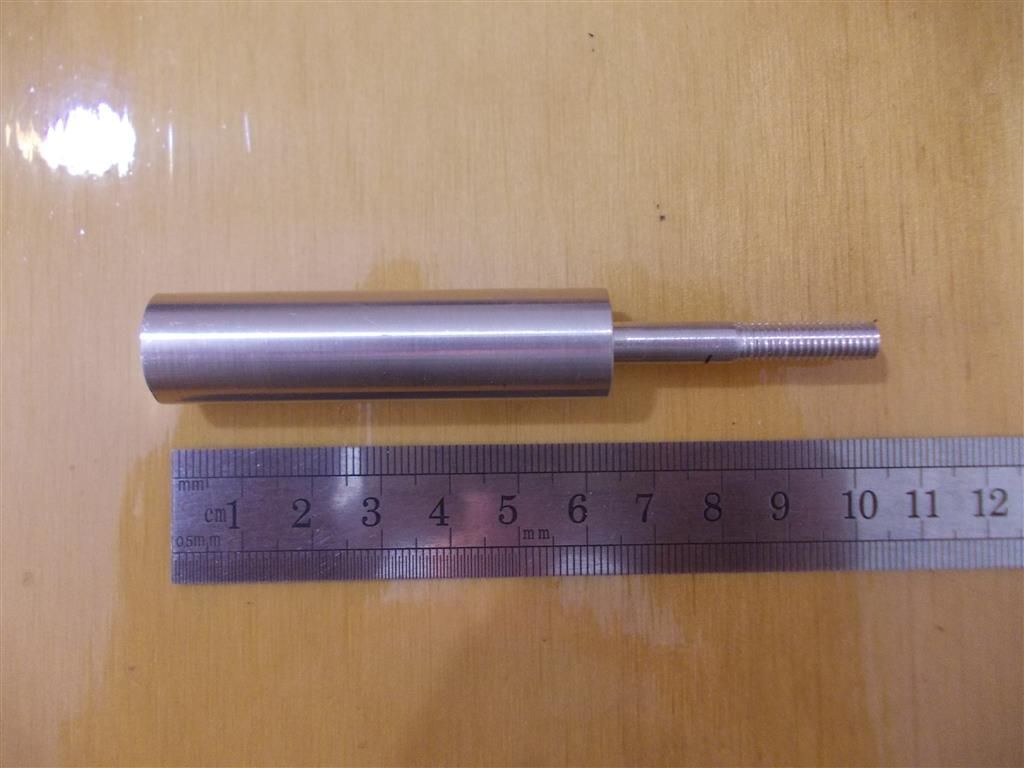
Here is my first finished mandrel. The unthreaded bush is 5.95mm in diameter which may be too small and I am still not happy with the fit. I will cut a few more holes in something tomorrow and check it. Cutting the 6mm thread was surprisingly easy by placing the die holder against the tailstock and forcing it against the shaft while turning the lathe chuck by hand. (NEXT JOB : spindle handle for the lathe !) Cutting a thread on steel is probably more difficult.
NOTE : total length is 100mm, major shaft 60mm long and 15.5mm diameter, minor shaft unthreaded 18mm long and threaded minor shaft is 22mm.
I will be making another one in aluminium and then try to make one from steel too.
Edited By Brian John on 08/09/2015 14:14:02
Edited By Brian John on 08/09/2015 14:19:25
I will be buying a half centre with my next Arceuro order but what is a reduced centre ? They are not listed on the website.
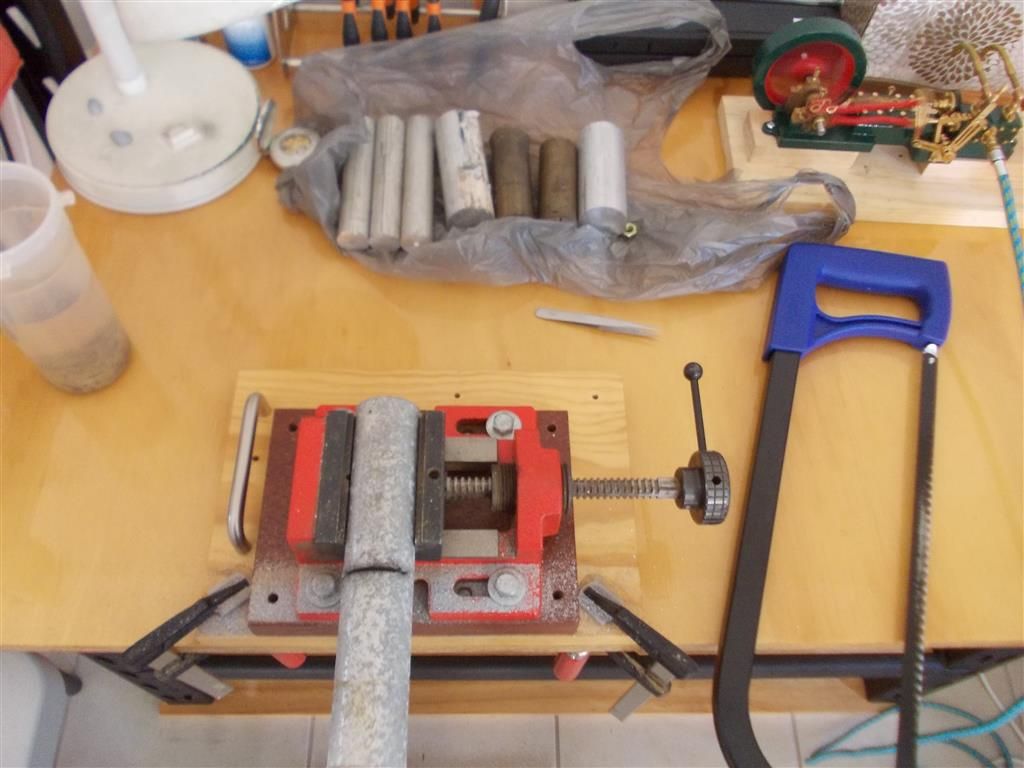
I spent some time today using my new full size hacksaw to chop up 25mm and 38mm aluminium and also a piece of 31mm brass bar from the scrap yard. It does not take much longer than the jigsaw !
I have reduced the length of the main shaft of the mandrel by 20mm by parting off in the lathe. This time I reduced the speed of the lathe until I found a speed (about 200RPM) where there was no grinding or chatter. The parting off worked well. I am still practising taking cuts off the minor shaft of the mandrel ; it is down to 10mm. I can get a good finish by taking 0.1mm cuts but even a 0.2mm cut will cause marks on the piece. Everything I have read says that I should take a fairly large cut as I get close to the required 6mm and not make the final cut a small one but this is not what I am experiencing.
Edited By Brian John on 07/09/2015 07:48:13
Is it just me or do others think that HSS tool has come straight out the packet ?
Can't see anything that looks like rake on it.
Looks very much like a right hand knife tool to me :-
These HSS tools were purchased from Arceuro.
The micros switches are operated by magnets ; there are definitely no pips.
I did ask before about the power of this motor ( I quoted 500 HP ! ) but it is 500 W. I would have thought a motor of this size should be capable of cutting steel but it does not seem up to the job…something I was warned about before purchasing it. I was also considering a SIEG C2 lathe at the time which is a much bigger lathe but only has a 250W motor. But the C2 will cut steel easily so why is that ? I thought the determining factor would be the power of the motor.
It is amazing what you learn once you actually have a lathe in your hands for a few days ie. what works and what does not and which features are desirable on the lathe. Even if I can get this lathe running again, I don't think it has the grunt to do very much…brass and aluminium only.
That is a very good point for beginners Brian. There actually is some sense in buying just to find out. Costs of doing that are actually fairly low because it will sell on the 2nd hand market. I'd guess with this one that you already have mixed feeling about swarf getting on an open lead screw on the compound slide. Your comment on brass and aluminium doesn't surprise me at all. The last person I know that went out and bought one even against advice turned round one day and said it's only any good on plastic to me, not really sure what it's any good for. He bought one because of the low weight. He also had worries about the strength of his shed floor – silly really if as bad as he the implied he wouldn't be able to stand up in it.
The wattage they quote does seem to have it's catches. I've long suspected that input power is quoted, expect up under 1/2 of that coming out in that case. The other aspect is electronic speed control. It really is difficult to get a grip on what that means in terms of torque on the cutting edge of the tool. It might even be extremely low at low speed settings. Speed reduction via belts and gears increases torque – even good electronic speed control doesn't because motors can only take so much current so as the revs go down so does the horse power. Some of the variable speed lathes do have a belt to give 2 speed ranges. The belt ensures that there is more torque in the low speed range. Frankly I feel they should have 3 belt settings not 2. I'd guess some people modify them. Some of these lathes use a gear to provide the lower speed range. Initially metal gearing which can be rather noisy. More recently plastic with metal replacements available if they break. I've no idea if they do.
I suspect as many people are happy with mini lathes you would have been pleased with the next model up – the mini lathe rather than the baby one. This and other reasons is why I sometimes say don't buy a lathe unless it weighs circa 60kg or more – unless you want to do pen turning for instance. Even then swarf will get in that lead screw. The slide that is on wont locate very well either as it's so short.
There are catches with the mini lathe as well. Power seems to vary. Some now come with brushless motors which might be better over a wider speed range. Probably for the same reason that a 6 cylinder engine produces more low speed torque than a 4 and an 8 even more. I've not seen what they have done so can't be certain on that aspect. They will still have a maximum current rating.
Metric versions of the mini lathe sometimes come with screw cutting indicators that allow metric threads to be cut without reversing and stopping the lathe etc – some don't. If you ever get to screw cutting you most definitely will appreciate an indicator even if it can't be used on all of the pitches the lathe can produce. Imperial lathes come with and without as well. This aspect seems to apply to all metric lathes. When provided they usually have several gears which can be meshed with the lead screw and drive the indicator dial.
As to what needs doing to them after they are bought ArcEuro provide a guide. This is why some people call them casting kits and even rework the saddle fit on the bed at times. The arceuro guide is very likely to apply to all of them even Opti – have you looked to see how well the underside of the slide has been machined? Or the fit on the cross wise adjustment of the tailstock if it has that. This is how the costs are kept low – or margins high – not sure.
Well I should add that a lot of people do decent work with mini lathes despite all of this. It seems to be the smallest size where this can be done. I have no idea how often the correct things with files and emery cloth etc.

By the way. Did you check that you haven't pressed the emergency stop button in by accident. Easily done and they latch and need rotating a little to release. On the other hand the variable speed drive electronics do fail sometimes. Often on early a machines so they started fitting an American design which might be better.
The best source of reviews on the web really are blogs and youtube all by ordinary people who are actually using them. Some however will be supported by the suppliers.
John
–
Some might suggest buying a used machine. Not an easy thing for a beginner to do as they might buy a load or rubbish. There is plenty about and they can be used but a new machine is likely to offer better general performance even if it has some catches.
John
–
ArcEuro sell a similar tapping aid which I’ve found very useful as the base has T-slots so is easy to fit a small holding jig for repetive small tapping jobs – I added a small collar + fixing screw between the handle and the top bar – makes replacing taps very easy without the chuck crashing down on the work – also provides a simple depth stop for blind taps – pity only works upto 5mm metric (6mm on some softer material) tho I did have to loctite the chuck to the rod (breakable seal tho)
Thank you for all the advice.
Hopper : I have taken note of those suppliers and I will call tomorrow. Yes, I may need your help soon ; I live at Mooroobool.
Why would you want to lock the carriage in place ? Before I tightened this bolt up a bit there was movement in the carriage. Obviously tightening it up a lot stops it moving but a 1/4 turn removed the slight wobble it had. I was still having problems with getting a clean finish today. I am hoping that when I try tomorrow, things will be better now that I have removed all movement from the carriage.
I was warned by the company who sold this machine that it was not really suitable for steel and that it was better to stay with brass and aluminium. I was a bit surprised at this advice because it has a 500 HP motor. The Sieg C2 lathe which is a MUCH bigger 12 X 7 lathe only has a 250 HP motor. Are there other factors in play beside the power of the motor ?
I am using top quality HSS taps and split dies purchased from Arceuro in the UK. I have found carbon dies to be rubbish. I am machining the 6.35mm silver steel bar down to 6.00 mm because I do not have any 6mm bar on hand at the moment. I will buy some 6mm aluminium bar instead as it should be easier to work with.
I regard screw cutting on the lathe as an advanced technique. If I am having trouble doing basic lathe work then I do not think I should be contemplating screw cutting on the lathe just yet
Cutting a 6mm thread on aluminium should be easier than cutting on silver steel.
Edited By Brian John on 30/08/2015 12:36:34
Edited By Brian John on 30/08/2015 12:59:00
Edited By Brian John on 30/08/2015 12:59:31
Edited By Brian John on 30/08/2015 13:00:18
A. The tool tip is in line with the tip of the dead centre of the tail stock ; it was the first thing I did when setting up the lathe.
that should be OK
B. So clockwise direction looking from the headstock from the headstock. That is ''R'' on my lathe. The opposite direction is marked ''L". I think I was using both directions today !
The tools you have are designed to be used at the front of the lathe with the metal being pushed down onto them.
C. I am not using a centre drill. This is a spotting drill which a different thing altogether. I was led to believe that the centre drills are only used to make a shaped hole in the end of the work piece for the tailstock to sit in. Correct me if I am wrong ?
Spotting drills are better then centre drills for starting holes, but you can use centre drills.
D. I was not using any lubricant as I thought it would not be necessary with aluminium.
Not necessary, but you can use a cutting fluid.
E. I am not using the automatic feed as I want to get used to using the hand wheels and get to know which direction things move in. I also need to be very careful about staying away from the chuck jaws when machining the outside of the pulley/flywheel.
Wise decision, gives you a better feel for the lathe, too.
> This is a good reason to make a faceplate or a mandrel so I do not have this worry ! Note that Arceuro said their mandrels are not suitable for this purpose as they may break.
Don't worry – most people use chucks as they are much more convenient
F. Too much overhang…noted for tomorrow.
Definitely 
G. I will keep in mind what has been said about footwear. I do not usually wear shoes in the house but I may have to change that policy.
Metal splinters in the foot are 'orrible.
H. I do not want to grind my own tools at this stage. Unless I know exactly what I am doing then I would only be introducing more errors.
Google each of the tools you have and read up on how to use them. Bear in mind the knife tools in y picture above cut on the SIDE of the tip.
Edited By Neil Wyatt on 26/08/2015 17:49:59
A. The tool tip is in line with the tip of the dead centre of the tail stock ; it was the first thing I did when setting up the lathe.
B. So clockwise direction looking from the headstock from the headstock. That is ''R'' on my lathe. The opposite direction is marked ''L". I think I was using both directions today !
C. I am not using a centre drill. This is a spotting drill which a different thing altogether. I was led to believe that the centre drills are only used to make a shaped hole in the end of the work piece for the tailstock to sit in. Correct me if I am wrong ?
D. I was not using any lubricant as I thought it would not be necessary with aluminium.
E. I am not using the automatic feed as I want to get used to using the hand wheels and get to know which direction things move in. I also need to be very careful about staying away from the chuck jaws when machining the outside of the pulley/flywheel. This is a good reason to make a faceplate or a mandrel so I do not have this worry ! Note that Arceuro said their mandrels are not suitable for this purpose as they may break.
F. Too much overhang…noted for tomorrow.
G. I will keep in mind what has been said about footwear. I do not usually wear shoes in the house but I may have to change that policy.
H. I do not want to grind my own tools at this stage. Unless I know exactly what I am doing then I would only be introducing more errors.
Edited By Brian John on 26/08/2015 13:35:28
Edited By Brian John on 26/08/2015 13:54:46
Too much tool overhang and no top rake at all. This will just plough a furrow in an alloy casting.
This looks like the 60 decree threading tool from of a 'standard' set of HSS tools, if so your should have left and right hand knife tools in the set.

Thy these with MUCH less overhang.
Neil
I have already tried to remove the chuck guard. It is only held on by two grub screws. However, once the guard is off then the lathe will not operate. I thought rotating the guard shaft towards me to simulate the closed position would suffice but this did not work. I spent 30 minutes mucking around with it and then put the chuck guard back on. There are no other switches that I can see ; it is a bit baffling.
I think the plastic guard on the tool post is going to get in the way when changing the cutting tools which is why I removed it. I will see how things go without it. I always wear a full plastic face shield when I use electric power tools that spin at high speeds.
The drill chuck is 1-10mm JT2 purchased from Arceuro in the UK. The drill chuck and the HSS cutting tools arrived in Cairns in 5 days… that is a record for my UK purchases. 
Edited By Brian John on 25/08/2015 17:43:48
.
Hello Bob.
You could do a lot worse than have a jolly up the A6 to Leicester and go and see Ketan at ARC
He stocks the Seig C6 which should fit nicely into that space leaving you some room for storage and tooling ect. Plus you being able to move around.
Link to C6 **LINK**
You as somone who has spent time with 'tools in your hands' it would be nice for you to see and feel a machine before you part with your coins I should think.
Don't forget to budget for tooling.
Nick
Hello all,
Thank you for your help and ideas.
I bought the bender from ArcEuroTrade ***HERE*** .
I'm satisfied and already made a bunch of hooks. I had to make some more pins for the needed dimensions and they worked fine. See ***HERE*** please.
Thank you for your help
Dias Costa
Would you recommend HSS or carbide cuttings tools for a beginner using his first lathe. The Optimum L685 machine will arrive this week and I realised that it does not come with any cutting tools. The size required is 8mm.
I was going to buy a carbide cutting tools set because they are so cheap but some people have said that the HSS tools are easier to use and give a better finish. I have found this nice set of HSS tools by Arceuro in a wooden box which is very cheap by Australian standards :
NOTE : I will NOT be grinding my own tools for a while yet. If I do that and things do not turn out well then I will not know if the problem is me, the lathe or the cutting tools ! By buying precut tools, then I can eliminate one variable ie. I cannot blame the cutting tools 
Edited By Brian John on 18/08/2015 12:32:50
Started by: Dougie Swan
in: General Questions
Robert Atkinson 2
Started by: James A
in: Manual machine tools
Andy Stopford
Started by: Bill Dawes
in: General Questions
JasonB
Started by: Alan Ambrose
in: Manual machine tools
Michael Gilligan
Started by: Andrew Tinsley
in: Workshop Tools and Tooling
Clive Foster
Started by:
dee
in: Related Hobbies including Vehicle Restoration
duncan webster 1
Started by: Harry Broadbent
in: Model Engineer & Workshop
vintagengineer
Started by:
David George 1
in: CAD – Technical drawing & design
JasonB
Started by: Chris Crew
in: The Tea Room
Neil Wyatt
Started by: Bill Dawes
in: General Questions
Dalboy
Started by:
Michael Gilligan
in: Clocks and Scientific Instruments
Kiwi Bloke
Started by: Tony Ray
in: Workshop Tools and Tooling
bernard towers
Started by: lucerne
in: Manual machine tools
bernard towers
Started by: COLIN MARTIN 2
in: Materials
fredjscipione
Started by:
dean clarke 2
in: I/C Engines
dean clarke 2
Started by: jimalm
in: Electronics in the Workshop
Vic
Started by:
duncan webster 1
in: Electronics in the Workshop
duncan webster 1
Started by:
Neil Wyatt
in: Manual machine tools
Howard Lewis
Started by:
JasonB
in: The Tea Room
jaCK Hobson
Started by: Roger Harvey
in: Workshop Tools and Tooling
ega
Started by: Andrew Tinsley
in: Workshop Tools and Tooling
Andrew Tinsley
Started by: Dalboy
in: General Questions
Graham Meek
Started by: Peter Simpson 3
in: Beginners questions
Peter Simpson 3
Started by: activeviii
in: General Questions
lukeama123
Started by: Nick Welburn
in: Work In Progress and completed items
Dave Halford