Search Results for 'arc euro'

Search Results for 'arc euro'

Home Forums Search Search Results for 'arc euro'

Viewing 25 results - 2,626 through 2,650 (of 4,843 total)
  • Author
    Search Results
  • #345178
    Neil Wyatt
    Moderator
      @neilwyatt
      Posted by Muzzer on 09/03/2018 12:15:57:

      Me too. Ashamed to say I had one for ages before realising how to use it like this. So quick and easy – and accurate.

      Type C is less than £4 from Arc.

      Murray

      LOL!

      Only a few days ago I was discussing these devices with a 'supplier of model engineering accessories' who will remain nameless. We both admitted that we don't know how they work but people seem to like buying them.

      Well now I do know. Much better than the probe on stick type as you can work it in and out to get the right position, but it looks more liable to mark the work.

      Neil

      #345172
      Muzzer
      Participant
        @muzzer

        Me too. Ashamed to say I had one for ages before realising how to use it like this. So quick and easy – and accurate.

        Type C is less than £4 from Arc.

        Murray

        #344611

        In reply to: Drummond M series

        Bazyle
        Participant
          @bazyle

          Peter, Are you trying to hold a drill in the tailstock in a chuck to drill a hole in something in the main chuck?
          You get a drill chuck and put it on a special tapered rod (called and arbor) that fits the taper in the tailstock. This will be a Morse taper MT1 and the chuck have a different taper (Jacobs) so you have to get a matching one. You see some on ebay but may be ropey and without a chuck key. So better to go to a supplier like ArcEuro who advertise at the top right of this page as they will make sure you get the matching pair.

          There are a lot of posts on the forum about the Drummond so do some searching and reading.

          #344346

          In reply to: Cobalt drills?

          Samsaranda
          Participant
            @samsaranda

            John good luck with a cobalt drill on your Dickson tool holder block, I had to open out the mounting stud hole on the one I recently fitted to my lathe, I needed to open out the hole from 11.2 mm to 12 mm, you would think that would have been easy, it certainly wasn’t. The hardened alloy steel just wrecked a number of cobalt drills and left me wondering how I was going to achieve the objective, I decided in the end to use a diamond core drill, obtained from Arceurotrade, they had a 12 mm size one and it was only about £4 or thereabouts, it did the job and easily ate it’s way through the toolpost, although I was only using it to remove .8 mm from the hole so I don’t know how you would cope with a solid hole, if you know what I mean. The hardened alloy steel that they use is incredibly hard, most cutting tools just bounce off it, have you thought about having the hole spark eroded? Let us know via this thread how you get on? Dave W

            #343927

            In reply to: lignum vitie bearings

            Tractor man
            Participant
              @tractorman

              I agree with Clive, what is there to lose? Lignum is used as self lubricating bearings in ship prop shafts I believe so it may do the job here. Is there no way to get oil to a plain bearing at all? And if not arc eurotrade do bearings down to well below that shaft size.

              #343816
              Ketan Swali
              Participant
                @ketanswali79440

                Announcement from Arc Euro Trade Ltd. 1st March 2018 from 2.30pm onwards:

                Our telephone lines and premises will be closed until Monday 5th March 2018 as per the banner copied below.

                weather.jpg

                Our website is open for business as usual, but all orders received after 2.30pm on 1st March 2018, are expected to be processed for dispatch from Monday 5th March 2018 onwards, subject to weather. Please accept our apologies for any inconvenience caused.

                Ketan at ARC

                #343683
                Martin Johnson 1
                Participant
                  @martinjohnson1

                  Thanks for all the responses.

                  Mark – yes it is probably running too slow, but it is direct on a 2800 rpm grinder, so cannot be changed very easily.

                  Douglas – yes 2 thou is getting on but I was modifying a milling cutter, so had quite a lot to chew off.

                  As for the rest, you are confirming what I had hoped that diamond for HSS is not theoretically right, but it seems for light hobby use it is OK.

                  Off to scan ebay and Arc Euro then………………….

                  Thanks all,

                  Martin

                  #343590
                  Martin Johnson 1
                  Participant
                    @martinjohnson1

                    Well, after many years I have lashed up a tool & cutter grinder, own design using bits of worden, stent, quorn all re-arranged to suit me.

                    Anyway, I purchased a 4" white cup wheel (no markings at all so probably Chinese s**t) from one of the usual suspects which seems very soft. Dressing it produces ridiculous amounts of grit all over the shop. Even taking grinding cut of a couple of thou can produce more clouds.

                    I am trying to keep the T & C grinder in the machine shop to avoid rust. I could put it in the welding / grinding area but that is very prone to rust. Carrying it to and fro for wheel dressing is possible, but hard work.

                    I have been thinking about changing to a diamond / cbn wheel (Arc Euro & others do them). Obviously great for carbide tooling, but what about using them on HSS?

                    Seems to me it would cut out the clouds of grit when dressing problem. Anyone have any experience good or bad?

                    Many thanks,

                    Martin

                    #343563
                    DMB
                    Participant
                      @dmb

                      I think you have to ask what's in it for me? Take cnc, e.g., is it really worth wasting months to learn how, just to make a few identical items? I reckon that I am better off fitting DRO s to my mill, financially and time wise. By all means, make use of all new tech. that comes along, to improve life, IF it will but not just for the sake of having it.

                      I have used a ring of less above my milling chuck to give all round shadow less illumination. Still retain the lethal arrangement of a naked 100W incanescent bulb hanging near each end of mill table. I have also gone over to 3ph motor and vfd controller on the Myford. Cannot praise this highly enough, should have done it long ago instead of waiting for the 1ph motor to peg it. I should add that the Newton-tessa version that I bought, is literally plug and play and no messing about programming the controller, etc. and I only recommend it as a satisfied customer.

                      I am typing this on my handy 10in. tablet, which I often use to order items from advertisers like e.g., Arceuro, Amazon and so on.

                      John

                      #343320

                      In reply to: An odd grub

                      Neil Wyatt
                      Moderator
                        @neilwyatt
                        #343279
                        Martin 100
                        Participant
                          @martin100

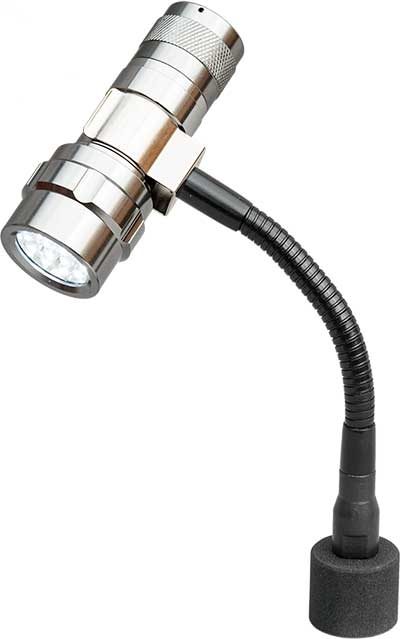
                          Bought one of these a while ago for the pillar drill to ease the issue of lining up centre punched dots. Powered by 3 AAA cells It just about did the job, but it was never really bright enough and eats batteries. Low self discharge Nickel Metal Hydride rechargeables make it cheaper to run but are a lower terminal voltage and so less bright.

                          The batteries are held in a plastic carrier like this

                          I've got a very similar Ebay special LED torch that has an option of the same arrangement of three AAA's but can also take a Lithium 18650 cell instead

                          Tried an 18650 in the Arc Euro lamp and despite the peak volts dropping from around 4.5v to around 4.2v it works much better and for much longer (AAA's are woefully poor in mAh capacity in both alkaline and rechargeable variants) The 18650's are at least 3x higher capacity.

                          The 18650 will work as a 1:1 replacement but would ideally have an insulated sleeve around 19mm ID and 22mm OD to centre the cell in the battery compartment.

                          Martin 100
                          Participant
                            @martin100
                            JasonB
                            Moderator
                              @jasonb
                              Posted by Adam Harris on 25/02/2018 19:56:23:

                              I have a great INT30 face mill that cuts really very close to the spindle. I see on fleabay some MT2 INT 30 sleeves so I do not understand why someone is not making similar for R8 or deckel or some such collets…any offers and I would be a buyer!

                              ARC do them but they won't solve your problem

                              Quite simply you can't get a R8 into a 30 spindle so they have to stick out the end

                              Edited By JasonB on 25/02/2018 20:07:50

                              #342777

                              In reply to: Tools

                              Brian H
                              Participant
                                @brianh50089

                                Hello Innes and welcome. Personally I would go for the 12mm (or 1/2" inch) but buy the ones you need rather than a set.

                                I don't know where you are but I've had good service by mailorder from ArcEuro in Leicester.

                                As to the type of tool i.e. carbide, HSS or insert well that depends on what materials you will be cutting but ArcEuro will advise.

                                Don't dismiss cooling fluid, especially if the lathe has a coolant pump. Coolant can provide a better finish and extend tool life but make sure that you get something that will not cause rust on the lathe.

                                Brian

                                #342583
                                SillyOldDuffer
                                Moderator
                                  @sillyoldduffer

                                  How fortunate Billy is to be setting up a new workshop with plenty of space! However, every silver lining comes with a cloud, in this case discovering that choosing a lathe can get complicated. Especially when it turns out you need a milling machine as well!

                                  There are several considerations, and I would advise newcomers to start by collecting their ideas first. Write a list. Advice on the forum is good but beware you ask the right questions – what matters to Billy may not matter to me and vice versa. Like Billy suddenly mentioning he has trouble with weights.

                                  Key things to clarify before parting with money:

                                  • What are you going to use the lathe for? (Clocks or locomotive Axles?)
                                  • Most important, what are your constraints?
                                    • Budget, including costs of stand, tooling, accessories, electrics, delivery, installation and materials. (Installation might involve paying a professional team to move a heavy lathe into a cellar, or buying an engine crane, or perhaps you can do it for free.)
                                    • Your experience and ability to cope. (Newcomers are advised to keep it simple.)
                                    • Space
                                    • Access to that space. (2 ton lathe in the loft; live 5 miles down a muddy lane; steps? )
                                    • Power (Shed at the end of a garden; 3-phase; > 13A etc.)
                                    • Noise and other impacts on your domestic situation
                                    • Your feelings buying new vs second-hand or Western vs Far Eastern and how much those feelings matter to you. Be aware when taking advice that feelings and logic are not the same thing.
                                    • Tooling: for example, if you particularly want to use carbide inserts a modern lathe is a better bet simply because they tend to spin faster. On the other hand, older lathes may come with hard to find accessories, such as a taper turning attachment. Do you have any special tool requirements?

                                  Normally I would advise buying the biggest lathe that can be accommodated. Partly because bigger lathes handle bigger work, partly because interests expand to fit the lathe, but mostly – in my case – because having more room makes work easier to set up. Generally a big lathe can handle small work, but a small lathe cannot handle big work, and you end up pushing the thing to it's limits. In Billy's case, he particularly mentions weight as a problem. That might mean chuck weight is his showstopper: a 100mm diameter chuck weighs about 3kg, 120mm about 5kg and 160mm about 10kg. There may be other issues with big lathes; they take up space, you have to stand at them, and they're comparatively hot and noisy.

                                  Last on my list is Make and Model Number. With older kit condition matters far more than brand. With new kit, warm feelings provided by Make and Model number may be misplaced. It's not obvious these days who made the lathe and there can be significant variation between similar models. In the UK, hobby lathes are bought from badge distributors, not manufacturers. Distributors can and do change supplier. You're far better off looking at what they have on offer and deciding who has the better reputation for support. That can vary over time. Personally I've had good results from Warco and ArcEuroTrade; Axminster get a good press but are a little more expensive; that includes an extended warranty. As far as I know none of the UK Distributors are cowboys though some have been reported to be less sympathetic than others if there's a problem.

                                  I recommend reading Neil's current series on lathes in Model Engineering Workshop. (Also Jason's parallel series on Milling Machines.) There's also a lathe series running in Model Engineer. I feel the ME series is Myford centric and for that reason a little old-fashioned. Neil is much more up-to-date and writes about an interesting modern lathe that you can buy new today.

                                  Compared with a Myford Super 7, the Warco 250 is about the same size and capability. A 280 is like a 250 but bigger; it's about as big as I can fit in a cluttered single-garage sized workshop. No problem running it off a standard 13A plug. Next size up takes you into gear-head lathes which come with more time saving conveniences, but you have to start looking even more carefully at weight and power requirements.

                                  What's wrong with Myford? Nothing much, a very successful and well-proven design. Unfortunately for both good and bad reasons they attract premium prices. For less money you can get even better quality kit like a second-hand Boxford or a new machine with warranty.

                                  Hope that helps. I don't think you would go far wrong with a WM250 or an SC4. One last thing; buying a lathe used to be a once in a lifetime experience because they were expensive compared with income. That's not really true of hobby lathes today – many could realistically consider buying a £2000 lathe and replacing it after a few years. More expensive than a washing machine but cheaper than a car and definitely not an heirloom!

                                  Dave

                                  #342582
                                  Bikepete
                                  Participant
                                    @bikepete

                                    I was thinking that too – buying used potentially gets you so much more iron and rigidity for your money, at the expense of some uinknown amount of wear. So for lathes you're looking at e.g. 2.6 tons of S&B 1024 for £1800 (before haggling, but not including transport costs) vs 95 kg for £1500ish inc carriage (Arc SC4).

                                    Personally having used heavier machines I'd tend that way every time, if space permits… but I can also see the argument for buying smaller and new.

                                    No connection with the S&B seller BTW, or knowledge of its condition beyond what's in the ad – it just came up on a search just now when I was looking for an example.

                                    #342439
                                    David Standing 1
                                    Participant
                                      @davidstanding1
                                      Posted by Martin 100 on 20/02/2018 14:25:54:

                                      You appear to want something bigger than your unimat but there a constraint at the 'size of a Myford' Is this because you don't have the space, or don't ever envisage needing the capacity or something else?

                                      Buying 'new' at that scale of machine going on for nearly half a century after most of the UK machine tool sector abandoned this market means either the Myford or any one of a multitude of far eastern produced machines from £1000 upwards. Buying secondhand opens up hundreds of opportunities across dozens of brands including a secondhand Myford with lots of extras.

                                      Would allocating some of those funds towards a larger workshop be money better spent? How about spending part of those funds on a milling machine, or a brazing hearth, or a TIG welder or a workbench or more tooling, or a DRO or better storage or all of them.

                                      I think your best bet is to totally forget that budget, and really examine your requirements, what you really need now and might like to have in say 5 or 10 years time. The two may coincide.

                                      Go to the suppliers be it Myford / Warco / Arc Euro etc or get to one of the model engineering shows and look at the machines. Even look on Ebay or the small ads here or or elsewhere online. Maybe go to one of the many secondhand machine tool suppliers. You might find spending a small fraction of that £8000 is all you need. £2000 spent with one of the usual suspects might give you everything and more.

                                      But what someone here recommends might not be right for you.

                                      Can £8000 of 'new' Myford produce a better result than £2000 of lathe X and £2000 of milling machine and £2000 of new workshop and £2000 of tooling?

                                      This is an £11000 brand new far eastern manufacted lathe Big enough for many industrial scale jobs

                                      This is an £8000 brand new EU manufactured lathe Small enough to hide in the corner of a very tiny shed

                                      Martin

                                      Size constraints?

                                      Billy already stated 'Fortunately we have space'.

                                      He also stated in another reply that his needs are dictated by physical size of what he will be engineering, not by his workshop space.

                                      #342438
                                      Martin 100
                                      Participant
                                        @martin100

                                        You appear to want something bigger than your unimat but there a constraint at the 'size of a Myford' Is this because you don't have the space, or don't ever envisage needing the capacity or something else?

                                        Buying 'new' at that scale of machine going on for nearly half a century after most of the UK machine tool sector abandoned this market means either the Myford or any one of a multitude of far eastern produced machines from £1000 upwards. Buying secondhand opens up hundreds of opportunities across dozens of brands including a secondhand Myford with lots of extras.

                                        Would allocating some of those funds towards a larger workshop be money better spent? How about spending part of those funds on a milling machine, or a brazing hearth, or a TIG welder or a workbench or more tooling, or a DRO or better storage or all of them.

                                        I think your best bet is to totally forget that budget, and really examine your requirements, what you really need now and might like to have in say 5 or 10 years time. The two may coincide.

                                        Go to the suppliers be it Myford / Warco / Arc Euro etc or get to one of the model engineering shows and look at the machines. Even look on Ebay or the small ads here or or elsewhere online. Maybe go to one of the many secondhand machine tool suppliers. You might find spending a small fraction of that £8000 is all you need. £2000 spent with one of the usual suspects might give you everything and more.

                                        But what someone here recommends might not be right for you.

                                        Can £8000 of 'new' Myford produce a better result than £2000 of lathe X and £2000 of milling machine and £2000 of new workshop and £2000 of tooling?

                                        This is an £11000 brand new far eastern manufacted lathe Big enough for many industrial scale jobs

                                        This is an £8000 brand new EU manufactured lathe Small enough to hide in the corner of a very tiny shed

                                        #342420
                                        David Standing 1
                                        Participant
                                          @davidstanding1

                                          Billy

                                          And how big is your space to put it in/how big a lathe do you need for your needs?

                                          If you want new, I would look at the Arc Euro Sieg lathes, or Warco, particularly if you want bigger than the Arc offerings. The Warco gearhead (GH****) lathes are particularly versatile.

                                          Secondhand, it is a matter of following all the usual sources, and wait for a bargain, they do come along.

                                          Always buy a secondhand lathe on condition rather than price.

                                          Two lathes sit in my workshop. I'm not suggesting this is what you may want, merely an example of what comes along if you are patient, and keep your eyes peeled.

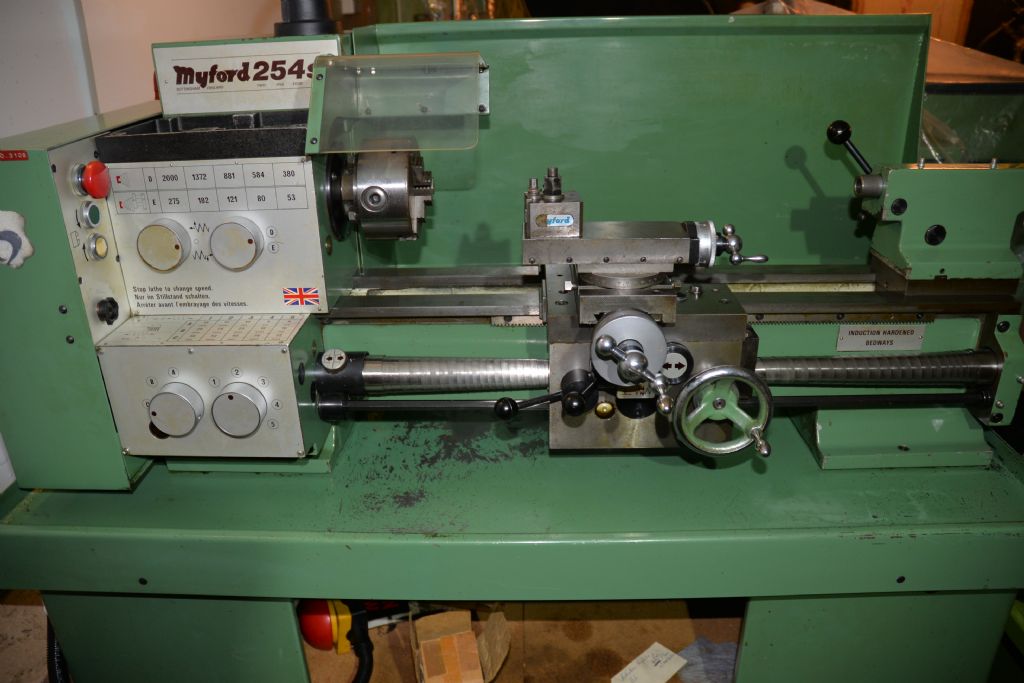
                                          The Myford 254S immediately below I paid just £1,450 for a few months back.

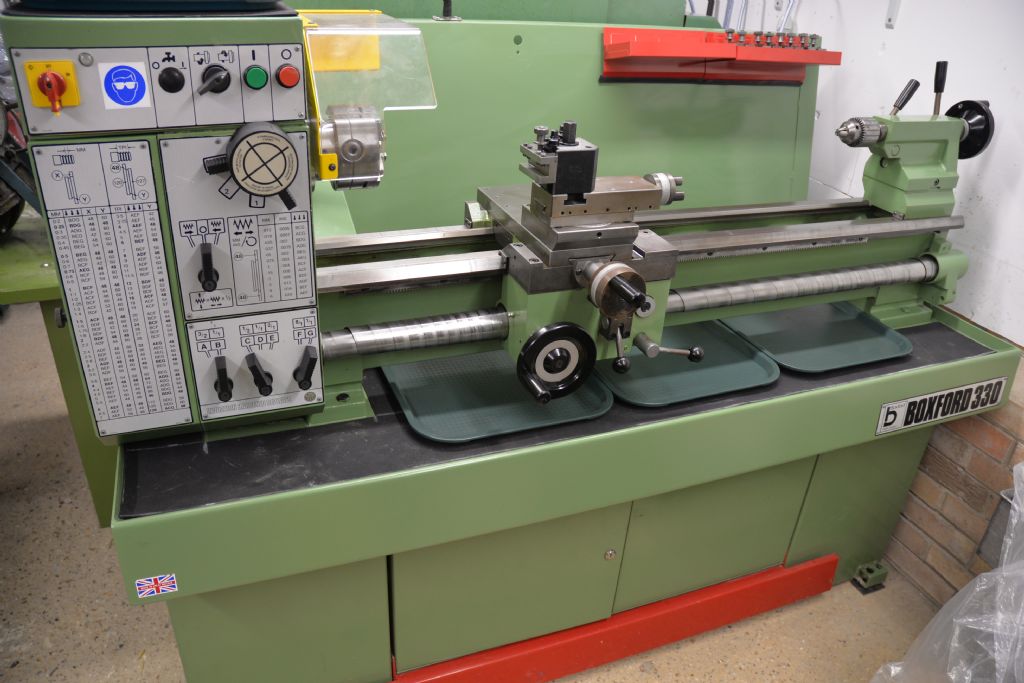
                                          The Boxford 330 (330mm swing, 1000mm between centres) I paid just £2,200 for last year, it came out of a school that had not really used it, it just sat in the corner, and was pretty much as new.

                                          dsc_1166.jpg

                                          dsc_1223.jpg

                                          #341793

                                          In reply to: Boxford AUD

                                          Brian Wood
                                          Participant
                                            @brianwood45127

                                            Hello Steve,

                                            By all means do but it is all in my book 'Gearing of Lathes for Screwcutting' On sale via Amazon but also by ArcEuro at the colossal price of £12.50. Nicer I think to support the local supplier

                                            The watch threads are later thinking which came after publication and I will happily make those available to you by email—incompatability issues prevent me from adding such stuff and photos to postings

                                            I can be reached at wood_y(at)btinternet(dot)com

                                            Kind regards

                                            Brian

                                            #341538
                                            Samsaranda
                                            Participant
                                              @samsaranda

                                              Larry, ARCEurotrade sell files that are really good quality for the price, I am in the same boat with most of my files now being well past their use by date.

                                              Dave W

                                              #341259

                                              In reply to: Rescuing a 920 lathe!

                                              michael howarth 1
                                              Participant
                                                @michaelhowarth1

                                                My Chester 920 is my second. The first was a Warco which I bought secondhand and despite all the advice freely given about taking someone who knows lathes, I did not know any such person and ended up with a lathe with a badly worn bed down at the business end. In all other respects I found it to be a fine machine and after a fashion learnt to compensate for the worn bed enough to do some reasonable work. I did extend the cross slide travel, which probably wasn't really necessary but it did give me the opportunity to fit the Arc Euro anti backlash bearing set which was. I also made a 4 bolt compound mounting which reduced the top slide flexing on heavier cuts. As I have already mentioned the best mod of all was the inverter drive which transformed the machine and did away with the hassle of belt changing and belt breakages. That clutch knob can easily slip out of an oily hand and bang goes another fragile and expensive belt. This one had a 730 belt which was always a bit loose and could slip off the pulley with the clutch out. It would also run with a 710 but that was a bit tight until well run in. I also made a Steve Bedair type tumbler reverse but never actually used it in anger. I also upgraded the gib strip adjusting screws with the addition of bearings and this smoothed the cross slide action considerably.

                                                Eventually the worn bed got the better of me as I became more critical of my own work and I sought to give it away to a youngster or other impecunious soul who maybe wished to get started but I found giving it away a lot more difficult than may be imagined. I heard a few "hard luck" stories which I just did not believe but eventually it found another home. I did take the inverter drive off and reverted it to original condition.

                                                The features that I liked best about the 920 were its compact size and the threaded mandrel nose but these things were not easily found on other lathes. A Myford for instance was just a bit too big for my workshop. The ability to just screw on / screw off different chucks was a great time saver as well as an encouragement to use the right chuck for the job, & I was not prepared to give it up so I went for another 920 but found that Chester were then the only importers. I have of course refitted the inverter drive and apart from just the odd squirt of oil, the belt drive door is now rarely opened. Cosmetically, the Warco had the edge on the Chester which does have a few rough bits on the castings. It doesn't affect the running of the machine but I am sure that smartening up these areas wouldn't have put a great deal on the price.

                                                Sorry to ramble on but the old hip is twingeing badly and keeping me out of the workshop so I had to find something to do.

                                                Mick

                                                #341236
                                                richardandtracy
                                                Participant
                                                  @richardandtracy

                                                  One of the responses in a recent thread brought it home to me that quite a few people have totally different cost-quality assessments from me, and I was wondering what yours are.

                                                  I have often seen it said 'Buy the best you can afford'. Over the last 30 years I have been, accidentally, conducting an experiment to test this assertion with electric corded drills. In 1988 I bought a fairly expensive Bosch drill, and it was the best I could afford at the time. A year later, I came across a job where I was going to need to mask up, and effectively use the drill as a mortar rake in conditions that would seriously shorten the life of my expensive drill. So, I bought a cheap drill, as cheap as I could find. After that job, I used the two interchangeably, and when the cheap one wore out, I replaced it. When there was a horrible job, the cheap one always got used to protect the Bosch.

                                                  Now, 30 years on, my Bosch drill is just about worn out, as is my fourth cheap drill. So, I thought I'd look at the running costs over those 30 years, taking inflation into account. Over that time, taking inflation into account, the current value of my Bosch is £150. The current value of the 4 cheap drills is £100. And they had a harder life, always being chosen for the difficult, dusty jobs with large side loads etc.

                                                  So, is it worth buying the best you can afford? In the case of hand held electric drills, my experience would suggest that it's a foolish assertion. I know it's a limited sample, but is one where people have decided opinions.

                                                  Now, there are other cases. I have seen, and that is what prompted me to start this thread, the assertion that milling cutters should be bought to last a lifetime.

                                                  Why?

                                                  On the face of it, it seems sensible advice, but look more closely & the foundations to the assertion seem shaky. I'd like to explain:

                                                  1. As time goes on, cutter geometry improves, feeds & speeds can be increased. How many cutters from the 1930's are viable now? That's a lifetime ago, so would fall into the category of 'Buy tools for a lifetime'.
                                                  2. Inherent in the assertion is that more expensive = better. That is a fallacy as more expensive just means you have less money in your wallet. If you have had any experience of marketing people, you understand that they will always charge as much as they can, and value is not directly related to cost
                                                  3. If a factory in a far eastern country churns out 50,000 tools using cnc machines at £5 each, does that inherently make them of lower quality than the same tool made as a one-off tool in the UK with a manual machine at £75? No, quite obviously the far eastern country is benefiting from investment that enables them to get huge production savings, and the UK company has squandered its competitive advantage by not investing in machinery.
                                                  4. In 20 years time, will the hugely expensive tool do the job you want? Or would it have been better to invest in a tool at a lower price so you can afford another tool to do the job you need to do now?

                                                  When doing an assessment of cost-vs-quality, I look for the cheapest tool that will do the job well enough. Well enough means +/- 0.02mm for most of the work I do (for cost reasons at work we try to keep machinings to +/-0.5mm as any tighter tolerances is not often needed if the design is adequately thought through). If the tool looks as if it'll only last the one job, that is a weighting on the cost side, making the tool less attractive. Basically, looking at the tools ArcEurotrade sell, I reckon they have the quality about right, but if I can get the stuff cheaper, I'll be a happy bunny.

                                                  Where does your cost – quality dividing line sit? And do you have other considerations that come to play in most of your purchases? Do you go for a tool per job at one extreme, or a tool per lifetime at the other?

                                                  Regards,

                                                  Richard.

                                                  #341152
                                                  Ross Lloyd 1
                                                  Participant
                                                    @rosslloyd1
                                                    Posted by JasonB on 08/02/2018 11:01:16:

                                                    To use the ER collets in your mill you need a chuck like this, for each size or ER collet. Not much point in buying two and two sets of collets so just get an ER32 Coller Chuck and range of ER32 collets. You save a little by purchasing a starter set with say 6 commonly used sizes then add to that as needed.

                                                    The best way to use these ER collets in your lathe is with a chuck like this as it allows long work to pass right through into the spindle, not something you need to buy straight away.

                                                    So with these two chucks the same collets can be used in either machine and also in things like collet blocks, indexers etc. Again not something you need straight away

                                                    Any MT3 taper tooling can be held in you MT4 spindle by using an adaptor this is MT4 on teh outside and will have a MT3 taper on the inside.

                                                    Thanks for the detailed info, thats really helpful

                                                    #340423

                                                    In reply to: Bench Grinder advice

                                                    Brian Rutherford
                                                    Participant
                                                      @brianrutherford79058

                                                      Think the record is a no no. Had 2 lots of bad reports. There also seems to be a lot of second hand ones about.

                                                      I think the Allwin ones on arc euro look ok the cheaper Titan ones on Screwfix are very cheap but come with 20mm wheels and not 25mm. One thing with Screwfix you can try it and if it vibrates or wobbles you can take it back for an easy refund no arguing

                                                    Viewing 25 results - 2,626 through 2,650 (of 4,843 total)

                                                    Latest Replies

                                                    Home Forums Search Search Results for 'arc euro'

                                                    Viewing 25 topics - 1 through 25 (of 25 total)
                                                    Viewing 25 topics - 1 through 25 (of 25 total)

                                                    View full reply list.