…
If the WM250 happens to be unavailable, Neil is running a beginner series in MEW based on the Arc SC4-500. Never seen one in the flesh but it looks like a capable machine, albeit a bit smaller.
Dave
Edited By SillyOldDuffer on 12/07/2018 14:48:30
Compare the screwcutting ranges before you decide. I replaced a well-used Myford Speed 10 a new WM250V after a lot of comparison in 2015.
So far I've no regrets.
Lot to be said in favour of a Myford ML7 or Super 7 in good condition. Not plane sailing buying one:
If the WM250 happens to be unavailable, Neil is running a beginner series in MEW based on the Arc SC4-500. Never seen one in the flesh but it looks like a capable machine, albeit a bit smaller.
Dave
Edited By SillyOldDuffer on 12/07/2018 14:48:30
30yrs or so ago I was an investor in a plant & tool hire Co' that subscribed to the Hire Association Europe as an industry trade association.
Back in those days the industry was very much still in its infancy, finding it's feet & not 100% sure of its future direction.
We very much took the HAE for granted & subscribed mainly because they researched, formulated & provided a set of T&C's for the contracts that looked well thought out.
We took them for granted until we got a bulletin about forthcoming legislation in the european parliament which would automatically have been adopted by the UK. The wording of the legislation was very vague but aimed mostly at stopping the short term hiring of some fairly dangerous equipment (like chainsaws etc) without some form of competance test on behalf of the hirer. This was no doubt well intentioned & very much needed in what was a largely unregulated industry.
But, the way the legislation was worded, which was picked up by the HAE's lawyers, would've meant that anyone being handed a sharp bladed tool would need to prove their competance in handling & operating such a tool. That means ANY sharp bladed tool.
We were told this after the HAE & their law team had stopped that legislation being passed with 6 (SIX) hours to spare.
The ramifications, if that legislation had passed, would have rendered the whole fledgling small tool hire industry unsustainable overnight. Just one injury by one hirer of a sharp bladed tool would see all of our insurances withdrawn.
It would also have meant that the restaurant you're in could not provide a knife & fork unless you produce evidence of some form of competance in cutting up your own food.
Just a thought but what about using toe clamps to fix the work directly to the table? If not then look at the usual suspects like Arceurotrade, Chronos, Warco and RDG etc for a vice.
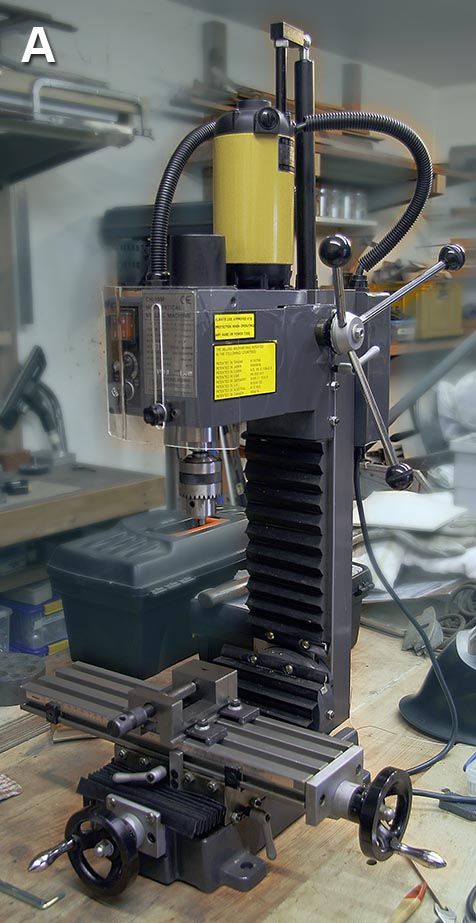
I’ve succeeded in repairing the transmission of my old CH-10M mill/drill and thought it might be instructive to others if I shared some of my experiences gained during the process.
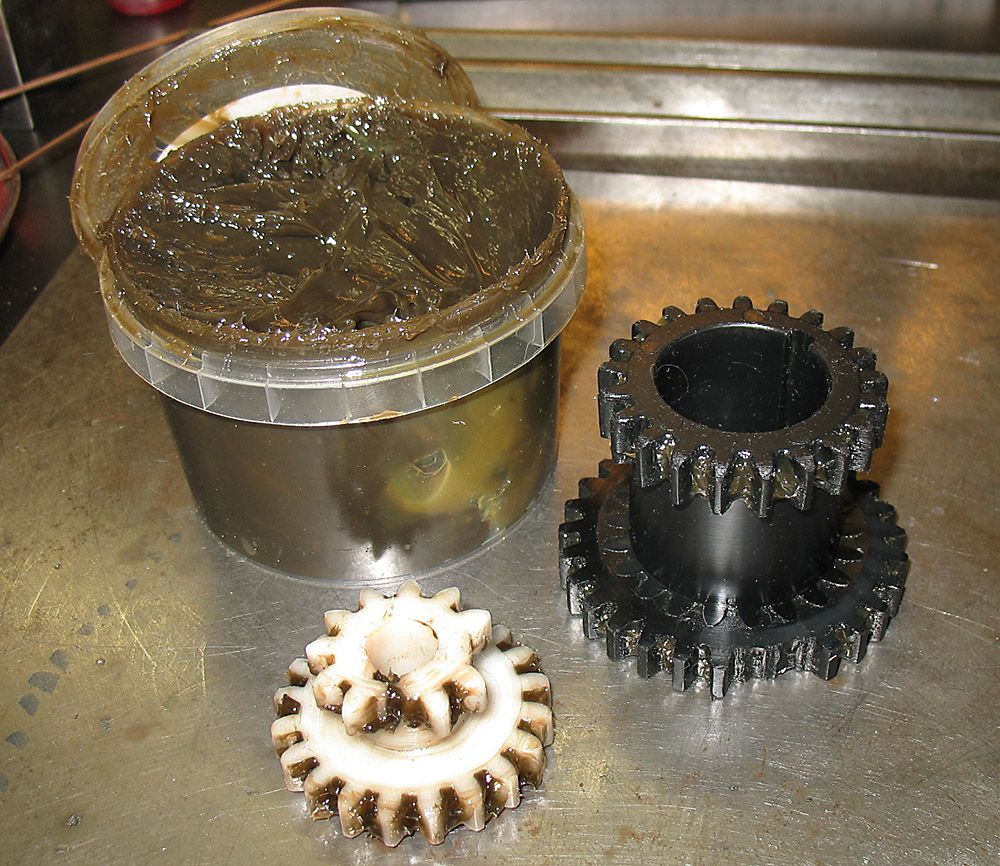
As already reported in a previous post – **LINK** – I had the misfortune to overtax this unit and tear out the teeth of the low end of the two-speed drive. In the picture just below you will see the two original plastic gears in somewhat sorry condition. Behind them will be seen a tub of grease which some previous owner had stuffed into the transmission and which I had to dig out of there to even see what I was doing. What a mess that job was. This is perhaps 80% of the grease, the rest being smeared over an assortment of rags and paper towels in the trash bin. The transmission casing had never been designed (nor sealed) for that amount of lubricant and the mill had been constantly weeping and flinging gobbets of grease during operation ever since I purchased it. More on that later…
The plastic gears in these little mills is something of an Achilles heel, being prone to breakage and also very inconvenient to replace. Fortunately, there are metal gear replacements.
My original thought was to just use a metal replacement gear on the main spindle, that to be running against one of the plastic ones on the intermediate gear in the hopes of quieter operation. Too, should it break, the plastic gear on the intermediate shaft is much simpler to replace as compared to the drive gear on the main which entails a lengthy operation to pull the main spindle and bearing(s). But ultimately I decided that the effort of disassembling the mill’s head unit was something I would just as soon totally avoid in the future if at all possible and so opted for metal gears on both the intermediate shaft as well as main spindle. These metal replacement gears are the same ones as fit the old Sieg X2 Mini Mill and were secured from Arc Eurotrade.
The gears, upon arrival and inspection, looked quite reasonable. The intermediate gear had a bit of hobbing flash, but a few minutes of work with some needle files brought that round right. The main gear, however, proved to be a problem.
The original, plastic gear for the main spindle on the CH-10M is a one-piece injection molded unit. The metal replacement offered by AET is actually a three-piece stack-up arrangement of two gears with a spacer between. Two difficulties immediately presented themselves.
The first problem was that the total height of the three-piece, gear-spacer-gear stack-up was not equal to that of the original one-piece, plastic main spindle gear – measuring 2.25mm too short.
The second problem was rather more vexing. It turns out that main spindle shaft key on this unit is not quite as long as required for the metal replacements. The keyway length is not an issue at all if using a one-piece plastic main spindle gear as originally designed. Unfortunately, the three-piece stack-up arrangement of the metal replacements means that when assembled on the main spindle the topmost gear in the stack is doing little more than just kissing the rounded end of the drive key and would never be able to transmit driving power to the spindle.
Now, of course, the simple approach would be to mill the main spindle keyway a bit longer, slip in some longer key stock and ‘job done’… or at least, that’s what I would have chosen to do. Obviously, with my only milling machine in pieces this approach was out of the question. Instead, I opted to solve the two problems using my TIG welder and metal lathe.
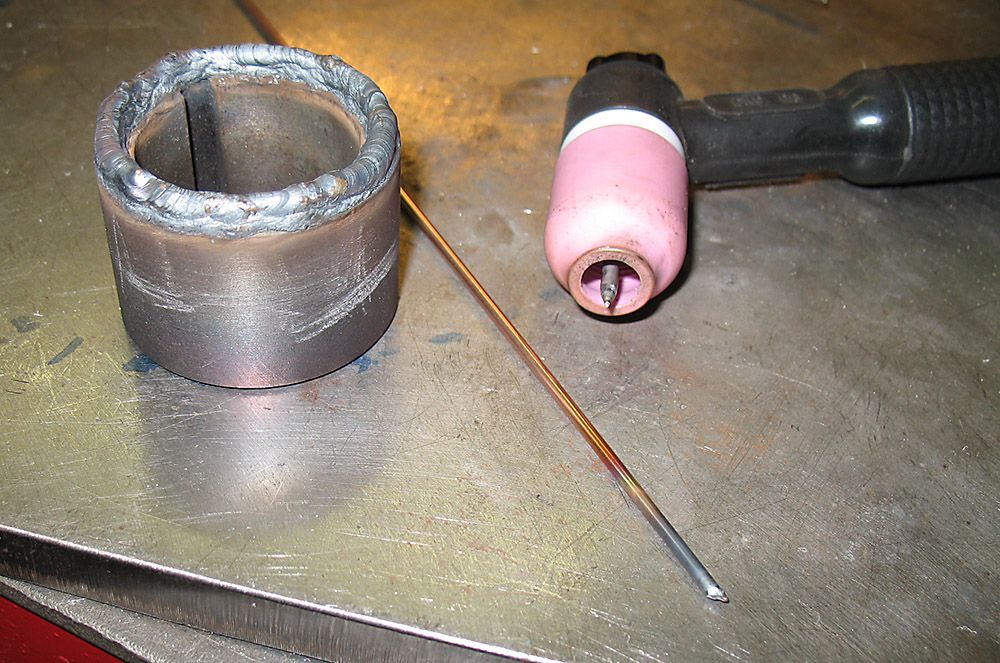
My first task was to make up the the missing height in the gear stack-up. To this end I added filler metal to build up one end of the metal spacer.
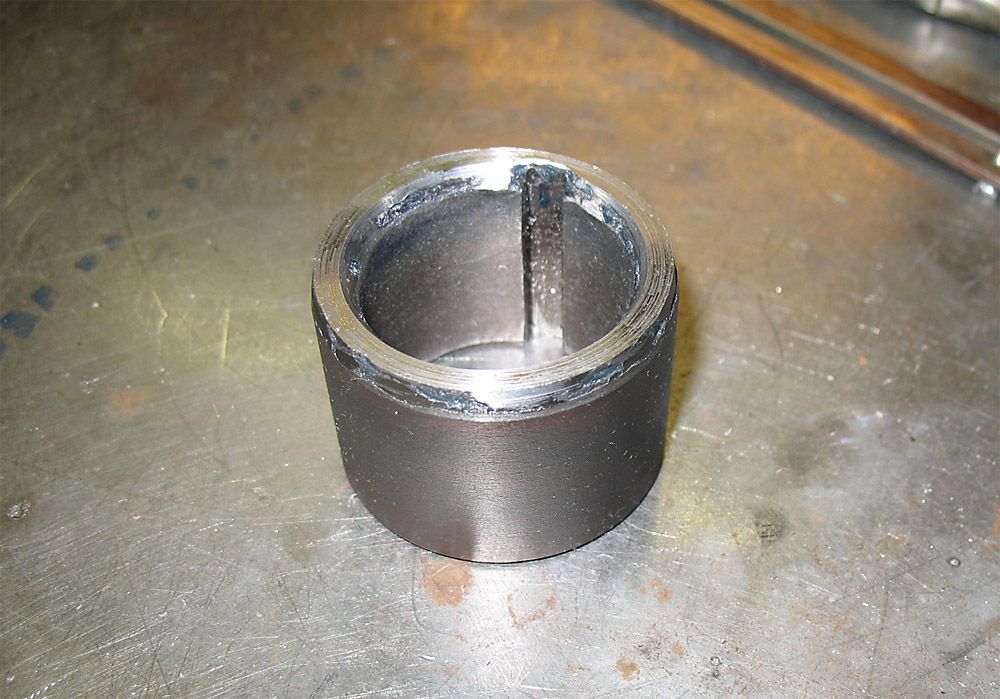
The spacer was made from some unknown steel mix that seemed perilously close to pig iron and did not play nice under the heat of the torch – spitting and smoking most unpleasantly. Nevertheless, after six or seven passes around the rim I had built up sufficient metal after which I chucked the spacer in the lathe and turned it back down to the correct size – it now having the necessary 2.25mm extra length.
Edited By Ignatz on 09/07/2018 07:59:54
Some interesting, but not very enlightening, points about the ebay item:
Probably nothing sinister, but 'does not compute'
MichaelG.
Hi Michael,
Probably nothing sinister.
If the product is 'unbranded', it just allows the manufacturer – Soba to sell it to someone else who does not want Sobas brand on it. Or, if there are rejects to which they do not want their name associated, it could come onto eBay via various back-door dealers. This practice we have seen a lot. For example, during our inspection process in Delhi, ARC rejected a high percentage of swivel angle plate because they failed to meet our specific need. We had checked each and every unit. The order was large, and the rejection was large. The manufacturer was not happy. His statement was, 'if it is good enough for x, it should be good enough for you'. We agreed to disagree. He took back the rejected stuff, and now we see a bucket load of the rejected stuff on eBay. He also had to re-make a new lot for us, which he did, to our satisfaction.
Almost all of the Indian manufacturers have 'back door' dealers and own back door accounts (one of whom has eight accounts), for one reason or another ranging from greed, over run disposal, rejection disposal.
Ketan at ARC
Maybe eight or ten years ago not long after Chronos first brought onto the UK market the Soba ER32 chucks for the Boxford lathe they wouldn't even thread on the spindle nose more than a turn or two because although they were bang on 8tpi they were supplied with a 60 degree unified thread form rather than a 55 degree whitworth thread form
Phoned up, same story, about them 'all being the same' and 'no one else had a problem' exchanged for another one, exactly the same issue.
Was it my spindle. No. I tried it on my other Boxford (1950's rather than 1960's) then on a spare 'used' spindle I picked up long ago and finally on a brand new 350 quid 1980's produced spindle still in the wrapping from Boxford.
Total waste of my time, their time, the CNC time and 40 quid or whatever. (The only thing even remotely acceptable quality was the collet nut but I've since replaced all mine with the ball bearing type)
So I bought a backplate and ER32 chuck from Arc Euro and although it's slightly more bulky it fits both lathes perfectly and runs true although to be honest that is with a 10ths indicator – I haven't measured it with my 0.5 um Mahr comparator.
Yes, I bought one of those. Returned it for a replacement which turned out to be, as you say, exactly the same. I ended up turning a bit of bar in the 3 jaw, mounting the collet chuck "backwards" on it and screwcutting a whisker off the thread.
Maybe eight or ten years ago not long after Chronos first brought onto the UK market the Soba ER32 chucks for the Boxford lathe they wouldn't even thread on the spindle nose more than a turn or two because although they were bang on 8tpi they were supplied with a 60 degree unified thread form rather than a 55 degree whitworth thread form
Phoned up, same story, about them 'all being the same' and 'no one else had a problem' exchanged for another one, exactly the same issue.
Was it my spindle. No. I tried it on my other Boxford (1950's rather than 1960's) then on a spare 'used' spindle I picked up long ago and finally on a brand new 350 quid 1980's produced spindle still in the wrapping from Boxford.
Total waste of my time, their time, the CNC time and 40 quid or whatever. (The only thing even remotely acceptable quality was the collet nut but I've since replaced all mine with the ball bearing type)
So I bought a backplate and ER32 chuck from Arc Euro and although it's slightly more bulky it fits both lathes perfectly and runs true although to be honest that is with a 10ths indicator – I haven't measured it with my 0.5 um Mahr comparator.
I ordered some chuck keys from Arc Eurotrade on Friday and they arrived this morning, impressive service. Your key is probably a 040-010-00321, check their website and check. Regards Pat
Sounds suspicious, but what did you measure – the chuck alone, or a test rod held by a collet properly fitted inside the chuck?
You might have a dud but it's not unknown for chaps to get in a stew by measuring the wrong thing. (Don't ask how I know!!!) If the runout is poor when measured against a test rod in a collet, speak to Chronos.
If you're new to ER collets, check fitting as per this advice on the ArcEuro website. That catches people out sometimes.
Dave
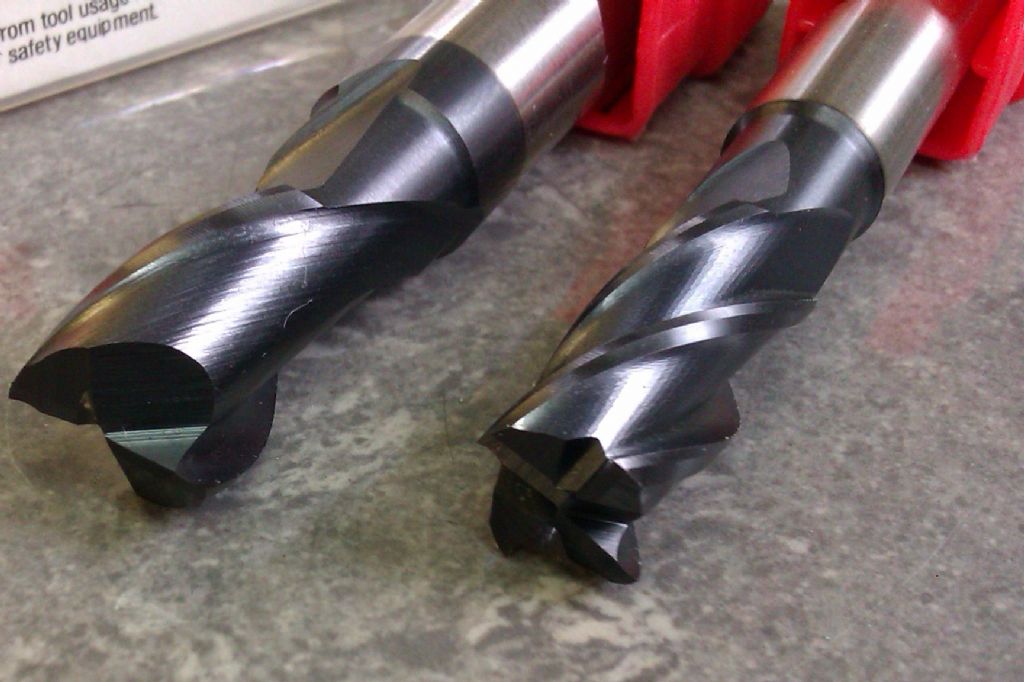
Sorry I can't agree with that old way of thinking, many "end mills" produced now have centre cutting edges and would now be better named "4-flute milling cutters" as they can plunge cut. Ok this is a rougher but same applies you can plunge, ramp and side cut with 4-flutes
2-flute cutter also tend to cut a lot closer to their nominal size where as a 4-flute can cut over width if it deflects in a heavy cut.
Have a read of part 4 of my series for a bit more info
Not the best photo but the 4-flute on the right will plunge cut
Where do I find your series Jason, I,m probably missing the obvious.
Edited By JasonB on 01/07/2018 13:46:21
Sorry I can't agree with that old way of thinking, many "end mills" produced now have centre cutting edges and would now be better named "4-flute milling cutters" as they can plunge cut. Ok this is a rougher but same applies you can plunge, ramp and side cut with 4-flutes
2-flute cutter also tend to cut a lot closer to their nominal size where as a 4-flute can cut over width if it deflects in a heavy cut.
Have a read of part 4 of my series for a bit more info
Not the best photo but the 4-flute on the right will plunge cut
Edited By JasonB on 01/07/2018 13:46:21
Thanks everyone for the replies.
One last question for just now having got the lathe it only has a fixed 2 support steady rest, does anyone know where I can buy accessories like a live centre steady rest from and other spares? I have put a post on the 9×20 yahoo group with no response (to be honest there is little going on on that forum apart from some debate about moving the platform away from yahoo.)
Thanks again for all the help, some nice carbide tooling is arriving from JB cutting tools, Banggood and some HSS from arc eurotrade.It will be interesting to compare quality & delivery times.
+1 for Ian S C; I do the same; & have collected, over the years, varying makes… Osbourne, Dormer, Presto etc. I also have sets from china which have proved very good VFM, some not so good, & a couple that are total crap. A mix of Carbon Steel & HSS & from British suppliers such as Arc Euro, Tracy Tools, Chronos, etc. usual disclaimers on all ref. plus car boot sales. I recently broke a HSS M2 taper tap from a set I'd bought from Arc Euro, carbon steel, so that will be replaced by HSS shortly, you pays your money…
George.
I
What's weird though is I bought a 12x12mm index tool holder, not amazingly expensive, about 20 quid from arc eurotrade. Using the supplied carbide tool it immediately had the same problems as the home brew tool did before, even when adding some angle. Makes me think there is something else I am doing wrong.
Can you post a photo of how you have the tool positioned, when cutting right an indexble tool should throw the swarf away from the finished surface so you must have something wrong. Also what material, speeds and feeds would help.
Hi Jason
It is throwing it away, but it feels like from time to time some of the chips get caught or go under the tool, which results in the swarf rubbing on the face. You can feel a clear grinding sensation through the handwheels. Is it possible this is just because I do not have the cross slide locked? This only happens with the index tool, which has a much smaller nose radius than my ground tool. The latter cuts really nicely now.
Will try to get some shots too.
I
What's weird though is I bought a 12x12mm index tool holder, not amazingly expensive, about 20 quid from arc eurotrade. Using the supplied carbide tool it immediately had the same problems as the home brew tool did before, even when adding some angle. Makes me think there is something else I am doing wrong.
Can you post a photo of how you have the tool positioned, when cutting right an indexble tool should throw the swarf away from the finished surface so you must have something wrong. Also what material, speeds and feeds would help.
I reground the tool so it had more clearance angle on side and top rake, and added a little radius. Cuts MUCH more nicely now, beautiful smooth finish to the eye, slight ripples to the touch.
What's weird though is I bought a 12x12mm index tool holder, not amazingly expensive, about 20 quid from arc eurotrade. Using the supplied carbide tool it immediately had the same problems as the home brew tool did before, even when adding some angle. Makes me think there is something else I am doing wrong.
Am going to experiment with locking the cross slide, as it does seem super sensitive, as well as getting the tool overhang as small as possible.
Cheers
Older cheap sets were often complete rubbish but my more recent purchases have proved surprisingly good, including a dirt cheap metric set from Lidl (apart from the M4 tap!)
A great deal depends on how often you use the set and the metals you thread. More expensive sets last much longer on difficult metals like Stainless, but cheap sets – provided they're sharp – deliver long service on Aluminium and Brass, and do reasonably well on mild-steel.
Because threading steel tends to blunt inexpensive taps and dies, I now keep two sets : one for ferrous, the other for non ferrous work. Both are supplemented by particular sizes and replacements most of which come from Tracy Tools, because they hit my 'value for money' bullseye. (They also sell tap-drills, which you also need.) Owning two sets plus add-ons might seem an extravagance: it's not. Part of the tool revolution is accepting that disposable tools are reasonable substitutes to heirloom quality in a hobby workshop. It is no longer 1955!
My advice is to buy a cheap set like one of these; don't fret about quality, just replace as needed. After using them for a while you will know whether or not you need something a little better.
Dave
depends on your usage – most cheap tap + die sets are ‘use once’ (esp on steel) and most of time you will be buying ones that will see little use – better value is to buy individual as required – if you are only using Brass or Ali then carbon steel will be fine but if if steel is generally required then HSS is usually a better buy.
Tracy Tools are generally by return of post, Arc-euro also have competitively priced taps + dies inc sets which I’ve found to be good value.
Edited By Frances IoM on 26/06/2018 11:34:03
Indeed, that would do the job though a bit pricey. Actually it doesn't have the 4th axis stepper motor but just the driver for it.
Arc do a 4" rotary table as a plug-in (the 6" version would be a bit big for the KX1)
https://www.arceurotrade.co.uk/Catalogue/Workholding/Rotary-Tables/4-Rotary-Table-with-Stepper-Motor
I've got this part and it does work very well.
The prices really have shot up – getting nearly double what I paid about eight years ago and I got Mach3 and Cut2D bundled in the machine price.
Jim.
Edited By Jim Guthrie on 25/06/2018 09:24:42
Many people find the Sieg X1L from Arc a good small mill, and many have been converted to CNC. An alternative if milling metal is not important would be one of the many Chinese gantry routers available on eBay at reasonable prices. I have no experience with those but I'm sure lots of people here have. Just search for CNC milling machine on eBay and stand back…
Mach3 has the benefit of being reasonably priced and versatile. If you want it to run properly using the parallel port then an old 32 bit XP machine is best. It can also run on later Windows machines but may need an external motion controller (for example with a laptop). Mach 4 is probably better, but definitely needs an external motion controller.
Then there is Linux CNC. Many people find it very good, but you need to load Linux on your machine and it is reputed to be hard to get going unless you have Linux experience.
There are several other CNC controller software packages around – UCCNC is one, you'll find others discussed here. Again these need an external motion controller as well as a PC.
You can also buy dedicated controllers that replace the PC. If using a mill platform you will presumably need 4 axes – XYZ & A – that may limit the choice of suitable controllers.
If you are going to start converting a machine then be warned that it is quite involved and you'll need access to machine tools to do it – that may make the gantry router approach attractive if it comes with all the mechanics and steppers already assembled. Another benefit is that they usually have high speed spindles, better for working in wood.
I'm sure that Brian is correct
These blocks were originally 'metrology' items, and priced accordingly: **LINK**
http://www.starrett.com/metrology/product-detail/706BZ#Features
But the concept is now widely used, and machinist's versions are affordably priced: **LINK**
MichaelG.
.
Edit: Found it
… This is the best write-up I have seen:
https://www.circuitousroot.com/artifice/machine-shop/auxiliary-tools/setup-blocks/index.html
Edited By Michael Gilligan on 24/06/2018 07:52:13
They offer a similar vise to the Arc one called "Value brand" but it has limited jaw opening (142mm vs 199mm), despite being apparently the same basic design. I expect Arc (Ketan) worked with his supplier to optimise the design beyond the basic concept, which is something you get from the better purveyors of Chinese goods.
Murray
You need to clamp it to the table with tee bolts and a couple of slotted clamps. The larger ones don't seem to come with them but you need a clamp set anyway, which are on offer from MSC (but check your slot width)….
I notice that the MSC vise is on offer at £130 at the moment (page 13). Good deal!
Edited By Muzzer on 22/06/2018 23:12:22
Ross,
Like you, I ordered a 6 inch vice for my Warco VMC mill, only to find that. when it arrived, I could only just about lift it and it was way too big for the machine. I packed it up and took it back to Arc Euro Trade, who were very understanding and swapped it for the smaller, 100mm version. I'm exceedingly pleased with my purchase and it is indeed a "versatile" precision vice, as advertised. Recommended.
I am a satisfied customer and committed Arcophile, only. No connection otherwise.
John
Hi John
Absent shots of the underside on the web, I am wondering: How does the vice attach to the milling table?
Cheers
Howard,…My Conquest was definately made by the Real Bull factory and yes, it had 4mm keys….the cogs from ArcEuro were/are for Seig machines and need the keyway opening out in order to fit. The tight fit on the studs can be got over by (carefully!) heating the cog with a hot air gun which make forcing onto the stud a bit easier……I did try a reamer but in the end found it problematic to use mainly due to the keyway.
I actually liked my mini-lathe and although I viewed it as a bit of a toy initially I did go on to make some interesting items with it and then started making clocks so it was quite a successful machine especially since it was small enough to live in the house and was just the job for late night turning sessions with a mug of tea and Classic FM…a scenario which continues with the rather better WM180 which replaced it.
Started by:
Michael Gilligan
in: The Tea Room
Martin Johnson 1
Started by: Speedy Builder5
in: Workshop Techniques
Clive Foster
Started by:
Sonic Escape
in: General Questions
martin haysom
Started by: fingerscrossed
in: Manual machine tools
Dave Halford
Started by: Dunc
in: General Questions
martin haysom
Started by:
John Purdy
in: 3D Printers and 3D Printing
JasonB
Started by: Ian Parkin
in: The Tea Room
Bazyle
Started by:
JasonB
in: The Tea Room
Nicholas Farr
Started by: old mart
in: Workshop Tools and Tooling
old mart
Started by: Kiwi Bloke
in: Materials
howardb
Started by: john fletcher 1
in: General Questions
Clive Steer
Started by: Speedy Builder5
in: I/C Engines
John Purdy
Started by: Bill Phinn
in: Workshop Tools and Tooling
Nicholas Farr
Started by: tomcnc
in: CNC machines, Home builds, Conversions, ELS, automation, software, etc tools
tomcnc
Started by: tomcnc
in: CNC machines, Home builds, Conversions, ELS, automation, software, etc tools
tomcnc
Started by: Martin Johnson 1
in: Workshop Tools and Tooling
Wade Beatty
Started by: tgglass
in: Beginners questions
Michael Gilligan
Started by:
Wade Beatty
in: Electronics in the Workshop
Robert Atkinson 2
Started by:
dean clarke 2
in: I/C Engines
KEITH BEAUMONT
Started by: Graeme Seed
in: Workshop Tools and Tooling
alecs
Started by: lucerne
in: Manual machine tools
lucerne
Started by: COLIN MARTIN 2
in: Materials
alecs
Started by: grizmaster
in: Introduce Yourself – New members start here!
noel shelley
Started by: Mike Cooke
in: General Questions
Mike Cooke
Started by: Speedy Builder5
in: Materials
Speedy Builder5