Brian Wood
@brianwood45127
Zan,
I did say earlier, but I used the Green Timesaver.
Brian

Paul Kemp
@paulkemp46892
Zan,
Sorry I don't have the original packaging, I would say it was a fairly course grade though, was originally purchased by a mate for a job on a full size traction engine and he kindly passed on a small amount loose to me for my job. I can try to find out this coming weekend and if I do will let you know.
Paul.

SillyOldDuffer
@sillyoldduffer
Posted by Danny M2Z on 07/01/2020 09:36:39:
Posted by Zan on 06/01/2020 19:42:52:
…
…
This forum is not the place to talk politics, it's about Model Engineering. …
* Danny M *
Trouble is this isn't politics, or shouldn't be. Scientific opinion is clear about the technical cause of global warming. There is hypothesis and theory in the evidence based scientific sense of the words. Unlike man-in-pub opinion which is based on emotion and prejudice. We can do better than that!
No place for emotion when solving technical problems, and Engineers, Model or otherwise, should be careful to exclude it when analysing problems coming up with solutions. The criteria isn't 'do I feel good', it's 'does this match the facts and will this work in the real world'.
I'm nervous that politics is being allowed to suppress a technical problem. Why shouldn't engineers debate technical matters and propose solutions? Could it be the majority prefer to believe the easy reassurances of ignorant politicians? Is debate forbidden because no-one likes being told they're wrong, even if they are!
I suggest Climate Change is no more or less political than any other technical issue. For example, it would be foolish for Moderators to ban threads on electrical matters just because my easily offended cult fervently believes Ohms Law to be wrong. (Obviously the scientific evidence supporting Ohms Law is complete rubbish because Carbon Fibre has negative resistance. That's why my central heating broke down. It's failure had nothing to do with me saving a few quid by neglecting it…)
Dave

Danny M2Z
@dannym2z
Posted by Zan on 06/01/2020 19:42:52:
My sis lives in Auckland is so bad that it’s affecting her there in New Zealand , 2000 or so miles away. The sky is orange and stinks of smoke..
Here are a few before and after photos taken from my verandah. The trout was from a few years ago. – After, still from the same location but just taken a few days ago.


This forum is not the place to talk politics, it's about Model Engineering. There are probably a lot of places online for people so inclined to discuss the whys and wherefores of what is happening.
My immediate problem is how to help the victims.
Managed to score/beg a heap of board games and packs of cards (from local business's that I shop at) which went down very well at the local evacuation center, As I learned in the Australian Army, people get bored just sitting around doing nothing.
There is a bit of a lull at the moment so warnings are being downgraded a little but things are set to get a bit warmer later this week.
TV showed a map of the fires in Vic and overlaid it with a map of Belgium which fitted in easily.
Still rather live here than in Belgium though (I have been there). Terrible beer!
* Danny M *

Zan
@zan
Bryan and Paul K . What grade did you use?
i will contact the sellers, but if people have actually used it on our situation the advice here is much better from the end user thanks for the link great help! It’s packed with loads of info and it will take some digesting!
Paul L. , I have also used valve grinding compound on the cam operated stainless on bronze inlet valve seats ( there’s no exhaust in a uniflow) . I wasn’t happy with the possibility of embedding the abrasive which does not degrade in the same way as timesaver. In this position it’s actually directly in the cylinder., in any case I have no idea what the actual garage the “fine” and “coarse” is!
Edited By Zan on 06/01/2020 18:59:50

Brian Wood
@brianwood45127
Hello Zan,
I have used to to lap both the saddle and tailstock to the bed on an old Churchill Cub lathe I am renovating. I know that sounds like a foolish thing to do but the amount of material removed would be hard to measure.
The quality of the fit afterwards was quite remarkable, these components just glide over each other on oiled surfaces
In this case I used the green Timesaver
Regards Brian

dcosta
@dcosta
Hi Zan,
Thanks for your help.
Zan: My led and key board came in two days so why risk it?
DC: I hope the one I ordered takes only two days to arrive … Usually it takes longer.
Zan: Have you got the stepper turning?
DC: I haven't reached that stage yet.
Dias Costa

dcosta
@dcosta
Hi Phil,
Thanks for your help.
I've tested the board and as far as I can understand it works well. The voltages are correct and once mounted on the TI board, the power already reaches LED1 and LED3.
It happened to me the same as to Zan ("the display connector pins projection under the board fouls and shorts into one of the small jumpers on the board if it's pushed fully home"
, but tomorrow I will cut the pin concerned so that the assembly stay robust.
If it wasn't for Zan's message I would still not be aware of the problem, because I don't have the display yet so I can understand what's going on…
For those who have not yet assembled the board and since the terminal block once assembled covers some of the information printed on the board, it may be a good idea to take note of that information before mounting for ease of use.
Dias Costa

Phil Grant
@philgrant54580
Zan,
Have you got the logic level the right way for the stepper driver module, I can't remember which way they should be off the top of my head.
Have you connected with a common ground or a common 5V?
Phil

Enough!
@enough
Posted by Zan on 20/12/2019 17:20:59:
..our phone is on permanent answer phone
You obviously don't have a spouse for whom it is physically impossible to ignore a ringing phone.

ega
@ega
Posted by Zan on 16/12/2019 23:09:41:
I don’t think it’s really important as you only drive the saddle in one direction at a time so any backlash is catered for each time you change the direction it’s being moved. It is of course consistent in value. As ega says, adjust the nylock nut in any case
However, in their "blurb" Hemingway do say:
"Axial slip of the leadscrew is a common cause of thread inaccuracies. A slight oscillation imparted to the screw will cause a periodic error in pitch. Georg Schlesinger adopted a pass-off criteria of half of one ten thousandth of an inch of slip for the 1920's German machine tool industry. To adjust clearance in the right hand bearing of the Myford Series 7 leadscrew is a difficult balancing act, generally resulting in excessive thrust loads."
What do others think?

Zan
@zan
Posted by OuBallie on 30/08/2014 16:33:44:
Another thought for the web designer is to include a 'Preview' button if possible.
Just found this thread and I wholeheartedly agree with this, a preview would remove the frequent edit info.
edit. Just like this one like a number of mine for typos or silly auto fill
Edited By Zan on 16/12/2019 23:14:27

John Haine
@johnhaine32865
Watch lathes often use WW collets which are as Zan says a draw-in type with 8mm shank. They are not cheap but more precise than (cheap) ER types, and only hold one diameter. For some more info see –
**LINK**
For a design of a spindle which I think uses the same system see the Quorn drawings. Very easy to machine the collet seating, and the collets use a drawbar.

Michael Edwards 1
@michaeledwards1
Zan, yes and no. I like the idea of watch making and I think the lathes are a work of art. I would like to make something that can be used but not used everyday or last 100 years but I want it to be functional. I have an issue and that issue is I get stuck up on numbers. If something says it has to be 10mm then that’s not 10.1 or 10.02. So I thought if I could make a lathe that could make a clock or a watch then I wouldn’t be so stuck up on numbers and accept things.

Pete Rimmer
@peterimmer30576
Posted by Zan on 12/12/2019 18:18:22:
It was difficult enough to get all the bores and 45 degree seats concentric in the first place, I think the only way to lap them is how we used to grind car engine valves, ie one pare against the other. This is why I want to use Timesaver, as it’s non- embedding and it wears down to nothing. Separate laps for these components would be very difficult to make and get a fit. But thanks.
Ah, I'm with you. I thought it was just the diameters you were lapping. It makes sense to lap the valve seats together.

Zan
@zan
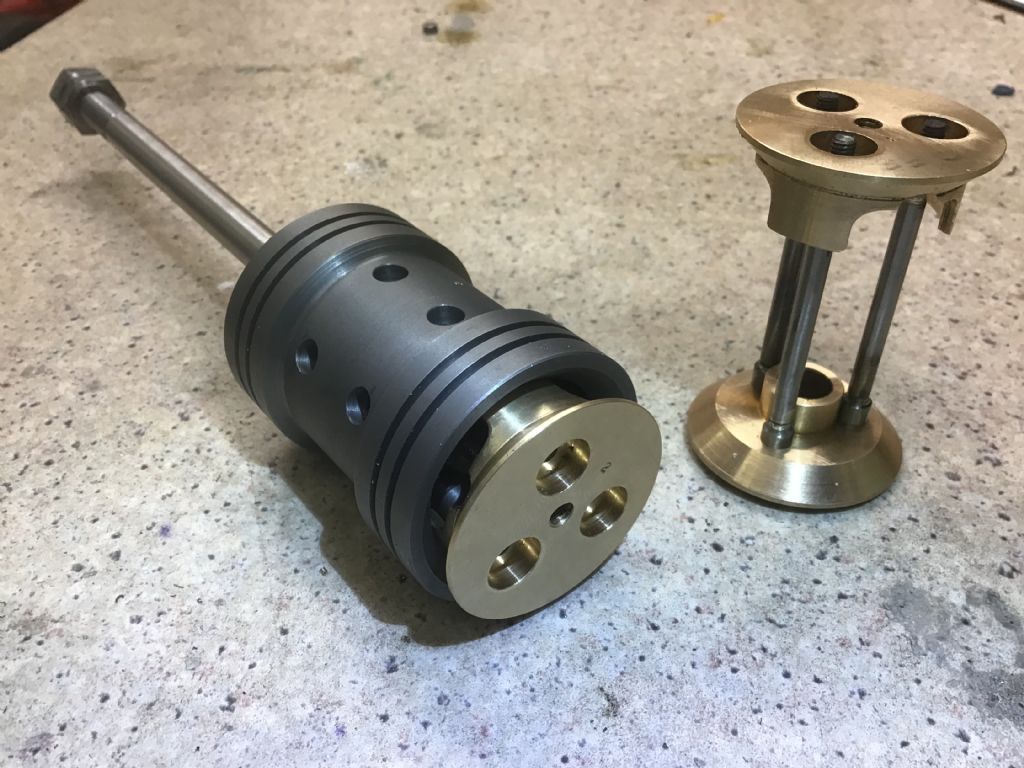
This is the piston for my uniflow engine which I am remaking, incidentally the full assembly has 23 individual pieces of metal including the fixings!
My question is that I want to lap the fine machined valve heads of bronze into the piston body made from cast iron . So which do I get, the type for ferrous metals or for yellow metals? In addition for those who have used itimesaver, which grade do you suggest for this task. The piston is 1.75” diameter

Edited By Zan on 12/12/2019 17:32:45
Edited By Zan on 12/12/2019 17:34:48

Raphael Golez
@raphaelgolez
Posted by JohnF on 11/12/2019 14:07:00:
Posted by Zan on 10/12/2019 23:19:25:
That’s the way John I did that recently. But in answering the main question, you have to withdraw the leadscrew to remove the apron. After removing the right bracket, which will be achieved by bending the screw outwards to get the bracket off the dowels. The problem is re assembly. Briefly it goes like this
Edit. Dratt . I should have looked at the link before writing an essay on the difficulty of refitting……deleted!
Edited By Zan on 10/12/2019 23:22:22
There should be 2 tapped holes in the dowels to facilitate removal with a small puller, they are ??BA have to check and you need a piece threaded bar & nut or an allen screw, a tube and a washer. I have heard some machines do not have the tapped hole ??? but never seen one.
John
Hi John you meant to facilitate jacking up the dowels via the thread? It wouldn't be a dowel if it had a thread, instead it would be a tapped hole in which case a bolt would be logical. Mine had a two bolt holding it down and a 2 dowels. To be honest I never attempted to apply force here after removing the 2 bolts. I could not see any thread in the dowels either. Like I said if this is threaded how would you pin the dowel without damaging the thread unless its a threaded bolt you using.
Raphael
Edited By RAPHAEL VAL GOLEZ 1 on 11/12/2019 14:20:45
Edited By RAPHAEL VAL GOLEZ 1 on 11/12/2019 14:21:22
Edited By RAPHAEL VAL GOLEZ 1 on 11/12/2019 14:21:55

JohnF
@johnf59703
Posted by Zan on 10/12/2019 23:19:25:
That’s the way John I did that recently. But in answering the main question, you have to withdraw the leadscrew to remove the apron. After removing the right bracket, which will be achieved by bending the screw outwards to get the bracket off the dowels. The problem is re assembly. Briefly it goes like this
Edit. Dratt . I should have looked at the link before writing an essay on the difficulty of refitting……deleted!
Edited By Zan on 10/12/2019 23:22:22
There should be 2 tapped holes in the dowels to facilitate removal with a small puller, they are ??BA have to check and you need a piece threaded bar & nut or an allen screw, a tube and a washer. I have heard some machines do not have the tapped hole ??? but never seen one.
John

ega
@ega
Posted by Zan on 10/12/2019 23:19:25:
That’s the way John I did that recently. But in answering the main question, you have to withdraw the leadscrew to remove the apron. After removing the right bracket, which will be achieved by bending the screw outwards to get the bracket off the dowels. The problem is re assembly. Briefly it goes like this
Edit. Dratt . I should have looked at the link before writing an essay on the difficulty of refitting……deleted!
Edited By Zan on 10/12/2019 23:22:22
Aren't those dowels tapped to facilitate their removal?

Zan
@zan
That’s the way John I did that recently. But in answering the main question, you have to withdraw the leadscrew to remove the apron. After removing the right bracket, which will be achieved by bending the screw outwards to get the bracket off the dowels. The problem is re assembly. Briefly it goes like this
Edit. Dratt . I should have looked at the link before writing an essay on the difficulty of refitting……deleted!
Edited By Zan on 10/12/2019 23:22:22

Zan
@zan
I used silver steel when I made mine, hardened then tempered to blue, ( spring temper) been using it for years
If it’s good enough for a screwdriver, it’s ok for a Chuck key
Edited By Zan on 09/12/2019 09:33:55

Zan
@zan
Iv been mulling this over as well. I don’t know how many steps would actually be lost, but here’s my calcs
1 turn of the 8 tpi leadscrew takes 200 steps x 8 micro steps = 1600 per rev
Lost motion per lost step …… cutting an 8 tpi thread, so 1 turn of Leadscrew gives saddle move of
0.125” / 1600= 0.000078” Not very much!
So 10 lost steps = 0.00078”. Still very little.
as most threads I cut are at 24tpi+ this is reduced by 1/3 to 0.000026” and 0.00026”
can a humble myford work to these limite? Are my tools ground accurately enough? What effect on the thread does my chaser present? How accurate is my leadscrew?
conclusion, servo ain’t worth the extra cost
Edited By Zan on 07/12/2019 10:30:08
Edited By Zan on 07/12/2019 10:32:12

Limpet
@limpet
Thanks Zan I remember now that Clough42 plugged the encoder into the driver so it looks like I will be getting a servo motor and driver. I might try it with just a stepper to check what torque motor I need as I have some. I'm still at the thinking/waiting stage until I get some parts arrive, i also thinking of adding a magnetic clutch in the lead screw drive chain so i can still use the handle on the end without worrying about induced voltages generated by the motor, as i said still at the thing stage
Lionel

Tony Pratt 1
@tonypratt1
Posted by Zan on 06/12/2019 16:44:07:
Tony.
Jeffree talks about changing the voltage which gave a lot more power. What are you running at. And what power does your psu put out?
Edited By Zan on 06/12/2019 16:44:31
Hi Zan,
I will have to ask my son who I am seeing on Sunday, as I really don't want to give you guys false info.
Tony