See this recent thread here for extensive discussion of a number of rotary tables, good, bad and toothless: LINK
You probably would not go wrong with a 4" rotary table from ArcEurotrade.
Edited By Hopper on 21/03/2019 03:33:58
Ok, age not an issue it is brand new not yet delivered from the factory. Manufacturer really not that important or relevant to the original question I think, I just want to find out if the flange of the sizes mentioned matches any established standard. Yes I am well aware of Classification Societies, their rules and approvals process, it won't be of any particular concern to them that the flange may be an odd ball as long as it can be shown by calculation and testing it meets their requirements. Unit in this case can be DNV approved for appropriate fee.
Had another dig around on the DIn website (Michael G provided a link also) and searching "marine shafts" gives a fair number of links, most interestingly enough seem to be referenced back to SAE standards. I found one I think may be relavent but they want to charge me 32 euro's to read it. Shan't be bothering with that as its not that critical! Been in the marine industry 40 odd years and never come up against this before. I will ask around my peers and if I find an answer I will let you all know.
Thanks,
Paul.
Is DIN 225 coupling even a real thing? Could it be DN (Nominal Diameter) ? That designation is widely used in piping (which as we've seen uses flanges).
These days most standards are harmonised across Europe – so what is BS EN ISO xxxx in UK is DIN EN ISO xxxx in Germany. Relatively few purely National standards are left – though there are some.
I did a quick search on the BSOL site under Marine Drive – 50 pages of results…. , tried Marine Flange – just piping. Any more suggestions for what they might be called ? Is this main propulsion, or something else?
Can you tell us the manufacturer, or are you trying to make the quiz especially difficult?
Marine stuff could even have a specific Lloyds Register classification…
I used arc eurotrades QCTP with no problems at all, I replaced it with a swiss multifix unit which costs way way more.
Depends on what you're doing as always. If you only use a few tools you obviously only need a few holders. But like most things in this hobby more is better so do take the other advice to buy plenty of holders.
At present I have ten holders permanently set up with everything from knurling tools to parting off to diamond turning tools, and I could still have a few more.
I also ended up buying 1/8” 1/4’ and 3/8” ER32 collets for the convenience. I’ve never had a cutter slip but then I use bearing nuts on my chucks:
I also use a longer 4 prong spanner.
I wouldn’t be without my ER32 tooling and apart from a full set of collets I have three chucks, several collet blocks and a Stevensons Spin Indexer.
Edited By Windy on 16/03/2019 12:02:32
Edited By Windy on 16/03/2019 12:07:21
Woo hoo! Mill arrived from arceuro.
The shipping had been subbied out to arr craib big (ish) outfit up here in the frozen North. Driver appeared, in a flatbed 1.5 tonne wagon, no taillift, no handling equipment. I really felt for the driver, he'd been stuffed. His previous drop had been an engine to a garage (that also didn't have a forklift, oddly I don't have a forklift at the house either…..)
Proffered tea and buns to the driver, found a couple of neighbours, opened the box in the back of the truck and got as much out as possible to get the weight down. And through pure unreasonableness got the mill into the garage.
After much stretching, pre lift planning, hoiked up onto bench. Cleaned up, plugged in and tested.
Ooh, it's nice.
Ooh, it's quiet.
Ooh, it's shiny (now that the shipping grease is mostly off) I'm really impressed by the kit supplied by arceuro and know that shipping is not really in their hands when things come this far north.
Mill bolted down, Garage tidied, plans afoot to go skip diving at some of the local fabrication outfits to get bits of metal to launch round the garage ..
it does look like a very cool bit of kit. The table operation is very smooth, the mill is amazingly quiet at low revs, very much looking forward to having a play and making "chips" (swarf where I live)
How long do end Mills last
Are they disposable items
Even though I had a set of Dore-Westbury castings and drawings before I got my Beaver milling machine, I would say that nowadays one would be better off getting something like the Seig 2 or 3 machines from the likes of Arceuro. Similar price, but more capacity, but still bench mountable if that is a requirement.
As you are both new and may not be aware of how it works this is what you do.
In the grey bar under each post are several options if you click "message member" you can then send a message that only they can read.
If you have a message the "inbox" icon in the green bar along teh top of all pages will flash and you will also get a flashing envelope just under the ARC Euro Trade advert. Click either to open your message and then reply to exchange contact details.
Hopper have you got a link to the £400 tables and what sort of spec do they come out at compared to what the OP measured?
The ArcEuro 6" just used as an example, following on from Ketan's posts about the search for reasonable quality suppliers etc. Although I think there were others quoted somewhere in the thread at several thousands of pounds. Compared with the 56 Quid Warco job in the previous post now. For that price, I could live with a few thou slop. And backlash does not worry me at all. Not sure why so many people worry about backlash. As long as direction of movement is uniform, backlash is unimportant. (Maybe I'm just used to using worn out old machines and "backlash compensation" is a natural habit.)
But I don't think I could ever get over the 47 tooth wormgear. The sheer indifference of the manufacturer would bug me every time I used it. I would have to use the table to make a 48-tooth worm gear ring and shrink it on. Could be done I suppose if you turned the handle 46/47th of a turn for each cut, giving you one extra turn at the 48th post for the extra tooth.
Like a micro-drilling attachment I bought recently. For use with .5mm drills and the like. Looks beautiful but the little chuck has so much runout the tip of a drill bit has about .010" runout . So I'll be salvaging a very nice chuck off an old but not worn pistol drill and making my own micro-drilling attachment shank to suit. The old "If you want a job done right…" Could have saved myself the price of a carton of beer.
Edited By Hopper on 14/03/2019 09:51:47
Edited By Hopper on 14/03/2019 10:01:16
Been lurking on the forum for a week or so,
Some hugely informative and helpful posts by what look to be a really nice bunch. Decided to register and say hello, probably to ask questions and may post on occasion.
I'm semi retired oilfield trash (I get away with staying at home as long as the current Mrs G can put up with me) and work a few months of the year when she can't put up with me any more.
I'm a pretty active glider pilot and part time tow plane pilot.
Ride a motorcycle faster than a man of my limited abilities and advancing age should.
Have had "ideas" bubbling in the back of my greying napper for downhole tools and surface disconnect systems for years and kind of want to "prototype" them.
To this end, I've started to kit out my garage properly, I've now got some decent workbenches on which to start plonking machines on.
Arceurotrade have relieved me of some ill earned dosh and I shall endeavour to launch unsuspecting finely cast metal in various directions from the seig 2.7 Mill and as yet undecided lathe 'till I read the instructions or start to get the hang of what i' M doing.
My only practical engineering fabrication Al experience is breaking things well trained engineers have made for me at work.
I'm intending making up small working models of the half baked wheezes I have. Time will tell how I get on (in the interim, the mill will be placed as far from breakable windows as possible ) my only practical knowledge is that the toys have more than enough grunt to remove fingers, so I'll be very very careful (and be prepared to duck when things get launched)
Roy.
How about one of these, loctite a sleeve on for the 15mm, turn it down a tad for the 7/16
Look here for similar…more reasonably priced ( usual disclaimer ) …
George.
Edited By mechman48 on 05/03/2019 13:04:43
Agreed George there are many competitively priced units, it depends o what you are making of course but I find that many of them are too short to be of use hence my choice of the longer one at 2.0" , really a cannot see why suppliers don't have them longer the cost would be [should be !] negligible and "putting on tools" are rarer than hens teeth !
John.
Look here for similar…more reasonably priced ( usual disclaimer ) …
https://www.arceurotrade.co.uk/Catalogue/Blank-End-Arbors
George.
Edited By mechman48 on 05/03/2019 13:04:43
To answer Finnian's question directly (perhaps he wants to make several cylinders over a period, and doesn't want to rely on someone else):
Almost any mini-lathe will do the job. It could probably be done on a Microlathe (Seig C0 size), but I'm prejudiced against them – too small.
Cheapest way in the UK, not sure about Eire, is to order a mini-lathe direct from China. I wouldn't because of the hassle if the lathe turns out to be faulty, and because there's more risk it might be. Read the small-print, chances are you will be required to return a faulty machine at your cost, and this will be ouch expensive. The other issue is that some cheap machines are seconds or factory rejects. Safer to buy from a local vendor who you can talk to, preferably one with a reputation to protect.
You don't need an expensive mini-lathe – these have useful additions like hardened ways, more accessories, and brushless motors not needed for a simple turning job.
All mini-lathes I seen advertised come with a 3-jaw chuck, which is what's needed to hold the cylinder.
My advice, even though it's not critical, avoid very cheap. Something mid-range, about £500.
Brass is easy to cut dry, but don't get the swarf in your eyes!!! Aluminium isn't difficult provided you avoid the alloys that don't machine well. (For example the alloy used to make window frames is intended to be extruded. As such it's soft and sticky and it machines badly, yuk.) Other alloys are intended to be machined and are good to work with. Aluminium needs to be lubricated during cutting with paraffin or WD40 – splash it on with a brush.
An ordinary HSS RH Knife will turn the cylinder down to size. Likely you also need a LH Knife to 'face-off' the ends of the cylinder. 6x6mm or 8x8mm tools will fit the lathe, note they have to be shimmed so the cutting point is at the same height as the cylinder's centre. Occasionally mini-lathes come with a set of cutting tools, usually you have to buy them separately. Strictly speaking, you need a grinding wheel to keep HSS knives sharp. However, provided you don't let them get too blunt, they can be touched up with an ordinary oil-stone.
You could buy a parting tool to cut the cylinder off the stock. However as 'parting off' is quite difficult, especially on a mini-lathe, I'd hacksaw the cylinder off in a vice and return it to the lathe to be faced-off cleanly to size.
120mm is getting on the long side to be turned without support at the tail-stock end. But, with care you should be OK. If you can't hold the diameter (the lathe cuts a taper because the work bends during cutting), ask again.
For both Brass and Aluminium I'd run the lathe at about 500 rpm and take approx 0.2mm cuts. Experiment for best results.
Dave
Edited By SillyOldDuffer on 05/03/2019 10:26:43
The other 12 will be shank diameter
Are you sure there is nothing missing off the end as around 80mm overall length would be right, have a look here for the 4 dimensions
Edited By JasonB on 04/03/2019 15:44:59
… I believe a (major?) obstacle is the protrusion into which the post itself threads requiring that the base be drilled out further…
Could you turn down and thread the post that comes with the toolpost to fit your lathe (or even make a new one), leaving the lathe unaltered?
I'm afraid I cannot recommend any particular toolposts (other than avoid the very cheap aluminium ones – I wish I had avoided them), but if you look on Arc Euro Trade's website the specifications of each of the ones they sell are shown in full, so you could work out the size you want from there.
Brian
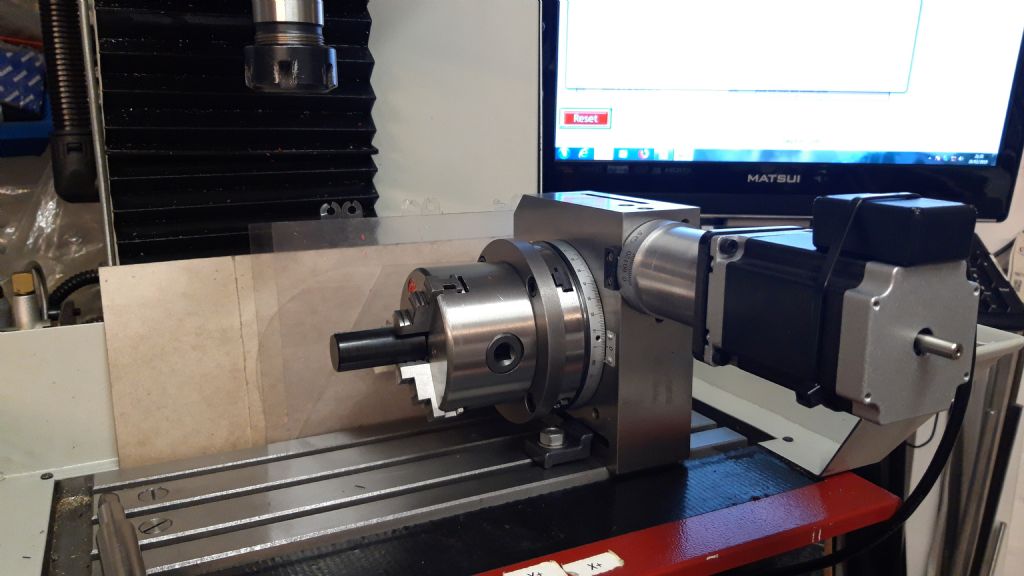
As the description suggests I have recently bought a 4th Axis for my KX1 from Arc Euro, first impressions I am very impressed with the build quality and rigidity.
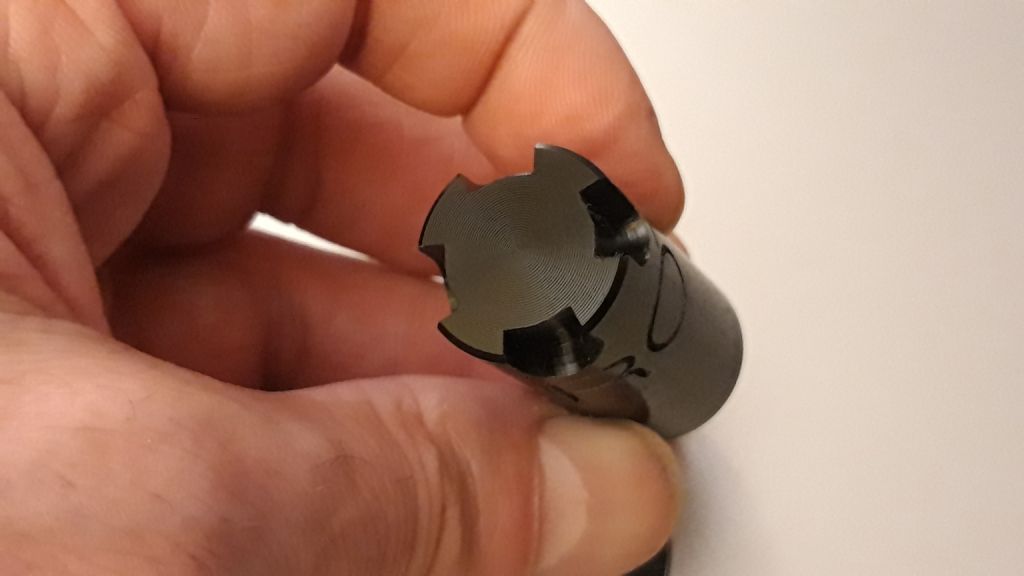
It is the 4 inch rotary with stepper (Arc's own fitment) which is just the right size for the KX1, plug and play and off we go with a little test program made with Vectric VCarve, using a piece of 20mm dia Acetal, I set about machining rotary text spelling 'ROTARY' and four slots. Using two tools, an engraver and 3mm end mill. Press start!
And soon stop! although the device was communicating with Mach3 there was no relation between the angles required for each letter or slot, they all merged into each other and overlapped, even though the Mach3 screen showed it machining okay. This was because the motor needed tuning, So by looking into the motor tuning menu I tweeked the 'steps per' and 'velocity' and some trial and error and maths I got the 'steps per' to the correct 400 (it was set at 2000), and the velocity to 2500, now everything machined as planned, although I will need to change the velocity so it matches the X axis feed rate.
Here's a couple of photos of my set up and first test piece. More to come as the adventure continues!
i have just got a kx3 mill from arc euro . i have downloaded mach3 and liecensed it ,however icant get the machine to respond to any commands ,the dro fiures move but the machine dose not x,y or z or spindle.it is fitted with a paralell port .any help would be very welcome .markl
Hello Mike,
If in your message you mean that the Tomé Feteira files are of Swiss manufacture, you are wrong.
They are, in fact, manufactured in Portugal.
Read, please, the text you can find ***HERE*** .
Best Regards
Dias Costa
Hi Jason, just a bit of info for you. Not sure why your machine won't move but if it helps my KX1 came supplied with a combined Mach3 and Sieg set up disc from Arc Euro who also supplied me with a separate emailed licence file for Mach3 (they are a third party supplier of Mach3 and can issue licences) this is a little file called 'Mach1Lic.dat' . This must be inserted (by copying and pasting) into the main Mach3 file. This will unlock the full Mach3 program and remove the line limit.
The set up disc will also include the Sieg Kx1/Kx3 screen set to operate the machine, and you will also need another little file called 'Sieg_USB_ setup_1.6.0.0'. this will unlock the necessary operating system for USB connections. Again this must be copied and pasted into the Main program. This file could be downloaded from SmallCNCsupport but no longer! You'll know if it is the right screen set by looking at the bottom right of the screen it should say KX1 USB or KX3 USB. If you can't get hold of this file I can send it to you.
Hope this helps
Ian
I’ve been very pleased with the Swiss pattern Tome Feteira needle files sold by Arc Euro Trade. Cheaper than Vallorbe, and good quality.
Mike
I have just fitted the Arc Euro needle thrust bearings and ball race to my ML7 cross slide machining the end casting as prescribed.
All went together nicely, gave the thrust bearings a slight pre load and all feels good.
I have measured the endfloat on the cross slide which shows I have 0.003 in of wear in the leadscrew/nut assembly, I thought that wasn't too bad?
I fitted a new long cross slide and feed screw probably 30 years ago but the nut is original from 1951!
Alan
I know ARC dosn't issue accuracy certificates with there machines but there are a number of other sellers that do re the same or very similar machines made in China. When you see the accuracy certificate that they state on every machine the customer gets it does make you wonder if these are simply stamped pieces of paper with lies told on them to fool the customer. When you look into some of these machines where very experienced engineers know how to check there machines & have the facilities to put things right, must say things were never machined right during original manufacture. I do know that a seller of Chinese machines told me when i asked them about the certificate that came with the machines said the certificate done in the Chinese factory was only valid for the day the test was done & no more than that. A clear way out in my book, i know they have no control on what happens once the machines leave there factory's. The certificate is not worth the paper it is printed on, i know these machines might be cheap but why try & fool the customers into believing they are getting a machine that is more accurate than what they actually are from day one.
Martin,
To understand this, you need to understand assembly of these type of machines – manual process- as well as history (i am not trying to patronize). 'Back in the day', machines were checked in the same way 'in Europe' when 'we in the West' made machines.
If machines were made 'by manual process', there were variables. The machines when they left the manufacturer, left in similar way as they do from China. There were gremlins in many of them from new – even Myford (regardless of what some may say). Once the machines were delivered, a machine tool fitter came to the place where the machine was to be installed, checked the place it was to be installed, on what, levels, as well as the the machine, did the adjustments to the machine as necessary, before commissioning the machine, as who know what the machine went through in transit. The user never opened up the machine to look for gremlins. As long as the machine worked as the user needed, that is all that mattered. Most of the users were practical engineers.
The certificates issued by most reputable factories are correct and issued after the machines have been assembled and accuracy adjusted after assembly, at the factory. We are regularly offered these certificates, and I have seen the checkers do their job to check the accuracy. But ARC refuses to accept these certificates because we don't know what will/will not effect the machine until it is installed. So, in this respect, the certificate is only true at the point just before the machine is packed in a 'reputable' factory, wherever it is from in the world. This holds more true for 'lighter' machines, built in this way. e.g. SX2.7 is light, and a Bridgeport is heavy.
Now, instead of a machine tool fitter, the end user is expected to handle, lift the machine out of the case – properly, put it on a level surface/location, and carry out adjustments. If an experienced person does this (I don't mean a person with a piece of paper degree out of university) carries out the checks and does the adjustments, all is well. We have 'respected people' out of industry, with decades of practical experience in machine assembly, with good knowledge of tolerances and accuracies, who have bought and used the machines as supplied, over the years. I don't say this to just inflate my ego. Nor do I say this to patronize. This is just an observation. My reputed competitors some of whom have been around much longer than ARC have similar experiences.
So, to suggest that they are trying to fool you with the certificate is a little wrong. Perhaps they could clarify how and where the tests are made. Perhaps they could clarify that things could change in transit/handling, temperature, installation by you – the customer, adjustment by you the customer. If left unadjusted what could happen even perhaps?… who knows?… At the price you pay, you have to decide if you feel it is good value for money. In most cases, the machines are accurate and fit for hobby use. If you want something which is outside these remits, it will cost a lot more.
Ketan at ARC.
Posted by Piotr Gertz on 19/02/2019 08:06:18:
…
I accepted that, after all it’s a hobby machine,
I'm trying to think of another hobby where equipment that did not work or do what it was supposed to do right out of the box without major work would be acceptable.
…
Certainly true of Amateur Radio in the past, less so today. And I think for exactly the same reason, that is a smallish hobby – not millions of people and a lot of money – wanting equipment of a quality they can't or won't pay for.
When I first played radio, most people bought and adapted second-hand commercial equipment, mostly ex-military. Although well-made this stuff usually needed tlc. It was possible to buy new at affordable prices, but what you got was basic with indifferent performance. Part of the hobby fun was modifying new or second-hand to better suit the owners needs. Coughing up a few months pay would get you an altogether better new radio, but they were still considerably inferior to professional equipment costing a year's plus plus salary.
Home metalwork being a relatively small market there isn't much money in it. It's not like cars where the trade is worth billions and makers have to constantly improve value or go out of business. Far eastern tools are pitched at prices hobbyists are actually prepared to pay. Unfortunately there's not much on offer for chaps prepared to spend, say, 100% more on 'quality'. Instead, if you want 'quality' you have to buy an industrial machine, and new ones aren't cheap! Not many hobbyists spend appropriately serious money on a home workshop.
Amateur radio has benefited from developments in consumer electronics and computing. Very large number of customers chasing the best they can get coupled with a technology where Moore's Law applies. Wonderful! The market for machine tools doesn't have the same dynamic.
Perhaps Piotr has been unlucky to find an example of old-fashioned manufacturing technique done poorly. Castings have been poured and machined. As castings are often flawed, when the mill was assembled someone had to fit the parts together. Fitters were once important men in British factories, but – where labour is expensive – it's soon cheaper to eliminate fitting by making precision parts that assemble without needing more work. To quote Mr Jeremy Clarkson on the subject of unreliable super-cars, 'there's only one thing worse than hand-finished and that's handmade.'
I think the reason lathes and mills aren't made entirely using modern precision techniques is that the start up cost is prohibitive: huge numbers of machines would have to be sold to recover the investment. Instead, hobby lathes are only precision made with bought in mass-produced components like bearings & motor, and on moving and alignment critical parts like the bed & headstock. Everything else is fitted down to a cost.
I think this explains why some examples of the same model hobby machine are 'good', most are 'OK', and some are 'bad'. It's often possible for the owner to improve these machines by fettling, though I doubt they will ever be 'excellent', and a basket case might be beyond hope. But you and I might well do a better job than a rushed Chinese worker. If hobbyists had been serious about 'quality' off-the-shelf they would have supported Myford. Poor old Myford got caught making an expensive machine, which their greatest fans usually bought second-hand, whilst competing with much cheaper Chinese lathes that, despite rough edges, are mostly 'good enough'.
Be interesting to know the history of Piotr's machine. We know that ArcEuroTrade and Warco both visit their Chinese suppliers seeking improvements and others likely do the same. We also know duds do creep through reputable sellers and that factory rejects are on the market as well. Those bargain prices offered by an unknown auction site seller might not be such a good deal after all! Or perhaps it's genuine, who knows?
It's an imperfect world.
Dave
Edited By SillyOldDuffer on 19/02/2019 12:19:16
Started by: martin haysom
in: General Questions
Dave Halford
Started by: Clive Foster
in: Manual machine tools
peak4
Started by: rumz
in: Traction engines
Speedy Builder5
Started by: James A
in: Workshop Tools and Tooling
MichaelR
Started by: Nigel Graham 2
in: Manual machine tools
Michael Gilligan
Started by: Zan
in: Help and Assistance! (Offered or Wanted)
duncan webster 1
Started by: old mart
in: Workshop Tools and Tooling
Steve101
Started by: john fletcher 1
in: General Questions
Howard Lewis
Started by: lucerne
in: Manual machine tools
Charles Lamont
Started by: vintagengineer
in: 3D Printers and 3D Printing
Russell Eberhardt
Started by: Speedy Builder5
in: Workshop Techniques
martin haysom
Started by: Dunc
in: General Questions
John Hinkley
Started by:
Michael Gilligan
in: Workshop Tools and Tooling
Michael Gilligan
Started by: tomcnc
in: CNC machines, Home builds, Conversions, ELS, automation, software, etc tools
seemack
Started by:
JasonB
in: The Tea Room
Nigel Graham 2
Started by:
Hollowpoint
in: General Questions
Nigel Graham 2
Started by:
Sonic Escape
in: General Questions
Paul Mills 4
Started by: Ian Parkin
in: The Tea Room
Mark Rand
Started by:
Michael Gilligan
in: The Tea Room
Michael Gilligan
Started by: Alan Ambrose
in: Manual machine tools
Adam Harris
Started by: fingerscrossed
in: Manual machine tools
Dave Halford
Started by:
John Purdy
in: 3D Printers and 3D Printing
JasonB
Started by: Kiwi Bloke
in: Materials
howardb
Started by: Speedy Builder5
in: I/C Engines
John Purdy
Started by: Bill Phinn
in: Workshop Tools and Tooling
Nicholas Farr