Search Results for 'arc euro'

Search Results for 'arc euro'

Home Forums Search Search Results for 'arc euro'

Viewing 25 results - 201 through 225 (of 4,842 total)
  • Author
    Search Results
  • #766078

    In reply to: Jaguar [oh dear]

    SillyOldDuffer
    Moderator
      @sillyoldduffer
      On Nigel Graham 2 Said:

      So altogether a complex set of interleaved problems raising the awkward question of will people get about in, say, thirty years time, or will society return to something like 100 years ago when most people didn’t go very far very often, and then by rail or bus.

      Will the recovery be full, however that’s measured, or to some patchy, partial level based on very few manufacturers?

      Indeed, except I think there will be trouble ‘getting about’ rather sooner than in 30 years.   At the moment, electric is the best technical option, despite range problems.

      Hydrogen has considerable promise but the issue is safety, and it being a difficult to liquefy gas makes it hard to get enough weight into a vehicle, and leaks are scary!   Petrol heads might be enthused to know that Hydrogen is the fuel par excellence.  Burning a kilogram of Hydrogen produces 4 times more energy than burning a kilogram of oil, and about 10 times more than a kilo of best coal.  Very promising if the technical problems can be solved.

      I tend to see getting new technology to work from a historical perspective.  Before about 1700, mankind completely failed to tap the potential of coal, even for domestic heating.   Difficult to ignite, and requires a grate and chimney to burn well, neither found in ordinary homes until late medieval times.   But progress being progress, new homes were eventually built with chimneys, and they were bodged into ordinary hovels too!  Efficient coal stoves had to wait for cheap cast-iron, which took another 150 years to become commonplace.  Domestic coal took a long time to become popular.

      That mechanical energy could be extracted from heat was known to the ancient Greeks, but their technology wasn’t developed enough to tap into it.   Nor was the advantage of burning coal rather than wood or charcoal noticed.   A thousand years later Savery developed the first practical coal powered pump,  but it was very limited and highly inefficient.  A few decades after Savery, Newcomen put considerable thought and talent into designing his engine, by which time  blacksmithing had advanced sufficiently during the previous century for him to build one.   Though they worked, Newcomen’s engines were physically large, and there were considerable problems at first building boilers.   This despite them only needing to raise 2 or 3 psi, because the piston was worked by atmospheric pressure (clever!).

      Bottom line, Newcomen engines were expensive to run, being less than 1% efficient, and were usually found pumping water out of coal mines, where cheap slack coal was available by the ton.   The cost of coal limited their spread into other applications considerably.  Fixing that needed an expensive canal network, more problems, and no sooner were they perfected than railways bit, themselves taking about a century to mature.

      Smeaton widened the market by improving Newcomen’s original design, taking about 20 years to do it.  His enhancements were based on an elaborate series of experiments in which everything was measured carefully.   Applied science enabled him to roughly double efficiency.   At the same time James Watt was doing similar advanced work, concentrating on the ‘mechanical equivalent of heat’, and going beyond simply improving an existing design.   Watt came up with 7 or 8 major advances over about 40 years.  The first was the condenser.  Still a low-pressure atmospheric engine, but the condenser saved energy by keeping the cylinder hot, making the first Watt engines roughly twice as efficient as the best Smeaton/Newcomen.   Translating Watt’s idea into a real engine seriously challenged British industry, who took about 30 years to work out how to bore large diameter cylinders accurately enough to get the clearance between piston and cylinder down from about ¼” to less than ¹⁄₁₆”.

      By the time technology had moved on enough to manage high-pressure steam and opened the door to further efficiencies the by then elderly Watt was dead against further progress! He felt that his engines were all the world needed.  Despite being a double-barrelled genius in his youth he was of course wrong, ending up using his considerable experience as a nay-sayer.  It’s an occupational hazard of living!

      My main point though is that determined persistent effort is needed to get new ideas off the ground.  There’s always a phase during which new technology is unreliable and sits awkwardly alongside yesteryears methods.  But, after the bugs are cleaned up, the advantages of the new way overwhelm the old, which fades away.

      Anyone who reads ‘Railway Magazine’ circa 1900, will find correspondents explaining why the motor car will never catch on:  good grief – the entire road network will have to be paved, and tens of thousands of refuelling points and maintenance garages built.   Won’t be possible to train enough chauffeurs,  and motor cars are an unreliable fire hazard with terrible brakes, low mph, and an appalling accident record.  In comparison, railways were safe, reliable, and 60mph wasn’t uncommon.  Obvious to them that motor cars would be a complete waste of time.

      Sixty years later, ME, contains very similar letters from small-c conservatives rejecting diesels.  Dozens of objections and much delight in reporting unreliable diesels having to be towed home by good old coal burning chuff-chuffs!  Objectors didn’t read the accounts, and missing that essential information, failed to understand why steam had to go as soon as possible.  In the same period, after more than a century of superb service, stationary steam engines were being ruthlessly ripped out of factories and pumping stations across the world:  killed by electric motors, which have considerable advantages over steam.  Lots of folk didn’t understand that either.  These changes were all costly, took considerable effort, and had many misadventures on the way.   But ten years later, Britain’s steam based infrastructure was gone.   And it disappeared everywhere else in the world too – rapidly in advanced economies, more slowly in poorer countries.

      Tempus fugit, and now it’s our turn to face up to the need for major change.   Fighting change is a waste of time I think – the forces driving it are beyond individuals, or even nations.   In the end, what happens is mostly decided by the need to earn money.  Though engineering and politics have influence, the main drivers are economic – individuals, businesses, nations, and trade blocs deciding how best to spend their money, causing a constant need to produce more from less.

      Will recovery be full?  I don’t know!  I doubt it, we’re tap-dancing on thin ice.  For example, US voters feeling the heat, have elected a president who threatens a trade-war. He believes in tariffs too.  His main target is China, but America First includes all foreigners, including us.  At present the UK is badly placed relative to the US because we’re outside the powerful European Union and – so far – haven’t concluded a trade deal with the US.  Instead we trade on the rather unfavourable US rules they apply to countries who don’t have a trade deal which makes the UK particularly vulnerable if a ‘US first’ policy is applied.

      At the same time, China’s economy is showing signs of strain and might even go pop.  If it does, there will be wide repercussions.   For example, Australia earns a lot of money by exporting huge quantities of coal to China:  if China suddenly stopped importing coal, then Australia will be hurt, perhaps badly, reducing their ability to import from the West, which will hurt us.

      More problems in other economies around the world; none are rock-solid.  And now trade is globalised the impact of a sudden major change anywhere ripples round the planet.  Beyond knowing there will be winners and losers, it’s difficult to predict what will happen next.  A great deal depends on confidence.   Might resolve in smiles all round, though hard-liners make that unlikely.  Cycles of boom and bust are probale, and maybe a full-scale global depression, and more shooting wars.  I hope not!

      Jaguar’s advert isn’t aimed at Model Engineers so what we make of it is irrelevant.  I do say though that it’s generated a massive amount of free advertising for Jaguar, and our not understanding that is a good reason for not employing Model Engineers in Advertising Departments.  We’re unfamiliar with what Millennials and Zoomers are up to and don’t “get it”.

      Although time is remorseless, there is humour in it.  My kids are millennials, a group now mature enough for youth to find their attitudes and beliefs ‘old-fashioned’.  Only yesterday my daughter and I laughed about her first grey hairs and our mutual total ignorance of today’s pop-music…

      Dave

      #765790
      Roderick Jenkins
      Participant
        @roderickjenkins93242

        Richard,

        The forum looked into this problem a couple of years ago.  Greenwood tools used to supply these inserts individually but since they ceased trading the tips only seemed to be available in boxes of ten – rather more than most people need at £15 odd each.

        However, a quick search shows that Cromwell now seem to sell them individually Cromwell tools

        for about £20 each delivered.

        ARC Eurotrade sell a similar but much more pocket friendly system that works well ARC Eurotrade

        with replacement tips at a couple of quid each ARC GTN 2 tips.

        HTH,

        Rod

        #765119

        In reply to: New Here

        Howard Lewis
        Participant
          @howardlewis46836

          Looks like the changewheels are 16 DP. Myford are 20 DP, so unless you plan to change the whole set up, (Can you change the gear at the back of the spindle?) you may be stuck with a compound of some sort to mesh them together.

          Unless you can find suitable 16DP gears, the lathe is going end up as a bit of a hybrid; although if it does what you want, will that matter? Try posting a “Want” with the gear spec

          Using Myford gears would be easiest since they are fairly freely available, and they are 14.5 PA.. 7 Series are compounded with a key, where those for ML1, 2,3 and 4 use a 3/32″ pin, and 5/8″ bore.

          The Myford gears would only need drilling part way through for the 1/8″ driving pin.

          Or, you don’t mind plastic gears (Although metal sets are available) you could use Module 1 gears from a C2 or C3, but the problem might be changing the first driver to a 20T Mod 1.

          Plastic gears for Chinese mini lathes use 3 or 4 mm keys, depending which factory made the machine.

          Metal gears from Arc Euro Trade will have 3 mm keyways, since they are intended for machines made by Sieg

          If this is possible, all will certainly need modification, (boring out or bushing) and then making up a new studs for the intermediate gears, so that the final driven gear will fit onto the Leadscrew.

          HTH

          Howard

          #765032

          In reply to: New Here

          Howard Lewis
          Participant
            @howardlewis46836

            Welcome!

            You are sure to find help on here.

            Are you sure that the thread is 3/4 x 12 Unified?

            12 tpi is not a standard for UNF or UNC.

            But 3/4 BSF is 12 tpi.

            Catch 22, without changewheels, you can’t screwcut a backplate!

            If you have  a 3/4 BSF tap, you should be able to find a backplate (See what Arc Euro can offer. I modified one, by bushing and retapping, for a friend to take a 4 jaw chuck for his old small lathe )

            They also have 80, 100 and 125 mm chucks on offer, and a range of backplates which you could modify to fit your lathe.

            Changewheels may be hard to find.

            Check tooth count against OD to find the DP.

            Hopefully you could then find ones that can be bored or bushed to fit your lathe.

            You are experienced, so these activities should present little problem for you.

            Good Luck

            Howard

            #764752
            alan ord 2
            Participant
              @alanord2

              Brian, there is a guy who provides kits for the Warco WM 16 Mill. No idea what he charges and he is based in Europe. His name is Murat Bilgin Bilici. If you are interested he can be contacted via his e mail :- [email protected]

              If you do contact him I would be interested in how much he charges for a kit.

              Alan.

              #764699
              SillyOldDuffer
              Moderator
                @sillyoldduffer
                On Nigel Graham 2 Said:

                I know the CAD book you mean, and yes the cover illustration is of about 1990s vintage so may deter some buyers. Even I, hardly Alan Turing v.2024, queried it when I bought my copy at the TEE stand a few years ago. Very helpfully but slightly embarrassingly one of the staff winkled the author out from behind his own society stand, and he came over and explained that despite appearances, the basic principles of CAD, at least in 2-dimensions, are still much the same. …


                So although a cover photograph of a PC some 30 years old might be unwise for selling any introductory book on serious software, much of the contents is still relevant at that introductory level. You also need the specific tutorials for your chosen make of software, but those might not explain general CAD principles. Those still apply: what’s happened is that the software has grown much more powerful and flexible in that thirty years, with lots of extra new tools to use.


                And no, I didn’t ask the writer to autograph my copy…

                I fell off my chair reading Nigel recommending this book.  Partly because Nigel has a long track record of struggling to learn CAD, and partly because the book is badly out-of-date.   Not the author’s fault because CAD and computers develop far faster than mechanical tools; whilst a Myford designed during WW2 is still hot to trot in 2024, the same can’t be said of 1980’s CAD software, where progress and change is still rapid!    I found the CAD book unhelpful as a starter.  What do others make of it?

                That said, I feel the Workshop Series CAD book is the exception that proves the rule.  In general I highly recommend the Workshop Series.  Don’t expect them to get into advanced work though – they’re aimed at Model Engineers not professionals.   But what they do provide is excellent, and focussed better on my needs than the same information on the web.  Well worth learners buying the books that cover your area of interest.


                As for guides to other engineering processes – turning, soldering, etc – those techniques have not evolved greatly but the two areas I do not recollect being covered is that of sheet metalwork and carbide tooling.

                There is a Workshop Practice Series one on basic sheet-work; but I don’t think it went much further than mallets and blocks of wood in vices. It may have showed developments, I can’t remember, but since I also wanted advice on using a tinman’s jenny, rolls, bar- and tube- benders, forming locked seams, bending allowances and suchlike, I was disappointed.

                Nigel expects too much of a slim basic introduction!

                While it’s clear from enquiries on this Forum that using insert tooling is almost an art itself – hardly surprising because what we buy for our hobby are the seller’s best choices for our typical uses, from an utterly bewildering range of expensive little bits of tungsten-carbide ceramic with long code-“names”. Try something like the ‘Sandvik’ catalogue and you will see what I mean – complete with tool lives quoted in tens of minutes not exhibition intervals.

                Unlike HSS, information about carbide inserts is aimed squarely at production engineers.  Science not art.   Their job is to maximise output whilst minimising cost, which generally means cutting flat-out all the time. In this environment Carbide cutters last tens of minutes, whilst HSS either cuts for tens of seconds or fails instantly.  Inserts are selected by establishing the required production parameters and asking the supplier, or by entering requirements into a paid for spreadsheet.     Hobby machinists rarely cut metal at production rates, and we don’t have access to optimisation software. We break the rules too: a trick that works well for Model Engineers is turning mild-steel with uncoated inserts designed for non-Ferrous metals.  Buying inserts by number from a catalogue is a minefield.  One easy answer is to buy inserts from ArcEuro.  They only sell insert types that experience shows work well in hobby circumstances.

                It’s not helped when some respondents become rather dogmatic, almost telling the tyro, “Throw all that HHS stuff away, buy a hundred-quid’s worth of inserts and slave-drive your lathe at flat-out speeds and feeds”! Poor lathe, and poor savings-account. (I do use both HSS and carbide – and often at similar cutting rates.)

                I don’t remember anyone saying that!  Could it be that HSS fans are reading between the lines?    More accurately, carbide is simply more convenient than HSS, for example inserts pretty much do away with the need for a QCTP, and much reduce the need to learn grinding skills. Shocking I know, but plenty of beginners struggle with grinding.

                Ideally, inserts should be operated at production rates, but that needs a powerful rigid machine and high RPM, and those are rare in home workshops.   Far Eastern lathes tend to work with inserts better than classic machines because their being a later design comes with comparatively high RPM.  As inserts don’t shine on a speed restricted classic machine, HSS will be the best choice for them.   Otherwise, inserts are a ‘good thing’.

                I use inserts about 80% of the time, but don’t hesitate to switch to HSS when it suits the job.  Sometimes easier to get a good finish with HSS, and HSS can be ground to cut form shapes.


                So here’s a challenge:

                A book on proper sheet-metal, bar and tube forming tools and methods, an area oddly neglected in model engineering literature; though it may be more applicable for our non-model, model-engineering.

                A book on insert tooling, explaining for a start what all those letters and numbers mean…*


                I know… “Go on then, write them then!”

                Wot, me Guv? It’s me who needs read ’em!

                No problem Nigel:  wrap a wet towel round your head and do the research.  Hard work unfortunately…


                I owe a lot to L.H Sparey.  The only problem with “The Amateur’s Lathe” is he wrote it before Inserts, Digital, CAD and other advances were available.  Perhaps the answer is to bring Sparey up to date by adding a few new Chapters.

                Dave

                #763506
                Gerard O’Toole
                Participant
                  @gerardotoole60348
                  On Chris Crew Said:

                  Please don’t misunderstand me, I have every respect for wildlife and the environment but I have never quite understood the reverence that is afforded to bats. We have just had a report from the chairman of the now fairly pointless extravagance of HS2 that an additional £100million was required to build a ‘bat shed’ so that bats are not to be disturbed by the passing of high-speed trains. Apparently the organisations that are responsible for curating the environment, Natural England and the Environment Agency, are now trying to distance themselves from the demands that they both made which pushed up the costs to the taxpayer.

                  When HS2 was first proposed I was generally in favour of the new railway but as the project progressed it became apparent that it was going to be ‘over-engineered’ to cater for higher line speeds on slab track just, it has been postulated, to ‘get one over’ on the French whose design speed is lower on conventional track. This notion may contain a grain of truth and sowed the seeds for the emerging financial catastrophe that the taxpayer is having to pay for with absolutely no prospect of a return on the investment. No wonder that the project has been largely cancelled and rendered all but pointless, IMO, in its current configuration.


                  So, back to ‘bats in the belfry’! Evidently the species that a £100m is being spent to protect is not endangered in any way and, as in all things naturel, would probably have continued to exist quite happily in its present location or moved to another more to its liking because nature usually finds a way. I don’t know, but I suspect the French or the Spanish didn’t impose such costs as this upon their railway engineers when building their impressive and extremely successful high-speed networks of which I have had the pleasure of using on several occasions because we no longer fly if it can be avoided. Anyway, you can read the report here, if the moderator will permit, as there is no paywall to overcome.

                  https://www.theguardian.com/uk-news/2024/nov/07/cost-of-shed-to-protect-bat-colony-near-hs2-has-topped-100m-chair-says

                  I don’t want to wade into a debate that might be considered none of my business, but just to correct some of what you say.

                  the species that a £100m is being spent to protect is not endangered in any way,

                  A quick search shows that in fact it is a rare bat. I quote from a few sourches , including Bats.org and Wikipedia

                  Bechstein’s bats.
                  The Bechstein’s bat is one of our rarest bats, found in parts of southern England and south east Wales. It is found almost exclusively in woodland habitat. The destruction of ancient mature forests along with intensive woodland management practices has led to a decline in its numbers.”

                  you say

                  I suspect the French or the Spanish didn’t impose such costs as this

                  But again from a quick Google search

                  “Bechstein’s bat is also listed on Annex II of the EC Habitats Directive,
                  Bechstein’s bat is protected under the European Habitats Directive

                  So if the authorities in France and Spain are ignoring any risk to the bats then they are doing so illegally. I suspect they are in fact protecting the bats too.

                  And you also say

                  Natural England and the Environment Agency, are now trying to distance themselves from the demands that they both made

                  But the articles makes no such claim. It quotes Nature England as saying “Natural England has not required HS2 to adopt this structure, nor advised on the design or cost. Our input has been to comment on whether the proposed mitigations will work.”


                  #762806
                  Tony Pratt 1
                  Participant
                    @tonypratt1

                    The Dickson type worked well back in the day when made in England, the copies are not so good and I sold mine to be replaced by an Arc Eurotrade wedge type , I am 100% happy with this type which are meant to be more accurate in their location repeatability. There are various YouTube videos on this subject.

                    Tony

                    #762803
                    derek hall 1
                    Participant
                      @derekhall1

                      I am also considering changing from my Dickson quickchange tooling (that never seems to work that well) that I use on my Myford.

                      Two choices seem attractive from arc eurotrade, is the piston type or wedge type. Anyone got any experience and feedback on this type of toolpost?

                      What are the advantages and disadvantages of piston and wedge type when in comparison?

                      What size/types are suitable for a myford?

                      #760566
                      JasonB
                      Moderator
                        @jasonb

                        The number after the ER is based on the outer size of the collets and the bigger the outside the bigger the internal hole can be. For work holding I would suggest ER32 or at a pinch ER25 if you have a small machine.

                        This shows where the size “D”is taken from and also the available size ranges “d”of the collets for each ER size.

                        #759789

                        In reply to: Diesel

                        Macolm
                        Participant
                          @macolm

                          “He presumably believes there’s a cheap alternative that’s going to last forever… “

                          To respond to your points roughly in order, I am quite aware that fossil energy must be wound down, despite the increased energy costs and therefore a reduction in living standards. However, a very likely result of present policies is failure to solve the problem, accompanied by crippling energy price increases.

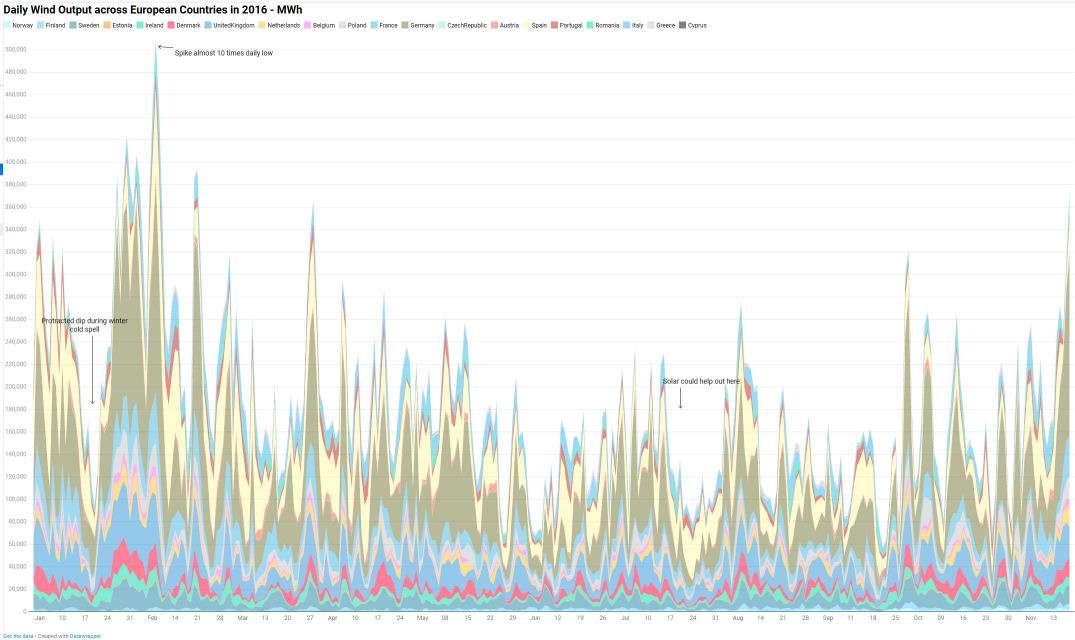
                          Spreading wind generation widely over large areas has been evaluated many times, and there is no evidence it makes any useful difference. Here is a graph from 2016 that shows how much averaging may be possible across all of Europe (Norway, Finland, Sweden, Estonia, Ireland, Denmark, UK, Netherlands, Belgium, France, Czeck Rep, Austria, Spain, Portugal, Italy, Greece, Cyprus). There seems no prospect of useful benefit.

                          EuropeWind2016

                          Bulk storage to make good deficits in renewables would appear to require a scale of things virtually impossible to afford and to resource. The existing pumped storage facilities were a good fit for the short term needs of morning and evening peaks in demand, and remain a useful resource for that. Recently, storage in the UK has been added to address the problem of grid stability due to reduction in synchronous inertia. However, this amounts to only minutes rather than the weeks needed to shore up wind and solar intermittency.

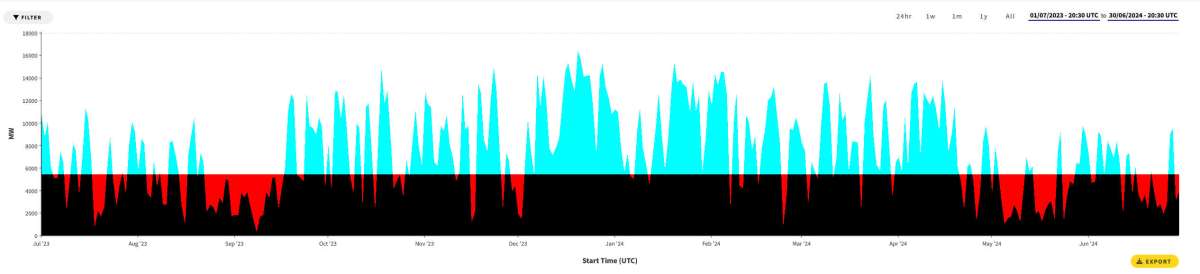
                          Here is a graph relating to long term storage derived from UK wind from July23 to June24. A horizontal dividing line has been chosen so that the deficits below the line shown in red equate with four times as much shown in cyan above the line. This is what is necessary to compensate for the losses due to hydrogen electrolysis, compression and other storage losses, and the efficiency of combined cycle gas turbine generation with a varying load. It can be seen easily that months rather than weeks of storage would be necessary. Are there, perchance, alternative more efficient, project ready technologies available?

                          FullYearColourFillReduced

                          What has changed is the belief by politicians that magic solutions can be mandated by them and their acolytes, rather than painstakingly developed using the traditional engineering method. But there is an affordable technology that has been proven to be cost effective and safer than the alternatives. That is nuclear power. Now I am not a keen enthusiast of nuclear, but the alternatives are worse. It was evident by the 1990s that wind and solar would prove deficient at scale, and so it has proved. If ‘net zero’ is essential, we have indeed wasted half a century (and counting) in putting in place the only enabling technology so far shown to be feasible.


                          Lathejack
                          Participant
                            @lathejack

                            Over the last few days I have thought about visiting the Midlands Model Engineering Exhibition, so I booked Thursday off from work just in case I do decide to make the effort to go on any one of the four days the show is on.

                            I’ve been visiting the model engineering shows every year since the early 1990’s upto 2019, mainly Donington, Harrogate and ending with Doncaster. They were usually the highlight of my year, and the main drain of most of my spare cash.

                            My main interest there was really the trade stands, particularly the new machine tool dealers, and just about all of my new machines, plus almost all my tooling, was purchased as a result of what I had seen and fiddled with at those shows.

                            But, for various reasons, quite a few of the main suppliers no longer attend the shows. Chronos, Arceurotrade, Axminster Tools, Warco, Chester, Proops, Rotagrip, and SPG Tools are all sadly not there. Although once or twice I have bumped into Ketan from Arc wandering around, as a visitor I think.

                            So, for me at least, the shows are not quite as good as those I enjoyed so much not too long ago. But thankfully there still is a show, and there seems to be plenty there. I did visit the Warwickshire Show a couple of times over ten years ago, but one year half way through the first day I left to visit Arceurotrades premises, then the following day I went straight to Arc again and spent all my spare cash there.

                            Anyway, I’m almost sure I’ll be making the effort to go on one day, it will be a 200 mile round trip for a 5 hour stay at the show to try and experience again the same atmosphere and enjoyment from all the MEX shows I visited in the past, and maybe spend a bit of cash.

                            I wonder what others think of the Warwickshire Show.

                            #759513
                            Andy Stopford
                            Participant
                              @andystopford50521
                              On Hopper Said:
                              On Lee Cooper Said:

                              Well I don’t *think* it classes as a mini lathe but after much deliberation I’ve decided to go with a Warco WM180. If it’s not everything I hoped for I rest safe in the knowledge that I can bitch to SillyOldDuffer about it.. 🙂

                              Can’t wait to get into the game and ‘be one of the boys’ so-to-speak.

                              Congrats on your new machine. Enjoy!

                              Yes I think at 7″ x 12″ (180 x 300) the WM18 would be classed as a minilathe. Unless there are more subtle differences the afficionados get testy about?

                              To my mind, “Minilathe” applies to a particular design (reputedly originally of E.European/Russian design), of which the “Creworks” is a stretched version. Warco’s standard length version is here:

                              https://www.warco.co.uk/metal-lathes/303410-mini-lathe.html

                              The WM180 is quite different and appears to be based on the Emco Compact 8:

                              https://www.lathes.co.uk/emcocompact8/

                              Having used both, I’d say the WM180 is much more rigid and behaves much more like a ‘proper’ lathe. Like its Emco ancestor, it lack a tumble reverse to the leadscrew, and has a slightly odd single slot banjo for the change gears which makes it difficult to cut anything other than the standard (but wide) range of threads advertised (it’s quite clever how they managed to get the range that they do out of it). I have thoughts of an electronic leadscrew for mine.

                              #759471
                              not done it yet
                              Participant
                                @notdoneityet
                                On Diogenes Said:
                                On not done it yet said:

                                … ..Compressors were always quoted FAD until the chinese realised they could con the buyers by issuing higher numbers for less money.

                                Same with chinese heaters – cheap 8kW diesel air heaters do not exist and even the touted 5kW versions likely deliver only a tad ove 4kW.  And so it goes on….dupe the ‘less well informed’ buyers.

                                Sorry NDIY, but that’s just nonsense – reputable industrial suppliers have always quoted FAD, but ‘domestic’ / ‘hobby’ outlets such as DIY store chains and ‘Discount Tool Warehouses’  quoted displacement figures for compressors and input figures for power machinery for as long as I can remember..

                                IIRC things were so bad by the early 1980’s that there was an ‘air’ company (from, maybe ?Sheffield?) who were able to use ‘full disclosure’ of spec for home-gamers as a Unique Selling Point, closely followed of course by Axminster, who really promoted their ‘transparency’ as a marketing tool that proved hugely successful – both of these companies sold imported machinery.

                                Why perpetuate conspiracy theory couched in such such offensively racist terms?


                                Maybe those reputable importers did a good job in being transparent, but for “as long as I can remember”, which may be less in this field, it has been the cheap chinese imports that were hyped.  My ‘old iron’ compound compressor was bought second hand from a farm sale about 30 years ago and is still going fine.  A genuine cast iron twin cylinder (compound) pump with 3HP motor, <u>delivering</u> around 10cfm.

                                The chinese can make very good products, but the cheap end (often aimed at hobbyists) leaves a lot to be desired where complete truthfulness of the product is concerned.  They pay (in one way or another) for good reviews.  They exaggerate the capabilities.  They provide misleading data (eg motor output power) – Arceuro do provide power output values, but I expect some outlets don’t do this for Sieg machines.

                                I have cheap chinese diesel heaters.  8kW versions simply cannot exist but are advertised as such (the pumps are insufficient and the fan speeds are already at maximum, even for the claimed 5kW versions).

                                Cheap chinese bearings were ‘outed’ by John (doubleboost) in one of his earlier videos (headed ‘chinese shite’ IIRCC).

                                I have cheap (imported from China) dehumidifiers.  They are rubbish for durability.  ‘Chicken fat” lubricants was the most common issue, leading to failed drives or fans.

                                I once bought a MT2 adapter which was not quite MT2.   Ban good carp.

                                I recently bought one battery cell balancer.  It did not work.  I needed 7, so I will try a better supplier – not directly from China!

                                Bangood, Vevor and Temu, among others, are a lottery where quality and specification adherence is concerned.

                                I avoid cheap chinese, unless I am able to fix it or can accept the shortfalls.

                                Good quality costs.  I remember one place I worked sent two containers back to China because the contents failed the quality required and the QA checks before being accepted.  Every consignment, <u>afterwards</u>, exceeded the quality inspections on arrival.  The Chinese supplier clearly could supply good quality but tried, initially, to get away with sub-standard products.  These were mostly electronic parts for electricity meters, BTW.

                                I’ve had a lot of experience with chinese products and (mostly) know how to decide on whether to purchase or not.  One reason why I have purchased most of my hobby items from Arceutotrade.  Don’t even go to Indian quality, either.  I know a bit about some of their (dangerous) practices in the past.

                                #759270
                                JasonB
                                Moderator
                                  @jasonb

                                  The inserts are intended to slope down towards the tip of the insert, this is to ensure the edge of the insert does not rub.

                                  Just clamp it by the flats on the shank

                                  See on the table here where the angles are given, steeper as the minimum hole gets smaller. It also shows you that the cornet of the insert should be what you set to ctr height

                                  #759053
                                  Mark Rand
                                  Participant
                                    @markrand96270

                                    Do you have a wheel arbor with the machine?
                                    If so, find a couple of bearing balls that are close to the maximum and minimum diameters. Put them in the arbor and measure their distance from the top with a depth micrometer ( or caliper, at need). correct for half the diameter of the balls to get centre distance, then the taper per side is tan⁻¹(((dia1-dia2)/2)/difference-in depth-between-centrelines)

                                    You can use the same calculation, with a bit more fiddling and swearing, by using rings with a known bore on the spindle.

                                    For a perfect fit, once you’ve turned up a female taper, use spotting blue to see how good the fit is and minutely adjust the angle to suit.

                                    Good luck 🙂

                                    PS:- the grinder looks as if it’s got the best bits of the B&S No2 and the Jones&Shipman 540 combined.

                                    #758874
                                    Hopper
                                    Participant
                                      @hopper

                                      Wouldn’t touch it with a 10 foot pole. As said above the vertical stretch on standard narrow bed is not going to work well.

                                      Have a look at the Sieg SC4 at 1200 Quid from Arc Eurotrade. A much more solid and usable machine with good after sales back up.

                                      Amazon returns policy is not going to cover a machine that works but works poorly due to inherent design weaknesses. Caveat emptor.

                                      #758550
                                      Taf_Pembs
                                      Participant
                                        @taf_pembs

                                        Afternoon all !

                                        So this captive drawbar thing..

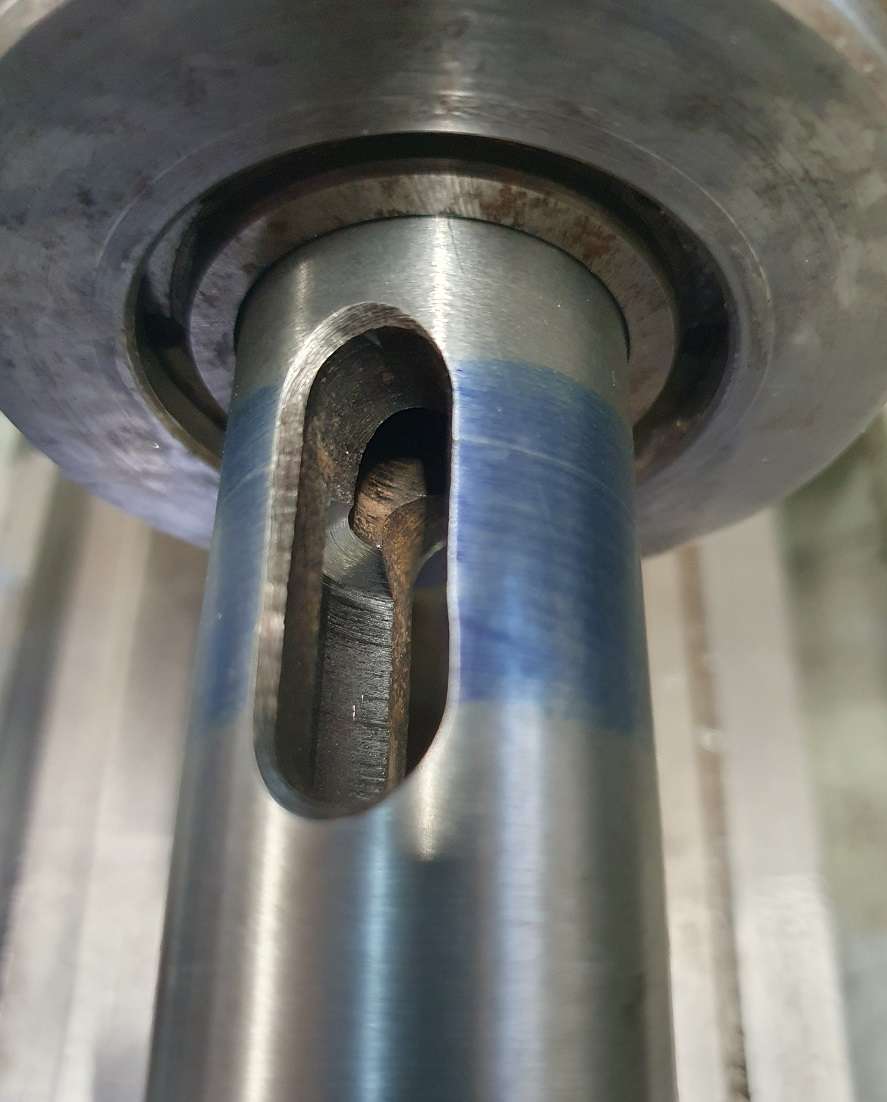
                                        When cleaning up the inside of the spindle in the area needed for the drawbar to stop and eject the arbour I had to go about 4 – 5mm into the ‘meat’ where the internal bore reduces to just over 12mm. Firstly to get the required clearance for the drawbar to work and also to provide a shoulder for it to seat on when ejecting. I decided that the internal shoulder of the spindle was going to have a 30deg taper and a small radius at the outer edge to prevent any sharp edges and create any stress points. So I stuck it back in the lathe collet chuck and again with a ludicrous stick out on a 12mm boring bar carefully cut it. It was trickier than I though to do the small outer radius than expected as you can only see when either of the tool ejection slots come round.. got there though. Difficult to see in this pic with the light but it is there.

                                        Captive_Drawbar_10

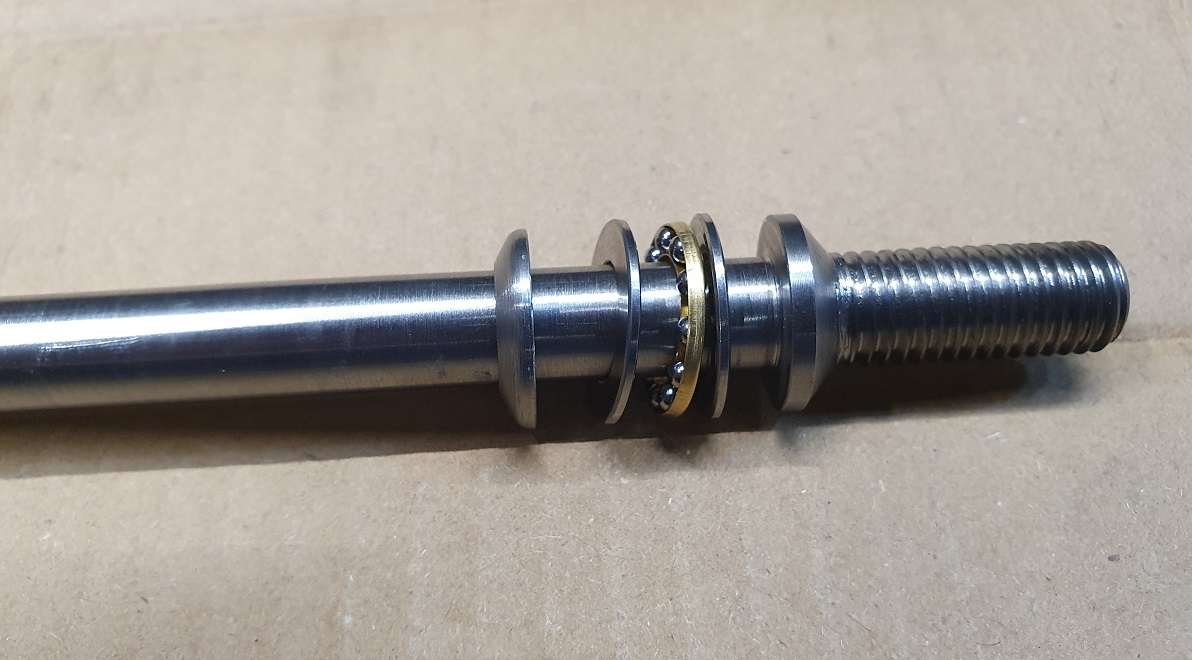
                                        Then just made a corresponding washer to sit above the thrust bearing.

                                        Captive_Drawbar_11


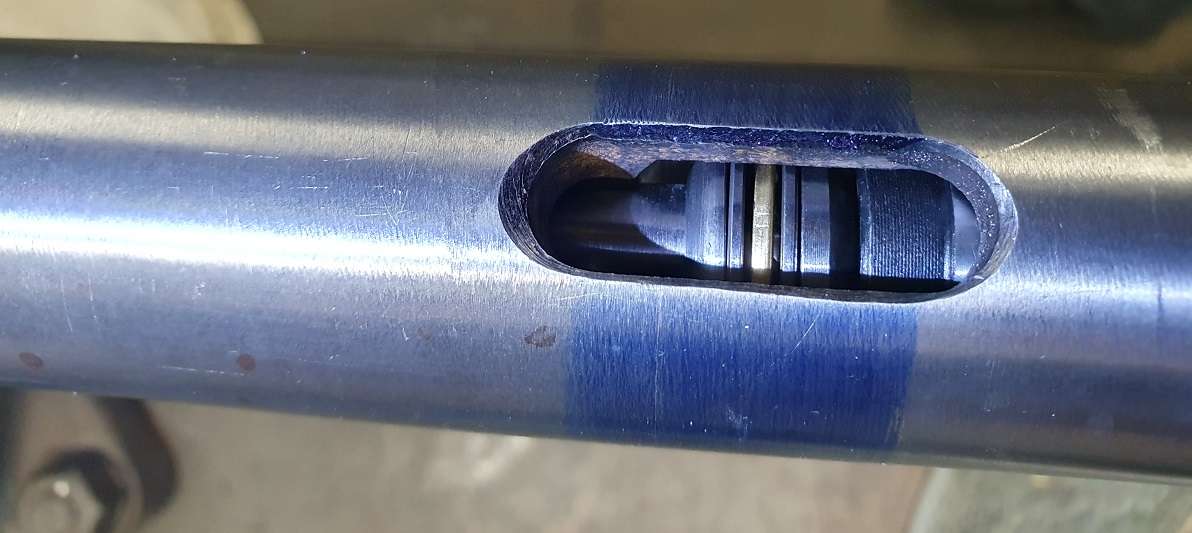
                                        And here it is with an arbour in the spindle and fully tightened.

                                        Captive_Drawbar_12

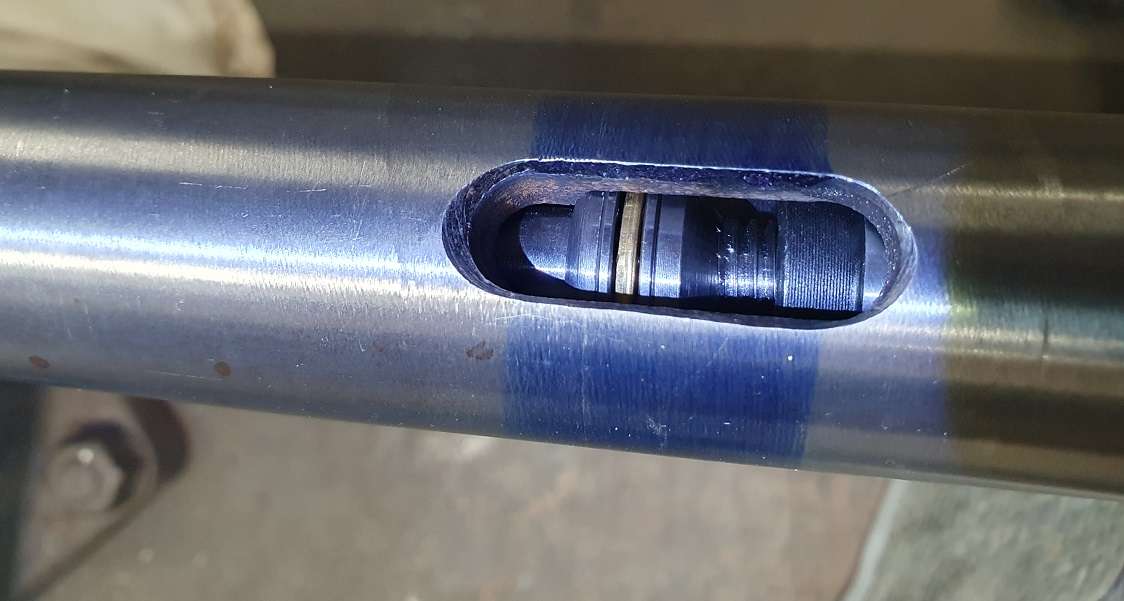
                                        And then this is with the drawbar unscrewed to the eject position

                                        Captive_Drawbar_13

                                        I thought there is no point being gentle with it, it is either man enough for the job or it isn’t so I put the spindle splines in the vice soft jaws as so..

                                        Captive_Drawbar_14

                                        I put an arbour in it and horsed it up significantly tighter than you should ever need to and then tried the ‘tapping’ method to remove it. It had a fair few pretty enthusiastic blows but refused to come out.. no probs I thought, I can just put a little gentle heat around it and it’ll come out.

                                        But.. before that I re checked the tightness of the drawbar just in case I had loosened it with the blows and if anything made it even tighter – oops, and as I’ve not pinned the top nut to the shaft yet, I just lightly locked the nuts together and gave it a try to see if the drawbar would eject it.

                                        I really wasn’t expecting much and already had the hot air gun out but with surprisingly little turning effort – not even supporting the spanner at the nut, just a 1 handed turn – it popped straight out! 😲 It only …… works!!


                                        The biggest frustration though is the new MT3 ER32 collet chuck I bought has the drawbar thread a fair bit off true the the axis of the chuck making it really difficult to insert the drawbar. The bore of the spindle is only a shade over 12mm, the drawbar is 12mm so the thread angle in the collet chuck means it goes pretty difficult to turn after only a little over 1 turn. The drawbar has to be wound in by spanner.

                                        Doesn’t show up that well in this pic but with the drawbar held in the vice the collet chuck oscillates round when threading it on to it (got a small video somewhere I might put up).

                                        Captive_Drawbar_15

                                        I was a little surprised at this, being from Arc Euro, everything else about it is excellent, run out, nut threads, finish quality etc and being well hardened there isn’t much chance of correcting in any way. I expect with a less stiff drawbar there would be enough flex in it to make this no problem at all. The others are all bob on so we’ll manage.

                                        Anyway, that’s enough rambling.. I need to get sorting the pics of the table fitment etc.

                                        Cheers all..!!

                                        Taf.

                                        #758302
                                        Bill Phinn
                                        Participant
                                          @billphinn90025

                                          I’m not sure whether it should be thought of as an expectation management issue, Dave, or rather a production management issue. Most aspects of the production management appear to have been got right; they’ve just fallen down on one critical dimension. Spoiling the ship for a ha’p’orth of tar, you might call it.

                                          I like to think I exercise discretion when buying goods, and don’t have unreasonable expectations of them when I take into account their price, description et al.  The countersinks were bought from Garrison Dales. They have their branding, and are sold alongside other countersinks of various brands the majority of which aren’t described as conforming to any declared standard.

                                          The lack of mention of a standard in the item description wasn’t a deterrent to me, as it clearly isn’t to many others of us who shop for tools of a similar kind. Arceurotrade sell two sets of unbranded countersinks. Neither is claimed to meet an established standard. And yet, judging by the levels of satisfaction with these sets I’ve seen expressed here and elsewhere, I suspect they meet the expectations of most, possibly all, users.

                                          I’ve bought many tools over the years that don’t claim to meet any recognised standard, and they’ve largely been fine. Some of the stuff I’ve bought in the past that is the same brand as the offset handles – “Sourcing Map” – has far exceeded my expectations in terms of its quality and fitness for purpose.

                                          So I’m not sure it’s an expectations issue unless expecting things not to have dimensions outside of the standard parameters by approximately 150%, as is the case with the 3/8” L handle, is unreasonable, and tools that are this far away from standard can still legitimately be claimed to be “of satisfactory quality”, when you bear in mind the undesirable knock-on effects of their quality on the other tools they couple with and on the execution of consistently competent work.

                                          #758254
                                          andy198712
                                          Participant
                                            @andy198712

                                            yes I belive the one that blew (literally smashed the glass) is a 5amp and listed as a spare part on arc euro as 5a. I did think it was low… but there we go.


                                            your right they are a nice cheap item thankfully, will complete my tests on them but worth a punt.

                                            #758178
                                            SillyOldDuffer
                                            Moderator
                                              @sillyoldduffer

                                              Is this an expectation management problem?

                                              Bill hasn’t said where his set came from or how much it cost.   The evidence suggests these are low-end countersinks of the type bought by DIY woodworkers.  Cheap, with a high-risk they will too cheap for serious metal-work.  No tears please if a set of 3-bits costing under £4 bought randomly off the internet turns out to be nasty!   The purchaser took a risk, and the product failed to meet his expectations.

                                              The expectation that hex-ended tools must be sized to a standard is also false.   As far as I know, there is no legal requirement for these tools to be made to an ISO, BS, JIS or any other standard.   These standards only apply if the seller claims the product is made to meet them.  Did the supplier claim that: I bet not.

                                              Trading Standards are fairly clear on who is responsible when purchasing goes wrong.    Organisations are expected to have a competent person in charge of purchases:  in a case like this it would be his fault if he bought an item without checking it met the standards required by his firm.   Consumers are better protected by law in that they aren’t expected to be competent.  Refund or replace if the product doesn’t meet their ‘reasonable’ requirements.   If the buyer or seller don’t agree on what’s meant by reasonable, off to arbitration or the courts.   In practice, at least in the UK, most sellers replace or refund without making a fuss.    Though it mostly works reasonably well, the system is imperfect.  Model Engineers are a case in point:  we’re a customer group with some competences who buy as consumers.  Having a few competences is a good start, but there’s more to competent purchasing than knowing a few reliable brand-names and assuming stuff.   For example, a pro-buyer has to know when it’s necessary for him to insist on a specification like ISO1173.   A Model engineer might assume incorrectly that was part of the deal: nope!

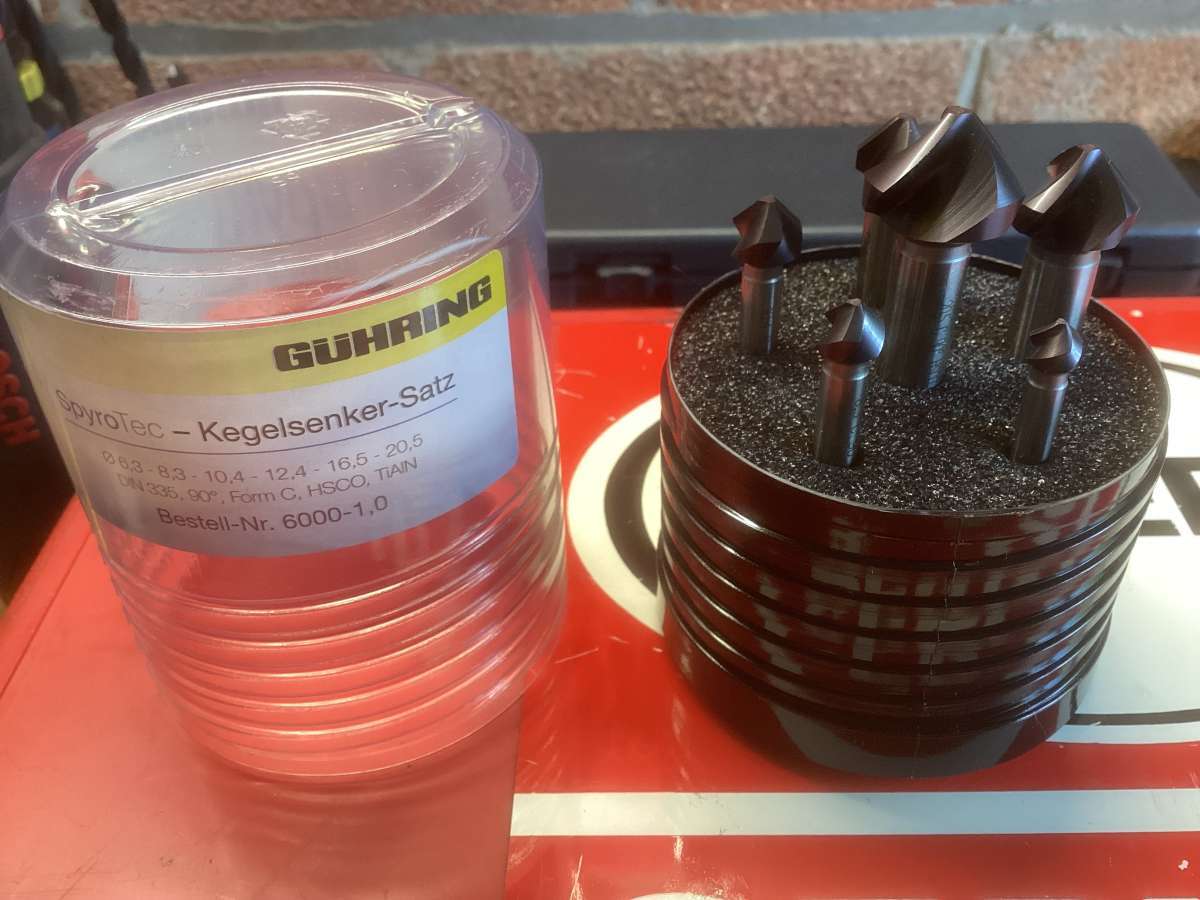
                                              I notice Bill has done bought a tool-set with a specification!  His Gühring Set has a DIN number on it, in the blur bottom left:

                                              guhring

                                              None of this confusion is new, certainly not a sign of the times. My memory of youthful tool buying is there was a lot of dreadful tat about.  The Romans advised Caveat Emptor, and we Brits know not to buy a pig in a poke, because that might let the cat out of the bag!

                                              Although honest trading is clearly most effective, there’s always a percentage of shady buyers and sellers who fink sharp practice is clever.   One clue we might be dealing with an opportunist is him offering items that are unreasonably cheap or, just as alarming, with a very high asking price.   Plenty of folk are fooled by ‘reassuringly expensive’!  It’s not easy, and we are lucky to have a Nanny State looking after us.

                                              Professional engineers do their best to dodge buying uncertainty by setting standards because specifications can be tested objectively.   Purchases based on cost, brand-name, or previous experience can all be a con!    Unfortunately purchasing to specification isn’t easy, and it tends to be pricey.   I don’t have a big budget, and Model Engineers famously have very deep pockets and extraordinarily short arms.

                                              What do I do myself?   Mostly I buy mid-range tooling from reputable UK hobby suppliers, relying on their expertise to avoid too cheap, and protected financially by UK consumer law.   ArcEuro do particularly well in this space, but I don’t expect top industrial tooling at rock bottom prices from them.   Ditto Tracy Tools, for taps, dies, and drills.  Others too.   They provide good value for money in my lightly loaded workshop, but sometimes a job makes it necessary for me to go upmarket.  I occasionally take a punt on ebay, so far without being sent rubbish.   The worst tools I’ve ever bought all came from street markets and exhibitions.   Consumer protection drops when the buyer actually sees the item:  then we are held much more responsible for our decisions.   If you buy in person, take extra care.   Distance buying is safer.

                                              My buying strategy turns out to have been excellent for bad reasons.   Two years ago my mother’s failing health dropped my time for workshop fun by about 75%.   Over the last 7 months I’ve been too ill myself to use the workshop at all, and the problem is ongoing.   A tiny consolation is that I didn’t spend a fortune on the best tooling.  Even better, I’ve told my children not to worry about the value of the workshop when I die.  If it suits them to dump the whole lot in a skip, they can.  Had I invested in an expensively tooled-up workshop, it suffering that fate would be heartbreaking.

                                              Do loose fitting hex shafts matter?  Not much in a basic DIY toolbox, perhaps only used once in a blue moon by a youngster to put up wooden shelves.   Same tools much less satisfactory when lots of countersinking needs to be done, and especially so in metal.   Robert points out that loose fitting hex shafts tend to chew up the driver, a quick way of wearing a good tool out.   Curiously all of my metal-working countersink cutters have round shafts and I don’t care what diameter their shafts are!

                                              Dave


                                              #757598

                                              In reply to: DRO scales

                                              SillyOldDuffer
                                              Moderator
                                                @sillyoldduffer
                                                On Pete Said:

                                                … But for what most of us might be doing, you first have to ask if you and the machines you own are capable of using or machining to even that level of accuracy…

                                                This is an important point!  The capacitive scales I fitted to my mill 10 years ago use the same technology as a digital caliper, and are accurate to about ±0.02mm (about a thou).    Never tried to measure how accurate my mill is, because that’s hard work, but it’s a shade better than ±0.02mm.   It’s a WM18 not a Jig Borer!  On a good day, with the screws clean, gibs spot on, sharp cutter at the correct speed and feed, work bolted down properly, and me driving carefully, not trusting the DRO, I can get ±0.01mm out of it at least over short distances.

                                                My mill’s limitations suggest fitting a 1 micron scale (0.001mm / 0.000039″) is a waste of money because the machine can’t match the scale’s accuracy.   A sooper-dooper scale cannot improve the accuracy of my work.   On my mill a 5 micron scale (0.005 / 0.0002″) is more sensible, because 0.005mm is good enough to detect what the machine is doing within it’s capacity – approx ±0.01mm.   When the ArcEuro scales do the decent thing and die, I will upgrade to 5 micron and a single display head.

                                                Same applies to lathes.  Mine is a WM280V, for those not familiar, it’s a Chinese Hobby machine somewhat larger than a Myford 7, but not massive.  A big example of a small lathe!  Like my mill, it comfortably works to ±0.02mm, suggesting a 5 micron scale is appropriate.  It is not a tool-room lathe.

                                                Unless his machines are worn, Pete’s workshop equipment is a notch better than mine.  That clearly nudges him away from cheap capacitive scales, and although 5 micron would probably be ‘good enough’, he might well get value out of 1 micron scales.

                                                Is a DRO necessary for accuracy at all?  Or is extreme accuracy itself necessary? Rarely in my workshop.

                                                Whilst DROs and Digital Calipers are a huge convenience and time-saver, I mostly work by fitting.  I do not bore a hole ⌀20mm ±0.02  and then turn a shaft ⌀19.90mm ±0.01 so the two will go together without further ado!  More likely I will bore the hole to about ⌀20mm, and then turn the shaft to a little over that.   Then, using the hole as a gauge, I shave down the shaft step-by-step until it achieves the required fit.    There is no need to measure anything accurately.  Usually shave down with a single point tool and then finish with emery paper.  Emery paper removes tiny amounts of metal, allowing even crude machine tools to achieve high-accuracy / close fits when needed.

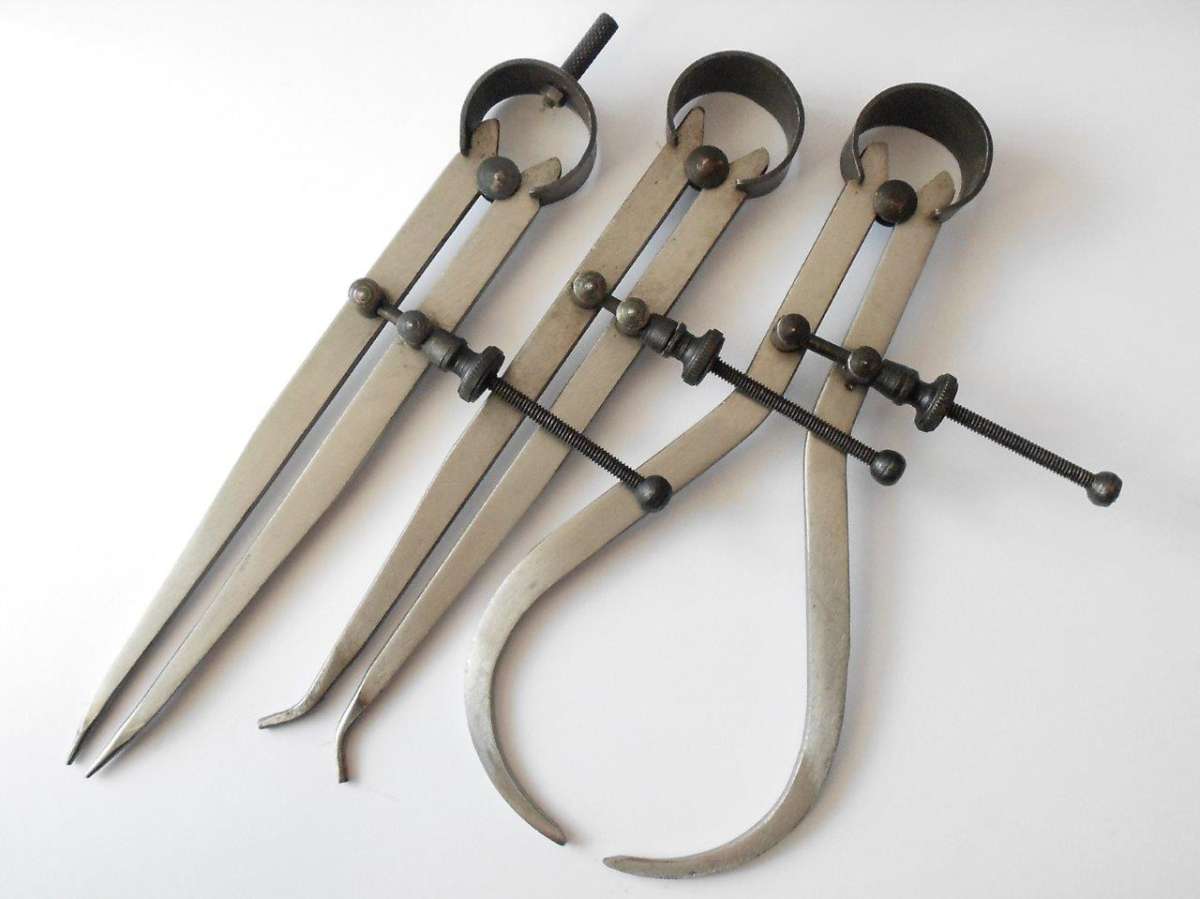
                                                Experimenting with old-school techniques is interesting if there’s nothing urgent on hand.  Although it takes longer, and the resulting parts aren’t interchangeable, fitting with nothing more than a plain spring caliper works surprisingly well without measuring. Better made versions available:

                                                SpringCaliperSetsmall

                                                I’ve found answers to Dalboy’s topic most useful.  Things have moved on since I fitted a DRO 10 years ago, in particular magnetic scales are now an affordable option.   As we have the same lathe, if Dalboy reports what he installs, I might well copy him!

                                                Dave


                                                #757578

                                                In reply to: DRO scales

                                                SillyOldDuffer
                                                Moderator
                                                  @sillyoldduffer

                                                  Pleased to see Roberts answer about size matches the thought process I went through selecting a DRO for my mill.

                                                  I prioritised inexpensive and easy to fit over features and best possible accuracy.  Capacitive tracks are easily cut and take up less space than other types, plus they are at the cheapo end.   I didn’t expect them to last, yet they’re still OK after 10 years.  Still available from Arc Euro, very basic, and they transformed my mill.

                                                  If money is no object, and you don’t mind a fitting challenge go magnetic.  Cheaper these days, but still pricey.

                                                  Glass was cheaper than magnetic, with several other advantages compared with capacitive scales, but harder to fit. For my purposes glass is more than ‘good enough’.

                                                  Rough rule of thumb, though much depends on your machine’s geometry, it’s easier to fit scales to bigger machines simply because they have more space.

                                                  Ten years ago there were a lot of incompatible proprietary scales and displays about.  So there was advantage in buying scales and display together as sets.  Probably less of an issue today because standardisation has had time to bite.  Nonetheless, if mixing and matching scales and display heads from different sources, I’d check their specifications to be sure they will talk to each other.  Just in case!

                                                  Dave

                                                  #757007
                                                  Sonic Escape
                                                  Participant
                                                    @sonicescape38234

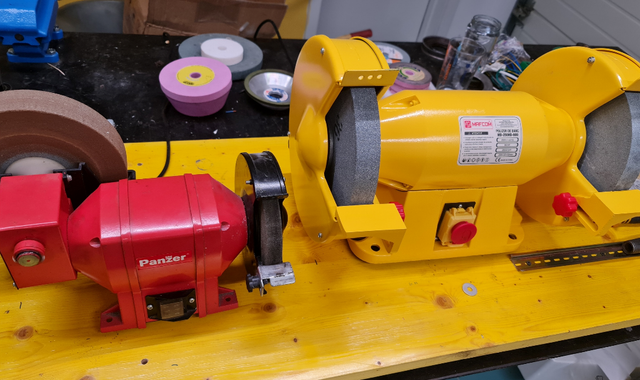
                                                    This is a review of two bench grinders I have. For some reason I regard the grinder as the most unimportant machine in my shop. Because of this the first one I bought was that 30 euro red thing. It has a 250W motor, a 150mm dubious quality grinding wheel on a 12mm axle and wet slow turning wheel that has almost 10mm left to right runout

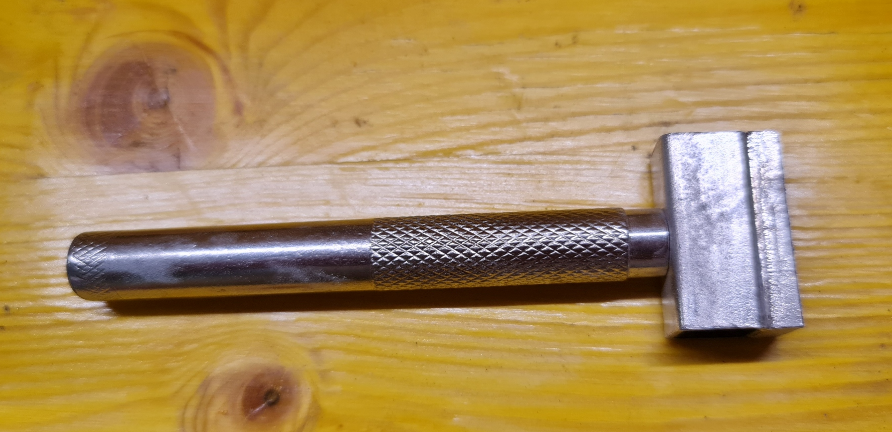
                                                    The large wheel got glazed after grinding some mild steel. I tried to dress it with a flat diamond tool, like I read in Machining Fundamentals. But I glazed it even more. So now is useless.

                                                    Just check this glorious concentricity:

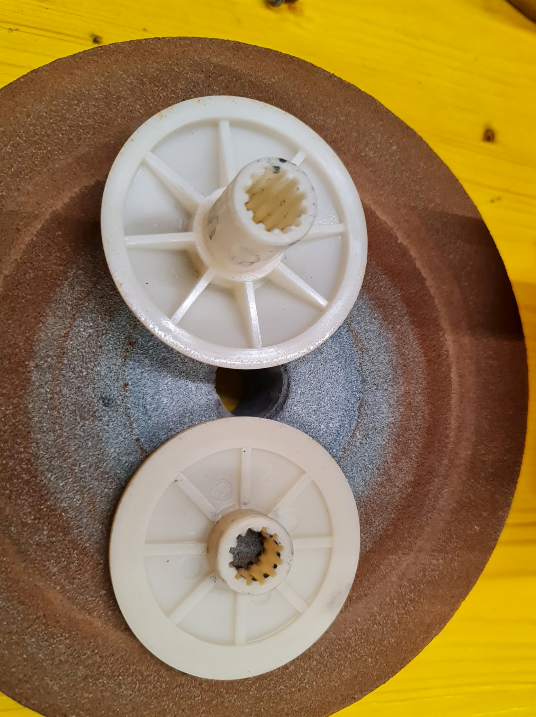
                                                    I traced the problem to this plastic nuts.

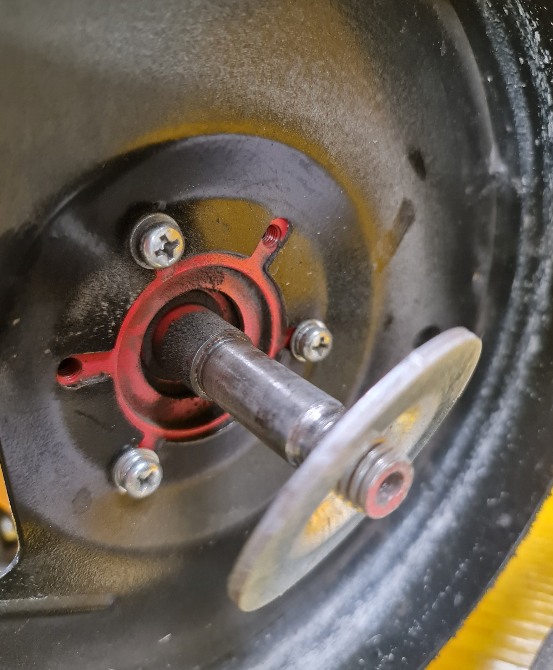
                                                    Another sad thing is the ridiculously small shoulder on its fast spinning axle, ~1.5mm. This is causing severe runout with some wheels.

                                                    Also, recently I purchased a bag of HSS blanks, and I started to make different lathe tools. The 150mm diameter wheel is too small and it created a visible radius on the workpiece. So, I decided to buy a new grinder with a 250mm wheel.

                                                    Since I am cheap when it comes to grinders, I searched again for a low cost one. And I found this no-name yellow grinder that is a good match with my workshop color. It weighs 35kg. Heavy is good. And at two hundred euro it is significantly below other more known brands. There was also the option to buy an old communist 3-phase grinder. The seller warned me that two people cannot lift it from the ground. This only increased my interest. But I had enough fun with restoration projects with my milling machine and I wanted an already working machine.

                                                    The first impression was good. The grinder feels solid and is very heavy. I spined the wheel by hand and I quickly noticed that the right wheel is quite oval. I measured the spindle runout but as you can see it is fine. I added the nut, and it is still not bad. This nut is a better system comparing with the old grinder. So, in the end I blamed the wheel.

                                                    But the horror came when I turned it on. The vibrations are severe. Now I have 35kg of metal jumping on the bench instead of some 8kg before.

                                                    I could try to dress the wheel. But with that dressing tool I was able to fix only a green wheel. That is more friable, and it turned round quite nicely. Or I just throw away the wheel. Anyway, I want to replace it with a white or pink one since I ground HSS most of the time.

                                                    But overall, the grinder is not bad. Whit good wheels it should be fine. The motor itself is quiet. The axle has 18mm instead of the more standard 20mm, but this is not a big deal.

                                                    #755448
                                                    JasonB
                                                    Moderator
                                                      @jasonb

                                                      Sounds like a job for one of those multo tool tailstock turret holders, you can have your running down box and a tailstock die holder mounted, maybe even a tool to round over the opposite end.

                                                      If you only have a small lathe then a 2-tool turret could be made with the tools in each end a piece that can rotate on a TT arbor at it’s centre.

                                                    Viewing 25 results - 201 through 225 (of 4,842 total)

                                                    Latest Replies

                                                    Home Forums Search Search Results for 'arc euro'

                                                    Viewing 25 topics - 1 through 25 (of 25 total)
                                                    Viewing 25 topics - 1 through 25 (of 25 total)

                                                    View full reply list.