Model Turbines

Model Turbines

Home Forums Stationary engines Model Turbines

Viewing 25 posts - 626 through 650 (of 655 total)
  • Author
    Posts
  • #826489
    Turbine Guy
    Participant
      @turbineguy
      On Turbine Guy Said:

      Hi Mike,

      None of my books or documents that give formulas for calculating the windage loss of rotors with or without blades include the side clearance. Church’s book gives equations for the windage loss for rotors with and without blades and the side clearance is not included in either one. In the report WINDAGE RESISTANCE OF STEAM-TURBINE WHEELS by E. Buckingham, Stodola stated the following:

      “Reducing the clearances, especially round the blades, reduces the windage. In some cases the amount of this reduction may be estimated from Table 10 but no general quantitative statement is possible. The reduction affects mainly the blade term”.

      Stodola used 19.88” OD rotors with blade lengths 0.797” and 2.361” running at 2000 rpm with axial clearances of 0.157” in Table 10 and got windage loss reductions of 0.55 and 0.38 respectively compared with running open. This indicates what you stated about the large reductions in windage loss were found at low speeds with large clearances is probably true.

      Hope this helps,

      Byron

      It should be noted that the rim speed of the 19.88” OD rotor running at 2000 rpm is a little higher than for my testing of your 1.254” OD rotor at 28,000 rpm. Therefore the surface speeds are similar. Also the information given for Table 10 did not say if Stodola tried different axial clearances and the value of 0.157” resulted in the minimum loss.

      #828340
      Turbine Guy
      Participant
        @turbineguy

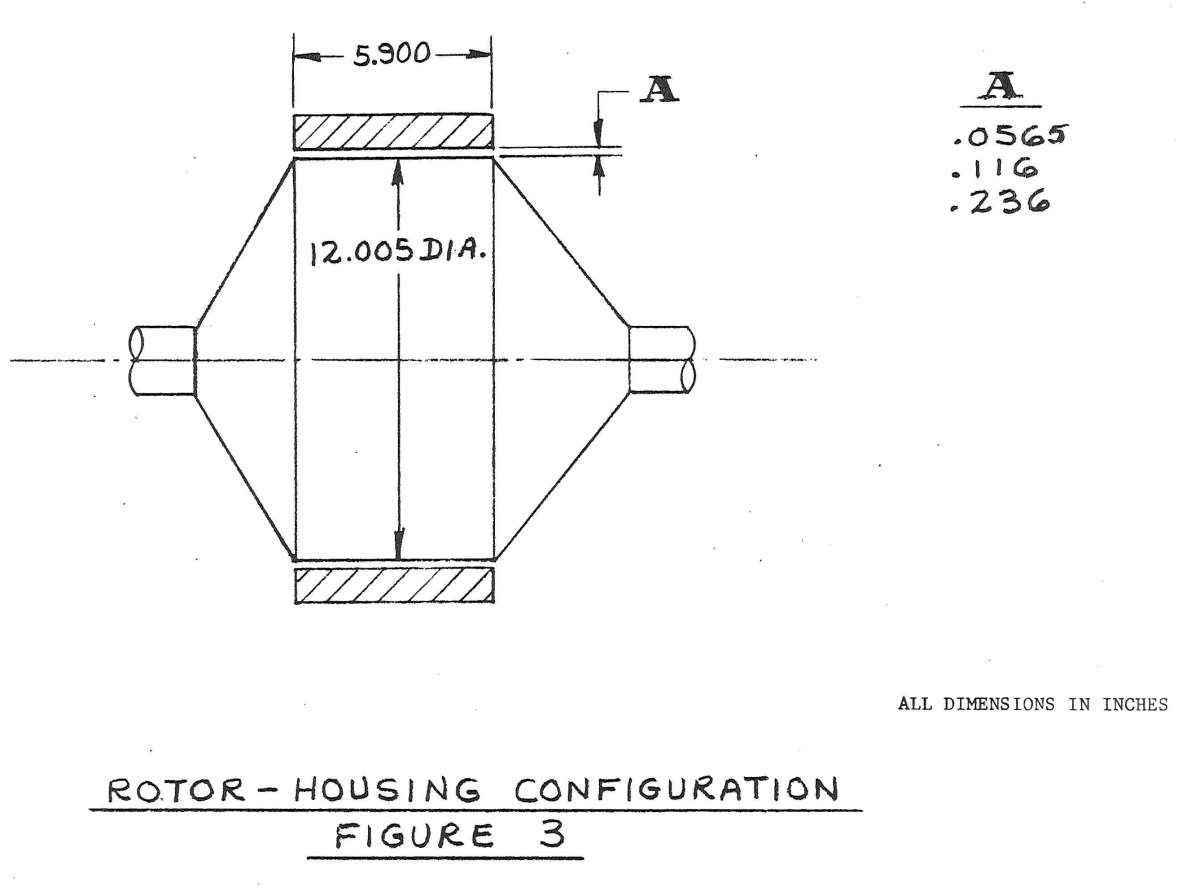
        I found the study EXPERIMENTAL WINDAGE LOSSES FOR CLOSE CLEARANCE ROTATING CYLINDERS IN THE TURBULENT FLOW REGIME in the Following Link. This study reviewed the effect of the radial gap between the rotor and the ID of the housing as shown in the following drawing. Both the rotor OD and the housing ID had very smooth surfaces but created significant windage losses that increased as the gap was reduced. The report measured the total windage loss but only the radical gap was varied so the windage loss of the open sides of the rotor stayed the same for each speed and was the largest portion of the total windage loss. For example the total windage loss for a speed of approximately 6,000 rpm was 174 watts for the 0.0565 gap, 153 watts for the 0.116 gap, and 130 watts for the 0.236 gap. The windage loss decrease due to increasing the gaps would be 21 watts going from the 0.0565 gap to the 0.116 gap, 23 watts going from the 0.116 gap to the 0.236 gap, and 44 watts going from the 0.0565 gap to the 0.236 gap. The report showed the total windage losses for Renolds numbers less than 350 were negligible for their tests. Their Reynolds number (Re) was given as Re= (rim speed x gap)/kinematic viscosity. Using their Reynolds number, all my tests would have Re<350 and be outside the limits of their guidelines due to the very small gaps of my turbines.  The rim speeds and kinematic viscosities are in the range they used in their tests.

        19700023755

        #830710
        Turbine Guy
        Participant
          @turbineguy

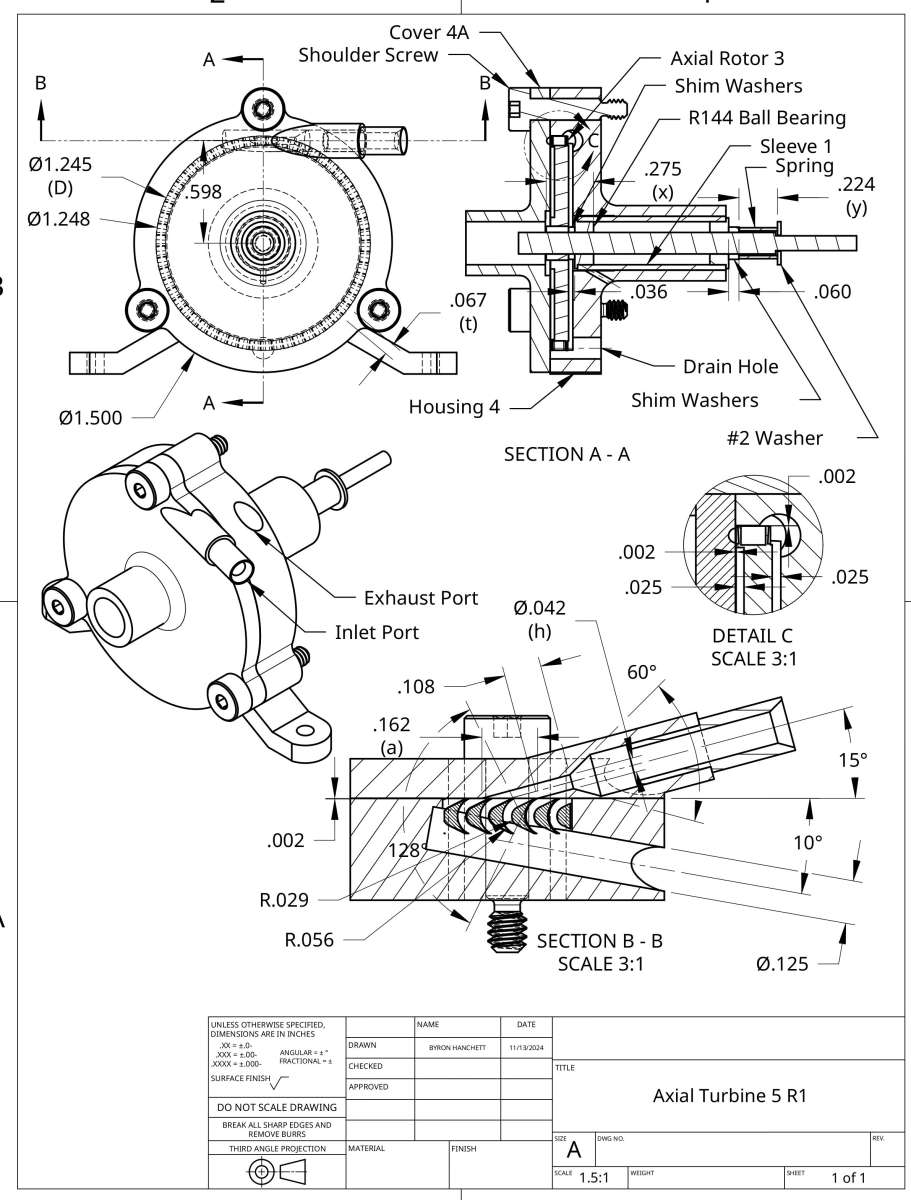
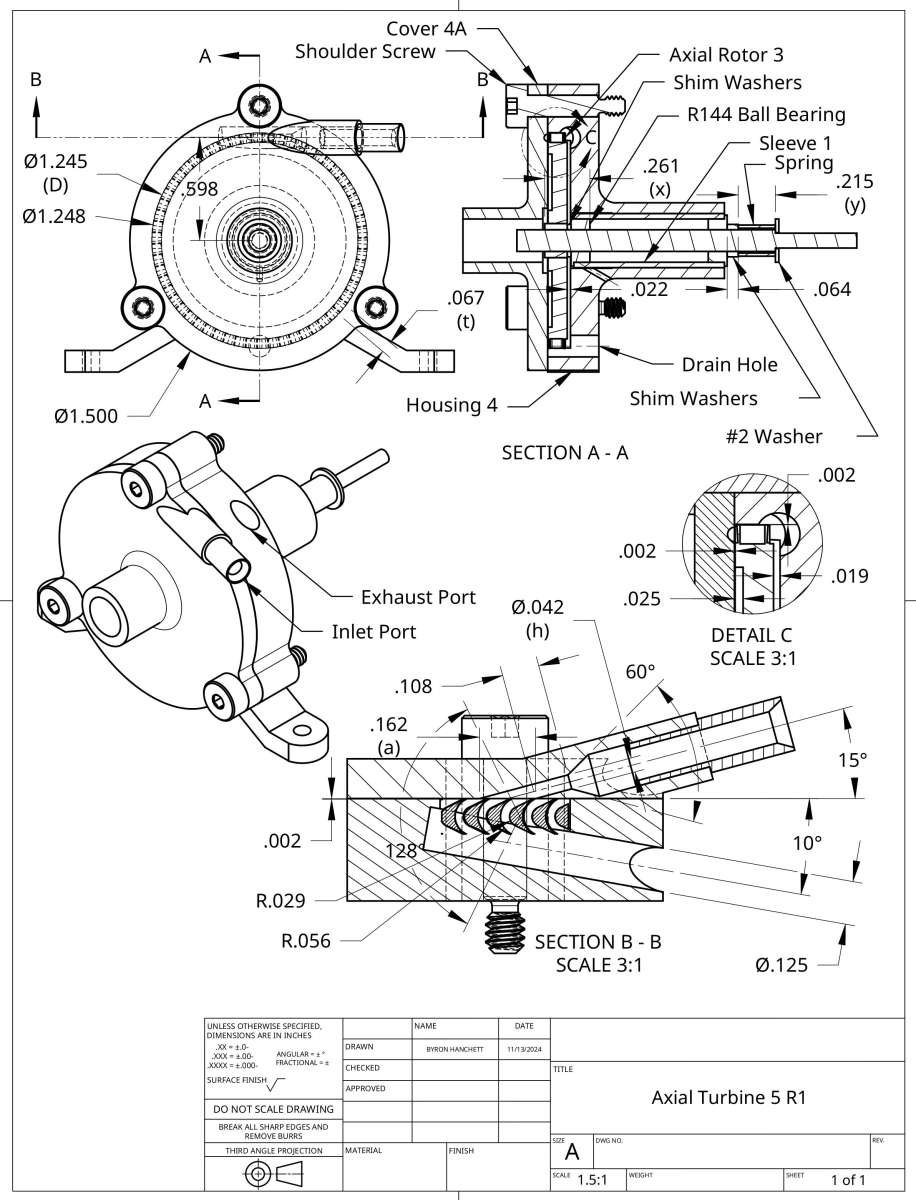
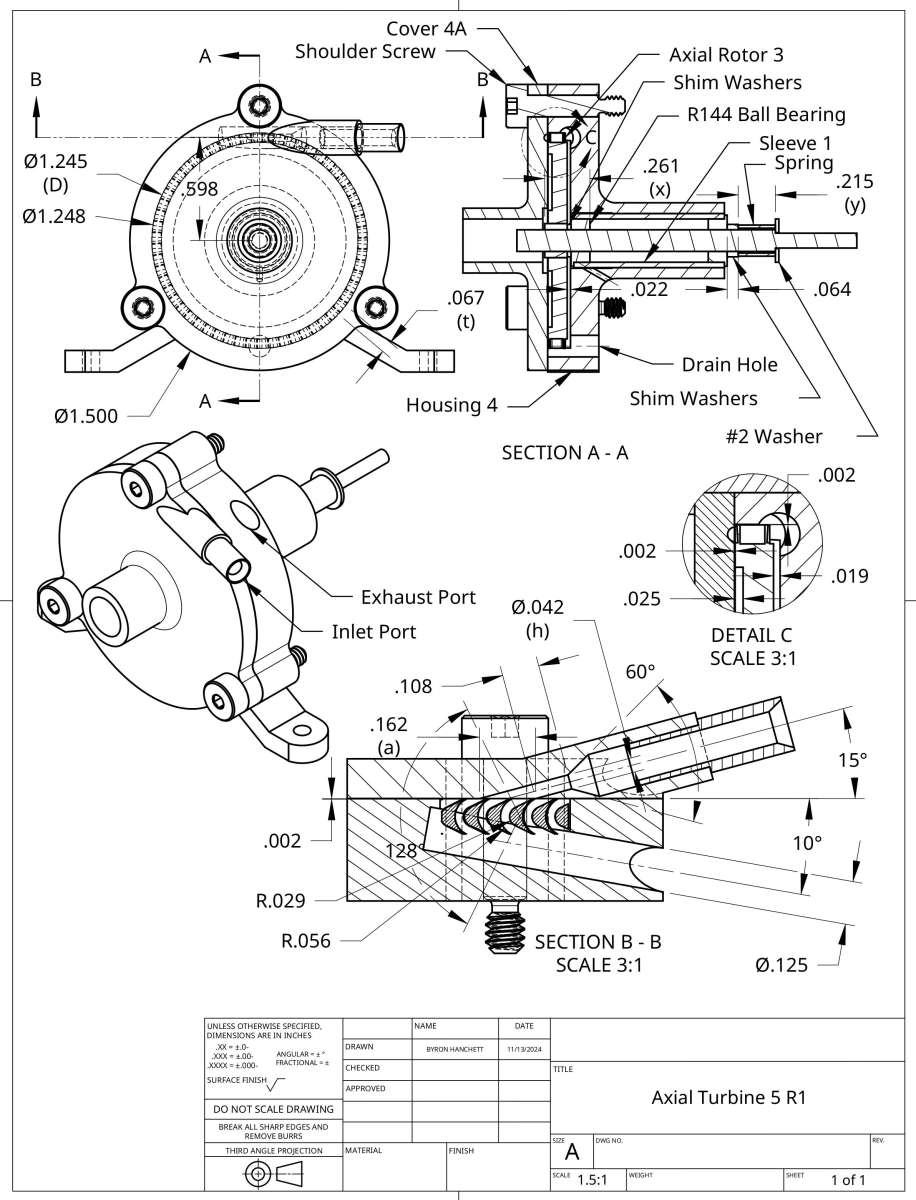
          The study described in the last post used gap to rotor radius ratios in the range from 0.01 to 0.4 commonly used on rotors to keep the Reynolds number close to the turbulent flow region since the windage losses get much larger in the laminar flow region. Using the smallest ratio of 0.01, the recommended minimum gap for the 41.2mm OD rotor used in the test described in the 24 November 2025 post would be 0.21mm. It was found in that test that gaps greater than 0.4mm (0.02 gap/radius ratio) gave the best performance. The gap to radius ratio of the test described in the 26 November 2025 post was 0.016. That test had blades which required the smaller gap. The gap to radius ratio that gave the best performance for the study described in the last post was 0.039. It appears that for surfaces without blades a gap/radius ratio of greater than 0.04 will provide adequate clearance. I have found from my tests that running the tightest clearance possible between the blades or pockets and the covers or housing gives the best performance. The increase in windage loss is more than offset by the decrease in leakage by the blades or pockets. If increasing the clearance in the bladeless region reduces the windage loss, I should get an increase in performance of Axial Turbine 5 by increasing the gap between the covers and the rotor as shown in the following drawing. Detail C shows the existing 0.002” clearance between the blades and cover and rotor OD and housing to prevent leakage. It also shows the proposed 0.025 clearance between the rotor and covers in the region without blades to reduce the windage losses. I will try adding the proposed clearances when the weather gets a little warmer.

          Axial Turbine 5 R1

          #830973
          Turbine Guy
          Participant
            @turbineguy

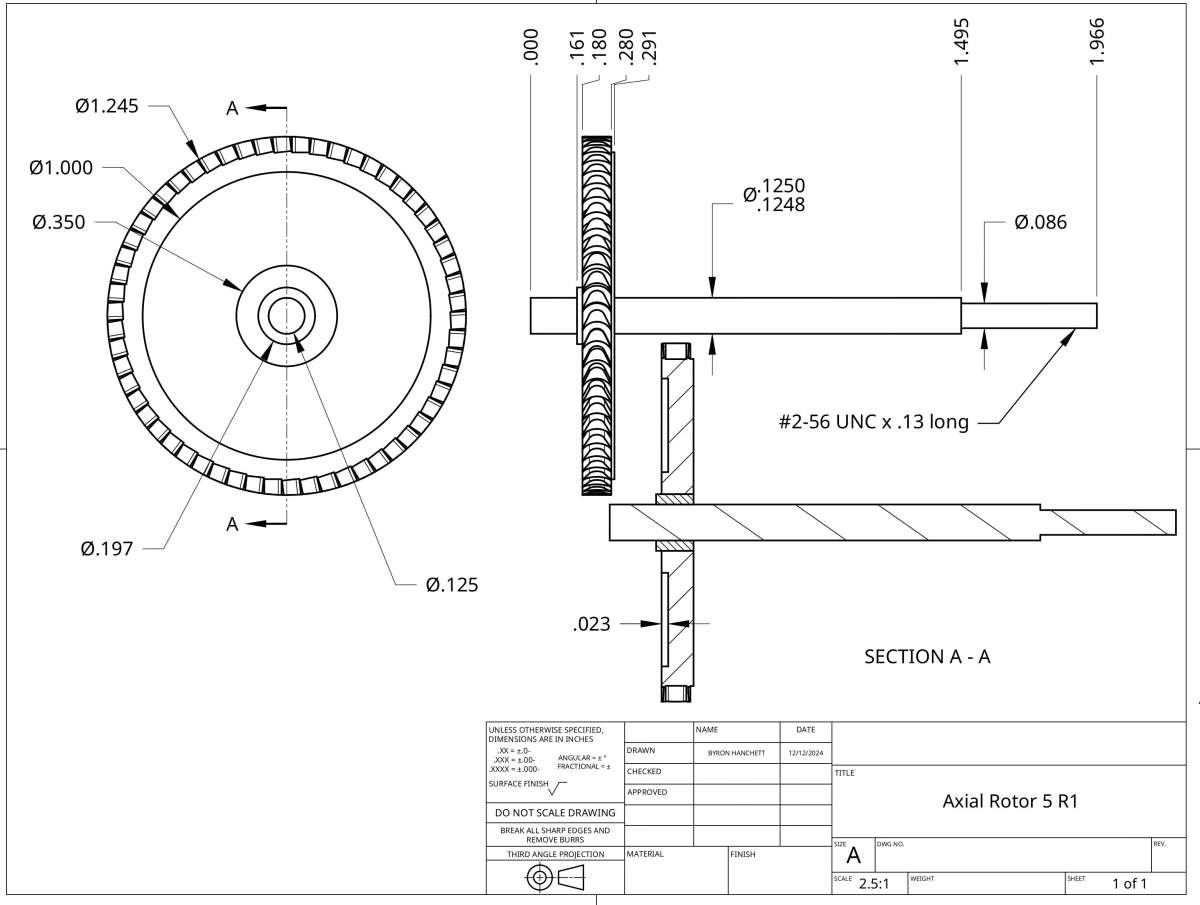
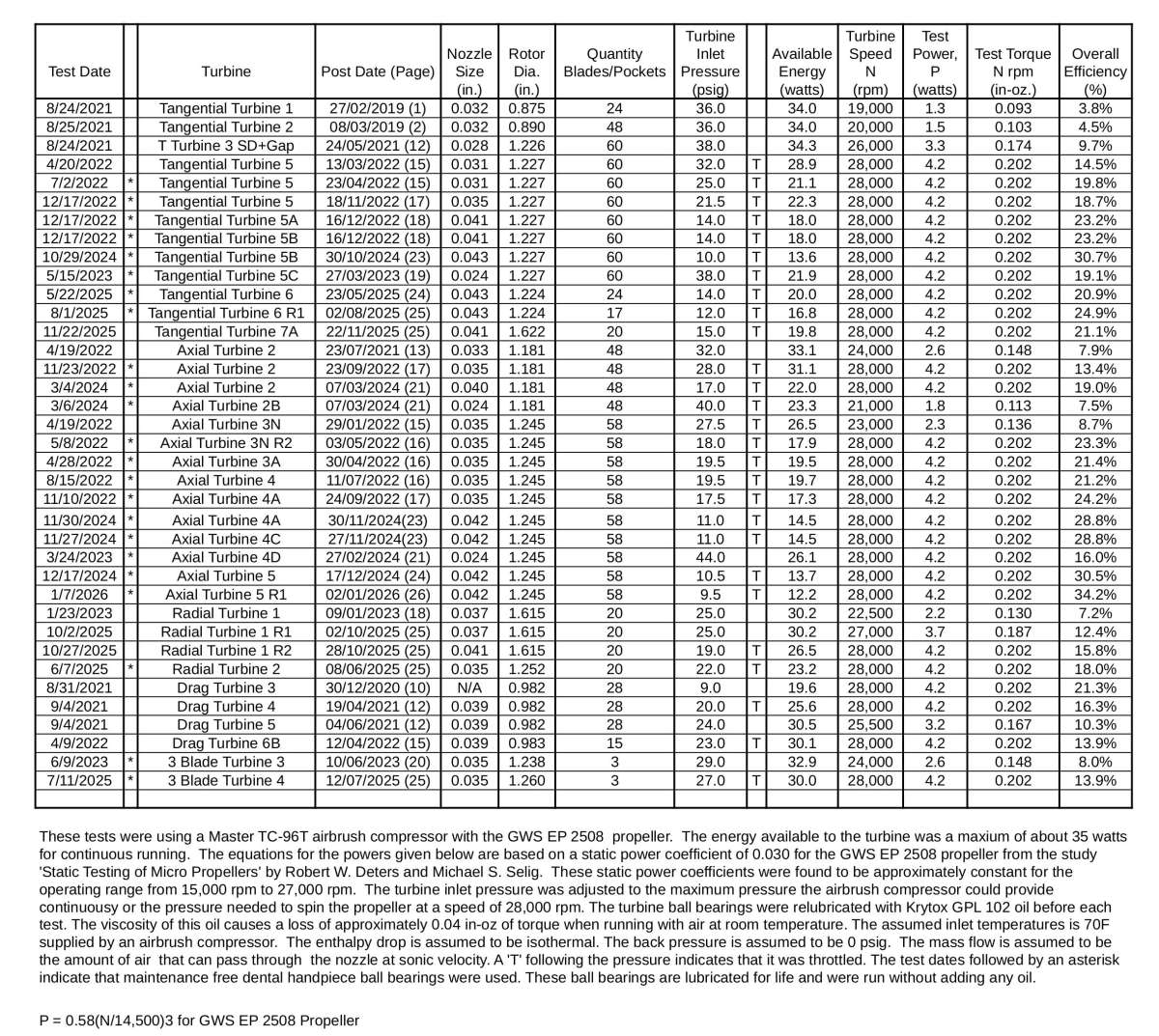
            I machined the rotor for Axial Turbine 5 as shown in the following rotor drawing and found the optimum position in the housing as shown in the following assembly drawing. Before machining the rotor I ran a test with the existing rotor and was able to turn my GWS EP 2508 up to the maximum speed of 28,000 rpm with a pressure of 10 psig. This is the lowest pressure I have ever been able to reach the maximum speed with the rotor before this last machining. The energy available to the turbine with an inlet pressure of 10 psig and a 0.042” nozzle size is 13.0 watts. I was able to turn this propeller to the maximum speed of the propeller with a pressure of 9.5 psig after the latest machining. The energy available to the turbine with an inlet pressure of 9.5 psig and a 0.042” nozzle size is 12.2 watts so there was a measurable reduction in power with the extra clearance in the non bladed area. The temperature in my shop when I made the tests was 50 F. I only put test results in my performance comparison spreadsheet when they are run at a temperature of 70 F since the performance running on air normally gets better as the temperature increases. I will wait until I get my shop up to a temperature of 70 F and run another test of Axial Turbine 5 R1 and add the results to my performance comparison spreadsheet. Adding the gaps decreased the amount of energy required by 6%.

            Axial Rotor 5 R1

            Axial Turbine 5 R2

            #831813
            Turbine Guy
            Participant
              @turbineguy

              We had a record breaking temperature in our area so I was able to run the test I said in the last post I was going to do. This confirmed the results of the last post as shown in the following spreadsheet for Axial Turbine 5 R1.

              My Turbines 1 R13

              #831838
              Mike Tilby
              Participant
                @miketilby23489

                Thanks for posting this data Byron. It is very helpful for my ongoing efforts and will mean a change in design. As we’ve discussed elsewhere, I shall now machine a recess in the face of the disc holding the nozzles instead of recessing the rotor disc. Also, I had been planning on decreasing the space on the exit face of the rotor disc because of the previous guidance that a narrow gap would minimise losses. That guidance had been based of tests with quite large rotor discs and your tests are the first test of that type on a rotor of the size used in models.

                Mike

                #831963
                Turbine Guy
                Participant
                  @turbineguy
                  On Turbine Guy Said:

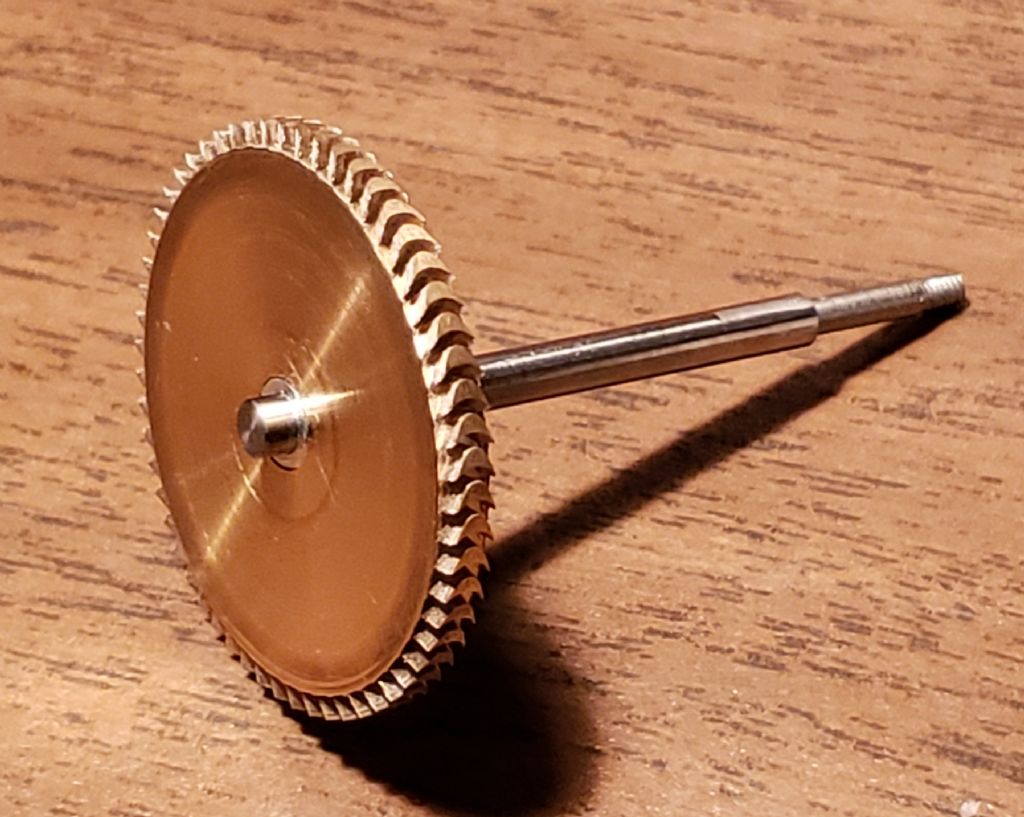
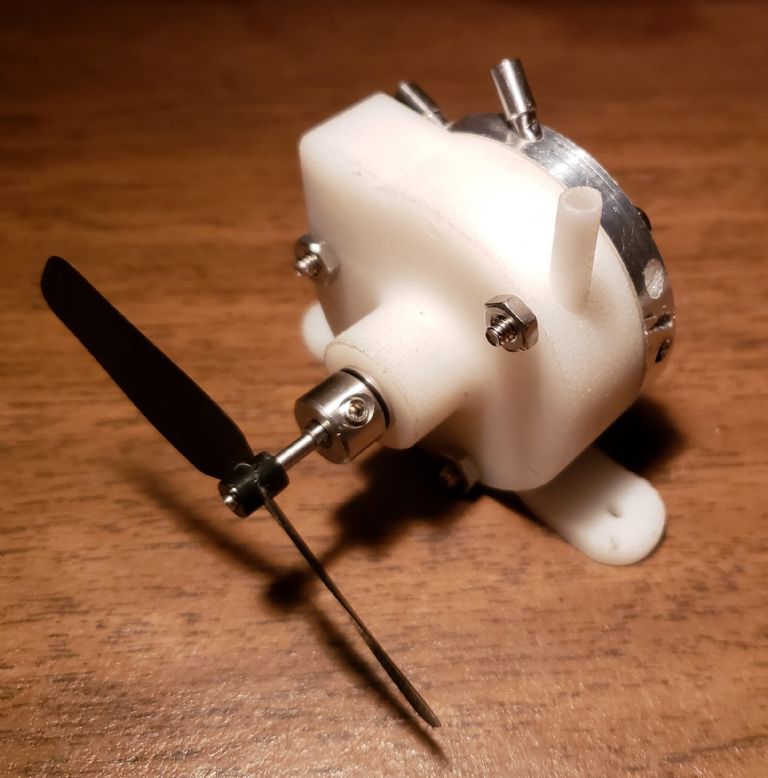
                  I received the rotor Mike Tilby made for me shown in the picture below. As you can see from the photo his machining is outstanding, well beyond what I am capable of. He spent weeks making this rotor and I can’t thank him enough. I mounted his rotor on the shaft and sleeve I machined and will call this assembly Axial Rotor 3 R3. The R3 indicates the drawing for this assembly was revised three times. The original drawing showed the dimensions of the solid model of this rotor based on my understanding of what Mike intended to make. The later revisions were made for adjustments we had to make for machining or to fit in my existing nylon housing. I had already created a folder called Axial Turbine 3 for this rotor and it was intended to use my existing aluminum housing. I created a new folder called Axial Turbine 3N for using this rotor in my existing nylon housing. The second photo below is a photo of Axial Turbine 3N. I am updating the folder Axial Turbine 3N to show the parts, photos, and drawings. I will do the same for Axial Turbine 3 when I decide to use the aluminum housing.

                  axial rotor 3 photo 2.jpg

                  axial turbine 3n photo 1.jpg

                  Hi Mike,

                  Your rotor has survived many of my tests since you sent it to me almost 4 years ago as shown in the quoted post. It has stayed almost the same while the housings, covers, nozzles, shafts, springs, and ball bearings were changed to gradually improve the efficiency up to the level shown in the last post. This last change to increase the gap is typical of the changes made to increase the efficiency. Each change was the result of someone or myself trying to find what was best for model turbines. Your interest in reducing the windage loss was what prompted the last change. I encourage anyone to suggest changes they think might improve the performance of model turbines.

                  Thanks for your input,

                  Byron

                  #832251
                  Turbine Guy
                  Participant
                    @turbineguy

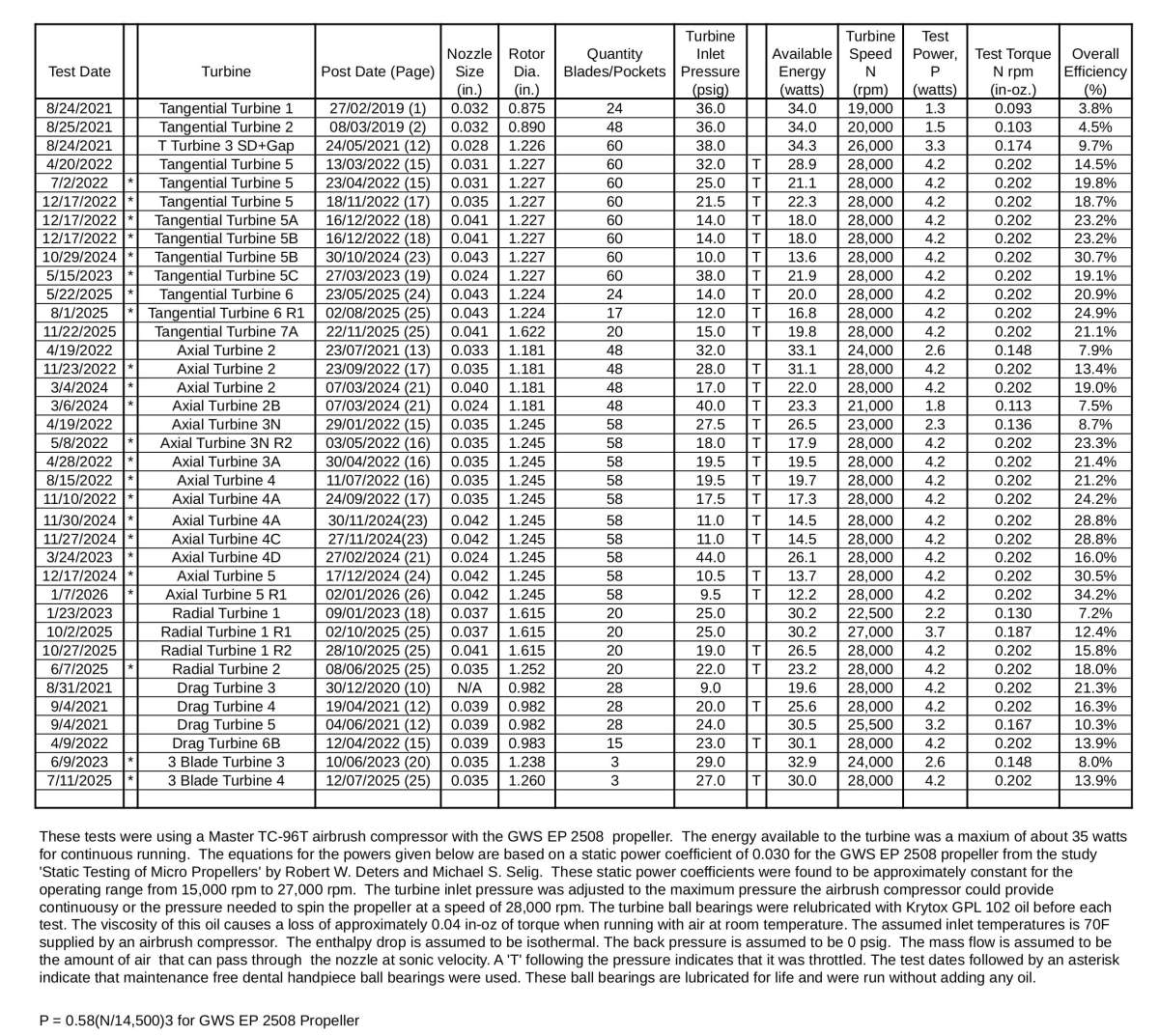
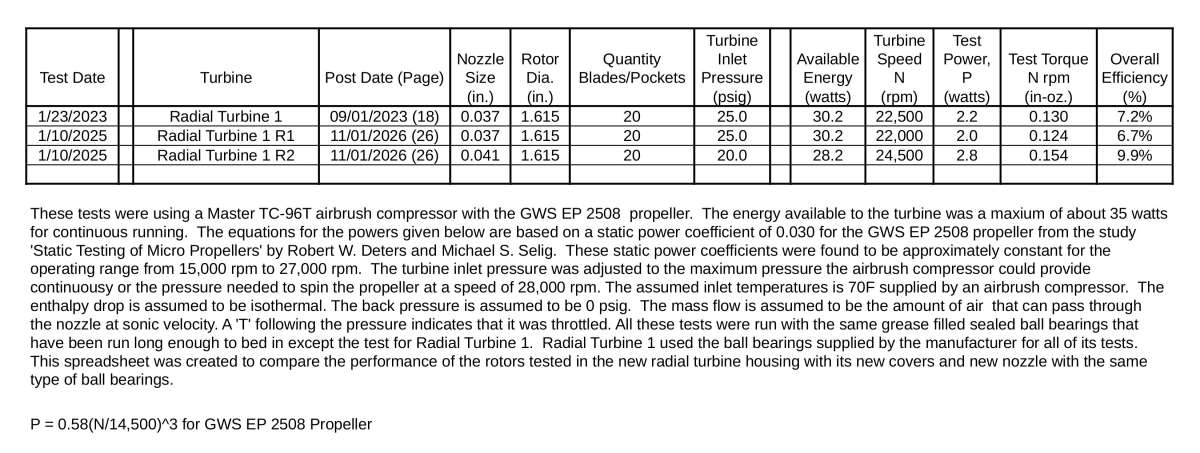
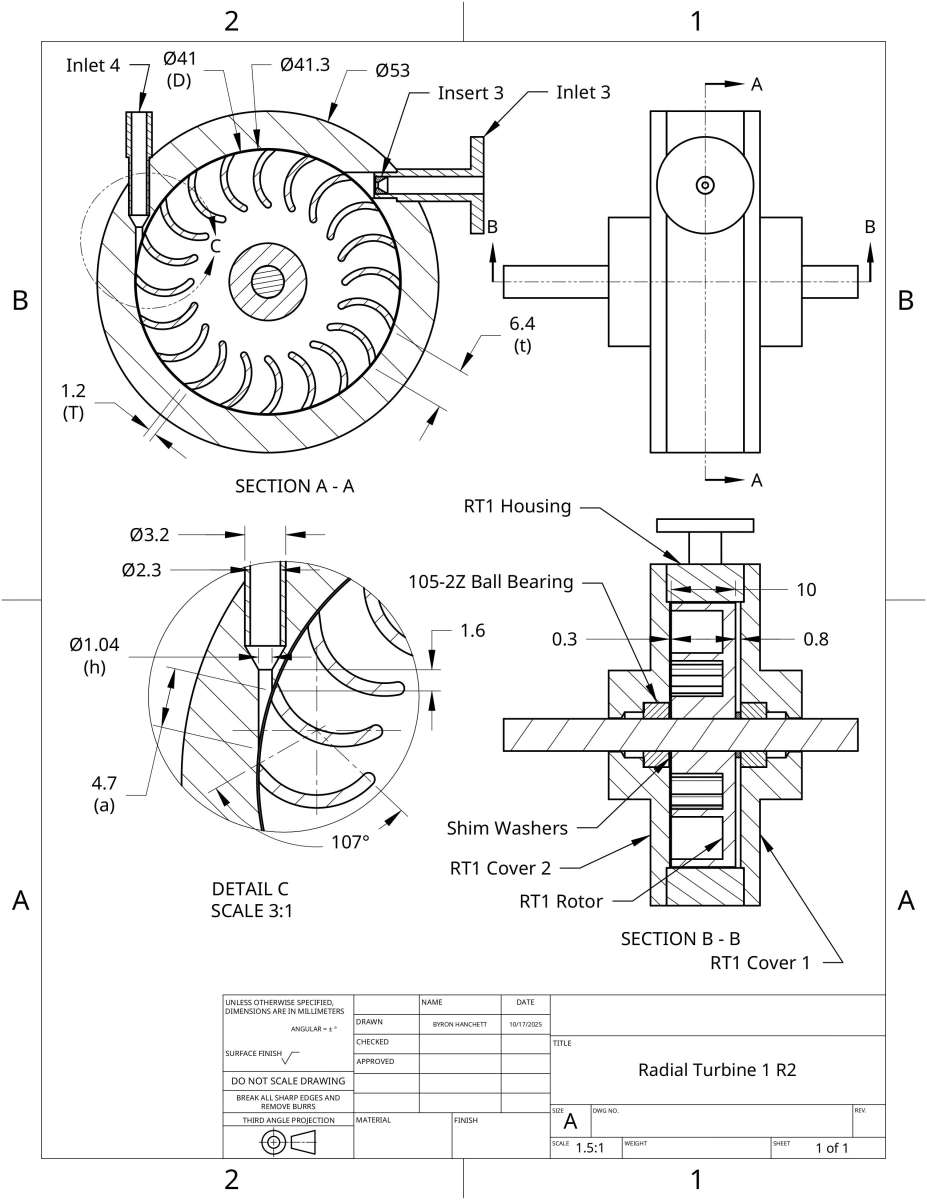
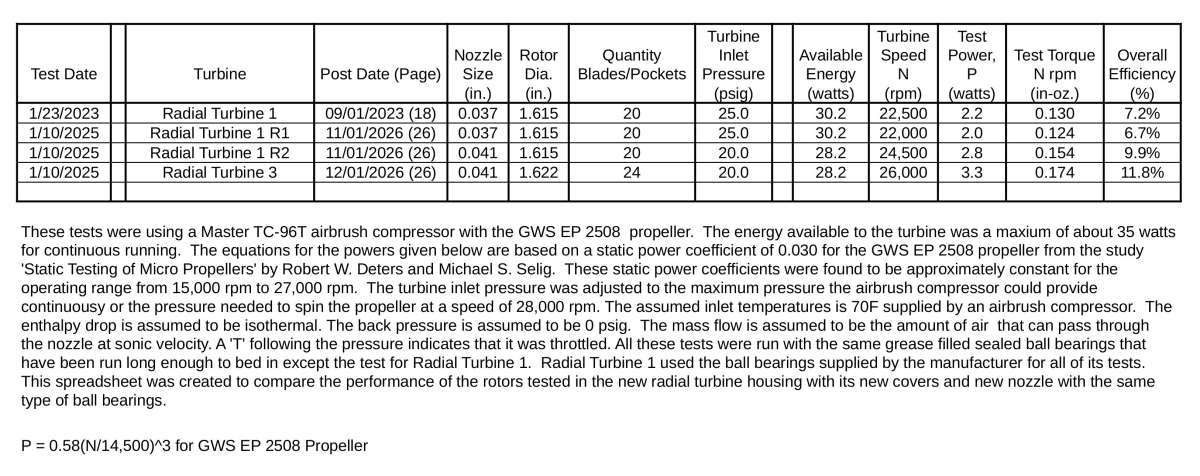
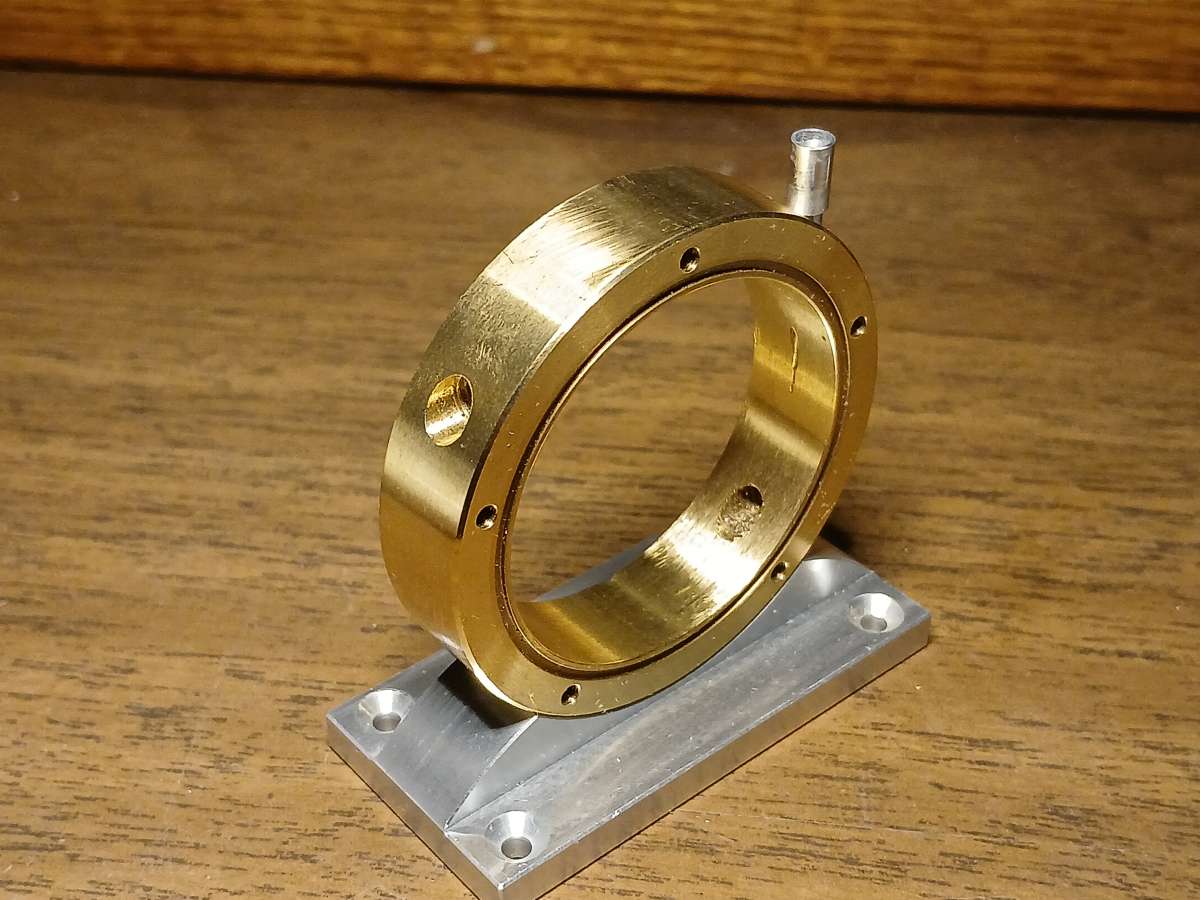
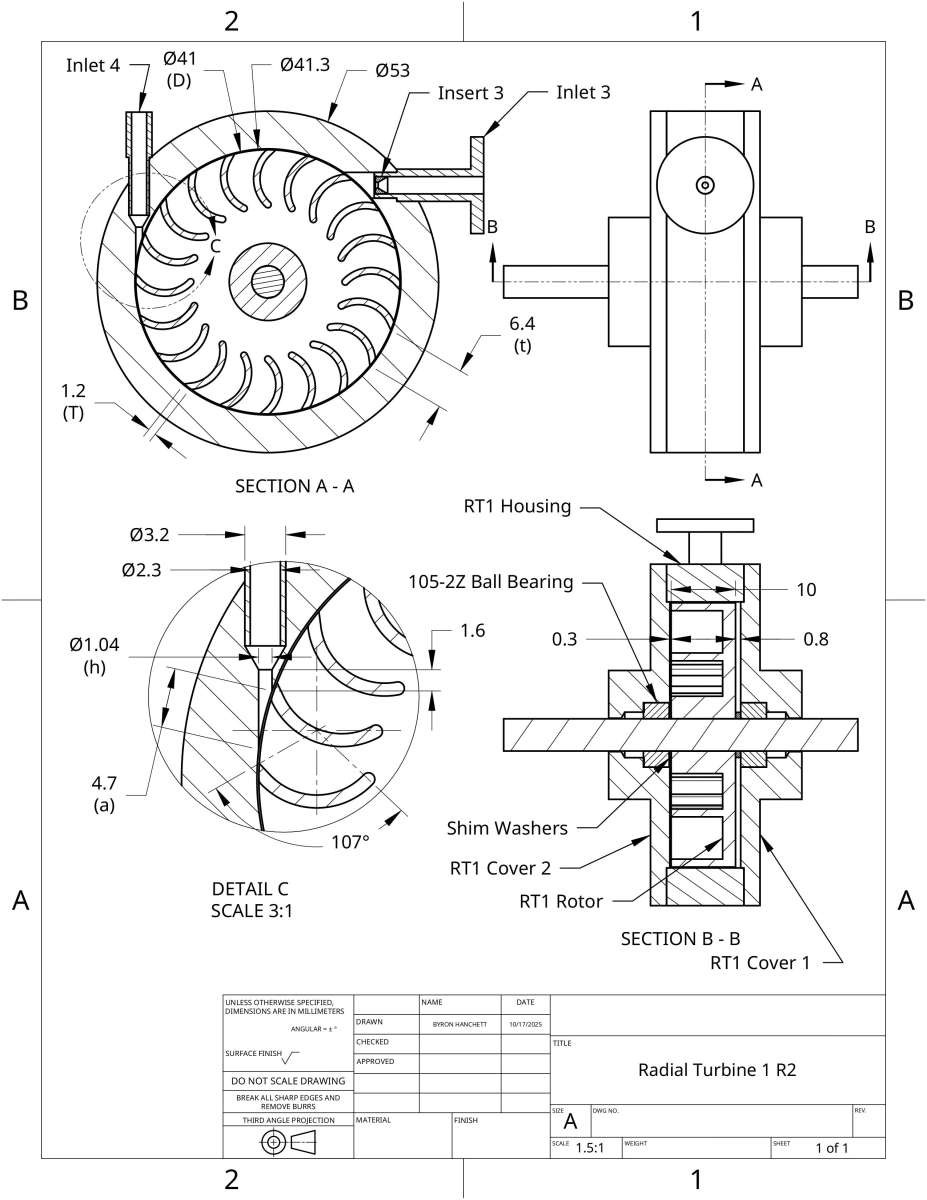
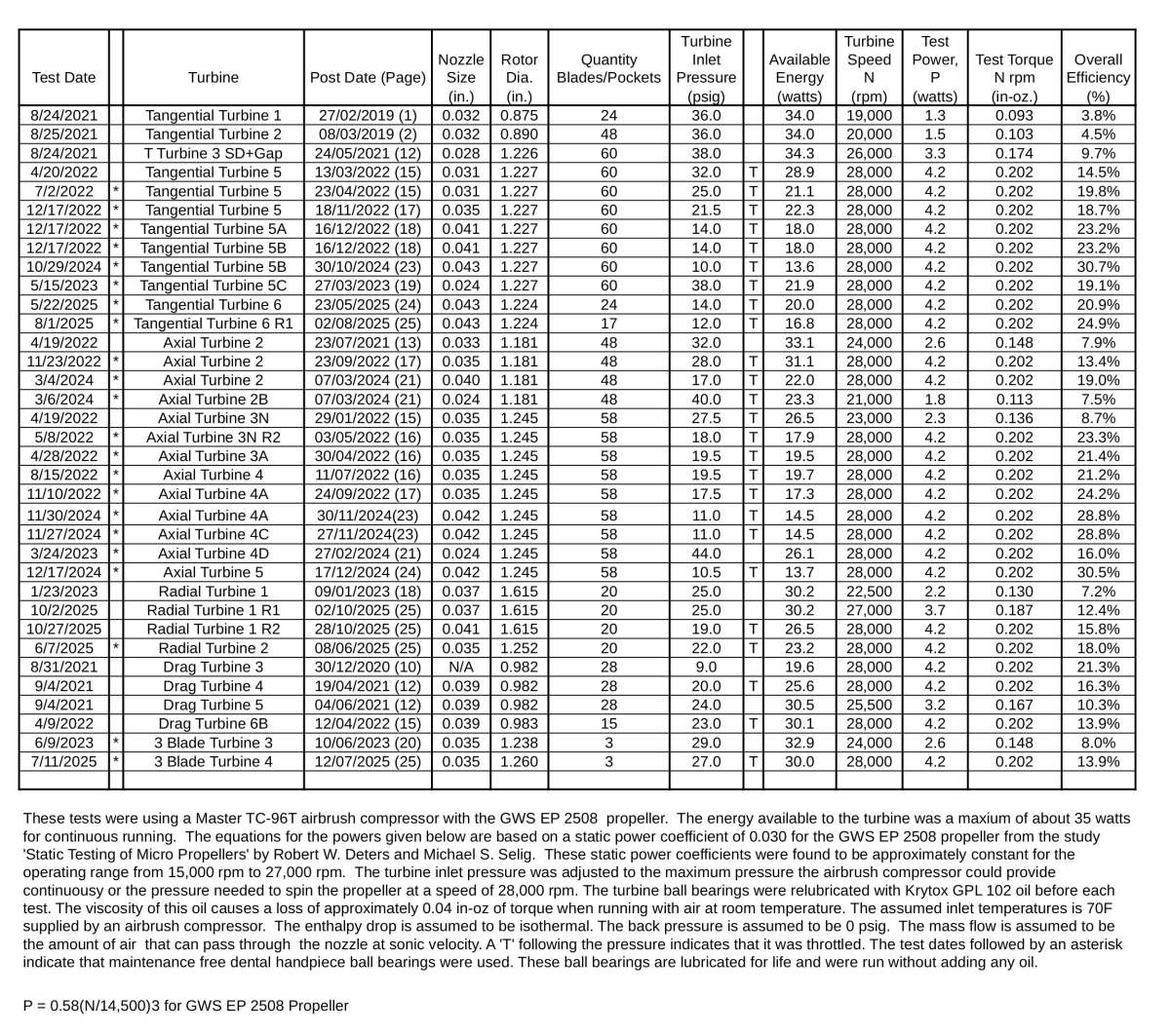
                    I started testing some rotors with the Radial Turbine 1 R2 housing, covers, and ball bearings. Some of the rotors I had tested before with this assembly but I couldn’t get the same results. The ball bearings I used to replace the original ball bearing that came with Radial Turbine 1 R1 are oil lubricated and require new oil be added occasionally. Each time the new oil is added, the performance drops until the oil thins out to the optimum point. The best performance occurs when the oil is thinned out to the minimum thickness and running much longer without adding oil can result in damage to the ball bearings. The results I get using the maintenance free ball bearings are much more consistent since once they are run long enough to bed in, the performance stays the same for a very long time. I decided to make a new turbine performance spreadsheet for the rotors run in the Radial Turbine 1 R2 housing that use the same maintenance free ball bearings for each test. The ball bearings used in these tests use seals and grease like typically used in most applications. They are readily available at low cost but are not intended for high temperature applications like running on steam. The following spreadsheet shows the performance of the first tests with the maintenance free ball bearings. Radial Turbine 1 was the first radial turbine I ordered and all its tests were done with the same ball bearings supplied by the manufacturer. Radial Turbine 1 R1 now has maintenance free ball bearings like came with Radial Turbine 1 and the performance is almost the same as shown in the spreadsheet. Radial Turbine 1 R2 has everything the same as Radial Turbine 1 R1 except a new nozzle was added that improved its performance. Using the new nozzle increased the power 0.8 watts and the efficiency 3.2%.

                    My Turbines 3 R1

                    Radial Turbine 1 R1

                    Radial Turbine 1 R2

                    #832379
                    Turbine Guy
                    Participant
                      @turbineguy

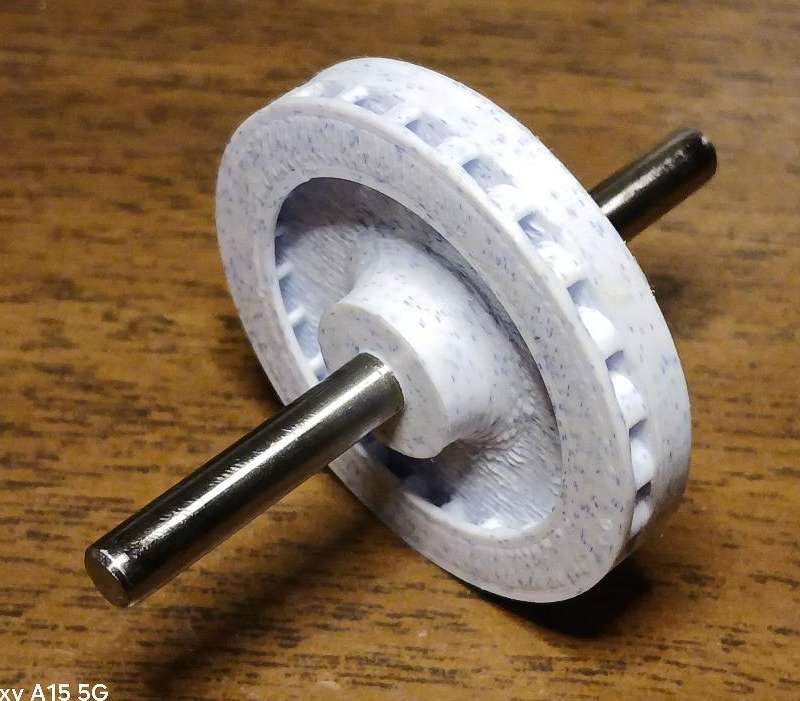
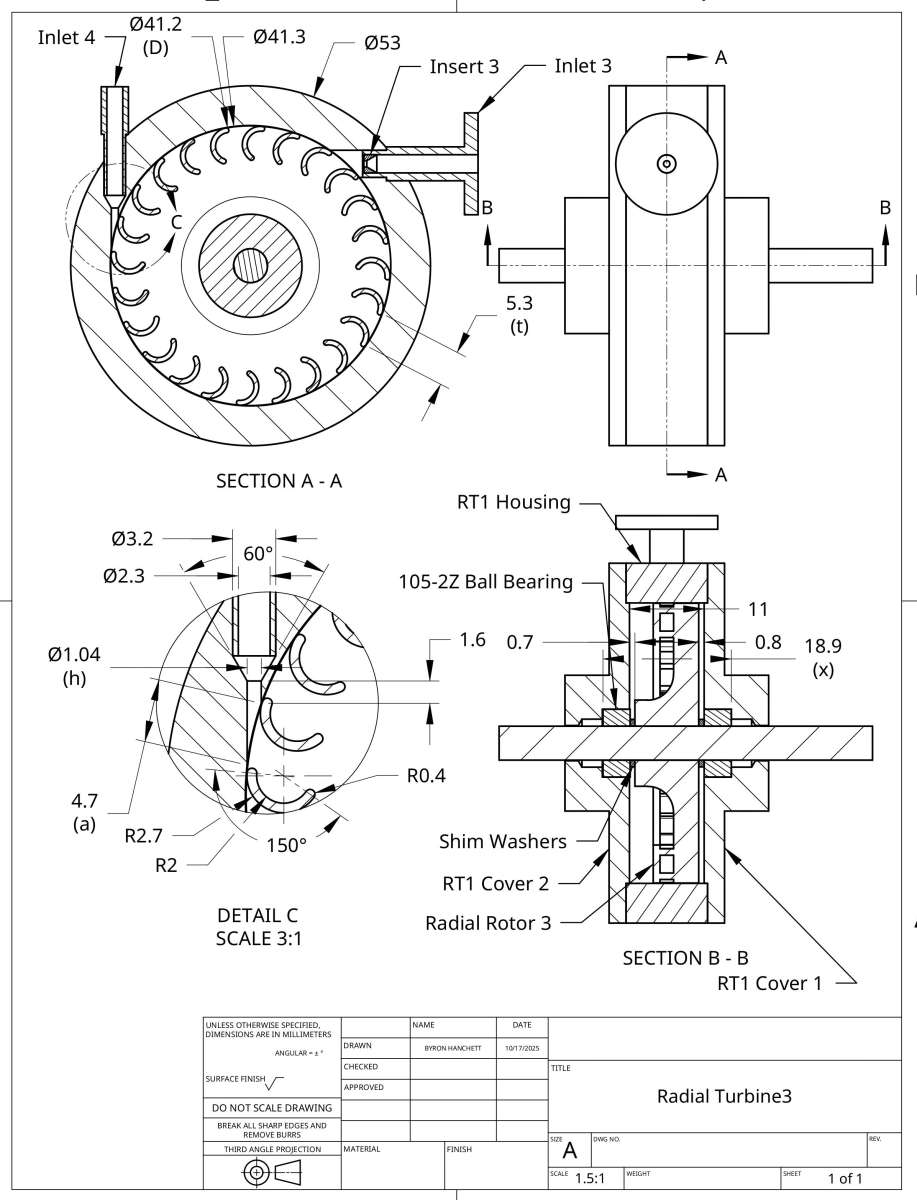
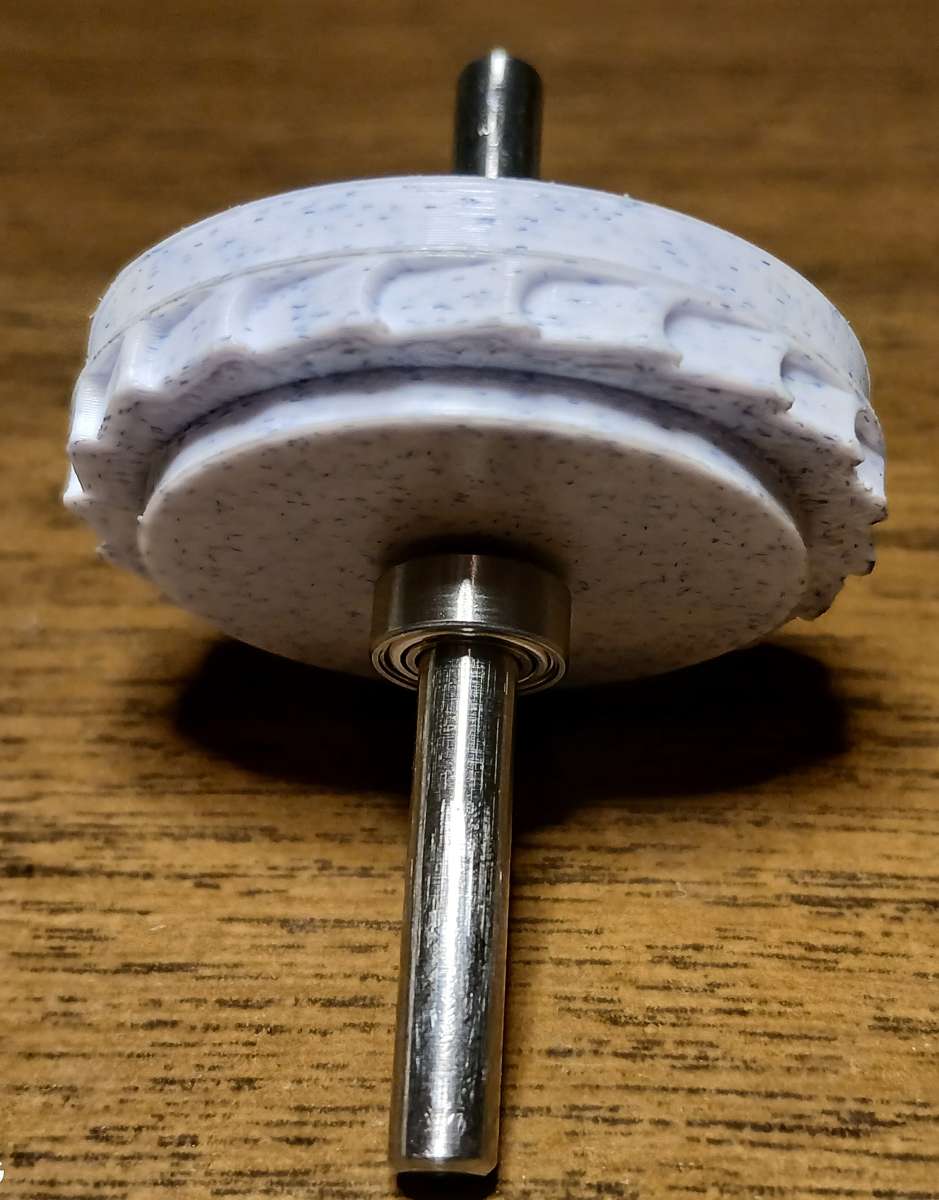
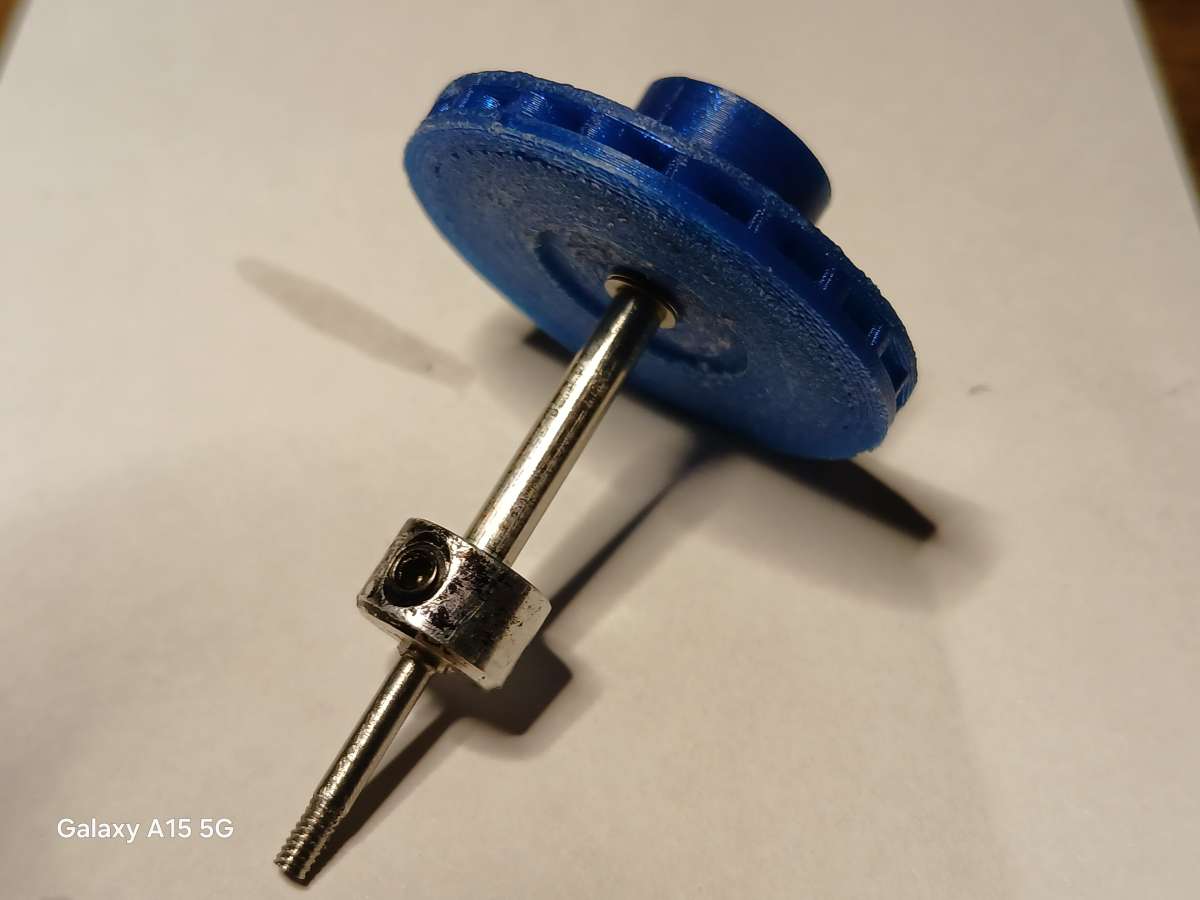
                      I changed the rotor in Radial Turbine 1 R2 to a rotor printed out of PLA shown in the following photo. This was the only change to Radial Turbine 1 R2 and I call the new assembly Radial Turbine 3 as shown in the following drawing. I tested this turbine the same day I tested the turbines shown in the last post so everything was the same except the change in rotors. The following spreadsheet shows the performance of Radial Turbine 3. Changing only the rotor increased the power 0.5 watts and the efficiency 1.9%.

                      Radial Rotor 3

                      Radial Turbine 3

                      My Turbines 3 R2

                      #832390
                      Turbine Guy
                      Participant
                        @turbineguy

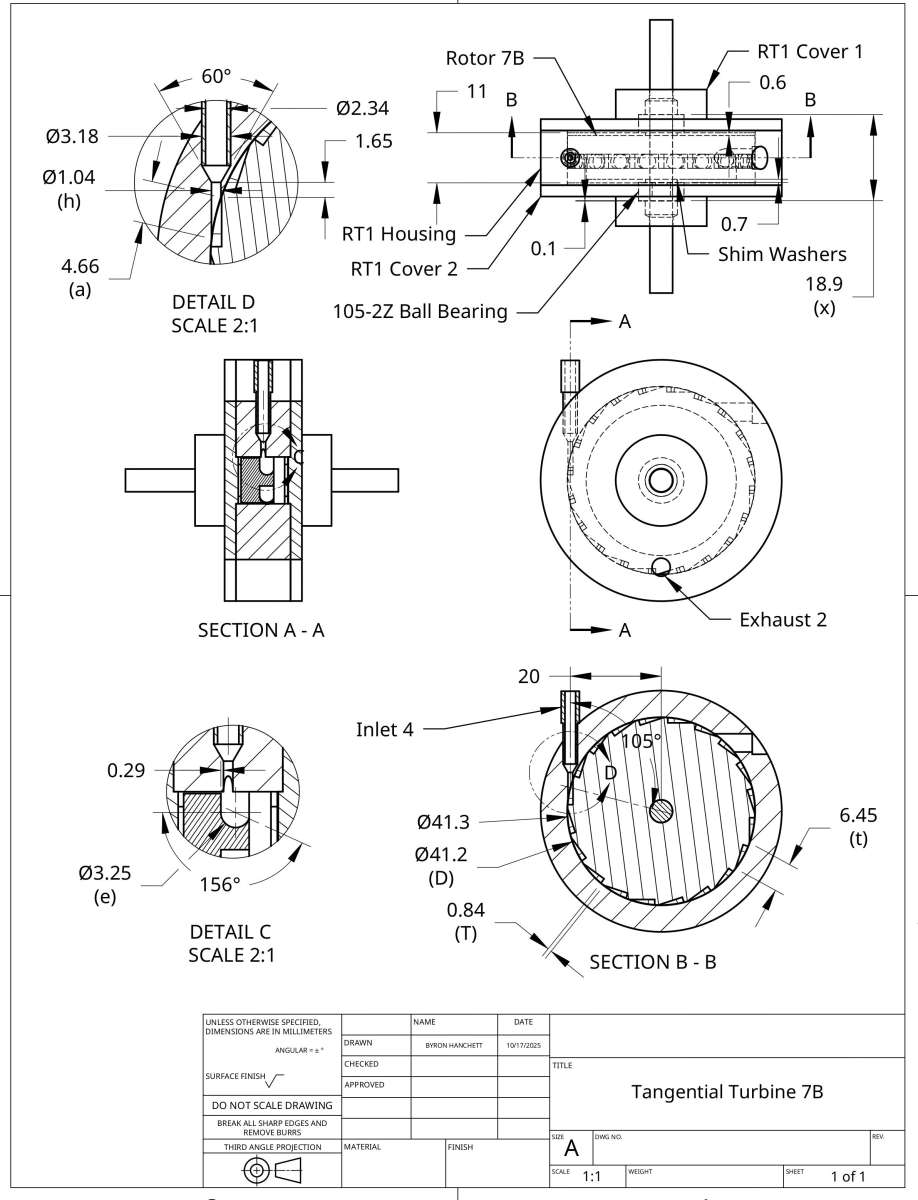
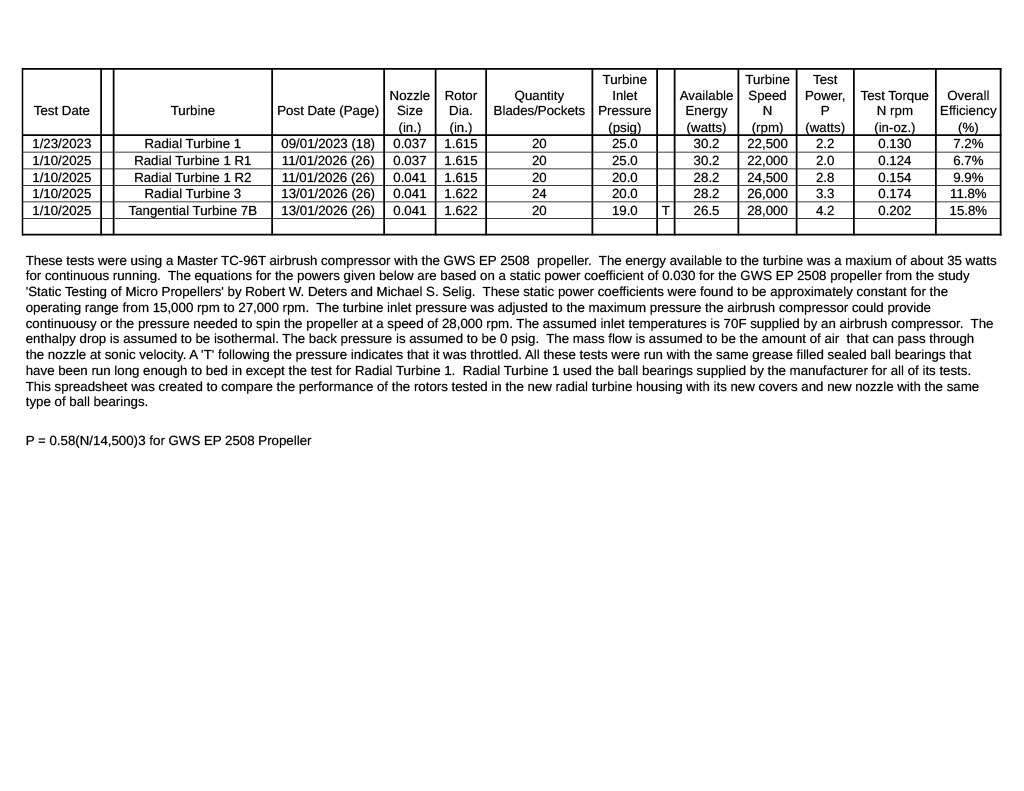
                        I changed the rotor in Radial Turbine 1 R2 to a rotor printed out of PLA shown in the following photo. This was the only change to Radial Turbine 1 R2 and I call the new assembly Tangential Turbine 7B as shown in the following drawing. I tested this turbine the same day I tested the turbines shown in the last post so everything was the same except the change in rotors. The following spreadsheet shows the performance of Tangential Turbine 7B. Changing only the rotor increased the power 1.4 watts and the efficiency 5.9%.

                        Rotor 7B

                        Tangential Turbine 7B

                        My Turbines 3 R3

                        #833335
                        Turbine Guy
                        Participant
                          @turbineguy

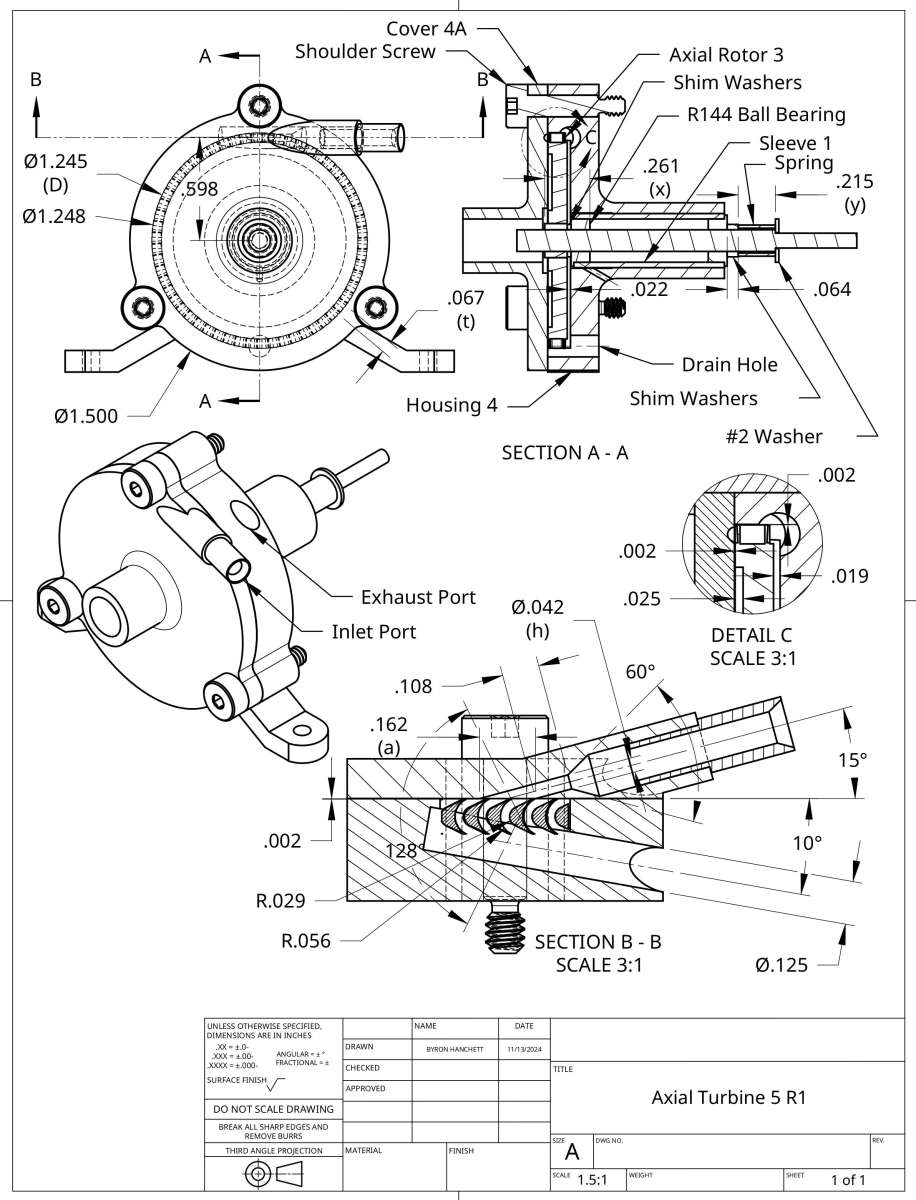
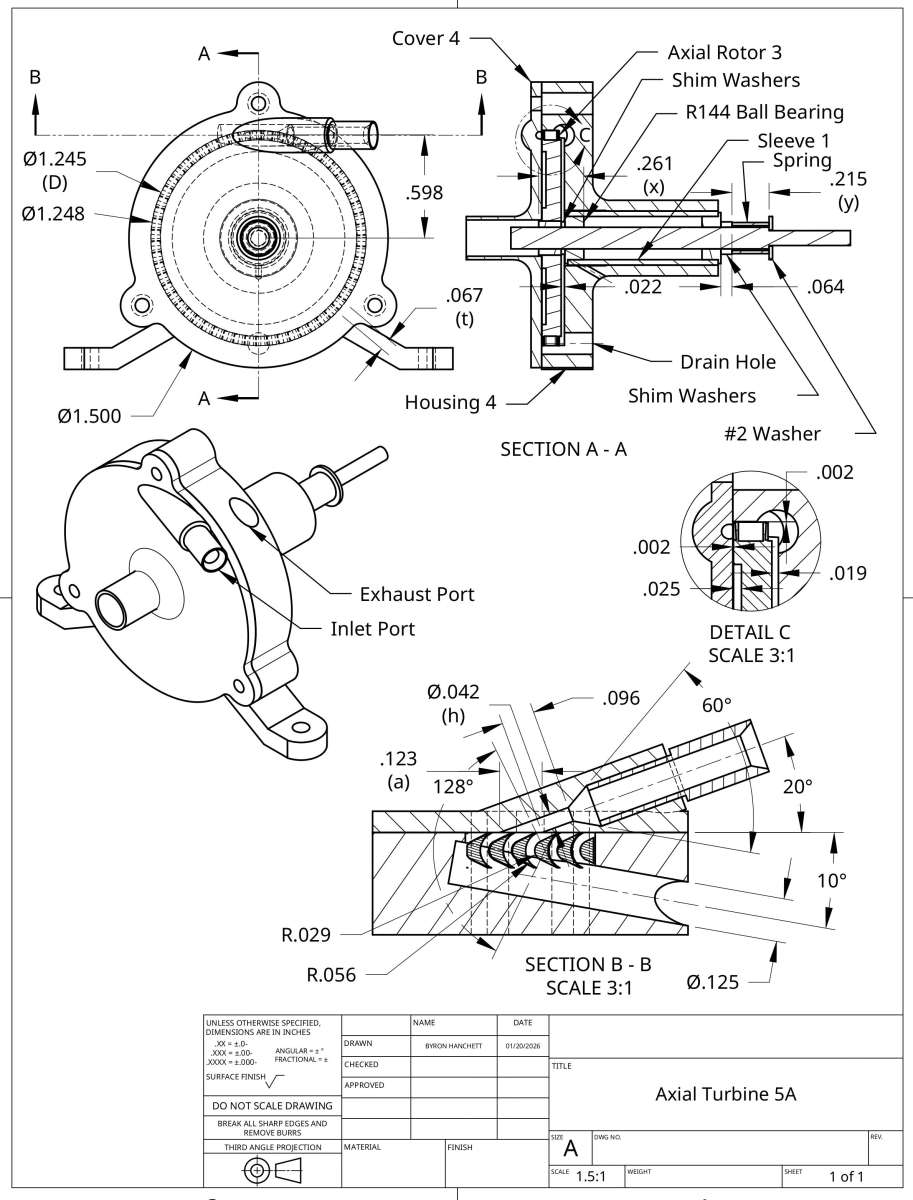
                          Both of my axial rotors were given to me. The rotor used in Axial Turbine 5 given to me by Mike Tilby was described in the 2 January 2026 post and turns the flow 128 degrees. This results in a rotor inlet angle of 26 degrees so I thought a nozzle angle of 20 degrees would give almost the correct alignment. Early testing with this rotor and covers with nozzle angles of 15 degrees and 20 degrees indicated that the 15 degree was better so I started doing all my testing with the 15 degree cover. I never felt that I had really given tests that gave a good comparison and decided to try using the cover with the 20 degree angle on Tangential Turbine 5 R2 with everything the same except for the covers. I call this configuration Tangential Turbine 5A as shown in the following drawing. My shop is at approximately 40 F and won’t get any hotter for quite a while, so I thought I would run a test of Tangential Turbine 5 R2 that has everything the same except having the 15 degree cover and then run a test of Tangential Turbine 5A at the same temperature. The drawing of Tangential Turbine 5 R2 is shown below for comparison. I will show the spreadsheets that give the performance of these tests in the next post when I finish them tomorrow.
                          Axial Turbine 5A

                          Axial Turbine 5 R2

                          #833521
                          Turbine Guy
                          Participant
                            @turbineguy

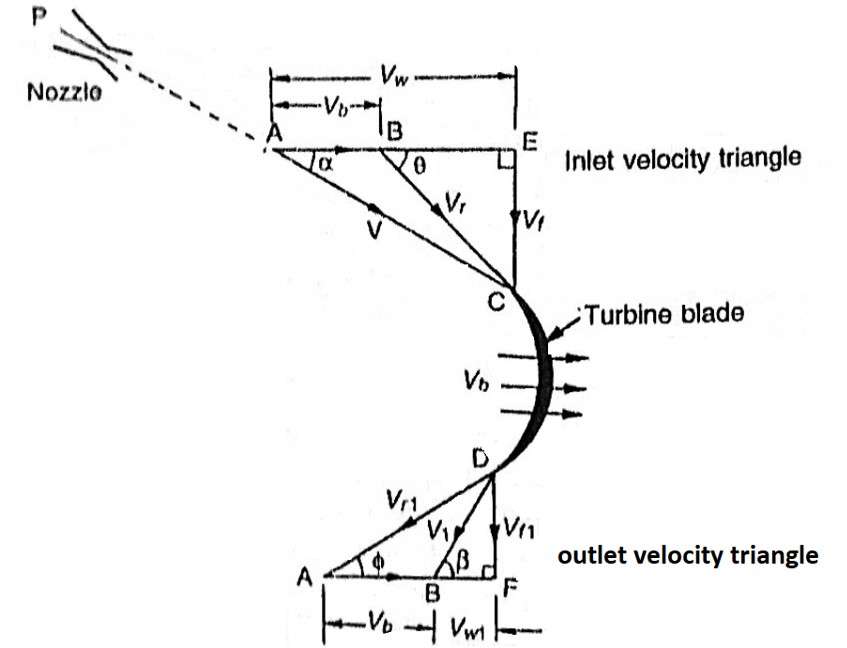
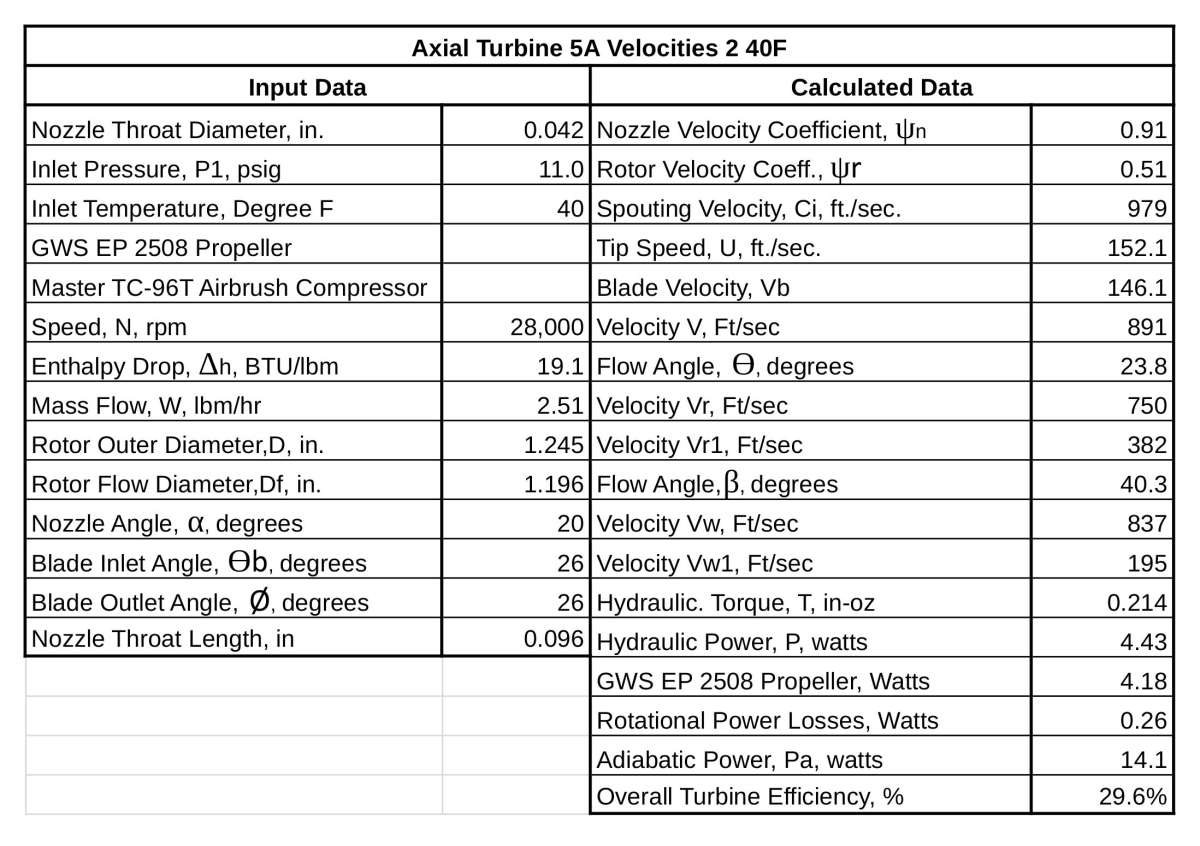
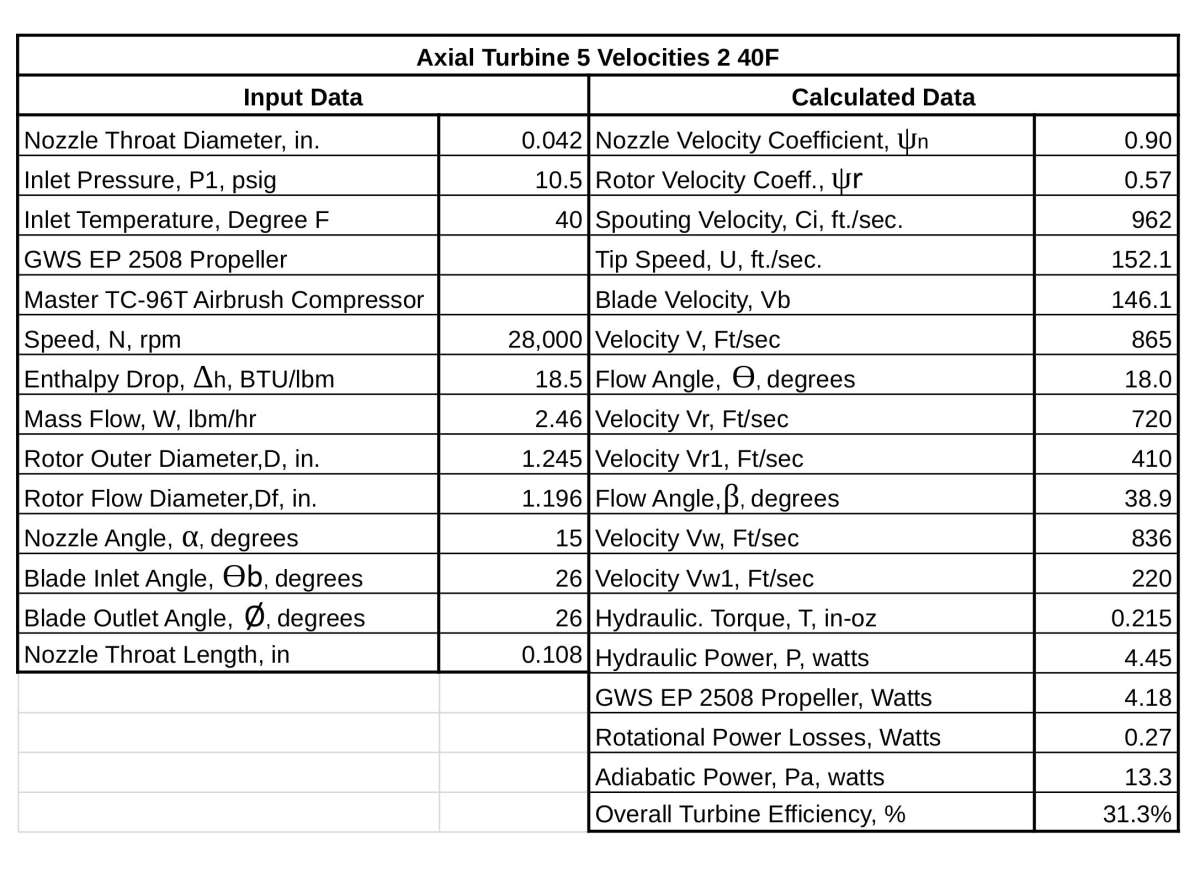
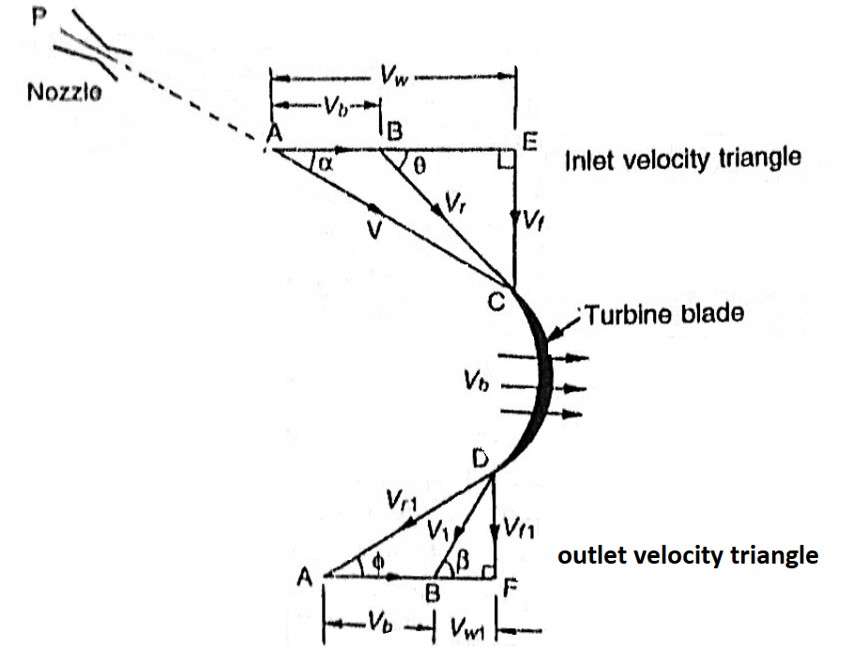
                            I used the following spreadsheets to compare the performance of Axial Turbine 5 R2 and Axial Turbine 5A mentioned in the last. The data on these spreadsheets is explained in the posts starting with 17 March 2023 and ending on 23 March 2023 on page 19 of this thread. These spreadsheets use the traditional way of calculating the hydraulic torque of a turbine using velocity diagrams like the one shown below used for the symbols in the spreadsheets. Using these spreadsheets is useful since the effect of several important items in the turbine design can be compared. The nozzle velocity coefficient explained in the 17 March 2023 post is affected by the gas properties, the nozzle throat length, and by the Mach number if the flow goes supersonic. The nozzles in these tests had everything the same except the inlet pressure and nozzle throat lengths. The differences in pressure and throat length were so small that the slight difference in the nozzle velocity coefficients was probably due to rounding the numbers. The rotor velocity coefficient of Axial Turbine 5A is lower than that of Axial Turbine 5 R2 even though the alignment of the flow with the blades of the rotor is better. The ideal alignment of the flow is where the Blade Inlet Angle, ϴb, is the same as the Flow Angle, ϴ. Apparently the larger nozzle overlap of the rotor shown as dimension, a, in the drawings is the most important. As discussed in 23 March 2023 post, the average rotor velocity coefficient is increased by the nozzle covering more blades. In this example, approximately 2.4 blades are overlapped by the nozzle on Axial Turbine 5 R2 and 1.8 blades for Axial Turbine 5A. The peak value of the rotor velocity coefficient depends on the blades being completely covered by the nozzle so Axial Turbine 5 R2 has 2 blades at the peak value and 1 blade with a much lower value. Likewise, Axial Turbine 5A has only 1 blade at the peak value and 1 blade close to the peak value. The average value of the rotor velocity coefficient for Axial Turbine 5A will be reduced quite a bit more than for Axial Turbine 5 R2 so that is probably the most significant factor.

                            Velocity Diagram 1

                            AT5A Velocities 2 40F

                            AT5 Velocities 2 40F

                            #834334
                            Turbine Guy
                            Participant
                              @turbineguy
                              On Turbine Guy Said:

                              It was pointed out to me that I used tangential where it should have been axial describing some turbines in the quoted post. Please let me know any mistakes you find in my posts. I hope I corrected all the errors in the 20 January post as follows.


                              Both of my axial rotors were given to me. The rotor used in Axial Turbine 5 given to me by Mike Tilby was described in the 2 January 2026 post and turns the flow 128 degrees. This results in a rotor inlet angle of 26 degrees so I thought a nozzle angle of 20 degrees would give almost the correct alignment. Early testing with this rotor and covers with nozzle angles of 15 degrees and 20 degrees indicated that the 15 degree was better so I started doing all my testing with the 15 degree cover. I never felt that I had really given tests that gave a good comparison and decided to try using the cover with the 20 degree angle on Axial Turbine 5 R2 with everything the same except for the covers. I call this configuration Axial Turbine 5A as shown in the following drawing. My shop is at approximately 40 F and won’t get any hotter for quite a while, so I thought I would run a test of Axial Turbine 5 R2 that has everything the same except having the 15 degree cover and then run a test of Axial Turbine 5A at the same temperature. The drawing of Axial Turbine 5 R2 (mislabeled as Axial Turbine R1) is shown below for comparison. I will show the spreadsheets that give the performance of these tests in the next post when I finish them tomorrow.
                              Axial Turbine 5A

                              Axial Turbine 5 R2


                              #837134
                              Turbine Guy
                              Participant
                                @turbineguy
                                On Turbine Guy Said:

                                I changed the rotor in Radial Turbine 1 R2 to a rotor printed out of PLA shown in the following photo. This was the only change to Radial Turbine 1 R2 and I call the new assembly Tangential Turbine 7B as shown in the following drawing. I tested this turbine the same day I tested the turbines shown in the last post so everything was the same except the change in rotors. The following spreadsheet shows the performance of Tangential Turbine 7B. Changing only the rotor increased the power 1.4 watts and the efficiency 5.9%.

                                Rotor 7B

                                Tangential Turbine 7B

                                My Turbines 3 R3

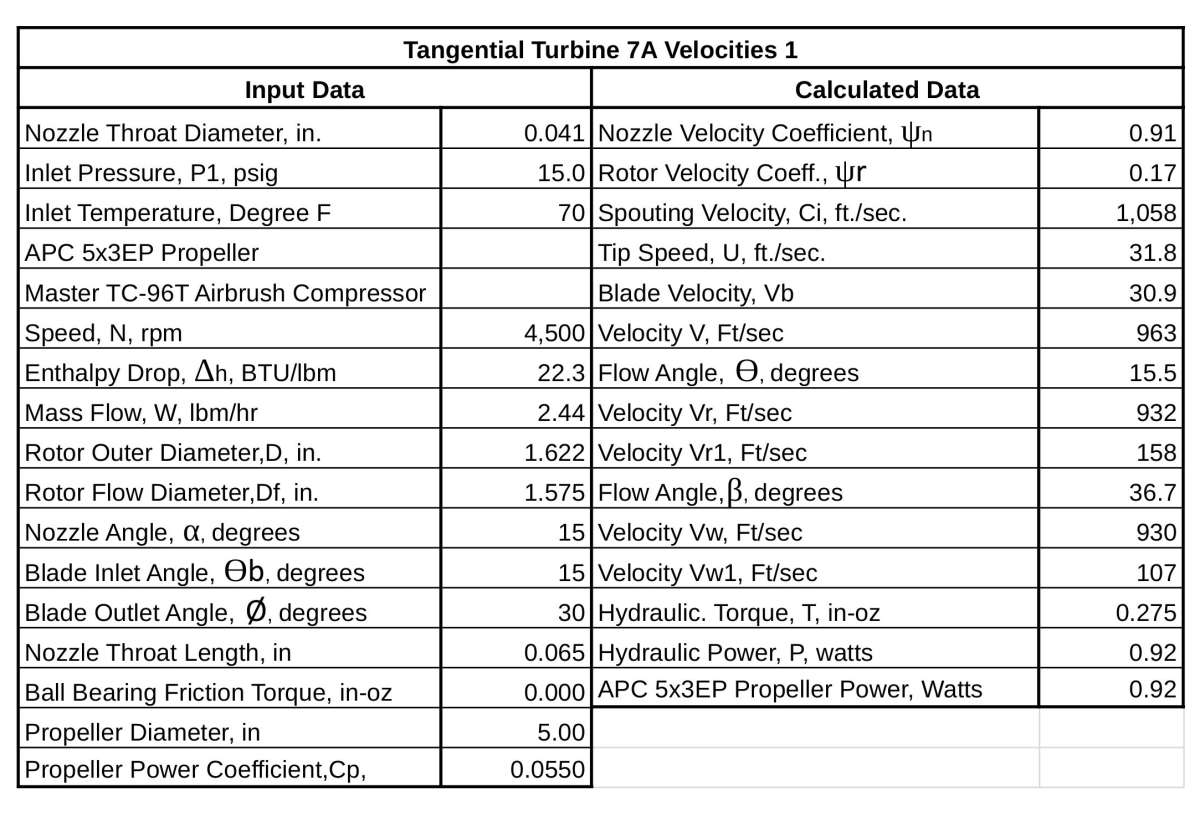
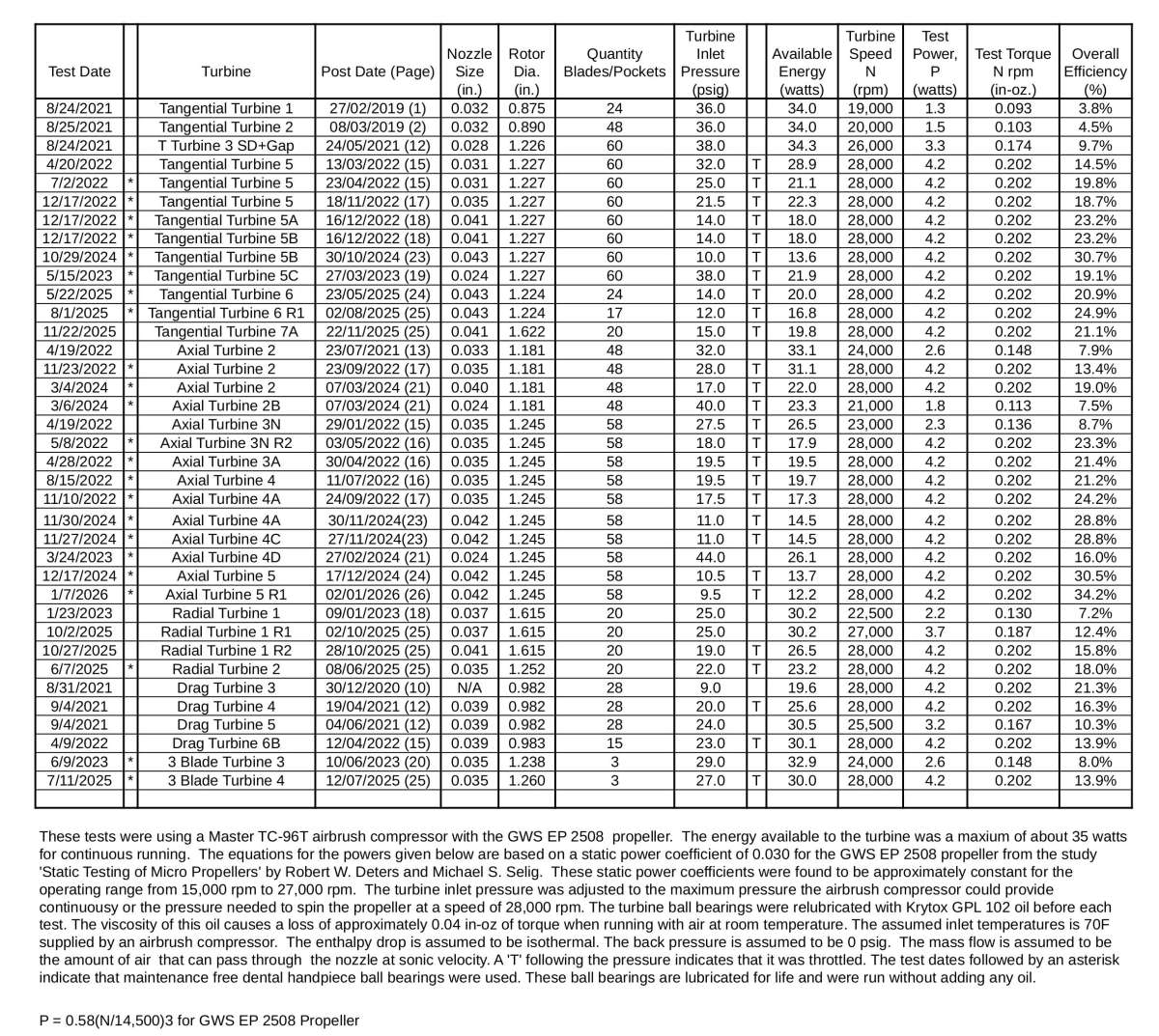
                                I would like to show the importance of the ball bearings and the lubrication they use in model turbines. The post I quoted shows the performance of Tangential Turbine 7B tested on 1/10/2025. The following spreadsheet shows the performance of Tangential Turbine 7A that was tested on 11/22/2025. The only difference between Tangential Turbine 7A is in the ball bearings. Tangential Turbine 7A uses an oil lubricated ball bearing with two shields. Tangential Turbine 7B uses a greased lubricated ball bearing with two seals. The resisting torque caused by the grease and seals in the ball bearings of Tangential Turbine 7B and the resisting torque caused by the oil in the ball bearings of Tangential Turbine 7A is the only difference in the rotational losses. The windage loss is identical for these tests since the same rotor, housing, cover plates, and rotor position was used for both tests. Tangential Turbine 7B required 6.7 watts more power to turn the same propeller to the same speed. The efficiency of Tangential Turbine 7B in the 1/10/2025 test was 15.8% so the extra power required to spin the ball bearings was approximately 1.1 watts. This is for an output power of 4.1 watts so you can see how significant the ball bearing loss can be with the extra friction of the grease and seals. The torque required to overcome the friction of the grease and seals is approximately 0.05 in-oz. The Design Study for a 100-Watt Turboalternator Power Unit by Dr. O.E. Balje and R. Spies made in June 1978 that estimated the efficiency of turbines as small as my models felt the ball bearing friction was important even for the 100 watt design. The report available in this link has several pages reviewing the advantages and disadvantages of several bearing types. The ball bearing they ultimately selected was the same as the dental ball bearings I use in most of my turbines even though they felt it would have a short life with 100 watt power and 60,000 rpm speed.  This report has quite a bit more information about small turbines you might also find interesting.

                                My Turbines 1 R13

                                #837286
                                Turbine Guy
                                Participant
                                  @turbineguy

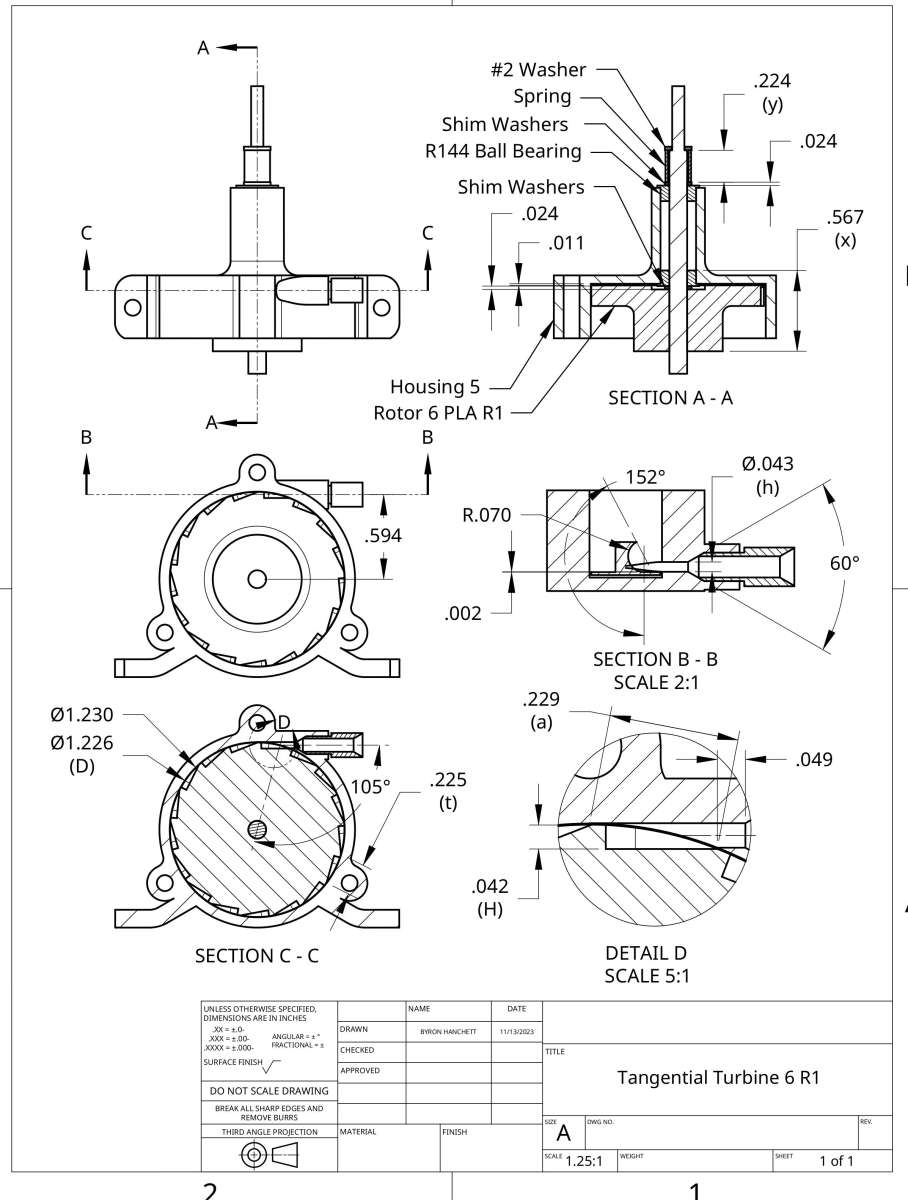
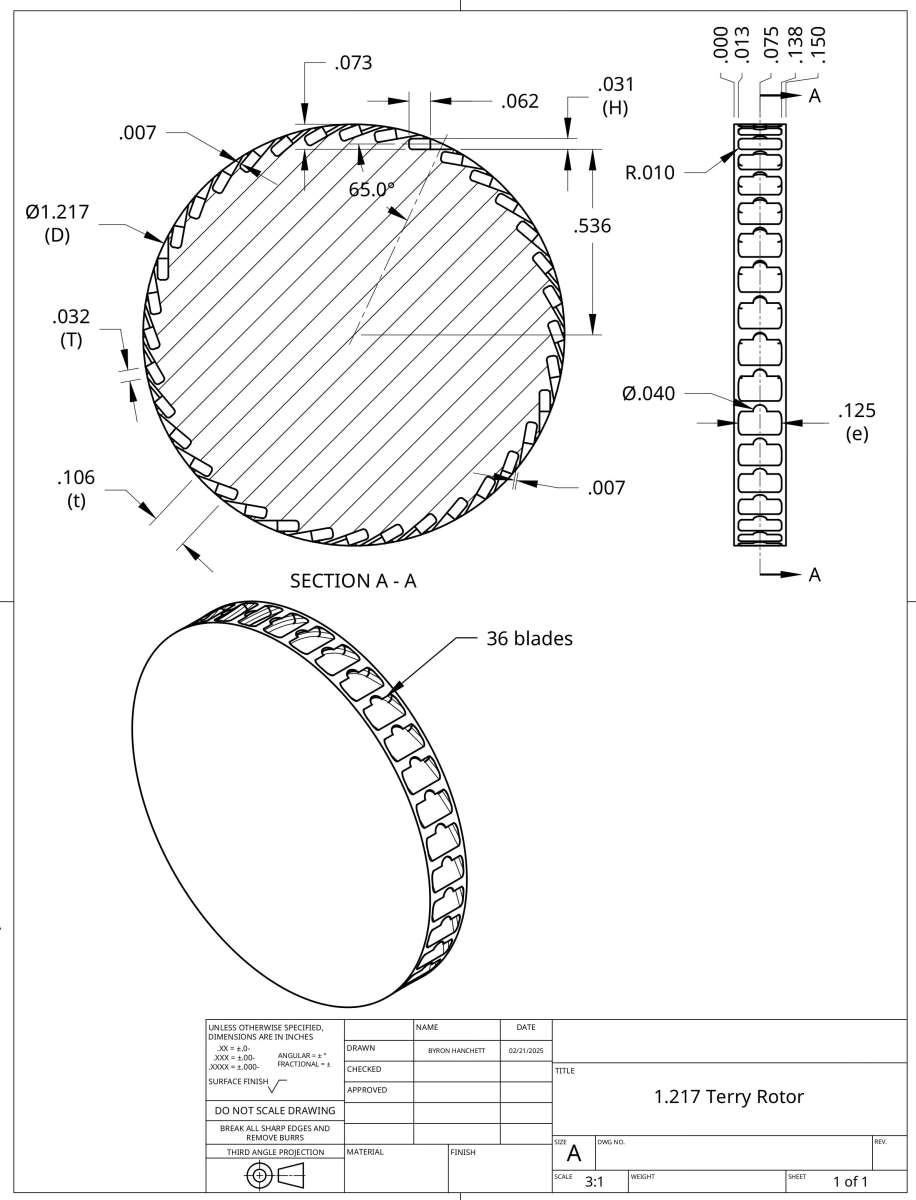
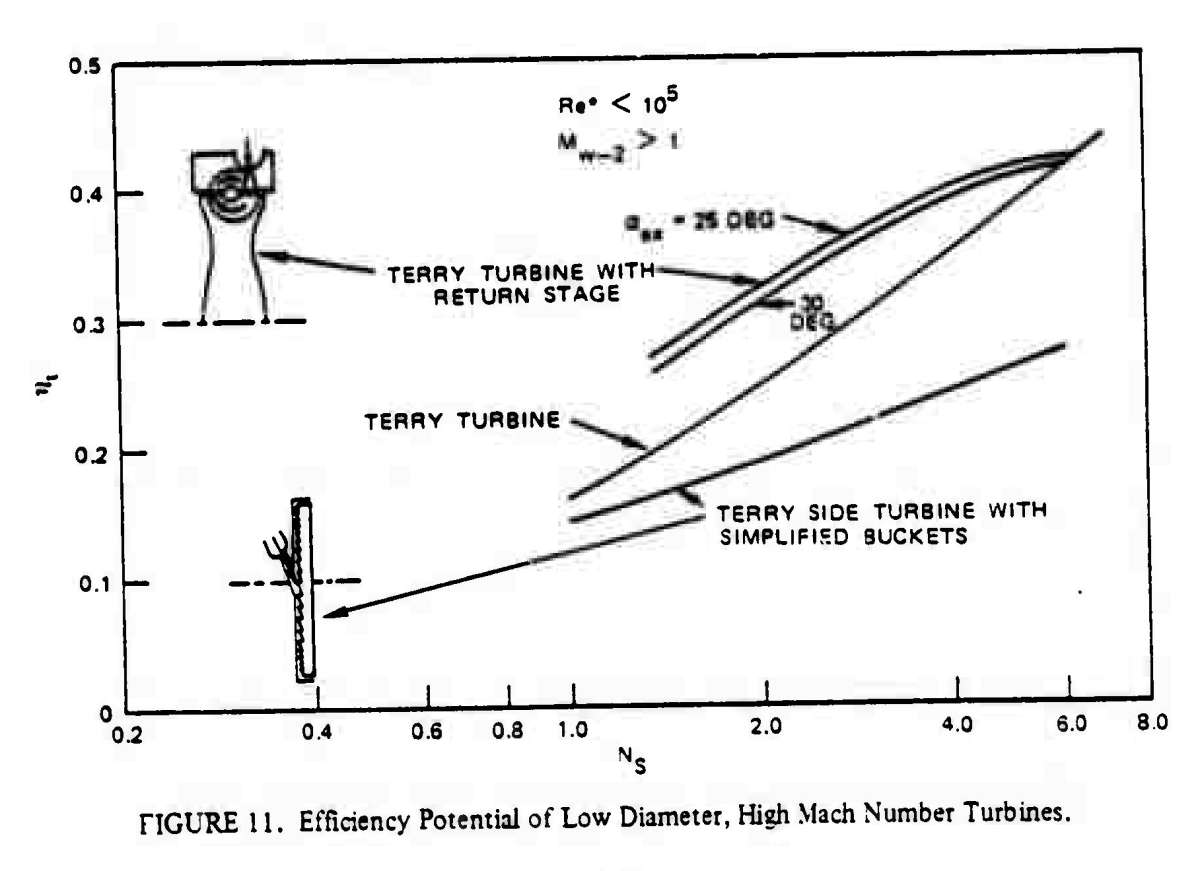
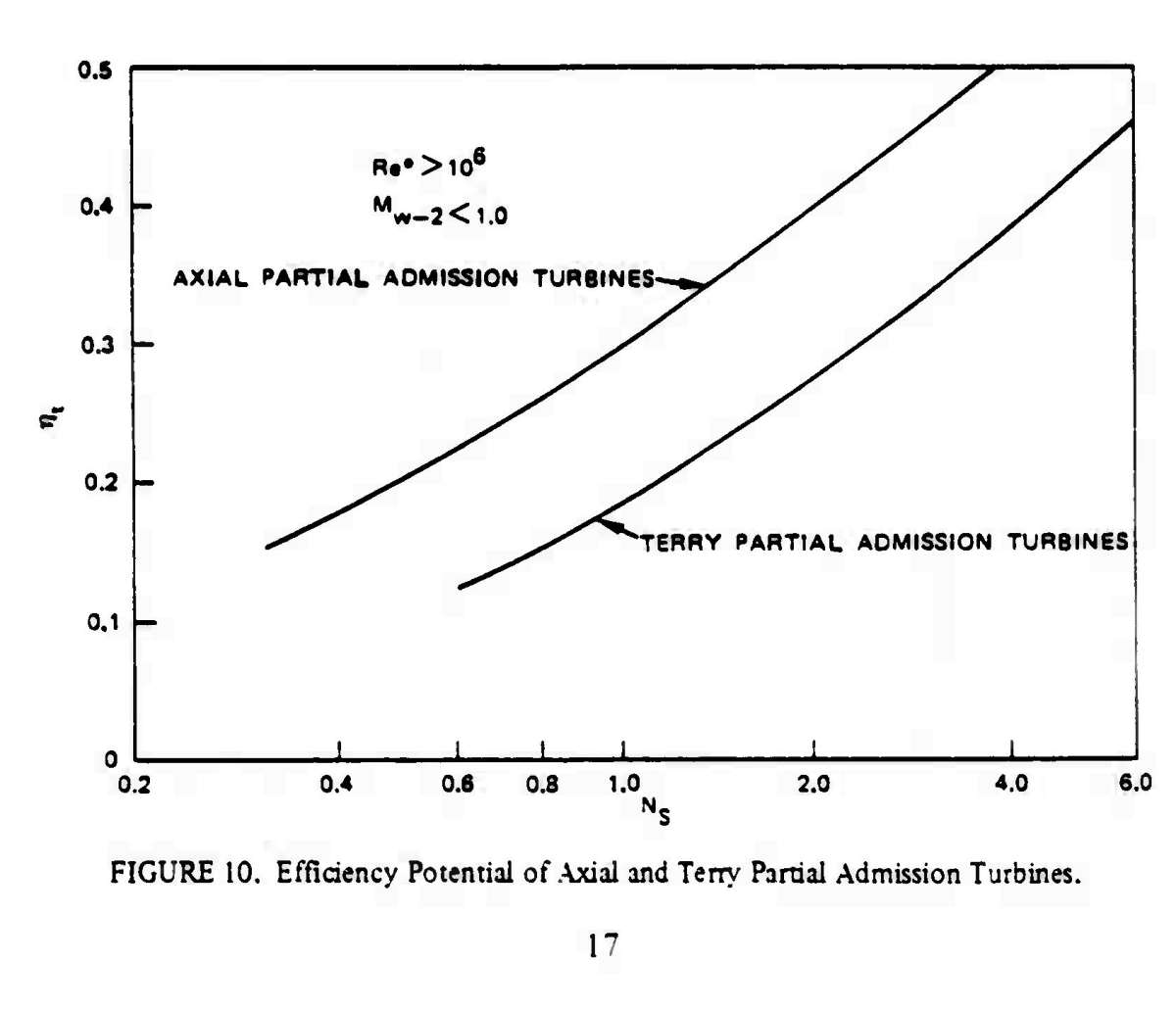
                                  The article shown in the link of the last post gave the performance of some Terry Turbines that were almost identical in size to some of the model turbines I have tested. The second drawing shows the dimensions of the Terry Turbine rotor that gave the best efficiency for a single stage. The first drawing shows the dimensions of Tangential Turbine 6 R1, which is a Stumpf type of turbine. I picked the Stumpf type to show how the simplest to make open pocket rotor has exceeded the efficiency projected for the Terry Turbines. Figure 11 shown below gives the projected efficiency at the specific speed, Ns, for the various types of turbines. The 19 March 2025 post on page 24 shows the equations for finding the specific speed Ns. The Terry Turbine had a specific speed of 2.8 and an efficiency of 29.9% which is a little below what was projected for that specific speed. Tangential Turbine 6 R1 had a specific speed of 1.9 and an efficiency of 24.9% that is a little higher than projected for a Terry Turbine at that specific speed and much higher than projected for the simplified buckets they chose. I point this out to show that the experts at the time of the article felt turbines with blades would always do better than turbines with open pockets. This may be true in large sizes but my testing indicates the tangential turbines of the Strumpf type do as well, if not better, than the Terry type of turbines in the small size of model turbines. This may be due to the flow path through the pockets being so short that the flow can’t expand much and the direction of flow holding the gas against the pocket.

                                  Tangential Turbine 6 R1

                                  1.217 Terry Rotor

                                  Figure 11

                                  #837329
                                  Turbine Guy
                                  Participant
                                    @turbineguy

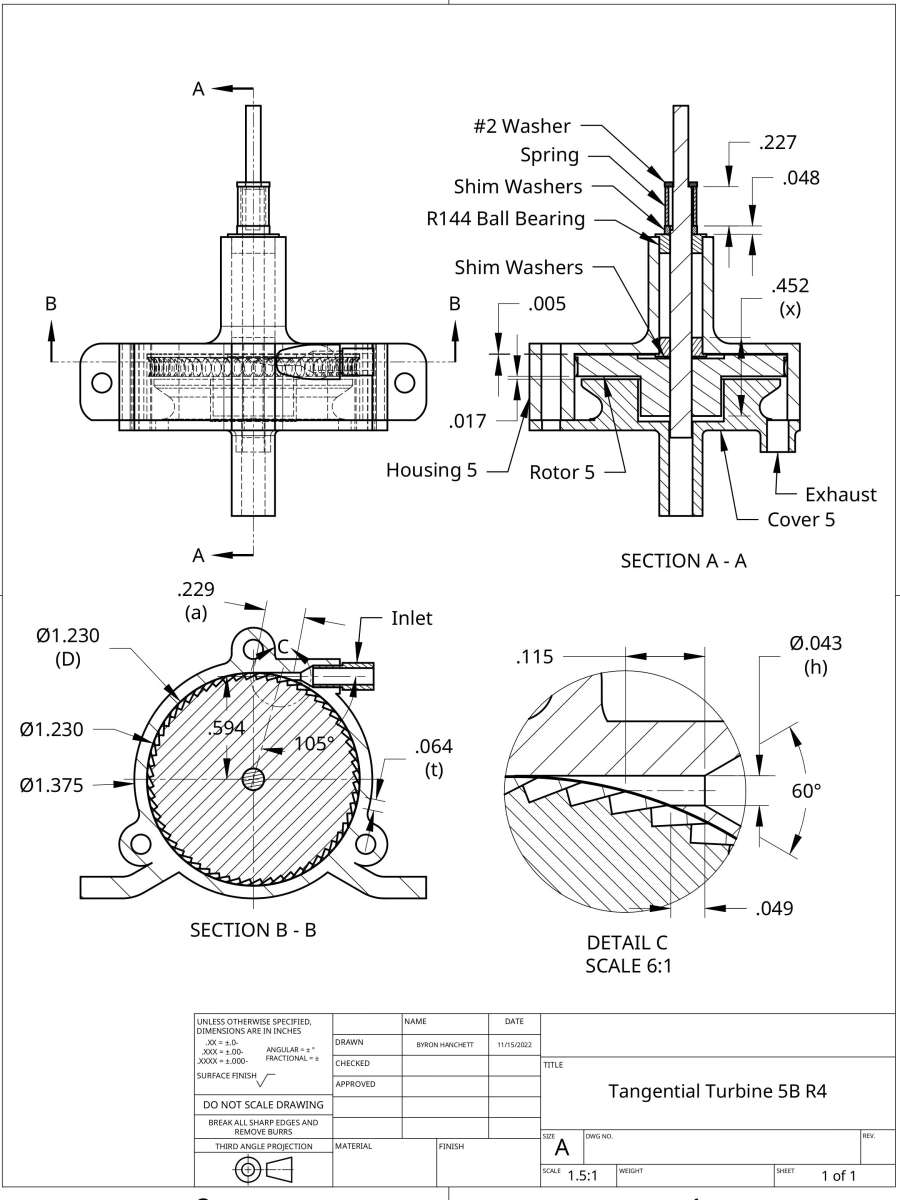
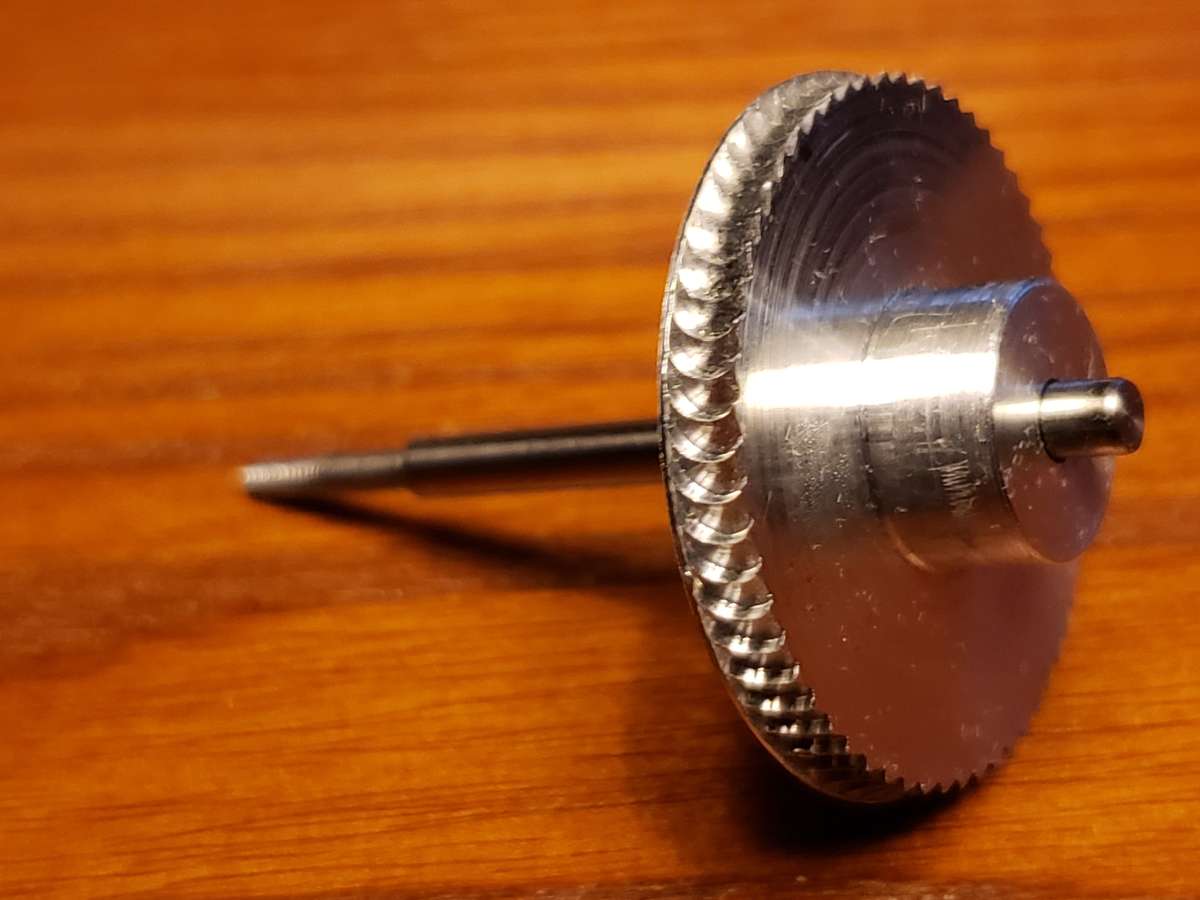
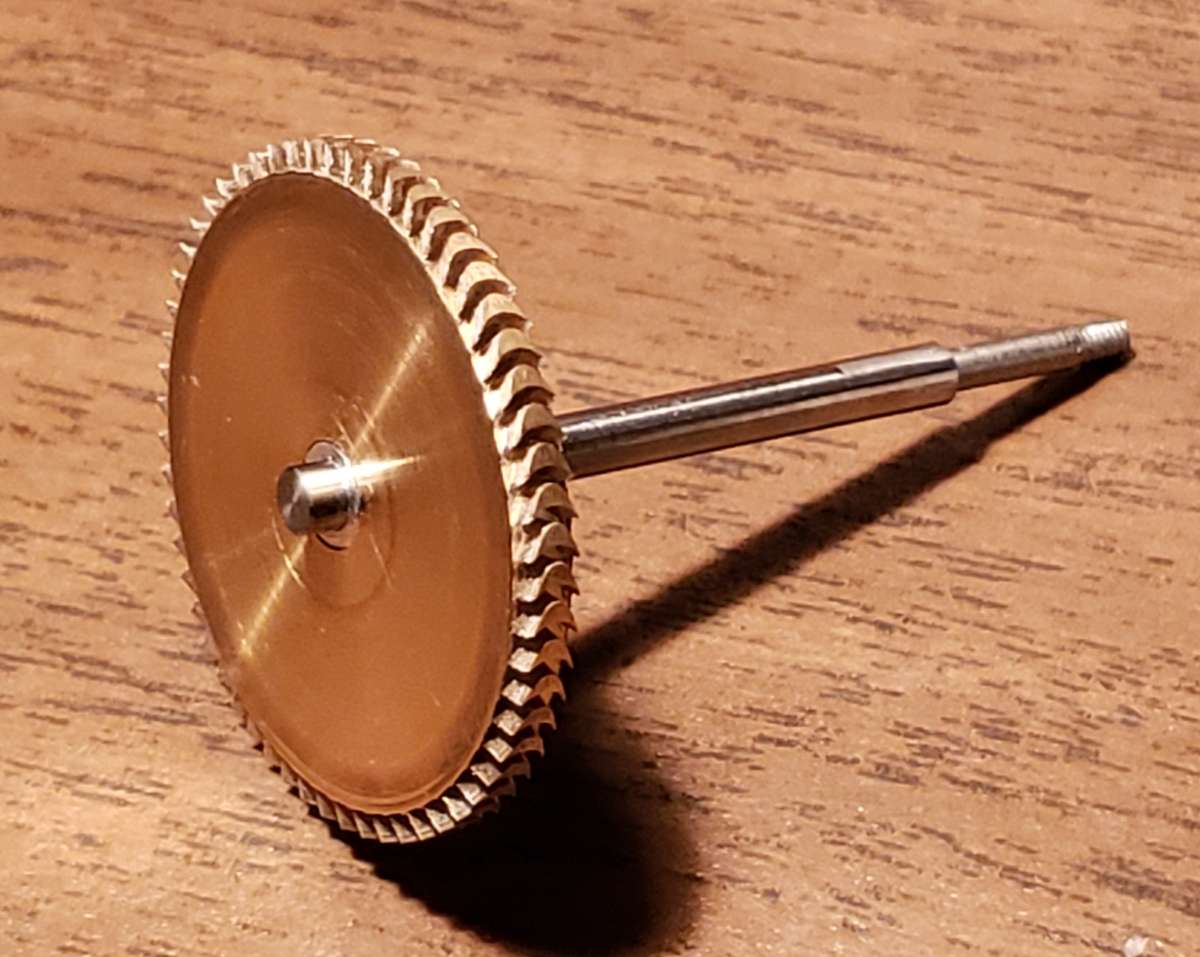
                                    I have not seen anyone use the overlapping pockets like in Tangential Turbine 5B shown in the following drawing, but they have been very effective for me. Tangential Turbine 5B obtained an efficiency of 30.7% with a specific speed, Ns, of 2.0. This efficiency is quite a bit better than projected for a single stage Terry Turbine with this specific speed as shown in Figure 11 of the last post. It even approaches the estimated efficiency of the Terry Turbine with a return stage for this specific speed. The rotor is not very attractive as shown in the following photo but it is very effective and the pockets are easy to machine. If you have the skill to machine the traditional axial rotor like Mike Tilby made for me shown in the second photo, it is still the best but the overlapping pockets are not far behind. This rotor was used in Axial Turbine 5 R1 and reached an efficiency of 34.2% with a specific speed, Ns, of 2.0. This got close to the projected efficiency for this specific speed for axial turbines with over 100 blades as shown below in Figure 10 taken from the same report mentioned in the last post.
                                    Tangential Turbine 5B R4

                                    Rotor 5 Photo 1

                                    Axial Rotor 3 Photo 2

                                    Figure 10

                                    #839743
                                    Turbine Guy
                                    Participant
                                      @turbineguy

                                      The extra power of 1.1 watts required by Tangential Turbine 7B to turn the GWS EP 2508 propeller at 28,000 rpm after changing the ball bearings as discussed in the 10 February 2026 post seemed way too high. I searched the internet and couldn’t find anything that indicated sealed and grease filled ball bearings would increase friction enough to be a concern. The ball bearing friction given for all the ball bearings I could find in the tiny size of my models was negligible regardless of if they had seals or not or were lubricated with grease or oil. To verify this, I tried running Tangential Turbine 7B without a load to see how high the pressure needed to be to start the rotor turning. It took less than 1 psig to start the rotor turning and to keep it running. I tried several other tests with other propellers that indicated the friction of the new ball bearings was not significant. I then changed back to the GWS EP 2508 propeller and found that I could run Tangential Turbine 7B to its maximum speed of 28,000 rpm with just 15 psig. This was the same pressure Tangential Turbine 7A required with the other ball bearings.  The new grease filled ball bearings needed to be run a little longer before they reached their minimum friction. When I started Tangential Turbine 7B the next day, it required an inlet pressure of 19 psig to reach the full speed but after running several minutes the required pressure dropped to 15 psig. This confirmed that I will need to run the new ball bearings several minutes before I start recording the results.
                                       

                                      #841654
                                      Turbine Guy
                                      Participant
                                        @turbineguy

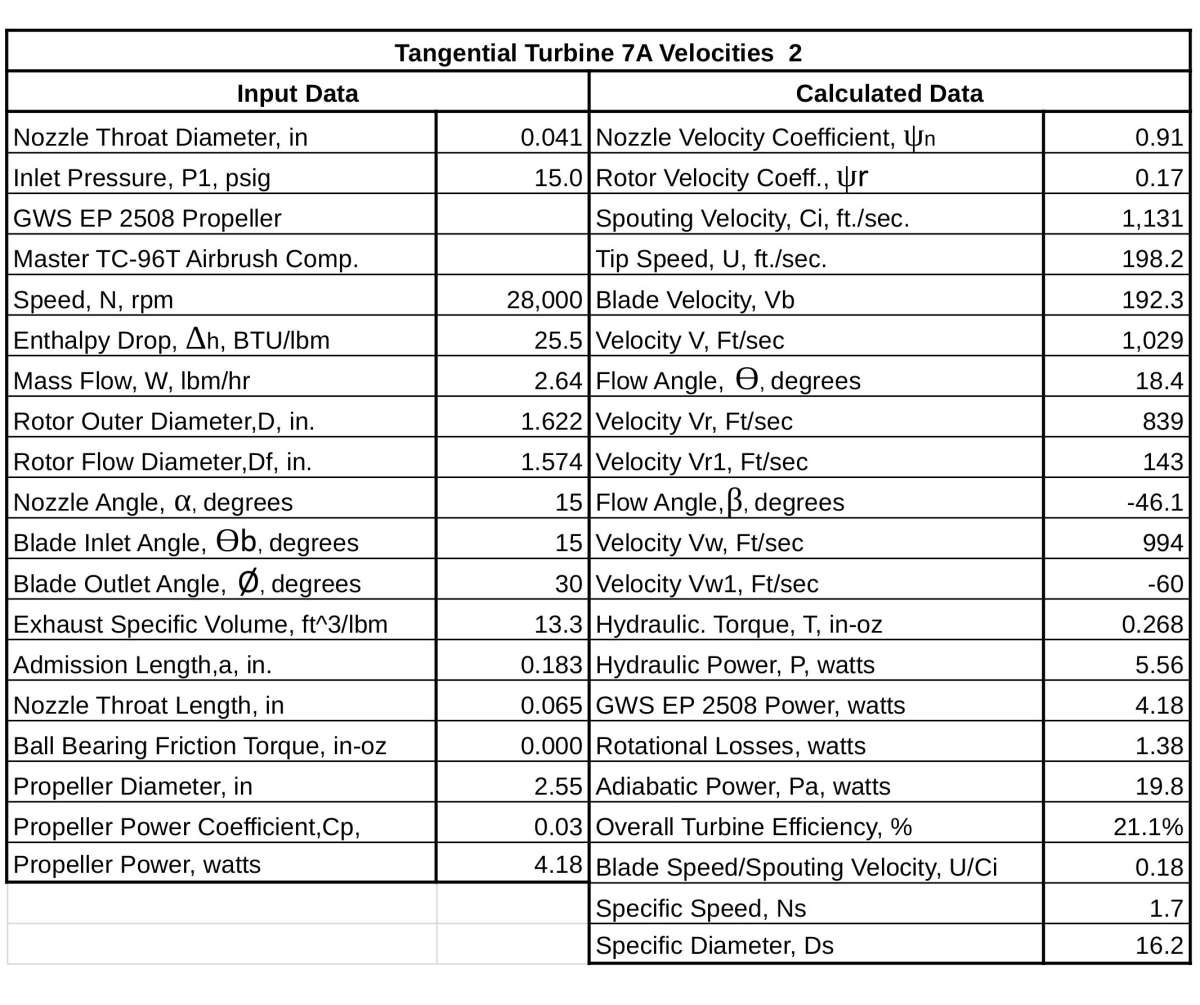
                                        I estimated the rotational losses for the rotors used in the radial turbine housing using the spreadsheets explained in the posts starting with the 17 March 2023 post and ending after all the posts of 23 March 2023 on page 19 of this thread. I used Tangential Turbine 7A to estimate the rotational losses as shown on the following spreadsheets. These rotational losses were higher than I expected so I ran Tangential Turbine 7A without a load and measured the pressure required to spin the GWS EP 2508 propeller to its maximum speed of 28,000 rpm. It required approximately 6.0 psig to reach this speed without a load. The power available to Tangential Turbine 7A with this pressure is about 6.6 watts. The efficiency of Tangent Turbine 7A as shown below on the Velocities 2 spreadsheet is 21.1% so the turbine power required was approximately 1.4 watts. This is very close to the 1.38 watts shown in the Velocities 2 spreadsheet.

                                        TT7A Velocities 1

                                        TT7A Velocities 2


                                        #843693
                                        Turbine Guy
                                        Participant
                                          @turbineguy

                                          I have tried everything I could think of to improve the performance of my axial and tangential turbines. Comparison of their performance with what some of the top experts in the field projected for turbines of this size were shown in the last few posts of this thread. The performance of the radial turbines has not been near as good and I will try to explain what I believe is causing this.

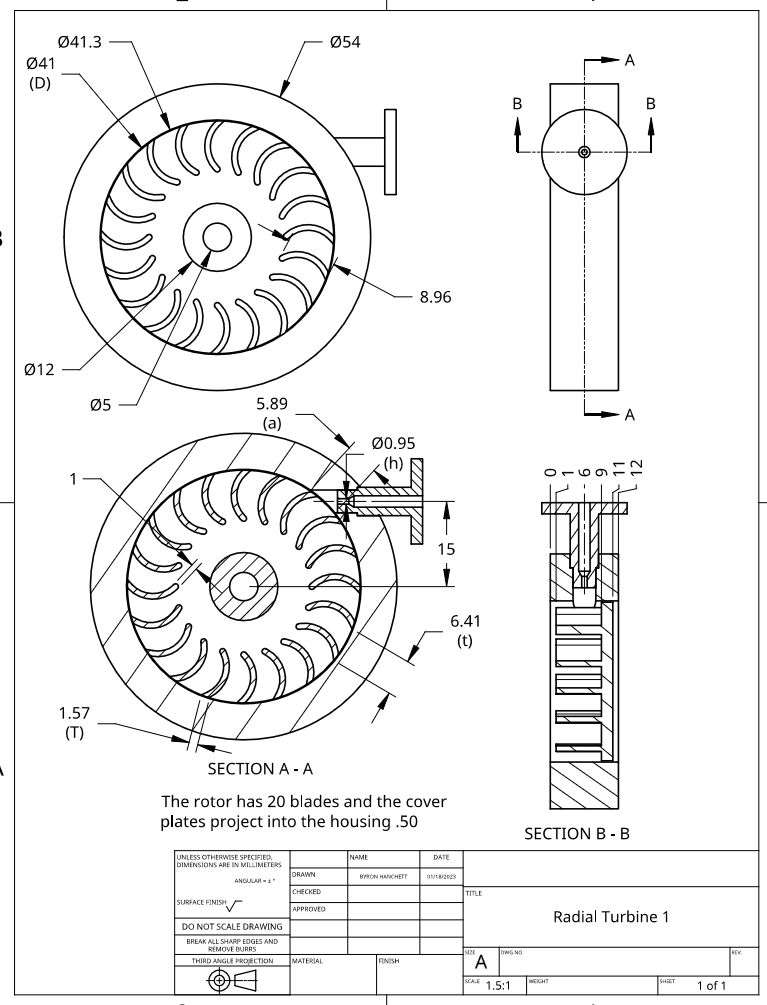
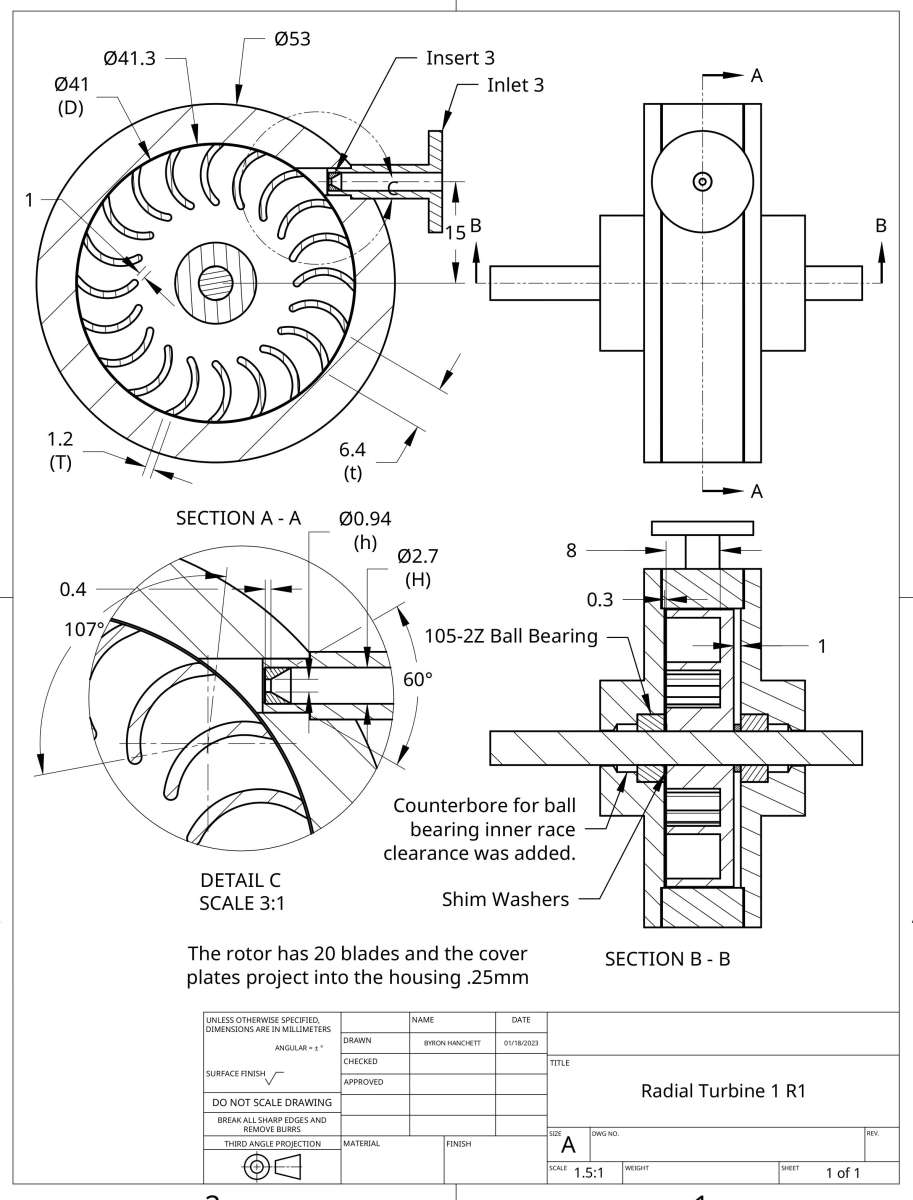
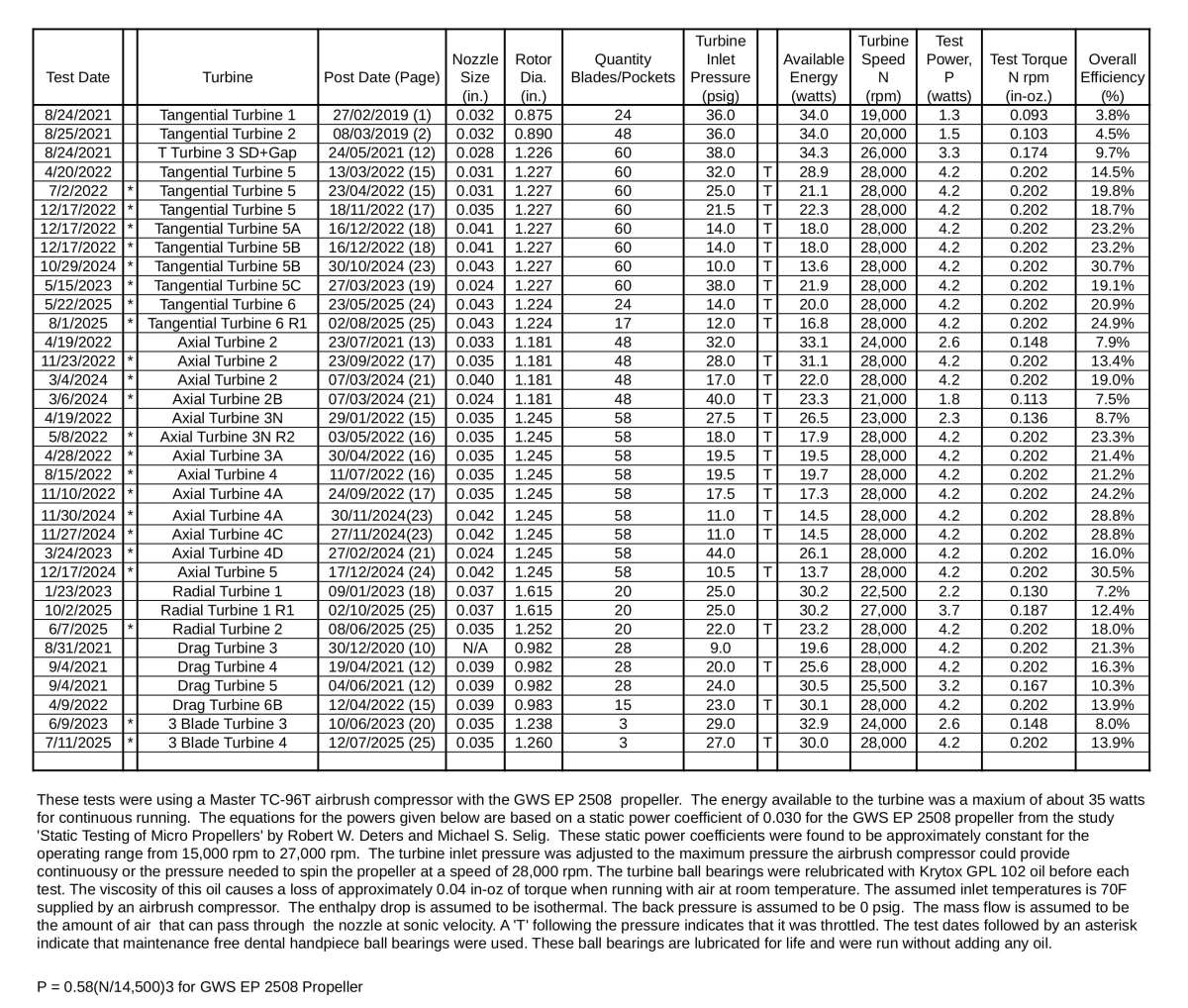
                                          I’ll start with the first radial turbine I bought that came complete and ready to run. The 1/23/2023 test of this turbine called Radial Turbine 1 is shown in the following spreadsheet and the details are shown in the following drawing. As shown on the spreadsheet, the description of this turbine was given in the 09/01/2023 post on page 18 of this thread. The following posts showed that even though the performance of this turbine was not nearly as good as I have obtained with my axial and tangential turbines, this same turbine was able to drive a model train. I show in these posts other tests of Radial Turbine 1 with and without the speed reducer that came with it. The best performance I got from Radial Turbine 1 running on air is the 09/01/2023 test shown in the following spreadsheet.

                                          In my opinion, the biggest problem with the design of Radial Turbine 1 is the very large height and width of the blades compared with the size of the nozzle. This gives a very large volume for the gas coming out of the nozzle to expand into and results in losing quite a bit of velocity. This also increases the length of the surfaces kept close to the housing to prevent leakage. The extra length increases the amount of leakage and friction loss. Full size radial turbines are generally only used with full admission and the blade height and width made no larger than the gas flow requires. The windage loss is very high with partial admission. I mentioned in the 27 January 2023 post: “Because of the high windage losses with the radial blades, it can’t spin fast enough without a load to do any damage even with my largest airbrush compressor. I ran Radial Turbine 1 without a propeller and with my largest airbrush compressor at its maximum output and it reached a top speed of approximately 40,000 rpm. This makes it very safe for running without a load.”

                                          Another problem with Radial Turbine 1 is the position of the nozzle so far below the OD of the rotor. This results in the momentum of the gas coming out of the nozzle hitting the rotor much closer to the center and reducing torque.

                                          I will show some of the things I have tried to improve the efficiency of Radial Turbine 1 in the next posts.

                                          My Turbines 1 R13

                                          RT1


                                          #843707
                                          Turbine Guy
                                          Participant
                                            @turbineguy
                                            On Turbine Guy Said:

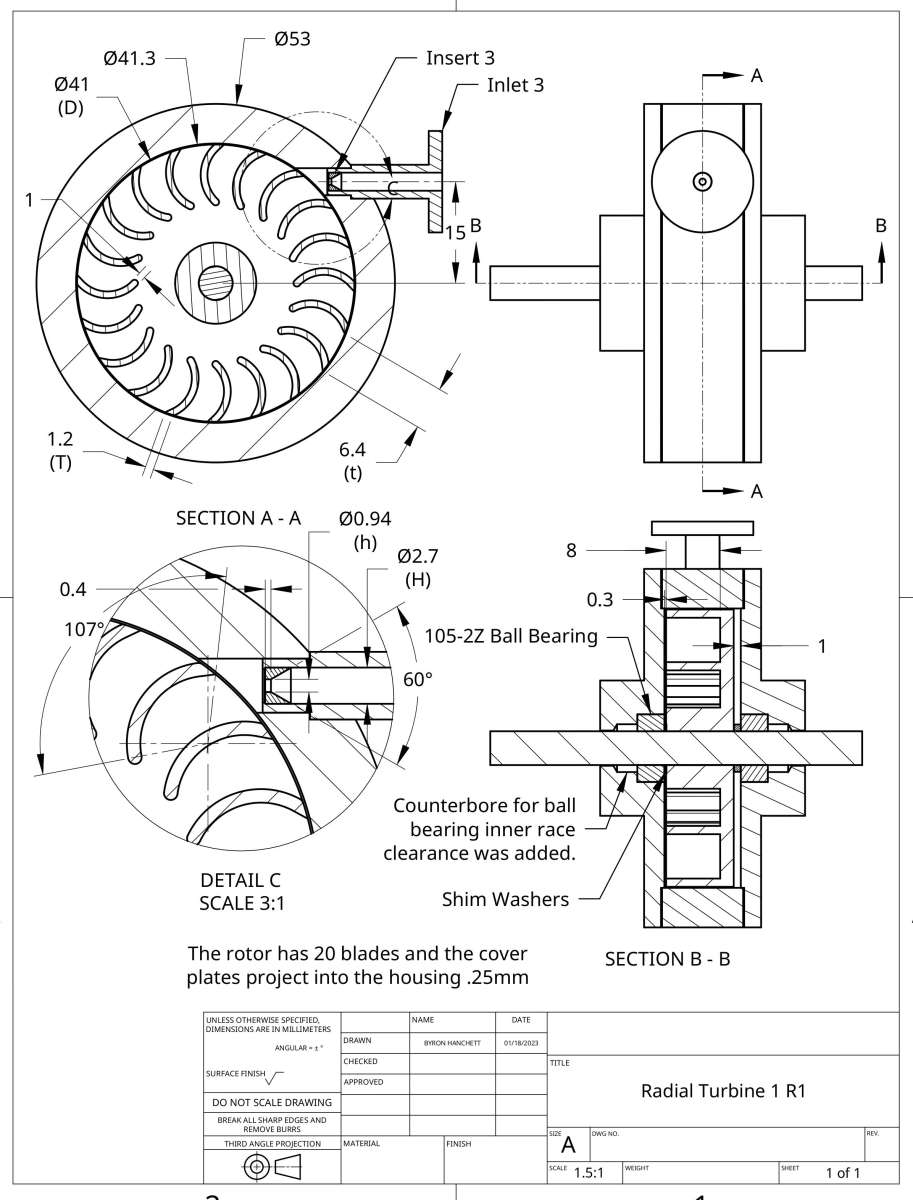
                                            I received the hex head bolts for Radial Turbine 1 that I mentioned in the last post. These bolts allowed me to fully compress the O-rings in the covers and eliminated the excess clearance between the rotor and covers. I was able to try various positions of the rotor and found that a 0.3mm shim between the front ball bearing and the rotor and a 1.0mm shim between the back ball bearing and the rotor gave the best performance. The following drawing was updated to show the changes. These were the same shim thicknesses that gave the best performance for the first Radial Turbine 1. Because of the changes I made in the second turbine I call it Radial Turbine 1 R1. The changes that affected the performance the most were making a new nozzle and adding new ball bearings. Balancing the rotor and adding clearance for the inner races of the ball bearing also helped. The following spreadsheet shows the improvement in performance with these changes. The power increased from 2.2 watts to 3.7 watts and the efficiency increased from 7.2% to 12.4%.

                                            Radial Turbine 1 R1 (1)

                                            My Turbines 1 R10


                                            The quoted post shows the changes I made to the second radial turbine I purchased and is identical to Radial Turbine 1 except for the changes noted. The quoted post shows the new name Radial Turbine R1 and it’s performance compared with Radial Turbine 1.

                                            #843723
                                            Turbine Guy
                                            Participant
                                              @turbineguy
                                              On Turbine Guy Said:

                                              I added a new nozzle to Radial Turbine 1 R2 as shown in the following photo and drawing. The nozzle was added at the outermost radius that has given me the best performance with the tangential turbines so it is not ideal for radial flow. The only change in this revision was adding the new nozzle. You can see on the drawing comparing Inlet 3 and Inlet 4 that the further the nozzle is from the center the more the thickness of the blades blocks the flow. Even with the additional blockage, inlet 4 performed better than inlet 3 as shown on the following spreadsheet. Radial Turbine 1 R1 that used Inlet 3 had an efficiency of 12.4% and Radial Turbine 1 R2 that used inlet 4 had an efficiency of 15.8%

                                              20251023_103651


                                              Radial Turbine 1 R2

                                              My Turbines 1 R11

                                              The quoted post shows the improvement of using a nozzle closer to the OD of the rotor.  The increase in torque more than offset the increase in blockage of the nozzle.

                                              #844087
                                              Turbine Guy
                                              Participant
                                                @turbineguy
                                                O

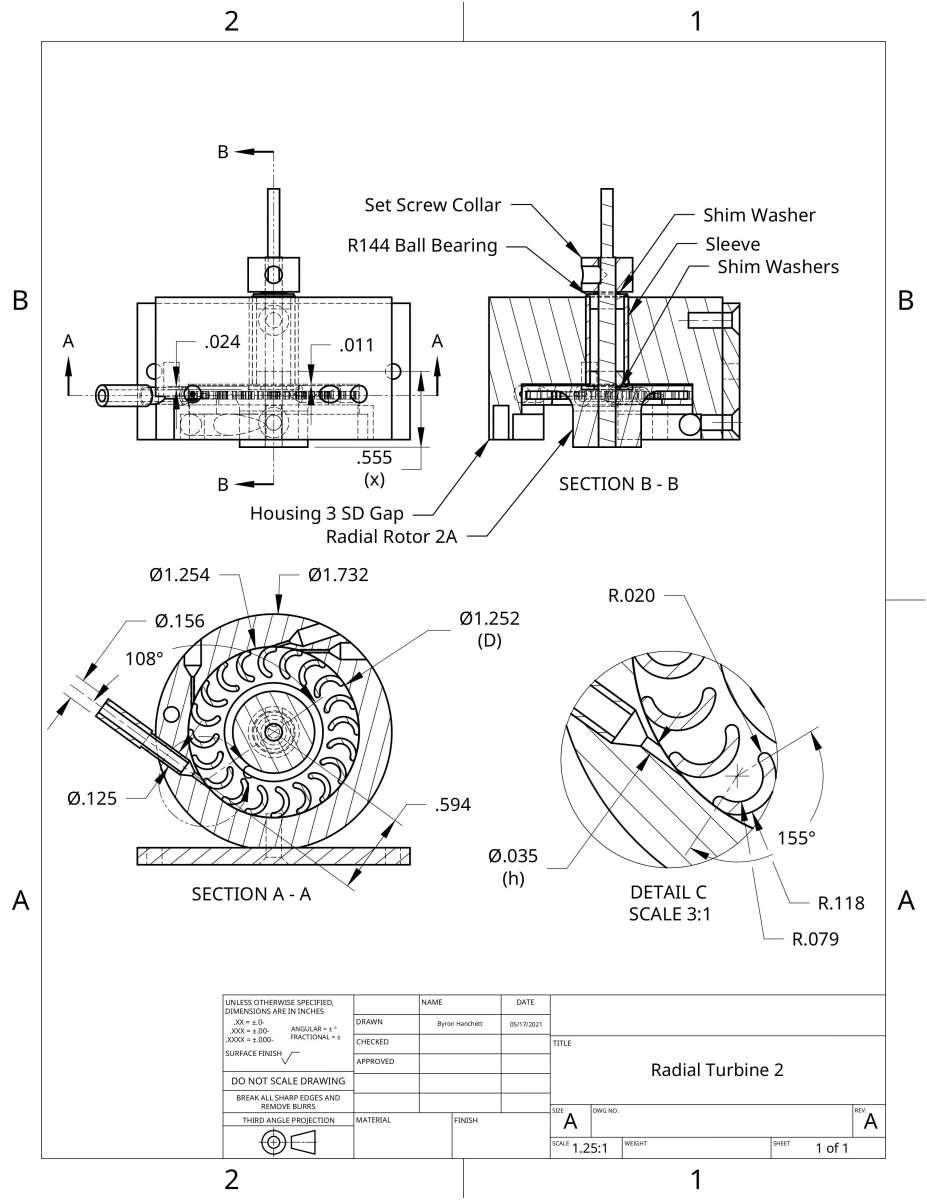
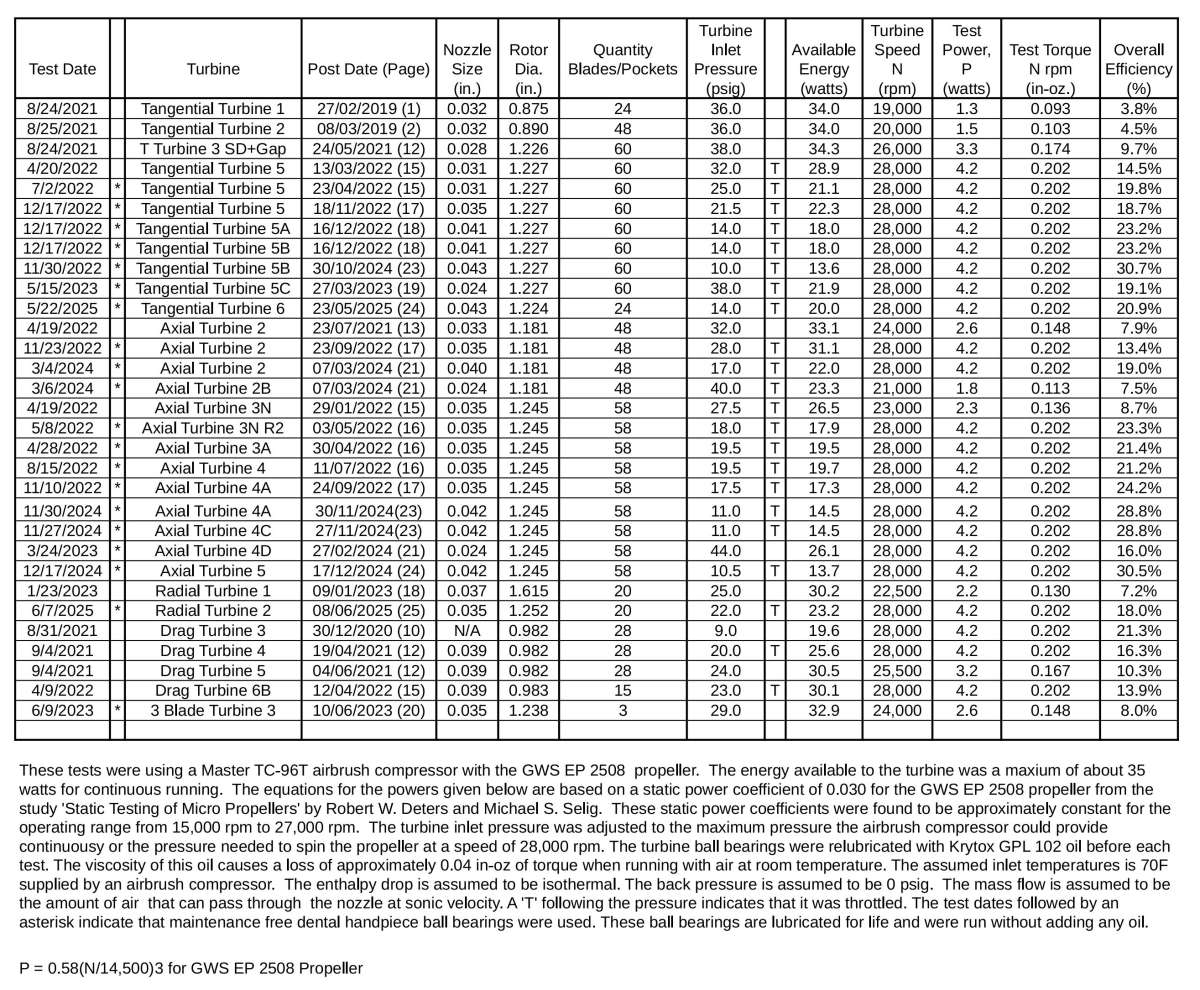
                                                The quoted post describes my purchase of the turbine I call Radial Turbine 1. The posts following this post discuss my testing of this turbine and what others have done with this turbine. I believed that I could improve the performance by designing a radial turbine for the GWS EP 2508 propeller I use in my turbine performance spreadsheet. I thought that by reducing the blade height, covering the blade on both sides, increasing the amount the flow is turned, and adding a radius to turn the exhaust flow would improve the performance. I 3D printed the rotor I call Radial Rotor 2A shown in the following photo and used it in what I named Radial Turbine 2 shown in the following drawing. The following spreadsheet was updated to include the performance of this turbine.  This design did significantly improve the performance over Radial Turbine 1.

                                                20250608_122301

                                                Radial Turbine 2


                                                My Turbines 1 R6

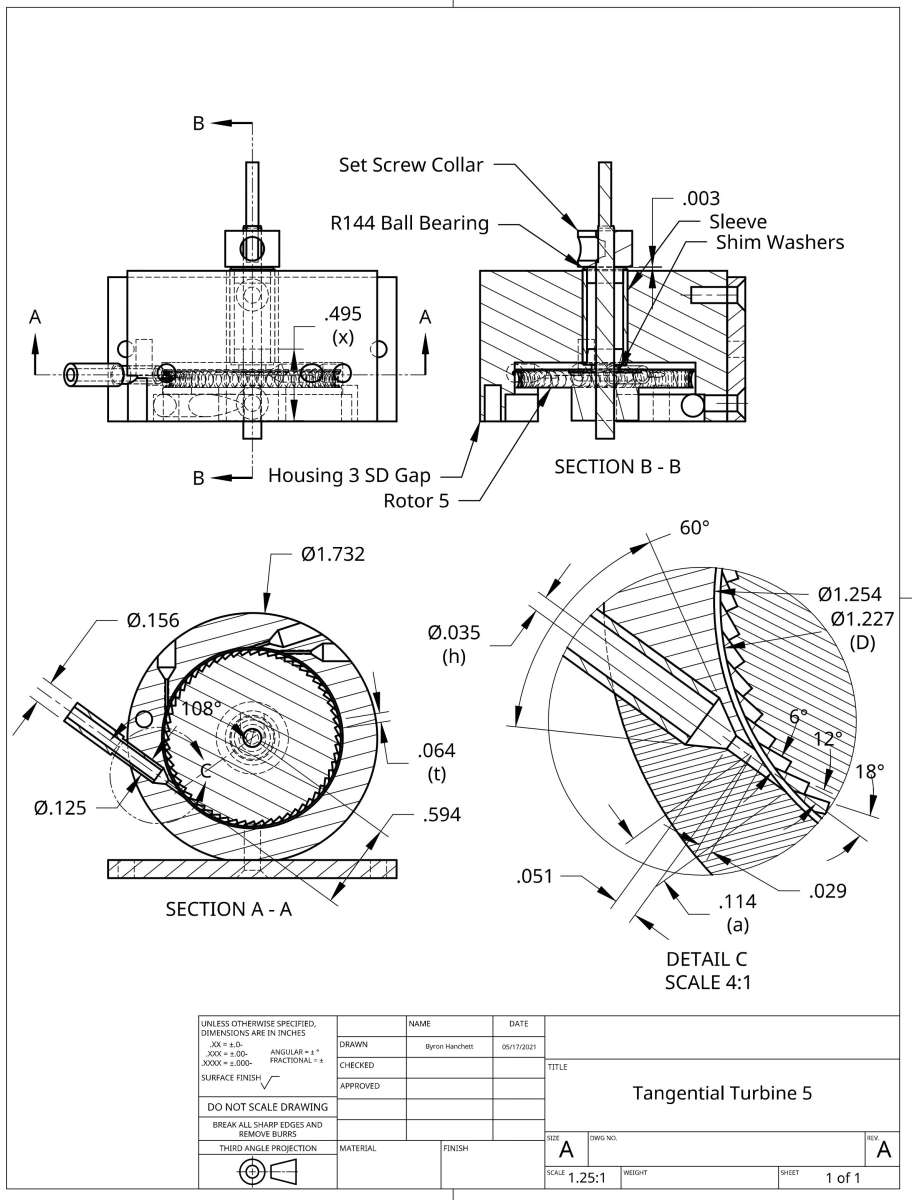
                                                The quoted post shows the details and performance of Radial Turbine 2. The only difference between Radial Turbine 2 and Tangential Turbine 5 shown on the following drawing is the rotors. The spreadsheet in the quoted post shows the performance of each of these turbines. Radial Turbine 2 achieved an efficiency of 18.0% and Tangential Turbine 5 achieved an efficiency of 18.7%. These results indicate that the radial turbine is capable of reaching the same efficiency as the tangential turbines with everything else the same. I tried in these last few posts to show what improved the performance of the radial turbines. The posts prior to this post showed the change in performance resulting from the change of only one item. This is my preference because if more than one item is changed, the amount of improvement caused by each item is not known. I wanted to try a radial rotor using the dental ball bearings so I had to make a new rotor that would fit in one of my housings that used these bearings. This resulted in several changes that combined to improve the performance of Radial Turbine 2. In my opinion the most significant changes were using the dental ball bearings and reducing the length of surfaces subject to rotational losses.

                                                Tangential Turbine 5 R4

                                                #844373
                                                Turbine Guy
                                                Participant
                                                  @turbineguy

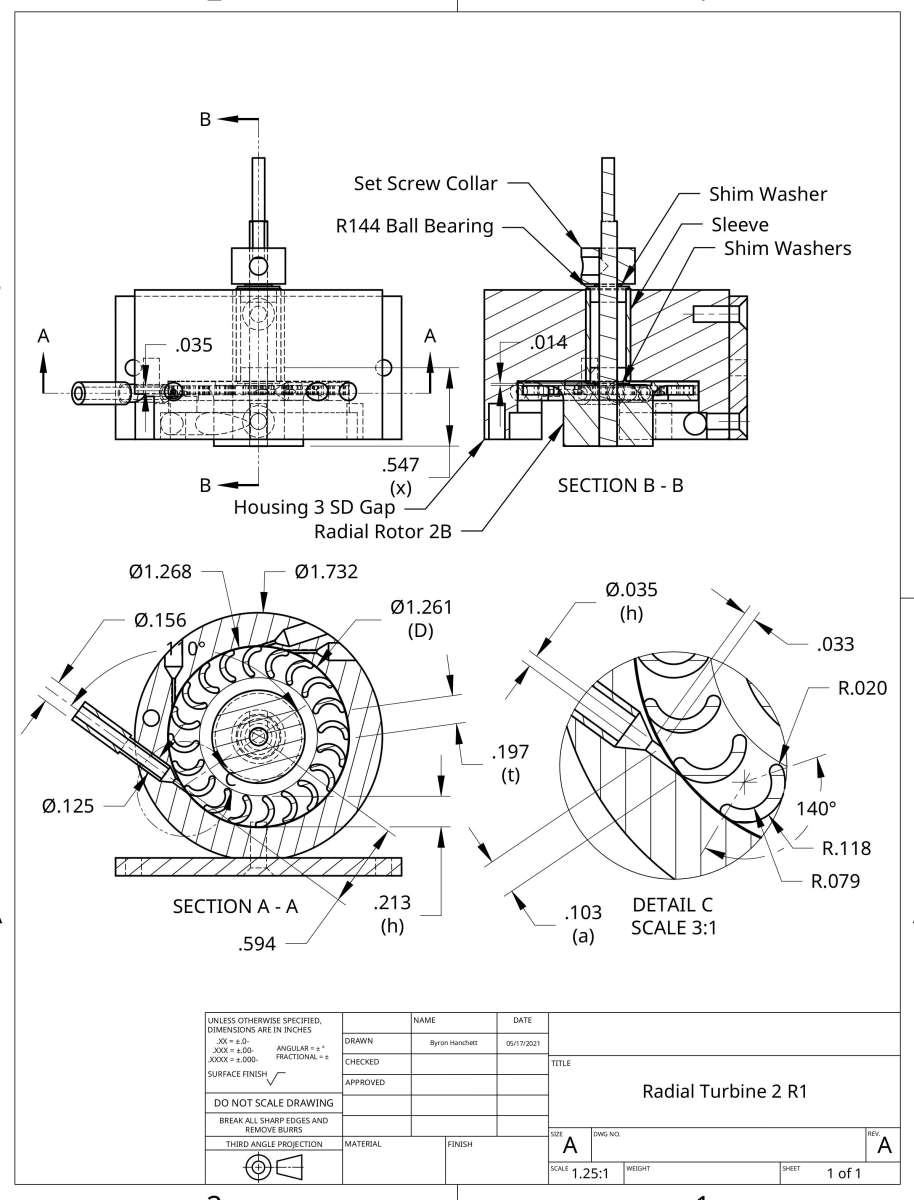
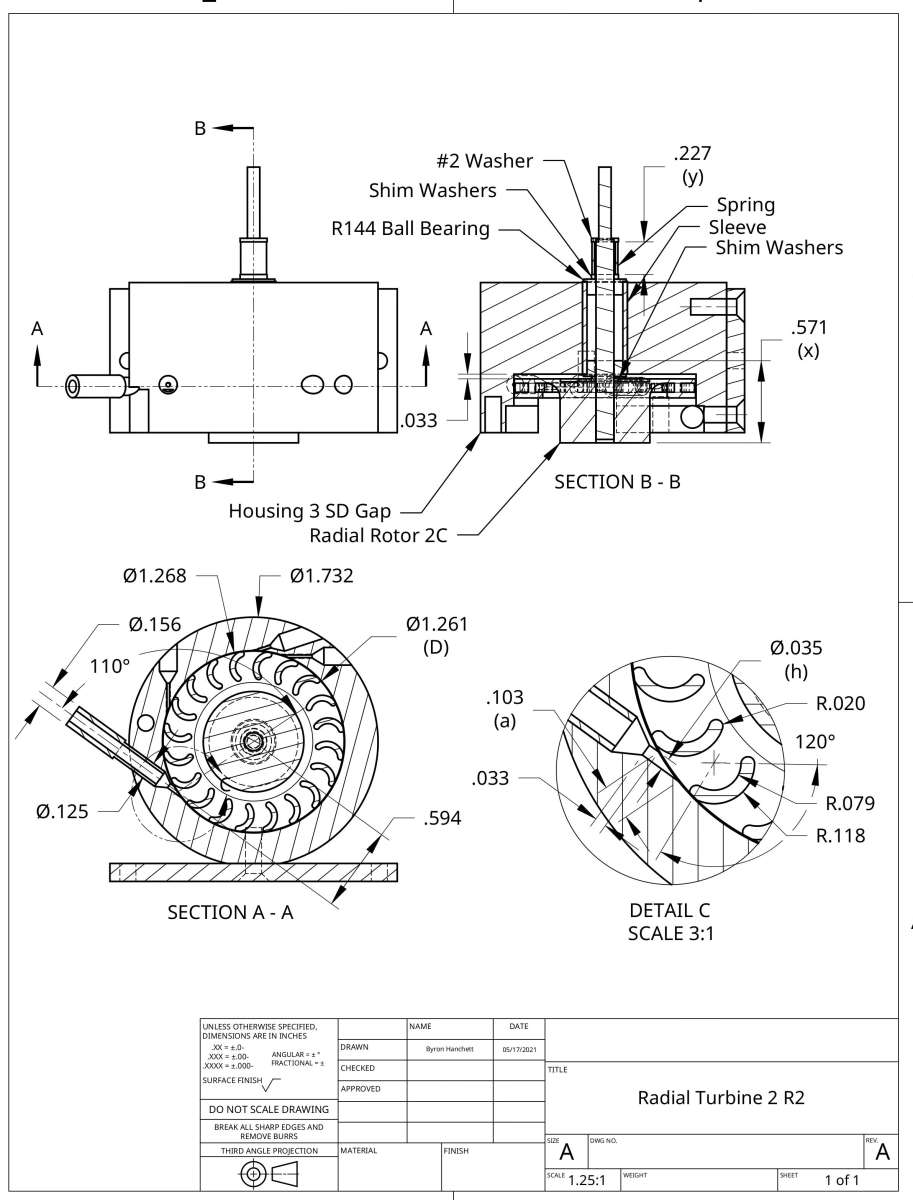
                                                  I decided to try a new rotor in Radial Turbine 2 and found that the actual diameter of the housing that the rotor fits in is 1.268” not the 1.254” shown in the drawing of the last post. I found that this increase in diameter was described in the 22 June 2023 post of this thread so it changed before the 6/7/2025 test shown in the last post. I checked in my copies of tests and the 6/7/2025 date for the data shown was correct. I checked the drawings in Onshape and found that Radial Turbine 2 R1 was current at the time of the test and show it below. This is the drawing that should have been shown in the last post. I removed this rotor from the shaft so it could be used in the 3 Blade Turbine 4 and damaged it in the process. I 3D printed another almost identical rotor shown in the Radial Turbine 2 R2 drawing and ran a test that resulted in identical results. I need the new rotor to analyze and use to find ways to improve Radial Turbine 2.

                                                  Radial Turbine 2 R1

                                                  Radial Turbine 2 R2

                                                  #845212
                                                  Turbine Guy
                                                  Participant
                                                    @turbineguy

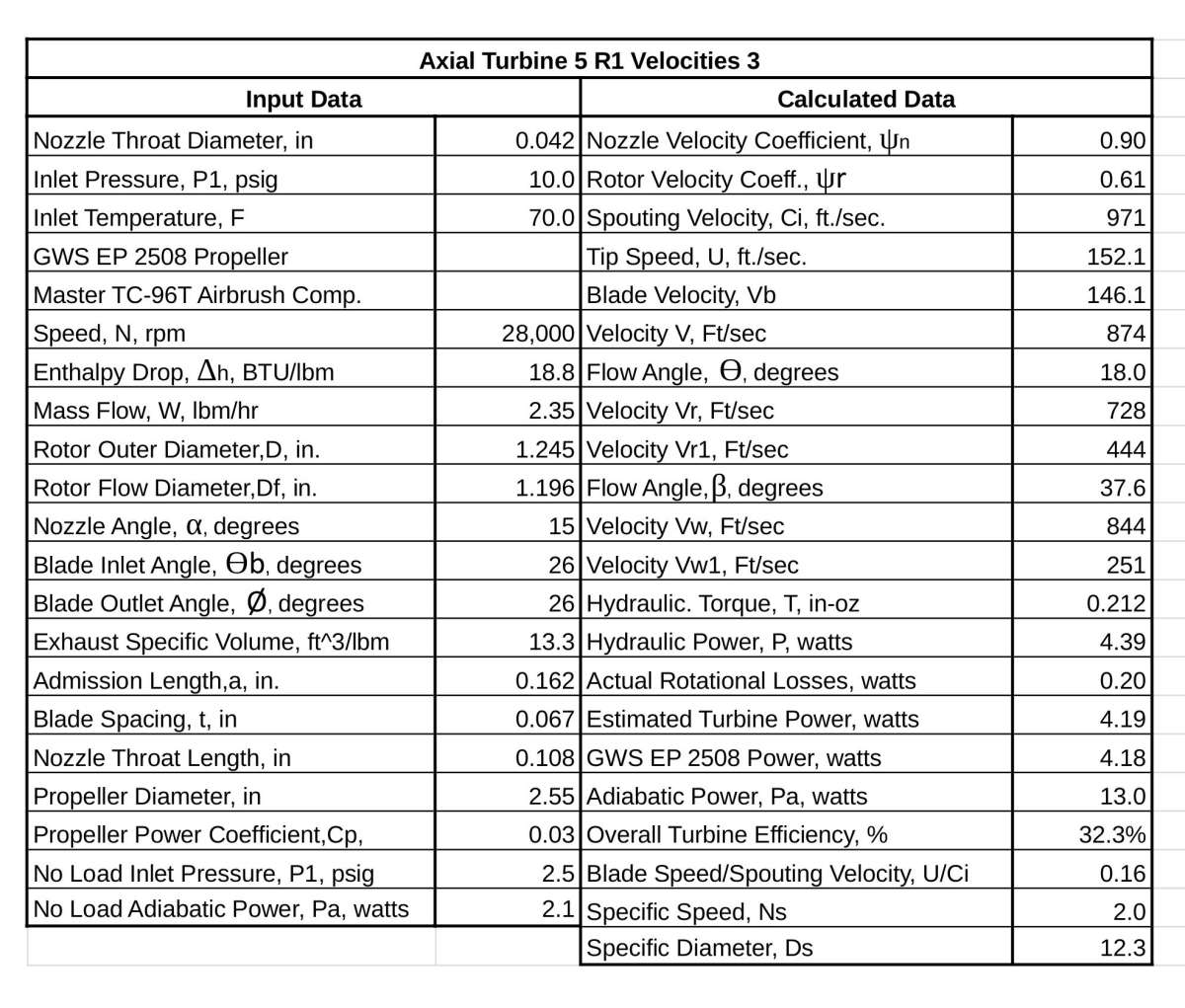
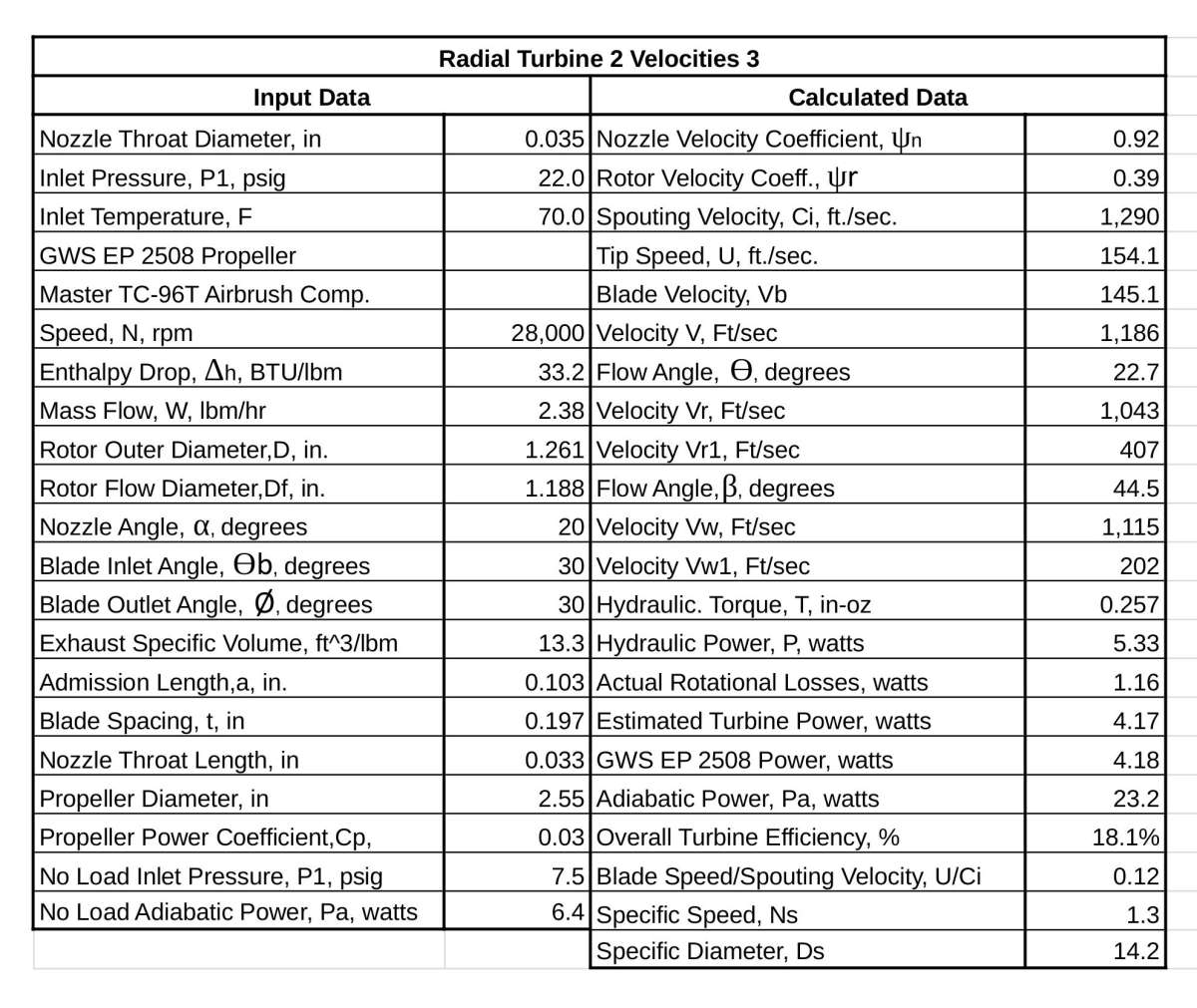
                                                    I decided to add the actual rotational loss to my spreadsheet for evaluating the performance of a model turbine. I used the methods discussed in the 19 March 2026 post of this thread to find the actual rotational losses. I like this method because it finds the total rotational losses including the ball bearings which have shown to be significant under certain conditions. I also like this method because it can be performed at almost the same time by running the model turbine with a load and then immediately after without a load. I added the blade speed/spouting velocity, specific speed, and specific diameter that can be useful in comparing the performance with information found from other sources. I made the following spreadsheet for Radial Turbine 2 R2 discussed in the last post of this thread that also showed the drawing for this turbine. I show the velocity diagram that illustrates the angles I used in the spreadsheet.  I also ran a test of Axial Turbine 5 R1 with and without a load and added the results in this same type of spreadsheet that I will show in the next post for comparison.  I picked Axial Turbine 5 R1 since it has the highest efficiency of any of the model turbines I have tested.

                                                    RT2 R1 Velocities 3

                                                    Velocity Diagram 1

                                                    #845229
                                                    Turbine Guy
                                                    Participant
                                                      @turbineguy

                                                      The following spreadsheet for Axial Turbine 5 R1 is the one I said I was going to add in the last post. I also show its drawing below. As I mentioned in the last post, these spreadsheets can point out the strengths and weaknesses of various types of turbines. As I mentioned in one of the previous posts in this thread, radial turbines are usually not used with single nozzles due to the high windage losses. This can be seen by comparing the total rotational losses for Axial Turbine 5 R1 (AT5 R1) with Radial Turbine 2 R2 (RT2 R2). The total rotational loss for AT5 R1 is 0.20 watts and for RT2 R2 it is 1.16 watts. The rotors in these turbines are about the same OD and they use the same dental ball bearings that have so little friction that the total rotational loss for AT5 R1 can be so low. Since the total power for both these turbines is 4.18 watts, having a windage loss of around 1 watt is a big deficit. The one advantage of RT2 R2 over AT5 R1 is the nozzle velocity coefficient of 0.92 compared with 0.90. Both these turbines use the same type of nozzle and the advantage of the RT2 R2 nozzle is its short throat length of 0.033” compared with the 0.108” long throat of AT5 R1. You can see in the drawings I tried to get the throat length of both nozzles as short as I could with the ⅛” OD center drill that I use. Another advantage of AT5 R1 over RT2 R2 is the rotor velocity coefficient of 0.61 compared with 0.39. The rotor velocity coefficient is affected by quite a few things like the blockage of the flow channel by the blade edges, extra volume allowing the flow to expand and lose velocity, leakage around the blades, and the friction of the blades on the flow. The biggest advantages of AT5 R1 over RTS R2 is the much smaller flow volume resulting in more blades being filled and less loss in flow velocity. AT5 R1 also has sharper blade edges reducing the amount of blockage of the flow. The clearance around the blades are about the same so flow leakage should be similar. The blade radius that turns the flow of AT5 R1 is 0.056” compared with 0.079” for RT2 R2 which results in a shorter length for the flow to travel but that is partially offset by the extra turning of the flow of 128 degrees compared with 120 degrees. I hope this illustrates the importance of some of the details.

                                                      AT5 R1 Velocities 3

                                                      Axial Turbine 5 R2

                                                    Viewing 25 posts - 626 through 650 (of 655 total)
                                                    • Please log in to reply to this topic. Registering is free and easy using the links on the menu at the top of this page.

                                                    Latest Replies

                                                    Home Forums Stationary engines Topics

                                                    Viewing 25 topics - 1 through 25 (of 25 total)
                                                    Viewing 25 topics - 1 through 25 (of 25 total)

                                                    View full reply list.