How do I learn machining ?

How do I learn machining ?

Home Forums Beginners questions How do I learn machining ?

Viewing 15 posts - 76 through 90 (of 90 total)
  • Author
    Posts
  • #836658
    Julie Ann
    Participant
      @julieann

      For what it is worth I thought I’d do a comparion test between MT and GT inserts.

      Material:20mm diameter brass, CZ121

      Inserts: CCxT09M09T304; same size inserts, same nose radius (0.4mm) and both new out of the box

      Cutting conditions: 1200rpm, depth of cut 0.05″ and feedrate of 4 thou per rev

      Surface roughness measurements were made using a Taylor Hobson Surtronic 3 and are Ra values in micrometres. That means each reading is an average, as measured by the unit. Modern measurements are usually Rz, which are peak to peak and arguably give a more accurate picture of the actual surface roughness.

      For each insert three measurements were made, equally spaced around the diameter and then averaged manually.

      CCMT:   2.16   2.26   2.16   Average = 2.19um

      CCGT:   2.51   2.50   2.55   Average = 2.52um

      An interesting aside; with the CCGT insert I messed up on the first cut, taking a depth of cut of 0.1″ instead of 0.05″. The swarf came off as a nice tight long helix, rather than the usual shower of small particles.

      In my experience CCGT inserts are far superior when turning aluminium, but I don’t use them for other materials as I find them a bit delicate for the DOC and feeds I use.

      Julie

      #836669
      JasonB
      Moderator
        @jasonb

        It would be interesting to see what the Ra is using the feed that the Emco gives. They only have the one feed of 0.02mm/rev or 0.0008″ and say a DOC of 0.25mm or 0.010″ which looks about what was used in the OP’s photo

        That is one thing I like about the **Gt inserts whan use don brass, the curls of swarf which don’t go everywhere. For the OP, there is an old video showing the two types of swarf.

        #836862
        Julie Ann
        Participant
          @julieann

          Same tests as before with the following two differences:

          Depth of cut = 0.01″

          Feedrate = 1 thou per rev, the slowest feed on my lathe

          CCMT: 1.15 1.15 1.25 Average = 1.18um

          CCGT: 1.46 1.62 1.54 Average = 1.54um

          In the previous tests it was difficult to visually distinguish between the two finishes. However, in these tests the CCGT portion has noticable bands, particularly for the first half of the turned length. I suspect this is reflected in the higher value of Ra.

          Swarf was different in each case. With the CCMT insert the swarf was the traditional fine spray associated with brass. For the CCGT insert the swarf oscillated between fine particles and tightly curled sections. I suspect that the transitions between the two types of swarf caused the noticable bands.

          Julie

          #836866
          JasonB
          Moderator
            @jasonb

            Thanks for taking the time to do the second test Julie.

            I wonder if the smoother measuerment from the MT insert is in some way due to the “blunter” edge deforming and flattening the work while the rougher measurement is because GT gives a crisper cut surface?

            #836913
            Julie Ann
            Participant
              @julieann

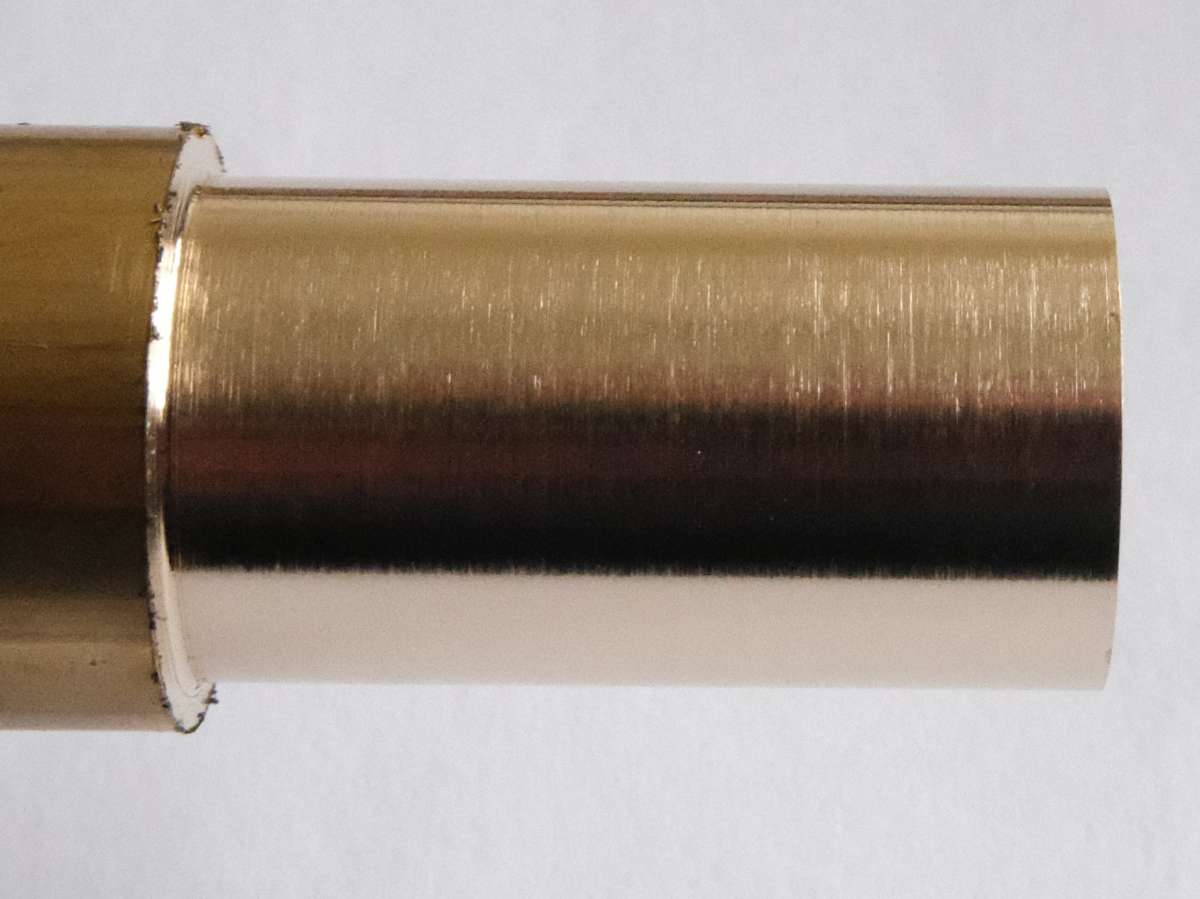
              Here are some pictures of the machined surfaces after the second test. The CCMT Insert:

              CCMT Insert

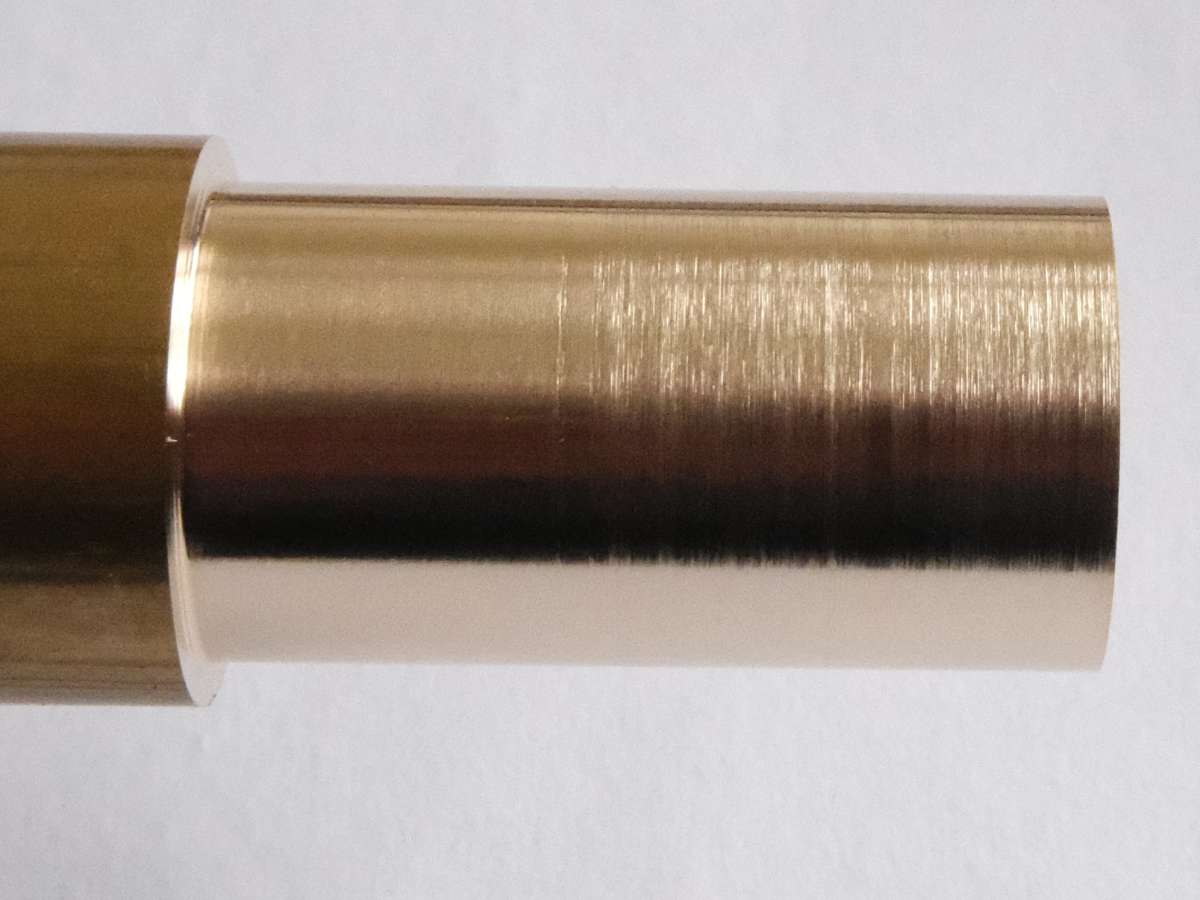
              The CCGT Insert:

              CCGT Insert

              The finish with the CCGT insert is significantly rougher over just half the length of the cut. Looking at the recommended DOC and feedrates on the back of the packets the CCGT is running just within parameters whereas the CCMT is just outside on both parameters.

              I don’t know why the CCGT should be so bad at the beginning of the cut. Could be because the cutting process can’t make its mind up as to how the swarf is going to break. Or possibly inconsistent material?

              Julie

              #836917
              john fletcher 1
              Participant
                @johnfletcher1

                If there is a MENS shed or MATES in your area, try them. I’m self taught, started 40 years ago at evening classes. Now give metal working tuition, turning/milling at the local MATES.

                #837583
                Julie Ann
                Participant
                  @julieann

                  Not sure if Johns advice was aimed at the OP or me?

                  Out of idle curiosity I looked at my local Mens Shed organisations. Of the four, one is only open to veterans and one is not taking new members due to lack of space at their venue. The other two meet, at seperate times, in the same temporary premises, for tea and chat only, while looking for permanent premises in their local villages.

                  It’s odd how a real engineering discussion kills a thread stone dead. 😮

                  When I have time I’ll try the same tests on EN3 which is a gummy low carbon steel notorious for poor finish.

                  Julie

                  #839510
                  Julie Ann
                  Participant
                    @julieann

                    Finally got around to doing some tests on EN3 using CCMT and CCGT inserts.

                    Material: 1″ diameter EN3 steel. Same inserts as for  the brass tests.

                    Cutting conditions: 800rpm, depth of cut 0.05″ and feedrate of 4 thou per rev

                    CCMT: 1.31 1.44 1.45 Average = 1.40um

                    CCGT: 1.74 1.85 1.90 Average = 1.83um

                    The finish with the CCMT was shiny and smooth and the swarf came off as a long tight helix. The finish with the CGT insert was dull but smooth, and the swarf birdnested badly, just like aluminium.

                    I also repeated the second set of tests.

                    Depth of cut = 0.01″

                    Feedrate = 1 thou per rev

                    CCMT: 5.81 5.71 5.81 Average = 5.78um

                    CCGT: 0.95 0.95 0.95 Average = 0.95um

                    The finish with the CCMT insert was rough and uneven whereas with the CCGT insert it was smooth. In both cases the swarf came off as an untidy fine but irregular helix.

                    Superficially the CCGT insert wins hands down at slow feedrates. However, the CCMT insert is operating well outside of the manufacturer recommended feedrates which start at 3 thou per rev. So the comparison isn’t really a fair one.

                    On a personal note these tests are the first time in 20+ years that I’ve used the 1 thou per rev feedrate, as far as I can remember. I almost never drop below 4 thou per rev as it gives an acceptable finish and I get bored waiting for cuts to finish at slower feeds.

                    Operating at 1 thou per rev, even at 800rpm, was worse than watching paint dry. 🙂

                    Julie

                    #839520
                    JasonB
                    Moderator
                      @jasonb

                      Thanks for the update.

                      As I have often said the GT inserts often suit the smaller hobby lathe which does not have the power, rigidity or both to give good results with MT inserts and your tests with the lighter cuts which are what may be expected on hobby machines bear out my findings that with the finer feeds and DOC they can work better than MT and a good surface finish can be had by using GT.


                      Again the GT will not be within the maker spec either as they only tend to quote cutting data for the non ferrous materials they were intended for.

                      On the plus side those using smaller hobby machines particularly the Unimat 3 that started this thread will not be working on such large parts so the amount of metal to be removed will tend to be less so the user may not get bored. For example that 1″ diameter part on a 4″ traction engine would only be 1/4″ dia x one quarter the length.and 1 thou feed just so happens to be a quarter of a larger 4thou feed rate.

                      #839553
                      JasonB
                      Moderator
                        @jasonb

                        To add a bit more to last nights post.

                        I have a Warco WM280 which is one of the larger “benchtop” hobby machines and my usual feeds and DOC are:

                        Facing feed 0.0015″ with roughing cuts apprx 0.040″ deep, finish cuts 0.010″ deep

                        Turning feed 0.0025″ with roughing cuts of 0.025″ deep (50thou off dia) and finishing anything from 0.010″ to 0.001″

                        Although my machine will take heavier cuts I find it sounds comfortable at these sort of loads. I would expect as the machine gets smaller and it’s power and rigidity decrease so will the size of cut it can comfortably take. Comments about how quickly I make things in the recent “Kelsey” thread would seem to suggest I don’t get bored or have to work slowly and I seem to produce models at a lot faster rate than many here.

                        #839566
                        cedric 1
                        Participant
                          @cedric

                          <p style=”text-align: center;”>.025″ feed for finishing? Or .0025″?</p>

                          #839569
                          JasonB
                          Moderator
                            @jasonb

                            0.0025″

                            #839572
                            cedric 1
                            Participant
                              @cedric
                              On JasonB Said:

                              0.0025″

                              I would have thought the 280 would take a deeper cut at that feed rate. My old banger of a Myford will happily take a .100″ deep cut at .0025″ feed.

                              #839578
                              JasonB
                              Moderator
                                @jasonb

                                As I said it will cut deeper and faster but is happy with what I use. You can tell it is working a lot harder on the bigger cut. Also a myford has gears so the motor is always at full speed, the variable speed machines loose grunt as you have to run the motor slower.

                                Here is an old video of it taking 0.25″ (1/2″ off dia) Two different top top rakes, one with long swarf another that breaks it.

                                And about as deep as you can go with a 06 size insert


                                #845591
                                Elliot Hirst
                                Participant
                                  @elliothirst42758

                                  Hi Paul, SMEE (The Society of Model & Experimental Engineers) has restarted its training programme. A trial of an updated version of the Basic Training Course was run at Marshall House, the SMEE Headquarters, in February/March and was well-received. A full course will run in June and is now fully booked.  The course is aimed at beginners taking their first steps in machining and covers the basics of health & safety, measuring and marking out, and the use of a lathe and milling machine to make two simple projects: a simple lathe tool height setting gauge and a machinist’s jack. A large pre-reading pack covers many of the typical beginners’ questions about equipment and the initial setting up of a workshop.  The three-day course provides classroom tuition and workshop experience one to one with a ‘buddy’ working on lathes and milling machines in the SMEE workshop.  In the second half of 2026 the ‘Polly’ course will be run.  This course has been the real starting point for many model engineers covering the making of a small vertical boiler steam engine based on a Tubal Cane design.  The course includes making a boiler, boiler fittings, a miniature pressure relief valve, a flywheel, crankshaft, small spirit burner and various small fabrications.  Further details are available from SMEE ( [email protected] ).

                                Viewing 15 posts - 76 through 90 (of 90 total)
                                • Please log in to reply to this topic. Registering is free and easy using the links on the menu at the top of this page.

                                Latest Replies

                                Home Forums Beginners questions Topics

                                Viewing 25 topics - 1 through 25 (of 25 total)
                                Viewing 25 topics - 1 through 25 (of 25 total)

                                View full reply list.