The Warco crate that contains the lathe is fairly solid. The stand is separate, so the crate is long and low, and as the lathe is bolted to the base, reasonably balanced. However, someone had decided to pop that onto a standard euro-pallet, which didn't support the length of the crate. Then the boxes with the base were piled on top, at one end – the head-stock end obviously. The result tipped over easily when the delivery guy turned the pallet truck.
He did say it toppled over gently. I was sceptical, but it looks ok so far. Once I can prove to myself the ways are true I'll be happy.
I have a lot of sympathy for those delivery guys, they're not the guys that package up the pallets, but they do end up dealing with the mess when things go wrong.
edit : I should also praise our local postie, who happily helped myself and the driver get the crate the right way up.
Edited By Jed Martens on 30/07/2019 20:57:22
I needed to make a 13mm hole with a decent finish in an alloy part the other day and failed. I crept up on the final diameter and the finish I was getting using stub drills on my VMC was great but the only 13mm bit I had was a jobber and although sharp it didn’t play ball. I don’t have a reamer that size either. One tool I’ve put off buying not least because of the cost is a Boring Head but I’m wondering if I could have done this particular job using one? I don’t think it’s something I’d use very often but being able to produce holes of virtually any size sounds attractive. I’m wondering if something like this
would have done the job. Do any of you have this particular head or are there any others I should look at? I’ve never used one before so any insights into their use would be much appreciated.
We have the mill bolted down on the 4" of wood using 12mm studding glued into 4" holes in the concrete floor. The machine is not being fully repainted, just a good abrading of the paint and a spray of Plastikote lawngreen paint. The colour is a brighter green than the top of the can suggests, so not exactly concours, but it seems to be oil resistant. The tray got sprayed Hammerite satin smooth black, and has a red strip surround intended for car doors.
We were lucky with the Y axis leadscrew nut, which in conjunction with new metric thrust bearings, seems to have only 0.001" backlash, I haven't checked it with a dti yet. The thrust bearing housing had to be bored deeper and larger diameter to accommodate the larger metric bearings, which are much heavier duty than the originals.
I am just starting the conversion to R8 spindle taper. I have an SKF taper roller bearing 35-62-18 for the bottom of the spindle. Also a spindle from ArcEuroTrade intended to fit one of the Chinese mills they sell. The spindle was bought because I didn't feel confident in producing the internal dimensions well enough. The spindle has been checked for accuracy and concentricity and to my relief, there is nothing over 0.0005" tir.
Simon Williams may be interested that prior to disassembling the head, I found that his mill is not the only one that has needle roller bearings in the spindle drive. The machine was made in 1969, has the long bed, the later style quill lock and all the castings have the same assembly number 7 stamped on them. A bit of a mystery.
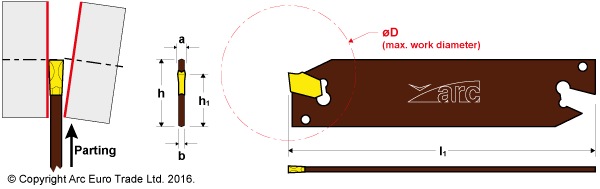
No they push against the rear of the insert and the "Flat" between the two circular stress relief holes.so it slides out. See ARC holder
You can get another type with a pivot pin that goes in the hole at the bottom of the blade and has a second flat pin that levers against the insert
Some blades do have a longer slot and the key does open up the slot in that case, such as the one Greenwood do
Edited By JasonB on 24/07/2019 13:14:56
Arc Eurotrade sell the SX1L. It works well out of the box, but have a look at these preparation notes on their website on how to get the best out of it.
Edited By Nick Clarke 3 on 24/07/2019 08:32:55
Most beginners WILL most likely break it.
Ketan at ARC
…
First time I used mine……I broke it ![]()
…
Me too! Still my preferred parting-off tool. Impressive when working well but not indestructible. Parting-off demands a lot of the lathe and the tool. Much easier to part-off on a heavy stiff machine than a bendy lightweight.
Two main problems I get.
I've found all parting-off tools perform best with a steady feed when cutting correctly, which means getting the tool height, rpm and feed-rate right. Not too fast, not too slow, and definitely not jerky. Swarf clearance is vital. Proper lubrication helps, and the tool tip should be in good condition. Add it all together and it's not surprising parting-off goes wrong!
Parting off is a balancing act. I found a lot more skill was needed to do it successfully on a Mini-lathe than my WM280, and I imagine anything heavier would be easier again, mainly because big heavy lathes are less likely to flex enough to allow the tool-tip to dip into a dig-in.
What's really annoying is some lucky chaps don't have trouble parting-off. I suspect they have a steady hand, quick reactions and a natural feel for when tools are cutting correctly. The rest of us have to practice and experiment. I no longer expect disaster every time I part-off, but I'm not surprised that it goes wrong every so often.
The design of NCIH holders may be deliberately weak:

I suspect in commercial use where feed-rates are carefully calculated and automated, a dig-in means something really bad is wrong, and the tool is intended to break before the expensive CNC machine does.
Still the best option for parting-off I've tried. Ketan's image shows the maximum parting-off diameter to be rather small: I invariably use the tool to take much deeper cuts than that!
Dave
I'll probably miss a few ….
Sieg SX1L from ArcEuroTrade – really great little machine once I'd removed the tilting column however the 100-150w motor was a pretty serious issue, I'd still happily have that machine now if it weren't for that.
Bridgeport dual speed motor belt driven (J head was it?) with mechanical variable speed cross feed on the table. Easily my favourite machine, it could tackle anything and had a shaper on the back, I loved it, but it was 7 feet tall and took up half the width of my domestic garage by the time you'd allowed enough space to rotate the ram and move the table left and right. Miss it, but it was impractical in a garage my size, maybe one day I'll be able to have one.
RF-30 machine, really heavy duty piece of kit, round column means you lose x/y coordination when raising/lowering the head which has to be done quite alot when changing from end mills in the spindle collets to drills in a chuck etc, can be worked around with stubby drills & hold everything in an ER collet – solid, reliable, and with the mentioned work around, very useable, would outlast me.
RF45 – seriously big hunk of kit for a desktop, the quick speed changes on the mill head was handy (bought at auction it was going cheap, sold to a friend + £100 for my troubles/transport)
Astra L4 horizontal and vertical mill – probably the nicest machine I've owned, it was so capable, but so small, it had to go! Being a horiztonal mill, the vertical milling was done via a knuckle type head mounted directly on the horizontal spindle, leaving very very little room down to the table. It was a very very small machine with very limited x,y travel, ideal if you only want to make small things on a 3.5" lathe but no good for my general purpose, I miss it, and i dont miss it at the same time!
My current machine and I don't think I'll ever sell it, unless a VMF falls in to my lap(… Frank…. ahem…. just in case you need the space in crete….
) Myford VMC with 5 micron M-DRO scales and central lube system, the slides and screws are the smoothest of any machine I've ever used, they're on par with bad ballscrews, it's a dream to use, I will make a small column riser if/when needed as it's ever so slightly tight but it's not given me any real trouble yet (I've got two pieces of stock the right size for a 3.5" raiser, I'll use one and sell the other once made).
I had to get a small mill for general use and heavy duty drilling at work and I went with an RF30 clone as it's just a solid piece of kit, belt drive, very little to go wrong – someone drilled the table within a week, bloody apprentices and electricians……. ![]()
Hi Jim,
This product and similar have been discussed on here and more recently on MEM. I cant find the links at present.
As a summery, it is a bit like marmite. You either like it, get on with it and are happy, or the exact opposite. I personally happen to prefer the HSS Co8 type…which is also thinner than the carbide offering, at 1.5mm or 2mm. My reasons are down to fear.
In the 'likeit' camp are people like Smithy from MEM, our Neil Wyatt, the late Sir John and many others.
The main issues are – not so good for beginners, and as you have to run the machine relatively fast, the fear is there during parting, combined with rigidity issue around the machine components, combined with constant positive feed required for parting. The carbide blade/holder is not forgiving, and can break more easily if confidence levels are low. Great and easy to use for non-ferrous, but a lot of caution, skill and confidence required when using it on steel or cast iron.
For every five buyers, three get on with the NCIH type, one plays with it with some fear, and one breaks it. Most beginners WILL most likely break it.
Ketan at ARC
edited to correct spellings,… not had coffee yet.
Edited By Ketan Swali on 23/07/2019 06:40:02
Agree with Paul, CNC mills are more common than lathes, many years ago after purchasing a CNC mill I wanted a CNC lathe and could not find any so ended up buying a little lathe from Warco and converting it myself, I cannot remember Warco model number but it was cheap as they were discontinuing it, it is identical to the Sieg C1 on Arc eurotrade site.
Hi John and welcome,
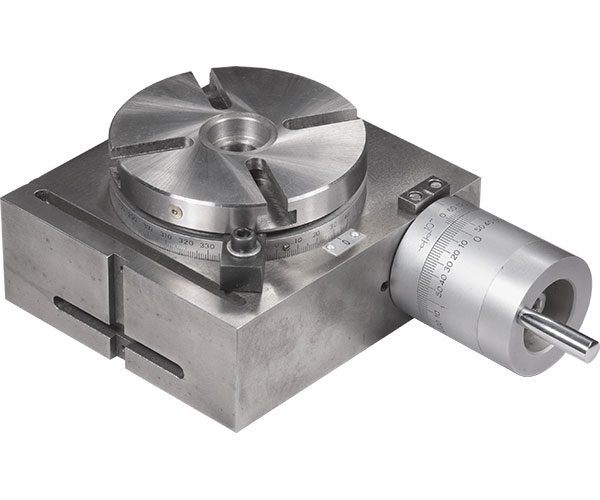
Can you explain more what you mean by an Indexer, I know of three types and there may be more. My example pictures are from arceurotrade's website apart from the Dividing Head, which is from Wikipedia.
1. A stand alone spin indexer where a pin engages in holes in a disk:

2. A stand alone Rotary Table where a handle drives a worm gear allowing angles to be traversed. Can mounted flat or vertical.

3. A Dividing Head. Also stand alone, usually with a Spin Indexer disk, plus a Rotary Table worm drive and also with the holed disk with brass 'clock hands' and drive handle arrangement at front. Divider Plates are an important aid to turning accurate angles as when making gears.
![]()
There are further variants, in particular I wonder if you mean a spin indexer attached to the lathe spindle, which allows work in the chuck to be held in a known position while – for example – horizontal splines are cut. These are far more common on woodworking lathes, where they are used to add decoration as when making pens. There was a thread a while ago on this forum about a metal-working lathe that appeared to have been factory fitted with a spindle indexer. It attracted a lot of interest because it was so rare! As can be seen from the photos, dividers and rotary tables are more often used on a Mill than a Lathe.
Rotary Tables can usually be fitted with Divider Plates as an accessory. Or, it's becoming increasingly common to drive rotary tables with a stepper motor and computer-controller that replaces the Divider Plate/Clock Hand unit and does all the sums for you (and doesn't lose count when the phone rings!)
If you can say what type of cutting operation(s) you want to do, then loads of experienced machinists on the forum able to help.
Apologies if I'm preaching to an ex-military armourer who already knows all this stuff!
Dave
Posted by Boiler Bri on 19/07/2019 22:54:00:
wigglers the ones that come in sets with things you can not work how to use,
Bri
Assuming you are referring to sets like the Arc Eurotrade one the purposes of the various things are :-
Ball ended rod is for picking up nominally vertical edges. Kicks sideways at half ball diameter from edge (plus a small offset related to joint stiffness).
Disk, actually small cylinder, ended rod is for picking up the sides of rods, round bars and curved edges. Align it with the diameter and it kicks sideways when it hits. Being a cylinder gives you some vertical tolerance when hitting the diameter. I don't like this type with the short cylinder of smaller diameter than the ball. Huffam sets have cylinder probes of the same diameter as the ball about two diameters long. Makes picking up the centre line of a rod dead easy. Theoretically the small end version as sold by Arc can get into smaller spaces but I've yet to find a need.
Needle point is for picking up on scribed lines as described in my previous post.
Last (bent) one is an indicator holder. Use it with a lever type indicator, such as a small Verdict, to find the centre of a circular part standing on end. Adjust the angle of dangle in the collet to bring the setting error within the indicator travel. Another one I don't like as they tend to sag under the weight of the indicator unless done up very tight which probably isn't good for the collet. Realistically anything heftier than the smallest Verdict is going to be a bit much. I have a suitable Verdict indicator and tried the one in my set once. Underwhelmed so I spent £50 on a import co-ax (Blake knock-off) indicator 40 odd years back and never regretted it.
Huffam sets only have ball and cylinder ended probes plus an extension piece for the shank.
From the link your "wobbler" is a standard edge finder. I've never been tempted by a set like that as using the various pointed probes doesn't make sense to me.
Clive
Edited By Clive Foster on 19/07/2019 23:23:37
Agree with Nick both wigglers and edge finders excel in different ways. A 3D Taster is a wonderful instrument but I pretty much don't use mine.
In practice there is a lot of overlap what they do and where they are used so its best to make one type your preferred device and get really good at exploiting it for most jobs and fill in with the other types when appropriate.
I'm a wiggler person because I like the very clear and very consistent indication that a good wiggler gives. In particular the ability to see what its doing from a significant distance. The latter has become particularly important with increasing age. As Bridgeport X-axis handles are on the ends of a relatively long table, I'm often too far away to have totally sharp view of the centre finding device unless I switch glasses.
My wiggler is a Huffam, somewhat more expensive than the Arc Eurotrade offering but better engineered. The Huffam supports the pivot ball via a spring loaded nylon pad giving a very consistent and low drag. Hence it reacts very quickly and is very repeatable.
The collet style sets as sold by Arc Eurotrade tend to be a bit stiffer in action and sensitive to the exact tightness of the collet.
I'm quite happy to use the Huffam in single sided fashion to find an edge directly and simply offset the found dimension by the probe radius on all but very precise work. In contrast I feel the collet type are best used in centre finding mode where you touch off both sides of the work and calculate the centre. So easily done with a DRO that it should probably be your standard method if you have one. Touching off both sides automatically compensates for any slight variation in offset due to collet setting changes.
Realistically the Huffam is probably good to half a thou or so single sided whilst the collet type can be more like 2 or 3 thou unless you take great trouble setting them up.
My collet set, an OK brand whose name I have long forgotten, is now permanently fitted with the pointed probe used for picking up on scribed lines. Helped by a magnifier in my case. Great for that job as a bit of extra stiffness in the pivot is exactly what you need to ensure it stays spinning true once you have dressed it into position. I use my thumbnail but sensible folk use something a bit more resistant to impalement should the sharp point go berserk. For example the thick ruler out of a combination square set, preferably the one that came with that cheap alloy one you regret buying not the nice Starrett, M&W or other good brand you actually use.
Sticky pins are so "between the wars" period.
Clive
Edited By Clive Foster on 19/07/2019 22:38:24
Edited By Clive Foster on 19/07/2019 22:38:48
I have just been looking at arcEuroTrade and they have two types of edge finder.
There is the wiggler with its ball ended rods and there is a more solid looking type with a spring loaded end.
I understand how they work, but I dont understand the merits of each type.
Any thoughts?
Adrian
That is a HSS 2-flute cutter with the steeper angle specifically for aluminium and not coated to help stop swarf sticking. It is also a long series one so could probably be run a bit harder if standard length. ARC do the carbide version too and that does come in standard and long length and like the HSS work well on brass and bronze too.
The only downside with the single flute cutters that I can think of is you have to feed at half the rate of a 2-flute if keeping the chip load and speed the same.
This is another of teh HSS 2-flute sin action on th emanual mill
Just to upset everyone. This morning I parted off some 18 mm diameter 4140 steel(pretty tough stuff), with an Arc Euro type parting tool with carbide insert, starting at 450 rpm, ending up at about 600 rpm. Went through like a hot knife through butter. This was on a Sieg C3 (7" x 14" mini lathe).
cheers
Bill
Edited By Bill Pudney on 17/07/2019 10:56:28
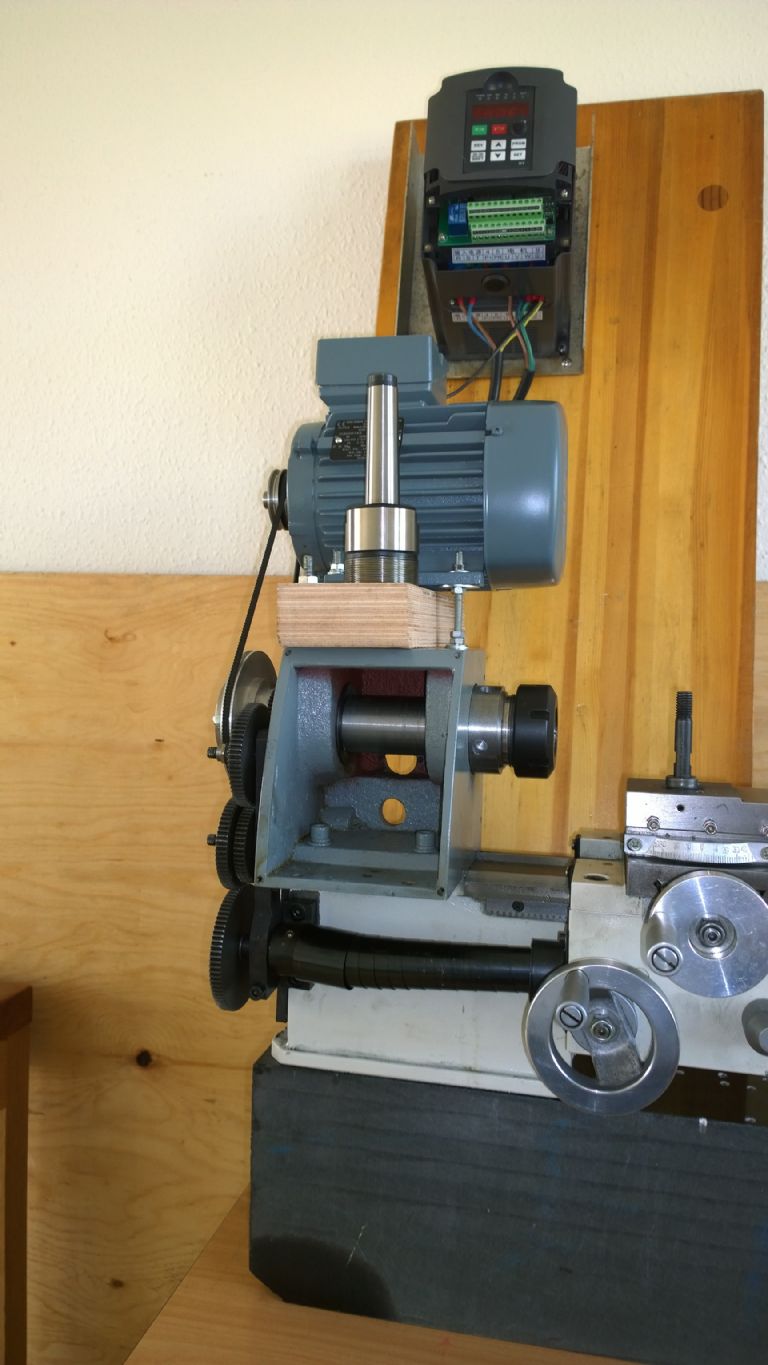
I have been working quite some hours to make a useable M50*1.5 ER40 thread.
Spindle- material was a cheap end of bar offcut and soft and like water pipe with inclusions of old scrap that is hard as tool steel.
It was quite a learning.The motor torque and power is more than enough for normal cutting and when it hits on of the hard spots spindle stops immidiately and belt slips.
Stopped motor and applied some brute torque with a C spanner in the spindle holes close to headstock.
One time the motor had not stopped (very low noise) and when I was through the hard spot,my guardian angle did her work..
Very ,very nasty.
Future considerations on motor power and rev will exclude motor powered single point screw-cutting.
A handle screwed on end of spindle is the way to go for old fools.
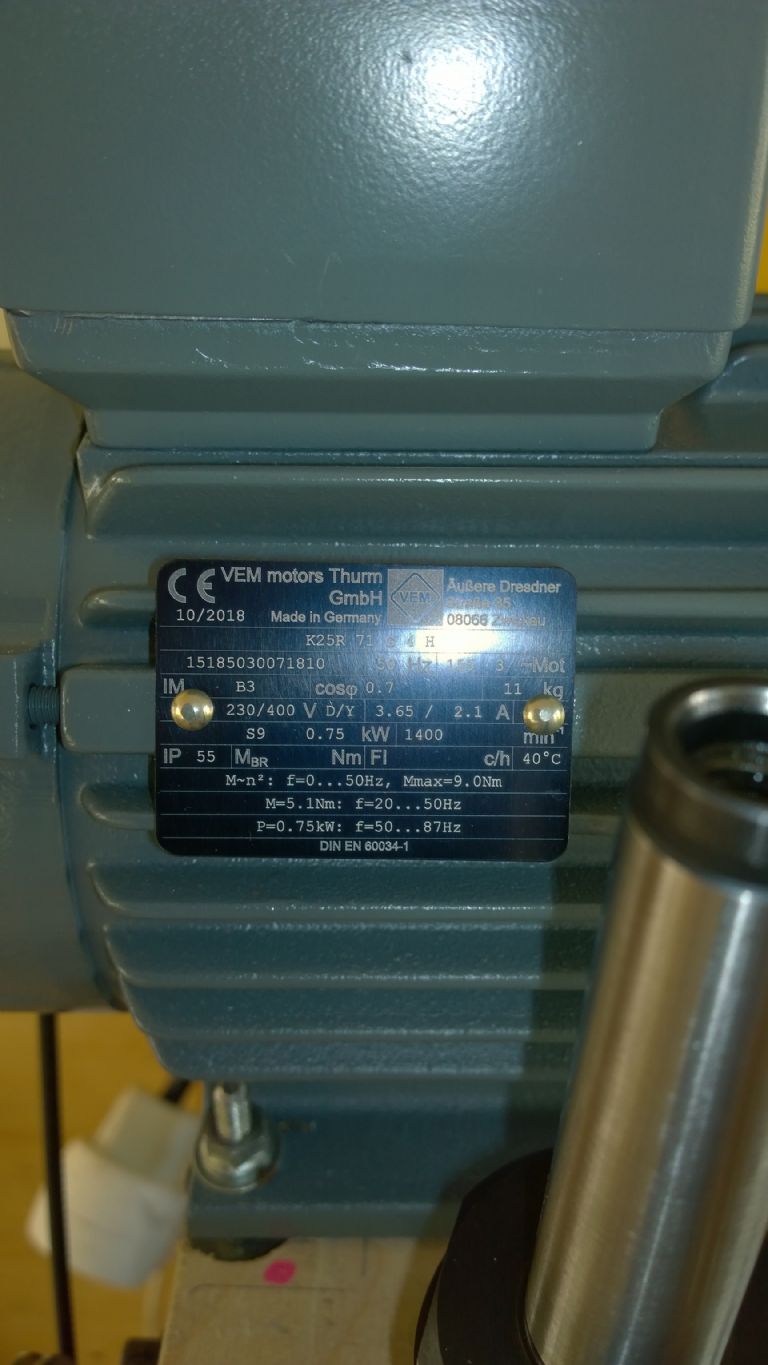
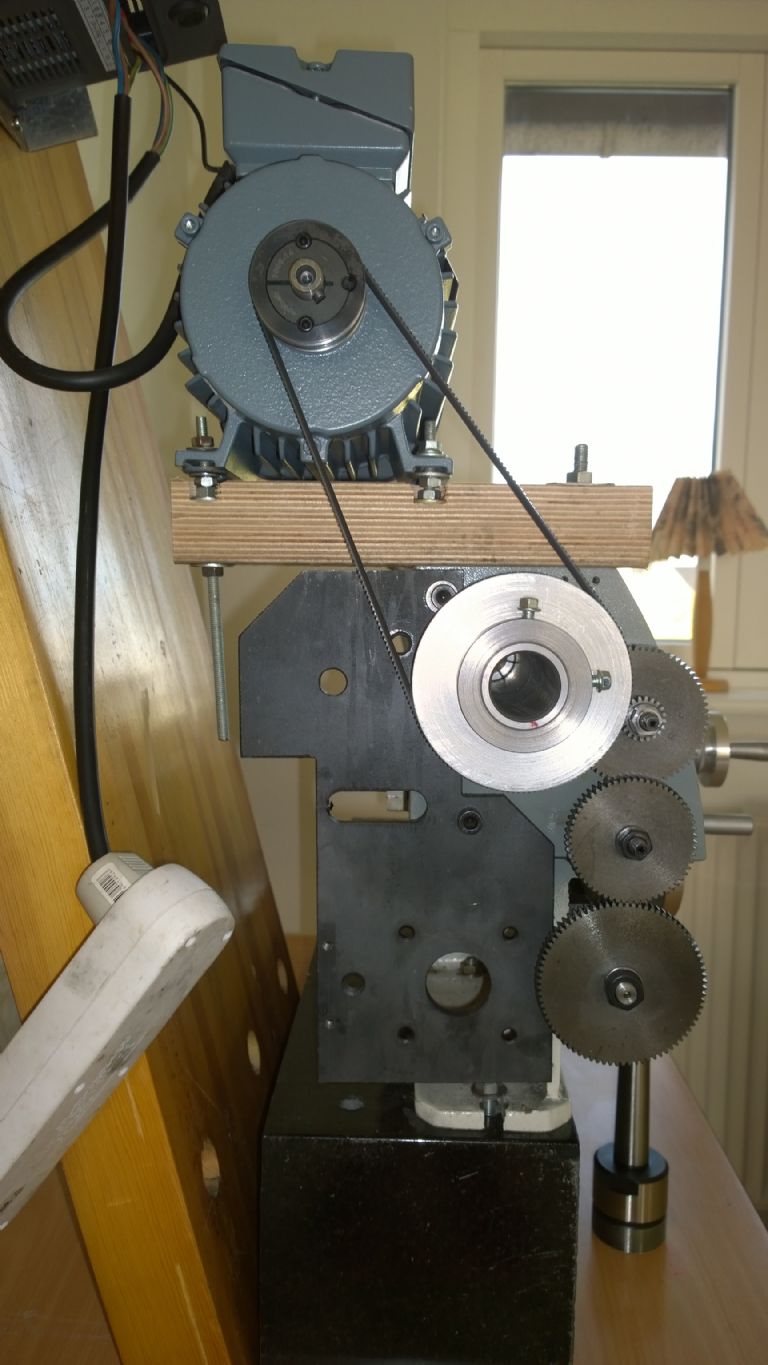
The frame 71 four pole motor turns a 50mm Gates5M belt pulley and spinde pulley is 100mm.
A frame 63 two pole with a 25 mm pulley can then do the same job but wil run two times faster and make more noise.
Will try and compare.
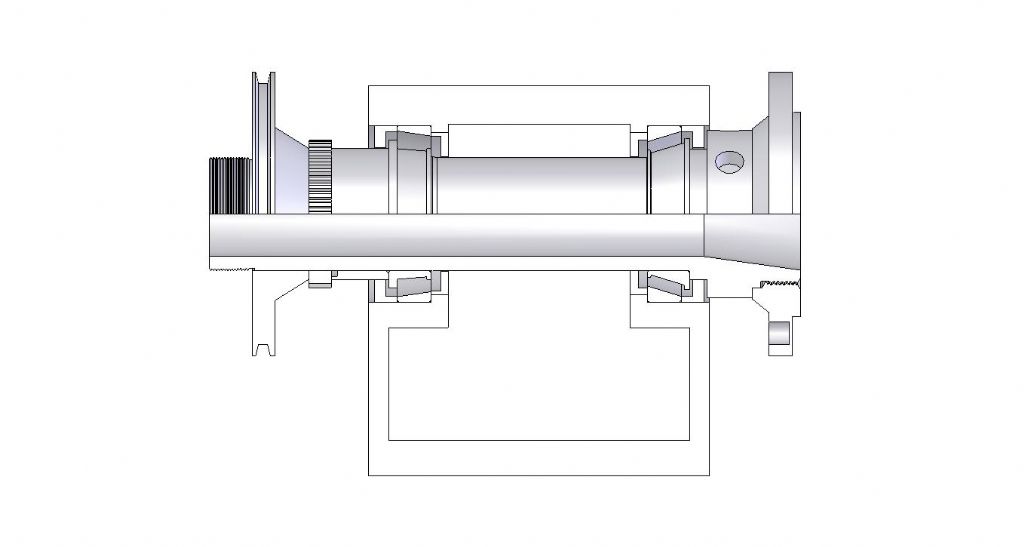
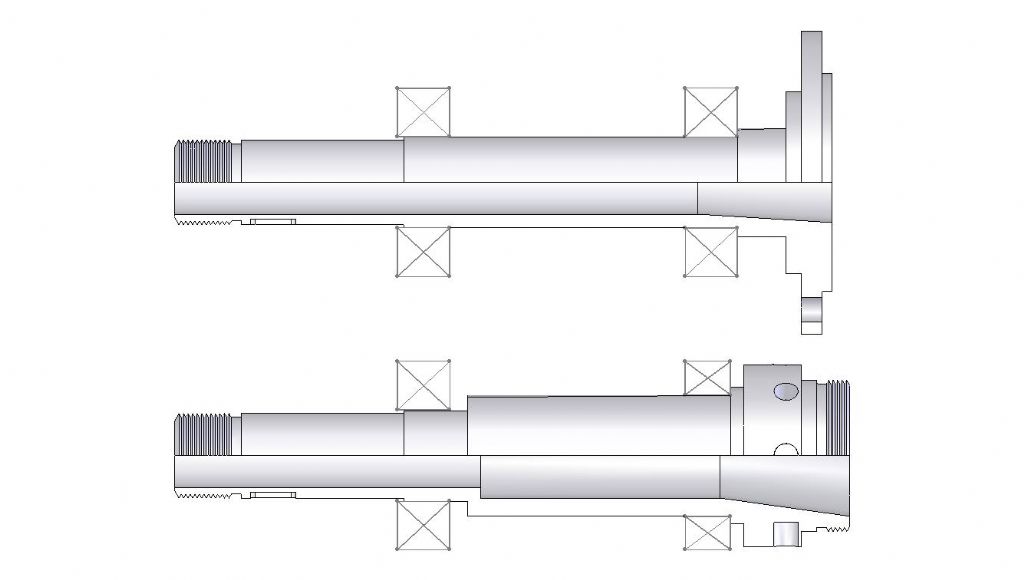
The spindle I am trying to make has 30mm bore full length and is an overkill.
It needs two new bearings, and all the grease seals need modification.The real trouble is the bigger (50 teeth)spindle gear wheel.
If the spindle looks like the lower of these it will only need to have front bearing changed.
Drive system with electronics and the geartrain to leadscrew can remain as is.
Powered speed range needed for me is 120 to 1200 rpm that can be done with existing DC motor in one step.
I think thats the way to go.
I bougth a MC3 ER40 collet chuck from Arceuro and was not shocked by price.
The factory that made the shown collet chuck/nut can easily make the new spindle for same kind of money.
Material and machining time are identical I think.
It can be a good buissness as there must be many thousands of these mini lathes around.
Edited By Niels Abildgaard on 15/07/2019 12:01:19
Edited By Niels Abildgaard on 15/07/2019 12:04:04
Ron, if your collet chuck had a standard nut remove it and place it in the cupboard and get one of the Ball bearing type like this. ![]()
Quite often I don’t even bother using the spanner for some small stuff, I just close it with my hand.
Edit: Dave beat me to it whilst I was typing!
Edited By Vic on 15/07/2019 11:07:02
Its my first time with ER collets, would I be right in thinking that the correct fitting procedure is to first fit the collet into the nut, (you can sort of feel it clip in) and then fit the nut to the chuck body, checking its correctly seated..
Ron
Tip: do them up as tight as you can with the supplied spanner. They 'like' being tight for accuracy and grip and won't be damaged if holding work in their capacity range, the standard torque is surprisingly high and hard to achieve by hand.
Neil
Thanks Neil, I didnt know that.
Ron
There's a posh version of the nut with a ball-bearing in it that's easier to tighten too: ArcEuro's page here.
Also, a good description of clicking the collet in.
Not essential, but ball-bearing collet nuts are definitely a step up.
Dave
Hi folks
I'm in the process or setting up a small workshop for prototyping. Would be nice to get to know any local machinists and engineers who are happy to give a bit of time. OR any local clubs or meet ups. I'm in the process of buying a Lathe and Mill… and feel I researched every option to death, and now need to act. I am trying to go for second hand and european made, and would prefer metric leadscrew. Ultimately I would love a bigger lathe and mill but need smaller combo to start with as present workshop is limited in size. I am thinking along lines of Emco Super 7 and Emco Mill. Need precision and threading etc.. and option for imperial threads. Been looking into a hardinge, but it's just too heavy for present workshop, also a Schaublin 102.. but really need power feeds on both axis. And with mills, did think of maybe a new Warco (which I know is Chinese but seem to be better made nowdays. Need to have enough HP to mill steel. Same with lathe.
Anyways. Thanks for time. Jon
Hello Brian!
Thank You. Secretly, I had been hoping that you add your words of wisdom!
I would be most grateful for your help.
I should have taken the easy way and followed the advice in your book, "Gearing of lathes for Screwcuttimg" and used the mini lathe with nits 1.5mm pitch Leadscrew. Because I am so much more conversant with it, I was looking to use my Engineers Tool Room BL12 -24.( This is a dual dialled version of a Chester Craftsman, or metric Warco BH600 ) It has Norton gearbox giving 40 combinations, fed via 120/127T Compound gear. I have 30T, 32T and 40T gears which can either drive the 120/127 or be driven as the input to the Norton box. So, by my calculations there are 1180 possible results. None of which provide a pitch of pi mm!
To my shame, I have cheque book engineered a solution by buying a 90T gear from Arc Euro, and a 1 Mod worm from RS. So the immediate problem has gone, but the curiosity as to how one achieves the desired result, still remains. You never know, I may want to cut another 1 Mod worm in the future!
So far my guesses have been futile!
The compulsion was a wish to be able to use the Division Plates from my HV6 on a small Dividing Head.
Probably, what I should have done was to cut a worm, (possibly 3/8 BSF or 1/2 UNF) and then a custom gear to match.
If you would kindly PM your E mail address, I will send over my spreadsheet, in the hope that you can suggest a way out for a simpleton like me.. My brain cells have just about seized on their spindles, by now!.
Presumably, this will entail cutting another 1.25 Mod changewheel to supplement the existing three.
Howard
I am also learning how diffrent cutters can be. I have Maydown, Franken and Osborn that cut perfectly and the £85 set of 20 are terrible. They seem to be sharp and do cut but the finish is all torn and very rough.
Any sugestions for reputable supliers of HSS cutters that dont cost an arm and a leg?
Some of the HSS cutters I have are Dormer, they work very well but are expensive. I have also bought HSS cutters from Tracy Tools and ArcEurotrade and they have worked OK for me. I also have cheap cutters that I regrind and use for roughing.
Thor
Hi Tony, according to the specs of the Arc Euro Trade one, the blade stroke is 70mm, stroke speed is 82/min, max cutting diameter 130mm. As far as I'm aware there is no adjustment for speed or stroke, and looking at the exploded diagram in Stuarts link, I don't se how it can be possible. If you wanted a power hacksaw with an adjustable stroke, you would be paying a lot more money than this model cost when it was new. I don't know of one that has an adjustable stroke, but there are some machines where the vice can be adjustable so that the unworn part of the blade can be used on smaller material, but they are often only on industrial machines.
Regards Nick.
Started by: Nigel Graham 2
in: Manual machine tools
Pete
Started by: Zan
in: Help and Assistance! (Offered or Wanted)
Nigel Graham 2
Started by: Nigel Graham 2
in: Locomotives
Nigel Graham 2
Started by: James A
in: Workshop Tools and Tooling
Dave Halford
Started by: old mart
in: Workshop Tools and Tooling
old mart
Started by: rumz
in: Traction engines
Georgineer
Started by: martin haysom
in: General Questions
martin haysom
Started by: Clive Foster
in: Manual machine tools
peak4
Started by: john fletcher 1
in: General Questions
Howard Lewis
Started by: lucerne
in: Manual machine tools
Charles Lamont
Started by: vintagengineer
in: 3D Printers and 3D Printing
Russell Eberhardt
Started by: Speedy Builder5
in: Workshop Techniques
martin haysom
Started by: Dunc
in: General Questions
John Hinkley
Started by:
Michael Gilligan
in: Workshop Tools and Tooling
Michael Gilligan
Started by: tomcnc
in: CNC machines, Home builds, Conversions, ELS, automation, software, etc tools
seemack
Started by:
JasonB
in: The Tea Room
Nigel Graham 2
Started by:
Hollowpoint
in: General Questions
Nigel Graham 2
Started by:
Sonic Escape
in: General Questions
Paul Mills 4
Started by: Ian Parkin
in: The Tea Room
Mark Rand
Started by:
Michael Gilligan
in: The Tea Room
Michael Gilligan
Started by: Alan Ambrose
in: Manual machine tools
Adam Harris
Started by: fingerscrossed
in: Manual machine tools
Dave Halford
Started by:
John Purdy
in: 3D Printers and 3D Printing
JasonB
Started by: Kiwi Bloke
in: Materials
howardb
Started by: Speedy Builder5
in: I/C Engines
John Purdy