Home › Forums › Clocks and Scientific Instruments › Measuring Clocks
Dave.
A ‘free pendulum’ is set going and left alone. There is no on the fly adjustment to its impulse. It gets the gentlest of nudges as infrequently as possible to keep it going and nothing else.
Who says that’s the definition of a free pendulum?
Whilst a mechanical mechanism can’t adjust the impulse, it is possible with a beam break sensor, some electronics. and an electromagnet. That a mechanical escapement can’t measure amplitude is a limitation of the mechanics, and it does not constrain other technologies.
Just two ingredients – gravity and its effect on a swinging mass. That is what makes it the reference.
Not so, I play the Hamlet card! “There are more things in heaven and earth, Horatio, than are dreamt of in your philosophy.”
I suppose a pendulum could be seen as ‘measuring’ gravity itself.
True!
Martin.
I’m bemused by this discussion, and the use of the term “infiltrate”. The latter is overloaded with negative connotations and could mean anything.
- If you want to counter the effect of circular deviation then you need to control amplitude.
- Using a separate (reference) clock which is asynchronous to the pendulum will give you a measure of amplitude (or actually velocity) based on photogate time in terms of the number of cycles of the reference which fluctuates by +/- 1 cycle of the reference, which can be averaged out.
- There is no way that then using that average to adjust the impulse to keep the amplitude constant can “synchronise” the pendulum.
- If by some lucky fluke the reference was synchronised then the situation is no different.
The only difference I would have with Dave is that I think his control scheme is too slow, better to have a much tighter loop.
Phew, that’s reassuring!
🙂
Could you please elaborate on [5] Dave ?
As I read it, you are now proposing to only use your clever electronics for an initial set-up and will then set the pendulum free to do its thing.
[ surely this must be misinterpretation on my part ]
MichaelG.
No, that’s right.
One of the advantages of a microcontroller is that the implementation is configurable, not fixed. Unlike a mechanical or analogue electronic design, where functions are fixed and difficult to change.
This clock can be told to apply any of the impulse strategies I listed earlier, and I’ll add the one suggested by John later. Being able to switch between impulse methods lets me experiment to find out which works best without touching the physical clock.
As the microcontroller can be commanded at any time to govern or not, in flight, it’s not difficult to have the governor on during set-up, and off when keeping time. The clock runs whether or not governing is active. The difference is governing stabilises amplitude automatically, and thus reduces circular error. Maybe!
In tests so far, the governor starts by repeatedly tweaking impulse, less so on each pass as it homes in, and once it’s found the right value, it rarely intervenes. It’s triggered by the bob gaining or losing energy, as might happen when changing air-pressure or humidity alter the viscosity of the air. More likely at the moment it’s compensating for a physical defect. The pendulum is stiff, something is causing excessive friction. I suspect the bob, rod, top holders and suspension spring are misaligned, and the bob is torquing rather than flying straight.
Dave
I’m bemused by this discussion, and the use of the term “infiltrate”. The latter is overloaded with negative connotations and could mean anything.
- If you want to counter the effect of circular deviation then you need to control amplitude.
- Using a separate (reference) clock which is asynchronous to the pendulum will give you a measure of amplitude (or actually velocity) based on photogate time in terms of the number of cycles of the reference which fluctuates by +/- 1 cycle of the reference, which can be averaged out.
- There is no way that then using that average to adjust the impulse to keep the amplitude constant can “synchronise” the pendulum.
- If by some lucky fluke the reference was synchronised then the situation is no different.
The only difference I would have with Dave is that I think his control scheme is too slow, better to have a much tighter loop.
Ask Tom – he has covered the topic in some depth.
the term ‘synchronise’ the pendulum to the external clock is perhaps incorrect.
The clock PERIOD is not synced to the external clock, but any attempt at eliminating rate change due to circular deviation, by regulating the amplitude, should not depend on an external clock source..
John, your second elevated photogate serves that purpose correctly, but using the BDC photogate measurement of the flag width is not appropriate. All else being equal proper amplitude control then relies on that flag width measurement, which is simply a measure of the quartz clock, or drips or water, or the kitchen clock…whatever the clock being used to time the passage of the flag. That is infiltration.
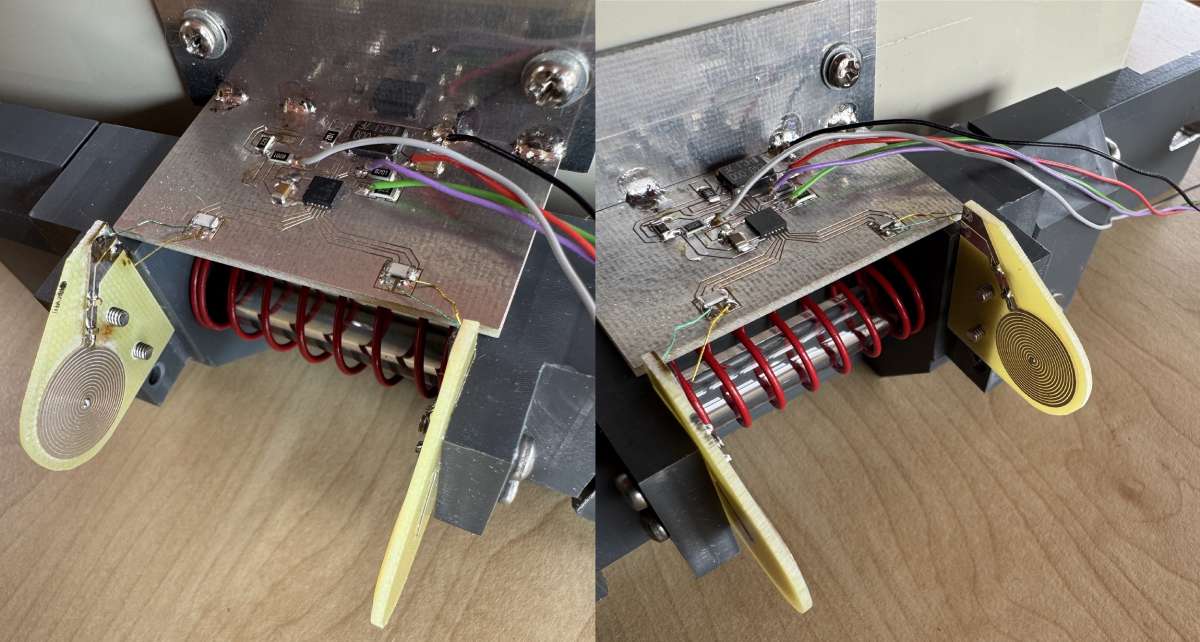
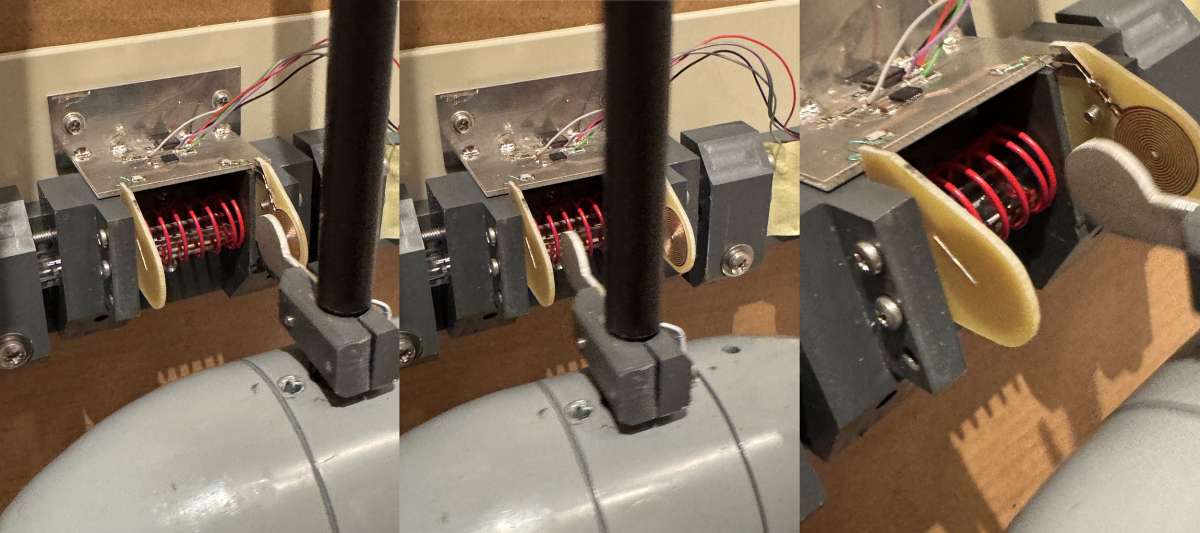
I use the Capacitive angle sensor to measure the actual angular displacement of the pendulum. I measure that with an AtoD and then compare that to a setpoint and adjust the drive accordingly. In my case, I do not pulse the pendulum, but drive it with a phase shifted version of the sinusoid coming from the angle sensor. These are all analogue paths only. Yes, the A to D is driven by a microprocesser, which needs a clock, but I could just as well use an analogue VOM, get the reading of amplitude, and twiddle a pot to change the drive signal to the pendulum.
Yes, I use a very accurate clock to measure the flag width at the BDC photogate( hence amplitude), but it is a measurement only, to find the error of my ways, not used in any control path.
To my mind, any use of any external clock to derives a means to regulate a pendulum, weather it be rate , beat or amplitude is a form of infiltration
Where Dave says – It shouldn’t artificially improve the pendulum’s time-
I disagree – if that clock was a count of drips of water from a bucket, it would degrade the clock’s amplitude control, if it was a Cesium clock source , it would improve the amplitude control, so if that is not infiltration, then go with the beat!
<p style=”text-align: left;”>Thus is all getting a bit deep. My objection to using vane passage timing as a measure of amplitude is that it relies on the processor’s clock. If the processor clock speed changes the control system will change the pendulum amplitude by the same percentage, which will have a much smaller effect on pendulum period. By detecting amplitude with a second sensor I take out this dependence. If my processor clock changes, it changes the duration of the impulse, but all that does is change the hit/miss ratio. I could get rid of that by discharging a capacitor through the drive coil, but I’m not a pendulista. Hope Jones, who invented the Synchronome, envisioned using photo switches. I think I could implement mine with just logic gates, no processor clock, but it would be a lot more difficult</p>
Perhaps we need a subset of free pendulum, the purely mechanical, to keep Blowlamp happy.
Thanks for the clarification, Dave
With the greatest respect to you and your project, I fear that the performance of your ‘liberated’ pendulum will prove disappointing.
Please continue with the great job you are doing … I would be delighted to find that fear unfounded !
MichaelG.
Duncan.
I’m already quite happy thanks, I just don’t want to see Dave chasing his tail by 1) Forever adjusting pendulum impulse power and 2) Using another time measuring device to do so. It’s akin to the back seat passenger telling his chauffeur how to drive smoothly.
If Dave powers his pendulum by electromagnetic means then I’m still happy, just as long as he uses a constant force to do so. In the Shortt clock this constant force is supplied free of charge by the gravity arm. In Dave’s clock he will be simulating gravity through (currently varying) magnetic attraction/repulsion.
Martin.
My post above was me expressing worries about the pulse length timing and its effect on the pendulum, but applying the same “what happens if the controller clock varies?” argument to speed measurement, then I would think this is going to directly affect pendulum timing. Let’s say the timing clock (not the pendulum) starts running more slowly. It is going to underestimate the pendulum speed which is measured using that clock as a reference, so the governor logic will increase pulse average impulse and the pendulum amplitude will increase. Direct link between external clock and pendulum period. The effect comes about by using pendulum speed as an indirect measure of pendulum amplitude and a more direct measure of amplitude is needed. The “speed” technique has the advantage of delivering a more-or-less analogue measure of amplitude (within the quantisation limits of the clock) so allowing a more subtle control algorithm where a “has it crossed the amplitude limit threshold?” as used (as I understand it) by Duncan is a digital yes/no decision Hipp mechanism-like.
Thoughts turn to a laser distance-measuring device in the plane of the pendulum looking horizontally so that it can measure the actual position of the pendulum at its closest point of approach and deliver an analogue value back to the governor logic. But there is still going to be a timing element in there somewhere that will “infiltrate” its way into the pendulum timing!
No wonder some of us just rely on something simple and straightforward like measuring time-of-arrival of signals from a bunch of low-earth orbit satellites to nanosecond accuracy and doing complex 3D trigonometry on them. That doesn’t need anything more complex than relativistic corrections to maintain accuracy…
As a sub-sub project, here’s another example of how the clocks microcontroller can easily do other useful measurements.
For various reasons the clock is physically levelled.
First step is to level the clock with a builders bubble. Don’t believe it need be highly accurate to fix right/left alignment, and it gets the vane close to BDC.
Close positioning of the vane relative to the opto-sensor is desirable. My design provides two ways of improving on the bubble:
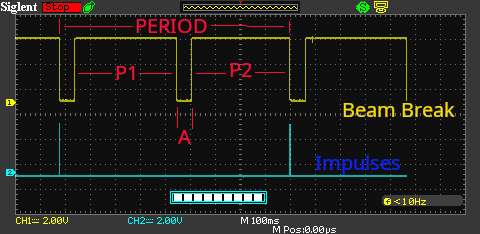
This graphic shows the pulse train detected by the sensor when the pendulum is swinging. The yellow trace is the opto-sensor output. The image is annotated in red to show period, transit time A ∝ amplitude, and the length of the pulses each side of the transit, marked P1 and P2.

The ratio P1:P2 gives the level. 1.0 means the vane is correctly positioned relative to the sensor at BDC. Less than 1 means the clock is leaning forward, greater than one means it’s leaning backwards. The clock’s microcontroller is easily programmed to measure Period, P1, R2 and A, and to calculate and display P1÷P2. Voila, this clock measures level!
To position the pendulum BDC, set the bob swinging and switch on display P1÷P2. Then adjust the rear level adjusting screw until it reads 1⋅000.
Made a mistake. Should have used M12 fine to make the levelling adjusters, not M12 coarse… Bit clunky, I can live with it!
Dave
Make a bush with a head on it M12 male outside, M10 female through. Then if you use an M10 bolt you have coarse adjust 1.5 mm per turn by turning the bolt, and fine by holding the bolt and turning the bush, 0.25 mm per turn
Before anyone points out the deliberate mistake, M12 core is smaller than 10mm, so read M8.
The ratio P1:P2 gives the level. 1.0 means the vane is correctly positioned relative to the sensor at BDC. Less than 1 means the clock is leaning forward, greater than one means it’s leaning backwards. The clock’s microcontroller is easily programmed to measure Period, P1, R2 and A, and to calculate and display P1÷P2. Voila, this clock measures level!
Correct, except when it’s not..
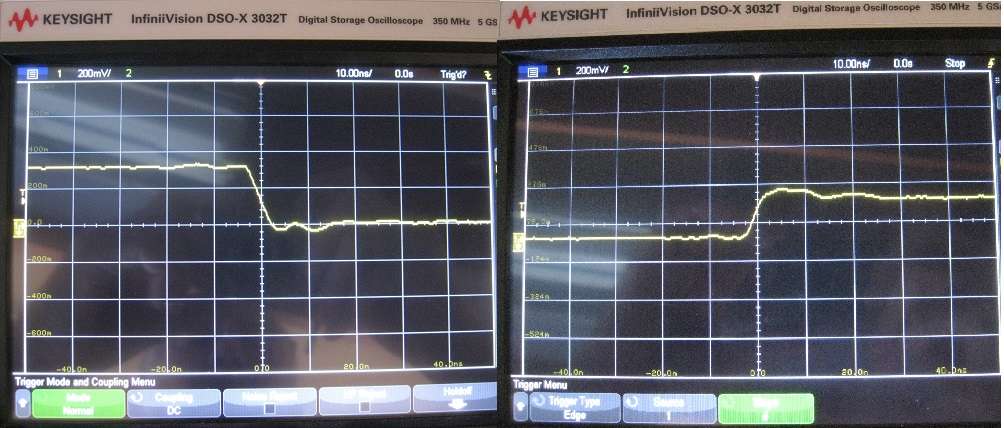
As is being painfully pointed out to me on another forum, there are many things that cause a measured delta between odd and even beats, not only tilt. At least two other culprits are the rise and fall time of the signal from the photogate ( and any ambient lighting it is exposed to), and worse, how the photogate is mounted.

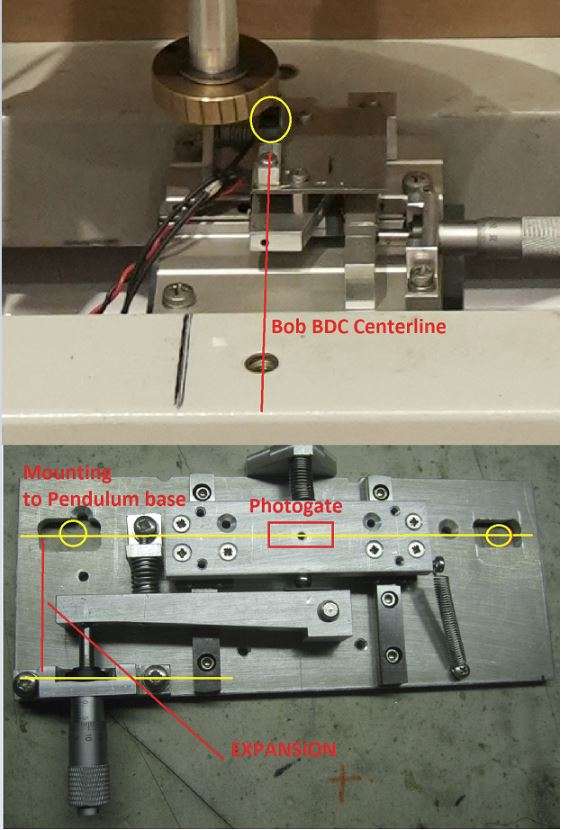
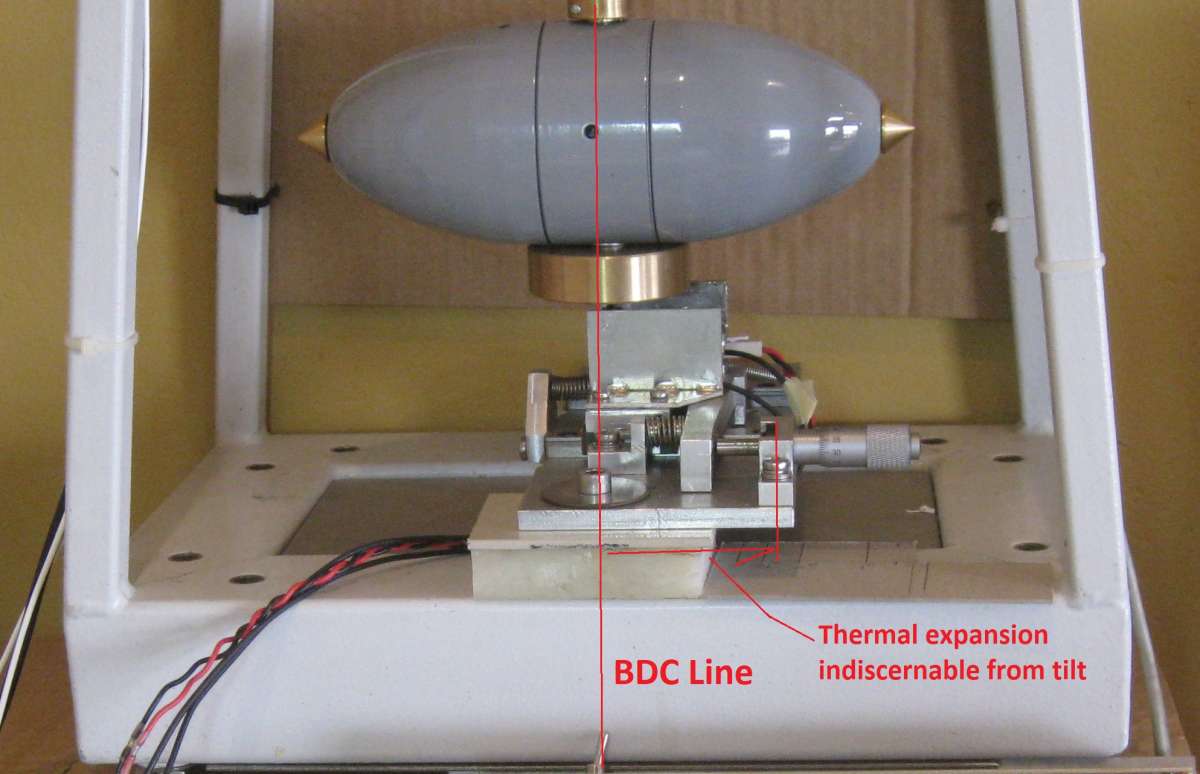
For example:
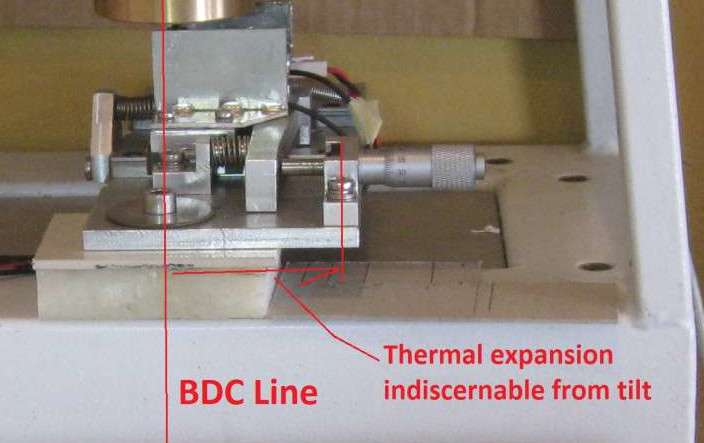
The photogate in these poor photos is ringed in yellow – it is mounted more or less in the center line of the micrometer sled that carries it. That sled is mounted more or less in the centerline of the bob’s BDC. The photogate sled has a micrometer, with a 7:1 lever arm, to adjust the photogate to BDC. 1 micrometer division (0.01mm) gives about 20us delta in the odd and even beat values.

The problem is that the micrometer is some 35mm away from BDC, so that section of Aluminium expands and contracts with temp, moving the photogate left and right – this looks like tilt and it is not..
This may not be important in your scheme of things – My setup can discern 8 micro-radians of amplitude variation, and interpolate down to 3-6 micro-radian, and any ’tilt’ is an issue if you are sensing amplitude in a peak manner, as opposed to peak to peak, As John indicated, there are ways of doing that, but not just with a BDC photogate.
And if your whole pendulum ’tilt’ can be adjusted by a ‘leveling screw’ , then that screw is a big culprit – it has a tempco which will translate into tilt. No free lunches anywhere with a pendulum, much to my chagrin..

Before anyone points out the deliberate mistake, M12 core is smaller than 10mm, so read M8.
Surely only a fusspot would worry? It’s the principle that matters! The slip is a mere detail…
I’ve added the idea to my TODO list.
The problem with M12 coarse is that the adjustment is concentrated within about ¹⁄₁₆ of a turn, and it’s gritty, so the ratio jumps across the ideal 1.0 setting. It’s on 1.02 at the moment, because I got fed up with it. A screwdriver with a fat handle might help .
Dave
Excellent post from Joe, #823142. Just what I enjoy with my breakfast coffee.
He’s absolutely right about the limitations of the levelling method described, and it’s important to keep them in mind when building a precision pendulum clock. For the moment, I’m of the view that the clock’s levelling measurement is ‘good enough’, and it is certainly better than adjusting by eye, and quicker than using an oscilloscope. But my perception of ‘good enough’ might not be ‘good enough’, and if that proves so, I’ll have to do better.
The need to do better is constant when building precision pendulum clocks. There appears to be no end to it! Every improvement reveals another set of shortcomings. Though Fedchenko went a little further, development of precision clocks effectively ended with the Shortt-Synchronome. Not because the clock is perfect. Development stopped when it became apparent that much higher precision and accuracy could be achieved by electronic means.
Hence amateur interest in building advanced precision pendulum clocks. Though seriously difficult, it is possible today to build a clock that outperforms a Shortt. A multitude of tiny improvements are needed, and they get progressively harder to implement at each stage.
Joe mentions ambient light as one of the problems afflicting photo-gates, and it’s serious. I deal with ambient light by enclosing the pendulum inside a tube, hopefully excluding infra-red entirely. Actually, though it eliminates gross errors, running the sensor in the dark isn’t enough! In my Mk1 clock, I had considerable bother with internal reflections. IR from the LED was reflecting off the moving bob and the fixed shiny metal structure. Reduced, not cured, by blackening shiny parts and adding internal shields and slits. The Mk2 opto-sensor is a Sharp GP1A57, which is more controlled. But the datasheet notes that the Sharp’s LED’s IR output declines over time, a problem I’ve not addressed. The effect of all this is to shift the impulse trigger point. Note though that controlling ambient allows the sensor to easily outperform mechanical escapement. In mechanical terms, gravity escapements are excellent; by electronic standards, gravity escapements are poor. But electronic beam breakers are still imperfect – always more to do.
Be interesting to compare the design of the three clocks featured on the forum recently:
Must stop, have an appointment!
Dave
Good point about the IR emission declining. I have recent experience working on a system using LED sources where the light output declined over ~50 years to the point where it seriously malfunctioned. A problem with the Sharp type device is that it is packaged so one has no access to the emitter and detector. I intend to move away from them and use a separate IR LED and photodiode in a more optimised optical package. As photodiode lifetime seems to be much longer (x10?) than an LED it might be sensible to measure the photodiode signal level before applying a threshold and adjusting the LED current to keep it constant. Dave could also use his processor to turn off the LED except when it’s going to be needed which ought to give at least 10x longer life.
Before having to rush off, I was going to compare my opto-sensor platform with Joe’s. I’ve already said a screw adjusted platform would be advantageous, but they are double edged.
Joe and I have taken different approaches and I’m not clear which is best, or even if it matters! The pros and cons are different.
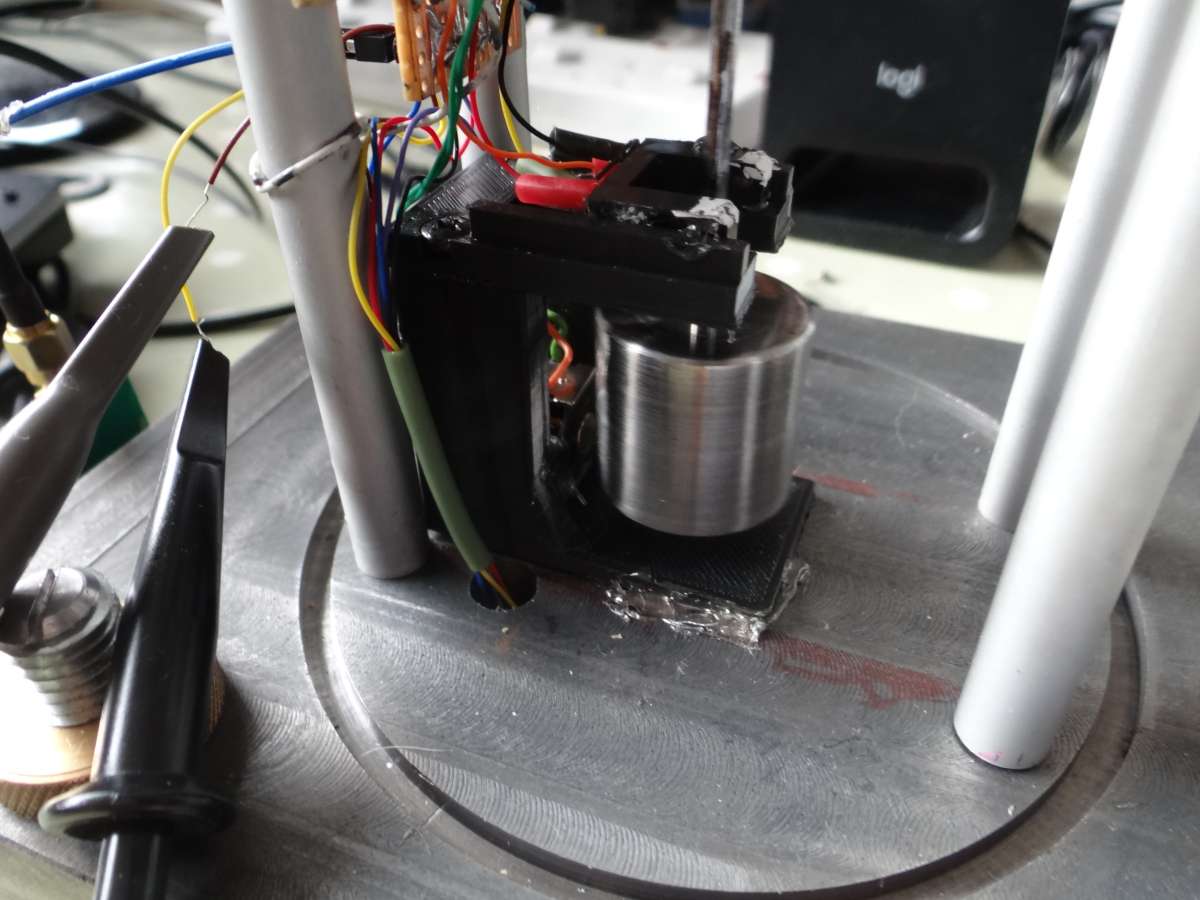
Joe first. His platform is precision engineered in metal, including a micrometer head.

Mine is crude! It’s 3D-printed in PLA, and not adjustable. It’s aligned and positioned using scratch marks in the base and hot-glued in. The Sharp sensor is aligned between printed rails, accuracy ±0.1mm ish on a good day,

So, what I’ve done suits me at the moment, but PLA may prove a bad choice in future. Or maybe not!
My temperature management strategy is to compensate the whole clock in software. This scheme does not rely on conventional techniques like Invar rods or grid-irons. I’m guessing that the thermal expansion of the base, tower, suspension, rod, bob and opto-sensor all combine to produce a single compensation coefficient. We’ll see. One problem is the parts all have different thermal latencies, and I don’t allow for that. A secondary problem is finding the coefficients is statistical, more measurements the better. Ideally at least a year, taking 31.5 million measurements at one sample per second. Shortt didn’t have the technology or needed to collect the data, or, even if he had, the manpower needed to do the sums. I have computers.
I have a notion that thermal latency errors are reduced by mounting the pendulum on a cast-iron block. As I will insulate the PVC tube with aluminium foil and glass fibre, heat can only get in and out through the block, which, I hope will slow the rate of temperature change down. The clock should also be located away from changing heat sources, A cellar rather than a south facing window-sill with a radiator below!
Final point, these mechanical difficulties are the tip of an iceberg. Electronic methods obsoleted pendulum clocks by side-stepping most of them. But electronics hit the same problem – a constant need for more and more difficult to achieve improvements. The ‘fun’ is endless!
Dave
If the photo gate is being monitored by polling can’t you set the software so that if output this time is less than output last time (with some margin to allow for noise) it takes it as triggered. The transition is quite abrupt, at least on mine. One could even have the processor tell you that it is time to swap the sensor.
Just remembered, my sensor has built in Schmidt trigger, so of course it has an abrupt transition. Doh!
If the photo gate is being monitored by polling can’t you set the software so that if output this time is less than output last time (with some margin to allow for noise) it takes it as triggered. The transition is quite abrupt, at least on mine. One could even have the processor tell you that it is time to swap the sensor.
Not on the Sharp I’m using. It contains a built-in comparator / Schmidt trigger, so is either ON or OFF. Aging alters the trigger point and I can’t think of a way of detecting that it’s changing.
I guess my Sharp’s trigger point would be increasingly delayed as the IR emitter slowly dimmed over many years. Although the pendulum has the same period, it appears to the clock as if the phase has shifted. Say a 1s pendulum is detected exactly at BDC by a new sensor. 10 years later, the dimming sensor might be triggered 0.0001s later. Ticks are still accurately timed, but they are all late. It’s a form of drift. If the LED dims at a predictable rate, the drift could be compensated in the counter.
I don’t care much for polling very much in a precision time-piece because:
But being able to measure the trigger voltage of a polled analogue sensor might be do-able.
A thought. Do Hall Effect Sensors age! Permanent magnets do, but that could be detected as Duncan suggests. Begs the question, what exactly are the pros and cons of optical vs sound vs capacitive vs inductive sensing?
Dave
- I guess my Sharp’s trigger point would be increasingly delayed as the IR emitter slowly dimmed over many years. Although the pendulum has the same period, it appears to the clock as if the phase has shifted. Say a 1s pendulum is detected exactly at BDC by a new sensor. 10 years later, the dimming sensor might be triggered 0.0001s later. Ticks are still accurately timed, but they are all late. It’s a form of drift.
- poll interval varies.
- Polling is much slower than an interrupt,…….. One cure is to reduce the complexity of interacting functions by is to put time-critical functions one microcontroller and everything else on another.
- Plus two computers have to communicate, perhaps by clocking both in synchrony with the same crystal.
…….. Begs the question, what exactly are the pros and cons of optical vs sound vs capacitive vs inductive sensing?
Dave
1.
Decent photogate’s performance variations are not that simple. Some mnfr’s provide timing tables that show hoe the pulse width for a controlled interrupter varies with varying led current. It is not just that the pulse is delayed, ie, that both the leading and trailing edge are delayed equally – each edge is not delayed by the same amount either. This is normal in a ‘new’ photogate under evaluation, due to the hysteresis of the Schmidt trigger, and that remains fairly constant. However, the photo-detector (before the Schmidt) switch point varies with irradiation intensity for the dark-to light-to dark transition. This causes the pulse width to reduce or increase, not only its position in pendulum time.
You said :Ticks are still accurately timed
I believe you need to quantify your target and define what you mean by accurate..
I am chasing sub-microseconds, and micro-radians – and timing measurement methods that are rigorous and can withstand scrutiny -I am not sure what you are chasing. I am far from that point still – I don’t see a smooth road ahead for your approaches.
For your comments 2,3,4
I really think these tangents are counter-productive and each new one just adds to the uncertainty of your measurements.
Polling anything that is time critical is fine for measurements where critical encompasses a week.
Interrupts are better but not for example, to measure directly the flag width, or the ‘instant’ that an event occurs.
There is always latency and jitter. To cope and cater for that you have to go and analyse deeply each such process, understand what the interrupt delay might be, and if associated jitter affects the result detrimentally. That in my book is a waste of analytical time – you will never be sure. Again, because I do not know your definition of accuracy, and what your target is, maybe 1msec is good enough for you…
Using more than one processor – I don’t see why this is as complicated as you put forward. They do not need to be synchronous – if they do , you have made some bad choices in system engineering…
There are very few process that require ‘absolute’ timing discipline . Vane of Flag width is one. Use the hardware in the uP- don’t use software – a capture timer that captures the number of (accurate..) clocks between rising and falling photogate edges does it all. let the falling edge then interrupt you so you can at leisure go and read the timer – after all, you have a second to do that..Use a second timer to measure the time between rising edges , in the same way, and you have odd and even beat values.( Or use Tom’s picPET..)
If your uP is stressed, and it should not be with this approach, offload menial tasks – reading the environmental sensor ( pressure, temp, humidity..etc) – put it on a serial link to the ‘main’ uP – or to your R-Pi…they do not need to be synchronized at all, nor do their clocks need to be the same. They also do not need to communicate – you only need to collect all the data in one place for belated analysis. The more the system is over-complicated the more it will bite you. For local real time control of the pendulum, feed only the relevant data into the ‘main’ or controlling uP – the other data is analytical only.
Regarding sensor choices.
How would you use sound in your setup? No tick to listen to, possibly in a vacuum.
Optical – well, we all know that one, and the fact that most use it probably speaks to its ease of use and good performance. But there are other optical types too – encoders, etc.
Capacitive/inductive.
Well, that covers such a wide range that you would first have to define what you mean. I presume you mean proximity sensors only?
I use a capacitive sensor to measure Semi-arc, but it is stretching the term to say its a capacitive sensor it use a system of vanes and excitation paltes and pickup loops…The output is a DC voltage proportional to pendulum position – 2v at TAP, 0v and BDC. It works very well, can discern angle down to 8micro-radian, but took months to engineer it so that it’s tempco is better than the pendulum’s. A basic capacitive or inductive proximity sensor, say at bob TAP, is not great at all, they all have , for this application, poor tempco’s – from a few PPM to many tens of PPM
That said, I am testing an inductive sensor based on the TI LDC1612 – a 28bit resolution proximity sensor. It has some neat features, apart from the good resolution, in that the tempco can be completely nulled out.
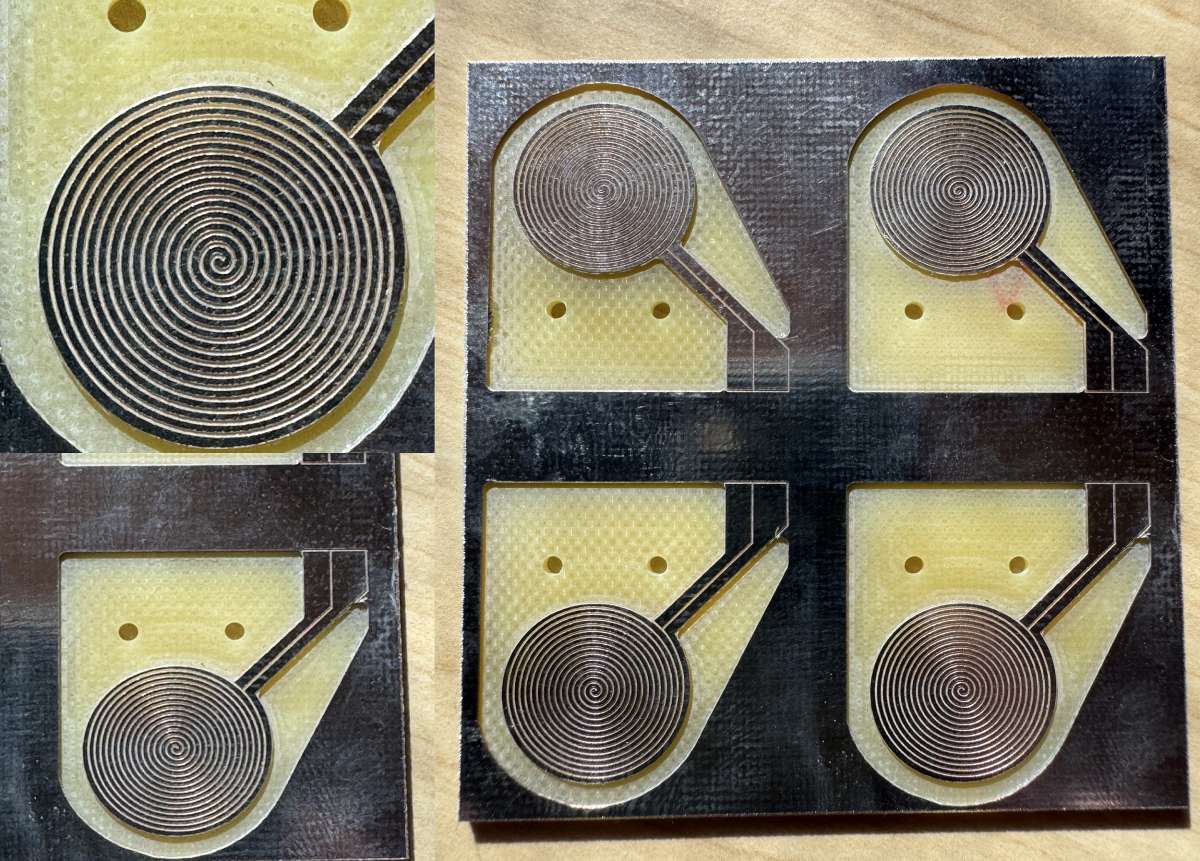
It can cater for 4 sensor coils – I use two, and when the bob is in proximity of the one, the reading of the other is use to check the value against an initial reference value – any delata is temp shift – deduct that from the next time ( 1 second..) the bob is there, and the tempco is gone…A small Aluminium disk moves with the bob and approaches each senss coil in turn. the values are summed, the tempco-vs-ref subtracted, and you have PP swing reading – these have shown to be as good as the Capacitive angle sensor. I am going to fit a Renishaw partial arc optical sensor early next year – this gives a count of around 100,000 per 1deg of swing, so 200,000 counts for my 2deg swing pendulum. ANd that is pretty absolute, except for the expansion coef. of the optical grating.
So, beware when generalizing WRT sensor types..
And, yes, this sensor has its own arduino nano, via a serial link to the main STM processor – data is sent leisurely between swings and likewise collected by the main STM (Nucleo) processor, whicjh in turn send all callected data ( timers, environmental, etc to the host logging PC..
It is so much easier to analyse compromises, and odd values, if the system is compartmentalized and if each function is independent and does not rely on polling or interupts for timing. I speak glibly – I have suffered to get this far, and all it has taught me is that I am still on the start line..
Not sure I have anything more to contribute here, so may bow out again..If it seems I am speaking from authority, scrap the idea right away. On the other forum I post on, I am proved to be at the very bottom of the pile – I have just had a few very good tutors.


I’ve lost track of the aim of the project.
Is it to make an accurate pendulum clock, or is it to find the best way to electronically impulse a pendulum clock?
Martin.
- I guess my Sharp’s trigger point would be increasingly delayed as the IR emitter slowly dimmed over many years. Although the pendulum has the same period, it appears to the clock as if the phase has shifted. Say a 1s pendulum is detected exactly at BDC by a new sensor. 10 years later, the dimming sensor might be triggered 0.0001s later. Ticks are still accurately timed, but they are all late. It’s a form of drift.
- poll interval varies.
- Polling is much slower than an interrupt,…….. One cure is to reduce the complexity of interacting functions by is to put time-critical functions one microcontroller and everything else on another.
- Plus two computers have to communicate, perhaps by clocking both in synchrony with the same crystal.
…….. Begs the question, what exactly are the pros and cons of optical vs sound vs capacitive vs inductive sensing?
Dave
1.
Decent photogate’s performance variations are not that simple.
Agreed! I’ve been making the point all along that precision clock making is endless. There isn’t a single correct answer. I’m making the best use of the technologies available to me, and do not claim that the choices are the best. Confusion abounds because I’m building an experimental clock, hoping for better accuracy than a Shortt-Synchronome, with lots of R&D, not a straightforward application of existing best practice. The experiments are fruitful in two ways: the idea works, and can be improved, or it’s a dud! Either way I learn summat. There is always room for improvement!
Some mnfr’s provide timing tables that show hoe the pulse width for a controlled interrupter varies with varying led current. It is not just that the pulse is delayed, ie, that both the leading and trailing edge are delayed equally – each edge is not delayed by the same amount either. This is normal in a ‘new’ photogate under evaluation, due to the hysteresis of the Schmidt trigger, and that remains fairly constant. However, the photo-detector (before the Schmidt) switch point varies with irradiation intensity for the dark-to light-to dark transition. This causes the pulse width to reduce or increase, not only its position in pendulum time.
Yes, the datasheets say so. Though the pulse width varies too is a useful clarification, but does it matter? My clock triggers on the leading edge of right swinging pulses. Pulse length is ignored, apart from levelling during set-up. I don’t believe pulse length affects period because the error occurs whilst the vane is covering the photo-sensor. Though I might use transit time to indicate relative amplitude, transit time doesn’t contribute to period. More thought needed – I can’t quantify how a dimming LED would affect period or phase.
You said :Ticks are still accurately timed
I believe you need to quantify your target and define what you mean by accurate..
I am chasing sub-microseconds, and micro-radians – and timing measurement methods that are rigorous and can withstand scrutiny -I am not sure what you are chasing.
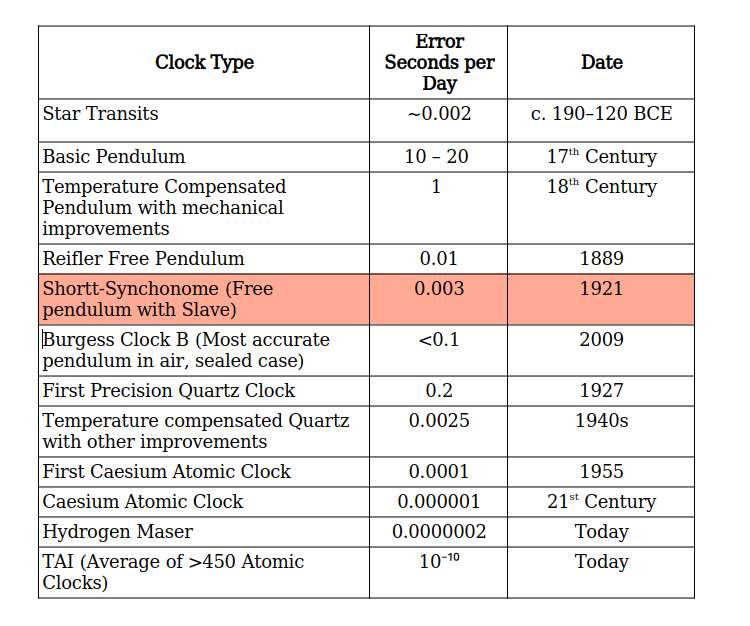
0.003s per day. Problem is you’re dipping into a project mid-stream and haven’t seen the rationale or goals, which date back two years. My fault: I’ve already noted the need to write an up-to-date statement. I did define accurate at the beginning of this topic though, my target is the Shortt-Synchronome, yours might be Burgess Clock B?

I am far from that point still – I don’t see a smooth road ahead for your approaches.
Nor do I expect it to be. I’m trailblazing!
For your comments 2,3,4
I really think these tangents are counter-productive and each new one just adds to the uncertainty of your measurements.
Yes, thread drift. The tangents are a response to Duncan’s question, not what I’m doing.
Polling anything that is time critical is fine for measurements where critical encompasses a week.
… Again, because I do not know your definition of accuracy, and what your target is, maybe 1msec is good enough for you…
I agree, and it’s why I don’t use polling. Not guilty.
Using more than one processor – I don’t see why this is as complicated as you put forward. They do not need to be synchronous – if they do , you have made some bad choices in system engineering…
I actually said: perhaps by clocking both in synchrony with the same crystal. I didn’t say the microcontrollers need to be synchronous – that depends on the Use Case! No bad choices in system engineering either – I’d be reluctant to go that way. Possibly I made the point badly – I’m explaining why polling is a bad idea in this application, and why using two microcontrollers to overcome problems so caused is also difficult. We agree – avoid!
There are very few process that require ‘absolute’ timing discipline . Vane of Flag width is one. Use the hardware in the uP- don’t use software – a capture timer that captures the number of (accurate..) clocks between rising and falling photogate edges does it all. …
Again, the backstory has been missed. What Joe recommends is in the Mk1 version of my clock, and will be in the Mk2 too. Not there yet, because I altered the clock mechanically, forcing some software housekeeping changes in addition to upgrades. Though several upgrades have been implemented and debugged, I’m having bother with housekeeping, like reliable starting. The clock will have PET capability, the code is written and tested, just not installed yet.
Regarding sensor choices.
How would you use sound in your setup? No tick to listen to, possibly in a vacuum.
Sonar! I only mentioned sound as a possibility, not because I think it’s a runner. Was trained explicitly not to discount options without due process. Never dismiss solutions just because they seem unlikely, and because relying on experience misses opportunities. I haven’t assessed sensor options formally, therefore my choice may not be the best. Actually I know it isn’t! Over a year ago John Haine recommended a Sharp photo-gate. Then illness stopped the project, restarted last month. In the meantime, John has moved on, has a better approach, so I need to change again. Good suggestions from others too. So here I am: Mk2 working isn’t yet, and a Mk3 redesign is looming…
Optical – well, we all know that one, and the fact that most use it probably speaks to its ease of use and good performance. But there are other optical types too – encoders, etc.
Capacitive/inductive.
Well, that covers such a wide range that you would first have to define what you mean. I presume you mean proximity sensors only?
Hoped that was clear from the context: accurate detection of pendulum swings.
I use a capacitive sensor to measure Semi-arc, but it is stretching the term to say its a capacitive sensor it use a system of vanes and excitation paltes and pickup loops…The output is a DC voltage proportional to pendulum position – 2v at TAP, 0v and BDC. It works very well, can discern angle down to 8micro-radian, but took months to engineer it so that it’s tempco is better than the pendulum’s. A basic capacitive or inductive proximity sensor, say at bob TAP, is not great at all, they all have , for this application, poor tempco’s – from a few PPM to many tens of PPM
That said, I am testing an inductive sensor based on the TI LDC1612 – a 28bit resolution proximity sensor. It has some neat features, apart from the good resolution, in that the tempco can be completely nulled out.
It can cater for 4 sensor coils – I use two, and when the bob is in proximity of the one, the reading of the other is use to check the value against an initial reference value – any delata is temp shift – deduct that from the next time ( 1 second..) the bob is there, and the tempco is gone…A small Aluminium disk moves with the bob and approaches each senss coil in turn. the values are summed, the tempco-vs-ref subtracted, and you have PP swing reading – these have shown to be as good as the Capacitive angle sensor. I am going to fit a Renishaw partial arc optical sensor early next year – this gives a count of around 100,000 per 1deg of swing, so 200,000 counts for my 2deg swing pendulum. ANd that is pretty absolute, except for the expansion coef. of the optical grating.
Really interesting thanks, especially “it took months to engineer”. I share your pain!
So, beware when generalizing WRT sensor types..
We are in violent agreement!
And, yes, this sensor has its own arduino nano, via a serial link to the main STM processor – data is sent leisurely between swings and likewise collected by the main STM (Nucleo) processor, whicjh in turn send all callected data ( timers, environmental, etc to the host logging PC..
It is so much easier to analyse compromises, and odd values, if the system is compartmentalized and if each function is independent and does not rely on polling or interupts for timing. I speak glibly – I have suffered to get this far, and all it has taught me is that I am still on the start line..
Me too! The further I go the more I realise how much I don’t know.
Not sure I have anything more to contribute here, so may bow out again..If it seems I am speaking from authority, scrap the idea right away. On the other forum I post on, I am proved to be at the very bottom of the pile – I have just had a few very good tutors.
Snap – what’s the other forum? I should be reading it! And what you’ve said here is much appreciated.
I’m very impressed by your clock and the thinking behind it. Wish we could meet face to face and discuss clocks over a beer!
Back to my clock now, hit another silly time-waster yesterday. Here am I trying to beat Shortt, with a clock that doesn’t even start reliably! And I’m pretty sure the pendulum is bent…
🙂
Dave
I’ve lost track of the aim of the project.
Is it to make an accurate pendulum clock, or is it to find the best way to electronically impulse a pendulum clock?
Martin.
My understanding is that the aim is to produce a clock that performs “better” than the Shortt Synchronome … using a mechanically simple pendulum, monitored and adjusted by sophisticated electronics.
Ambitious = Very
Entertaining = Very
MichaelG.
I’ve lost track of the aim of the project.
Is it to make an accurate pendulum clock, or is it to find the best way to electronically impulse a pendulum clock?
Martin.
According to the thread title, it’s about measuring a clock, but it has wandered a bit…
Dave, it’s the HSN forum.
Home › Forums › Clocks and Scientific Instruments › Topics
Started by: old mart
in: The Tea Room
Paul Lousick
Started by: Speedy Builder5
in: Electronics in the Workshop
Versaboss
Started by: jimalm
in: Electronics in the Workshop
Versaboss
Started by:
Neil Wyatt
in: Locomotives
Nigel Graham 2
Started by: Andrew Tinsley
in: Workshop Tools and Tooling
Andrew Tinsley
Started by: Lee Kennedy
in: Manual machine tools
speelwerk
Started by: jaCK Hobson
in: Workshop Tools and Tooling
Andrew Crow
Started by: AStroud
in: Work In Progress and completed items
old mart
Started by: rikt
in: Manual machine tools
rikt
Started by:
dee
in: Introduce Yourself – New members start here!
noel shelley
Started by:
duncan webster 1
in: Electronics in the Workshop
duncan webster 1
Started by:
Neil Wyatt
in: 3D Printers and 3D Printing
Neil Wyatt
Started by:
JasonB
in: Stationary engines
duncan webster 1
Started by: Ian R
in: Locomotives
Ian R
Started by: barryblundell
in: Materials
howardb
Started by: Dr_GMJN
in: Workshop Techniques
ega
Started by:
David George 1
in: CAD – Technical drawing & design
David Jupp
Started by: Pippin
in: CNC machines, Home builds, Conversions, ELS, automation, software, etc tools
Derek cottiss
Started by:
John Hinkley
in: CNC machines, Home builds, Conversions, ELS, automation, software, etc tools
John Hinkley
Started by: steven49
in: Introduce Yourself – New members start here!
steven49
Started by:
Blue Heeler
in: I/C Engines
Blue Heeler
Started by: Kevan Shaw
in: General Questions
John Purdy
Started by: wigan2026
in: Workshop Tools and Tooling
Grindstone Cowboy
Started by: Andrew Tinsley
in: General Questions
JasonB
Started by: Peter Hoerlein
in: Work In Progress and completed items
Peter Hoerlein