Measuring Clocks

Measuring Clocks

Home Forums Clocks and Scientific Instruments Measuring Clocks

Viewing 25 posts - 1 through 25 (of 283 total)
  • Author
    Posts
  • #821804
    SillyOldDuffer
    Moderator
      @sillyoldduffer

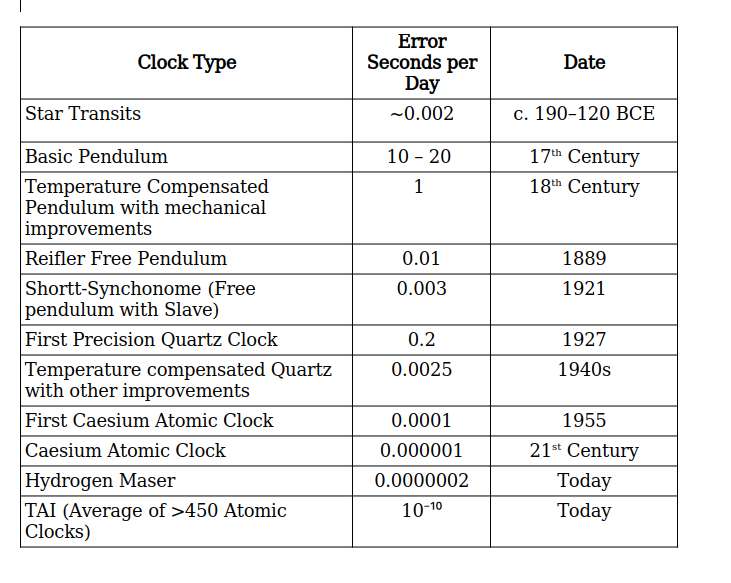
      This is a subproject: I’m building an experimental precision clock in hope modern techniques and materials might let me exceed the performance of a 1921 Shortt-Synchronome. The Shortt represents the ultimate pendulum clock, further development of the type being rendered unproductive by electronic clocks.  But development of pendulum clocks being stopped means it might be possible to outperform Shortt.  Always smart in engineering to define what good looks like, so this table puts numbers on expectations. To beat Shortt I need better than 0.003s per day.

      clockAccuracies

      Before Quartz and Atomic Clocks, time was set by observatories fitted with a transit telescope accurately aligned North-South, so the astronomer could detect the moment a known star passed directly overhead.  Fairly accurately!  The information was used to set the observatories pendulum clock, the best money could buy, and then to determine it’s rate (of drift).   The clock was left well alone, and the actual time signal was calculated as an offset from the pendulum dials.   At noon Greenwich would fire a cannon and drop a ball down a flagstaff so ships in the Thames could set their chronometers.  Around the world, other observatories expressed their time relative to Greenwich Mean Time. The GMT standard was based on a mean, by calculating the average of many measurements.  Meticulous hard work and lots of sums I don’t have time for!

      Anyway, though my main project isn’t going well, I need a method of measuring it. Not done by watching the hands or listening to time pips! I need to measure short-term stability in the microsecond region, or even nanoseconds, and long-term stability over months and years.  And my system needs to be tested too – I may have blundered in the implementation and my maths are famously bad.

      A four part problem:

      • How much does the period of a pendulum vary swing by swing,
      • How much does period vary over millions of beats?
      • What causes the errors? Many, many errors!  Pendulum clocks are vulnerable to outside influences, notably temperature and air pressure, but also vibration, draughts, turbulence, friction, mechanical defects, gravity, impulse disturbance, amplitude variation and other defects. A precision clock builder has to identify and fix as many issues as possible. It gets exponentially more difficult, and Shortt got close to the mechanical limit.
      • What can be done to eliminate or compensate for the errors?

      Just as toolroom or metrology lab tools have to be about 10x better than what they’re measuring, so do my methods. The table above lists the levels of accuracy achieved by clocks through the ages.

      One goto tool for microsecond measurements is the delightfully cheap PicPET, which, when fed with a 10MHz oscillator, measures pendulum period down into microseconds. A Precision Event Timer can also be implemented on some Arduinos, with various pros and cons.  In both cases accuracy depends on the oscillator.  An OCXO beats a TXCO, which beats an ordinary crystal, which beats a Ceramic Resonator.

      For long-term measurements, ordinary Network Protocol Time on a Linux Box is never wrong by more than 150mS, usually much better, and accuracy can be enhanced. Though Windows time is comparatively lackadaisical it too can be configured to perform well.

      GPS is superior to NTP: it emits super-precise seconds, and a serious player would use GPS to discipline his local NTP time, thus getting closer to atomic clock accuracy.  Ideally with a GPS receiver that specialises in time rather than the cheaper navigational types.

      Roughly speaking, the Shortt clock is just accurate enough to detect astronomical time varies. A good Quartz clock circa 1945 definitely sees planet earth is wobbling, and an atomic clock sees more discrepancies.

      Anyway, having built an Arduino PET, and able to exploit NTP, I thought it worth testing both against a moderately good electronic clock, one I built using another Arduino fitted with a Temperature Compensated Crystal Oscillator.  No data-sheet for the TXCO, but it turned out to be fairly good. Gained 5.3 seconds over 108 days, noticeably better than my domestic quartz clocks and wristwatch. The wristwatch  keeps good time because body heat keeps it close to constant temperature and they all come with a specially ground crystal.

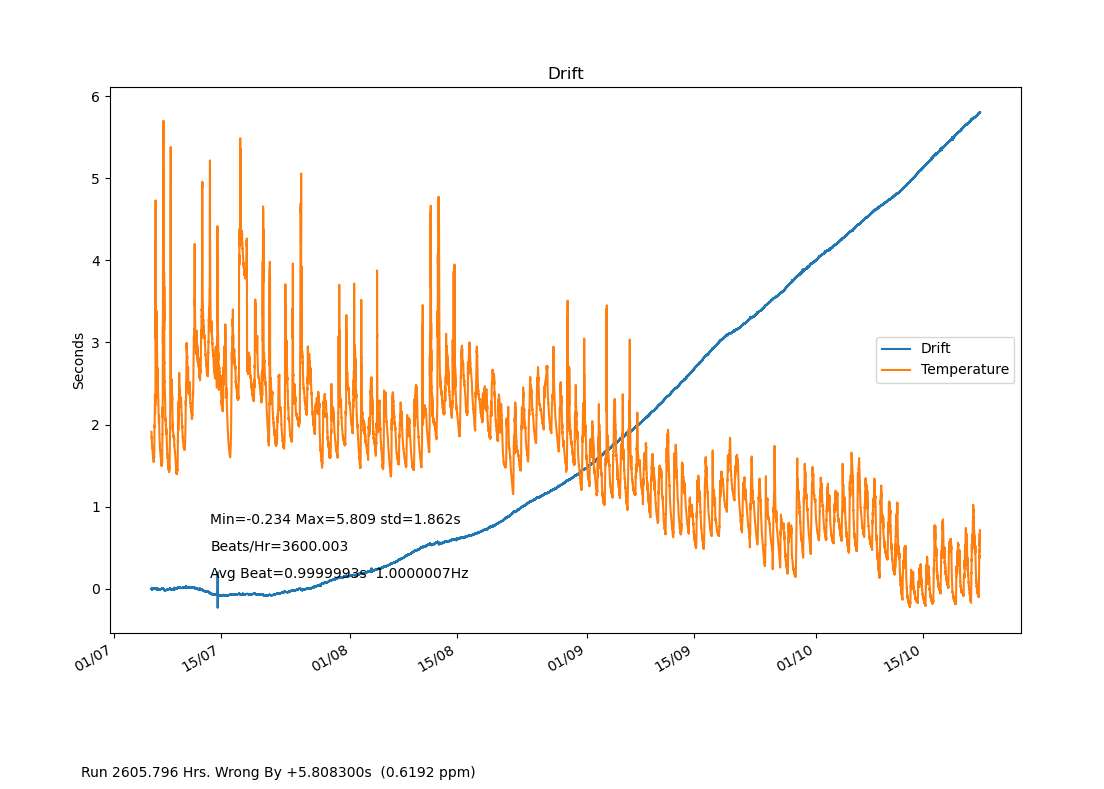
      Why is my TXCO clock drifting? I don’t know! It ran without significant drift for about a month, and then began to gain at a roughly constant rate.  There may be a correlation with temperature, but if so it’s slow acting. The yellow temperature line shows temperatures peaking at 37C during July, and then the average slowly dropping as the planet tilts away from the sun as we approach the winter solstice. Average 30°C down to average 18°C, and falling!  Sadly, I had to stop the test before the central heating was allowed on to keep the TXCO cosy.   Ideally the test would have run for more than a year. Might set it going again in an unheated spare room on a UPS and come back to it in a year or three. You can’t hurry time measurements.

      Here’s the graph, plotting temperature and time:

      digiCloclGraph


      The yellow temperature line shows wide daily swings that don’t seem to affect the TXCO at all, so the effect may not be temperature related. Maybe the crystal is aging due to mass transfer (dirt inside!) or stress. Stress includes movement of the structure supporting the crystal and the crystal itself due to temperature changes, and these would accumulate consistent with the graph.

      My electronic clock’s error is about 0.049s per day, twice as good as anything made before Reifler’s 1889 Free Pendulum clock,  But that expensive beast beats me by a factor of 5.  The reason Quartz ousted pendula is that they’re immune to vibration, gravity, air-pressure, mechanical problems and other factors that upset pendulums. And can be improved in many ways not limited by mechanical difficulties.

      So there we have it: an electronic clock that outperforms most pendulum clocks is defective!

      In the month before it started to drift, I doubted NTP time was fit for purpose. NTP shines in the long term by resetting the computers internal clock periodically, but that means the computer’s clock can wander between NTP corrections. Some are better than others.  Less frequent synchronisation is one reason raw Windows is more likely to be off than raw Linux. Linux isn’t perfect: the NTP software is being replaced by chrony, which I have yet to evaluate.   Also, the clock I’m measuring doesn’t do leap-seconds, whilst I’m comparing it with one that does; Unix CLOCK_REALTIME is UTC. Maybe I should switch to CLOCK_TAI, which ignores the planet entirely and just counts seconds. Except the last leap second was added in 2016, so not that!  And TAI currently differs from UTC by 37 seconds.

      Any ideas about what might be causing the drift or spoiling the measurement?

      A warning to prospective precision clockmakers!  Let my ship-wreck be your sea-mark. As can be seen making and testing precision clocks is difficult.  And it gets progressively worse.  Every improvement reveals more problems, and every fix is harder than the one before.  Wish I was a masochist!

      Dave


      #821806
      Michael Gilligan
      Participant
        @michaelgilligan61133

        One thing I must add, Dave

        Please remember that the Shortt, et al, were already good enough to detect ephemeris and tidal fluctuations … a fundamental ‘problem’ with any physical pendulum !

        You are now living in a world where TIME itself has been conveniently re-defined … so what exactly are you chasing in terms of accuracy? The behaviour of the historically best pendulum clocks, or the new version of Time ?

        If you ever get near enough for that to actually matter, than you will have achieved near-perfection … but the question must surely be included  on your list !

        MichaelG.

        #821811
        Robert Atkinson 2
        Participant
          @robertatkinson2

          I’d suggest a failing TCXO. Probably drifted outside of the available compensation range or the temperature sensing circuit has drifted / failed.

          By the way crystals are not immune to gravity effects. I can easily see a frequency change in realtime as a good 10MHz OCXO is rolled through 180 degrees (2G change).

          I suggest you get some OCXO’s. At least 3. There are some ex-telecom used ones available from China at very low cost. The come as just the OCXO or assembled on a PCB.

          Robert.

          #821812
          SillyOldDuffer
          Moderator
            @sillyoldduffer
            On Michael Gilligan Said:

            One thing I must add, Dave

            Please remember that the Shortt, et al, were already good enough to detect ephemeris and tidal fluctuations … a fundamental ‘problem’ with any physical pendulum !

            You are now living in a world where TIME itself has been conveniently re-defined … so what exactly are you chasing in terms of accuracy? The behaviour of the historically best pendulum clocks, or the new version of Time ?

            If you ever get near enough for that to actually matter, than you will have achieved near-perfection … but the question must surely be included  on your list !

            MichaelG.

            Ah yes, but I’m trying to outdo Shortt’s pendulum clock with my pendulum clock.

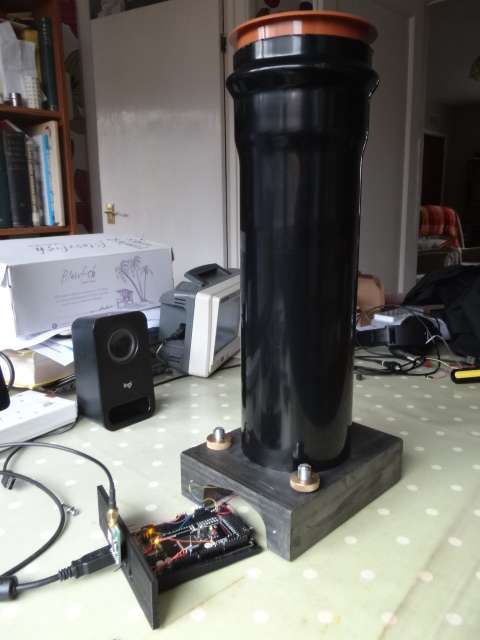
            DSC06955


            The soil pipe can be evacuated once I’ve sorted a vacuum valve.  Unlikely to hold a hard vacuum, but it might do 0.8bar.  After going for a PVC pipe I realised the plastic will probably gas, and pull out the plasticiser, causing wormholes.  I’m sure the pipe will hold 2bar but a vacuum is different because gas molecules are smaller than water.   We’ll see!  A friend has a length of Aluminium pipe that might replace it, but sealing the top is too much trouble at the moment.

            The green module plugged into the front panel is a Ublox M8Q GPS: it’s used to set the clock accurately, and then find the pressure and temperature compensation values.   Then it’s unplugged and the pendulum keeps time on it’s own.   A display can be plugged into the same socket to show time, and time is also logged to a PC via USB.   The PC can send commands to the clock, so I can experiment with impulsing the bob on every beat, or allowing it to swing several times between impulses.  In air I found it best to impulse on every beat, but may be better to impulse less often in a partial vacuum.    Also possible to change the software without touching the clock.

            I’m sure it’s possible, not least because Shortt didn’t have access to reliable electronics.  But I also have to prove my pendulum clock really is better than his.  Hence my need for a high-end way of measuring precision pendulum clocks, ideally in the 0.0002 second per day region.   Not possible with the original gold standard (star transits), but achievable with GPS, and an OCXO might do.  Or I could buy an atomic clock.

            As I write, the latest rebuild of my Shortt basher is reluctant to start, and only runs for about 20 minutes. The previous version started and ran reliably, but though good by ordinary pendulum standards, it was considerably inferior to Reifler, leaving me to improve it by about 20x to get up to scratch.

            Made several changes causing new problems.  Why the clock doesn’t start and run reliably might be the subject of another thread.  I’m hoping the bob is too far from the electromagnet, and I can fix it by installing a fatter bob.  My understanding of the relationship between the bob’s inertia and the strength of the magnetic field needed to move it is poor.  The strength of a magnetic field decreases with the cube root of distance, which I thoughtlessly increased.  Result, adjusting the impulse is incredibly finicky, and I’ve not found the happy medium.  The bob either crashes into the structure or loses energy and stops.   Being a little too far from the electromagnet would explain the faulty starting too.  Not the end of the world because I can change the holder to bring the electromagnet closer if need be.  Fortunately, the holder is a Solid Edge 3D model that can be reprinted in a few hours provided I get my act together! Making a bigger bob on the lathe is an easy job, but the mass may be too much for the electromagnet.

            All very annoying because the planned improvements and parts needed to have another go were put in a box when illness forced me to stop last year.  When I opened the box recently it was empty!  And I’m only semi-remembering what needs doing.  Arghh!

            I do wish you hadn’t put the idea of chasing electronic perfection into my bonehead!  It’s a another kettle of rotting fish, and I’m in enough trouble already!

            Dave

            #821827
            Michael Gilligan
            Participant
              @michaelgilligan61133

              Apologies, Dave … I didn’t intend to burden you by asking the rhetorical question:

              ”what exactly are you chasing in terms of accuracy?”

              … but I think it will ultimately prove to be important, so it does need some contemplation.


              I’m delighted to see that you are sufficiently recovered to re-boot your activity on this … it’s probably the most fascinating project I have seen in the last four years.

              MichaelG.

              #821837
              Dave S
              Participant
                @daves59043

                Probably thread drift, but a question occurs to me:

                Vacuum is preferred because there is noting in the way?
                But holding vacuum is hard.
                Why not run in a sealed pressurised system? There is more energy loss, but that could be dealt with I think by a larger impulse, and if the pressure is constant the loss should also be?

                Dave

                #821848
                SillyOldDuffer
                Moderator
                  @sillyoldduffer

                  Excellent comments thanks, and I don’t mind a bit of thread drift.

                  No need for Michael to apologise about his “what are you chasing?” question.   It’s another interesting aspect of the time problem.  As is “what is time?”   I like time being a consequence of the Second Law of Thermodynamics, stemming from Lord Kelvin’s study of steam engines, and developed by Clausius with the concept of entropy.    Time flows in one direction because entropy is increasing, and if so, time stops with the Heat Death of the Universe.   Blows my tiny mind!!!

                  Robert’s information that quartz crystals respond to gravity was news to me, but of course he’s right.   Quartz must be less sensitive to gravity than pendulums though.   It’s another example of a time-keeping technology that results in a step improvement, but the clock is still imperfect.

                  I have couple of ex-equipment 10Mhz OCXOs.   Two problems: how to trim them accurately to 10MHz?  And, for my purposes, 10MHz is an awkward frequency.  16MHz divides down to 1 second from a power of two, easy peasy.  Which reminds me – there’s a small inaccuracy in my test clock because the 20MHz TCXO doesn’t divide exactly to 1 second either.  Must check if that’s causing the drift!  An alternative oscillator is changing the frequency output of a GPS unit.  I have a uBlox M8Q that can do this, but not all frequencies are stable.  On the face of it, it’s a cheap GPS disciplined oscillator, except I don’t know how good it is.  More work!

                  I’ve already seriously considered Dave’s run above pressure suggestion. It solves the container problem and stops varying air pressure disturbing the pendulum.   Unfortunately, it increases the density and viscosity of the air causing more friction and turbulence.  Might be possible to address that.   At the moment I’m using a cylindrical bob, which is aerodynamically poor.  Aerodynamics don’t matter in a vacuum, but increased pressure makes airflow important.  So pressuring takes me into finding the best aerodynamic shape for a bob, which is a major project in it’s own right!  And the shape might not fit into what I’ve already built.  Dave’s point about pressure and loss being constant hadn’t occurred to me:  be nice if simply increasing the impulse was enough.  I’ll stick with the vacuum for the time being, but if it fails, over-pressure is on the agenda.

                  I’ve decided to re-design the magnet holder to bring the electromagnet 4mm closer to the bob.  With luck it will make adjustment less critical and start the bob swinging from stopped reliably.

                  Dave


                  #821851
                  Michael Gilligan
                  Participant
                    @michaelgilligan61133


                    Not wishing to distract Dave from his wonderful endeavour … I am linking this as background to my what exactly? comment.

                    The credentials of the author are beyond dispute, and it is very clearly written.

                    https://www.britannica.com/science/second

                    MichaelG.

                    #821852
                    Michael Gilligan
                    Participant
                      @michaelgilligan61133

                      IMG_1172

                      Probably not ^^^

                      #821863
                      Robert Atkinson 2
                      Participant
                        @robertatkinson2

                        10 MHz divides easily in hardware to 1Hz with decimal dividers. Most counters and pre-scalers built into microcontrollers are binary. It’s generally better to use hardware dividers. If you do want a handy number for binary math you can get 80kHz or 16kHz from 10MHz with an integer divider. This can be external to the micro.
                        An exception to the “hardware is better” rule is the PicDIV.
                        http://www.leapsecond.com/pic/picdiv.htm
                        If you cant program Pic’s I can do one for you.

                        I’m sure you know, but just in case, the force from a electromagnet falls with the square of the increase in distance (gap) so fine adjustment may be required for small gaps. It’s alsp “positive feedback” for a pendulum. If it swings closer for any reason it gets more energy, swings closer….

                        Robert.


                        #821875
                        JA
                        Participant
                          @ja

                          All this assumes that time is a constant (which it is).

                          However it is a function of age. It speeds up as one gets older. There should be a nice lot of maths there.

                          JA


                          #821876
                          duncan webster 1
                          Participant
                            @duncanwebster1

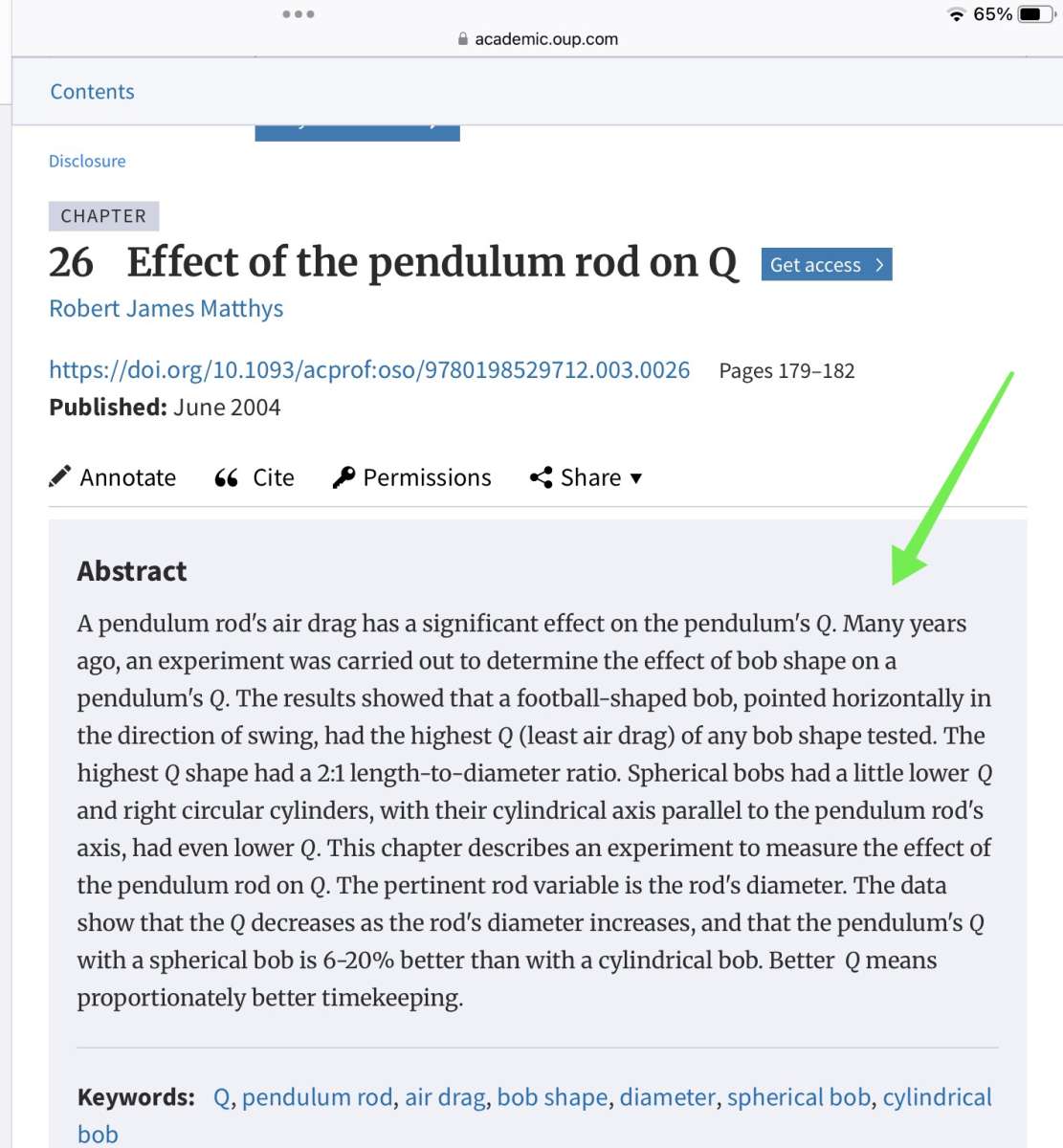
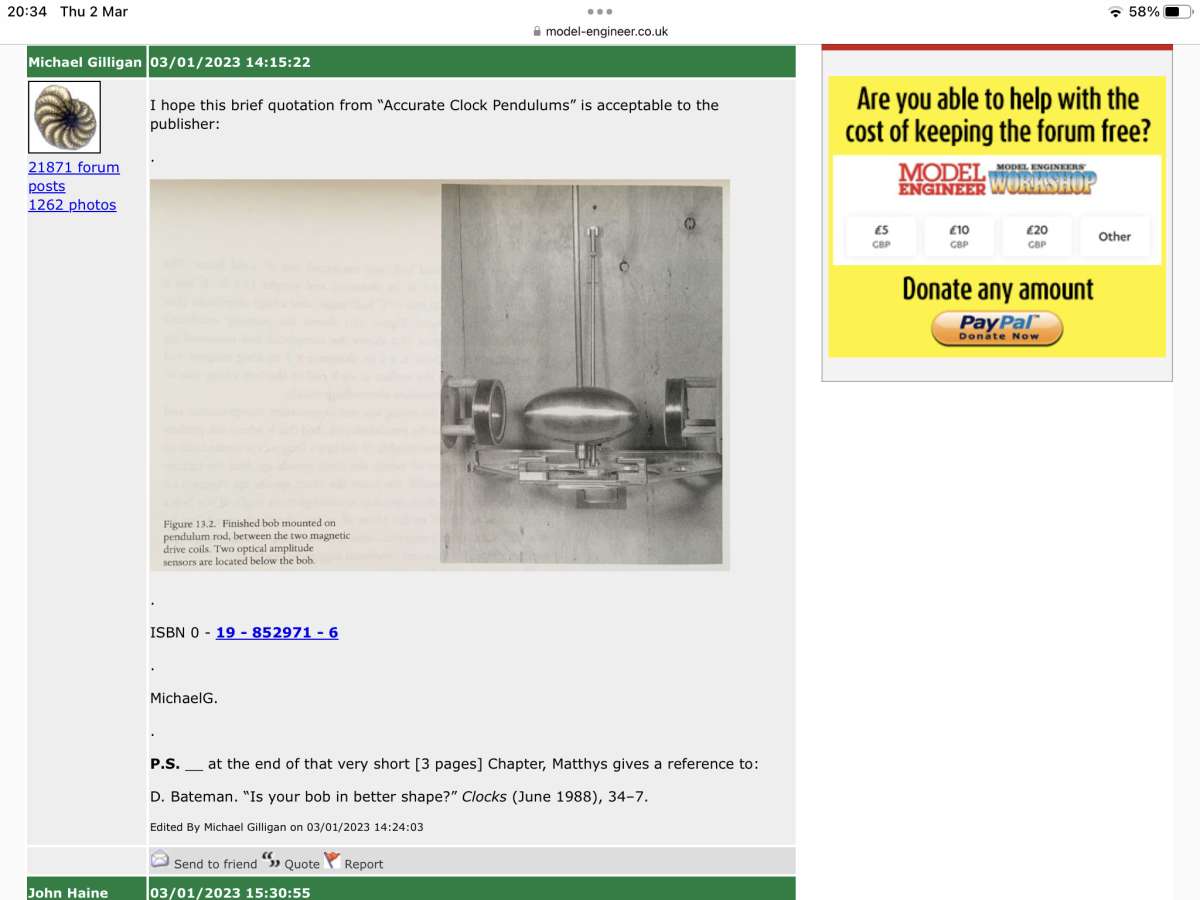
                            Best shape for bob is reputed to be like American football, but I can’t find reference.

                            For ally tube, try combi boiler flue suppliers

                            #821880
                            Michael Gilligan
                            Participant
                              @michaelgilligan61133

                              Almost sure it was Matthys, Duncan

                              … I will check later

                              MichaelG.

                              .

                              Ref. __ https://www.researchgate.net/publication/344573673_Accurate_Clock_Pendulums

                              #821886
                              John Haine
                              Participant
                                @johnhaine32865

                                No, Doug Bateman.

                                #821892
                                Michael Gilligan
                                Participant
                                  @michaelgilligan61133

                                  You’re right, of course, John

                                  Matthys cites Bateman’s experiment

                                  MichaelG.

                                  .

                                  IMG_1173

                                  #821894
                                  Bazyle
                                  Participant
                                    @bazyle

                                    Replying to Dave S: The problem with the air is not the presence of the gas which can be allowed for so much as the change in properties with temperature and pressure. However because of the extra ‘friction’ more impulses are needed and that too is a source of error.

                                    #821896
                                    John Haine
                                    Participant
                                      @johnhaine32865

                                      What physical mechanism causes the direction or strength of gravity to change the frequency of a quartz crystal?

                                      #821900
                                      John Haine
                                      Participant
                                        @johnhaine32865

                                        On the bob shape question, the actual shape within reason doesn’t seem to make much difference to Q though the optimum seems to be an ellipsis.  Joe Noci uses an ellipsoidal bob.  Worth looking at Chris Raynerd’s thread on his Tekippe clock which uses a length of hex brass bar at right angles to the rod with a blunt point at each end.

                                        #821901
                                        Michael Gilligan
                                        Participant
                                          @michaelgilligan61133

                                          IMG_8049

                                          #821907
                                          Andrew Tinsley
                                          Participant
                                            @andrewtinsley63637

                                            Just to correct one observation, time is NOT constant! It depends on your position in a gravitational field. Einstein’s relativity theory made this clear.

                                            Time on a GPS satellite is different to time on earth’s surface. GPS has to make allowances for this, otherwise your Sat Nav doesn’t give the correct position.

                                            Andrew.

                                            #821908
                                            Michael Gilligan
                                            Participant
                                              @michaelgilligan61133
                                              #821920
                                              duncan webster 1
                                              Participant
                                                @duncanwebster1

                                                Excellent link Michael, but I wouldn’t go trying to buy depleted U unless you want a call from the security services. For starters the swarf is prone to catching fire if you machine it, and it is slightly radioactive.

                                                As I don’t have a CNC  lathe or copying attachment to make the oblate spheroid I wonder how well a series of truncated cones would work? I’ll try to draw it up later

                                                #821933
                                                Robert Atkinson 2
                                                Participant
                                                  @robertatkinson2
                                                  On John Haine Said:

                                                  What physical mechanism causes the direction or strength of gravity to change the frequency of a quartz crystal?

                                                  It’s the change caused to stresses within the resonator (a thin slice cut from a actual crystal. It should be remembered that it is a mechanical resonator. For some types of crystal cut can also be affected by changes in shape of the resonator caused by accereration.
                                                  Pressure also affects them. Some high accuracy pressure transducers use this effect but the cut of the crystal is selected to maximise sensitivity to pressure.

                                                  https://www.microwavejournal.com/articles/7711-managing-crystal-oscillator-acceleration-sensitivity-in-mobile-applications

                                                  Robert.

                                                  #821950
                                                  Robert Atkinson 2
                                                  Participant
                                                    @robertatkinson2

                                                    You can own up to 15kg of depleted or natural Uranium without any licence or permit. It has a couple of issues in addition to being radioactive and a heavy metal toxin. As Duncan says it is pyrophoric and it oxidises readilly so ideally you need to machine it in an inert atmosphere and elecroplate it right away. Tungsten would be a better choice but you would probably have to grind it.

                                                    Robert.

                                                    #821951
                                                    Michael Gilligan
                                                    Participant
                                                      @michaelgilligan61133

                                                      I am way out of my comfort-zone, so please forgive me for pondering ‘out loud’

                                                      Would there be any merit in repeating Bateman’s shape comparison in either a wind tunnel [higher airspeed] or a water tank [higher viscosity] ?

                                                      I’m thinking that these environments might stretch the results, such that Bateman’s numerous small experimental errors get trivialised by by bigger signals.

                                                      .

                                                      Grateful for any education from someone ‘experienced in the art’

                                                      MichaelG.

                                                    Viewing 25 posts - 1 through 25 (of 283 total)
                                                    • Please log in to reply to this topic. Registering is free and easy using the links on the menu at the top of this page.

                                                    Latest Replies

                                                    Viewing 25 topics - 1 through 25 (of 25 total)
                                                    Viewing 25 topics - 1 through 25 (of 25 total)

                                                    View full reply list.