Measuring Clocks

Measuring Clocks

Home Forums Clocks and Scientific Instruments Measuring Clocks

Viewing 25 posts - 76 through 100 (of 283 total)
  • Author
    Posts
  • #822487
    duncan webster 1
    Participant
      @duncanwebster1

      Changing tack a little, if the pendulum is impulsed by an electromagnet or coil at middle position attracting an armature or repelling a magnet, it seems intuitive that the force is not far off vertical, and has a much larger vertical component than horizontal. This must affect period as it changes effective gravity. The pendulum in Michael’s post of 3 1 23 is arranged to exert horizontal force, is this fundamentally better? Brillie and ATO clocks were similar.

      #822499
      John Haine
      Participant
        @johnhaine32865

        Constant amplitude = constant circular deviation. So adjust the impulse to keep amplitude constant.  There is nothing in the Shortt which keeps the amplitude constant.  Both the master and slave pendulums’ amplitude decay over the 30 seconds between impulses.  If you record the period you can see it changing over that 30s.

        #822531
        SillyOldDuffer
        Moderator
          @sillyoldduffer
          On blowlamp Said:

          Within reason, circular error won’t matter as long as it is constant. As soon as the circular error changes then so does the period of the pendulum and is important if you want to surpass the performance of a Shortt clock.

          Martin.

          In a real clock the circular error isn’t constant.   Not if you look close enough!   I’m accurately measuring individual beats and finding amplitude varies, mostly, I think, due to the clock being on a wobbly dining table, and partly because the impulse isn’t spot on. Amplitude increases if the pulse is too strong, and decreases if the pulse is weak.

          My goal is to get closer to constant.  Two ways under investigation:

          • By varying the impulse power methodically over a range to find the power that results in the most stable amplitude. Problem isI expect the exact sweet spot depends on the environment, notably temperature.  Not constant.
          • Recognising that the exact sweet spot moves, the alternative is to measure amplitude, and alter the impulse to keep it close to the sweet spot.   Nearer to constant than it would otherwise be.

          In the context of aiming to outdo a Shortt-Synchronome, the definition of “within reason” is very broad.   High performance requires everything to be as good as I can get it.   In theory, I’m tackling big errors first.  Not always: running the pendulum in a vacuum will deliver bigger benefits, but sealing the clock will be difficult, and it’s hard to change the mechanicals once they’re locked inside.  I’m putting the vacuum side off, playing with governing amplitude first, because its relatively easy.

          I’m very worried about the vacuum!  Not confident my plastic drainpipe is up to the job.  A chap on the internet spent a lot of money on a Pyrex vacuum enclosure,  and found it didn’t hold a vacuum. Problem was that new Pyrex is gassy.  Had to repeatedly pump the tube out to get rid of it, taking a few months before it cleaned up/    Bet my PVC pipe will be even gassier, and may never be leakproof.  Air-pressure could create wormholes by pushing plasticiser out of the PVC and into the vacuum chamber.  Although PVC is waterproof, gas molecules are much smaller than water.   Likely to find a way in!

          This is an experiment rather than a practical project.  Some ideas are working out, others not.  Whether I get anywhere near Shortt-Synchronome accuracy remains to be seen.   Don’t bet the farm on it!

          Dave


          #822532
          Michael Gilligan
          Participant
            @michaelgilligan61133

            Any interest, Dave ?

            I hadn’t seen these GPS combiners before.

            https://www.ebay.co.uk/itm/286904626799?

            MichaelG.

            #822543
            John Haine
            Participant
              @johnhaine32865

              Just the job to lose 6db sensitivity…

              #822544
              blowlamp
              Participant
                @blowlamp

                To state it more clearly. Amplitude decreases from the moment the pendulum starts to swing, so it could be argued that there is actually no such thing as ‘constant amplitude’ under any circumstances in any clock.

                The Shortt clock uses the constant of gravity to not only cause the pendulum to oscillate, but also uses the same constant to give an exactly repeatable impulse to it, via the gravity arm, every 30 seconds.

                The way the impulse is applied means that almost no variations occur and ensures that the cycle repeats predictably. It would be fair to say that 30 seconds between impulses was arrived at as a good compromise between the steady loss of amplitude (isochronism) and the unwanted effects of applying unecessary impulses.

                In contrast, Dave seems to be trying to maintain constant amplitude by detecting the transit speed, deriving the error and then compensating for it by applying a calculated, on the fly, variable restoring force.

                Introducing intermittently applied correcting forces seems to be problematic to me.


                Martin.


                #822560
                SillyOldDuffer
                Moderator
                  @sillyoldduffer
                  On blowlamp Said:

                  To state it more clearly. Amplitude decreases from the moment the pendulum starts to swing, so it could be argued that there is actually no such thing as ‘constant amplitude’ under any circumstances in any clock.

                  Agreed!

                  The Shortt clock uses the constant of gravity to not only cause the pendulum to oscillate, but also uses the same constant to give an exactly repeatable impulse to it, via the gravity arm, every 30 seconds.

                  The force isn’t exactly repeatable, there will be variations

                  The way the impulse is applied means that almost no variations occur and ensures that the cycle repeats predictably.

                  Not exactly predictable, because ‘almost no variations’ is not the same as ‘no variations’.   Though very good, Shortt’s free pendulum is not completely isolated.


                  It would be fair to say that 30 seconds between impulses was arrived at as a good compromise between the steady loss of amplitude (isochronism) and the unwanted effects of applying unecessary impulses.

                  In contrast, Dave seems to be trying to maintain constant amplitude by detecting the transit speed, deriving the error and then compensating for it by applying a calculated, on the fly, variable restoring force.

                  Introducing intermittently applied correcting forces seems to be problematic to me.


                  Martin.


                  Surely Shortt dropping a weight every 30 seconds is an “intermittently applied correcting force”, of the type Martin objects to?  If I’m wrong, so is Shortt.   The question is, will my magnetic escapement work better than Shortt’s electromechanical design?

                  I suggest there’s no difference in kind between the two.  A metered impulse provided by dropping a gravity arm with an electromagnet. and an electromagnet applying a metered impulse directly to the bob both add energy.   I feel a direct acting electromagnet may be able to do better than Shortt because there’s no mechanical contact between the free-pendulum and the impulse.  And magnet pulses are potentially less intrusive because the magnetic field applies a soft force.  Not attempted the maths, but I think a magnetic impulse is closer to the sinusoidal ideal.  Less of a bump.

                  The proof is in the pudding, but gut feel, I suggest a system providing a magnetic pulse of very accurate start and duration, should deliver energy far more precisely than a falling lump of metal!  It’s surely worth trying.  Worth emphasising that I can alter the force applied by the electromagnet in tiny increments – there is no crashing about. My clock’s amplitude will be delicately maintained close to constant, which the Shortt-Synchronome doesn’t do; it balances the disturbance out over with a 30 second cycle.  I’m hoping to minimise disturbance  faster than that, by slightly changing the impulse power.

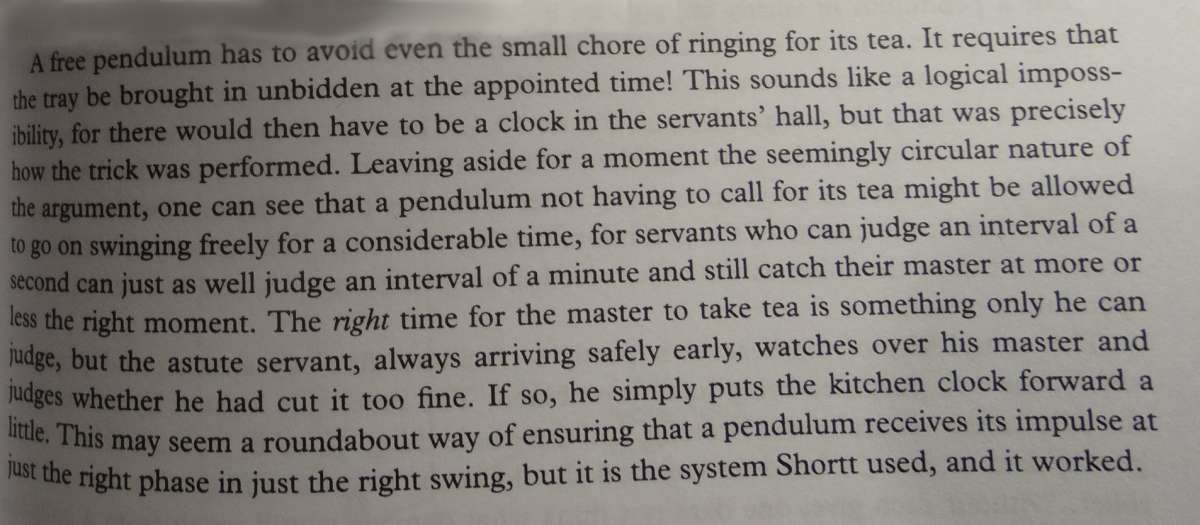
                  Chapter 10 of “My Own Right Time” has an interesting discussion on ‘A free-pendulum has to avoid even the small chore of ringing for it’s tea.”  Shortt and/or Hope-Jones arranged a timed gravity arm, probably derived the timing empirically.    In contrast, my pendulum’s servant supplies tea when needed.  Possible because transit time (amplitude) can be measured without disturbing the pendulum.   Shortt didn’t have the technology, I do!

                  Right or wrong, it’s all very interesting.

                  Dave


                  #822561
                  Michael Gilligan
                  Participant
                    @michaelgilligan61133
                    On John Haine Said:

                    Just the job to lose 6db sensitivity…

                    But with four GPS modules connected, it should give Dave more reliable coverage of the sky.

                    Sorry if I’m being dim … I just thought it might be useful.

                    MichaelG.

                    #822564
                    John Haine
                    Participant
                      @johnhaine32865

                      30s because the synchronome “master” clock had to operate useful time displays, ie the “slaves”. That forced the same reset interval on the Shorter free pendulum but in fact it could operate for much longer between impulses.

                      I would like to operate an EM clock without amplitude control to explore barocentric compensation but drive voltages, coil resistances, and magnetic characteristics are all too variable, hence the interest in gravity escapements.

                      #822567
                      duncan webster 1
                      Participant
                        @duncanwebster1

                        Various Internet references quote Fedchenko as the most accurate pendulum clock, and that was electrically impulsed. It dis have a rather clever suspension which was supposed to eliminate circular error, and so amplitude control wasn’t needed.

                        #822568
                        blowlamp
                        Participant
                          @blowlamp

                          Dave.

                          How often does your pendulum receive an impulse?


                          Martin.

                          #822576
                          SillyOldDuffer
                          Moderator
                            @sillyoldduffer

                            Not a good day.  Found a new bug in the starter.  The code I wrote to stop the pendulum makes things worse!  Interruptions and poorly again.

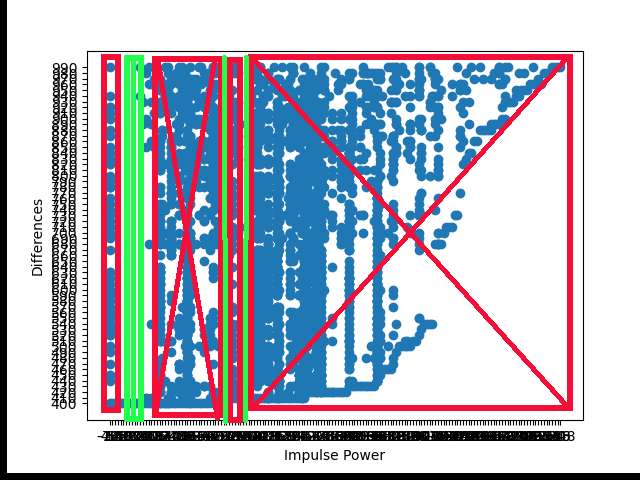
                            This scatter graph shows my attempt to find the optimum impulse power.   The clock was told to increase impulse power from too slow to too fast, and the effect on amplitude captured.   Shows differences between the period of successive beats, which is a measure of bad behaviour.  Ideally there should be no difference.

                            diffImpulseScatter

                            I’m very suspicious of the results for several reasons.  One is the scan was too fast a ignoring that it takes many beats for the bob to react due to inertia.  It needs time to settle.  The increase rate was aggressively, and I leaned on the table several times during the run.

                            Anyway, the areas marked in RED show the pendulum reacting badly.   Fairly obviously on the right, impulsing with too much force disturbs the pendulum.   As does not applying enough force on the left!  Disturbance at the low power end may be a fib – measurements taken before the pendulum had settled from a cold start.

                            However, the wide green area on the left shows the pendulum is less disturbed by weak impulses, not surprising!  The optimum running impulse is probably in this region.

                            More surprising are the good and bad bands in the middle.  Hard to explain.  Faulty experimental method, or perhaps the rod is twanging.  Conventional pendulum clocks impulse close to the suspension.  Magnetically impulsed clocks, including this one, usually apply force at the bob end, which might cause the rod to bend as it does the equal and opposite reaction thing.  Dunno. I’ll have to come back to it.

                            Dave


                            #822578
                            SillyOldDuffer
                            Moderator
                              @sillyoldduffer
                              On blowlamp Said:

                              Dave.

                              How often does your pendulum receive an impulse?


                              Martin.

                              Once per beat at the moment. However, the clock is configurable.   When I update the code (it exists in the Mk1 clock), it can impulse after ‘n’ beats, or if the amplitude falls below a given level.   Could also be programmed to impulse every ‘n’ beats whilst increase/decreasing power depending  on amplitude too.  Not got to that one yet.

                              I suspect the method that works best in air may not be best in a vacuum.  Has to be trialled to find out.  Also, that which is best depends on the pendulum – mine is unusually short and light.

                              In the Mk1 version of the clock I found period was less disturbed by lightly impulsing on every beat rather than intermittently.  It’s mentioned this evening’s earlier reply to Duncan.

                              Dave

                              #822579
                              John Haine
                              Participant
                                @johnhaine32865
                                On Michael Gilligan Said:
                                On John Haine Said:

                                Just the job to lose 6db sensitivity…

                                But with four GPS modules connected, it should give Dave more reliable coverage of the sky.

                                Sorry if I’m being dim … I just thought it might be useful.

                                MichaelG.

                                But only 1 antenna, which is what determines sky coverage.  Modern GPS chips can receive multiple channels from multiple constellations on multiple frequencies so there’s not much benefit from feeding them all from the same antenna.  Best to have one antenna in a good location and minimal loss between that and the receiver – for timing at least.

                                #822588
                                John Haine
                                Participant
                                  @johnhaine32865

                                  On the question of circular deviation (CD) and escapement deviation (ED), conventional thinking is that one should impulse at the centre of swing and keep amplitude constant to minimise both.  But some very god clocks use escapements such as dead-beat or some types of gravity principle which introduce quite a lot of ED which makes the clock rate change with amplitude.  One can arrange to balance this against CD to get zero sensitivity to amplitude variation at a specific arc.  This is what the Tekippe clock like Chris Raynerd is building does.  Or like clock B you can arrange to let amplitude change with air density and have some residual CD to compensate for buoyancy variations.

                                  #822589
                                  duncan webster 1
                                  Participant
                                    @duncanwebster1

                                    <p style=”text-align: left;”>I think this discussion has prompted me to redo the electronics on my 3/4 second clock and arrange it so that instead of missing a pulse on excess swing it gives a shorter pulse. The ideal would perhaps be an analogue measurement of amplitude feeding into a PID controller. I can imagine how to do the amplitude, but PID is out of my pay grade.</p>
                                    It won’t happen any time soon, too many other half finished projects

                                    #822593
                                    Michael Gilligan
                                    Participant
                                      @michaelgilligan61133

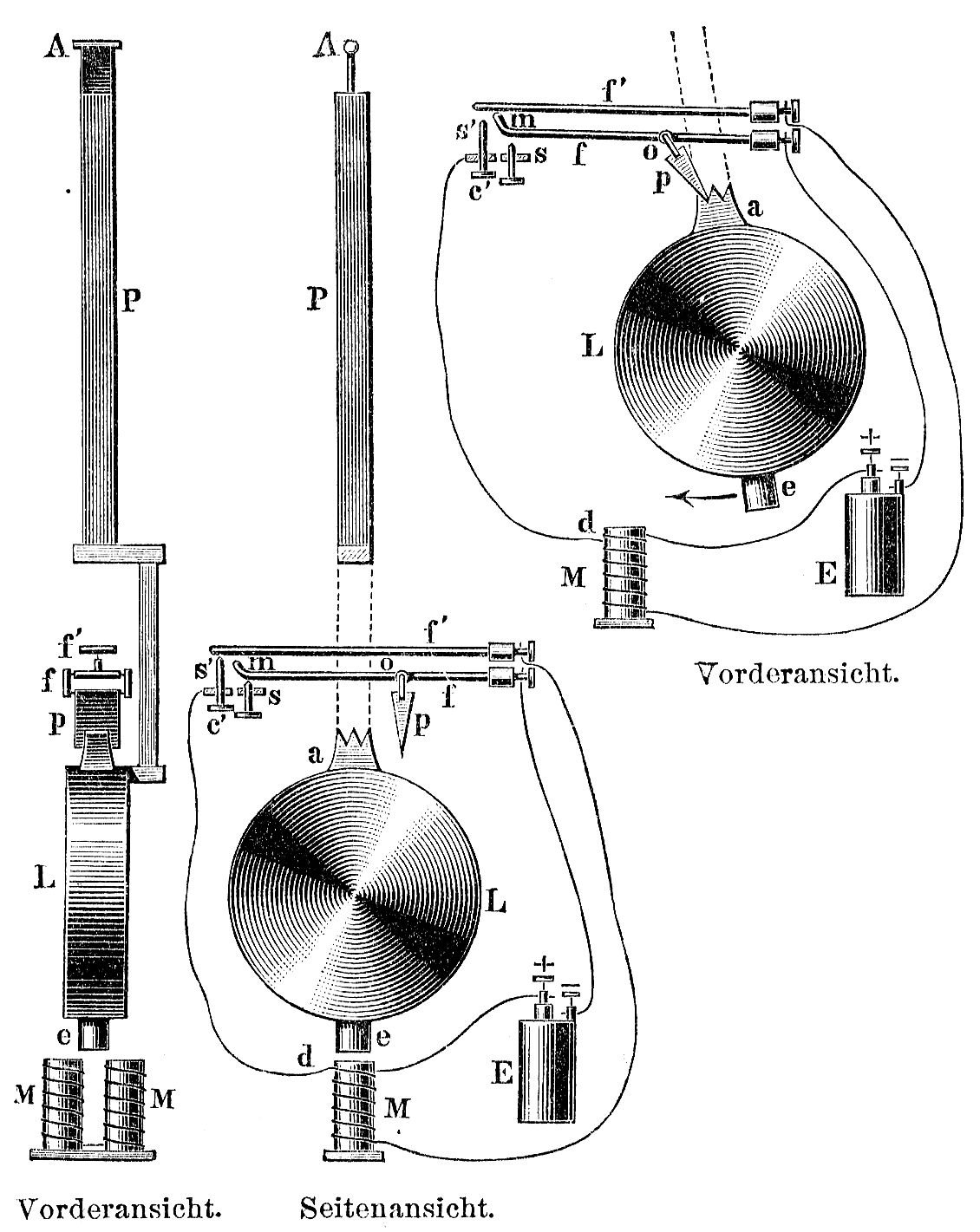
                                      Just found this excellent engraving of Hipp’s clock:

                                      https://upload.wikimedia.org/wikipedia/commons/c/cf/Matthaeus_Hipp_Elektrische_Pendeluhr.jpg

                                      Source is cited on the page.

                                      MichaelG.

                                      .

                                      Edit: … and here’s my find of the day, for Hipp enthusiasts

                                      [complete with the blueprint]

                                      https://www.worldradiohistory.com/UK/Practical-Mechanics/30s/Practical-Mechanics-1938-10-S-OCR.pdf
                                      .

                                      Sorry, Dave … I will keep quiet for a while.

                                      #822613
                                      Michael Gilligan
                                      Participant
                                        @michaelgilligan61133
                                        On Michael Gilligan Said:

                                        Just found this excellent engraving of Hipp’s clock:

                                        https://upload.wikimedia.org/wikipedia/commons/c/cf/Matthaeus_Hipp_Elektrische_Pendeluhr.jpg

                                        Source is cited on the page. […]

                                        MichaelG.


                                        https://en.wikipedia.org/wiki/Matthäus_Hipp#/media/File:Matthaeus_Hipp_Elektrische_Pendeluhr.jpg

                                        #822809
                                        SillyOldDuffer
                                        Moderator
                                          @sillyoldduffer

                                          Good progress yesterday on the software.

                                          • Implemented the amplitude governor; the logic works but the parameters need attention. The governor has to get a lock over a wide range, mustn’t under or overshoot, or hunt, and has to react in a timely fashion.  Delicate adjustments take too long, and rapid adjustments disturb the pendulum.
                                          • Improved the pendulum starter so it recognises when the pendulum is:
                                            1. already moving, and increases amplitude slowly to target.  OR
                                            2. stopped, and has to be powered up brutally and then settled by switching to method 1 above.
                                          • Added status report so a PC can ask for the current settings
                                          • Added intermittent pulse option.
                                          • The impulse options can all be turned on/off by PC command and their control parameters changed.
                                          • Code tidy up.

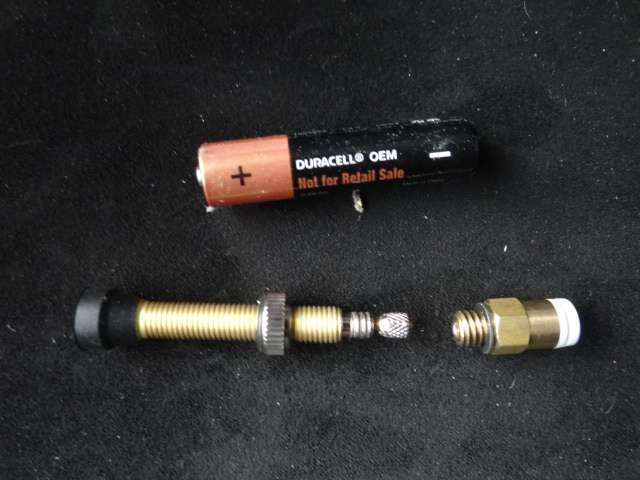
                                          As a change from software, I’ve started on the vacuum valve.  Plan A is a Presta Bicycle valve in reverse.   Needs to be connected to a 4mm diameter plastic pipe, for which I have a connector.  Presta and tube connector shown below, AAA battery for scale:

                                          DSC06973

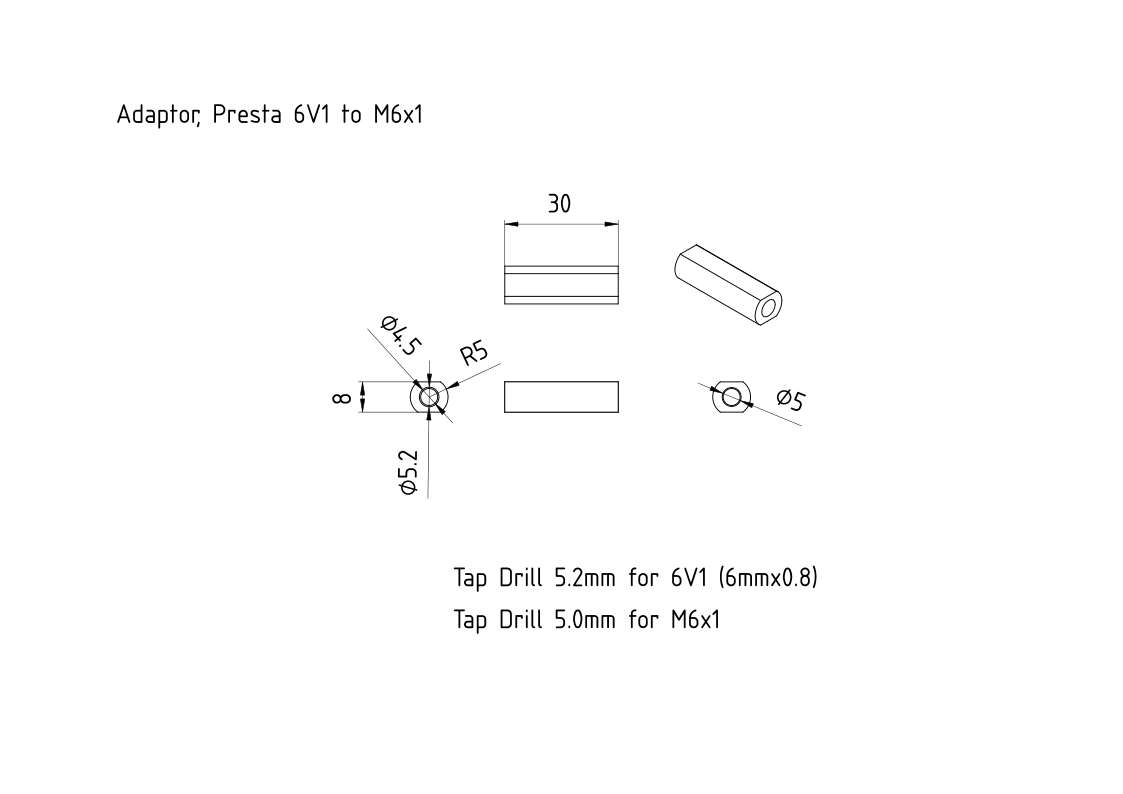
                                          An adaptor is needed.  The tube connector is M6×1.  The Presta thread is new to me: it’s ISO4570 6V1, 6×0⋅8, which isn’t a standard metric fastener thread.   Fortunately taps are available so I don’t have to make one!

                                          adaptorPresta

                                          To seal the adaptor, propose to:

                                          • cut the threads for a tight fit
                                          • fit with plumber’s goo on the threads
                                          • then dip whole assembly in latex rubber.

                                          I shall test the valve on a small cylinder before fitting one to the clock.  If it doesn’t work, Plan B as suggested by Michael G.

                                          How to seal the pipe and electrical wiring where it passes out through an 8mm hole is another worry.  I’m thinking hot-glue or latex because proper vacuum sealing compound is expensive – £107 per kg.

                                          Dave

                                          #822841
                                          old mart
                                          Participant
                                            @oldmart

                                            For a pendulum in air, I would think that the”pointy eliptical” one would be best, but with the body curved to match the pendulums radius. The best shape for a body moving in air is the teardrop, but it is limited to one direction and a pendulum has to reverse ti work. Densimet tungsten alloy uses tungsten particals sintered with iron as a binder and it machines very well. It has a relative density of around 18, I have made several lathe tools for holding carbide inserts from it, very good for boring bars as it is stiffer than steel, denser and not brittle like solid carbide, it is magnetic, but less than iron.

                                            #822863
                                            Robert Atkinson 2
                                            Participant
                                              @robertatkinson2

                                              Hot glue will work OK for vacuum seal but even better is is good old fashioned sealing wax as used on letters. It’s good even for high vacuum but ideally use solid bare wire through it as the insulation or stranding of flexible cable will leak more than the wax.

                                              Robert.

                                              #822880
                                              SillyOldDuffer
                                              Moderator
                                                @sillyoldduffer
                                                On Martin Kyte Said:

                                                If you are altering beat difference measures by your electronics you are synchronising the pendulum to your electronic time base so surely the clock becomes a slave not a master. You can really only use the electronics to measure or to sense and then trigger the impulse beat by beat. Unless of course I misunderstood your intentions.

                                                I’m not altering the beat difference as measured electronically, I’m detecting changes in amplitude by measuring transit time. Granularity ±1mS which is considerably less accurate than the pendulum.   There is no synchronisation!  I hope!

                                                This paragraph from “My Own Right Time” refers:

                                                DSC06975

                                                I’m using a “Kitchen Clock” too, but only to measure amplitude, not when to drop the gravity arm,

                                                The governor does not act on every beat.   In one test it applied 5 ‘amplitude high’ corrections, followed about 15 seconds later by 12 successive amplitude low’ corrections.  About 30 seconds later 3 successive ‘amplitude high’ corrections.   A few minutes later, a single ‘amplitude low’, an that followed about 4 minutes later by a single ‘amplitude high’.  The impulse power is only changed when amplitude is out of range, too high or too low.  I suggest Woodward’s kitchen clock and servant analogy is good for my system too.

                                                The governor alters impulse power, not impulse timing.  Timing is determined by the bob passing BDC, not by the governor.  Changing impulse power stabilises amplitude, and that reduces circular error.  Period is improved because circular error is reduced, not because there’s a master-slave relationship.

                                                A common strategy is to impulse only when amplitude falls below a threshold.  Duncan detects falling amplitude with a sensor, I measure it with a stop-watch.  Like Shortt, Duncan allows his pendulum to free-wheel between big impulses.  For the time being I’m impulsing lightly on every beat, but the clock can automatically tweak impulse power if the amplitude decays or increases due to over or under-impulsing.   The governor tunes impulse power to achieve an accurate target amplitude, and once that’s done, it leaves well alone.

                                                In contrast a gravity escapement isn’t clever enough to change it’s drop to manage amplitude.  Not possible to measure the amplitude of a free-pendulum mechanically, so Shortt, I think. set the gravity drop empirically.  The Shortt-Synchronome depends on careful set-up;  mine doesn’t, because the electronics can home in.

                                                I believe the technique is kosher, but it’s optional.  All done by code in a microcontroller,  where governing is turned on by me sending the clock the command <g 1> and off with the command <g 0>.   If someone proves it synchronises I can turn it off with touching the clock physically.   Excellent for experimenting, which is what this is about.

                                                Dave


                                                #822937
                                                duncan webster 1
                                                Participant
                                                  @duncanwebster1

                                                  Contrary to what SOD says above, I impulse my clocks on most swings, only missing one out if it detects excess swing. Next step if I ever get round to it is to send a reduced impulse rather than miss one entirely, but too many other unfinished projects

                                                  #822946
                                                  Joseph Noci 1
                                                  Participant
                                                    @josephnoci1

                                                    …………….. I’m detecting changes in amplitude by measuring transit time…….

                                                    Measuring elapsed time requires some sort of time base, window, clock, i.e. , an infiltrating clock..

                                                    The measurand remains a slave of that time…

                                                    #822955
                                                    SillyOldDuffer
                                                    Moderator
                                                      @sillyoldduffer
                                                      On duncan webster 1 Said:

                                                      Contrary to what SOD says above, I impulse my clocks on most swings, only missing one out if it detects excess swing. Next step if I ever get round to it is to send a reduced impulse rather than miss one entirely, but too many other unfinished projects

                                                      Ah, I misunderstood!  Never mind, it’s an opportunity to ask what the team think of the various impulse options I’m considering.

                                                      The goal is to apply the smallest force needed to keep the bob swinging reliably, neither gaining or losing amplitude sufficient to cause circular error to vary.  And definitely not to crash or stall the bob.

                                                      Impulse can be adjusted by altering the energy quantum delivered per impulse (pulse duration), or by skipping beats (average energy delivered over ‘n’ beats by huff and puff.)  Possible also to do both; adjust power and to skip beats.  My feeling that doing so is complicated, for no obvious advantage.

                                                      That leaves impulsing:

                                                      1. On every beat. (My default, and most mechanical escapements.)
                                                      2. Every nᵗʰ beat, fixed power. (Shortt-Synchronome)  My command ‘e’
                                                      3. Beat only when amplitude falls below target.
                                                      4. Skip beats if amplitude is greater than target. (Duncan’s choice)
                                                      5. Every beat, but reduce power if amplitude is greater than target.
                                                      6. Every beat, but increase power if amplitude is less than target,
                                                      7. Every beat, increasing or decreasing power as necessary to keep the measured amplitude value within a narrow target range. (My controversial method!  My command option ‘g’ )

                                                      My clock can do 3 of these, and I’ll add the others later.

                                                      These options depend on finding sensible values for impulse power by experiment.   (Though possible to calculate the target amplitude needed to achieve a given swing in degrees, I haven’t done so.  My clock’s physical construction limits swing to 7° max, so setting power to not quite hit the electromagnet results in reasonable swing of between 4 and 5°.    Swinging tess than 5° would reduce circular error, but less energy makes my pendulum in air unreliable.  Running in a vacuum needs less energy so should be able to reduce amplitude later.   If my evacuated by PVC soil pipe doesn’t leak!

                                                      Grateful for any comments.  Have I missed any impulse strategies?  Are any of the options better than the others, and what are their pros and cons?

                                                      Ta,

                                                      Dave


                                                    Viewing 25 posts - 76 through 100 (of 283 total)
                                                    • Please log in to reply to this topic. Registering is free and easy using the links on the menu at the top of this page.

                                                    Latest Replies

                                                    Viewing 25 topics - 1 through 25 (of 25 total)
                                                    Viewing 25 topics - 1 through 25 (of 25 total)

                                                    View full reply list.