It strikes me that Margaret is largely blameless in all of this, and the info given out by ARC is partly responsible for her confusion.
I've got a Model 000 toolpost from ARC, which came, as the ARC website suggests, with an M10x1.5mm stud. The page in that link meant to me that the stud supplied was threaded M10x1.5 at both ends, as indeed it is. As expected, it also came with a matching M10x1.5 flange nut for the top end. It fits my lathe fine with no adaptations needed.
Based on this experience of ARC's website's descriptions, if I were buying a Model 100 toolpost I would expect it to come with an M14x1.5mm (both ends) stud and matching nut. Perhaps owners of that toolpost could clarify that this is the case.
Finally, if I were buying a Model 111 toolpost, as Margaret apparently did, I would expect it to come with a 9/16" UNF (both ends) stud, as the link I posted earlier suggests. It seems, however that it too comes with an M14x1.5mm stud and nut, or at least something that is not 9/16" UNF. Perhaps an owner out there could again clarify this.
With the limited thread and diameter measuring capabilities Margaret has, she seems to have gone about things pretty logically. She knew firstly that she needed a stud with an M8 female end to thread on to her lathe's existing old toolpost stud. She then deduced, from Arc's description and the roughly 14mm diameter stud they supplied to her with the Model 111 toolpost, that the nut that came with ARC's toolpost would fit the stud she needed to buy (for its female 8mm thread on one end) from the LMS.
But it didn't, because the stud and the nut that are supplied with ARC's Model 111 toolpost are presumably M14 x 1.5, not 9/16" UNF, as stated, or at least strongly suggested (if my buying experience with the Model 000 is anything to go by) on ARC's site.
Have I got this right, everyone?
And is this a fair representation of how you got to where you are now, Margaret?
I should add that in one thing you are slightly to blame, Margaret: you have visibly marred the unthreaded surface of the LMS stud, presumably by tightening it into the hole with grips? Is this how you went about tightening down the LMS stud?
If so, when you buy your 9/16" UNF nut, buy at least two: you can then lock them together at the top of the stud and turn the top one to tighten the stud down and the bottom one to loosen it.
If I was in the same situation you are Margaret, that stud would have been a simple to replace lathe project. I'd do it between centers just to keep everything a bit more concentric. Obviously metric is now the much more prevalent standard in the UK. And whatever the female threads that have been tapped through the top slide for the bottom of the stud you'd of course have to match those. At the top you can cut whatever thread pitch and size is the most standard and available where ever anyone is as long as your lathe is capable of cutting threads in either the metric or imperial pitch you want to use.
Due to the number of various thread standards used over the last 100 plus years, with a lot still in use and some obsolete or almost so today, I'd agree and it can be a bit confusing. I've also read and for various manufacturing purposes, there's over 600 thread sizes, thread forms, pitches, flank angles, root and crest shapes that are common or at least still being used today. And yes having a couple of those different metric, imperial or possibly a few others such as BA depending on exactly what your doing, those thread gauges are almost a requirement for most of us. There's also a fairly easy method of substituting almost any thread pitch standard to something else that is convenient with a online search for the dimensions. Old Model Engineering drawings would be a prime example. Something like those BA threads to metric or imperial, just look up the recommended tap drill size for whatever size and thread pitch is used on the drawing, then find a tap drill chart for the thread pitch standard you want to use for the fine / course thread pitch you have available that would be closely comparable to the drawings tap drill size and just use that. The very small sizes such as 9BA -16BA could be difficult and probably expensive to replicate with either metric of imperial. Think about it this way, any of those metric and imperial thread pitches were standardized for the expected use while still being adequate for strength. Since either still has to do the same job in whatever size and pitch they are, there sizes are quite comparable to each other. Only the diameters, TPI or threads per MM are just slightly different between the two systems. So for what almost any of us are doing, then the substitution method I mentioned will work fine. For very high strength and safety critical items, without question proper engineering data and high grade screws and/or nuts would still be the safest method. And for some such as the Model Engineering 32 and 40 TPI thread series, it's of course not quite as easy. So those might also be necessary. But again it just depends on what your doing.
For myself and in North America, our Machinery's Handbook would be pretty much the usual source for most machining standards. And it has about everything I might need, especially so for threads. I've heard but don't actually know the Zeus black book of standards that seem to be common in the UK and Europe are comparable and possibly even better for some topics. Yes most or maybe all of that information could be found online and for free with enough searching, but it's not convenient or all in one place. And if that Zeus information is anything like what I'm using, then it should greatly simplify anyone's understanding about threads and a whole lot more. Online forum posts or even videos simply can't provide the same amount of detail for obvious reasons.
OK, I think I've got there folk (maybe
)
For whatever reason related to Margaret's lathe, the studs supplied by Ketan don't fit.
She needed a stud where one end is internally threaded M8 and was able to obtain one from LMS
https://littlemachineshop.com/products/product_view.php?ProductID=3712&category=521186833
This has an external 9/16" UNF thread, and needs the appropriate nut.
The ArcEuro web site and paper catalogue differ slightly in their presentation, but the column which specifies the stud size/hole diameter is labelled as øD where the ø refers to the hole diameter's nominal size.
On the web site, The 101 toolpost says øD 14mm (M14x1.5mm Stud)
But for the 111 toolpost says øD 14mm (9/16" UNF Stud)
i.e. same hole diameter, but just mentions a different stud; likely either will fit.
Ketan supplies a stud suitable for an SC4 lathe, but that has an M12 lower thread and an M14x1.5mm top thread
https://www.arceurotrade.co.uk/Catalogue/Machines-Accessories/Lathe-Accessories/Tool-Posts/Model-100111-Tool-Post-Stud-and-Nut-for-SC4-Lathe
I'm guessing this was the source for the nut which doesn't fit Margaret's LMS stud from the US.
It looks like the ArcEuro stud wouldn't fit Margaret's lathe, hence ordering a suitable one, (threaded M8 internally), from abroad, which unfortunately didn't come complete with a suitable nut, though for a US buyer, they are readily available.
The end result is that Margaret just needs a 9/16" UNF nut and washer, which should be easily available.
9/16" UNF flange nuts seem hard to find in the UK, and I've tried quite hard; up to 1/2" do seem to be around.
The only possibility I did find for an off-the-shelf flange nut was a wheel nut for some very specific American cars, such as a Dodge RAM; most UK 9/16" UNF wheel/lug nuts have tapered or spherical seats, rather than a plain flange washer, so would be unsuitable.
Bill
Guys, I’m getting more and more confused (doesn’t take much!)
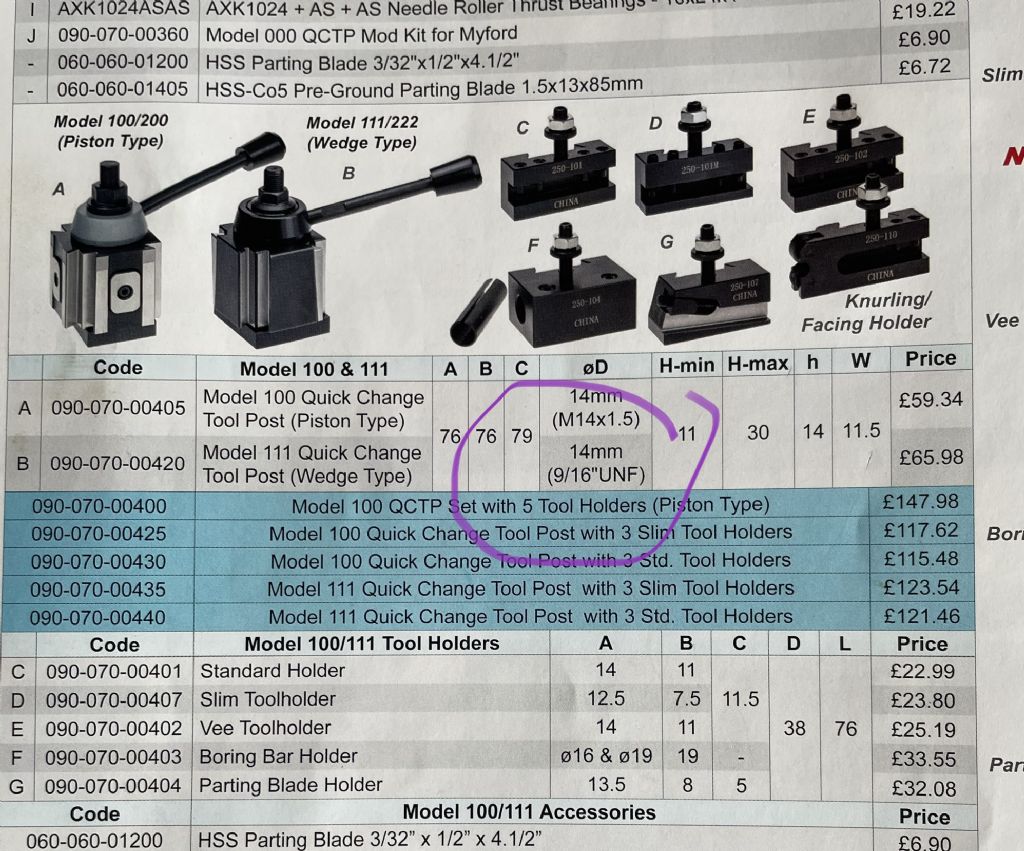
As mentioned in my opening post – the arceuro 111 QCTP is supplied with (according to their catalogue) a flanged nut specified as 14mm (9/16 UNF).
The toolpost stud from LMS is specified on their website as having a 9/16-18 thread.
to recap – the nut supplied with the 111 QCTP (specified as 14mm (9/16 UNF) WON’T FIT this stud.
So if I buy a 9/16 UNF nut surely it’s going to be the same as the arceuro nut? Or am I missing something?
Thanks all
M
I can't see where ArcEuro say their nut is both 14mm and 9/16 UNF? I did find 'The Model 100/111 Tool Post Stud is threaded M14x1.5 at the top with a ø14mm shank to match the tool post bore and is threaded M12 at the bottom for the SC4 lathe’s compound slide.' in their 111 for SC4 fitting instructions,
I think root cause was buying a post from Little Machine Shop in the US. American customers would expect the 111 QCTP to be fitted with a UNF nut. Not so in Europe. Here, metric is far more common than UNF, making it likely ArcEuro sell the same QCTP apart from the post having a metric thread (M14x1.5) Not normally a problem unless a European customer buys from the US or vice versa.
In the event no-one is able to gift a 9/16" UNF from their junkbox, I'd buy a full nut from a UK supplier and put a washer under it. (£2.55 from Westfield) When the tool post is working, not too difficult to make a flanged 9/16" UNF on the lathe.
Dave
Hey Bill.
Lol – glad I am not going mad!
the middle pic is from the arceuro printed catalogue.
best wishes
M
Edited By Margaret Trelawny on 24/09/2023 16:27:11
Edited By Margaret Trelawny on 24/09/2023 16:27:42
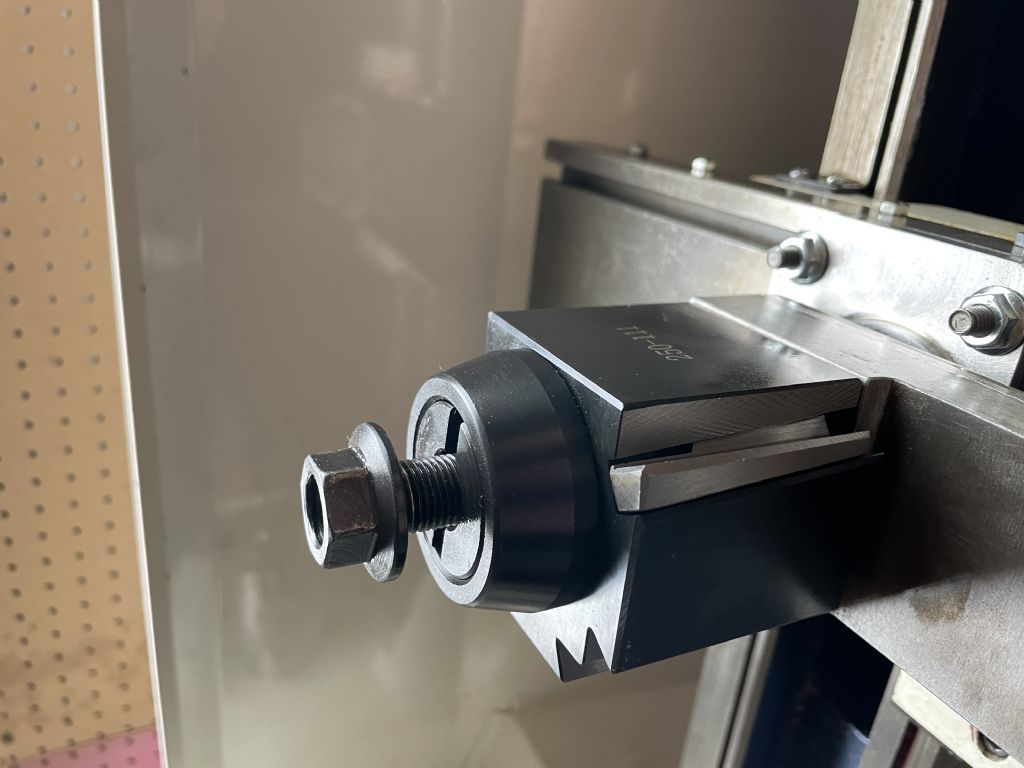
ok, so the attached photos show the new ‘sleeve’ stud from LMS in place.
the second shot shows the nut sitting on top – it won’t turn anymore than this.
also shown are the arceuro catalogue page which gives the spec of the 111 QCTP and lastly, the LMS webpage spec for the ‘sleeve’ stud…
Posted by Bill Phinn on 24/09/2023 15:28:39:
.
[…]
The source of confusion, I think, Jason is this page, where the clearance diameter of D is given as 14mm and then qualified, in brackets, with the words "9/16" UNF stud" .
.
Thanks for posting that link, Bill ![]()
… I can feel my sanity slowly creeping back.
MichaelG.
Guys, I’m getting more and more confused (doesn’t take much!)
As mentioned in my opening post – the arceuro 111 QCTP is supplied with (according to their catalogue) a flanged nut specified as 14mm (9/16 UNF).
The toolpost stud from LMS is specified on their website as having a 9/16-18 thread.
to recap – the nut supplied with the 111 QCTP
(specified as 14mm **(9/16 UNF)** WON’T FIT this stud.
So if I buy a 9/16 UNF nut surely it’s going to be the same as the arceuro nut? Or am I missing something?
Thanks all
M
Margaret, sorry if I didn't word my previous reply clearly enough.
From what I can make out, and please correct me if I'm wrong, you have a 111 QC toolpost from Ketan, but are using a stud from LMS.
From the link I supplied for the ArcEuro toolpost, the thread specified in their catalogue is M14x1.5mm
This is not 9/16" UNF as you state in brackets.
I believe you have sourced an LMS stud from the USA to replace the ArcEuro one
This is a different thread and is 9/16" UNF, so you need a nut to match the specific stud you are using.
The toolpost might possibly accept either stud, but the nut is specific to the stud, not the toolpost
If you do actually have an LMS stud, you seems to need a 9/16" UNF nut
If you are using an ArcEuro stud you need an M14x1.5mm nut.
Bill
Edited By peak4 on 24/09/2023 15:38:23
Michael as my post above Ketan is saying they supply a stud of 9/16" dia shank, top is reduced and theraded M14 x 1.5, bottom is reduced to 12mm and threaded M12 coarse.
As the hole in teh toolpost is 9/16 you want a nice close fitting 9/16" shud shank for repeatability.
No Porkies being told
The source of confusion, I think, Jason is this page, where the clearance diameter of D is given as 14mm and then qualified, in brackets, with the words "9/16" UNF stud" .
Guys, I’m getting more and more confused (doesn’t take much!)
As mentioned in my opening post – the arceuro 111 QCTP is supplied with (according to their catalogue) a flanged nut specified as 14mm (9/16 UNF).
The toolpost stud from LMS is specified on their website as having a 9/16-18 thread.
to recap – the nut supplied with the 111 QCTP (specified as 14mm (9/16 UNF) WON’T FIT this stud.
So if I buy a 9/16 UNF nut surely it’s going to be the same as the arceuro nut? Or am I missing something?
Thanks all
M
.
Well someone, somewhere, must be being ‘economical with the truth’
9/16” is 14.2875mm so that conversion is obviously ‘ish”
You do really need to measure these things
MichaelG.
.
Edit: __ as Jason says, the 9/16” would be a nice clearance hole for an M14 thread.
P.S. __ M14 x 1.5 is a very coarse pitch of thread compare with the other two you have mentioned.
Edited By Michael Gilligan on 24/09/2023 15:24:08
Guys, I’m getting more and more confused (doesn’t take much!)
As mentioned in my opening post – the arceuro 111 QCTP is supplied with (according to their catalogue) a flanged nut specified as 14mm (9/16 UNF).
The toolpost stud from LMS is specified on their website as having a 9/16-18 thread.
to recap – the nut supplied with the 111 QCTP (specified as 14mm (9/16 UNF) WON’T FIT this stud.
So if I buy a 9/16 UNF nut surely it’s going to be the same as the arceuro nut? Or am I missing something?
Thanks all
M
…………..
The one supplied in the arceuro QCTP is 14mm (9/16 UNF) and the LMS stud needs a 9/16-18 flange nut – seriously- you could not make this up!
Can anyone help me please with a 9/16-18 flanged nut? To buy one from the US is circa $25 plus about the same post. I cannot justify that.
Any suggestions most gratefully accepted. Fed up doesn’t come close!
Many thanks
m
Margaret, I think you're getting your threads a a bit mixed up.
The ArcEuro tool holder looks to be this one which on the spec sheet says the thread is M14x1.5mm
Yes, the 14mm diameter is about 9/16" but it's not an imperial size.
The LMS version on sale, I assume is this one; it specifies 9/16" x18 tpi, which is a UNF thread.
The actual toolposts are probably the same, it's just that the fixing post is a different thread.
Traditionally the UK used Whitworth/BSF threads on machine tools etc, whereas the USA uses Unified.
The diameters may be the same size, but the thread forms are different.
Most of the rest of the world uses Metric, which is why many of the far eastern tooling imports feature metric threads; hence the same QC toolpost marketed in the US uses a 9/16" x 18UNF thread, and our version often uses the M14 stud as it's cheaper than having BSF ones made specially for us, as almost no-one uses it any more.
Your local car spares will likely have a 9/16" x18 UNF plain nut, which you can use with a thick washer for the time being; You could even use a Nyloc nut and turn off the plastic locking ring.
Your local Landrover spares counter will almost certainly have the Nyloc ones, as they are used for leaf spring shackle bolts; N.B. make sure you specify the thread to them, as they may also stock BSF (& metric).
Longer term let me have your address and I'll knock one up, but I'm not using the workshop at the moment, as I await new specs following a cataract operation; I'm not safe using machine tools at the moment.
Bill
Hello again everyone,
So the continuing saga (farce!) with fitting a QCTP to my lathe continues.
I sourced a stud from Little Machine Shop in the US and it fits right over my standard stud – it has a M8 tapped internal thread which works perfectly. So I fit it, and slide on the QCTP and try on the locking flange nut at the top – and guess what!?!? Yep / it doesn’t fit!!!
The one supplied in the arceuro QCTP is 14mm (9/16 UNF) and the LMS stud needs a 9/16-18 flange nut – seriously- you could not make this up!
Can anyone help me please with a 9/16-18 flanged nut? To buy one from the US is circa $25 plus about the same post. I cannot justify that.
Any suggestions most gratefully accepted. Fed up doesn’t come close!
Many thanks
m
I found this thread interesting as I'm just doing a job that needs a flat surface with a good finish. It is similar to Andrew's application a heatsink for high power semiconductors. This is a aluminium heatsink and as usual with these it is near pure so soft and sticky. It's also used so I have to re-surface it and plug a couple of holes. The original finish was obviously made with a fly cutter. I did consider that approach but my mill is a small high speed model (SX1LP). so not Ideal. I decided to try a 90 degree (two insert) 25mm indexible end / side mill from ARC
https://www.arceurotrade.co.uk/Catalogue/Cutting-Tools/Indexable-Carbide-End-Mills/90-Indexable-Carbide-End-Mills
with APKT 1604 PDFR polished inserts. This has the added advantage that the semiconductor (MOSFET in SOT227B package) will just fit in the width of a single cut.
Had a go today. Using it dry with vacuum chip extraction, 2100 RPM and light cuts. Finsh is pretty good (not up to Andrews standard). It's clearly a milled surface but no roughness detectable by a fingernail .A check with some blue, a flat and one of the devices shows it is flatter than the MOSFET. The critical area of the MOSFET is in good contact with just finger pressure dispite not being perfectly flat. I'll sort out some photos. The holes that needed plugging were tapped M3 so I put plated brass screws in with Loctite 601 retainer. Left it for an hour and just machined the heads off.
I fitted a digital read-bar to the long travel of my ML7R and would not be without it. They cost around £30, depending on length, from Arc Euro Trade, Chronos Tools and others and in my humble opinion worth every penny.
Dick
Ordered from Arc Eurotrade 3.00pm Friday 15 September (yesterday). Goods received via DHL 9.45am Saturday 16 September (today).
Just wanted to record what I consider to be astonishing service from both companies.
Usual disclaimer: no connection apart from being a very satisfied customer with some new toys!
Peter.
A perfectly good question Andrew and not controversial, just different opinions…
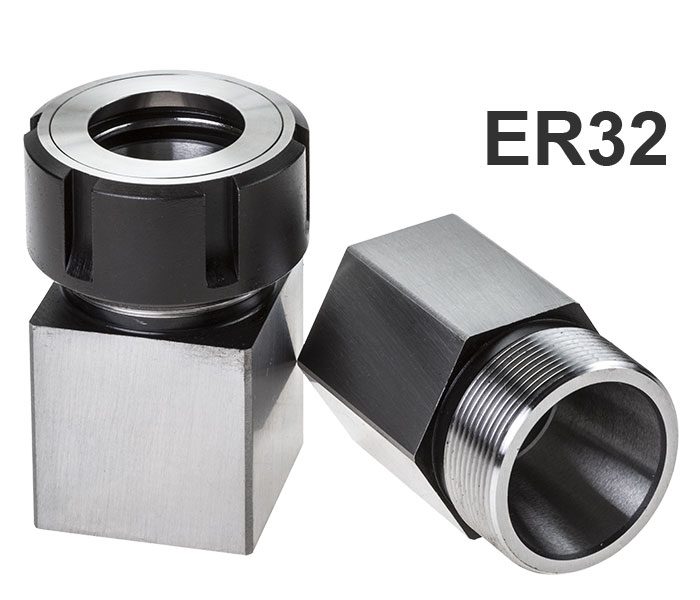
Always useful to explore options. My ER collets are mostly used for tool-holding, but every so often they're good for work-holding as well. In my case, mostly when smallish round jobs are moved repeatedly between machines. I have an ER collet chuck for the lathe, and square and hexagonal Stevenson Collet blocks from ArcEuroTrade:

If I did a lot of collet work, I'd invest in a set of 5C collets. They aren't restricted to round work only, and can grip shorter lengths. (ER collets need an inch or so of round to grip on.) ER and 5C both achieve low run-out. 5C are best for work-holding, but costly. ER are are cheaper because they clamp over a wide range and can be used on both lathe and mill. Which is most useful depends on the type of work being done, and in that sense run-out is secondary.
Dave
Edited By SillyOldDuffer on 16/09/2023 11:56:04
For flattening the tops of material a 16mm is probably as large as you want to go as it becomes less economic to pay more for larger cutters and just wear the end away. For side cutting then there is little to be gained in going up to a larger cutter as you won't gain rigidity considering the rest of the set up and the need to run the larger cutters slower will take the motor out of it's power band unless you go with solid carbide milling cutters.
Fly cutters will work but do need to be kept sharp they are also relatively slow to remove metal as you only get one cut per rev where you will get more with fluted cutters. They can also be a bit harsh on the drive train as unlike with a milling cutter you will get long periods of no tool engagement which can "knock" as the single cutter comes round each time. Something like these, the middle size 25mm head, swinging about 35-40mm dia would do
We have a few members here who use the two insert 25mm insert mill on their X2 size machines, if you do go down that route then I would suggest using the APKT inserts meant for non ferrous metal on all materials as they are sharper and put less strain on the machine. They won't cover quite such a large area as a flycutter but with twice a smany cutting edges and being able to run higher spindle speeds due to carbide will make quicker work of a job.
Both the flycutter and the insert cutter you would not want to take off more than 0.5mm per pass.
Remember that if the tram is out then the larger the diameter cutter the greater the chance of getting a concave surface so you really critical parts it can be better to make multiple passes with a sharp small 3 or 4 flute cutter of say 6mm dia
Edited By JasonB on 11/09/2023 07:04:36
Good Morning
I'm new on here & this is my first post, so hopefully have put this in the right section.
I own an SX2P & was wondering what is the largest endmill I can safely use in this machine?
I currently run up to a 16mm (gently) but was wondering what everyone else uses for facing larger surfaces?
I note that some people use small fly cutters if so what size?
Would it also be safe to use Arc-Euro's 25mm Dia. Indexable End Mill R8 (060-282-00258)?
Thanks in advance for any help you can offer, Steve.
Hi everyone
Just a general question, now I have almost completed my Quorn grinder as it has taken me so to build it!, I have noticed that not only normal uncoated end and slot mills are available but coated versions of end and slot mills.
My question is therefore while the Quorn should be able to deal with the normal (traditional?) End and slot mill cutters, what about the coated variety such as those on the ArcEurotrade web site I.e. TiAIN and TiN cutters?
If so would the same grinding wheel for standard HSS be suitable? Or are these coated variety whilst supposedly longer life, be regarded as non resharpable and therefore disposable after getting blunt?
The current attractive 15% off sale in ArcEurotrade has a lot to do with my question!
All the best
Derek
Morning all,
My SX2P was bought new from ARCeurotrade in May this year (I'm it's second owner) so I'm guessing it's a relatively new model/version. It has an aftermarket tacho kit which is powered by 9v battery that I'd like to eliminate.
Does anyone have a detailed elec' drawing for the mill? I was hoping to find somewhere to "borrow" a DC supply from, to replace the 9v battery. According to the info on the tacho and sensor, between 8 and 24vdc will do.
I also want to fit a reverse switch. This seems very simple – there is an unused 3 pin header on the potentiometer board which gives forward/reverse when either pin 1 or 3 is shorted to pin 2.
A bloke in the USA has a vid on YouTube demonstrating this in action but has anyone on here done it without ill effects?
Thanks
Gareth
Posted by Andrew Tinsley on 03/09/2023 20:05:36:
… I did use the search function, but didn't come up with a run out figure that was deemed acceptable by the majority of model engineers. …
Apart from the limitations of the search engine, the forum isn't structured as a reference source. Wikipedia is best for that, but you can't have a conversation with it! Wikipedia's article on runout doesn't answer the question either – it's an overview without figures. Maybe we should improve it?
There probably isn't "a run out figure that was deemed acceptable by the majority of model engineers", because the answer depends on the nature of the work. Money matters too! A few things I do are crude enough to let me swap ends in a 3-jaw without worrying about the resulting error. Other work demands much more care, usually with a 4-jaw adjusted to the best of my ability. My lathe, chuck, and my Dial Indicator limit the best I can do to about 0.01mm close to the chuck. Long work requires steadies and an accurately adjusted tailstock. For close up only I have an ER collet chuck, which can be carefully centred with the same Dial Indicator, so similar run out to the 4-jaw. My collets are inexpensive, bought from Warco and ArcEuro, and they're all as good as the chuck.
I rarely attempt high accuracy work, instead working within the ordinary limits of my equipment, which is something like 0.02mm or a thou. I don't use collets often, but once in a while I do a job with round shafts being repeatedly taken on and off the lathe: when this happens collets are much faster than the 4-jaw.
You can guess I don't do much watchmaking or instrument work! If I did, something like a Cowells with a complete set of collets would be needed.
Industry have another reason for wanting low TIR collets, especially ER. They spin them very fast, and a slightly unbalanced collet at 30,000 rpm does a poor job. The same collet at 3000rpm would be fine.
So I come at run-out by asking 'what do I need to do to get the required result?' Quite often there are alternatives; just as well – I dislike spending money on tooling that's better than my lathe or mill can make use of.
However, as Model Engineering is a hobby, others enjoy owning the very best, even if there's no practical need for it. Always nice to have capability and reliable tools, especially if someone else paid for them! Most of us own a mix of more-or-less suitable tools obtained by various methods.
Dave
Normal load-bearing concrete has a compressive strength of around 40 Newtons per square mm. This stuff never had any substantial compressive strength – 4Newtons per mm^2 – so should really only have been used as supported panelling.
It would appear that its light weight was too much of a tempting idea to use it – such that the supporting structure could also be down-specced. IMO, it should never have been used as a ‘roofing material’.
Your typical garage base would be made with ‘20N’ concrete – and need to be 150mm thick, probably with some form of reinforcement in the base – either a layer of weld mesh, or stainless steel needles (or even plastic fibres) in the mix) if expected to be loaded heavily. That concrete would be laid over a well compacted sub-base, too.
RAAC concrete – if one could call it concrete – was not only lightweight (more like a mortar sponge) but was also much cheaper to produce (the virtual final strength was achieved in less than a day compared to a month for normal concrete). Normal concrete would be made based on the 28 day strength, but would continue to slowly gain strength – possibly over several years.
One thing that is not suspect is the cement. Cement, made to BS12 was perfectly adequate for the purposes for which it was specified, in structural concrete. Your average sectional concrete garage panels are stronger than this stuff. I never came across this stuff and cement was proper cement until the industry started to blend in things, such as fly ash, in the 1970s (to compete with cheap imports from Europe).
This problem is down to architects along with cheap building design and construction. What do they say? Buy cheap, buy twice. It is coming home, now….
Hi All,
I need to put some form of protective structure over my classic car before it becomes an integral part of the local scenary.
I looked at Carcoons and other similar controlled environments but a) I wanted to be able to easily work on the car and b) our location in the South of France means high ambient temperatures (high 30s) in summer and sub zero in the winter and I didn't feel that this type of cover would be suitable.
Looking further I came across a series of dedicated tents designed as garages with >60 cms all around access.
The price appears to be dictated by the weight of the structure (ranging from round 34/38mm tube to oval 32×45 mm) and the weight of the PVC covering.
These range from 450 through to 2300 but I have not really got a good feel for the effective differences in each grade in terms of longevity and ability to deal with the weather.
The site is moderatly exposed, we do get 70-80kph winds, very heavy rain and the aformentioned strong sun and heat….
BTW, price range is 500-1000€, my budget doesn't run to anything more expensive, however suitable it may be deemed to be…
So, after the long intro, does anyone have any experience that they can share?
Simon
This will ease your frustration go to another supplier that sells the 50mm heads with a choice of Arbors to suit your machine. Bonus is it will also save you some money
Started by:
dee
in: Related Hobbies including Vehicle Restoration
Bill Phinn
Started by:
David George 1
in: CAD – Technical drawing & design
David Jupp
Started by:
duncan webster 1
in: Electronics in the Workshop
SillyOldDuffer
Started by: jimalm
in: Electronics in the Workshop
Julie Ann
Started by: Tony Ray
in: Workshop Tools and Tooling
Charles Jambon
Started by: Roger Harvey
in: Workshop Tools and Tooling
ega
Started by: Andrew Tinsley
in: Workshop Tools and Tooling
Andrew Tinsley
Started by: Dalboy
in: General Questions
Graham Meek
Started by: Peter Simpson 3
in: Beginners questions
Peter Simpson 3
Started by: activeviii
in: General Questions
lukeama123
Started by: Nick Welburn
in: Work In Progress and completed items
Dave Halford
Started by:
Neil Wyatt
in: 3D Printers and 3D Printing
timdotd
Started by: Nigel Graham 2
in: Manual machine tools
Graham Meek
Started by: Dr_GMJN
in: Workshop Techniques
Diogenes
Started by: Andrew Skinner
in: Electronics in the Workshop
Robert Atkinson 2
Started by:
Michael Gilligan
in: Clocks and Scientific Instruments
John Haine
Started by: Speedy Builder5
in: CNC machines, Home builds, Conversions, ELS, automation, software, etc tools
Speedy Builder5
Started by: paul1956
in: Beginners questions
bernard towers
Started by: activeviii
in: Introduce Yourself – New members start here!
activeviii
Started by: fln742j
in: Workshop Techniques
noel shelley
Started by:
Bazyle
in: General Questions
Macolm
Started by: Martin King 2
in: Help and Assistance! (Offered or Wanted)
Clive Foster
Started by: IanT
in: CNC machines, Home builds, Conversions, ELS, automation, software, etc tools
jaCK Hobson
Started by: Clive Brown 1
in: The Tea Room
mark costello 1
Started by: Turbine Guy
in: Stationary engines
Turbine Guy