The non-cutting end of a thread tap

The non-cutting end of a thread tap

Home Forums Workshop Tools and Tooling The non-cutting end of a thread tap

Viewing 25 posts - 1 through 25 (of 25 total)
  • Author
    Posts
  • #278349
    Anthony Gibson
    Participant
      @anthonygibson71082

      Hopefully somebody might know, a Google search is a little fruitless on this subject as the results are bloated with descriptions of the cutting end not the 'holding' end.

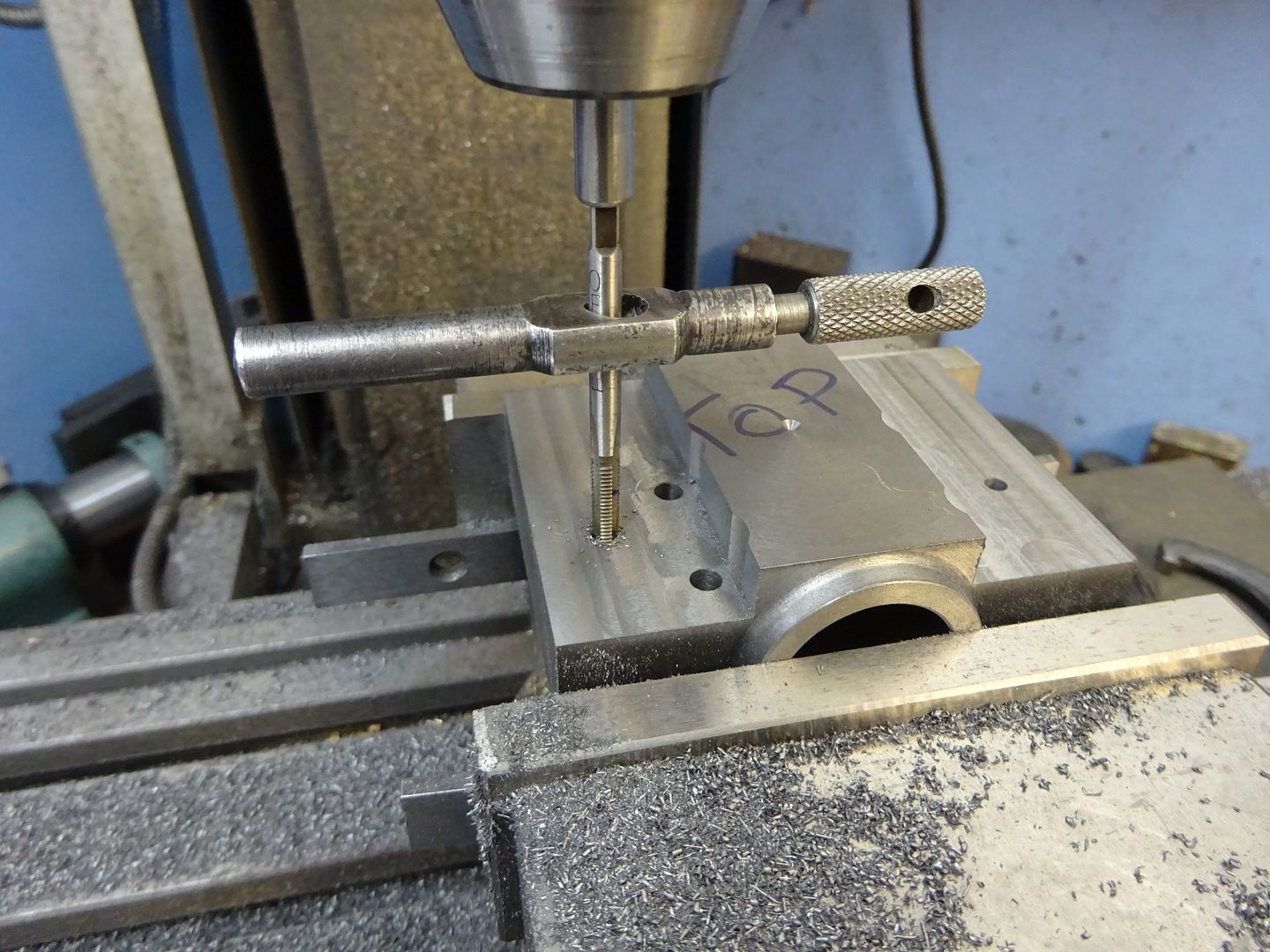
      So i fully understand why taps have a centre hole (enables use of spring centre), but whats with the pointy end version?

      Some tap sets I see and own, have a pointed end at the non-cutting end. now it could be that a different type of spring centre could be used. The pointy ends seem to always be on the smaller size of taps so maybe drilling a centre hole is too hard and so the inverse is used and the spring centre is female rather than male.

      Or it is something else. I am just curious and its a slow morning at work…

      #18368
      Anthony Gibson
      Participant
        @anthonygibson71082
        #278352
        Mike Poole
        Participant
          @mikepoole82104

          I think you are correct but the centres are for manufacturing the tap, it is convenient that they are there for Spring centres etc.

          Mike

          #278353
          Vic
          Participant
            @vic

            I have a double ended tapping guide, one end has a point the other a cone.

            #278354
            MW
            Participant
              @mw27036

              You raise an interesting point, as they could all in theory be flat faced and centre holed, there's no reason why a smaller tap couldn't accommodate that.

              Michael W

              #278358
              Michael Gilligan
              Participant
                @michaelgilligan61133
                Posted by Michael-w on 17/01/2017 09:36:56:

                You raise an interesting point, as they could all in theory be flat faced and centre holed, there's no reason why a smaller tap couldn't accommodate that.

                .

                … but a male centre on the small tap gives much more support in the grinding machine.

                MichaelG.

                #278362
                Ajohnw
                Participant
                  @ajohnw51620

                  They are production items Michael so will be done in a fashion that causes least problems when they are being made. At the point where they feel that location for processing hasn't sufficient strength they will switch to pointy ends. The other aspect is probably auto loading into machines. Less initial positional accuracy needed.

                  I noticed and interesting tapping fixture recently for use in a lathe. I assume a hole had been drilled in the end so all that was needed at the tailstock was a pin to guide the tap. I'd estimate that the pin was about 1/8" dia so it could probably be used from something like 1/4 dia and up. At some point a larger diameter pin could be used. It might have been a manufactured item but I haven't seen anything else like that.

                  John

                  #278363
                  maurice bennie
                  Participant
                    @mauricebennie99556

                    Hi ,I think they are pointed so that there is less chance of jamming on the end of a blind hole. The flat end ,if screwed down hard, would have more chance of jamming tight and breaking .Told to me by a very old engineer, and it seems to work.

                    #278365
                    MW
                    Participant
                      @mw27036

                      Some fair and good counter arguments made,

                      when you look at it actually, not only is it pointy but square faced, this implies it probably suits a particular socket to give it extra support against the flats.

                      Like john says, there is probably a point, around maybe M6 or 0BA where they deem a simple grip on a round shank is strong enough to handle the machining forces.

                      Michael

                      #278366
                      JasonB
                      Moderator
                        @jasonb

                        As said all you need is a female ctr to support a tap with a male end

                        #278368
                        MW
                        Participant
                          @mw27036

                          I do actually have a double ended spring guide/centre. A grub screw tightens up against a spring to control the force and the main access point to the centre to switch faces.

                          I'm pretty sure it's of an English design that's been copied again and again. I bought mine off the bay.

                          I quite often use it on the lathe and like Jason has, a small BA tap wrench used on the body to steady the tap as it passes through.

                          Michael W

                          Edited By Michael-w on 17/01/2017 10:09:27

                          #278372
                          Anthony Gibson
                          Participant
                            @anthonygibson71082

                            what a response, i was not expecting so many so soon.

                            So consensus is its a manufacturing thing, possibly useful for machine holding (manufacture of the tap and in use).

                            Nobody has said that its a sign of cheap (or good quality) taps, it is what it is and in use a cone spring centre works just as well.

                            My curiosity was around why its there, is it a good thing or a bad thing, advantage or disadvantage..

                            All your comments have been really useful, thank you,

                            if we don't ask questions we don't learn things

                            #278375
                            MW
                            Participant
                              @mw27036
                              Posted by Anthony Gibson on 17/01/2017 10:31:36:

                              All your comments have been really useful, thank you,

                              if we don't ask questions we don't learn things

                              Totally agree, we remain stagnant if nobody comes along and says "what's that for?". I always wondered what the holes in parallels were for. Two lifetime experienced engineers couldn't answer me.

                              I like to remember that if we aren't making mistakes, we're not challenging ourselves.

                              Michael W

                              #278380
                              Ian S C
                              Participant
                                @iansc

                                According to Patience & Nicholson, NZ tool and cutter manufacturers (just a few K from here), they changed from female centers to male because the female center holes were causing some tools to crack.

                                I usually grind the point off the thread end of taps, it can allow an extra thread or so in a blind hole.

                                Ian S C

                                #278384
                                John Haine
                                Participant
                                  @johnhaine32865
                                  …… I always wondered what the holes in parallels were for. Two lifetime experienced engineers couldn't answer me.

                                  I like to remember that if we aren't making mistakes, we're not challenging ourselves.

                                  Michael W

                                  I wonder this too. My parallels (bought surplus) are ground on two sets of faces so they can go "upright" or "flat". I think the holes are for clamping bolts when they are flat. But none that I have match the tee-slot spacing on my mill.

                                  #278385
                                  not done it yet
                                  Participant
                                    @notdoneityet

                                    Surprisingly, or maybe not, this topiic was covered by mr pete on utoob just this last couple of days. Have a look at his recent vids?

                                    #278386
                                    Michael Gilligan
                                    Participant
                                      @michaelgilligan61133
                                      Posted by John Haine on 17/01/2017 11:03:01:

                                      I wonder this too. My parallels (bought surplus) are ground on two sets of faces so they can go "upright" or "flat". I think the holes are for clamping bolts when they are flat. But none that I have match the tee-slot spacing on my mill.

                                      .

                                      John,

                                      I am happy to be corrected, but I think the holes are for weight reduction, and convenience of handling; not clamping.

                                      … It will be interesting to see how this one develops.

                                      MichaelG.

                                      #278387
                                      Hopper
                                      Participant
                                        @hopper

                                        And the tapered ends would be quicker, easier and therefor cheaper to produce than drilling a centre hole in each end of each piece, especially with teeny tiny fragile centre drills needed on smaller sizes.. The taper could be machined on as each blank was parted off.

                                        #278451
                                        Clive Foster
                                        Participant
                                          @clivefoster55965

                                          Having shattered the countersink of a small end-mill (4 mm and under) a couple or three times before I understood correct use of a Clarkson chuck it seems quite plausible that a countersink in the end of a small tap isn't strong enough to reliably stand up to manufacturing loads.

                                          Clive.

                                          #278463
                                          Jeff Dayman
                                          Participant
                                            @jeffdayman43397

                                            Holes in parallels are primarily to hold your cigar off the workbench, while stood up on their side, according to an old toolmaker I worked with.

                                            I guess they COULD be used for clamp bolts or to reduce weight…..

                                            The old hands had some odd habits. One used to cook a cheese and onion sandwich on the lathe motor at morning break. Stunk up the shop something terrible. JD

                                            #278473
                                            Nick Hulme
                                            Participant
                                              @nickhulme30114

                                              I suppose it's because I studied metalwork and engineering at school and college that it's never occurred to me to wonder about this, it's obvious that the end shapes on taps are manufacturing artefacts that happen to be useful in using them.

                                              – Nick

                                              #278474
                                              Nigel McBurney 1
                                              Participant
                                                @nigelmcburney1

                                                Holes in parallels,possibly to reduce mass of material and provide a suspension point during heat treatment,

                                                #278482
                                                Neil Wyatt
                                                Moderator
                                                  @neilwyatt

                                                  Holes in parallels are for clamping. How else are you going to keep them in place if you are using them in a jig that needs to stay set up the same when you change the workpiece?

                                                  #278518
                                                  David George 1
                                                  Participant
                                                    @davidgeorge1

                                                    I was involved in the manufacture of parallels and the holes in the larger ones were there mainly to lighten but also because they were case hardened the case hardening only penetrative about 0.060 inch and also gave the holes a hard coating to the holes which gave stability to the shape of the parallel like a hard tube through the structure. They were up to 5 feet long and 12 inch by 6 inch down to 1/16 by 1/2 inch by 6 inch long. The smaller ones were through hardened and any holes were only for support or fastening in to an angle plate etc.

                                                    David

                                                    #278528
                                                    Keith Rogers 2
                                                    Participant
                                                      @keithrogers2

                                                      I was told many years ago by a toolmaker that the point on a small tap was thereto fit a female centre on the thread grinding machine.

                                                      Keith

                                                    Viewing 25 posts - 1 through 25 (of 25 total)
                                                    • Please log in to reply to this topic. Registering is free and easy using the links on the menu at the top of this page.

                                                    Latest Replies

                                                    Viewing 25 topics - 1 through 25 (of 25 total)
                                                    Viewing 25 topics - 1 through 25 (of 25 total)

                                                    View full reply list.