My adventures with a bench top CNC mill

My adventures with a bench top CNC mill

Viewing 25 posts - 26 through 50 (of 68 total)
  • Author
    Posts
  • #846859
    Engine Builder
    Participant
      @enginebuilder

      I use an ex domestic fridge compressor for my air supply. Does the job and very quiet.

      #846874
      JasonB
      Moderator
        @jasonb

        I have a larger 50lts compressor that I use but turn th eregulator down to about 20psi. With a small nozzel this gives enough velocity to keep chips away from the cutting action but not launch them into orbit. If I’m doing something like  a bore that is not much larger than the tool then I will just turn up the flow rate. The compressor only kicks in once in a while rather than having a small one chugging away constantly. I’m not sure how your machine directs the air?

        I also have a tee off with a blow out gun which is handy for cleaning swarf out of your collets & nut.

        #848331
        John Hinkley
        Participant
          @johnhinkley26699

          My, how time flies when you contemplating what to do next.  Managed to get the mill out of its substantial amount of packaging and stowed away the 4th axis accessory and laser module for another day.  The extra 26 bits free gift arrived a while after the mill and the end mill holder pictured earlier is now fully populated with still some left over.  Mostly duplicates.

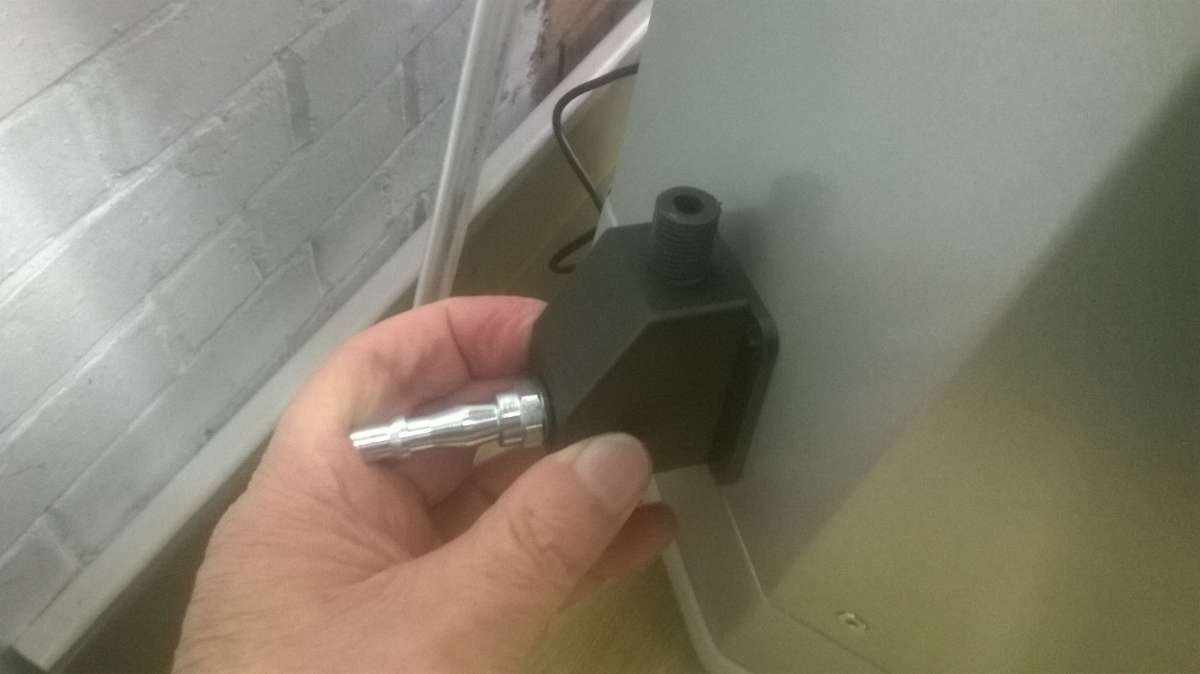
          With the help of a (much younger) neighbour got the mill up onto its dedicated bench and spent a long while reading the manual – for a change. I had difficulty getting the laptop to talk to the mill, not because there was anything wrong with either bit of kit, rather my inability to follow simple, clear instructions.  I decided to try with a cheap tablet which I duly ordered from eBay.  While waiting for this and the pipe and fittings for the air assist supply to arrive, I amused myself designing an angled block to neaten up the pipe run at the rear of the machine.  Here I am, holding it in position.

          Position of block on case

          Still waiting for the female push fit connector to arrive to fit the pipe in place.

          Everything is all set up for the first cuts tomorrow.  I have been holding off until the air assist is working and I couldn’t work out in my mind whether, if I put the z-axis probe in the spindle and ran the g-code for the first operation, it would try to run the spindle and ruin the probe.  After a bit more digging and searching, I believe that uploading the g-code file and clicking the Z-probe box in the settings, it will probe the workpiece for the height offset before returning to the “rest” position and signalling for a tool change.  Then it’s just a matter of changing the z-probe for the 4mm end mill and pressing “GO”.  I hope.  I’ll let you know how I get on later.  There are four more operations with the same bit, so no more probing required until I have to change to the 2mm ball end mill for smoothing operation.  Then back to the 4mm bit for final cutting out.  I’m expecting the entire machining process to take several hours, so I will spread it over a number of days.  Obviously it’ll look a lot quicker in the video.

          Exciting times ahead, at least for me.

          John


          #848788
          John Hinkley
          Participant
            @johnhinkley26699

            A couple of days later as it turns out the lawn doesn’t cut itself and the shopping isn’t done automatically, either. So, back in the workshop and fire up the kit.  This is intended to be a “warts ‘n’ all” coverage of my experiences, so here come the first of today’s warts.

            I’d had no luck with the cheap tablet – no matter what I did, I couldn’t get it to find the cnc codes that I had downloaded onto it, so I gave up (temporarily) and reverted to the Windows laptop. That allowed me to progress to the point where I was ready to press the ‘go’ button. A dry run showed that I’d got things sorted and the program was going to execute in the way that I wanted it to.  By this time, it was getting late so I put off the video recording until the next day. Next day dawned and armed with the camcorder, I switched everything on. The compressor burst into life and I adjusted the air assist to what I thought would be a sufficient flow.  Pressed the run button and the spindle moved to scan the work area and it probed the workpiece Z height.  So far, so good.  The spindle returned to the default position and a very loud beep prompted me to change to the 4mm end mill.  That done, I pressed “continue ” and held my breath. The spindle moved to the starting position and began its helical path into the aluminium.  Wart 2 coming up…….  The machine was making “I’m not happy” noises which I interpreted as the spindle speed being too slow.  Hit the stop button before any damage could occur.  End of session!

            Back to  the computer indoors and more reading of Makera material and watching videos.  Their suggested speeds and feeds indicated that they should both be upped considerably.  I have re-run the post processor in Fusion and set the spindle speed to 12,000 rpm and the feed rate to 500mm/min.  Put them on a memory stick to transfer them tomorrow and try again.

            That’s all for this instalment.  Please let me know if you are finding these accounts too long and I’ll bring you just the highlights (and lowlights) instead.

            John


            #848792
            John Hinkley
            Participant
              @johnhinkley26699

              Another thought has come to mind. The milling cutters are normally fitted with plastic collars to restrict the distance that they are inserted into the collet.  This is needed for the correct operation of the automatic tool changer on the flagship Carvera mill. The “Air” version without the ATC doesn’t need these, so I intend putting the 4mm end mill into the collet a bit further to give less stick out.  Hopefully that will help, too.

              John


              #848796
              JasonB
              Moderator
                @jasonb

                Speeds should be whatever F360 gives for a 4mm cutter slotting aluminium No matter what the machine. So 12,000rpm

                Feeds I would reduce a bit as the lighter machine is not going to be able to take such a large cut per tooth. If it is a 3 flute then maybe half what I use so 500-600mm/min at the 12,000rpm spindle speed.

                The big variable is going to be the actual depth of cut, I’d be happy at 1mm but you may need to come down to 0.2mm.

                Width can’t be changed as the type of cut uses the full width of the cutter.

                I think I said before to ditch the spacers and only have enough stickout so you ar enot holding the flutes and there is enough clearance so the collet does not hit anything. So at just over 12mm depth from top of stock say 15mm total stickout

                As I said in the other post a few trials on a block of aluminum would show what the machine is capable of and then settle on something a bit less than what it starts to complain at. This sort of thing

                #848827
                John Hinkley
                Participant
                  @johnhinkley26699

                  Thanks, Jason.  I’m going to give it another go tomorrow with a spindle speed of 12,000 rpm, DOC 0.2mm and feed rate 500mm/min.  I am using a Carbide 2-flute end mill with as I said, less stick out, and I’ll post back here with the results.

                  John


                  #849139
                  John Hinkley
                  Participant
                    @johnhinkley26699

                    I think that I should have titled this thread ” My (Mis)adventures with ……

                    Well, I reworked the g-code to incorporate the increased spindle speed and the new feed rate.  Back to the machine and load it up.  All seemed to be progressing nicely as the height probing was successful with the bit inserted into the collet to give a much reduced stick out compared to that obtained with the use of the plastic collar.  The spindle didn’t sound as if it was doing 12,000rpm and proceeded to work its way down into the workpiece.  It didn’t get very far before the spindle stalled and the mill went into a fault condition.  Switch off and have another long think.  Obviously there was something wrong in the g-code so I loaded it into a text editor, only to find that very early on in the g-code was the command “S 5000” where it should have been “S 12000”. Back to Fusion and check the procedure and, sure enough the spindle speed had reset itself to 5000. Changed it again and back to the mill. Same result.  Had another look at the g-code in the text editor. Aha! The S 12000 command was there, but a couple of lines further on was a countermand S 5000 entry. Goodness only knows why, though further ferreting around throws suspicion on the post processor in Fusion.

                    I’ll try again tomorrow and hope for a better outcome.

                    John


                    #849152
                    JasonB
                    Moderator
                      @jasonb

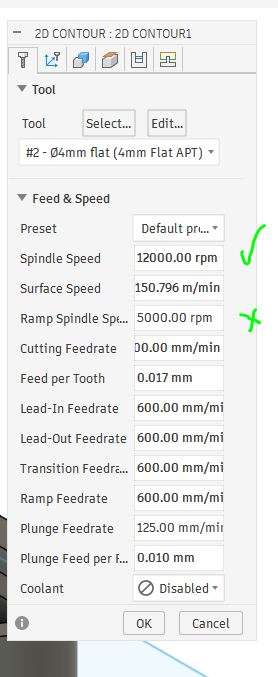
                      John I suspect what you have done when changing the speed is only change the spindle speed. A couple of boxes lower down is the ramp spindle speed which would also need to be increased to 12000.

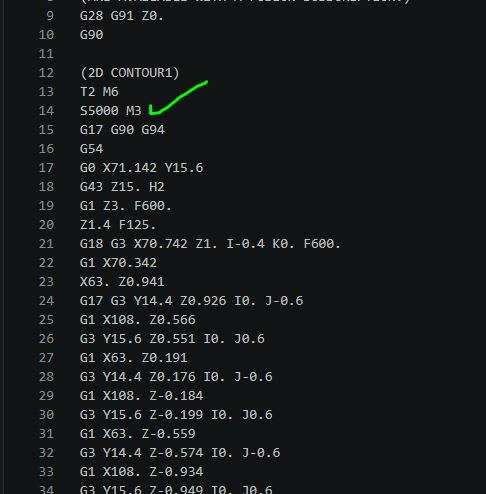
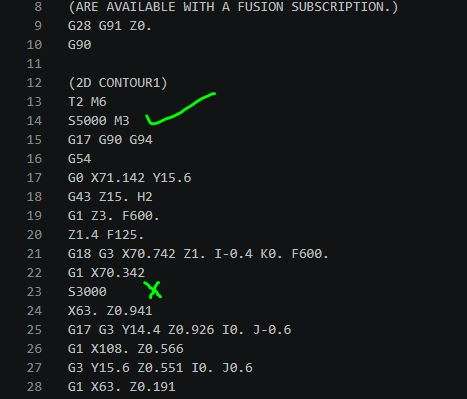
                      Looking at the G-code for all the three first 4mm tooling paths I only have one spindle speed right at the start (line 14) if I alter my ramp to something different then the second “S” spindle speed line appears.

                      Correct code with spindle & ramp set the same

                      correct speed

                      If I change the Ramp spindle speed to 3000

                      slow ramp

                      And the two boxes which you should have at 12000

                      dialogue

                      #849156
                      JasonB
                      Moderator
                        @jasonb

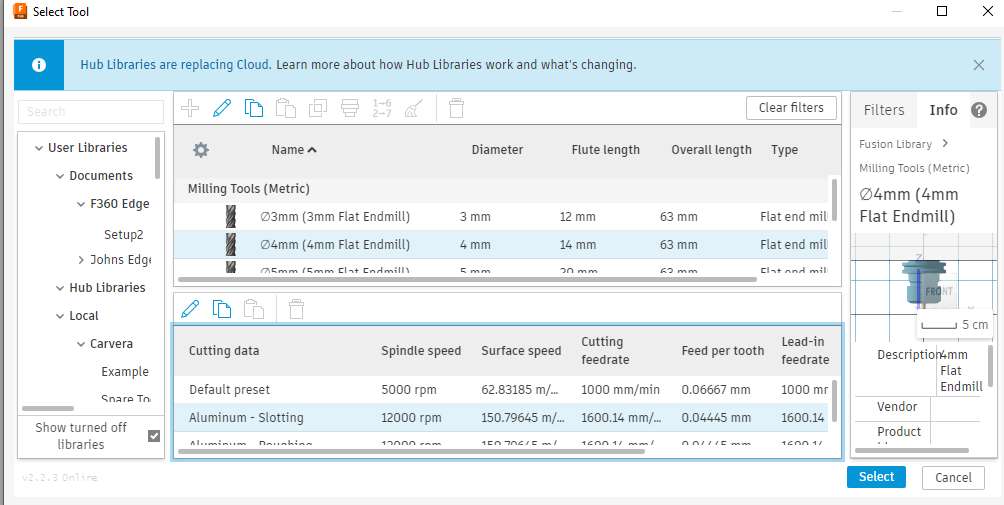
                        Looking back at the thread I did you wil see that I suggested selecting a 4mm tool from the F360 library and then coming down to the aluminium slotting option. this would have given you the 12000 an that would also have come up in the ramp speed box.

                        Photo 11

                        #849167
                        John Hinkley
                        Participant
                          @johnhinkley26699

                          Thanks Jason.  Unfortunately the tool management window shown in your screenshot above isn’t in my version of  Fusion, so I’m reliant on the Makera imported tool definitions, which do not include a 4mm end mill.  I’ve had to make up a custom definition.

                          I looked, yet again, at the set-ups for the individual operations and you are right.  In some, although the spindle speed was correctly set at 12000 rpm, the ramp speed was reverting to 5000 and in a couple of cases, it was 10 (ten!) rpm.  Go figure.  I didn’t do it, honest guv’nor.

                          Once more into the breach with the latest post processed codes and try again.

                          One glimmer of hope on the horizon – the new version of the Makera software called Makera Studio is due for release on 28th May.  From email exchanges that I’ve had with Makera support, it should solve a few of the problems that I have with their existing CAM software, i.e. I can’t easily read the GUI toolbar because of their choice of colours and the black background to the workspace doesn’t suit my ageing eyes either.  That’s the main reason for me reverting to Fusion for the G-code. It’s my birthday the next day, so let’s hope it’ll be a welcome birthday present.

                          John


                          #849171
                          John Hinkley
                          Participant
                            @johnhinkley26699

                            Forget what I just said about the tool manager page.  I’ve just found it with a little further (that is more than superficial) digging.

                            John


                            #849175
                            JasonB
                            Moderator
                              @jasonb

                              They should all be there in the background even in the free version, you may need to turn them on as and when you first need them. This will change them from greyed out to black text.

                              turn on

                              #849204
                              Engine Builder
                              Participant
                                @enginebuilder

                                John

                                I had something similar with my machine yesterday.

                                Spindle did not run up to speed and then the machine threw up an error and stopped.
                                Turned out I had set spindle speed to 1200 intead of 12000. There is a limit to how slow the spindle will run. Maybe check you have not made the same error.

                                If you have not managed to machine anything yet I suggest trying some proved code like the ones I sent you.

                                #849213
                                John Hinkley
                                Participant
                                  @johnhinkley26699

                                  Engine Builder,

                                  Thanks.  I have checked and rechecked the spindle speeds and they are all now set to 12000rpm.  I will be running the code for the first pass again very shortly.  I’m hopeful that the guidance that Jason has given will be sufficient to get it going.

                                  I’ll post here with a note on the success (or lack thereof) soon.

                                  John


                                  #849234
                                  John Hinkley
                                  Participant
                                    @johnhinkley26699

                                    Well, it worked!  You’ll have to wait for the video to be published on YouTube to see what happened, I’m afraid, I don’t do “shorts”.  I will try to knit the files together and get it out tonight and post a link here at the same time.

                                    John

                                    #849249
                                    John Hinkley
                                    Participant
                                      @johnhinkley26699

                                      Like it or not, here’s the link to  the video on YouTube.

                                      John


                                      #849276
                                      JasonB
                                      Moderator
                                        @jasonb

                                        It certainly did not like those helical entries!

                                        That will have to be put down to the machine as mine will happily do that at 5000rpm and 500mm feed rate in all metals but it must be too heavy a cut for the lighter and less powerful one.

                                        I notice you did not bore down on the final attempt but used a ramp/pocket type cut which will just use the very tip of the tool so expect it to wear faster than the option I went with that will give you some use from the sides of the cutter. Check it is sharp as you were leaving quite a burr which is a sign of a blunt or under performing cutter.

                                        I can’t help thinking that the two clamps are not going to be holding the work down that firmly with the screws so far from the work, that would also affect the quality of the cut if the work is not held firmly.


                                        #849290
                                        John Hinkley
                                        Participant
                                          @johnhinkley26699

                                          Jason,

                                          I was under the impression that I had used the same toolpath definitions that you had used.  I copied your pocket/contour selections or so I thought.  All part of the learning game , I suppose.

                                          I’m sure you are correct about the machine’s rigidity. I’ll have to watch other people’s videos of aluminium (and even steel) again to gauge how their set ups fair.  In the meantime I’ll carry on with the g-code as is and see what happens.

                                          John


                                          #849297
                                          JasonB
                                          Moderator
                                            @jasonb

                                            By reordering the work you have affected the toolpaths.

                                            Looking at the video you did the screw head recess first rather than the full depth slot.

                                            As there was no previously milled full depth slot the tool had to get down to depth by using a helical ramp to the full depth of the cut. The stall was not so much the helical cut but actually the cutter starting to make it’s way along the tool path which would have been a full 4mm width x 3mm deep (the width will reduce after the full length initial cut)

                                            The final attempt you reduced the stepdown to something much less possibly 4mm width x 0.2mm depth which is only 1/15 of the load on the cutter. This would still have been more than the 3mm deep x 0.2mm wide cut I had suggested as a starting point.

                                            #849302
                                            John Hinkley
                                            Participant
                                              @johnhinkley26699

                                              Yes.  I thought I was being clever by not doing the narrow slots first; that by cutting out the recesses it would reduce the strain on the cutter when subsequently milling the slots.  Every day’s a school day – 7/10, must do better!

                                              Off to try the slots after elevenses.  Results in an upcoming video.

                                              John


                                              #849320
                                              Julie Ann
                                              Participant
                                                @julieann

                                                A few random thoughts:

                                                • I’d definitely mill the slot for the screwheads before tackling the narrower slot
                                                • Waaaaaaay to much stick out on the tool, in general no point in making it more than the length of the flutes
                                                • Not sure why there is a speed control for ramping? I run linear and helical ramps at the same speed as milling, but reduce the feed rate as the centre of the cutter is cutting at a very low speed
                                                • For slots I run a roughing pass to remove the bulk of the material and then a finish (profiling) pass to clean up the sides
                                                • I normally leave 0.5mm, or a bit less, for the profiling pass
                                                • Roughing involves climb and conventional milling as the CAM program sees fit
                                                • Finish passes are almost always climb milling

                                                Now back to the garden!

                                                Julie


                                                #849331
                                                John Hinkley
                                                Participant
                                                  @johnhinkley26699

                                                  Thank you for your thoughts, Julie.  I can’t put the cutter in the collet much further in case it bottoms out but I will try to insert it a bit more to increase its resistance to bending.

                                                  I’ve deliberately not used roughing passes followed by a finishing pass to speed things up a tad. I am after all using this as a learning curve a bit at a time and I am making an accessory not a piece of art.

                                                  I’m going to rework the files so that there is a lot less time spent cutting air, too.

                                                  All good fun!

                                                  John

                                                  #849338
                                                  Engine Builder
                                                  Participant
                                                    @enginebuilder

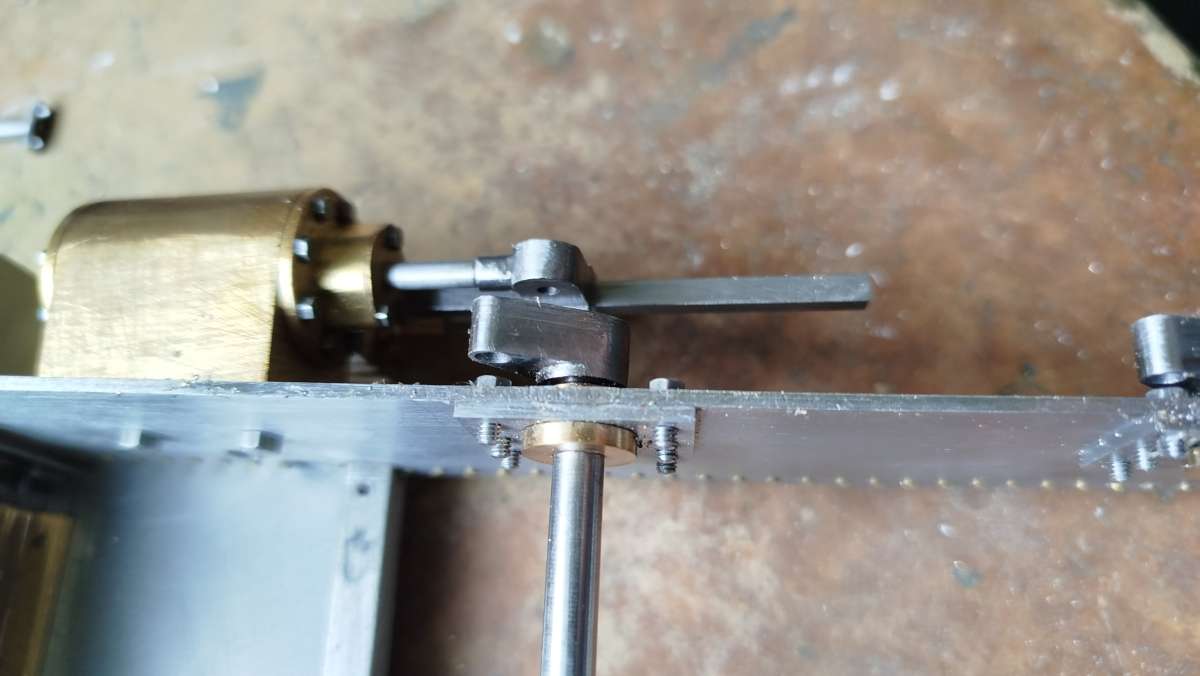
                                                    All the steel parts here were machined on the Carvera Air. Thr cranks were profiled from 1/4″ mild steel.

                                                    It’s quite capable. Use smaller tools and cuts.

                                                    IMG_20260523_164431

                                                    #849341
                                                    JasonB
                                                    Moderator
                                                      @jasonb

                                                      As I said in the other thread I did not think finishing passes were really needed for this item. It’s a tool, the inside of the slot is likely to get chewed up by the screws as it is just aluminium. The ouside will need the tabs filed off so may as well just drawfile the whole outside to get a uniform finish, or linish as in the original designer’s video.

                                                      I did watch a few videos of these machines in action before suggesting my approach. They did not look that good at doing a helical cut to get the cutter down into the work, as John’s video illustrates so my method avoided that. Also with only air John will have to watch out for swarf trapped in the helical hole, easier to do the long slot first where the air has a chance to get in and clear the swarf, may be different with flood coolant that Julie runs which will flush out the swarf and also reduce the risk of swarf sticking to a dry tool.

                                                    Viewing 25 posts - 26 through 50 (of 68 total)
                                                    • Please log in to reply to this topic. Registering is free and easy using the links on the menu at the top of this page.

                                                    Latest Replies

                                                    Viewing 25 topics - 1 through 25 (of 25 total)
                                                    Viewing 25 topics - 1 through 25 (of 25 total)

                                                    View full reply list.