Search Results for 'arc euro'

Search Results for 'arc euro'

Home Forums Search Search Results for 'arc euro'

Viewing 25 results - 276 through 300 (of 4,842 total)
  • Author
    Search Results
  • #732237
    Howard Lewis
    Participant
      @howardlewis46836

      If the chart calls for a 63T gear, that suggests that it has an Imperial Leadscrew.

      Have you carefully checked the pitch of the Leadscrew? (What are the graduations on the Cross Slide and Top Slide handwheels? If they are Imperial, the chances are that the Leadscreww is also Imperial; possibly 16 tpi.  If need be, check, Engage the half nuts, Take out the backlash, and them set a DTI to zero and measure how far the Saddle moves for 5 or 10 revolutions of the Leadscrew. A simple calculation will tell you the pitch of the Leadscrew. The answer is likely to be 0.0625″ if Imperial, 1.5 mm if Metric.

      If the graduations are Metric, than the leadscrew might well be 1.5 mm pitch.

      If your machine had a 1.5 mm pitch Metric Leadscrew, to cut a 1,25 mm pitch thread, you would need to set up a gear train where the Leadscrew rotates 1.2 times slower than the chuck. (According to the chart for my mini lathe, a possible changewheel set up would be DRIVER 50T, IDLER 40T, LEADSCREW 60T.

      IF your machine has an Imperial, 16 tpi Leadscrew, you would need to compound the 63T gear with the 40T IDLER, using spacers to bring all the meshes into line.

      If this IS the case, and you need a 63T gear, you should be able to buy one, in Aluminium alloy, from Arc Eurotrade

      Carefully measure before doing anything!

      Martin Ckeeve’s book,”Screwcutting in the Lathe” is No. 3 in the Workshop Practice Series.

      For a 1.25 mm pitch thread, he quotes FOR a 8 tpi LEADSCREW

      35 – 50

      45 – 40

      30 – 60  He says that this gives an error of   +1 in 8000

      Or alternatively

      45 – 55

      50 – 40

      25 – 65  He says that this gives an error of -1 in 1144

      So you would need to change at least one of the wheels to suit a 16 tpi Leadscrew, so that it rotates twice as fast, relative to the chuck, as it would for a 8 tpi Leadscrew.

      Change the 40T to a 80T driving the 30T, in the first example?  Check my arithmetic!

      Another book that may also help you is Brian Wood’s “Gearing of Lathes for Screwcutting”

      HTH

      Howard

      #732171
      Paul Mercer
      Participant
        @paulmercer13838

        For anyone that stumbles across this post, also looking for the same tool holders; I’ll probably chuck my old ones at the back of a cupboard. If you could make use of them, they are yours if you cover shipping.

        my lathe is an AmaDeal 250V x 750. (I’d already replaced the tool post with an unknown brand qctp) Alternative models are: Precision Matthews PM1022 PM1030, Grizzly G0602, Seig, Husky pc36, and a Craftex cx700

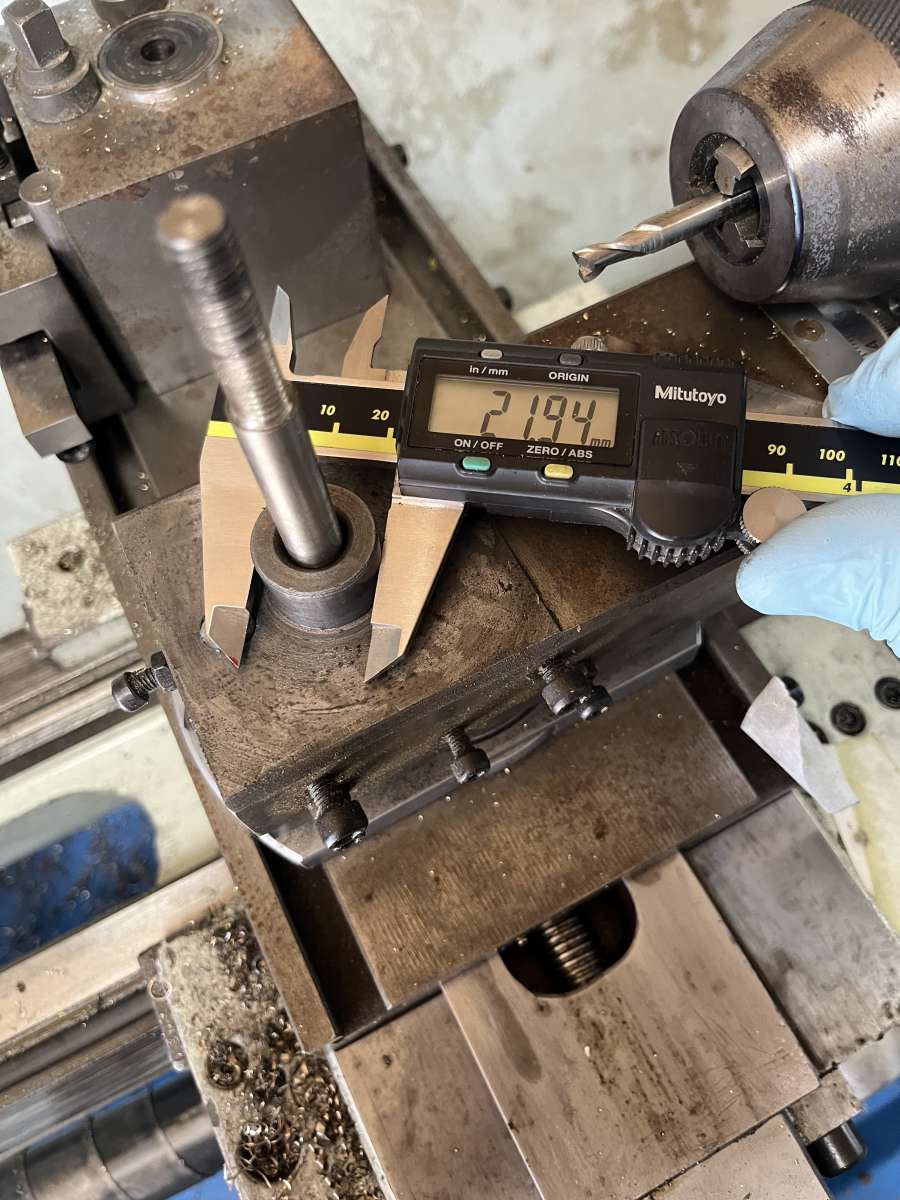
        The boss on my cross slide limited which tool post I could fit. My solution was to machine off the boss and drill the hole out to 12.5mm  I then tapped it with 14×1.5 which is the thread that the model 100 QCTP from ArcEurope comes with. The model 100 simply fit onto the newly machined cross slide. Now that the boss has been removed, I suspect the wedge tool post would fit as well.

        IMG_7845

        #732153
        SillyOldDuffer
        Moderator
          @sillyoldduffer
          On Paul Mercer Said:

          Thanks for all the assistance. In the end I went to Arc Euro Trade and bought a new tool post, and numerous tool holders…

          Smart move I think to buy ‘numerous tool-holders’ with a new tool-post.

          I wouldn’t say buying holders later is bound to cause trouble, but Paul’s experience isn’t unique.   Every so often someone finds a newly purchased tool-holder won’t fit, either because dimensions are different, or the shape is wrong.

          Seems QCTPs and their tool-holders aren’t fully standardised, and there a few different systems and odd sizes kicking around.   Buying a full set of holders with the tool-post ensures compatibility.

          I avoided the problem by not bothering with a QCTP, a device I’m not convinced has much value and at least one disadvantage.   But if  one is fitted,  how many tool-holders are needed?   I’d guess at least 6, and would probably buy 8.

          Dave

          #732150
          SillyOldDuffer
          Moderator
            @sillyoldduffer

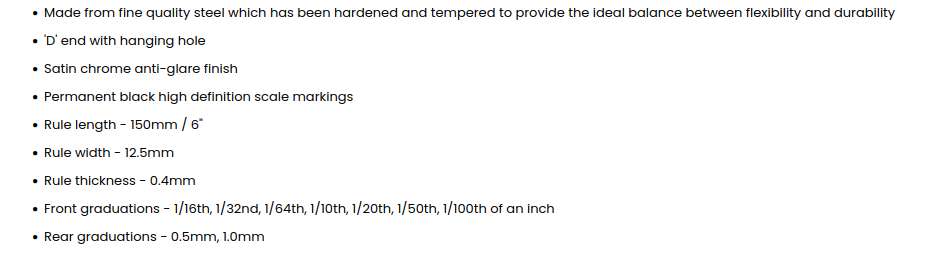
            Odd,  Allendale’s website is clear that the rule is 0.4mm thick:

            Screenshot from 2024-05-24 10-35-33

            As the thing was bought from Allendale, and doesn’t match their description, I’d expect Allendale to refund or replace, unless Mick bought from a different spec.   M&W and Bowers Group are irrelevant because Allendale are the supplier and Mick is the Customer.

            Me banging on about the dubious value of trade and brand-names is a hobby horse I know, but my advice is not to expect much of them.   They usually represent commercial entities, and don’t guarantee anything.   Much depends on the commercial attitude of the company, some work hard to maintain the credibility of their brands, others don’t give a hoot.

            Nothing wrong with M&W who appear to sell mid-range metrology products rather than the unaffordable best.   The  name is owned by Bowers, who are part of Spear and Jackson, which is a trading name of Neill Tools Limited.  I don’t think knowing that helps.

            Times have changed.   In 1906 Frank Moore started a small company that knew all about the stuff they made and sold.  Not unusual then back then, but personal service started to disappear in the 1970s.  Unless it’s expensive, purchasing today is much less conversational and stuff is usually retailed through an unskilled supply chain.  It’s become hard for a consumer to talk to anyone who knows a technical product inside-out, and possible that no-one knows any details.   This is why ArcEuro shine compared with ebay box-shifters:  there’s a good chance ArcEuro can answer technical queries about their product line.   Not perfect!  As expertise is hard to recruit and train I’d be amazed if all Ketan’s employees are technically savvy, but Arc Euro generally do a good job in the help department.   I’ve also got sense out of Warco, though I had to ask them a specific question; they weren’t able work out what I was after by decoding my vague symptoms and terminological errors!

            By the by, a £3000 hobby lathe is not expensive!  If you want the personal touch, buy a £250k CNC machine…

            Dave


            #732091
            Paul Mercer
            Participant
              @paulmercer13838

              Thanks for all the assistance. In the end I went to Arc Euro Trade and bought a new tool post, and numerous tool holders. I wanted the wedge version, but speaking to the sales team, due to having a ‘boss’ on my cross slide, the wedge version wasn’t suitable. I went with a piston version, and ended up machining off the boss anyway!

              Thanks again.

              #731095

              In reply to: Which collet

              SillyOldDuffer
              Moderator
                @sillyoldduffer

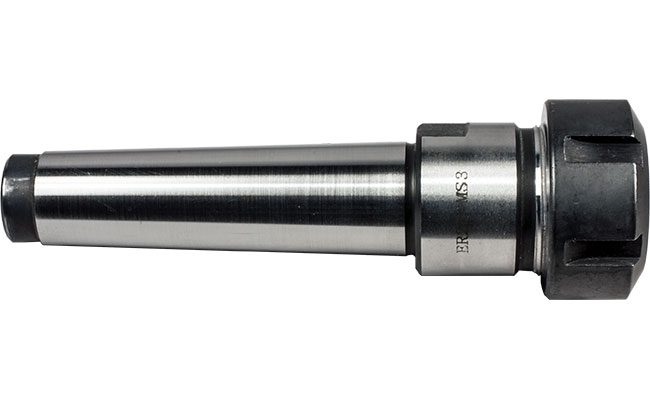
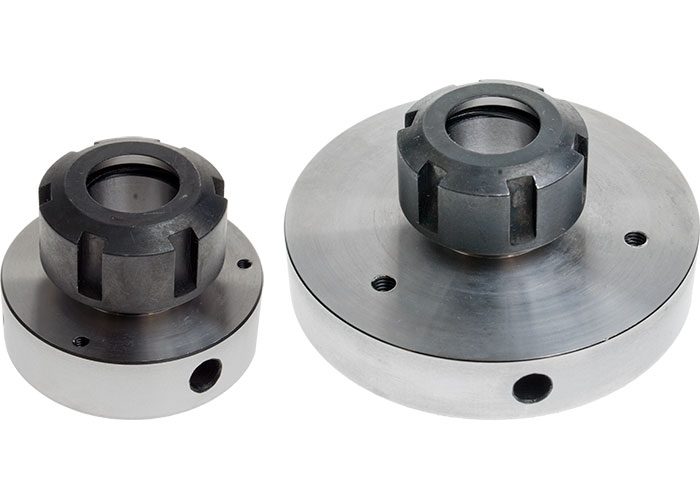
                Pictures pinched from ArcEuro!

                First I’d stick with ER25, rather than ER32 or a different system, because you already have ER25 collets for your mill – save money!

                ER25 collets cover a reasonable range, 1 to 16mm, probably my choice for a mini-lathe.   If bigger is needed look to ER32 (2-20mm) or ER40 (3-26mm).

                One way of mounting ER collets is a collet chuck connected to an MT taper that plugs into the spindle:


                Main disadvantage is this type is threaded for a drawbar so long stock can’t be passed through the spindle.  You can’t shove a rod through the headstock, grip it with a collet, work on it, part-off and repeat, which is handy for repetitive work.   Without a drawbar there is some risk this type might come loose in the headstock.   They can be plugged straight into the lathe and should be accurate without further adjustment.   Not all lathe spindles will take a full-length MT male, in which case saw it off!

                The alternative is a lathe collet chuck:


                These attach to the baseplate and probably have to be zeroed.  Mine is zeroed with a DTI by tapping it with a mallet, but once done collets can be swapped without affecting accuracy.  No need for a drawbar and long stock can be passed through the spindle.

                Which is best depends on the type of work you do.    For me the advantages of the lathe collet chuck type out-weigh the quick change possibilities of the MT holder.

                If serious about collets 5C is a good choice.  The ER system only holds round stock, and the whole grip length of the collet should be used.   5C collets can be £bought to hold square stock, and I believe they don’t need as much grip length.  A major disadvantage in my cheapskate workshop is that 5C is price, and because their grip diameters are small limited, a lot more expensive collets are needed compared with ER.    I think ER is a better bet unless you already know why you need 5C!

                Dave


                #731066

                In reply to: Which collet

                ChrisLH
                Participant
                  @chrislh

                  For lathe work a collet chuck that fits on the spindle nose is usual so that work can pass through the lathe spindle. Whether such is commercially available though depends on your lathe design. As you will know ER collets are good because they do not require a drawbar, they steplessly cover any size within their range and they grip really well. Have a look at the Arc Euro Trade site and look for “ER lathe collet chucks” to get an idea of what is available.

                  #730935
                  Diogenes
                  Participant
                    @diogenes

                    I have a ‘wedge-type’ toolpost on my GH600, think it’s a brilliant thing; the ‘block’ has a big footprint, the wedging action pulls the holders firmly onto the post so that they are properly supported on their ‘back’ flats, the repeatability of tool-position is excellent, and the overall design is inherently accommodating of minor variations in holder dims. without compromising function.

                    Also spare standard holders currently cost £15.20 inc.vat.

                    https://www.arceurotrade.co.uk/Catalogue/Machines-Accessories/Lathe-Accessories/Tool-Posts/Model-111-Quick-Change-Tool-Post

                    Check it will fit before ordering.

                    I think Sirola’s original design is not far shy of genius.

                    Howard Lewis
                    Participant
                      @howardlewis46836

                      FWIW, I would also commend Arc Euro Trade; given the service, and support that they have given to me.

                      Depending on what you want to do, will decide what machine you choose.

                      You can do small work on a big machine, but the reverse is more difficult. A small machine may well lack features present on a larger machine, and be less powerful.

                      I have cut small BA threads, and 5 x 0.5 mm (Using Taps and Dies) in a 12″ x 24″ machine, (Essentially Metric) but also used it for 40 x 1.5 mm and 2.25″ x 8 tpi threads.

                      If I were in the market for a new lathe, I would most probably go for the Sieg SC4, since the changewheels supplied would also allow me to cut accurate Imperial threads on a Metric machine.

                      And it looks as if it would do all that immediately comes to mind.

                      Having used a VFD, the variable speed facility is most appealing.

                      If the machine is used, as instructed, I can see no reason why the electronis should not be durable.

                      Abuse will damage any machine.

                      Howard

                      noel shelley
                      Participant
                        @noelshelley55608

                        ArcEuro for me, and good advice from Dave and Robert. Noel.

                        Robert Atkinson 2
                        Participant
                          @robertatkinson2

                          Plus one for the ARC Euro Trade machines. Good value for money and truly excellent support.
                          SWMBO bought me a SX1LP mill for a wedding anniversary (she had some hint’s 🙂 ). After she ordered it they called her to ask if she was sure it was thae right choice as theis is a small high speed machine mostly used for light alloy and “electronics”. She assured them I was in the electronics bracket. After sale support has also been excellent.
                          It is often said that all Chinese machines are the same. This may be somewhat true of the basic designs, the basic quality depends on what the customer wants and is prepared to pay for.

                          Robert.

                          #730298
                          Graham Meek
                          Participant
                            @grahammeek88282

                            By way of a comparison, the U3 was set up with an Arc Euro 6mm square Knife tool. (Not ideal for large metal removal rates).

                            At 550 RPM the max cut on a 19mm diameter bar was 2.5 mm deep, 5 mm off the diameter. With a 12.7 mm bar a max cut of 3 mm was possible, 6 mm off the diameter. By adjusting the PWM control I could get to a 3.5 mm cut.

                            As this machine was overhauled by me recently I would consider it to be in as new condition. (There is a post somewhere covering the overhaul). The limiting factor with this machine is the O-ring belt drive. Not due to slippage, but due to the elasticity of the belt itself. This elasticity can set up an oscillation in the drive as the tension in the belt fluctuates. Keeping the tool pressure constant is of key importance. That does not mean I am dissatisfied with the drive system nor am I likely to change it.

                            The Compact 5 was tried using the same tool. The 19 mm bar at 330 RPM would easily cope with a 4 mm cut, 8 mm off the diameter. This could be increased to 4.5 mm if I used some cutting oil.

                            At 550 RPM and by way of imitating the Hardinge demonstration. The 12.7 mm bar was reduced to 0.7 diameter in one cut of 6 mm depth.

                            This machine was new in the late 1980’s. It also has a proper Vee Belt drive and a more powerful Induction motor. Yet the dimensions across the bedways of each machine are the same. What is different is in the design of the cross-slide. Which is about 3 times the length of the U3 and thus has more bearing area, which yields greater rigidity.

                            EN1A Pb was used throughout.

                            Like I said earlier these machines do all I ask and metal removal rates do not prove anything. If anything I tend to use the CNC approach, a lot of quick power fed cuts of around 1 mm deep. Timing the use of a tipped tool using this approach it was found to be considerably quicker than one large cut powered by me, by a couple of minutes.

                            Those of you who have been following the C5 modifications will know I recently added a refinement to the cross slide dial. The bearing adjustment was carried out during the winter months, (7-10 C workshop ambient temperature). When I went to use the lathe yesterday the effort to turn the cross-slide handwheel was not as I remembered it. Slackening the adjustment and resetting restored the correct feel. Workshop ambient was 26 C yesterday.

                            Regards

                            Gray.

                            (Grammar error)

                            SillyOldDuffer
                            Moderator
                              @sillyoldduffer

                              The idea of a ‘make’ when buying hobby machine tools isn’t solid ground these days.   In the past, taking British lathes as an example, there were a plethora of individual firms each offering tools of wildly different capabilities, ranging from ‘too cheap’ to ‘too expensive’.  After WW2 Myford dropped a bomb on most of these firms by producing, at reasonable cost, a modern, well-balanced general-purpose and versatile lathe of just the right size for most home workshops.  So for 30 or 40 years the simple answer to ‘what hobby lathe?’, especially in the UK, was Myford.

                              However, time marched on, and many improvements were made in industrial tool design.   Many of those improvements were aimed at reducing manufacturing cost, which gradually put the older Myford design at a serious cost disadvantage.  Today the hobby market is dominated by rather similar tool designs.  The story goes their design was developed from Western ideas by Soviet Russia, then passed into the public domain via Communist China.   Whatever the reason, much the same machines can be made by anybody with a suitable factory, and in the past many did, causing quality to vary wildly.   Today I believe most hobby lathes and mills are made by two Chinese firms to similar designs,  but neither has a monopoly, and both badge their products to suit the badge owners price point, including “too cheap”.

                              Another major change is that considerable cost savings are achieved by letting the customer do the final quality checks.   It is cheaper to replace a small percentage of faulty goods that escape from the factory than it is to fully inspect everything.   That means the customer should buy from a source who will make minimum fuss about replacing the odd duff item when one turns up.   To me that means buying from a reputable UK supplier rather than a grey importer.    Also, UK suppliers who want to maintain good customer relationships, are likely to filter out the worst, working with the maker to avoid issues.

                              My impression is that all the major UK suppliers do the decent thing should the product be defective, though some are more nimble than others.    Personally, I’ve had good support from Warco.  ArcEuro have a particularly good reputation.    Chester sometimes get a mildly bad press, as do the others occasionally, but the forum isn’t full of posts warning folk not to buy from Company ‘X’.

                              At one time Axminster were more expensive because their price included an extended warranty.  MachineMart isn’t ideal because their  staff are unlikely to know anything about lathes, but you can go and look at them in store.

                              A bit of expectation management may not go amiss.   To me, spending a few thousand quid is big money, therefore I expect what I buy should be absolutely perfect!   Unfortunately that’s unreal because hobby lathes are built down to a price.   I bet all the UK suppliers have stories about customers expecting far too much of their hobby purchase.  An industrial machine of roughly the same capability will be at least 6x more expensive, be much more heavily built, and able to run flat out for long periods without harm.    In comparison, hobby machines lack finesse, stamina and rigidity.   For what I do hobby limitations don’t matter:  my machines work well-enough provided I operate within their limitations.   Daft I think to expect a hobby lathe to endlessly chew through steel with tool-room accuracy.

                              I dithered before buying a mini-lathe and have always regretted the time wasted!  I was obsessed with details that turned out not to matter.  Almost any lathe would have done to get me started!   After I’d used it for a few years I was much clearer about what I needed, which was a BIGGER machine.   Such a common experience, that most people should start with the biggest machines they can.

                              Avoid combination mill/lathes unless absolutely stuffed for space and money.   They don’t perform well compared with separates.

                              Dave


                              JasonB
                              Moderator
                                @jasonb

                                Also worth a look at ARC Eurotrade as they are the more popular choice of supplier for the Sieg machines and general tooling.

                                If you intend to mostly make stationary steam engines you will soon find that a lot of designs have a 9″ flywheel as this is what could fit in an old Myford’s gap so worth looking at a lathe that can swing that size such as the Warco 250V. It will also have  areasonable ctr height if you want to mount work on the cross slide to use the lathe as a horizontal borer.

                                Mill wise a Sieg SX3 would go well with it but thats right at the top of your budget so maybe come down to an SX2.7, it’s a bit lighter but still has the capacity for most stationary engines.

                                #730056
                                SillyOldDuffer
                                Moderator
                                  @sillyoldduffer
                                  On Andy_G Said:

                                  Arc Euro give the part numbers for both contacts open when off and contacts closed when off for a similar machine (not necessarily an exact equivalent):

                                  Link

                                  “There are two possibilities available depending upon which speed control board is fitted. The correct pot should be identified either from it’s own label (if present), which speed control board is fitted to the machine or by the switching operation (if working).”


                                  Code / Potentiometer Label / Speed Control Board / Switch Operation

                                  SX1-124A / WH24-2 F4k7 / FC150BJ / Contacts Closed when switched off
                                  SX1-124B / WH24-2 Z4k7 / XMT2315 / Contacts Open when switched off

                                  I don’t know if any of those codes correspond to either the pot or the speed control board on your machine.


                                  (I did find a better quality replacement for the ‘contacts closed when off’ option – which is a rare beast. Let me know if you want the details.)

                                  Well I never!  In a lifetime of messing with potentiometers I’ve never come across one where the switch closed in the off position.  Yet here it is, a real live Unicorn!  Amazed a Chinese lathe would contain an unusual component like this.

                                  littlemachineshop explain:  This speed control potentiometer works an mini lathes and mini mills where the part number on the circuit board begins with FC. It has a switch on the back that is used with the emergency stop switch on some mini mills and mini lathes. If your machine doesn’t have an emergency stop switch, simply ignore the switch contacts.  …  Use this potentiometer with motor controller boards where the part number begins with FC.

                                  I’m always banging on about the danger of jumping to conclusions based on past experience, and here I am, hoist by my own petard.

                                  Most educational this forum, and many thanks to Andy for rocking my world!

                                  Dave

                                  #729969
                                  pvm
                                  Participant
                                    @pvm

                                    Thanks Andy for the codes which could be really helpful and thank every one else for their contribution on my problem   re Potentiometer.

                                    I have already made some enquiries to Arceurotrade and my original supplier Chester machines Tools with all info gathered here .My Chester contact has proved difficult ,He said he would investigate if they had any in stock

                                    I had no reply for about a 3 days on contacting him again he said sorry but advised he was off for a few days, but promised to pursue the investigation further ?.

                                    Arceurotrade were very helpful and said they had a similar Potentiometers but like you have pointed out they need to know which version I require.

                                    So plan A  Is to wait it out with Chester Machines to see what they come up with , and hopefully purchase new pot.

                                    Plan  B       With information gathered here purchase from Arceurotrade

                                    Plan  C       I have already made a beginning for plan C by purchasing  a three phase motor from internet in the                         event A and B fail.  I will then convert my mill to three phase drive using one of my inverters . I am sure                   down the line the existing drive system will fail.  I will keep you informed of the outcome has it                                 materialise.      PVM


                                    #729960
                                    Andy_G
                                    Participant
                                      @andy_g

                                      Arc Euro give the part numbers for both contacts open when off and contacts closed when off for a similar machine (not necessarily an exact equivalent):

                                      Link

                                      “There are two possibilities available depending upon which speed control board is fitted. The correct pot should be identified either from it’s own label (if present), which speed control board is fitted to the machine or by the switching operation (if working).”


                                      Code / Potentiometer Label / Speed Control Board / Switch Operation

                                      SX1-124A / WH24-2 F4k7 / FC150BJ / Contacts Closed when switched off
                                      SX1-124B / WH24-2 Z4k7 / XMT2315 / Contacts Open when switched off

                                      I don’t know if any of those codes correspond to either the pot or the speed control board on your machine.


                                      (I did find a better quality replacement for the ‘contacts closed when off’ option – which is a rare beast. Let me know if you want the details.)

                                      #729882
                                      Sonic Escape
                                      Participant
                                        @sonicescape38234

                                        That is a good idea. But I measured now the runout of the backplate and it is +/-2 or 3µm. Depending on the spot. The spindle taper is more precise. Those arceurotrade ER chucks don’t have any specs related to accuracy. This is not a bad sign?

                                        I just discovered that there are MT soft blank end arbors. If I could find an MT5 model I could make the perfect collet holder 🙂


                                        #729877
                                        JasonB
                                        Moderator
                                          @jasonb

                                          You would do better using a backplate mounted ER chuck as that will allow you to hold any length of material. The Tapered shank of an MT5 will block the spindle so only short work can be held.

                                          #729811
                                          Howard Lewis
                                          Participant
                                            @howardlewis46836

                                            If yiu can find the Sieg equivalent (I suspect that the machine is made by Sieg), Arc Euro might carry replacement boards as spares.

                                            A while mago, there was a chap on here, (John Rudd, I think) who could repar the PCBs for mini lathes.

                                            It might be nworth trying to contact him, if you can’t get a replacement.

                                            Howard.

                                            #729000
                                            Hillclimber
                                            Participant
                                              @hillclimber

                                              ArcEuro have a pretty amazing deal on Versatile Vices right now. So I ventured to replace the well-marked vice that had come with my used Sieg SX2.7.

                                              The new vice came with keys, to position it in the table slots. These are 12mm and I need to mill the protruding part to c.11mm to match the slots on the top of the table.

                                              Before I reinvent another wheel, does anyone have a recommended procedure to achieve this?

                                              I had thought: fit them into the vice with a shim below; invert the vice with a parallel in the jaws located in a table slot and clamped down; and face off one protruding face of the keys, or maybe both?

                                              Cheers, Colin

                                              #728376
                                              Vic
                                              Participant
                                                @vic
                                                #728159
                                                Vic
                                                Participant
                                                  @vic

                                                  This is the spin indexer I got for my mill, it takes ER32 collets and has come in very handy.

                                                  https://www.arceurotrade.co.uk/Catalogue/Collets/5C-Fixtures/Stevensons-5C-Indexing-Head-with-ER32-Nut-and-Adaptor

                                                  #728157
                                                  Vic
                                                  Participant
                                                    @vic
                                                    On Robert Bowen-Cattry Said:

                                                    Cheers Vic.

                                                    I’ve pretty much decided to go with ER25 collets based on advice in this thread, but the MT3 taper is the same as my lathe if I ever decide to get a collet chuck for that.

                                                    Good advice about the clamping set as that was something I was considering getting.

                                                    I would seriously rethink buying ER25. There are far more things that take ER32 collets. They normally only go up to 20mm capacity but you can get oversize collets up to 1”, so very handy. I would also advise getting a proper lathe chuck with ER32 so you can pass stock through it. I got this one:

                                                    https://www.arceurotrade.co.uk/Catalogue/Collets/ER-Lathe-Collet-Chucks/ER32-Lathe-Collet-Chucks


                                                    #727711
                                                    SillyOldDuffer
                                                    Moderator
                                                      @sillyoldduffer

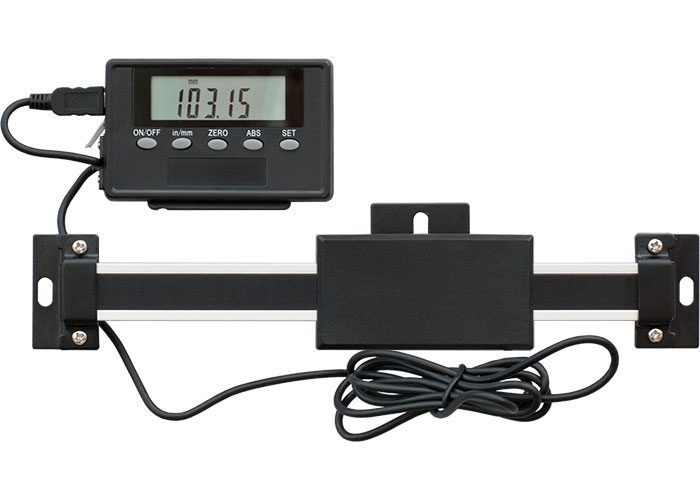
                                                      Almost a no-brainer, a DRO is so useful that no mill should be bought without one.   Doesn’t need to be anything fancy, I fitted mine with a pair of these, and was amazed at the difference they made!   Mine came from ArcEuro, other suppliers available.

                                                      DRO on a mill fixes a lot of human error problems.   With dials it’s easy to lose count when turning the hand-wheels multiple times, or to get confused when reversing, and be caught out by backlash.  Apart from saving the operator from silly mistakes, even a basic DRO like mine does a lot more, notably setting reference points and measuring interchangeably in either metric or imperial.
                                                      Dial Lever Indicator and edge finder.   A wiggler set is mildly useful, though I often use a dressmakers pin stuck in a  blob of plasticine.  Rubber mallet for tapping the vice into alignment.   Home made aluminium plate on a handle to deaden the hammer blows needed to release the drawbar.   Toothbrush to remove swarf from T-slots.    A variety of T-nuts, home-made parallels, spacers, jigs and v-blocks.  I bought a set of centre-drills to locate holes accurately before twist-drilling, and with hindsight think spot-drills are ‘better’, maybe.
                                                      Much depends on what you do.  I soon realised I needed a boring head and a rotary table (with headstock, though that doesn’t get used much).   Also, a small drill chuck that could be held in an ER collet.   Less vital, angle-plate.   I bought a clamping set which is too big for most jobs but wonderful for big ones.    Several tools become desirable when you need them; though I don’t use my Stevenson’s Blocks often, they save a lot of time!   I don’t do enough repeat threading to justify a tapping attachment.  For a long time I used a digital caliper to measure bores, then decided I did it often enough to justify a bore gauge set.    I also used a fly-cutter for years before finally coughing up for a shell cutter: again, not used often, but a real time-saver when it is.   Though entirely metric in theory, I have to clamp enough inch based objects in my ER collets to be a nuisance.   Although metric ER collets have the necessary range, it’s easier to use collets close to the right size, so I’ve invested in a set of common Imperial collets.  Worth it to me, not everyone else!
                                                      Biggest waste of money was a flood coolant system, even though it works well.   Mine is rarely used, partly because it’s so messy, and partly because I don’t spend hours hacking steel!  It’s not worth the hassle for small jobs.
                                                      I’m not against sets.  Although it rankles when parts of a set don’t get used due to every right-thinking Model Engineer’s extreme unwillingness to spend money, I’ve found most things in sets do get used – eventually.  And when the need arises, there it is, in the cupboard, ready to go    Experienced machinists dislike sets because they know what they need, forgetting that beginners don’t!   Not much harm I feel in splashing out on a set for educational reasons.
                                                      Dave
                                                    Viewing 25 results - 276 through 300 (of 4,842 total)

                                                    Latest Replies

                                                    Home Forums Search Search Results for 'arc euro'

                                                    Viewing 25 topics - 1 through 25 (of 25 total)
                                                    Viewing 25 topics - 1 through 25 (of 25 total)

                                                    View full reply list.