Webster engine – novice build!

Webster engine – novice build!

Home Forums Work In Progress and completed items Webster engine – novice build!

Viewing 23 posts - 1 through 23 (of 23 total)
  • Author
    Posts
  • #828120
    jps1982
    Participant
      @jps1982

      I joined up here nearly two years ago now, at roughly the same time that I joined my local model engineering club – but various life things derailed (no pun intended) my plans. But, hopefully, I now have a bit more free time – so thought i’d share this…

      As background – my interest is more in internal combustion than steam; and in motor mechanics/MIG welding/fabrication so I am essentially a complete novice to precision and machining work.

      After some Googling i concluded the Webster engine would be a good starting point. Hence a post in April last year; wondering how to decipher the language of exactly what material might be needed (possibly not helped by the fact the Webster design originates from the USA…).

      Anyway – with various bits of 6082T6 aluminium from Droitwitch Aluminim I’ve started with the basics of milling some flat plate, to make the baseplate and side plates which will support the crank; and against which the ‘cylinder head’ will bolt.

      Just this has been a learning curve in terms of mounting on the mill table and in the vice; and how hard it is to manually mark out with full accuracy to the nearest thou’ whilst using a vernier caliper and a small t-square… It’s clear I need to adjust some of my expectations – which I ‘expect’ I will do is not necessarily the same as what I ‘will’ do!

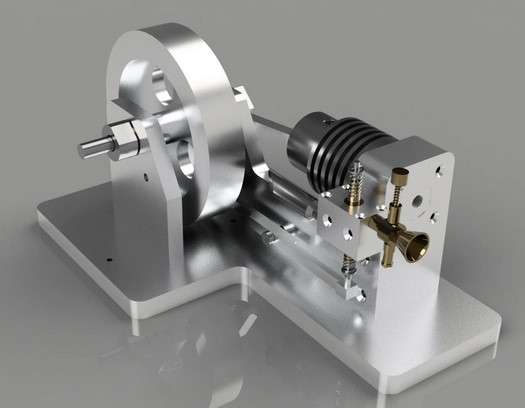
      CGI photo of the intended end result for interest; I will post some photos of progress if anyone is interested.

      Screenshot 2025-12-08 125650


      #828123
      SteveP
      Participant
        @stevepye68246

        JPS1982

        I’d be interested in seeing your engine progressing, it would be good to see another IC engine on the forum.

        I have an old twin cam engined car which one day, I hope I’ll make a minature replica of the engine.

        Best of luck with your machining.

        Steve


        #828171
        grubscrew
        Participant
          @grubscrew

          I’d like to follow your progress too….

          #828176
          Diogenes
          Participant
            @diogenes

            Yes, please do post – it’s always great to see active projects..

            Your marking-out parameters sound taxing – it’s something I rarely, or minimally do – even without a DRO, I tend to use the machine dials to establish all the critical dimensions..

            #828181
            JasonB
            Moderator
              @jasonb

              Good to see any build on here as we seem to lack them compared to other forums, so please show some progress and ask if you have questions.

              As said above I do not do much in the way of marking out, have a look at my Kelsey build that I am doing at the moment and see how I locate an edge and use the dials to position things from there.

              #828182
              jps1982
              Participant
                @jps1982

                No pictures but a key point from last weekend (I am doing all the milling at my local model engineering club workshop) was trying to get my head around which direction to feed material into the end mill. The information here has allowed me to get my head around it I think (but understanding the logic probably wasn’t helped by the fact I was milling down into 8mm plate with an end mill of about 15mm width..): https://www.cnccookbook.com/climb-milling-versus-conventional-milling/

                #828183
                jps1982
                Participant
                  @jps1982
                  On JasonB Said:

                  have a look at my Kelsey build that I am doing at the moment and see how I locate an edge and use the dials to position things from there.

                  I’ll check that out, having watched a good few videos on YouTube I suspect I know what you mean. The lathes and mill I have access to have no DROs, just hand wheel markings but I am sure I can achieve the same result.

                  Naively I had also started off thinking I’d hit every measurement on the plans to the exact measurement. I’m quickly learning about tolerances and what is/isn’t a critical dimension!

                  #828187
                  Dalboy
                  Participant
                    @dalboy

                    I always enjoy seeing other builds. I also am a novice at model engineering. Unlike Jason, I did post a build but without the set-ups just as a part was finished.

                    I have not long completed my first engine, which was a Farm Boy stationary engine (yet to run it). I seem to spend as much time going over each set up in my head and setting up on the machine than I do actual machining, I think this will become easier as time goes by.

                    #828188
                    noel shelley
                    Participant
                      @noelshelley55608

                      A very important lesson is that of knowing where precision is needed, or not, to achieve the desired result ie piston to cylinder fit though this is not a good example as one needs to allow for expansion of the metals, and the size of the flywheel. As an apprentice I had to sometimes work to .00025″, other times 1/8″ was ok ! I often found myself working to silly tolerances in later life. You can always tell the steam locomotive built by the precision engineer – it’s the one that won’t run ! Good luck. Noel.

                      #828205
                      Howard Lewis
                      Participant
                        @howardlewis46836

                        Since you have a mill, a lot of marking out can be replaced by using the mill to co ordinate drill / ream / bore holes. This should give you greater precision than scribing, and centre punching with a square.

                        Start by making, and then using, one surface as a datum, and machine other faces from that. In turn, they can be used as datum faces / points for the co ordinates.

                        For machining the crankshaft, you can make a throw block, to ensure that the journal and crankpin centres are correct, when used in the lathe, for finish turning.

                        (With the journal bore centred in a four chuck, the throw block will place the webs for turning the outer radius or side faces).

                        HTH

                        Howard

                        #828250
                        Diogenes
                        Participant
                          @diogenes

                          Marc L’ecuyer’s Youtube channel also has ‘reliable and useful’ videos covering a wide range of the basics – example below – it’s rather unfortunate that his website now seems defunct – I rather fear the worst..

                          https://www.youtube.com/watch?v=hx7shEX0aFo


                          #828344
                          jps1982
                          Participant
                            @jps1982

                            A couple of photos to show the (limited!) progress so far.


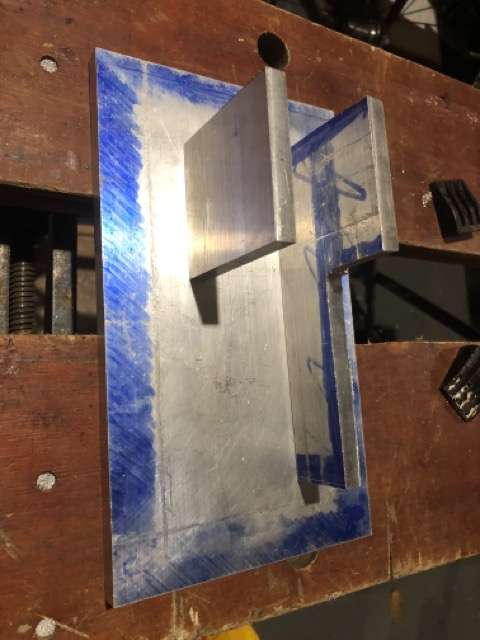
                            1) the base and side plates I have cut so far, none are to the finished dimensions yet but this does show roughly how they will be laid out. IMG_4472 Medium
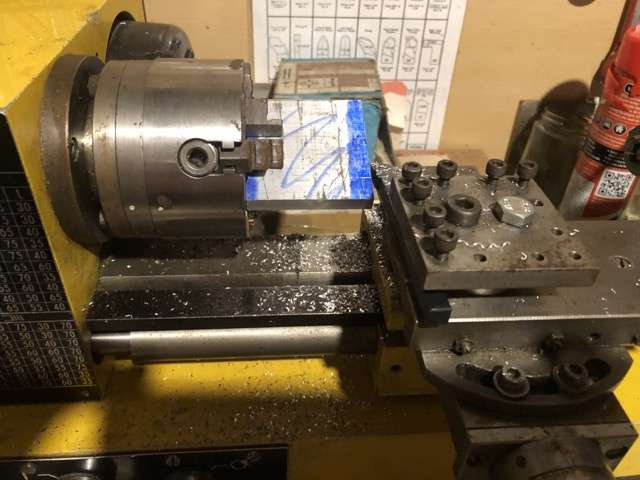
                            <p style=”text-align: left;”>2) The rough cuts for the 10mm and 8mm plate I’ve done with a Bosch jigsaw (with an aluminium specific blade) and until today all the fine trimming had been on the mill at my model engineering club. At home I just have hand tools, and a small Hobbymat lathe. But I thought I’d try mounting up the smaller side plate in my lathe and see if I could square off one of the edges which I hadn’t milled yet. I ended up doing both and they are pretty square. The finish across the faces is consistent to  within 0.08mm so not bad I guess but not as good as the milled faces (which are within 0.02)…</p>
                            IMG_4471 Medium


                            Advice on how to clean up / polish the surfaces much appreciated!!


                            John

                            #828356
                            Diogenes
                            Participant
                              @diogenes

                              If you’ll pardon me saying so that’s not an ideal set-up in terms of the size/thickness ratio of the aluminium – too much unsupported metal at the working edges..

                              – a better way would be to clamp the metal on the cross-slide at a suitable height and mill the edges with a fly-cutter or small face mill mounted in the (2MT) headstock spindle.

                              Hobbymat used to supply a T-slotted boring table / ‘pallet’ to fit on the cross-slide for this purpose – I can dig mine out later and measure up..

                              Cleaning up the surfaces of the plates can be done by working down through grades of wet/dry paper, with a sander or with paper taped to a ‘flat’ surface, if that is what’s required – be sure to remove all scratches and blemishes left from the previous sheet before going down to the next..

                              #828357
                              JasonB
                              Moderator
                                @jasonb

                                Although not the ideal setup there are two ways you could improve the finish so it needs little or no clean up.

                                1. It looks like you are using a a general puropse insert which typically have a golden colour. Change to an insert meant specifically for non ferrous metals which are bright and polished.

                                2. Use a small amount of cutting lubricant in the form of paraffin or WD40, this will stop th emetal sticking tho the insert and allow it to cut cleanly.

                                At the moment I would leave any polishing until the engine has been tested. When all is running then yoy can bling it up as you which. To start with a fine file and “drawfiling” will remove the machining marks far quicker than abrasives. To do this you hold the file across the edge of the work but move it along the edge. Make sure not to rock the file and round over flat surfaces and you can also rub chalk onto the file to stop bits of metal sticking to it which can gauge the surface. You can then wrap some emery around the file and work down to the grit you want.


                                #828376
                                jps1982
                                Participant
                                  @jps1982

                                  @Diogenes – more than happy to take the feedback. I thought I was chancing my arm, but wanted to see what might be possible at home – rather than waiting until Friday (the next day my club workshop is open) to get it back into the mill. I was surprisingly pleased with the result to be honest!

                                  Once i’ve milled everything up to my satisfaction, the next challenge will be choosing suitable metric fixings as alternatives to the #4-40 and #6-32 threads specified on the original (American) plans…

                                  I’m erring towards using M3x0.5 for both; rather than buy taps and bolts at both M3 and M3.5…

                                  #828386
                                  JasonB
                                  Moderator
                                    @jasonb

                                    You could go upto M4 in place of the #6 threads as M3 would be a bit tight to get oil pots into but would be OK for the base to side connection though M4 is my usual substitute.

                                    There is a spreadsheet in my Gallery that highlights the alternatives I use in different colours.

                                    #828396
                                    Dalboy
                                    Participant
                                      @dalboy

                                      I do sometimes mark out just for my own sanity but when on the milling machine tend to use the DRO for final work once I have machined to major size and established a datum.

                                      The only thing I do get wrong is the momentary loss of concentration and turn the handle the wrong way, which seems to be getting less frequent now.

                                      #828401
                                      JasonB
                                      Moderator
                                        @jasonb

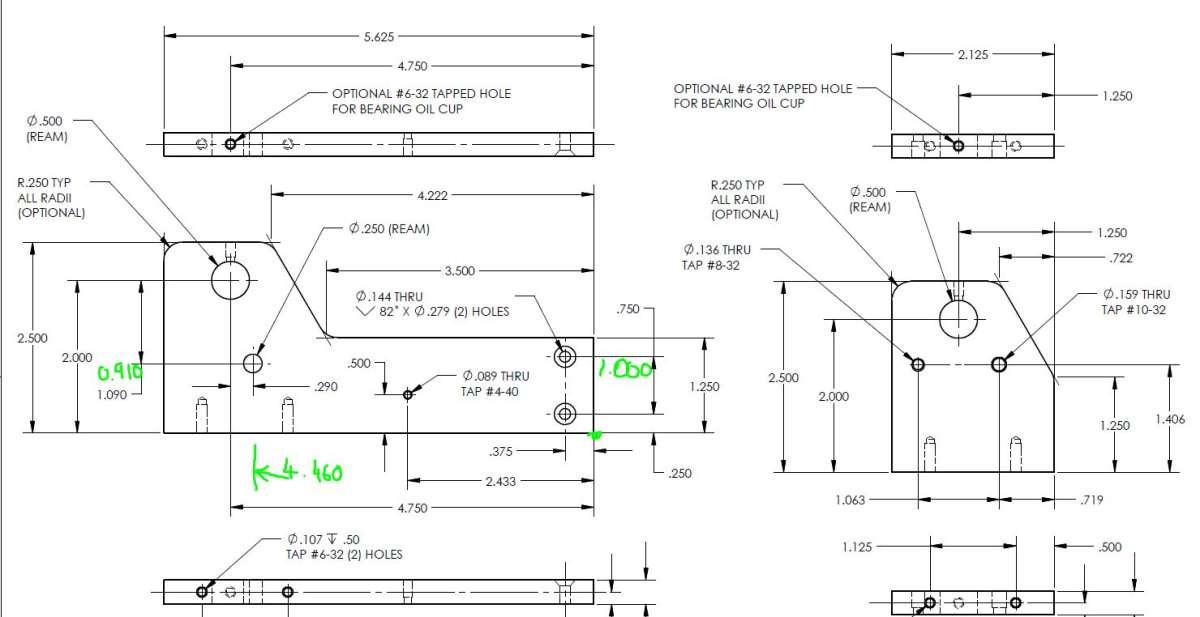
                                        If you do decide to try th eco-ordinate method then you can save some of the limited time at the club workshop by making your drawings co-ordinate friendly. Go through them and work out all the hole positions from the one single corner then you are not going to have to worry about backlash or the time taken to calculate .

                                        co ords

                                        #828409
                                        Diogenes
                                        Participant
                                          @diogenes

                                          Re. fasteners – I don’t tend to use M3.5 for modelling either – either M3 or M4, judging each case on it’s merits.


                                          #828604
                                          jps1982
                                          Participant
                                            @jps1982

                                            Thanks for the guidance everyone. It occurred to me I could consider the width of a nut to try and gauge how much width of material I need for a given tapped hole size. Looking up M4 I see a nut is 7mm across the flats so assume I should be confident tapping an M4 into the side of an 8mm thick piece of plate (as long as I am in the middle!).

                                            Yesterday evening I was back on the mill at the club workshop and the smaller of the two side plates is to  dimensions I am happy with.

                                            IMG_4476 Medium


                                            Attempts to square up the longer, L shaped, side plate were less successful. I had it clamped horizontally in the vice but think I have failed to clean the vice properly and introduced so swarf that pushed it slightly off square. Next time I’ll clamp the workpiece to the table and clock it with my DTI to see if I can do better.

                                            Various taps and drills are on the way from eBay but I need to get some sort of edge finder so I can try plotting out my holes on the mill as discussed above.

                                            John

                                            #828629
                                            Dalboy
                                            Participant
                                              @dalboy

                                              As you have found out, always clean the vice surfaces including the one any parallels sit on. As well as deburr any cut edges before reorientating a piece.

                                              Yes as a novice myself I learnt the hard way so now do both of these things as a matter of habit. An paint brush is handy to remove the bulk and a paper towel for a quick wipe over.

                                              #829576
                                              jps1982
                                              Participant
                                                @jps1982

                                                Managed to get the baseplate milled down to size this Friday evening, before a bit of a disaster…

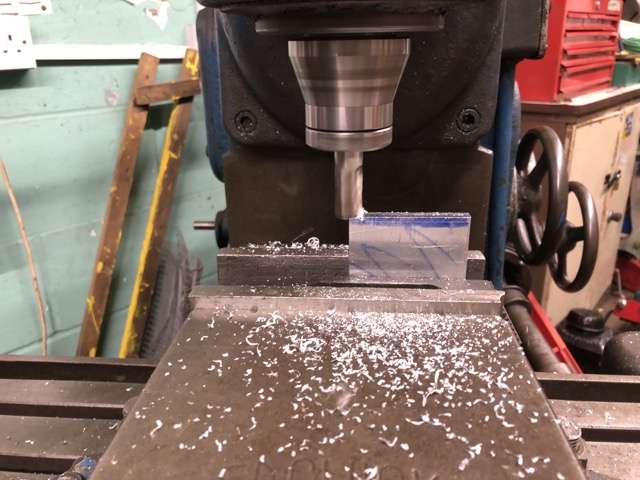
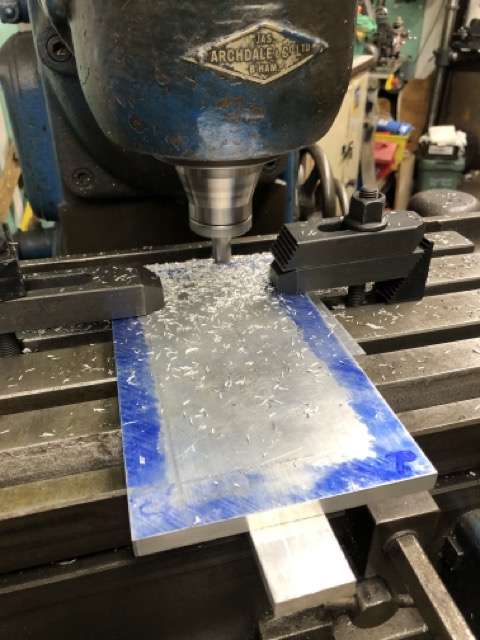
                                                First up, I clamped the baseplate to the table and was shown the technique of using a square to align the workpiece off the vertical face of the mill. Then I took off close to 300 thou to get down to the right dimension, using the power feed and the moveable end stops to save lots of winding the table.

                                                IMG_4487 Medium

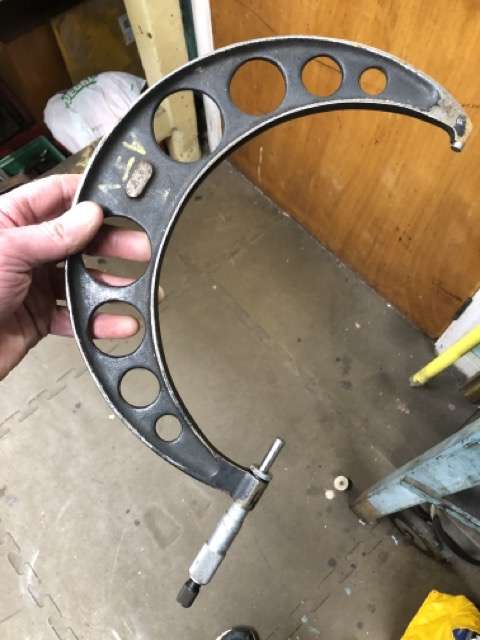
                                                I’d picked up a 8-9” vernier caliper for only a few pounds at one of the club auctions at the start of the year, so finally got to put it to use.

                                                IMG_4488 Medium


                                                Next time I’ll definitely be less cautious with the rough cutting I do (I used my jigsaw, with an alu specific blade) and clearly left a much greater room for error than needed.

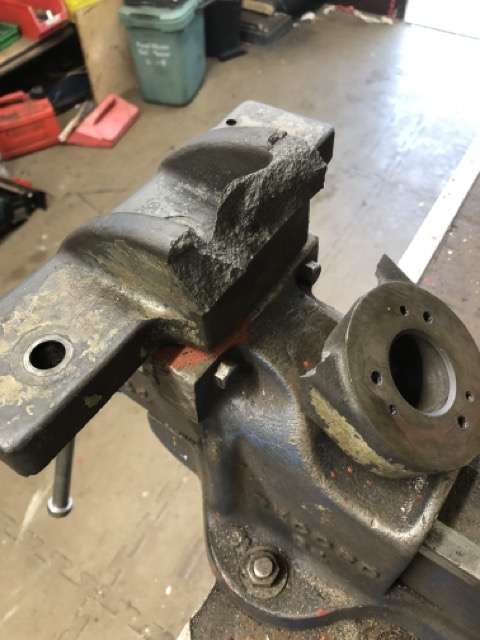
                                                This done I then mounted the longer of the slide plates to see if I could mill the end squarer. Measuring up showed me I had about 6 thou to play with before I started to go undersize, so I setup the piece as before and started with a very light cut, again using the power feed. Concentrating on the depth of cut being taken this is where it all went wrong, I ran the mill table into the knee and jammed everything solid. The hand wheel hangs from the table on a cast iron bracket and it was tight up against the body of the mill, with a crack evident…

                                                The other club members present on Friday tried to free things up,  this Sunday morning we were successful in getting things disassembled. Thankfully it looks like a taper pin in the power feed drive snapped, saving the power feed gears. It was apparent the crack I’d opened up was an old one, but whilst stripping the casting down (it needed repairing regardless so a brass bush had to be driven out ) it cracked completely. So I am now putting out feelers for somewhere local that can repair broken cast iron!

                                                IMG_4492 Medium

                                                #829664
                                                bernard towers
                                                Participant
                                                  @bernardtowers37738

                                                  Your clamp studs on the plate will work a lot better if the studs are closer to the workpiece, more pressure on the workpiece for less spanner torque. Hope this helps.

                                                Viewing 23 posts - 1 through 23 (of 23 total)
                                                • Please log in to reply to this topic. Registering is free and easy using the links on the menu at the top of this page.

                                                Latest Replies

                                                Viewing 25 topics - 1 through 25 (of 25 total)
                                                Viewing 25 topics - 1 through 25 (of 25 total)

                                                View full reply list.