Home Made Rear Toolpost Issue

Home Made Rear Toolpost Issue

Home Forums Workshop Tools and Tooling Home Made Rear Toolpost Issue

Viewing 25 posts - 76 through 100 (of 161 total)
  • Author
    Posts
  • #532399
    Tony Pratt 1
    Participant
      @tonypratt1

      A mild steel top plate will be fine, using cast iron on the original toolpost was bound to end in tears.

      Tony

      #532400
      old mart
      Participant
        @oldmart

        Bad luck with the holder, I have mostly used mild steel, or sometimes EN24T / EN19T if there was a need for extra strength.

        The supplimentary clamp would indeed improve the stiffness. Could you see if a rear lock for the saddle is feasible?

        Edited By old mart on 07/03/2021 20:07:00

        #532403
        Dr_GMJN
        Participant
          @dr_gmjn
          Posted by David George 1 on 07/03/2021 19:42:09:

          Hi Dr_GMGN how about just making a top plate to clamp the blade similar to my one. It looks like it would make similar and you can then slide the blade in or out to suit the job to part off.

          20190316_164659.jpg

          David

          David, there is actually a slot machined in the other side:

          It's too shallow for the Sandvik tool, and I did want to use it because it's easier to move in and out. How do you set/adjust centre height though?

          I could easily enlarge the slot, but I assumed I'd need a profiled milling cutter to form a taper along the lower edge?

          So slice the top off the original block and use it as a clamp? Not sure what the two grub screws were for?

          I honestly don't know how these holders work, but I'd be willing to give it one last go, since I've messed about buying a t-bolt and milled the slots etc. (and it looked quite nice up to the cracking disaster.

          Thanks.

          #532406
          Dr_GMJN
          Participant
            @dr_gmjn
            Posted by old mart on 07/03/2021 20:04:11:

            Bad luck with the holder, I have mostly used mild steel, or sometimes EN24T / EN19T if there was a need for extra strength.

            The supplimentary clamp would indeed improve the stiffness. Could you see if a rear lock for the saddle is feasible?

            Edited By old mart on 07/03/2021 20:07:00

            What do you mean by "rear lock"?

            #532407
            Dr_GMJN
            Participant
              @dr_gmjn
              Posted by Chris Crew on 07/03/2021 19:54:59:

              For my two-pennyworth, mild steel does for most jobs probably simply because I acquired a mountain of the stuff when my erstwhile employer closed its tool room and workshop a few years ago and it is very easy to work with. I have made most things out of it even where other materials have been specified. Of course, it would not do in industry or a professional environment, but in the home workshop where sliding or rotating parts are not in use eight hours a day, five days a week, it is very unlikely that it will ever wear beyond use. The only things that I use higher quality hardening steel on are, obviously, home-made cutting tools. The Colchester rear tool-post I copied is made out of mild steel and works fine for me.

              Yep. This was inherited when I got the lathe. It's been in a drawer since 2007, so the material was selected for me.

              #532408
              derek hall 1
              Participant
                @derekhall1

                Hi Dr_GMJN

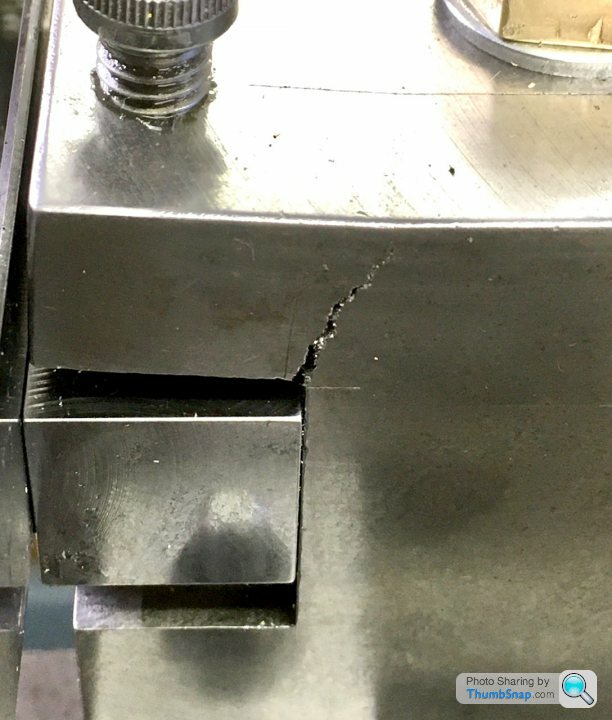
                Your picture shows beautifully crack propagation in cast iron when under tension. Cast iron should always be under compression loading.

                If the top plate was steel then that would be a better material.

                I enjoy making tools in my workshop as long as they are well designed and fit for purpose. Anything designed by George Thomas that I have made has been worth the time spent making it. I suggest looking at the myford rear toolpost sold as a kit by Kirk at Hemingway Tools. It's not a huge project but worth considering.

                I totally empathise we you about wasted time in the workshop, it happens to all of us but you still gain experience from these set backs.

                Regards

                Derek

                #532410
                Dr_GMJN
                Participant
                  @dr_gmjn
                  Posted by Tony Pratt 1 on 07/03/2021 20:00:25:

                  A mild steel top plate will be fine, using cast iron on the original toolpost was bound to end in tears.

                  Tony

                  Doesn't bolting a top plate on, then having bolts through that to the tool, reduce stiffness? I could imagine the loads would be managed better if the top plate was acting directly in the top edge of the tool – less bending moment?

                  Believe me I would love to be able to salvage this somehow, but if it's going to be another compromise/experiment….a Myford one is £50 new.

                  If its a couple more hours with a slitting saw and a tap, then I'm up for it.

                  Edited By Dr_GMJN on 07/03/2021 20:23:26

                  #532415
                  old mart
                  Participant
                    @oldmart

                    Most lathe saddles have a lock at the front which should be used when parting off. These locks usually clamp the saddle down to the bed. I added a rear lock to the Smart & Brown saddle for two reasons. The forces are upwards when using a rear parting tool. The bed of the lathe is very worn, and I added a rear lock to make sure the saddle was not lifted. There has to be some allowance for the saddle guides to have some clearance or the saddle would never reach the right end of the bed where there is no wear.

                    #532416
                    Dr_GMJN
                    Participant
                      @dr_gmjn

                      I've got this q/c blade holder that I don't think I've ever used. Could anything from this be salvaged to use on the cast iron thing? I noticed the lower groove is profiled, which is why I reject using the slot in the cast iron one – it's flat. I suppose I could angle a normal, small diameter, milling cutter to achieve the angle. The rest of the blade would be sitting against a flat face?

                      Thanks.

                      #532417
                      John Baron
                      Participant
                        @johnbaron31275
                        Posted by Dr_GMJN on 07/03/2021 18:06:11:

                        So I milled the key to clear the new bolt:

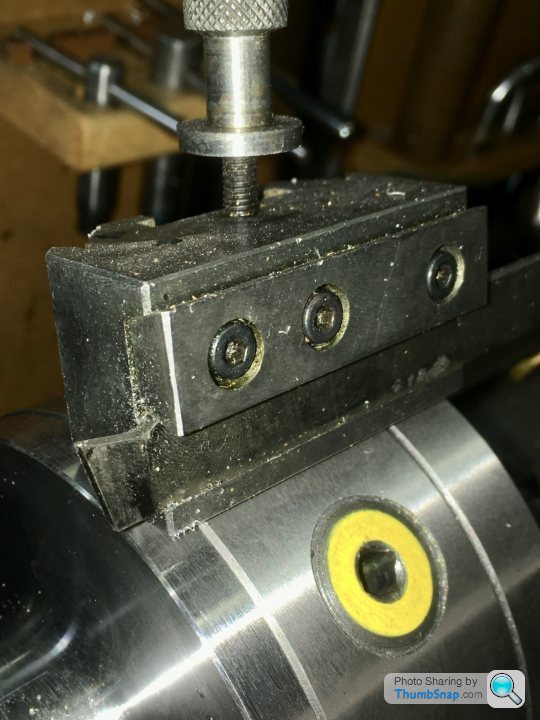
                        and set it up using the "against the chuck" method suggested earlier in the thread:

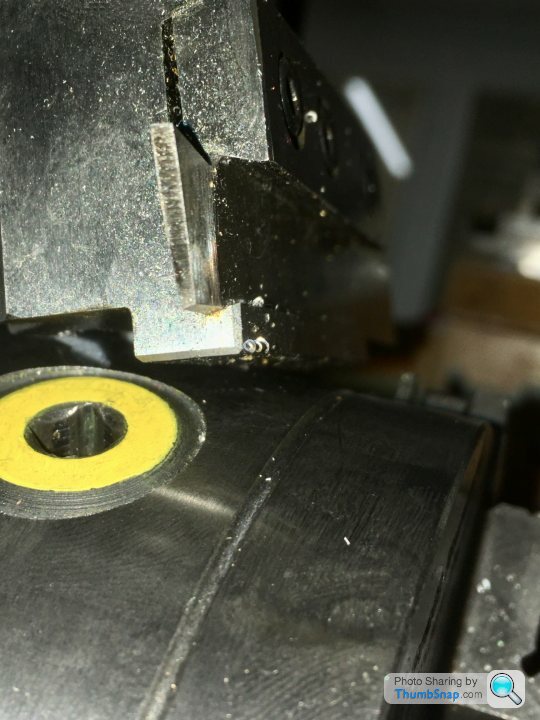
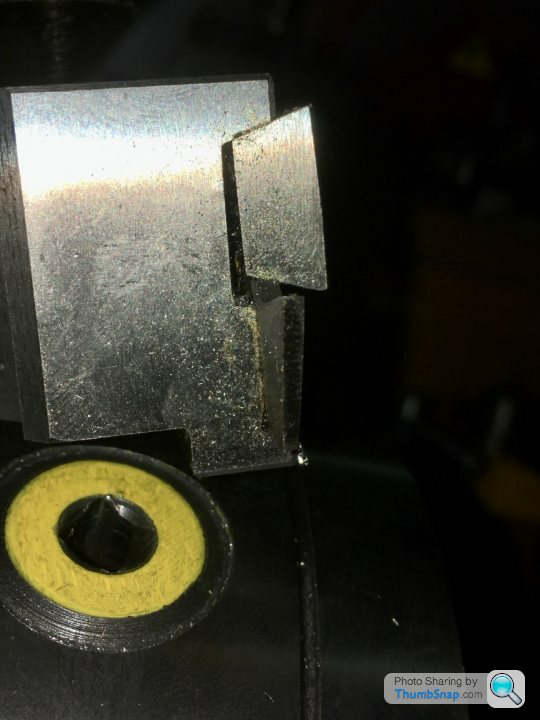
                        I tried it on some steel, and then some brass. It was "OK", but in no way was the step change I thought I'd notice having read about the improvements to parting this should give. I thought I noticed some movement, so I went ahead and milled an extra slot in the block, for a clamp, which fitted perfectly:

                        I then tightened the bolts after setting against the chuck again, and…something felt wrong. Surely not a stripped thread?

                        No:

                        So, undeterred – for now – can anyone recommend a rear toolpost for an ML7, and also a good parting tool? Please don't suggest making one – I have less than zero interest in making tooling, I just want to buy something that works.

                        Don't mess about ! Just break that lip off, mill a flat across the top and bolt a steel plate on there to replace the broken bit. That failure is about what you would expect from cast iron. Use a pair of M8 coarse threaded bolts. to fasten the new plate.  Shouldn't take more than an hour !


                        Edited By John Baron on 07/03/2021 20:39:11

                        #532418
                        Dr_GMJN
                        Participant
                          @dr_gmjn
                          Posted by old mart on 07/03/2021 20:32:24:

                          Most lathe saddles have a lock at the front which should be used when parting off. These locks usually clamp the saddle down to the bed. I added a rear lock to the Smart & Brown saddle for two reasons. The forces are upwards when using a rear parting tool. The bed of the lathe is very worn, and I added a rear lock to make sure the saddle was not lifted. There has to be some allowance for the saddle guides to have some clearance or the saddle would never reach the right end of the bed where there is no wear.


                          My ML7 already has a rear saddle lock, that pulls the saddle down when engaged. I always use it when the saddle doesn't need moving during a cut. It's a bolt head, and I keep a ring spanner on it. I was going to get the Hemmingway kit for an indexable handle, but it's another job to do that's not making parts.

                          Edited By Dr_GMJN on 07/03/2021 20:38:10

                          #532421
                          Dr_GMJN
                          Participant
                            @dr_gmjn
                            Posted by John Baron on 07/03/2021 20:37:55:

                            Posted by Dr_GMJN on 07/03/2021 18:06:11:

                            So I milled the key to clear the new bolt:

                            and set it up using the "against the chuck" method suggested earlier in the thread:

                            I tried it on some steel, and then some brass. It was "OK", but in no way was the step change I thought I'd notice having read about the improvements to parting this should give. I thought I noticed some movement, so I went ahead and milled an extra slot in the block, for a clamp, which fitted perfectly:

                            I then tightened the bolts after setting against the chuck again, and…something felt wrong. Surely not a stripped thread?

                            No:

                            So, undeterred – for now – can anyone recommend a rear toolpost for an ML7, and also a good parting tool? Please don't suggest making one – I have less than zero interest in making tooling, I just want to buy something that works.

                            Don't mess about ! Just break that lip off, mill a flat across the top and bolt a steel plate on there to replace the broken bit. That failure is about what you would expect from cast iron. Use a pair of M8 coarse threaded bolts. to fasten the new plate. Shouldn't take more than an hour !

                            Edited By John Baron on 07/03/2021 20:39:11

                            Won't that be a fairly flexible clamping method though? The bolts have to be offset for a reasonable distance in from the slot, so there's some prying load being applied when the lock bolts are tightened?

                            Not saying it wont work, but if I'm going to salvage it, I'd rather have the maximum possible stiffness. That seems to be through the top edge being restrained, but I don't know how centre height is adjusted in that scenario.

                            Thanks.

                            #532427
                            Maurice Taylor
                            Participant
                              @mauricetaylor82093

                              Hi ,I adjust the center height on mine by fitting shims between toolpost and cross slide

                              Maurice

                              #532428
                              John Baron
                              Participant
                                @johnbaron31275

                                Hi Dr_GMJN,

                                Just putting a steel plate on to replace the broken lip will not change the tool height or be any weaker than it would have been had it not failed.

                                You could of course do a much better job which would require far more work for very little benefit ! What I've and I noticed other suggested the same would produce a quick and easy fix.

                                Lets see piece of plate, five holes to drill four holes to tap. Two M8 two M6. Saw the top off, mill it clean, mark out for the five holes, drill. Tap the M6 holes, spot through the M8 ones. Drill 7 mm, thread the block M8. Fit the plate. Job done !  Opps forgot the hole for the long clamp screw.


                                Edited By John Baron on 07/03/2021 21:02:25

                                #532433
                                Dr_GMJN
                                Participant
                                  @dr_gmjn

                                  Ok thanks all. One way or another I'll retrieve it form the bin and give it one last go. Slot or top plate is the question. Top plate winning so far. I think I've got some plate that will do.

                                  #532439
                                  John Baron
                                  Participant
                                    @johnbaron31275
                                    Posted by Dr_GMJN on 07/03/2021 21:09:16:

                                    Ok thanks all. One way or another I'll retrieve it form the bin and give it one last go. Slot or top plate is the question. Top plate winning so far. I think I've got some plate that will do.

                                    I think anything 3/8" inch or thicker will be quite satisfactory. Don't forget that the nut on top will also be adding to the security of the plate.

                                    For what its worth, and I'm sure you have seen the picture of mine, I use a cheap Chinese parting blade that is 2 mm thick, 12 mm wide and 200 mm long. It is perfectly rectangular in section. And is clamped by two screws with a third used to clamp the supporting piece.

                                    I don't have any packings or shims under the blade, the height of the whole tool block being used to set the blade centre height.

                                    #532443
                                    Clive Brown 1
                                    Participant
                                      @clivebrown1
                                      Posted by Dr_GMJN on 07/03/2021 20:17:08:

                                      David, there is actually a slot machined in the other side:

                                      I could easily enlarge the slot, but I assumed I'd need a profiled milling cutter to form a taper along the lower edge?

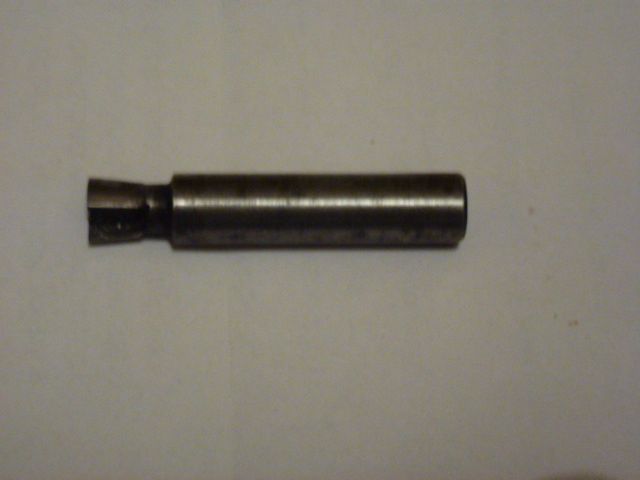
                                      A suitable milling cutter is readily made from silver steel. Taper-turn the 14 deg. (IIRC) angle and mill two flutes.

                                      Nothing fancy. Here's the one I made years ago for my GHT rear toolpost. Cuts the angle a treat!p1020873.jpg

                                      #532447
                                      Dr_GMJN
                                      Participant
                                        @dr_gmjn
                                        Posted by Clive Brown 1 on 07/03/2021 21:46:07:

                                        Posted by Dr_GMJN on 07/03/2021 20:17:08:

                                        David, there is actually a slot machined in the other side:

                                        I could easily enlarge the slot, but I assumed I'd need a profiled milling cutter to form a taper along the lower edge?

                                        A suitable milling cutter is readily made from silver steel. Taper-turn the 14 deg. (IIRC) angle and mill two flutes.

                                        Nothing fancy. Here's the one I made years ago for my GHT rear toolpost. Cuts the angle a treat!p1020873.jpg

                                        Presumably heat treated – I did make a spot facing tool from silver steel last year which worked ok.

                                        So how do you adjust centre height with this type – pack the entire toolpost as suggested earlier, or is there a better method?

                                        #532450
                                        John Baron
                                        Participant
                                          @johnbaron31275

                                          Hi Dr_GMJN, Guys,

                                          You could make a holder for the blade that clamps into the slot in the tool block and use shims under it ! There is no way I would want to start shimming under the whole tool post.

                                          #532454
                                          Dr_GMJN
                                          Participant
                                            @dr_gmjn

                                            The thing is…Years ago when I was given it – I drilled the Sandvik blade holder (god knows how), and bolted it to some steel, so I could use it in a quick-change holder.

                                            It's not the stiffest method, and there's always some spring between the end bolt and the end of the tool.

                                            Ideally I'd ditch the bolted connection altogether, and slide it into a slot directly milled in the cast iron.. That way, it's always held right to the end of the toolpost. Only problem is setting height.

                                            Edited By Dr_GMJN on 07/03/2021 22:21:10

                                            #532456
                                            Dr_GMJN
                                            Participant
                                              @dr_gmjn

                                              Angled slot so that in-out movement gives a tip height change?

                                              Only good for one extension from the post though.

                                              #532583
                                              Howard Lewis
                                              Participant
                                                @howardlewis46836

                                                My advice is to make the rear toolpost from Steel. (My one for the ML7 was 2 x 2 box section, with platforms welded into place. )

                                                Cast iron is strong in compression, but as you now know, weak in tension.

                                                Remake your toolpost in steel and you should have no further problems.

                                                If you are worried about the Tee nut, you can make it longer, with the key only just deep enough to engage in the T slot, say 1/8". It only there to prevent the nut from rotating and if it is over an inch long, should do so without risking damage the Cross Slide. Similarly, the key on the bottom of the post can be shortened so that it does not clash with the key on the T nut. IN this way, the nut cannot rotate and the post is located along the full width of the post.

                                                OR

                                                Locate the post with a dowel, fitting the T slot closely, at each end of the post and have a long T nut in between.

                                                If you look in the album, at the underside of my toolpost base, you will see that it is located by a 1/4" dowel at each end, which bear on the rear face of the Cross Slide.

                                                Location of the post has never caused any problems in at least 17 years!

                                                If you want to ensure that the tool slot is square to the axis.   Having machined the dowels holes, and fitted the dowels, and drilled the hole for the clamp bolt, Clamp the embryo post to the Cross Slide and flycut the front (Headstock ) face, before reversing and flycutting the rear face.

                                                The rear face can then be used as a datum to mill the slot for the parting tool, before drilling and tapping for the tool clamp screws..

                                                Howard

                                                Edited By Howard Lewis on 08/03/2021 14:39:42

                                                #532603
                                                Michael Gilligan
                                                Participant
                                                  @michaelgilligan61133

                                                  With all the wise warnings about the properties of Cast Iron … please do bear in mind what the ML7 tee-slots are made in.

                                                  An inverted rear parting tool looks like a great idea [swarf drops out; and motor runs in the forward direction] but there is always that fragility to consider.

                                                  MichaelG.

                                                  [ gloom & doom merchant ]

                                                  #532661
                                                  Dr_GMJN
                                                  Participant
                                                    @dr_gmjn

                                                    I found some M8 cap screws and a lump of steel plate about 15mm thick. Pretty much as suggested, I’ll chomp the top surface flat, and use 6x M8s (three adjacent to the now broken edge, three on the opposite side. I’ll d&t 4 M6s to hold the tool. I’ll keep my original Sandvik tool (because I got about 12 inserts with it), but make a steel clamping plate to spread the load of the securing bolts.

                                                    If that doesn’t work I’ll part off using a hacksaw from then on.

                                                    #532678
                                                    Hopper
                                                    Participant
                                                      @hopper
                                                      Posted by Dr_GMJN on 08/03/2021 21:35:59:

                                                      If that doesn’t work I’ll part off using a hacksaw from then on.

                                                      Actually Doc, for a lot of the model type stuff you are doing, you could do what I do and use a 5/16" x 1/16' HSS parting blade held in the front toolpost with normal forward spindle rotation direction. I use one of these on anything under about 3/4" diameter jobs and it works just fine. I only use the rear toolpost for lopping off sections of larger diameter bar etc.

                                                      Edited By Hopper on 08/03/2021 22:53:31

                                                    Viewing 25 posts - 76 through 100 (of 161 total)
                                                    • Please log in to reply to this topic. Registering is free and easy using the links on the menu at the top of this page.

                                                    Latest Replies

                                                    Viewing 25 topics - 1 through 25 (of 25 total)
                                                    Viewing 25 topics - 1 through 25 (of 25 total)

                                                    View full reply list.