Home Made Rear Toolpost Issue

Home Made Rear Toolpost Issue

Home Forums Workshop Tools and Tooling Home Made Rear Toolpost Issue

Viewing 25 posts - 126 through 150 (of 161 total)
  • Author
    Posts
  • #538083
    Dr_GMJN
    Participant
      @dr_gmjn
      Posted by old mart on 04/04/2021 21:53:29:

      You could get a lathe tool set to cut exactly on centre and then make a gauge that sat on the bed to match the height. A very useful gadget.

      What's the difference between that method and using a dead centre? Aren't you still judging it by eye?

      #538089
      JasonB
      Moderator
        @jasonb

        You can feel if the tool is the right height as it will either pass under the gauge(too low) or hit it (too high) Why not set a cutting tool to height on the top slide and then undo th erear post, slide it forward and see if the parting tool is above or below.

        I would also say that there will be some movement of your blade on those screw shanks as you would have had some clearance for the screws which will be taken up by cutting forces. So keep a lifting force on the cutting end as you do up the screws.

        #538092
        John Baron
        Participant
          @johnbaron31275

          Hi Dr GMJN, Guys,

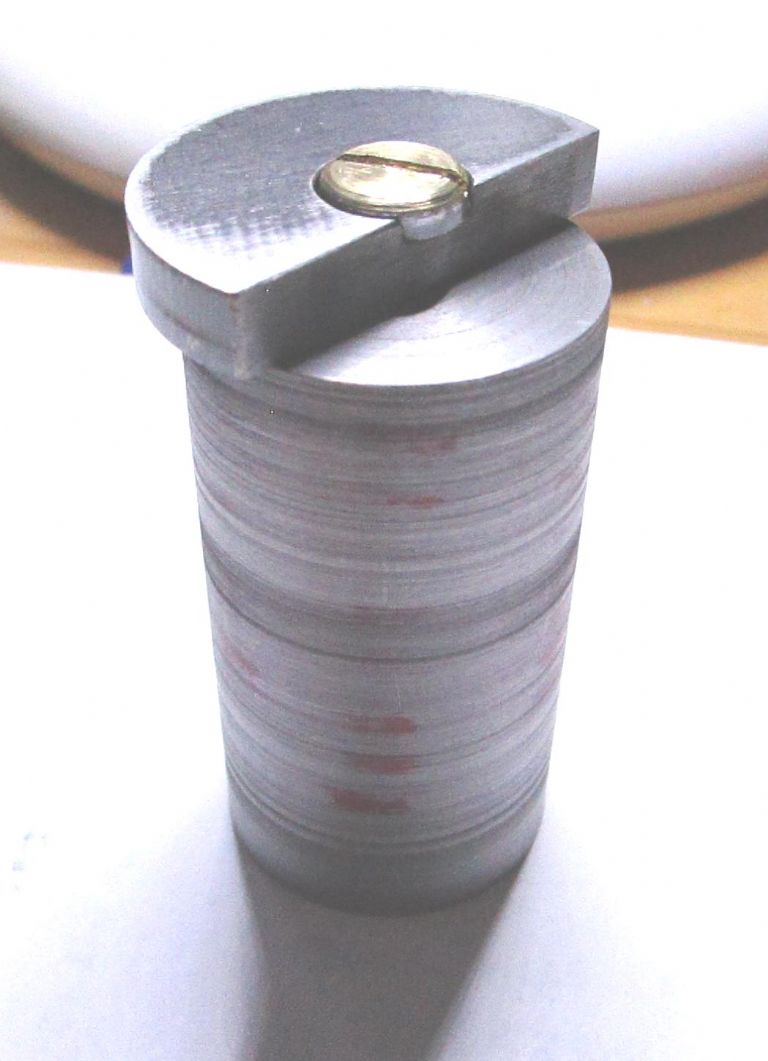
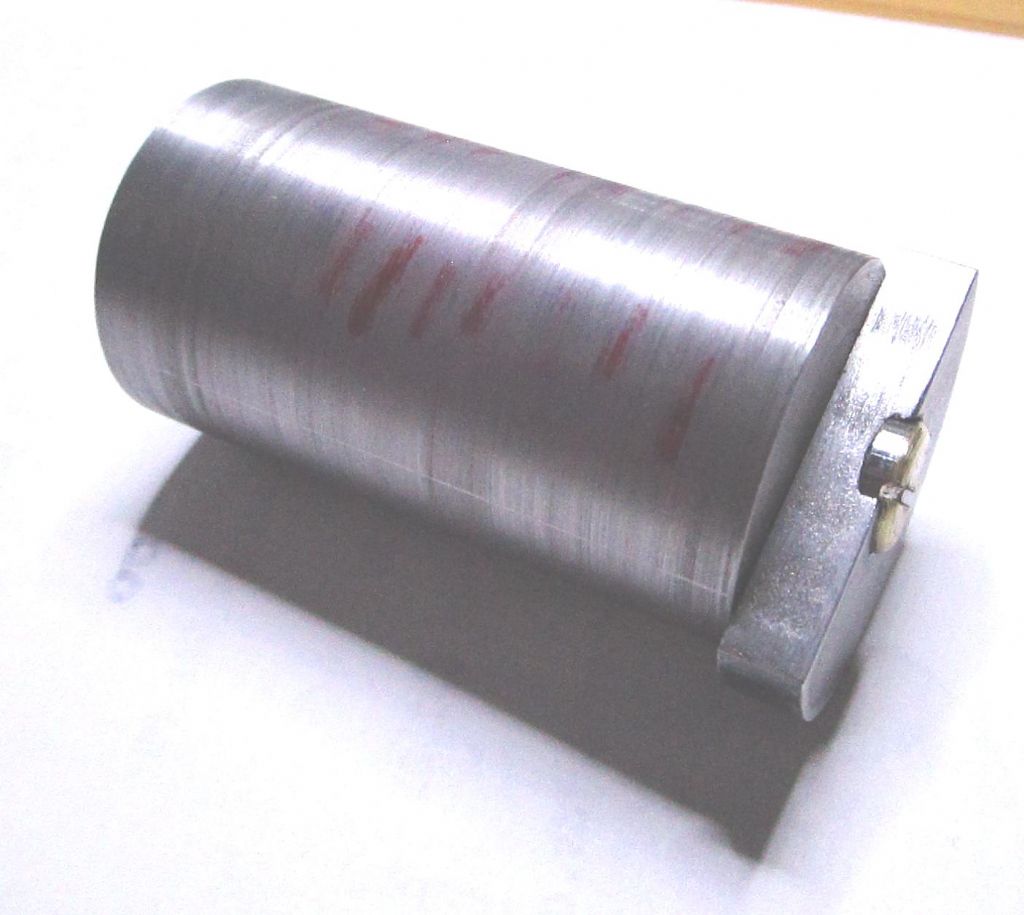
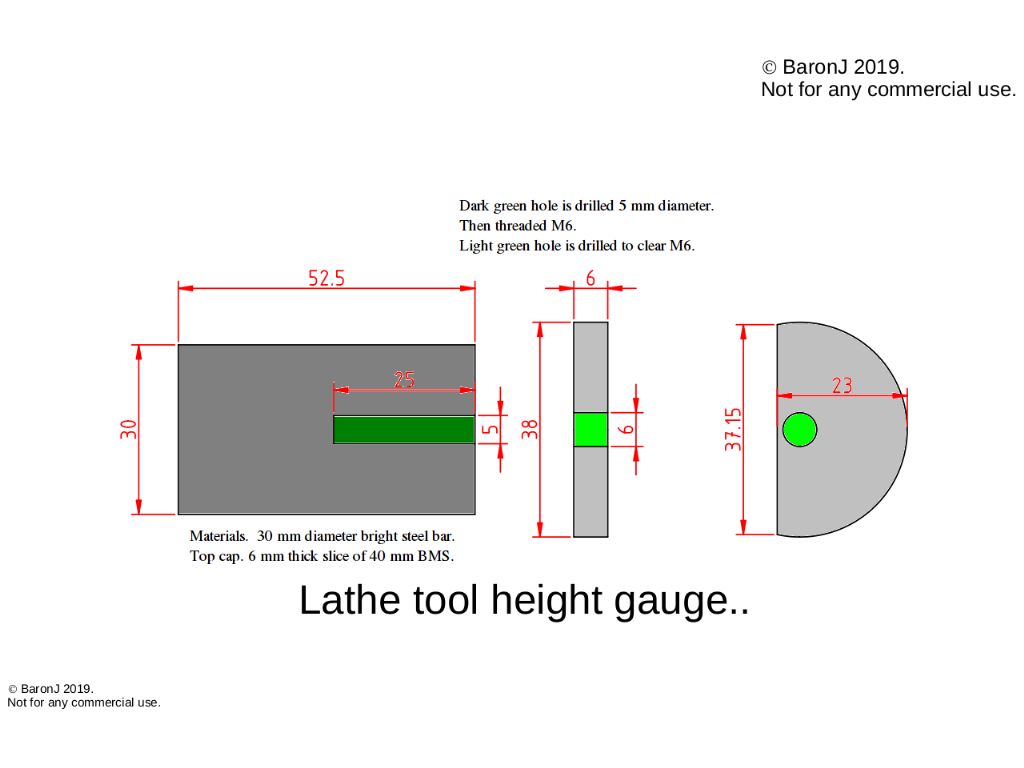
          Here is my lathe tool height gauge, made from bits of scrap !

          26-02-2020-01.jpg

          26-02-2020-02.jpg

          And a drawing !

          height gauge.jpg

          Its very handy. Just sit it on the cross slide and set the tool edge either under the cap or on the top at the side of the cap.

          #538094
          JasonB
          Moderator
            @jasonb

            It is also very handy to know the exact height of your lathes ctr line above the cross slide so that you can accurately set work on it by adding the required packing under it. So once you know the height if you have a height gauge that can also be used for tool setting, scribing ctr lines on the face of the work etc. I have it written behind the lathe but know it is 3.389"

            #538136
            Dr_GMJN
            Participant
              @dr_gmjn

              Ok thanks guys. So I could make a gauge similar to Johns. To get the height, perhaps put some bar in the chuck, then measure the height by putting slip gauges on the cross slide, then add the radius of the bar? Then machine to that dimension? I don’t have a height gauge, but have got most of a set of second hand slips.

              #538141
              ega
              Participant
                @ega
                Posted by Dr_GMJN on 04/04/2021 21:46:45:

                Determining centre height to that degree isn't something I could do. I'm currently setting tools initially be eye against a dead centre, then by trial and error to home in on not getting a pip. Pretty tedious.

                If you have a height gauge you can scribe a line on a flat piece of metal in the chuck, rotate 90 degrees and repeat until the two coincide.

                Any other suggestions?

                #538144
                not done it yet
                Participant
                  @notdoneityet

                  I’ve never had any need to set the centre height on my rear tool post – it was fixed when it was made.

                  #538147
                  Howard Lewis
                  Participant
                    @howardlewis46836

                    Dr

                    Two comments

                    1 You do NOT need the extra clamp. It WILL be in the way of the workpiece.

                    If the rear post does get in the way, it can always be unclamped and rotated so that the parting tool faces away from the workpiece, until needed.

                    The key in the base prevents the post from rotating. The stud and nut merely clamp it to the Cross Slide so that it does not lift out.of the Tee slot. A stud that size can exert enormous clamp load, probably in excess of 1 ton, but no need to go that far. Just a normal tightening torque, say 30 lb-ft with your calibrated hand!

                    (As a a guide, a 1/2 UNF bolt in W range steel goes into yield at about 175 lb-ft and exerts a load of 9 tons. )

                    Take a look at my album.and see my rear toolpost. It only comes off when a collet chuck is used, to allow the Saddle to move closer to the Headstock, or when I take it display at a Show.

                    2 Make yourself a Centre Height Gauge, to set both tools. . See mine, the first of my albums. (Also look at the other picture showing my four way rear toolpost on my lathe. Obviously, this can be rotated, when needed to keep the tools out of the way.

                    Make all the components. Note the relief on the base, so that the rim is left for the gauge to sit on.

                    Having screwed the stud into the base, grip the stud in the chuck and face across the end. This will ensure that the stud is perpendicular to the Base.

                    Take a piece of bar, preferably steel, and face the end.

                    Keep shimming the tool until there is no "pip"

                    The tool is now at Centre Height. Set the Gauge on the Cross Slide, and clamp the upper blade so that it just touches the top of the tool in the FRONT toolpost.

                    Set the lower blade up against the upper blade. The inverted tool in the REAR Toolpost can now be set to this.

                    From now on setting tools to centre height will ,be much easier, for both toolposts.

                    Howard

                    #538183
                    Martin Connelly
                    Participant
                      @martinconnelly55370

                      Have a look at this Youtube video from Winky's Workshop. Interesting how much difference the chuck overhang causes. Collets always make parting off easier as well.

                      Martin C
                      #538202
                      ega
                      Participant
                        @ega
                        Posted by Dr_GMJN on 05/04/2021 11:07:35:

                        Ok thanks guys. So I could make a gauge similar to Johns. To get the height, perhaps put some bar in the chuck, then measure the height by putting slip gauges on the cross slide, then add the radius of the bar? Then machine to that dimension? I don’t have a height gauge, but have got most of a set of second hand slips.

                        I don't think this post was up when I suggested the use of a height gauge. I believe slip gauges are indeed the pukka way to measure but the bar radius would need to be carefully ascertained.

                        #538204
                        John Baron
                        Participant
                          @johnbaron31275

                          Posted by Dr_GMJN on 05/04/2021 11:07:35:

                          Ok thanks guys. So I could make a gauge similar to Johns. To get the height, perhaps put some bar in the chuck, then measure the height by putting slip gauges on the cross slide, then add the radius of the bar? Then machine to that dimension? I don’t have a height gauge, but have got most of a set of second hand slips.

                          Hi Guys,

                          The easy way to get your lathe centre height is to put a scriber in the chuck and use a piece of plate on the cross slide and scribe a line ! Measure it and record the figure. If you are not happy with any chuck run out when you do this, just rotate the chuck 90 degrees and scribe again. You will certainly be more accurate than doing it by eye and guessing.

                          #538220
                          Howard Lewis
                          Participant
                            @howardlewis46836

                            If you decide to use slip gauges, don't forget to use the protective slips.

                            Building a stack of slips under a bar in the chuck risks damaging the slips, and does not take into account any eccentricity in the chuck. (A good 3 jaw will have less than 0.003" or 0.0075 mm. I have seen a worn one with 0.036" nearly 1 mm!, but still made an effective Centre Height Gauge for that machine. )

                            Slips are accurate to millionths of an inch, so no need to risk damage by not using the protectives.

                            If scratched, or worn, they will no longer wring together, and then be difficult to stack for other dimensional checks.

                            Not sure that using for direct measurement on a machine is really a proper use for them.

                            Usually, they are used in conjunction with a Height Gauge and DTI on a surface plate. The Height Gauge is adjusted on the machine until the DTI reads Zero. The Height Gauge is being used to compare the dimension against a stack of slips on the surface plate.

                            (That was how I set up my centre height gauge, taking into account any eccentricity in the chuck. )

                            That's the way that professioinals, in industry, use slips..

                            Or, if you have one, you could use the height Gauge, and DTI and a Height Micrometer., instead of slips..

                            Both methods should allow you to measure to 0.0001", which is probably more than you need for setting a tool to centre Height.

                            Howard

                            #538225
                            Howard Lewis
                            Participant
                              @howardlewis46836

                              P S

                              It is possible to manage without slips,

                              Make up a bar which is adjustable for length. (Ideally use a fine thread such as ME 40 )

                              Having zeroed the DTI on the bar (Silver Steel? ) in the chuck (having measured and noted any eccentricity ).

                              Adjust the length bar until the DTI reads Zero again, when held vertical on a good flat surface. Bedway?.

                              Measure the length of the bar with a calliper., and note.

                              Measure the diameter of the Silver Steel

                              Using the diameter of the bar and the eccentricity, calculate the Centre Height.

                              Bar length – (Radius of Silver Steel and half the eccentricity )

                              Adjust the length bar to this new dimension (Measure with the calliper ) and set the Centre Height Gauge to this .

                              Job done!

                              Howard


                              Edited By Howard Lewis on 05/04/2021 19:05:59

                              #538226
                              JasonB
                              Moderator
                                @jasonb

                                Easier to turn a bar in the chuck than faff about measuring and compensating for any eccentricity if you want to use that method.

                                #538238
                                Ron Laden
                                Participant
                                  @ronladen17547

                                  I just set my tools (turning and parting) to centre height by eye against the turned point of my home made scriber set in the chuck. Is it absolutely spot on to a fraction of a thou, probably not but its as close as makes any difference as I dont have any issues in both turning or parting.

                                  #538241
                                  DMB
                                  Participant
                                    @dmb

                                    I dont possess a tool height gauge. I just set tool by eye, face bar and adjust tool height to remove pip, then lock the adjuster. Jobbie done! Having done each TH, all is set for nxt turning job.

                                    #538244
                                    not done it yet
                                    Participant
                                      @notdoneityet

                                      As demonstrated in that video on Martin’s post, you can measure to the ‘n’ th degree but if there is any deflection, while under load, it will count for nothing. Altering the cutter overhang, for parting different diameter stock, will make a difference. There will be some deflection – make no doubt about that – on a worn hobby lathe. Practicality will trump theory for most of us.

                                      #538265
                                      Dr_GMJN
                                      Participant
                                        @dr_gmjn
                                        Posted by Howard Lewis on 05/04/2021 18:51:29:

                                        Slips are accurate to millionths of an inch, so no need to risk damage by not using the protectives.

                                        If scratched, or worn, they will no longer wring together, and then be difficult to stack for other dimensional checks.

                                        Not sure that using for direct measurement on a machine is really a proper use for them.

                                        Howard

                                        Thanks Howard,

                                        I’d have to get rid of the PVA glue off them first – I find a Brillo pad is quite effective for this.

                                        #538269
                                        Grindstone Cowboy
                                        Participant
                                          @grindstonecowboy

                                          frown Hopefully tongue firmly in cheek

                                          #538271
                                          Dr_GMJN
                                          Participant
                                            @dr_gmjn
                                            Posted by Grindstone Cowboy on 05/04/2021 22:20:00:

                                            frown Hopefully tongue firmly in cheek

                                            Nope. I bought them solely for the purpose of weighting down decks and other parts of card ships while the PVA sets. The different sizes are handy to fit between various stiffeners and bulkheads. I bought them a few years ago off Ebay for £30. Incomplete set, and I have no idea of their accuracy, so wouldn’t trust them to be used as intended anyway. Some wring together, some don’t. They do come in handy for general use as parallels/packers though – accurate enough for the things I’m doing.

                                            OK the Brillo pad was a joke – I use water soluble PVA so just dunk them in hot water ha ha.

                                            #538276
                                            Dr_GMJN
                                            Participant
                                              @dr_gmjn

                                              So the largest diameter I can envisage parting in the near future is c.42mm cast iron, for steam engine cylinder caps. By pure dumb luck, the projection of the blade is just enough, plus a bit, for that. So once set by trial and error, that will be it for the rear post.

                                              For turning tools, I can imagine spending hours making a setting gauge, then ending up re-setting by trial and error anyway, depending on tool projection, workpiece overhang and material type. Maybe I’m being defeatist, but most fettling I do on the lathe (eg tailstock alignment) seems to end up in a compromise due to inherent wear. I can’t see tool height being any different.

                                              #538283
                                              Dr_GMJN
                                              Participant
                                                @dr_gmjn

                                                Re. the toolpost being left in-situ, and the front clamp causing an obstruction:

                                                This is a top view of the lathe showing the front toolpost, and rear post turned 90 degrees. The front post is usually angled a bit, and the tool not extended as much, which makes the relative clearances shown fairly representative. You can see that there is not much room with the rear post in place, and it’s far less risky and stressful to simply remove it:

                                                Likewise in this image you can see that the front clamp is not in the way of the workpiece – still room even though I don’t envisage turning parts any bigger than that shown, at least not outside the gap:

                                                #538289
                                                Howard Lewis
                                                Participant
                                                  @howardlewis46836

                                                  Yes, see what you mean. The Cross Slide is a bit short to carry both posts when machining large diameter stuff.

                                                  I fitted my ML7 with the long Cross Slide, so did not have that problem. And the one on the present lathe is long enough to carry both. The problem here is that the rear post fouls the Chuck guard when using a collet chuck, and has to be removed to work close up to the Headstock.

                                                  Horrified at thought of PVA on slips!

                                                  NO Brillo pad. NO olistone / diamond lap. PVA is water soluble, so soak it off. If the slips won't wring together, it is too late. But they should still be the most accurate piece of equipment for measuring that you have, so take care of them..

                                                  At least you are now set to have fewer, if any, parting problems.

                                                  Howard

                                                  #538291
                                                  JasonB
                                                  Moderator
                                                    @jasonb

                                                    You have got a lot too much of that turning tool projecting out of the front toolpost, move it back into the holder say 20-25mm by the looks of things and then you will have more clearance behind.

                                                    #538300
                                                    not done it yet
                                                    Participant
                                                      @notdoneityet
                                                      Posted by JasonB on 06/04/2021 07:31:19:

                                                      You have got a lot too much of that turning tool projecting out of the front toolpost, move it back into the holder say 20-25mm by the looks of things and then you will have more clearance behind.

                                                      Dead right! It looks like it only needs ~6mm to clear the work, so a workpiece of 80mm diameter should be easily possible.

                                                    Viewing 25 posts - 126 through 150 (of 161 total)
                                                    • Please log in to reply to this topic. Registering is free and easy using the links on the menu at the top of this page.

                                                    Latest Replies

                                                    Viewing 25 topics - 1 through 25 (of 25 total)
                                                    Viewing 25 topics - 1 through 25 (of 25 total)

                                                    View full reply list.