The clutch on my ML7 (K11860) isn’t working. I reckon it just needs a small adjustment. To get to the relevant screw, I think I need to remove the motor drive belt guard? There seems to be a hexagonal nut at the back which I have loosened but there seems to be something about halfway up on the left hand end still holding the guard. It could be an Allen (Woodruff?) key? Would that release the guard? I can’t find anything to fit it. Any ideas on size/what tool to use? The illustration in the Myford booklet doesn’t provide detail of that area of the lathe.
I contacted Myford but they said they have no engineer who is familiar with the ML7 as it had been discontinued when they took over the business, so they have concentrated on the Super 7.
Help please, any suggestions welcome! Thanks, Mike
Thank you for your responses everyone! I will try to address them the best I can below! If I haven’t your question it may have been answered in a different reply.
Q1 How big is the budget? Remember that the rule of thumb is that you will spend as much again as the machine costs on tools, tooling and accessories. I suspect you will also quickly find the need for a small milling machine.
If 50mm is the biggest size you can see yourself turning, then I would suggest a Taig, Sherline or if the budget will stretch to it a Cowells. The Taig will be cheapest (see Rotagrip for information), but it is more of a kit of parts than ready to run. Sherline (Millhill supplies) is dearer but ready to make chips out of the box. For both I would suggest getting the ER16 collet headstock. Cowells is the Rolls Royce option.
I do clock scale things, and have a Taig. most of what I turn fits into an ER16 collet (up to 10mm) with chucks and faceplates for bigger stuff. With some ingenuity (and riser blocks) the Taig will turn something 150mm diameter.
Budget right now is a variable situation. I understand these tools often are not cheap, and I can stretch decently for the correct machine. Having said that though, the Cowells option I would suggest is well out of budget unfortunately, although I think it’s a superb looking machine.
I must say I like the look of all three of these lathes. I’m not adverse to assembling things myself, but having zero experience leans me more towards the Sherline.
I must say all of these suggestion are much more compact than what I have been looking at. I’m wondering if I’ve overestimated the type of machine I’m going to need!
Either will do perfectly. Depends how much you want to spend. If you want new, your choices are far east unless you are cash rich.
Bear in mind the cost and availability of spares/accessories is as much an issue as the price of the machine. Therefore Boxfords, and other older British makes are best avoided. There is some nominal support for Myford (at a price).
The cohort of the population that had an interest in this hobby are starting to move on in increasing numbers, so quite a lot is becoming available S/H and prices are more affordable. For a decent basic ML7 I wouldn’t give more than £700 maybe max £1K for a Super 7. you could double those prices if fully loaded with appropriate tooling.
An ML10 (go for the speed 10), it is nice and compact and might suit your requirement. One on this site with a fair set of equipment and a tumbler reverse mod (not sure if still available).
There is plenty available out there so take your time. Might be worth sending a round robin to various local clubs to see if anyone is wanting to move kit on.
Spares support is an excellent consideration, and something I have not thought about. Having no experience means I’m probably going to make mistakes, and if mistakes equal damage then I need to make sure I can repair.
I will keep any eye out! I’m not aware of any local clubs to be honest, I’m certain there will be some I’m not aware of, but I don’t know how to find them!
Martins advice about local clubs is a good one. You can easily double your outlay by the time you have it tooled up so bear that in mind unless your lucky and it is already kitted out. How much do you have or want to spend ? Many a good tune can be played on an old fiddle. Even buy a cheap worn unit to get started – then when you have a better idea upgrade . VFDs and variable speed are nice – but not essential. A clutch is handy but again not essential. Simple milling can be done with a vertical slide, there are many ways to skin a cat,rabbit Etc.
Take your time, Good luck. Noel.
I’ll have a look round to see what I can find! Definitely a lot to consider. Thank you!
If it were just upto 50mm I would probaly go with the Sherline but by th etime you have got some bits with it you are into their C package type pricing of around £1700. The Sherline and similar size lathes are ideal to work at sitting down if that is a consideration, otherwise you will be standing at the other options. Not just something to think about due to age but small work may require the use of magnification which is more comfortable when seated to bending down peering over the work.
For £3-500 less you could get a 210mm swing far eastern machine that will do what you want and a whole lot more with it’s bigger capacity for those jobs that are bound to come along. I’ve made plenty of model engines on far eastern machines and they are more than upto the task and you can get a good tune out of them. Look at the overal lprices and see what is includes for example you may get a 4-jaw chuck as standard from some suppliers but not others, same applie sto the Sherline and Myford.
A Myford that is in good condition is certainly another option but would you know a dog that has been gone over with Scotchbrite and had a lick of paint to a good condition one that may not look as cosmetically pleasing?
This is the direction I’m leaning towards. I’m inclined to stand up when I work, so sitting is not particularly a concern right now, but definitely something to consider!
Regarding your last question, I would honestly have have no idea what I’m looking for. There is currently a Myford ML7 fairly local to me, and I must say it looks unused in the pictures. But I wouldn’t know how to take it apart and check for wear inside, this is a completely new world to me!
Now at the risk of making myself look like a fool, I have seen several recommendations for the Sieg sc2. I have also seen several recommendations NOT to buy a Sieg sc2. It’s seems cheap for what you get, I assume that’s for good reason? Where would it stack up against the Taig and Sherline offerings?
Hello – As a long time forum lurker here, but apparently a rare UK PD400 owner, I thought as my first post I would offer some thoughts on the PD400 given that there appears to be some confusion above:
The PD400 is an 85 mm centre height machine actually made by Proxxon in Germany i.e. not a rebadged import or a branding exercise. I recall reading that it was developed from the Japanese Toyo ML360 (the big brother to the ML210), which Proxxon had built under license as the PD360 before developing the PD400. At first glance it does indeed look oddly expensive when compared to Chinese machines, but not so expensive when compared to other European built machines (e.g. Myford/Wabeco/Emco when last available). Reflecting that, the (subjective) fit/finish/feel is notably better than any Chinese machine of a similar size that I have seen, whilst not quite being as good as Myford/Emco standards. Is “Made in Europe” worth the extra money? that depends what you want to do with it, how long you think you will use it, and what exactly it is you enjoy about the hobby – i.e. everyone will have their own individual answer 🙂
Some non-obvious things that I appreciate about the PD400 design compared to other similarly sized machines that I have seen:
To make a potentially controversial statement, I am pretty sure that for the kind of work I do the ~50kg PD400 can remove metal on average faster than the ~85kg Myford ML7 that I had access to in the past (old, but reasonable condition). This is the case even for ~100 mm steel diameters (the largest I normally use), for which you would expect the heavier Myford to have a clear advantage. Having never seen an HBM180 I cannot compare to that, but I make the point simply to illustrate that more cast iron does not always translate to a more rigid machine.
I bought the PD400 because I had an enjoyable experience with a Unimat-3-in-a-cupboard set up during lockdown, when I did not have access to the ML7. The PD400 seemed like a good way of replicating that on a slightly larger scale in a small upstairs spare room. Like all machines it has its oddities, and if I had more space I would have gone for a larger Chinese or second hand machine, but for my use and with my constraints I find that the PD400 works well for its size and is enjoyable to use.
(It may be worth searching on more European forums with the aid of google translate (if needed) for further opinions, as I think the PD400 is more common there, particularly in Germany).
Interesting discussion!
I enhanced my Myford ML7 by fitting an early-pattern gearbox, making then new, shorter leadscrew it uses so as to keep the original as a spare, and this certainly makes both normal turning and screw-cutting much more efficient.
However, this thread (!) is about attachments to retract the tool at predetermined points.
Can we approach screw-cutting and plain turning the other way, though – by stopping the saddle travel?
The basic approach is an ajustable stop-bar and trigger on the clasp-nut control to stop the traverse at the inner end of the thread, and I believe such mechanisms have been published for lathes like the Myford and Drummond.
That looks after the thread length but still relies on the thread-dial indicator (TDI), low spindle speed and deft operation by an alert operator.
SO….
Has anyone looked at prinicple of the Ainjest (patented) attachment, to design something similar for the Myford or similar-size lathes? The original Ainjest attachment was for lathes of around 5″ to 9″ centre-height; and enables rapid screw-cutting for higher production rates.
The Ainjest does not retract the tool – the operator has to do that, with due care if using the half-angle method to allow for the advance this creates. Instead, the adjusted end-stop trips the traverse at the thread end; and for the next cut, finds its own, repeating engagement-point.
It does not use the lathe’s own half-nuts. It has its own. The lathe’s own clasp-nut stays serenely at rest, open.
The turner simply retracts the cross-slide, winds the saddle back, sets the next depth, presses the operating lever and lets the machine do the rest. Its advantage is allowing screw-cutting at the normal turning-speed for the work, and relieving the operator of having to follow the TDI’s counting.
I assume the attachment has something like an internal “TDI” that sets the repeated engagement on the same “number”, to close its half-nuts. The turner presses the operating-lever down, and the device closes the nut as soon as it is ready. Since the lathe can be run fast the operator would probably not notice any delay. The lever seems self-locking but not so it cannot be disengaged if necessary.
The Ainjest unit has another control, with four positions: I could not determine its function from the information I managed to find, but guess it allows either multi-start threads, or pitches normally dictated by specific even/odd/same TDI numbers.
It would be an interesting challenge but not insurmountable. Not knowing what is actually inside the Ainjest, the key to the repeatabality may be the internal “TDI” rotor having, e.g., a step or notch to admit the clasp-nut link. One such pass-point would equate to using the same number all the time on a conventional TDI.
I agree a very interesting discussion.
I have never seen a Ainjest threading attachment in person, and not sure if there are any here in New Zealand, but have seen them on Ebay occasionally, usually advertised as from a Colchester or a Harrison. They are certainly a marvel of engineering and, designed for production threading.
There are a number of interesting solutions that people have come up with to aid them in their situations and they obviously work for them.
The generic Taiwanese belt drive lathe has been found to be a good lathe, just with a few deficiencies/issues (I don’t think any lathe is perfect, well none that I have found to be readily available). My solution is to address some of the deficiencies/issues the belt drive lathe has and make the lathe easier to use for threading both metric and imperial and both external and internal threading.
This is where the reversing clutch comes in and the retractable top slide or cross slide also is an advantage. I have the drawings for the reversing clutch and at present I am looking at the differences between the retractable top slide vs the retractable cross slide. One withdraws the cutting tool at 1/2 the included angle of the thread and the other withdraws the tool straight out from the thread.
GH Thomas designed the retracting topslide for the Myford and I’ve looked at the drawings for this, now I’m trying to find the drawings for the retracting cross slide, so I can evaluate that solution and see which solution would be best for me to build.
Regards
Ian
Yes photos would be most helpful.
The Myford ML7 Users Manual is comminly available for free download if you Google it. The ML10 differs in detail but general principles are the same.
As already said above, could be the clutch lever and or belt tension lever need a nudge. Both are located at the right hand end of the overhead countershaft, pretty much straight in front of the operator’s nose when standing at the lathe.
Another possibility is the back gear dog is not engaged. Symptom here is that the stepped pulley on the main headstock spindle behind the chuck is spinning, but the spindle itself is not, therefore the chuck is not spinning . See the manual for how to engage the back gear dog at the large end of the stepped pulley. And make sure the back gear lever is disengaged, or it will lock the spindle.
Simon, the regular stop start does NO electric motor any good and even a 3 Ph one will heat. In single phase it is the start winding that will soon fail due to heating, likewise the centrifugal switch will not like it. The number of starts in an hour is may be 12 before heating may cause trouble and this can easily be exceeded in the home shop. so an industrial setting is not the issue, and as to using the clutch, YES all the time. That you have a VFD and 3Ph motor does not remove the need for a clutch, you have chosen to disable it, and set the parameters for the VFD to take account of this. In passing a single phase motor may on initial start up draw up to 1200% of its full load amps, though the duration is too short to melt a fuse, but it is the reason a fuse will NOT protect an overloaded or faulty motor.
What does the clutch offer – see above !
The brake shoe clutch was the Myford 1466 as previously described then there was the later cone clutch. Ian Bradleys books on the Myford 7 series lathes has diagrams of both types and also how to adjust them. The 1999 printing of the Myford ML7 manual shows a diagram of this clutch and states the shoes are not available. My 1968 S7 has the cone clutch. Noel.
The Warco only appeals if it’s cheap enough. I already have an ML7 and it would make a nice addition, being able to interchange accessories.
This is true of all machine tools, even within the Myford catalogue! A new ML10 was cheaper than an ML7. ML10s aren’t bad machines, but they’re made down to a price aimed at folk with less well packed wallets; chaps who couldn’t afford an ML7. Similarly, the ML7 was cheaper to make than the Super 7, itself available in several more or less pricey variants. All these machines attempted to satisfy customers with limited financial means. Although popular with hobbyists and in small commercial workshops, Myfords were considered too lightly built (ie cheap) for rough educational and industrial hard-work. For robust reliability, one had to go up-market, where Boxford’s entry level lathe was roughly twice the cost of a Myford Tri-leva with gearbox and clutch. And there are plenty of industrial lathes more expensive than a basic Boxford!
To my mind, whether a Warco 720 Myford clone is worth buying or not depends on condition and price. Brand-names aren’t a guarantee. They don’t magically protect second-hand machines against historic wear and tear, poor maintenance, abuse, lost parts and accessories, ageing electrics, or being stored in a damp cellar!
I have a perception that the market has changed since I started a workshop in the run-up to retirement.
Mick’s mention of accessories is important. What I do doesn’t demand accessories! Partly I think because owning a milling machine eliminates the need for many lathe add-ons, and partly because I don’t work at speed – as ordinary dies cut threads fast enough for me, I don’t need a Coventry Die Head! Older lathe books tend to emphasise accessories because home milling machines were rare back then. Not so today – the game has changed. But my view of accessories applies only to me and people like me: others might well be prepared to pay for must have accessories.
Dave
I had the same slight dilemma, but bought one anyway; I would do so again under similar circumstances.
I also have a pre power x feed genuine S7 changewheel model.
Yes main spindle is on taper rollers and uses grease; as far as I can tell, the rest of the lubrication is as per genuine Myford S7.
For those not aware, the 720 is a 70’s/80’s copy of a Super7B with power cross feed.
Quality of parts isn’t up to Myford, and some of the shafts, such as where the belt adjustment fits, are mild steel so subject to wear; clearly they could be re-made.
I had an issue with the clutch, where it would spontaneously engage, so I needed to modify the cross shaft a bit, but again, no major issue.
The rack on mine was a bit short, so the saddle ran off the right hand end, but I replaced it with one from an ML7 so fine now.
Metric threads can be cut using the 21/33/34 gear dodge, but you will need to budget for a genuine Myford stub/drive gear, as the Warco one is a single piece twin gear, so you can’t change just the drive gear for the 33 tooth one. Other than that, it works fine.
It’s an imperial lathe with an 8tpi leadscrew, but the fittings are metric, so for 1/4″BSF think 6mm, 2BA 5mm etc.
Mine has a Newton Tesla 750 motor package, which I’d certainly recommend.
Some accessories certainly fit, I’m using Myford steadies and a taper turning attachment
If you’re anywhere near Buxton Derbyshire, drop in for a brew and play with one.
Bill
I installed the above Myford link belt recently to the headstock. Very happy with it. It does need to be the correct way around. It does work in reverse, but have not done any slip test on it. I am not into seeing how big a cut I can take on my S7. I am more interested in having the highest precision in roundness of the parts I make on it. I have another lathe for roughing out stock with. In the process of making a Myford Nose adapter for my other lathe. So I have the stock in the chuck, and just swap out the chucks with the stock still in the chuck.
I put the linkbelt from the motor to the clutch many years ago. It made a big difference to the surface finish, as there was less total vibration. The headstock link belt makes the lathe rpm alot more consistent than the normal full section belt. I did not notice any change in vibration, ie not seem more vibration with the link belt on the headstock. I set the tension a bit like the old belt. When it takes a cut, you can see the free side with a little slack happening. If there is too much slack happening, there seems to be an effect on the surface finish.
I had another belt that has the metal rivets that twist and lock the links. I have not used that one yet. I just had an unfounded fear of the rivets running somewhere in the bottom of the Vee.
What I did notice, is that for the same 50hz in top speed, instead of being 610 rpm as it was with the old Vee belt(Installed 1996) the new Myford sectional belt now has a top speed of 645rpm. This is the top speed on the spindle and the lower speed from the motor to the clutch. I guess as it stretches and wears in, the rpm will lower to the correct value that is on the plate. In time it may need a link removed. Also not a big deal. In 96, I replaced the belt with a Gates belt that has the sections removed to improve the small radius deformation of the belt to the pulleys. Same for the motor to clutch belt.
I think that if the belt is too tight and something goes wrong, I would rather stall the spindle than stall the motor anyways.
I do like that the link belt is done without disturbing the spindle assembly. Both the S7 and the ML7 have their quirks when it comes to removing and then reinstalling the spindles. Read the lathe Manual and it will explain what is required.
…
That trio of shafts, if the lowest bar is a shaft not part of a travel-stop, and the tail-end gearing intrigues me…
…Looking more closely, I think the lowest “shaft” operates a clutch to stop the feed or screw-cutting at the required point.
According to the (quite convoluted) description on lathes.co.uk, the bottom shaft powers the cross feed. The middle shaft powers the sliding feed and the top shaft is the leadscrew, used for screw cutting and for fine feed via the gearing on the tailstock end. A remarkably complex system.
No wonder each lathe took 900 hours of work to produce, the factory struggling but unable to get it down to an economical 700 hours. The Cromwell 3.5″ lathe cost 448 Pounds new, when the recently released Myford ML7 cost a measly 46 Pounds. Puts the Myford into a bit of perspective.
An interesting write up on an interesting old machine.
Another telltale sign of high mileage on these lathes is look at the condition of the V-belt pulleys on the lathe spindle and countershaft. They are made of Mazak
Not on a Super 7, Hopper.
Both headstock multi-vee + the clutch pulleys are cast iron & the motor pulley (on my machine at least) appears to have been turned from solid. And the “long cross slide” is a standard S7 part as well – most areas of the S7 were “upgraded” from the ML7. The cross slide isn’t that rigid, though, due to the mounting & clamping arrangement for the compoud slide – overtightening the two clamp screws causes the cross slide casting to bend. Both my current machine + another I had bought to get the QC gearbox both had cross slides bent at the same position, fortunately not so much that couldn’t be ground out.
Although the S7 has the spindle lock pin that engages the rear of the spindle multi-vee pulley, ultimately it is the Woodruff key in the bull gear that takes the strain of removing a stuck chuck – cheaper & easier to change a key than repair or replace a damaged gear, though.
All the Dewhurst switch detractors seem to have missed that the Super 7 has a spindle clutch, so the motor does not have to be switched off every time to stop the spindle. Like JA, my machine has a 3 phase motor & an inverter (used as a static 240V 3 phase source) & it doesn’t get turned off for in process measuring, tool swaps etc. Always off & switched off at the mains if the chuck key comes out, though.
I oil mine with a normal pump action oil can with a piece of PVC fuel pipe that is a snug fit over the oil nipples pressed onto the end spout. If you get the Myford Tecalamit pump oil gun, these can be made less leaky by putting a folded over piece of cotton cloth (like an old sheet or table cloth) between the gun & the nipple.
Super 7s are versatile machines that are very nice to use – hope the OP enjoys his.
Nigel B.
From Tony’s Page, The clutch with the brake shoes seems to have been official, but intended for the ML7, rather than the Super 7

Hi Guys,
trying to find the full size drawings that were a lift out from MEW june/july 1991.
This was for the Countershaft clutch for the Myford ML7.
I have the article itself just need the drawings.
Thanks
Myford ML7 clutch PDF’s will not open they have a 404 error code
I remember a new Myford ML7 for sale in our local ironmongers shop in the early 1960s, and it was grey I viewed that lathe with envy can't remember the price but it was out of my pay scale at that time.
MichaelR
May 1960 price, basic £63.12. 6 to this you needed to add motor and clutch if required.
When I bought my ML7 in the late 50s I think I paid £57 or there abouts, still have it sitting in the corner as an unused heirloom! Good as new.
Definately Myford Grey
As far as I know there is nothing in law to have stopped the workshops repairing the firm's ladders provided the repaired ladder passed independent inspection before being released for service; but it was probably cheaper to buy a new one!
.
The last couple of evenings actually…. trying to fathom out the second-hand screw-cutting gearbox I have fitted to my Myford ML7. I have the facsimile instructions, copied by lathes.co, for the two types that were made; but had really struggled to make the machine cut the right TPI. The manual is really vague and ambiguous, but finally I realised I was using the wrong size tumbler pinion. It should be a rather worryingly tiny 12T wheel described as for extra fine feed. I put a beefier 24T pinion on and successfully cut the intended Brass Thread (26tpi) by setting the gearbox to 52tpi. I will have to use the 12T pinion for ME threads though.
Had to screw-cut it as I've lost my 1/2" BSB die…
.
Me today?
A leisurely day at the club, as with a crocked shoulder I was not going anywhere else and won't be for a while.
'Twas busy with several people running traction-engines or locomotives. One member's young son proved himself a very capable driver of Dad's steam-outline battery-electric loco. The club's petrol-hydraulic loco was not co-operating, with a lot of misfiring and so many loud back-fires from its Honda engine someone remarked the neighbours will be calling the Police Firearms Unit. Four, I think, went home clutching new boiler certificates. (Why is the paperwork so complicated?). I managed a little light hedge-pruning before it hurt.
.
Later resumed making the cave rescue team's new ariel-wire reels, after a hiatus while they examined the prototype and suggested a modification that meant me buying extra metal.
Full marks for prompt service for that, from M-Machine and Royal Mail: it arrived this morning.
I cut the remaining cross-bars ( a pair per reel of 75mm lengths of 1/2" diameter aluminium alloy) then found by the ER32 collet would not grip that the first batch I'd made were actually of 12mm stock, the new metal 1/2"! (I'd used a chuck for the first ones). Still, I had all 34 pieces now faced and spot-drilled one end. The latter as a second-operation to bring all to the same stage – hence the size snag.
The size difference won't matter in practice; I'll pair them by diameter…. and if God Forbid it's me one day the rescuers are hauling out from below ground, the last thing on my mind will be my metalwork!
Now found when setting to bring all to length that the Myford-accessory spindle depth-stop will not allow the work to enter the collet to a sensible distance. More naughty words based on, "What use is this as a depth-stop?", and lots of cogitating.
Nowt for it. I will have to make a depth-stop that allows the work to protrude backwards into the spindle, but with the proviso that rather than be a jig for this one task it will be adjustable, to suit other, similar work (e.g. studs).
Sorry Jason, the machine most certainly does know and care if a single or 3 phase motor is fitted.
Despite the appearence of constant speed a loaded induction motors speed is not constant. It accelerates and decellerates between poles due to variation in torqe "torque ripple" for the same numbrf of poles it is worse with a single pahse motor. Some single phase motors are worse than others. This cyclic variation in torque and speed creates vibration and noise from the machine. More importantly it can affect the surface finish. This is particuarly true of surface grinders. Thwy don't do well when fitted with single phase motors.
Another advantage that has not been mentioned on this thread so far is stopping and starting. Single phase motors do not like a lot of stop-start cycles. This is one reason why Myford fitted a clutch to the S7. Fitting a 3ph motor and VFD to a ML7 overcomes the lack of a clutch.
Robert.
The evolution of my lo-tech carriage stop on the Myford ML7. Its main use has been when cutting the lines on graduated dials etc. Different length lines are achieved by use of the topslide, doing all the short lines in one go-around, then all the medium length "fives" and then all the long "tens". But also handy for a stop when turning.
Like most carriage stops, it is not designed to be crashed into under power feed. You disengage the halfnuts just before and finish the cut under hand feed. Even many friction drive feed lathes will overpower the carriage stop and either move it or damage the feed mechanism if crashed into. Drummond M Type had the solution, a dog clutch on the leadscrew operated by a knock-off bar with adjustable settings along the length of the bed.
Edited By Hopper on 09/02/2023 02:25:06
Don't let the "haters" get to you – nor wind 'em up by calling them that.
Nevertheless…
If you are installing anything electrical in your workshop for hobby use, only you need and can judge if you are "competent" within the meaning of… but it is wise to consider your abilities very carefully. If any doubt find a reputable electrician, preferably with industrial wiring knowledge; although the task is not technically difficult if you are using a purchased, complete set provided with the circuit-diagram and instructions.
I have fitted 3ph conversion sets to four machines: a Harrison L5 and a Myford ML7 lathes, a Myford VMC mill and a BCA jig-borer; but for each case bought an appropriate motor and electronics set (Newton-Tesla) having told them for which machine; and I followed their instructions very carefully. Though my years of specialist electrical and electronic assembly work did help me..
The ML7's electronics are manufactured as self-contained in a single box I could screw to the cabinet, with a simple shield over it. For the other machines I placed the inverters well away from the moving parts and swarf, with the important point about thinking where to put the controls. (They are in separate units.)
That for the Harrison lathe is above the tailstock, within reach when standing in the normal spot, but needing my arm move away from the chuck to use it. Though I still need use the clutch lever in its horrible designed place above the headstock!
'
One important point. Motor speed!
The motor still needs run fast even if you want the chuck to rotate slowly, so don't be swayed by those who advocate throwing the machine's pulleys and belts or gearbox away! It allows maximum torque and slow cutting speed / feed without over-heating the motor by its fan barely spinning – I am not sure if there are other potentially deleterious effects.
The controller on the N-T sets has its red sector at low, not high speed.
.
I find using the ML7's direct drive on the middle and low spindle pulleys covers most turning, back-gear for screw-cutting or as otherwise applicable , without stressing the well-shielded motor.
The L5's spindle speed is around 60-70rpm in lowest gear with the 3ph motor, on a frame above the headstock, happy at around 900+ rpm, according to the controller scale.
The milling-machine still has its 2-stage belt and pulley arrangement, and that will stay despite being awkward to use, unless I can design some better system. Or more accurately, physically make it…
The BCA is a fast-running machine anyway so the existing belt drive from the replacement 3ph motor is fine.
I am recommissioning a small horizontal mill (Denbigh H4) but will stick to simple 1-phase motor and mechanical transmission for that. It does not need anything sophisticated. In fact only today I collected a mechanical variable-ratio drive to use on it, from a private-seller advertising on this very Forum!
Speaking as a Myford owner and a ARC Eurotrade customer (mill and tooling), I suggest you purchase the SC3. It will do most of what you want, their service is excellent and If you do decide to get something bigger later it won't have lost much value unless you abuse it.
Buying a decades old lathe is a risk especially if you have nothing to compare it to. Yes they can be great projects and even a early ML7 is very capable if it's in good condition. But most are not and parts are expensive. Even the bolts are old sizes so you will have to get at least a couple of BSF spanners etc. If you have not used a lathe before it will be hard to know what is right and my blame yourself for issues caused by the lathe and vice-versa.
Remove some variables, don't learn about outdated systems (single phase motors that need a clutch for example) Get the SC3-300 HiTorq
Robert G8RPI.
Good evening, Chris,
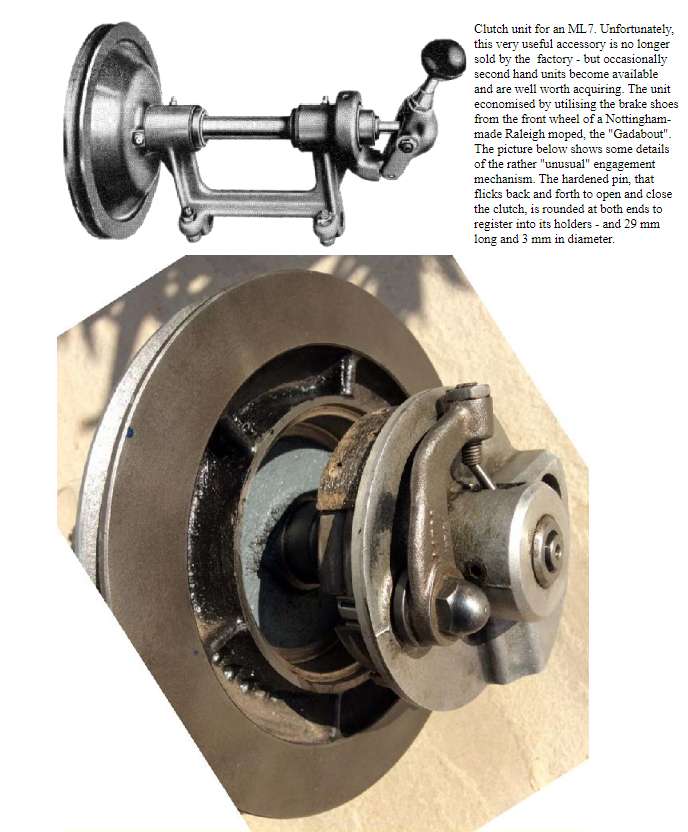
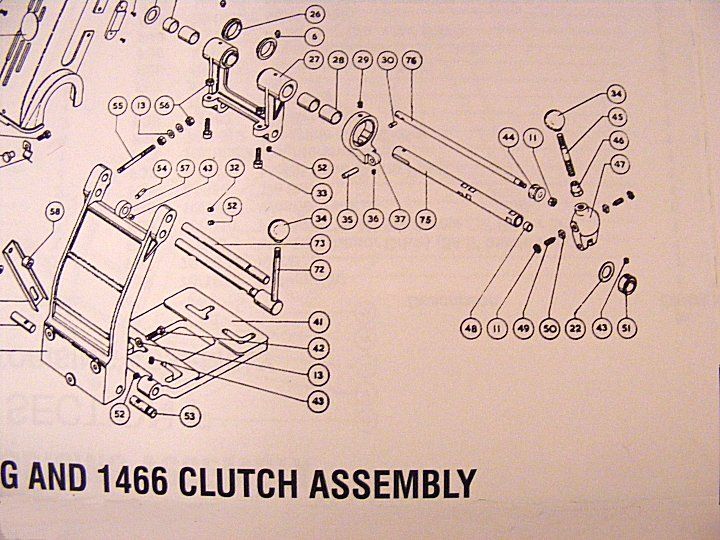
Here's an exploded diagram of the Myford 1466 Countershaft Clutch unit for the ML7:
I draw your attention to part number 44. On my unit, this is made of brass. Your photo looks different.
Also, look at part numbers 49 and 50. Part number 50 (2-off) is a rectangular block of red fibre that engages with the groove in part 44. Part 49 (2-off) secures part 50 and permits the parts to be adjusted to engage properly. Thus, operating the lever moves the pair of part 50, pushing the rotating part 44 and the operating rod, part 76, to engage or disengage the clutch.
Study the diagram, compare with your clutch and then come back and we can discuss some more.
Best regards,
Swarf, Mostly!
The toolpost screws are 1/4 BSW from any bolt supplier. If the dont have BSW, then UNC will work. Thats what I use.
The Myford ML7 Users Manual is available for free download all over the net if you google it.
The other must-have book for these old lathes is The Amateurs Lathe by L H Sparey. Out of print but still widely available new or used.
Your lathe looks like a good 'un. The clutch is a nice accessory to have. Paint would be good enough for me but Myford.co.uk sell the paint and stickers and many other parts.
Happy lathing.
Edited By Hopper on 30/05/2022 00:40:11
I have recently become the custodian of an ML7 of late 1970s vintage. The lathe belonged to my late father who bought it, still in its crate, from the original owner. The lathe has sat unused for a long time, since my father found it difficult to use after he suffered a stroke.
I have started to clean and check the lathe and I found a few bits are missing, and I am seeking some advice.
The lathe is fitted with the Myford clutch assembly, but the clutch will not engage. I see that one small part, shown in the parts diagram and list, is missing: Part No A1803, Operating Rod.
I am guessing that this operating rod is just a piece of round steel rod, with rounded ends. If so, it's something I can easily make, rather than trying to obtain a genuine Myford part — I should mention that the lathe and I are in Australia.
If somebody here can tell me some basic details and dimensions of the clutch operating rod I would be very grateful. And, if my guess is wrong and the piece is more complicated, I would welcome correction.
Cheers, Peter
Missing operating rod
Started by: Nigel Graham 2
in: Manual machine tools
Nigel Graham 2
Started by: larry phelan 1
in: The Tea Room
Nigel Graham 2
Started by: Speedy Builder5
in: Workshop Techniques
Nigel Graham 2
Started by: wigan2026
in: Workshop Tools and Tooling
Grindstone Cowboy
Started by: Mick Bailey
in: Workshop Tools and Tooling
Nicholas Farr
Started by: duncan webster 1
in: Electronics in the Workshop
peter1972
Started by: Andrew Skinner
in: Manual machine tools
Howard Lewis
Started by:
drnewcomb
in: Manual machine tools
Howard Lewis
Started by: bernard towers
in: Electronics in the Workshop
Martin Johnson 1
Started by: southernchap
in: Manual machine tools
peak4
Started by:
Michael Gilligan
in: The Tea Room
alecs
Started by:
drnewcomb
in: Manual machine tools
John Haine
Started by: AStroud
in: Work In Progress and completed items
alecs
Started by: jaCK Hobson
in: Workshop Tools and Tooling
Charles Jambon
Started by: Andrew Tinsley
in: General Questions
Andrew Tinsley
Started by: Peter Simpson 3
in: Beginners questions
Adam Harris
Started by: Steve Withnell
in: Workshop Techniques
John Purdy
Started by: Phil Whitley
in: The Tea Room
Phil Whitley
Started by: Richard Kirkman 1
in: Work In Progress and completed items
Richard Kirkman 1
Started by: zuji miko
in: Beginners questions
Nicholas Farr
Started by: Andrew Tinsley
in: General Questions
Adrian R2
Started by: Richard B
in: Traction engines
Richard B
Started by:
JasonB
in: The Tea Room
Nicholas Farr
Started by: wigan2026
in: Introduce Yourself – New members start here!
Harry Wilkes
Started by:
dean clarke 2
in: I/C Engines
alecs