Hi Clogs
When I was buying my Myford new in 1971 I had a look at both the Super 7 and the ML7, and decided that I just had to afford the Super 7. The Super 7 has a much better (higher) speed range with spindle bearings to cope, more powerful motor as standard, a self ejecting tailstock, clutch, longer cross slide, better top slide with full 360 degree rotation, etc, etc. Also power cross feed with the later machines.
For more information about these machines I'd suggest that you have a look at **LINK**.
You will almost certainly pay more for a Super 7 of equivalent age and condition, but I think that you'll find the extra expense is well worth it, If you can find a machine with a gearbox (screw-cutting) then so much the better as it will give you a good range of power feeds as well.
Good luck with your hunt for a machine.
Regards, Roger
Hi Nick,
I sold an ML7 using the classified's on here last year. Your father's machine as described, has a gearbox, clutch and comes with a rack operated tail-stock all desirable accessories. As mentioned above, take some clear photos and describe it well. Good Myfords are sought after by some people, often now seen as collector pieces (sad to say).
Here is the album (as an example for you) which was used to help describe my machine. **LINK**
Check the sold prices for ML7's on Ebay to get a feel for the value, please note: Myford Super Sevens especially, are fetching silly money at present.
Regards
Phil
Edited By CotswoldsPhil on 17/04/2015 19:01:57
Hi, I need to sell my father's lathe which, I'm told, is a Myford ML7B with clutch and capstan-handle driven tailstock. It comes complete with spare main chucks and tailstock chucks and a wealth of cutters, tools and accessories. My expertise stops at recognising taps and dies!
I could really do with someone who has some knowledge to advise me of a realistic value, please. It's all in my garage near Petersfield, Hants (GU32).
Many thanks.
After fitting the clutch to my Myford ML7-R Lathe earlier in the week, I decided I need to put it to good use.
I'm going to (attempt) to make the IDRIS that's just started as a feature in ME.
Metal ordered to make the boiler.
Here goes…
Hi Neil
If the main cover was closed you would see ML7R not Super 7 badging ![]()
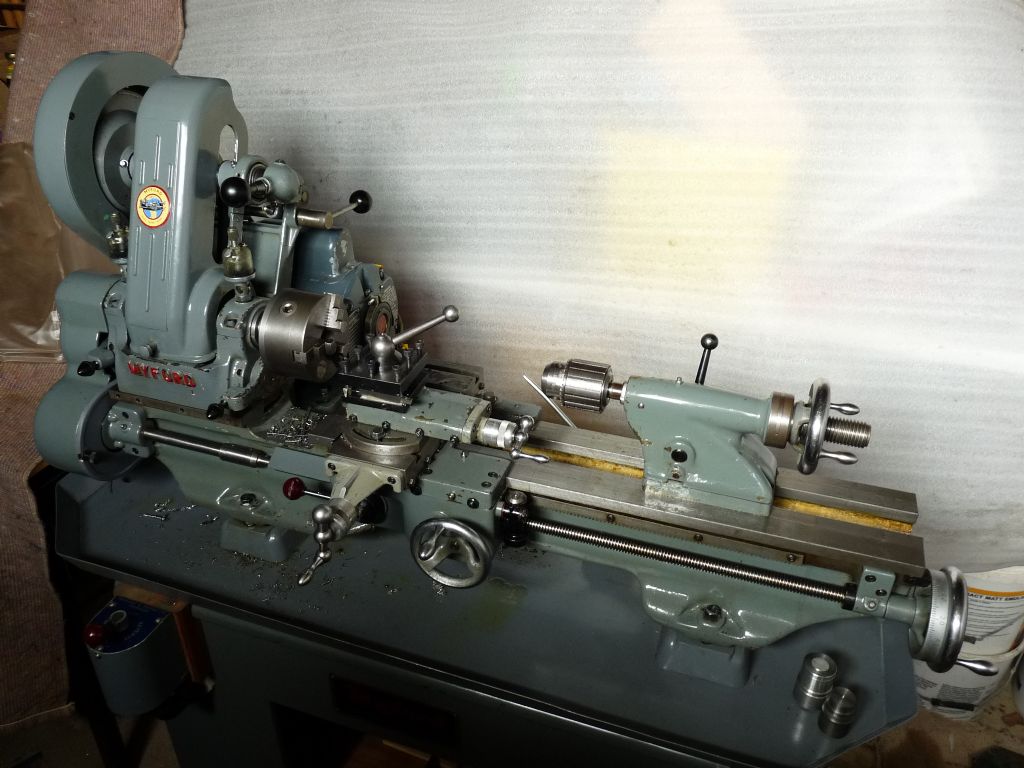
For the avoidance of doubt here is an original ML7; this one has the optional clutch.
Note the very different headstock, but I agree, there is no badging to tell you what it is other than a Myford.
The B suffix indicates a Gearbox is fitted ! So you could have an ML7RB.
Regards
Phil H
Edited By CotswoldsPhil on 02/02/2015 15:32:20
Can a Myford ML7 Gearbox be fitted to a early glass sight Super 7 with ease and preferably no expense?
My brother has bought an ML7 with a gearbox to follow me in to this little modelling adventure, and has offered me the gearbox for a fair price, or the whole lathe as a swap for my early super 7 (to save removing and installing the gearbox)
I've been doing a bit of research so I've got a few direct questions but I'd welcome any suggestions or comments/opinions.
Does the leadscrew need modifying or replacing – will I have to replace his or modify mine?
As I see from researching, this is not a very early box, I think the leadscrew passes through. I also gather it will possibly need a replacement access cover as the ML7 and Super 7 differ slightly.
– I don't think I'd like to swap him, everything seems smaller on the ML7, ie. smaller leadscrew, smaller bull wheel, smaller top slide, less refined dials and hand wheels – and it only has three selectable speeds on the belts, and no clutch. Admittedly, none of this makes its any less suitable for my needs – they're just "nice to have" I guess.
I don't need a gearbox to be honest, again, it's another "nice to have" item but Its Christmas
![]()
The Myford ML7 is perfectly adequate with the standard speed range,higher speeds will spoil the bearings, too many amateurs nowadays seem to be obscessed with high speeds,carbide tooling, and digital readouts and powered feeds.I would suggest that beginners start by learning to use a lathe correctly ,learn to sharpen tools (HSS) ,and learn to handfeed by winding handles. By feeding by hand you learn to feel the tools cutting action ,soon find out if it is blunt or has wrong cutting and clearance angles,the usual problem with grinding tools for brass turning ,is not enough side clearance and then careless honing with the stone ,too much stoning will tend to round off the sharp edge,keep the stone flat against the face you are stoning do not let the stone roll in an arc. Stone the front and side clearance faces first then lightly stone the top face to remove the slight burr. The top face of the tool bit( for brass) should be left as it is and not hand ground. When I was apprenticed a lot of the instrument turning (brass ,nickel silver,)was done on a Boxford and a 125 mm centre height plain lathe ,work for a month on these you soon learnt to sharpen tools,the plain lathe had large handles 3 or 4 times larger than a Myford and spun easily in your hands,for 8 hrs a day .the Boxford had power feed in both directions but was only used on one job about once a year ,its quicker to wind handles than mess about with feed clutches and if you are good at the job the finish is no different . The most common oilstone used was triangular India slipstones .,medium grade. The HSS toolbits were 3/8th square on the Boxford,and 5/16 square on the instrument lathes,any grade of HSS bit is ok for non ferrous material, the super HSS grades are better on stainless and tough steels.
Hello Phil and Chris,
Phil Lucky you, I have a 1940's era chicken shed about 22 feet square with A frame roof timbers, 4 in all spanning the length, topped off with a corrugated asbestos/cement roof. To one side there is a lean-to section which adds a bay about 6 feet wide full length, but the roof is low there and it is all down to storage of one kind or another
The inner sanctum is a block built well insulated structure about the size of a single garage which I can heat. The outer workshop has a resident Tom Senior [the Junior model] horizontal mill and an Elliott 10 shaper.
The inner area houses a Myford ML7R with many modifications, a home built Dore Westbury vertical mill, also heavily modified from drawing spec. an old bench mounted Progress 1/2 inch bench drill [£25 in the mid 60's and yet more mods] and an Axminster 4.5 inch capacity metal cutting bandsaw. At the remote end is an old Graul tool and cutter , bench fitting, that I picked up at a BR auction in Darlington for £60. More modifications on that and I can 4 facet grind MT4 drills on it for when I had a part time job at a local agricutural engineers some years ago. Then I had access to a big DSG lathe and immense vertical mill with hudraulic drives, as well as a 50 tonne hydraulic press. I an still welcomed back but the DSG is now a Colchester Bantam
My interests lie in machine tools, not modelling, although I admire the workmanship and dedication that goes into those creations. Present projects include the Graham Meek screwcutting clutch/reverser drive which is in my view an inspired piece of work.
Chris The intermediate change wheel stud is just a name for the short carrier that holds the big wheel in your photo, there is room to fit two gears on it for a compound drive. More up to date lathes have two such studs, which add a great deal to the possiblities of the output from the screwcutting gearbox. As I think yours is arranged, there are few useful alternative arrangements and the results will be very limited.
The gearbox is unusual in that there isn't another choice of ratio change from A or B. The B choice halves the output from the box and gives finer pitch screwcutting. More modern lathes also have a C choice which gives x2 the output. The CovMac has to do that by swapping the gearing down from the headstock and it is all very manual since other useful arrangements do not have space left in which to set them..
Have a look around for spare wheels, there is one lying in the swarf tray under the gearbox. If you can find a 127T it will be a bonus; there should also be an 80T and a 40T to make up the set supplied. It wouldn't be hard to lose things like that in the general clutter.
If you can get a 2 tonne crane it would be much better suited to this job, a 1 tonne version. while badged as such, would I suspect be operating at close to full capacity even with the headstock removed and being built to a price it might struggle.
A word of caution If you are tempted to take off the headstock lid to see what's inside [I don't think that involves the spindle bearing caps at all] be careful not to lose the two slippers that will be on the inner ends of the lever arms that move the gear cluster and dog clutch. They could easily drop out and fall into the sump below. If that does happen, refit them with grease blobs holding them up on the levers to defeat the effects of gravity. It might be that they are secured, my Myford version is a loose push fit and can get lost under the gear cluster [don't ask!]
My description of how the headstock gearing works might fry the grey matter, but at least it is only logic—no maths there!
I look forward to further bulletins
Brian
Hi Michael,
I've been researching Myfords a bit before buying an early Mk11 Super 7 (1973) to replace my ML7 (1965 vintage) mainly because when I was a nipper, my Uncle had one, and I watched him make fine I.C. engines on it, I need the higher spindle speeds for the small stuff I tend to make.
I'm sure you are aware of the lathes.co.uk site – here is an extract with a potted history from http://www.lathes.co.uk/myford/page2.html
I hope I've not broken any rules – the extract is duly acknowledged.
Myford ML7R
Introduced at more or less at the same time as the power cross feed Super 7, this is the lathe that confuses people new to the make. Although called an ML7 – and you would therefore expect it to be a development of, or directly related to, the original machine of that name – it was actually a non-power cross feed Super 7, but without a clutch and fitted with ML7 cross and top slides. It was designed to fit below the Super 7 in place of the ML7 and allowed a rationalisation of production around just one design of bed, headstock and tailstock. The lathe was eventually fitted with Super 7 cross and top slides, the ML7R name dropped and the "new" model renamed "Super 7 Sigma".
I look forward to your exploits; I've already replaced the annular contact bearings in my headstock with great success (they had been packed with grease) – story board in my album.
Regards
CotswoldsPhil – I'm also a Phil H (there appear to be a couple of Phil H's on the Forum)
Edited By Neil Wyatt on 04/09/2014 20:06:42
Edited By Neil Wyatt on 04/09/2014 20:10:02
Morning,
I've been looking for a ML7 tailstock to be able to use the Cowell attachment on the (new to me) Super 7 (as advised elsewhere on this Forum) but the prices being asked are unreal. There appears to be a growing market in expensive bits from broken Myfords.
I'm astonished at the prices being asked / made on 3Bay and GumTr33 for what look like scruffy basic machines with little or no tooling. Over the last couple of nights I've watched the end of auctions for ML7's to try and gauge their worth ready for the sale of my ML7.
ML7 (MK1 tailstock) no clutch, no stand, just a basic machine, which looked to have been repainted some years before – it made £510.
ML7 (Mk11 tailstock this time) no clutch, no stand, a little basic tooling, but no 6 inch 4 jaw, it made £700.
ML7 (Mk1 tailstock again) looks neglected with visible rust, no clutch, on a stand with some tooling and 2 chucks asking £950.
Inside the back page of the latest MEW are adverts for ML7's – no clutch, no stand, just a 3 jaw chuck included; asking £1225 and £1425 + 20% Vat, they are later wide-guide saddles at least.
What's happening to Myford prices?
Regards
CotswoldsPhil
Hello,
My name is John,64 years old and am looking for advice on my new hobby.
I have purchased a Myford ML10 lathe and am considering a way round to fitting a clutch unit from an ML7 lathe with some modification,but I am now sold on the idea of using a 3 phase motor together with an inverter so that I am able to attain variable speed control as opposed to the 6 designated speeds that are present now and also eliminates belt changing. Does anyone have suggestions as to whether this is a good option or not.
I'm hoping to kit this lathe out in the near future with some home made mods. which I have in mind in order to make the lathe better equipped.
I realise that I have a lot to learn in terms of metal turning and will in no way become a professional in my lifetime but I am happy to plod along and enjoy this wonderful hobby and learn from others of more experience.
Any advice would help.
John.
Just completed recommissioning a 1972 vintage Myford Super 7 I bought last Thursday in excellent original condition. The only issue was with the spindle bearings which had been greased with what looked like Molyslip and were deemed shot when cleaned, and oiled. So my local bearing supplier came to the rescue and obtained suitable alternatives to the R&M LJT25's removed. I've fitted Fag 7205B's from Germany (£38 pair) so should be of suitable quality. The Myford Super 7 has cleaned up very well and has very little wear. The carriage moves freely, without the apron, from chuck to tailstock after the gibs were set up at the chuck end. The front shear has less the .0005 wear in width and thickness when compared to the tailstock end. The machining marks are still visible of the front face of the front shear, and there are only a couple of chuck-drop-dings and a small bruise half way down the bed which was scraped flat. Note to self – make a chuck board.
I've photographed the process of replacing the bearings and set up an album which contains some tips which might be useful when replacing the bearings or just changing a headstock belt on a Super 7 – nothing to be scared about- really.
I'm very pleased with my acquisition which will shortly be replacing my well loved ML7 which has been used to build a Minnie traction engine. I have owned the ML7 since 1969, I was the second owner, it was manufactured in 1964, and from what I gathered, the first owner realised that model engineering was not for him, so he sold up.
The ML7 will be packaged with the Myford cabinet stand, deep-tray and raising blocks from the S7 purchase; (I have a purpose built stand in the workshop for the ML7 ready to receive the S7) the ML7 has a counter-shaft clutch, moveable index-dials, lead-screw hand-wheel and a very useful Cowell rack and pinion feed tailstock, I've also adapted a DRO for the cross-slide which should be possible to move to the S7.
It is the tail-stock attachment I am most attached to, it is brilliant for all drilling, tapping and reaming, being free to move with the progress of the work. I'm toying with swapping the tail-stocks on the machines to retain the Cowell rack and pinion feed tailstock facility. I expect that the S7 will see me out, so potentially devaluing the S7 is not really an issue. What do you think?
Hi all,
I am very new here so please bear with me!
I have recently got a very nice clutched ML7 of 70's vintage, 3 & 4 jaw chucks, swivelling vertical slide, full set of collets & holder with draw bar, knurling tool, centres, faceplates, quite a bit of tooling, indicators, stands etc. NO steadies; quick change tool post and 4 holders, rotary table etc
Has a boxed complete Myford dividing head and manual. NO Riser block
I have manged to set this lathe up on its cabinet and got it leveled out. Using a 2MT test bar the run out is about .001" at 8" from the headstock, Is this OK?
Had a few problems getting the oil feeders to work consistently they either emptied in 3 mins or did not seem to let any oil at all through.
I have made a few REALLY SIMPLE bits and pieces for our woodwork tool restoration business which have come out OK. Things like ferrules, pins, collars, etc all of which has been good practice for my newbie skills, (last metalwork was at school 50 years ago!).
Although I know it is possible to mill on this lathe I am leaning towards getting a dedicated milling machine as I have the room for a smaller unit.
I do not however want a 'micro-mill' type as they would seem to me too light for my needs. I am leaning towards something like a WARCO 16 or 18. which is within budget.
What worries me is what all the 'extras' are going to cost so I wonder if you all can tell me the basic stuff the I 'MUST' have and some 'would be nice' bits and pieces.
Is DRO a 'must have' ?
I do have quite a lot of milling cutters of various diameters, many have threaded ends so may not be of use, the different sorts of designs are a bit baffling to me
Obviously it would be good if any of the Myford bits could also be used on the mill.
Will be mainly working brass and alloy and mild steel, nothing too massive.
I would like to think that after a while I might have a go at making some of the simpler tooling that I have seen here and elsewhere to stretch me a bit.
I live in South Dorset and if anyone is close by I would appreciate any help or advice they might be able to offer, perhaps in exchange for some free tools or materials, we get a lot of engineering type stuff that we do not really want, usually comes in the engineers tool cabinets that we buy a lot of. Loads of drill bits reamers, tool steel cutters etc etc, often just gets scrapped!
Any help and advice will be much appreciated.
Cheers, Martin
Hello, I am new to this, I just bought Myford S7 serial number SK 66463 may be made 1963 – 1964. with industrial cabin, and coolent pump with Three phase motors .this lathe was really very much abused and neglected. I dismantiled the machine as i have done this sort of work on many ML7s with no clutches ten yeas ago . but the clutch on this machine puzzle's me. from reading threads above and other materials this machine may have latest or second type of clutch, any help to how to start this proccess of dismantilling the clutch and what I have to be aware of . i have downloaded the manual but it is not very clear and my eyes not that great. any help will be very much valued. cheers Saif
Hullo all
I have a an ML7R – Trilever with gearbox. It came from an industrial location via GandM tools. Darren and his colleague came down and worked their magic on it.
However, the carriage is tight close to the head-stock and towards the tail-stock. As the lathe came with many Hardinge collets and the operating lever (since sold) I can guess why it is worn in just the one place. I have since (with some muscle help) installed an inverter and 3-phase motor. Also every time I try using it I get awful chatter. I have HSS, Indexable and Trangential tools but always the chatter.
As I am a carer I have little time to spare in the workshop – usually about 1 – 2 hours a day , and as I can be called in at any time I cannot really start anything where I cannot stop just whenever I need. So boring a cylinder is out.
I cannot find anywhere in West Sussex (where I live) to regrind the bed.
Also I am now 81 so lifting heavy stuff is out and I use my lathe for recreation.
My problem is should I sell the Myford and go foreign or should I try and get a firm to collect the lathe and put it into as new condition? And does anyone know of such a company locally?
And what do I buy that has a mandrel clutch and a lever operation for the
tail- stock and has speed control from zero to 2-thousand odd?
Or is there someone locally who would come, look and advise me for payment?
I will be very grateful for any help or advice.
Richard.
Hi there, Jon,
I've found that those Woodruf keys can be easily removed using a pair of side-cutters. The problem can be that once they start to come out, they can fly so I'd suggest that you sweep the workshop floor first!
As to repairing the stripped thread, using a Helicoil is going to be a bit expensive for just one hole unless you happen to already have a Helicoil kit for that size (or access to borrow one).
It's possibly worth mentioning here that the illustrated parts lists (aka 'exploded diagrams' ) for the ML7 are all available on the new Myford's web-site. (I wrote 'all' but I couldn't find one for the ML7 counter-shaft clutch.)
Best regards,
Swarf, Mostly!
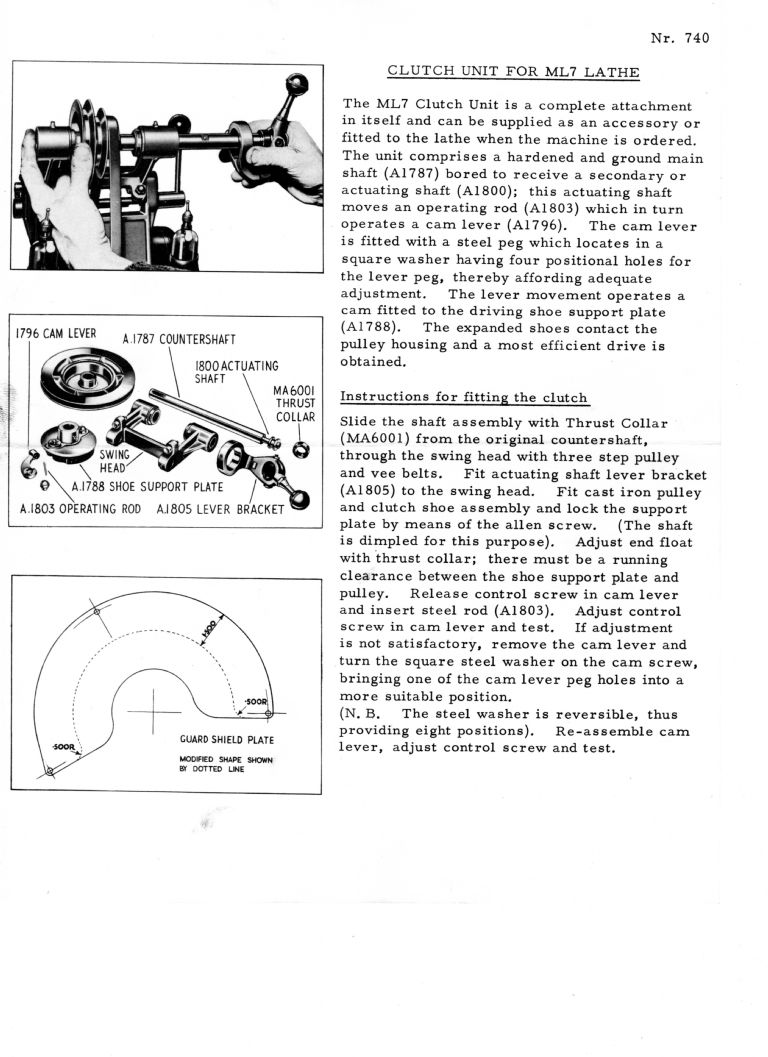
Neil, if you look at the image "ML7 clutch" in my album, you will probably find it is the same as yours. I have been trying to insert the image into the post, but the system to do this is not working, at least not in IE,
Steve, as well as the 2 oil nipples, you can oil the lever end at the obvious pressure points, and you can lubricate the pivot points at the brake shoe ends inside the drum, but I would only use Copaslip or similar for this, and use it sparingly, as that is designed for use in brake systems and won't "creep" onto the linings.
I will scan a page fom the Myford ML7 lathe manual (Ian Bradbury) which will give you a clearer idea of how it works, but again you will have to look at it in my "My Photos" for now.
Phil

Edited By John Stevenson on 23/08/2013 23:51:32
Tom,
Have a look at this thread Myford S7 – Type 1 clutch – advice sought.
Steve
Still can't get picture into posting. Have a look in "My Photos" ML7 clutch
Phil
Hi Steve
Apologies – I completely misread your post (and the one following). My comments below apply to the MK1 clutch fitted to a Super 7, not yours. You may however, find the link of interest. I presume you will NOT need to lubricate the moped brake type clutch.
If you copy and paste the following link into your browser, you'll get details of part of the clutch mechanism.
http://www.lathes.co.uk/myfordrebuild/www.onepoint6.co.uk/Myford/Countershaft_and_Clutch.htm
Don't worry about the text as he is rebuilding an ML7. The main part of your clutch is inside the cone pulley (sadly, not shown) and is activated by the bits in the first picture in the link.
The clutch is basically a spring clip (like you'd put onto a shaft and which fits in a groove), but is around 20mm thick. The ends get pushed apart by the clutch push-rod and causes the outer diamerer to engage with the inside of the cone pulley.
Lubricate it (oil only and fairly sparingly) via the nipple in the cone pulley.
The only thing you might need to do is adjust the push rod (through the hole in the pulley, should the clutch slip. Mine was adjusted the once and has been OK since (touch wood).
Spares are no longer available for this clutch, so if it breaks you are in trouble. You can apparently fit one of the newer Myford clutches (it would be interesting for someone who has done this to provide comment re difficulty, etc.). I recently bought a little used Mk1 clutch complete, on fleabay for £90 – just in case.
Hope this helps.
Regards Tom
Edited By Tomfilery on 20/08/2013 16:45:24
Edited By Tomfilery on 20/08/2013 16:45:47
Hi Steve,
As far as I know the ML7 only had 1 type of clutch available from Myford, that was the one using brakes shoe from a moped inside a drum. There were designs for shop-made ones. I was going to include the Myford info, which is in my photos, but as usual this website is being unusable. Will post it later.
The Super 7 had 2 types of clutch, the "Mk1" was enclosed inthe pulley spoindle (that's a type of spindle!) and can be temperamental. The "Mk2" is the familiar cone clutch on the end of the spindle (or spoindle).
Mk2 is covered in all the manuals, ask on this forum for details on the Mk1
Basically, lubricate and adjust as per intructions and they all last a long time. It would be an expensive job to buy a good used one just in case you need it, so I wouldn't bother.
Phil
Hi All, I am new to the forum but have been reading what I can on Myford lathes since recently aquiring one. I am not new to lathes but new to the myfords.
My Myford ML7 has an early clutch and all is working well however apart from oiling the bearings what general maintenance is required of the clutch/counter shaft?
There seems to be many knowledgeable people on the forum so thought Id join and ask the question, as I have not read much on general clutch maintenance (if anything) that is required of them. Mine appears to have been running for many years without much issue.
Is is worth buying a spare countershaft/clutch assembly for when its needed?
Regards
Steve
I knew I'd seen it SOMEWHERE
Many tried…
but all failed miserably… to copy the coutershaft clutch
So treat it with the reverence it deserves, you are handling sacred engineering
Users in the UK report that the lathes were accurate with one professional gunsmith, who used his for over 25 years, reporting no problems.
Other versions were also made including a Super 7 – with a strange mixture of ML7 and Super 7 but with a roller-bearing headstock, no clutch on the ML7-type countershaft,
Yet another Chinese-built Myford copy but this time a curious mixture of ML7 and Super 7 with parts (resembling those) from the latter including the tailstock, a roller-bearing headstock, hinged covers over headstock and changewheels – whilst from the former the simpler form of cross and top slides was used and there was no clutch fitted to the countershaft
Edited By Ady1 on 30/08/2012 00:52:33
Myford Super 7 Lathe
The Myford operation and maintenance manual has very helpful exploded views and oiling diagrams along with other very useful data and general information. The Myford ML7 Lathe Manual by Ian Bradley is also good reading, but when it comes to really getting down to investigating and repair of the cross slide clutch housed in the saddle apron, they are of no help what so ever.
To remove the apron, ‘the lead screw must be removed, to remove the leadscrew the change gear quadrant assembly must be removed and so on’. I didn’t know that at the time and the books kept it a secret also.
In a moment of darkest despair I searched the web in English for removal of the apron and eventually found a small comment that the leadscrew must be removed first. So with this as a key word I quickly came to the Model Engineer Workshop Forum web site and found some correspondence with an e-mail address recommendation for Darren and Pete.
I wrote a mail with embarrassment explaining very briefly that I had over loaded my Super 7 and would he visit me in Germany to repair and service my lathe. He does no do visits outside of the UK, but would be very happy to support me by e-mail and that’s exactly what he did. ‘Thank you Das’.
There then followed a couple of weeks of very precise correspondence between Das and myself. I must point out at this point that I was the slow coach with the mails, Das answer by return of mail explaining the sequence for stripping and other tips and tricks and then of course rebuilding the machine. As a point of interest the problem was that the cross slide ball bearings had ridden high in the clutch drive shaft and badly bruised the drive gear bearing surface. This was ground of with by hand an oiled stone.
I have now a very sweet running super 7 again.
Best wishes and regards Jess Dickinson
Darren may be contacted as follows:-
The guy that is thinking of selling has never cut threads on it, so can`t advise me how to go about it!
—-
Could be a good deal if he chucks in a load of add on bits, sounds like he hasn't used it much
Threading is a natural progression BUT, and it's a big but, the biggest but of all, an ML7 lacks a leadscrew clutch, (which a Drummond Mseries has) and this makes threading miles easier for someone who is learning
Beats me why myford removed it with the new ML7 after the war
So an ML7 user has to "smartly disengage the leadscrew nut" at the precise moment or face disaster, not much fun if you have to do that 40 times in a row
Making up a disengagement system would probably be an essential improvement
If you search on "screw" and "clutch" you will get a load of returns
This is a good thread, screwcutting simplified
Edited By Ady1 on 17/06/2012 11:14:12
Started by: Mick Bailey
in: Workshop Tools and Tooling
Michael Gilligan
Started by: Shaun Churchill
in: CAD – Technical drawing & design
JasonB
Started by: larry phelan 1
in: The Tea Room
Roderick Jenkins
Started by: Andrew Skinner
in: Manual machine tools
bernard towers
Started by: zuji miko
in: Beginners questions
JA
Started by: AStroud
in: Work In Progress and completed items
AStroud
Started by:
drnewcomb
in: Manual machine tools
old mart
Started by:
JasonB
in: The Tea Room
renardiere7
Started by: Speedy Builder5
in: Workshop Techniques
blowlamp
Started by: duncan webster 1
in: Electronics in the Workshop
duncan webster 1
Started by: Nigel Graham 2
in: Manual machine tools
Bazyle
Started by: bernard towers
in: Electronics in the Workshop
Dell
Started by: wigan2026
in: Workshop Tools and Tooling
Grindstone Cowboy
Started by: southernchap
in: Manual machine tools
peak4
Started by:
Michael Gilligan
in: The Tea Room
alecs
Started by:
drnewcomb
in: Manual machine tools
John Haine
Started by: jaCK Hobson
in: Workshop Tools and Tooling
Charles Jambon
Started by: Andrew Tinsley
in: General Questions
Andrew Tinsley
Started by: Peter Simpson 3
in: Beginners questions
Adam Harris
Started by: Steve Withnell
in: Workshop Techniques
John Purdy
Started by: Phil Whitley
in: The Tea Room
Phil Whitley
Started by: Richard Kirkman 1
in: Work In Progress and completed items
Richard Kirkman 1
Started by: Andrew Tinsley
in: General Questions
Adrian R2
Started by: Richard B
in: Traction engines
Richard B
Started by: wigan2026
in: Introduce Yourself – New members start here!
Harry Wilkes