Thanks Chris & Hopper.
Lathe is approx 1958 vintage going from the serial number, though it's got a later clutch, a later wide bed saddle and roller bearing races, so it won't win any originality prizes.
So it looks like my ML7 tailstock is in fairly decent shape, apart from the loose handwheel. I won't bother sorting out the C plate, I'll go straight for making a lever arm setup instead, I've found some photos of the ML7 version of the lever arm and it doesn't look that difficult to replicate. The hardest part will be turning the internal Acme thread (I'm a first timer doing screwcutting, though I've watched plenty of youtube videos on it) I assume that it is an Acme thread and not a special Myford one-off thread ?
Regarding drawbars on MT tooling, is it permissible or advisable to mod MT tools by either drilling & tapping them (assuming they're soft enough) – or welding on a nut if not ? None of my MT drills or centres have tapped holes in the back.
Is there a standard thread for MT2 drawbars & tools ?
Dave.
Edited By Dave Whipp on 07/02/2019 21:55:09
What you have there is a project in itself. Depends if you want to spend you time time and money building a Simplex or spend it restoring a lathe. Personally, I'd hold out for a complete and working lathe if I wanted to get on with Simplex building. But your priorities might be different.
Depends too on your engineering experience level. Restoring machine tools from a pile of (largely missing) parts is not really a beginner level project, hence the popularity of the cheap Chinese mini lathes amongst beginners and the more-experienced too. (Although some of them can need a bit of fiddling with to get them up to snuff too!)
The lathe as pictured will need a leadscrew before it can be used for much. The carriage handle on the M type is too high-geared to be used for turning feed etc so you really must have the leadscrew and its handwheel in place to feed the carriage when taking a cut. But even then, you will be limited to hand feed and unable to do any screwcutting, which may or may not impact a Simplex project, I would not know. Plus of course the new chuck and backplate. Don't waste your money on an original M-type chuck. They were all worn out when your father were a lad.
And if you are going to do any milling in the lathe, the one area the ML7 Myford has an advantage is bigger spindle and bearings that seem to stand up to to milling use a little better. The Drummond wiill do the job but takes longer due to lighter cuts.
The countershaft arrangment (big bracket with the pulleys attached) in your pic is an interesting one. Not original Drummond, but maybe home shopmade. The rusty handle with ratchet mechanism looks like it could be a clutch lever, operating a clutch on the larger pulley? Could be kind of neat, but also something else to get working.
Edited By Hopper on 28/12/2018 08:35:24
Yes, def. a Drummond M-type. Appears to be made pre-Myford's takeover during WW2, judging from the flat belts and the animal horn handle on the carriage handwheel. Myford converted to V belts and used steel for that handle in short order. There should be a serial number stamped on the rear bed way at the tailstock end somewhere. The lathes.co.uk site has a list of what numbers were produced in what year.
As well as the leadscrew, missing from the picture is also the leadscrew dog-clutch, the striker bar and links that operate it, the change gears and quadrant that drive it. (On the other hand, it looks like the apron "guts" are intact as the halfnut knob is visible, so halfnut must be attached.)
To buy all those parts individually on eBay could soon add up. Whole lathes of this model seem to sell very cheap for what they are (a very good, accurate machine if in good condition) so it could be easy to over-capitalize trying to build one from too many eBay parts.
A good source of info and parts is the Drummondlathes group on Yahoo groups. A bit of an awkward format forum to use but worth the effort.
If the bed is in good condition, it could be worth pursuing a restoration to working order if cheap parts are chased down. The M type will do anything an Myford ML7 will. I've used mine over many decades to make motorbike parts and model projects and even a small dividing head, including gear cutting etc.
But give the bed a very good inspection with a straight edge and feeler gauges before spending too much money. Any more than .003" wear on the vertical surface of the front bed way is cause for concern and possible regrind. Wear is usually mostly at the lefthand end of the bed ways, about six inches in from the end. Top surfaces of the ways can get away with .005" wear before being a concern.
Edited By Hopper on 28/12/2018 02:57:26
The lathe didn't get a bid at the reserve price so clearly it is priced above market value. It is only worth what someone will pay for it.
Most definitely depends on what someone is willing to spend as mentioned.
I've however seen far worse for not much cheaper than $4000 here, i.e. people just expect to get ridiculous prices for even a worn Myford. Based on that I'd spend extra money to have the one in the crate, pending viewing preferably, but perhaps that's not normal.
I too have looked at purchasing out of the UK but for the same reasons mentioned I didn't. It also depends where you buy one from, some dealers I spoke to at the time were already over $3000 equivalent without shipping considered. The 2350GBP ML7 from Myford Lathes above in a previous link is an example albeit with a clutch and gearbox.
Edited By mrbuilder on 11/09/2018 10:33:55
Any English made machine of the vintage of a ML2, ML4 or ML7 is likely to have Whitworth form threads. BSW if a coarse thread, BSF if fine, with BA possibly for smaller sizes, and certainly for electrical terminals etc.
Later Myfords may well have started using metric hardware.
Hardware with Imperial A/F hexagons will be SAE or Unified threads. Metric hardware be should be Metric A/F hexagon sizes.
From time to time you come across oddballs.
The thread may be Unified or Metric form, but be a finer than standard pitch, such UNEF, or 10 x1 or 12 x 1.
Examples: A Bristol RE bus with a Gardner engine (using Whitworth form hardware as standard) retained the clutch to the flywheel with 3/8 BSF bolts with 5/8 A/F heads!
The BMC A Series engine used 1/8 BSP threads in the Rocker Arms, with 7/16 A/F locknuts, to adjust the Valve clearances.
It pays to check.
Howard
Hi,
I've recently acquired a Harrison 155 lathe. I've been running a Myford ML7 for a number of years so I have some lathe experience but this is a new unit and I have a few questions!
Hopefully anyone running a 12", 165 or MK2-3 etc. might be able to assist. I've just spent 40 hours cleaning it. That's a LOT of really dirty work. It's wired and works just fine i.e. I've just turned it on and the chuck spins and the motor sound good etc. Well, in actual fact the motor runs backward which I'm pretty sure means I haven't quite got the 3 phase connections right but we can get to that later.
First off – lubrication. I've done an oil change on the headstock, 2.5 litres brought the visual oil level indicator perfect. I've used my Wanner oil gun to oil all nipples (24 oil nipples I think I counted, including the 2 on the clutch arm). Plus grease the 2 nipples on the motor. That's a load of nipples!
Next – gearbox – the oil sight level indicator is very difficult to see properly, I couldn't actually tell where the oil level was. So I removed what I believe to be the drain plug under the gearbox and nothing came out. I assume there's no oil there. When looking down the filler hole I can see some gears but no oil. But that's not at the base of the gearbox anyway. I put 400ml of oil into the filler hole but now I am getting oil (quite a puddle) coming out the side of the feedscrew area. Does anyone know what the oil capacity of the gearbox is? The sight level indicator is very near the bottom of the gearbox so I would again assume that there is very little oil actually used in the gearbox. Also is the small plug under the gearbox the drain plug. If there was already oil in there how come it didn't drain out when I removed the plug.
I do have a manual – for the MK2-3 – but it's not very good on those sort of things. I've read the manual many times now.
Next – the carriage has the pump oiler on it. When I pump it – nothing happens. So I put some oil in the filler hole on the Apron and it immediately drained out the bottom. At least I have identified the drain point. I can't quite see how it should be plugged, is there a hex screw that is supposed to fit in? Also once I solve that does anyone know the capacity of the oil pump chamber. I guess I just fill until completely full.
That's it for now, the next batch of questions is about 'those darn selector levers with a ball bearing that just doesn't want to move out of its recess in the body of the lathe' and 'why can't I get either the feedscrew or feed rod to do anything'. And I should probably address the running in reverse issue while I'm at it!
Many thanks
Phil
Michael
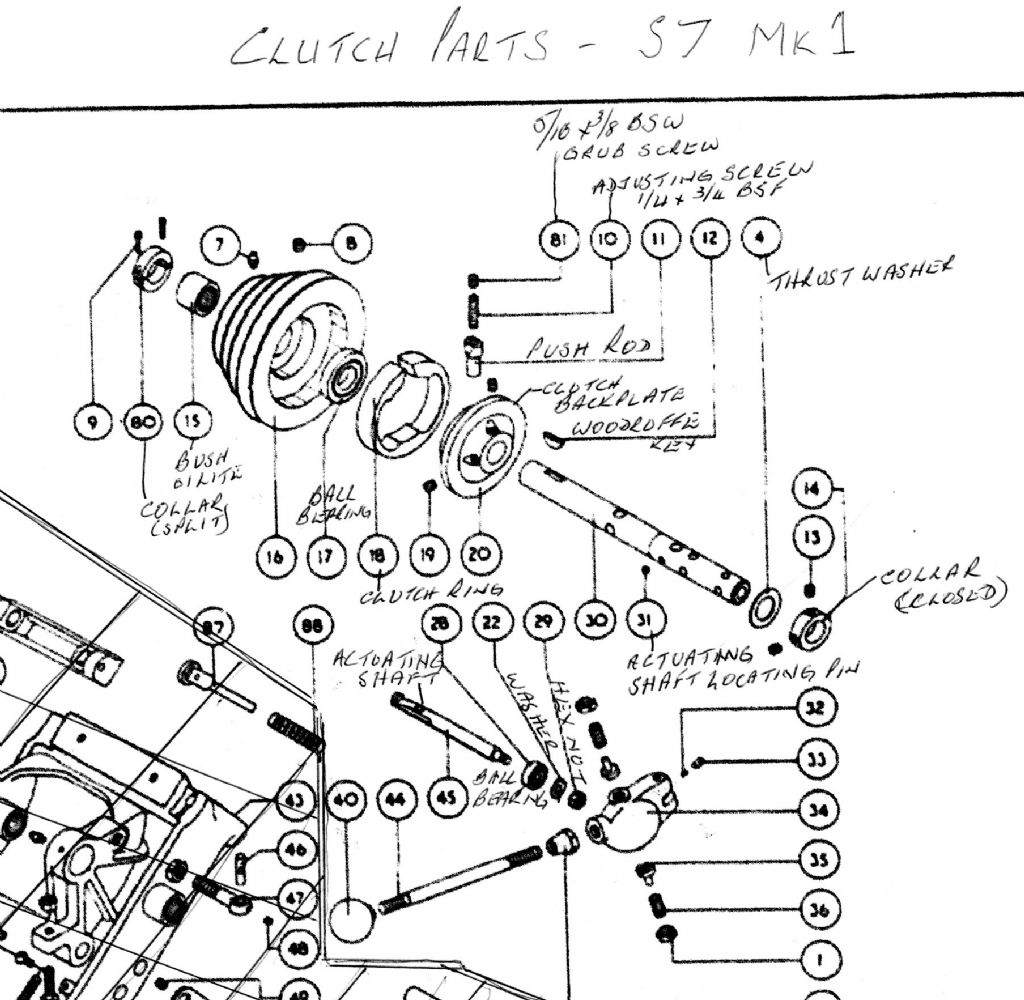
You've set a conundrum and caused some confusion here. From your description of adjusting your lathe clutch it is what is unofficially known as the Mark 1, and the clutch is an expanding horseshoe in a drum machined into the inside of the countershaft pulley cluster. However, you say your lathe is a 1963 model, and Myford stopped fitting the Mk1 clutch in 1958, and moved to the one fitted in the countershaft pulley at the left hand end of the countershaft.
So Dave, with his 1963 lathe, is referring to the latter type. And Rick is now thinking its the ML7 type which fitted on the left hand end of the countershaft.
If you have dismantled and cleaned your Mk1 clutch and the actuating mechanism, then lubricate on reassembly so that the push rod especially moves cleanly, and lubricate the visible mechanism at the clutch operating lever end. A drop of oil "down the hole" before fitting the adjusting screw and the locking screw will lubricate the tapered end of the push rod and the sliding wedge which forces the horseshoe into contact with the drum. Other than that then just keep the countershaft bearing oil cups topped up.
The drag you mention could mean that you haven't cleaned the mechanism and its sticking, or you need a bit more clearance on the adjustment. The wedge on the push rod may have got a bit worn and be sticking.
This drawing may help with the diagnosis.
… … now it needs the headstock lining back up with the bed and tailstock …
… another thing that could be causing the taper problem are the 2 taper roller bearings …
Before you go moving the headstock around and upsetting the factory alignment, a few things should be clarified and/or checked:
What exactly is "the taper problem"? How much over what distance? With the tailstock supporting the work, or without? (There are two distinctly different alignment issues between the two).
1. Have you correctly set the headstock bearings to the correct pre-load and ensured there is no spindle movement up and down or side to side?
2. Have you checked the lathe bed for "level" (which is really twist but is sometimes determined using a level)? If not, the Myford ML7 users manual available free all over the net contains the best description of how to level your lathe bed and how to add a small amount of twist to it if necessary to make it turn parallel. Consists of putting a small amount of shim under one foot or other on the tailstock end of the bed.
3: Regarding lining spindle with "bed and tailstock", aligning the tailstock is a separate operation, done last, by adjusting the tailstock body on its base to line it up with the spindle. Nowt to do with headstock mountings etc.
All these should be thoroughly checked and eliminated before you disturb the headstock mounting.
Re wear on the taper bearing races, yes they can wear. They should not be too expensive to buy (buy races and bearings, no point in replacing one without the other) and after 14 years could possibly be a little worn. I regard roller bearings as "consumables" like clutch plates and brake pads and like to replace them when I have something apart.
Edited By Hopper on 16/05/2018 07:17:19
Most parts are available from Myford, their website has parts diagrams for the machine and a list of parts and prices. eBay has a number of people who break myfords and most parts are available from them cheaper than new. The ML7R shares many parts with the pre power cross feed super 7. The headstock, tailstock and carriage are all the same, the cross slide and top slide are from ML 7. The mk2 clutch from the super 7 is a straight swap. Sourcing parts should not be a problem but the prices can be a bit steep.
Mike
As for the original question about which, if any, magazine to cancel all I will say is just be careful that readers other than beginners aren't forgotten. ![]()
No greater fool than the politician who chooses their policy according to the loudest voice, and the same goes for editors who set their editorial policy the same way. Don't begrudge space for others' ineterests if you want space for your own!
But how many hobby magazines have this much variety from technical to basic in one issue:
9 SHAPING UP
Bill Morris kicks of a short series on shapers with a bit of history and a guide to how they work.
13 SIMPLE CUTTERS FOR CLOCK PINIONS AND WHEELS
A straightforward explanation and method for making you own clock gears from Ted Knight.
9 A GUIDE TO MAKING SPUR GEARS WITH THE JACOBS HOBBER
Christopher Robinson continues his beginner’s guide to using a Jacobs Gear Hobbing Machine.
22 2017 METAL OF THE YEAR
And the winner is… announced by Jacques Maurel.
27 JOHN STEVENSON
We mark the passing of one of most familiar faces at the engineering shows.
28 LATHEWORK FOR BEGINNERS
This month Neil Wyatt cuts some metal, looking at basic turning.
34 3D PRINTING FOR THE WORKSHOP
Another interesting application of 3D printing from Darren Conway.
38 INDEX FOR ISSUES 249 TO 260
The latest index compiled by Barry Chamberlain.
42 THE 2017 CHRISTMAS CHALLENGE
The results of our recent competition.
44 POLISHING ON THE LATHE
Chris Gabel looks at the advantages of synthetic abrasives.
47 A SCREWCUTTING CLUTCH FOR THE MYFORD ML7
Graham Meek continues his description of this invaluable accessory.
46 ENHANCEMENTS TO THE SIEG SUPER X1L
Mike Cox and his power feed for the X1L.
60 SILVER SOLDERING
Keith Hale offers some advice to the novice in silver soldering.
65 AN IMPROVEMENT TO A FILING REST
No rest for the wicked – Peter Shaw had to update his 2014 device..
Regulars
3 ON THE EDITOR’S BENCH
Have your workshop projects stalled?
57 ON THE WIRE
More news from the world of hobby engineering
59 READERS’ TIPS
This month, tiny collets for tiny studs.
63 SCRIBE A LINE
Do you have a Merlin engine in your workshop?
67 READERS’ CLASSIFIEDS
Another pageful of great deals!
Two mentions of beginner and one of novice, but I'd argue that printing the FIRST proper guide to using a Jacobs Hobber is of far wider interest than just beginners and that Keith Hale's silver soldering advice will be useful to many as well.
Neil.P.S. I'm worried now that if I publish one of your articles you'll cancel your sub on the grounds you've read it already… 
I have an ML7 – they are beautiful things. Myford (not the original myford) sell appropirate oils online – https://www.myford.co.uk/acatalog/Myford_Genuine_Oil_and_Machine_Paint.html.
I paid 1300 for mine in good condition, with the optional clutch, rack operated tail stock, thread dial, 3 ph and inverter and accessories (face plates etc). Seen them go for 1800 or more in this condition though. 2000+ if the quick change gearbox is fitted. Quite a few come up on ebay and lathes.co.uk for comparison.
Lovely to work with – bit of a pain changing the gear train everytime you want to change feed but no probs if you like to tinker. Guess thats why the quickchange gearbox is so sought after.
Cheers
Matt
Sorry bit off topic ….. Why are Myford ML7's so bloody expensive and variant on pricing ?. I've seen super 7's from £500-2,500 and more
.
Well, a Super 7 is a different beast from the ML7, Super 7 has the better tapered headstock bearing set up, QC gearbox and clutch (usually) so is the most desirable of the Myfrods and they do tend to sell for more, although 2,500 is a bit over the top I reckon. 500 for an ML7 is probably fair enough if it is in genuine good condition without a clapped out bed and usually they will come with at least a basic range of chucks, faceplate, steadies, change gears and if you are lucky a good wodge of tooling etc. Compared with a new low cost import lathe, you are possibly getting a better machine with teh Myford, IF you get a good one. Trouble is, it is much easier to get a dog if you are not careful and/or lucky.
But I would certainly rather have the posted Harrison for 175! The seller claims it turns to close tolerances so IF the bed is not clapped out it would be a screaming deal. Bit more awkward to move than a Myfrod but that's just a matter of money to get a bloke in with the right truck and Hyab arm etc. to do the job. Maybe that's another reason Myfrods are so popular, you can fit them in a car boot with no expense to move it.
Edited By Hopper on 16/04/2017 09:24:35
Thanks Guys,
The microswitch idea sounds good! I am always a bit bothered by instant reversing in case the chuck comes off. I know it is only at slow speed, but the chuck / work inertia must still be a bit on the high side!
Making the dog clutch seems to be a most interesting project in itself, so I may well go ahead in the future, but will try the instant reversing first.
The references above are for a Myford Super 7, are there any snags with modifying an ML7.
Regards,
Andrew
Terry.
Have a look at this extract from the official "Nottingham Myford" parts list for all Super 7's.. No mention of change in headstock rear bearing alteration so undoubtedly metric bearings have always been specified.
The correct bearing is , as you have been advised 7205 BEP from SKF or other reputable maker. I bought a matched pair from Lathe Parts at a very reasonable price made by SKF in Austria.
Don't fash yourself about why Myford chose a Metric size bearing as they were probably the best overall dimensions for the headstock design. Hoffman , later RHP were the premier UK bearing supplier in the 1950s together with SKF who had 2 large manufacturing plants in Luton. My wife worked as SKF Luton for several years and was able to get me a substantial staff discount on bearings.
Popular Spare Parts For Pre-Power Feed Super 7,
Power Feed Super 7 and ML7R Lathes
History:
The Super 7 lathe, was introduced in April 1953 to compliment the already, very successful ML7 lathe. Whilst virtually identical in capacity, the Super 7 incorporated a number of features within its standard specification that made it a truly outstanding machine, these were:-
A spindle, supported in a taper bronze front bearing and a pair of angular contact ball races at the rear, which for its size gives outstanding performance, this coupled to 14 spindle speeds give an excellent and progressive speed range of 27-2105r.p.m. Over 40 years later there are many machines being marketed as screwcutting lathes, which have bottom speeds of 200 r.p.m. or so. This is just too fast for screwcutting. Other features are backgear engagement by lever, a countershaft clutch unit, a larger cross slide with block type gibs, a fully swivelling topslide, resettable friction dials on both cross and topslides, a self ejecting tailstock and a leadscrew handwheel. Over the years there have been a great number of modifications made to the original design as part of our continual policy of planned improvement. The major additions and changes are as follows:-
The first quick change gearbox became available in 1955. The gearbox used soft gears and the leadscrew drive was on the right hand side of the gearbox. In 1956, hardened gears were fitted to the gearbox.
In December 1956 the gearbox design was completely revised and from box No. QC 2501 the leadscrew passed through the gearbox and the drive was taken from the left hand side.
In June 1958 from machine No. SK 8128 the expanding sleeve clutch mechanism was changed to the current cone clutch. The change involved redesigned motor and headstock belt guards.
Customers are asked to note that we regret we are no longer able to supply spares for the early gearbox and clutch units.
In May 1959, from machine No. SK 9167 the drip feed lubrication to the headstock was replaced with a wick feed system.
In August 1972 from machine No. SK 108891B the broad guide bed and saddle were introduced in preparation for the launch of power cross feed models in March 1974 from machine No. SK 115830.
In February 1975 from machine No. SK 120965 swing head oilite bushes were ground on the outside diameter.
In June 1975 from machine No. SK 122657 the bronze cross slide feed nut on power cross feed models was changed to hardened steel unit.
In December 1975 from machine No. SK 126004 the power cross slide feedscrew was modified requiring a larger counter bore in the corresponding micrometer dial.
In November 1977 from machine No. SK 136311 the power cross feed apron was redesigned incorporating an adjustable cam for the leadscrew half nuts.
In April 1977 from machine No. SK 142981 the colour of machines was changed from grey to green.
Today over 40 years after it was first launched we are continuing to improve the Super 7. Apart from those items previously stated we can supply almost every spare part for these lathes.
-1-
No, Neil, in fact looking at adds on the back covers of old M.E and E I M, the price I paid in numbers of pounds was nearly the same as these Chinese machines were going for in the 1980’s / early 90’s. The only brand new lathe I ever bought was my trusty ML7 and it was exactly 106.00. I also bought the stand with drum reversing switch and raising blocks. That was , I think another 47. 00. I still have the ML7 and it now has a Super 7 style clutch which I made on the 1236 lathe after sorting a few of the problems that would have prevented accurate machining of those particular parts. The hardest part of that job was using Myfords manual and exploded diagram and parts list to work out the design and construction of the Super 7 cast iron to bronze clutch assembly. But it certainly works. Inspiration and part of the design comes from an article in a very early issue of MEW, , in fact that was the issue that twisted my arm up my back and forced me to become a subscriber. !!
Edited By Rick Kirkland 1 on 11/12/2016 15:47:15
Edited By Rick Kirkland 1 on 11/12/2016 15:48:20
I'm not sure how credible this [hopefully, some of our experts can comment], but it's quoted verbatim from http://www.lathes.co.uk/myford/ **LINK**
MichaelG.
.
Electric Motors:
For quiet and smooth running the makers recommend a resilient-mounted motor (with rubber rings isolating the main housing from the foot) and, so equipped, an ML7 will turn almost silently. While all Super 7s had a clutch fitted as standard, on the ML7 this was an optional extra – but one well worth having. The ML7 unit economised by utilising the brake shoes from the front wheel of a Nottingham-made Raleigh moped, the "Gadabout".
Unfortunately one-phase motors are not the most reliable of devices. They are best run near their rated capacity all the time (i.e. worked nearly flat out); if such a motor is switched on and off frequently against "no load" the windings will be damaged and, if run through a cycle where it is started, worked briefly, stopped and started again, the capacitor will fail prematurely.
It is very important not to "over-motor" a Myford (or indeed any other lathe); any accident or dig in will have far more serious consequences – and if the machine is worked beyond its capacity, excessive wear will occur. Early ML7s were fitted with 1/3 hp motors, later ones with 1/2 hp – the latter a figure that should not be exceeded. Apart from the very first examples, the Super 7 has always been equipped with a 0.75 hp motor (necessary to pull the top speed of over 2000 rpm) and this too should be respected as an absolute maximum. The original Brook-Crompton motors are very expensive; however, direct replacements, of exactly the same specification but more economically priced, are now available.
I have an imacculate myford super 7 at work and while I am quite familiar with them having grown up around one this is a 1980s long bed with power cross feed and gearbox that was acquired refurbished when I joined the company.
Two questions.
1.) It is on an ML8 stand in green but is lacking the bit ML8s have which the bowl turning attachment fits too and has a deeper front support under the tray with my ford logo as per ML7 stands. It has the square missing through where the ML8 belt goes through…. Is this stand dtrong enough for the lathe? It fits with standard long bed deep tray and coolant drain perfectly and does not move at all. the headstock area seems to be reinforced with angle iron about 10mm thick which it is bolted through. The tailstock though is reinforced either side of the mount point.
Its heavy, solid ridgid but Im just interested if its worth looking for a replacement even though the raising blocks spread the weight as does th estand and it measures the same as a long bed stand on ebay.
2.) The clutch was being investigated when it was dismantled for moving and on taking the black plastic cap off the clutch knob side there was a ball bearing about 3mm to 4mm diameter loose inside . It seems this was used as a detent with a small spring to the cam knob on top of the large spring and big ball bearing to engage the cluch cone/plates. Does anyone have any idea how I safely get this back in? the clutch works but is a bit floppy.
If I can get the cam knob out by undoing the hex grub screw underneath it I can probably push th ebearing back in but keeping it there while compressing the small screw and pushing the cam knob back in would be hard!
Regards
I had an old Myford Super 7 (a 1953, one of the very first)
It didn't have power cross feed and the clutch was problematic, in addition, the glass sight oiler could very, very easily allow dirt to be washed into the spindle nose bearing (luckily, mine had been cared for). The clutch I just had to live with as Myford soon completely redesigned it and spares aren't available (I didn't have the skills/confidence back then to reliably attempt to make new parts, although they were simple enough).
What I didn't appreciate, is that it's bed was like new and capable of easily making very accurate parts!!
So it strikes me, that the Myford 7 wasn't the golden wonder it was made out to be, and its "aura" made parts expensive, however it could cut though some serious steel, easily knocking 5-7mm off the diameter of a 50mm high carbon steel in a single pass without making a sound or vibration, it could be talked over while doing it) – if you tried that with a far eastern machine, If the tool post didn't tear away and the something in the drive didn't shatter, I would expect the bed to snap at the headstock (seriously) – I would guess taking 2-3mm off the diameter of a similar steel would be the limit. But what's the rush.
What matters is not what make/model you buy, it's what sort of condition its in. With the tool post and topside locked, will it turn parallel over 100mm by advancing the saddle using power feed, criteria number one for me, and not a straight forward answer, since it will have to be sat levelled, maybe have its tailstock feet shimmed to remove any twist in the bed and generally be in fine fettle to achieve this.
Second are it's spindle bearings in good condition, and if they're not, can they be easily replaced? Myford ML7's have white metal bearings, which cannot be replaced, you need to upgrade to a hardened spindle and phosphor bronze bearings (which is around £300-£500 for the parts alone if you can find someone who has one!) – other things, are more easily adjusted/replaced so long as the bed is straight and spindle points in the right direction!
If I were to do it all again, I would recommend to myself, to go and buy a new simple cheap lathe that will do screw cutting and learn how to get it setup and turning parallel, learn how to align the tailstock and get the hang of general machining operations etc.
If you decide it's not for you, you'll hardly lose a penny in value if you look after it! They cost £400-700 new from SPGtools/Chester Hobby Store/Warco/Amadeal/ArcEuroTrade, Amadeal had put a package together which included all the basic tools you'll need to make something to a tolerance, it came with cutting tools, measuring tools, and I think the magnet bases and dial indicators that you'll need to ensure the lathe is turning true and make the required adjustments
– Just to add to that, depending on what milling you need to do, a vertical slide for the lathe might cover all angle, and with a small bench top pillar drill you could be well on your way to easily creating whatever models you might want?
Edited By Russ B on 07/10/2016 14:12:02
Hi ML7s
I read comments on fitting the Myford clutch kit and how it seems to become troublesome. Of course its not advisable to keep switching the motor on/off. It will heat up and also you wear out the internal winding contacts quickly. So what I do is use the lever that tensions the belt and allows you to swap pulleys. It works a treat, so simple
Surely others must have thought of this?
Robin
But we must also remember that they were using real [mechanical] speed reduction, not just slowing the motor down by electro-magic.
MichaelG.
As it happens thats exactly how mine runs with a counter shaft , and with 200 watt chinese motor that came of one of those small hobby bench drills, works fine, just need to cut the second step on the motor and counter shaft pulleys so as to give six speeds + six more with the back gear, will set it up for a top speed of around 650ish rpm. The motor & counter shaft assy hangs out behind the head stock, works the same way as myfordboys ml/speed 10 using over centre eccentrics to release both belts also working as belt slip type clutch. Theres another chap on this forum with more or less same, type of set up, he posted under the handle of Nobby & had a few pics in his album, havent seen any post from him for awhile though,( hope you are OK Nobby if your reading this).
Martin, at a guess i'd think the numbers on your back plate pic would indicate 1inch od by 12tpi, were early Drummond m types that size ?. I think the latter Drummond/myford were the usual 11/8x12tpi with a plain register ie not stepped like ml7. I tried to mount motor under the bench cos i would have liked to have kept the cast iron tray, did get it going that way for awhile but wasnt really happy with it, its much better how it is now. I think you have done pretty well to track down the castings & gears for the tumbler reverse though, i`d pretty much resigned myself to mowing them out steel if i ever get round to it. The head stock you have pre dates the production ones so would not take things for granted as regard to spindle size…….b
Hi Dave,
Almost but the clamping bolt that holds the two parts together is slackened after the main big clamping bolt and then the rear dowel is pulled out. Then offset the tailstock by sliding it sideways and nip up the bottom bolt and then the main bed clamping bolt.
The tailstock parallel slide is a very good fit inside the top shears so it has true alignment with the bed. You will notice that the headstock sits on a flat surface so it can rotate on the pivot bolt. Unlike the ML7 and S7 which has a similar arrangement to the tailstock. Also on the ML7R / S7 there are pusher screws at the headstock end to align the headstock by a tiny amount. These screws are the same ones as the tailstock uses for offsetting.
There is one weakness on the Grayson tailstock which is the barrel locking screw. This often breaks the casting and it is very difficult to weld the cast iron pieces back together. Mine has this broken part and I have never bothered to get it repaired as the S7 came along at the right price.
On early ML7 lathes the bed was different to the later ML7R and the Super 7. When Myford brought out the Super 7 they scrapped the early bed design and the ML7R and the Super 7 used the new bed design. It has wider top shears to better cope with the higher cutting loads. Also they eliminated the internal bed slideways, that is why the internal slideways on the later versions have a gap between the internal slides and the bed top shear, it was redundant but they used up the earlier castings until new ones were introduced.
There wasn't much difference between the ML7R and the Super 7, the Super 7 was a rich mans version and it had the countershaft clutch, better vernier dials, a longer cross slide and a few other twiddly bits which the cheaper ML7R didn't get. By standardising on parts you can retrofit a ML7R to Super 7 specifications quite easily. The main difference is the headstock design. The Super 7 has the newer spindle with the taper bronze front bush and the two angular contact rear ball bearings to control end float. In the end the ML7R and the Super 7 became almost the same machine and the cost of the ML7R became too high as for not much extra you could buy the S7 version, so Myford dropped the ML7R and continued with the S7 version.
On my Grayson I made a long cross slide as per the Super 7 by hacking it out of a piece of steel with my (then) new vertical milling machine. I bought the new cross slide handle and nut assy from Myford and it made a big difference to working on the lathe.
On my Grayson the headstock is missing. I was going to make new front and rear bearings as per the S7 and sent it to a local company to do the machining. After a few months of not hearing anything from them I found out that they had folded and the liquidators had come in a cleaned out all the stuff, including my partially modified headstock and the chuck backplate from a new 4-jaw chuck I had loaned them as a gauge to cut the front register and thread. So my Grayson is sans headstock and the 4-jaw chuck is minus its backplate
Seems it was sold for scrap to raise some funds. I still have all the other bits but without a headstock it is just quietly gathering dust.
Edited By John Fielding on 26/02/2016 08:12:19
Hi
I have a Myford ML7 lathe with a 1466 clutch unit fitted, this worked very well until two weeks ago. Mechanically actuating the clutch lever does work the clutch as required, a strip down shows the lining are in good condition however no adjustment will disengage the drive to the head stock. In short the only way to stop the chuck is to turn off the motor electrically. Could anyone please advise a solution to the problem. Thanks in advance Richard
I must have used a cheap skate version as well OB that needed the flux and etc. To be honest I can't remember anyone bothering to anneal after butt welding but it was brief and a long time ago. The flux and etc is more recent.
When I asked where it was on a much smaller affair I was naive and expected what I had seen and used in industry. The question caused some amusement, the company employed a lot of older ex tool makers. This was my 1st real life intro to home machining. Then I bought a Peatol. I was impressed with that for what can be done at that size. It lived up to my expectations which are pretty extreme really – till something, probably the head bent and wrecked what was brilliant alignment. Then a Hobbymat pretty good too, no complaints other than having to deburr the dog clutch periodically. At that point due to job change it was more difficult to use larger machines so went Raglan. Pretty good too but some wear in the bed that was corrected and I had to remake one of the sides of var speed pulley. Then rust started kicking in so moved into the house. I was aware of the reality of used lathes. Then moved indoors so bought chinese, Disaster compared with what I expected and not a suitable design to sort out Then came a Myford so went for an ML7. Spent ages sorting it out and had missed that the seller set the belts super tight to get round rather loose bearings. Another dose of reality. Then came a super 7 head to fit to it – yet more sorting out and an intended trip to myford for a bed regrind. Then I noticed my current Boxford and bought it more or less blind off ebay. I did ask a couple of questions and got the right answers. Luckily not much needed doing, just a few adjustments. It just leaves me with a couple of niggles that I periodically try to sort out.
That's life for a home machinist, in my case anyway. One interesting aspect is my Dad pointed out that Boxfords were not bad machines when I was at school. Not bad because in his youth he had spent time on lathes when they were intended to offer excellent finish and accuracy and they got near to offering that and aren't too big and heavy. His idea of a small general purpose lathe was a CVA tool room lathe. More complicated bearings than most lathes and extremely expensive. He always reckoned that plain bearings in excellent order are the best. I'll bottom that out one day. He also mentioned that the first job on a new one is to make the next set while you can.
John
–
Thanks for the memory Ian (P).
Although I lived near Bolton, Gleaves was where I bought a number of my significant add-on's for my second hand Myford ML7. In particular, the stand, the clutch, and the Norton gearbox.
My last visit was in 1972, when, as a leaving present, the office staff where I had worked bought me a vernier caliper.
Do you remember the model railway which could be packed away in three guitar cases. The gauge was smaller than `N' scale and the builders had made their own rolling stock and wound their own motors. When asked how they got the spokes in the engine's driving wheels, one of them replied
"Oh, we just made a tool and bashed them out!"
Regards to all,
Sam
Paid £700 for my Long Bed ML7-R with Gearbox, Steadies, Metric and inch screws, Metric gear kit , Milling slide, QTCP. All in their sealed packaging.
There were still grinding marks on the bed.
I have added the Clutch. Makes tapping so much easier.
A Colchester would have been nice but my workshop is up 2 flights of stairs….
How many times do you see a 35 year old brand new machine ? Does happen, there is a Myford on Tony's site but this is a lathe and not a Myford, plus it also cost less than the average Myford ![]()
Started by: duncan webster 1
in: Electronics in the Workshop
duncan webster 1
Started by: Carl
in: Materials
old mart
Started by: Mick Bailey
in: Workshop Tools and Tooling
bernard towers
Started by: anonymouse
in: Materials
anonymouse
Started by: Shaun Churchill
in: CAD – Technical drawing & design
JasonB
Started by: larry phelan 1
in: The Tea Room
Roderick Jenkins
Started by: Andrew Skinner
in: Manual machine tools
bernard towers
Started by: zuji miko
in: Beginners questions
JA
Started by: AStroud
in: Work In Progress and completed items
AStroud
Started by:
drnewcomb
in: Manual machine tools
old mart
Started by:
JasonB
in: The Tea Room
renardiere7
Started by: Speedy Builder5
in: Workshop Techniques
blowlamp
Started by: Nigel Graham 2
in: Manual machine tools
Bazyle
Started by: bernard towers
in: Electronics in the Workshop
Dell
Started by: wigan2026
in: Workshop Tools and Tooling
Grindstone Cowboy
Started by: southernchap
in: Manual machine tools
peak4
Started by:
Michael Gilligan
in: The Tea Room
alecs
Started by:
drnewcomb
in: Manual machine tools
John Haine
Started by: jaCK Hobson
in: Workshop Tools and Tooling
Charles Jambon
Started by: Andrew Tinsley
in: General Questions
Andrew Tinsley
Started by: Peter Simpson 3
in: Beginners questions
Adam Harris
Started by: Steve Withnell
in: Workshop Techniques
John Purdy
Started by: Phil Whitley
in: The Tea Room
Phil Whitley
Started by: Richard Kirkman 1
in: Work In Progress and completed items
Richard Kirkman 1
Started by: Andrew Tinsley
in: General Questions
Adrian R2