Improving a 30 taper fit

Improving a 30 taper fit

Home Forums Manual machine tools Improving a 30 taper fit

Viewing 18 posts - 1 through 18 (of 18 total)
  • Author
    Posts
  • #850531
    Andrew Skinner
    Participant
      @andrewskinner94774

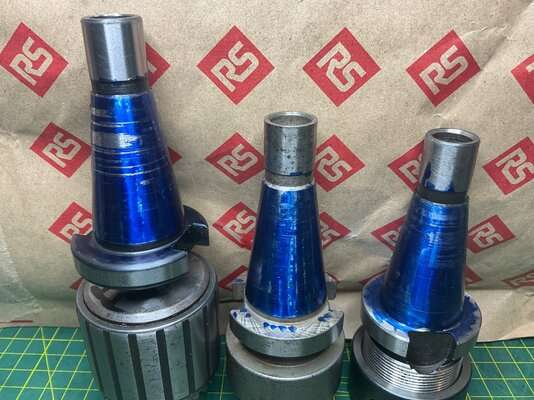
      Chasing down some runout on the Beaver mill. It looks like the fit on the 30 taper isn’t very good:

      IMG_1434

      What’s the best way to improve it? I’ve looked into lapping with valve grinding paste, and been told not to.

      #850537
      Tony Pratt 1
      Participant
        @tonypratt1

        To my mind you have way too much blue on the tapered spigots. Also what are you going to use as a reference taper? I would suggest as a first step going over the female taper and all the male spigots checking for damage etc etc.

        Tony

        #850541
        JasonB
        Moderator
          @jasonb

          Is that marking blue you have used rather than engineer’s blue.

          #850546
          Andrew Skinner
          Participant
            @andrewskinner94774

            It’s blue marker pen – I have some micrometer blue, but haven’t got the hang of using it yet. The reference taper will just be one of the toolholders. I’ve 3D printed one, with a view to making some sort of lapping tool, but not too sure about that.

            I imagine the female taper has suffered some damage from bits of swarf and various ‘dings’ over its lifetime, since 1961.

            Confession: I’ve just given it a very light lapping with some fine carborundum paste. Hardly any cutting, but it did make a nice matt finish and showed the marks up nicely. However, there are so many, that if I went at them all with a convex file, I’d end up filing away most of the taper.


            #850549
            noel shelley
            Participant
              @noelshelley55608

              I would stop NOW ! Sit and study the issue and possible causes, then decide if you REALLY need the perfect machine or whether you can work within what you already have. Good luck.  Noel.

              #850552
              Neil A
              Participant
                @neila

                How much runout are you chasing? Is it really significant? The other question is how you are measuring it?

                Personally, I would follow Noel’s advice and think very hard before trying to improve the fit of the taper. Once you have taken metal off, you can’t put it back on.

                The dents in the surface are never the problem, it’s the high spots and they require a bit of thought before being attacked. Far too easy to end up worse than when you started.

                Neil

                #850638
                Howard Lewis
                Participant
                  @howardlewis46836

                  I tend to agree with Noel.

                  The high spots are very few, and tightening the drawbar will pull the external taper into the internal one.

                  As Apprentices, at Rolls Royce, we used INT 40 and 50 tapers, and no one ever suggesteted that we blued them; jut got on and used them.  And had no trouble, even when taking cuts 0.187″ deep x 5/16 or 3/8 wide.

                  As Noel says, STOP before you do more damage than good, chasing microns.

                  When you tighten the drawbar, the metal will deflect,anyway, so stop worrying!

                  Howard

                  #850650
                  Andrew Skinner
                  Participant
                    @andrewskinner94774

                    Ok, thanks for the advice. I turned a slitting saw arbor on the lathe, fitted it into the INT30 collet chuck and ran it in the mill, and it wobbled visibly. Even with the saw blade off, the shank and boss of the arbor, which were turned in the same operation, ran out by about 6 thou.

                    Suspecting the collet chuck, I clocked in a length of silver steel on the lathe four-jaw, clamped on the collet chuck and measured the runout on its taper – 3 thou at the top, 1 thou at the base. Not too bad, since it was only 10mm silver steel and there may have been some sag and deflection.

                    The inner surface of the 30 taper runout was under 1 thou, but I could feel those dings inside, hence the blueing saga.

                    #850663
                    alecs
                    Participant
                      @alecs

                      Yes you are right about sag and deflection with a 10mm bar! I would take those readings with a very large grain of salt.

                      I also would not use your shop-made slitting saw arbor to measure runout because you may have turned the taper just a fraction out and it is not seating correctly. You really need a reference taper to check it against with blue.

                      How much run-out are you getting on the shank of a milling cutter held in your collet holder installed in the spindle with drawbar tightened?

                      #850668
                      DC31k
                      Participant
                        @dc31k
                        On Andrew Skinner Said:


                        Suspecting the collet chuck, I clocked in a length of silver steel on the lathe four-jaw, clamped on the collet chuck and measured the runout on its taper – 3 thou at the top, 1 thou at the base.

                        How do you know the internal taper of the (is it an ER?) chuck is concentric with the external 30 taper on it?

                        You could check that by removing the drive keys from the mill’s spindle nose and clocking the collet taper in four positions. Leaving the keys in and doing two positions might tell you enough to be going on with.

                        #850777
                        Dave Halford
                        Participant
                          @davehalford22513

                          I’m sorry, but this has all the hallmarks of another rabbit hole thread chasing thous.

                          Please don’t use the drill chuck on the left.

                          What runout do you get on the shank of a milling cutter mounted in the Clarkson collet chuck?

                          #850833
                          old mart
                          Participant
                            @oldmart

                            I agree that the runout is probably less than you suspect, especially as one of the arbors holds a drill chuck. You may improve the chuck by removing it from the arbor and refitting it at 180 degrees from where it was. The 30 fittings have drive dogs which allow them to run with a poorly fitting taper anyway.Any lapping compound as coarse as valve grinding paste would be very much too coarse to use nothing coarser than 1200 grit would do, and I would recommend no lapping at all.

                            #850852
                            Howard Lewis
                            Participant
                              @howardlewis46836

                              The drill chuck is unlikely to hold work as concentric as you obviously wish. So DON’T use it to check alignments or concentricity.

                              Would feel inclined to tighten the clean tapers, internal and external – (The coating of “blue” might even cause eccentricity, so don’t chance it, clean it off) and clock off the internal taper for the ER collets.

                              If you are micron chasing, make sure that your measuring set up is absolutely rigid, and the clock is consistently repeatable. If this is not the case, you could easily get a different reading each time.

                              Your readings might be affected by ANY play in the bearings, or flexibility in the spindle set up.

                              The readings will not be ABSOLUTE, unless you have had the machine and measuring equipment soaking for at least 24 hours in a temperature controlled environment

                              In ordinary conditions, just be happy to get within 0.0005″ (Unless your ambition is to be a NASA subcontractor)

                              Howard

                              #851097
                              Howard Lewis
                              Participant
                                @howardlewis46836

                                Bear in mind that the taper was ground into the hardened steel by a cylindrical grinder capable of better precision than nthe milling machine in which you prpose to use these fitments.

                                What machine is it?

                                Being INT 30, it is presumably a small machine, probably of some age, ex industry?

                                If so, it will will probably have more wear, elsewhere, than the fittings that you wish to fit to it

                                Howard

                                #851263
                                Andrew Skinner
                                Participant
                                  @andrewskinner94774

                                  I’ve measured the runout of a 10mm carbide milling cutter in the collet chuck. 1.5-2 thou, and it made little difference turning the cutter, collet or collet chuck itself. The runout of the internal surface of the 30 taper was barely 0.5 thou, so pretty good.

                                  My slitting saw arbor must be bent, perhaps from too much tailstock pressure, or internal stresses? I’ll make another, since even a small amount of runout is painfully obvious on a slitting saw.

                                  It’s a 1961 Beaver VBRP Mk1, so not that small, maybe just old-fashioned. I was surprised by its original 1 hp motor for that size of mill.

                                  #851283
                                  JasonB
                                  Moderator
                                    @jasonb

                                    Slitting saws are well know to not run concentric.

                                    If you want to get a saw arbor as true as possible then leave it a few thou oversize when turning in the lathe. Then transfer to the mill, hold a turning tool in the vice and feed the rough arbor down against the tool to cut a true register for the blade.

                                    #851293
                                    Andrew Skinner
                                    Participant
                                      @andrewskinner94774

                                      Thanks – will do.

                                      #851309
                                      bernard towers
                                      Participant
                                        @bernardtowers37738

                                        I have found to cure the problem is to sharpen it and then its quite frightening how quick they cut and no wander on thin ones.

                                      Viewing 18 posts - 1 through 18 (of 18 total)
                                      • Please log in to reply to this topic. Registering is free and easy using the links on the menu at the top of this page.

                                      Latest Replies

                                      Home Forums Manual machine tools Topics

                                      Viewing 25 topics - 1 through 25 (of 25 total)
                                      Viewing 25 topics - 1 through 25 (of 25 total)

                                      View full reply list.