Search Results for 'MyFord ml7 clutch'

Search Results for 'MyFord ml7 clutch'
Home Forums Search Search Results for 'MyFord ml7 clutch'

Viewing 25 results - 26 through 50 (of 134 total)
  • Author
    Search Results
  • #588520

    In reply to: ML7 toolpost Thread

    Steviegtr
    Participant
      @steviegtr

      Hi Ian.

      I changed all the belts on my Super 7 when i bought it a few years ago. From your model year i would say if you have a clutch it will be the early type. It is a cast iron horseshoe type. It expands onto a drum. I have no experience with that version other than knowing from friends machines that.

      The cast iron ring is very brittle & can break in half if not looked after. Also with mine not having that type of clutch , cannot be sure how easy it is to strip.

      I think i do have a ML7 manual in PDF format. If i have you are more than welcome to have a copy.

      With that you can see every component & work out any problems before stripping down.

      I bought genuine belts from Myford & have never had any problems with slipping at all.

      Steve.

      #587769
      Hopper
      Participant
        @hopper
        Posted by Nigel Graham 2 on 01/03/2022 22:18:21:

        Neat designs! I like that " Myford Look " on Hopper's example.

        …'

        Regarding the gearbox, this is the earlier pattern with the shortened lead-screw driven on the right-hand side of the box. I gave the screw a double-length key-way for the pinion so that can be drawn out of engagement, avoiding having to wind all that machinery round when using the lead-screw hand-wheel.

        Thanks. I thought it was worth five minutes on the belt sander/linisher to make it blend in. Shame about the bright zinc plated cheapo threaded bar though! laugh

        I have the same issue using the graduated leadscrew handwheel on my change gear model ML7. Have to pull off the cover and remove two gears to free up the leadscrew for hand use. I got used to using the leadscrew handwheel on my Drummond, which has a leadscrew dog clutch for instant disengage. Very handy for measuring tool movement on the x axis and when using the vertical slide, and for rough turning before using the fine auto feed for finishing. Much steadier than using the carriage handwheel.

        So my next (proposed, on the round tuit list) project will be to make and fit a leadscrew dog clutch based on the ML10 method of a sliding sleeve over the leadscrew, which has been cut. As in pic of ML10 below. But I reckon I will add the Drummond style knock off bar along the bed so it can be used as an auto stop when cutting up to a shoulder etc, or even when screwcutting IF the TPI is a multiple of the leadscrew, so 8, 16, 24, 32 and 40tpi etc.

        ML10:

        ml10 dog clutch.jpg

        I figure for the ML7 I will add a support bearing (sintered bronze bush) bracket over to the right of the sliding clutch sleeve. I don't like the idea of the sleeve supporting the weight of the full length of the leadscrew. Although, it seems to work on the ML10. I'm not sure if the ML10 is the same length as the ML7. Maybe it's shorter?

        #586375
        Hopper
        Participant
          @hopper
          Posted by JasonB on 20/02/2022 07:15:29:

          Well that is one advantage of Steve's over Hoppers. If you were to run the carriage into Steve's stop too hard the bristol lever would likely allow the stop to slip rather than hitting Hoppers solid stop.smiley

          Edited By JasonB on 20/02/2022 07:15:54

          As I said in my post, my stop was made specifically for the purpose of putting the graduation lines on a set of resettable dials I was making for the Myford. It is designed NOT to move under impact so that the 100 small impacts as I put the 100 marks on each of the four dials I made will not result in the lines gradually getting longer as the stop moves.

          If you want a less solid stop, its just a matter of replacing the threaded rod and nuts wilth a piece of plain bar and putting a grub screw or clamp handle like Stevie's or Dave Wooton's examples.

          But my point was not how to make a stop. It was how the information could be grasped in 2.5 seconds in a couple pics and a paragraph of text, vs 25 minutes of video, to cover HALF the job.

          FWIW here are the gradaution lines, below, on one of my dials the stop was used to cut. I went around the circumfrence once with the stop set for the short marks, missing out every fifth mark. Then advanced the top slide by the 30 thou to make the intermediate length marks at the un-numbered "5" points. Then advanced the topslide by another 30 thou to go around a third time and do the 10 long marks at the numbered "10" points.

          Much quicker and easier to keep track of than the traditional method of varying the length of lines every fifth line, then going back to the default short setting then back to the longer after another five lines and so forth. I had the job done in a matter of minutes for each dial. This method also means you are using the lathe bed and carriage to "plane" the marks on the dial, not some dicky little shopmade graduating tool that always has slack between the body and the plunger, which is exaggerated by the lenth of the toolholding bar and results in inconsistent depths of cut. This way, the cuts are as consistent as your lathe's main bed and carriage.

          dial.jpg


          As far as the safety factor of not crashing into a carriage stop under power, goes, the Drummond M Type has that beat. A leadscrew dog clutch with an actuating bar running the lenght of the bed, with an adjustable trip that can be set to disengage leadscrew at any point. Brilliant on long jobs. Set it up, set your cut going on a long job an walk away confident the feed will stop at the set point. Lovely! The ML7 was a step backwards.

          My next job is to make one for the ML7 because I got so used to it with the Drummond I consider it essential. Handy too for disengaging the change gears quickly so you can use the leadscrew handwheel, which if you don't have a QC gearbox is a right PITA. I will do this by making an  ML10-style dog clutch consisting of a sliding sleeve over the existing leadscrew. with a couple of driving pins and slots. Then add the bed-length "knock bar" and actuating trip that gets knocked by the advancing apron at the set point.


          Edited By Hopper on 20/02/2022 10:28:20

          #20510
          David Jenner
          Participant
            @davidjenner61726
            #572846
            Mike Poole
            Participant
              @mikepoole82104

              Your lathe is a Myford ML7 which is different from the ML7R. The ML7 was produced by Myford from around 1946 until about 1979 when Myford consolidated their 7 range to the ML7R which was a non power crossfeed super 7 with some Super 7 features deleted, the main parts that were deleted were the clutch, and the Super 7 cross and top slide, it also lost the leadscrew handwheel. It is possible to add or upgrade the ML7R to the original Super 7 specification but the power crossfeed is not a cost effective upgrade as the entire saddle and lead screw need replacing. The ML7 that you have would have been grey originally and I not think the factory ever produced them in green. Many parts can be sourced from Myford who are not the original company but one that purchased most of the stock and rights to the name and designs from the original business, although a separate company they have strong connection to RDG the tool supplier. Many lathes get dismantled and the parts sold on eBay so you should not have much trouble with most parts. The white metal bearing shells are long out of production and the repair was to fit a new hardened spindle and phosphor bronze shells but I think this is out of stock and if required you would have to contact Myford to see if they intend to restock. For a lathe that has been out of production for 44 years the spares situation is pretty good.

              Mike

              The spindle kit appears to be available but it’s not cheap.

              Edited By Mike Poole on 24/11/2021 22:50:50

              Edited By Mike Poole on 25/11/2021 18:17:51

              #570334

              In reply to: Feed speed

              Howard Lewis
              Participant
                @howardlewis46836

                Jason,

                Your description of the lathe gearbox is very much as I suspected, plaving variations on the tune set by the changewheels.

                As to being self taught, effectively I am.

                After leaving the Training School, I did not lay hands on a machine tool for another 25 years or so, and that was only tho pull down the clutch lever on a Cincinatti vertical "To shown the nightshift". Apart from that, during my time in industry, I was a spectator, seeing all sorts of machines from big planers, down to small benchtop lathes, but never laying hands on…

                Eventually, I got a fairly well used Myford ML7 and began to awaken memories and get practical experience, (aided by my training notes from Apprentice days ).

                having an engineering background, was obviously, a huge help.

                But Experience is a good, if sometimes hard, teacher.

                Sam

                Hopefully, you will get your head around setting changewheels for different feed rates and thread pitches. It will become clear as time goes on.

                In a few years time, you will be familiar with he lathe and how to use it and on the way to becoming an old hand.

                Keep at it.

                Howard

                #570223

                In reply to: Clutch slip

                Salvie Cudlip
                Participant
                  @salviecudlip79156

                  Hi all,

                  I have clutch slip on my myford ml7! Cleaned, and deglazed shoes. Refitted, still the same.
                  can you buy aftermarket shoes? Can you also get the roll pin for the adjuster on the clutch?
                  many thanks

                  #564644
                  clivel
                  Participant
                    @clivel

                    In 2008, ME carried a series of articles by Graham Howe entitled "Making the Most of the Myford" in which he described the construction of some well thought out accessories e.g rear toolpost, ball turning tool, knurling tool etc.

                    I wonder though what the point of the series was because the drawings were presented without a single dimension and often little detail, thus not really of too much use to anyone who would like to duplicate one of the designs.

                    The one item that caught my eye is his design for a simple clutch for the ML7 as shown in ME 4322. This operates by lifting the drive belt when the belt tension is released by the belt lever.

                    As I am keen to fit a clutch to my ML7, I was wondering if anyone has made this or a similar device and is able to provide dimensioned drawings?
                    Thanks,
                    Clive

                    #562594

                    In reply to: Myford ML7 accuracy

                    Mike Poole
                    Participant
                      @mikepoole82104

                      The newest ML7 is going to be 40 years old as is was superseded by the ML7R which is a non power crossfeed Super 7 with no clutch and the ML7 crosslide, a few other details were deleted to make the ML7R slightly more budget friendly. All the parts for the Super 7 can be retrofitted to make a 7R into a non power crossfeed Super 7. When buying a Myford condition is everything so view the machine preferably with someone who is very familiar with the machine, a bit like buying a secondhand car really. There is no real reason why a ML7 will not be as accurate as a Super 7. The Super 7 had a lot of refinements and a high speed headstock and better tailstock. The top speed of the Super 7 and ML7R is about 2400rpm whereas the ML7 is not recommended to exceed 1000rpm. There will be people who have pushed their ML7 much higher and report no harm. If you damage the white metal bearings then as they are obsolete you are faced with an expensive upgrade to bronze bearings and a new spindle or trying to make new white metal bearings. The supply of the spindle upgrade seems a bit erratic and may not be currently available. I would not dismiss imported machines as they have improved greatly since the days when they often did fall short of a well built machine. Japan had a shakey start with quality but they bought into how to improve and then became the leaders. It’s a fact of life that quality will cost money but the Chinese will build you whatever you are willing to pay for so a truly bargain price will almost certainly not be the best made machine, however a bit more money seems to get better built and better specified equipment. If you buy a new machine the check what is included in the price, you may have to pay extra for steadies chucks and tool post etc. which may be included in some deals.

                      Mike

                      #551664

                      In reply to: Lathe DRO

                      Nigel Graham 2
                      Participant
                        @nigelgraham2

                        Stuart –

                        I have fitted and do sometimes use a leadscrew-handwheel on my Myford lathe, using the adjacent corner of the bed as a pointer, but that does give the screw and half-nuts a hard life. So as a general rule, I combine the carriage feed and compound.

                        Cut most of the length with the saddle travel, then (assuming it is actually set parallel) lock the saddle and trim the little bit with the top-slide. Or if working on the end of bar-stock, over-cut the length slightly and face it to length.

                        If I am cutting a short diameter within the range of the top-slide I sometimes use that to create the first step as a guide; then the saddle for the remaining cuts very slightly short, leaving a tiny but visible witness step, then the top-slide again just to finish to size.

                        I don't use dogmatic approaches, but go by which I think the best option for the particular task.

                        .

                        I have fitted a Machine-DRO 3-axis system to my Myford mill; but not to either the Myford or Harrison lathes. I have looked at the idea but it seems to put a lot of vulnerable bits where they ought not go, and anyway possibly get in the way.

                        I don't like this x,y,z nomenclature though. It makes sense on a mill, and does correspond to geometry (Y does not go "to the sky" in maths, map-reading or CAD; but is horizontal, towards the far edge or North; so should be that for a lathe cross-slide).

                        It's OK on the read-out itself when you are using it and accustomed to it: X long travel, Y cross-travel, Z vertical; but when writing describing machining operations, I prefer and use the proper machine terms.

                        .

                        On guards, I have to confess my lathes don't have such things, other than a crude plywood tool-tray that shelters the inverter screwed to the cabinet below the headstock, on the ML7. The electricals on the Harrison are well out of the way: the motor on a frame above the headstock, the inverter and controls on the wall above the tail end. Even so, I think I ought fit guards to both machines, if not interlocked, at least controlling the swarf, and on the L5 me due to the clutch lever position. A mass of steel string grabbed by a big, fast-spinning chuck is not nice…

                        #551273

                        In reply to: dirty clutch trick

                        brian jones 11
                        Participant
                          @brianjones11

                          I have an ML7 and as you know im sure, switching a motor on/off many times/hour stresses the motor and makes it how

                          I havent the misfortune to have a Myford clutch (Ive read horro stories about this on here)

                          Here' my cheap charlie way round the problem (maybe you all know this already, but I havent seen it posted)

                          I use the layshaft lever to loosen the belt drive and act as a clutch. Its worked fine for me for 5+ years and only last week had to put a new main belt on (ca £1.75 btw)

                          I daresay there will be purists who will throw hands up in horror – but it was good for me and beats stressing the motor

                          Hope this helps

                          Swarf, Mostly!
                          Participant
                            @swarfmostly
                            Posted by Hopper on 14/05/2021 09:54:54:

                            The clutch visible in the posted pics back on page 1 of the thread looks to be mounted outboard of the original ML7 pulley rather than inboard like the later Super 7 type clutch. Maybe it was a Grandpa Special? Further pics would clarify.

                            Hopper,

                            I think the scans I just uploaded resolve your conjecture.

                            Edit:

                            Oops!!  Well, then again, maybe they don't!  After first posting this, I revisited the photos in page #1 of the thread.  The clutch actually fitted looks to be some 1466 parts and some original countershaft parts.  The remainder of #1466 could be lying within the belt guard on the floor.

                            Anyway, my uploads do show the 'official' Myford ML7 countershaft clutch, #1466 (not to be confused with either of the two versions of countershaft clutch for the Super 7) .

                            Best regards,

                            Swarf, Mostly!

                            Edited By Swarf, Mostly! on 14/05/2021 11:11:27

                            Swarf, Mostly!
                            Participant
                              @swarfmostly

                              Hi there, all,

                              I've just uploaded three scans of the Myford leaflet on the 1466 Countershaft Clutch – see my albums. As usual, the uploading process has rotated all three images to portrait. I apologise for the less than perfect quality of the images – they are photocopies of an A5 format document from the era before doublesided copying was available.

                              The modification data for the 'Guard Shield Plate' is shown on the second sheet. The instructional text is peculiar to this document: Myford Publication #714A, 'Supplement to ML7 Lathe Pictorial Parts List'. The parts list and exploded diagram content duplicates section P of the main ML7 User Manual.

                              I hope this helps.

                              Best regards,

                              Swarf, Mostly!

                              Hopper
                              Participant
                                @hopper

                                Sounds like your clutch is an add-on so the original cover does not fit. If you look at pics of Super 7 Myfords with clutch they have an extra bulge on the large end to accommodate the clutch. No big deal to run without it, as the motor belt is far away from the operator and unlikely to catch cuffs etc in the way the main headstock spindle belt can. Or you could cut a circle out of the old cover and add a puddin' bowl etc as a clutch cover.

                                Good score on the oil! That will keep you going for life.

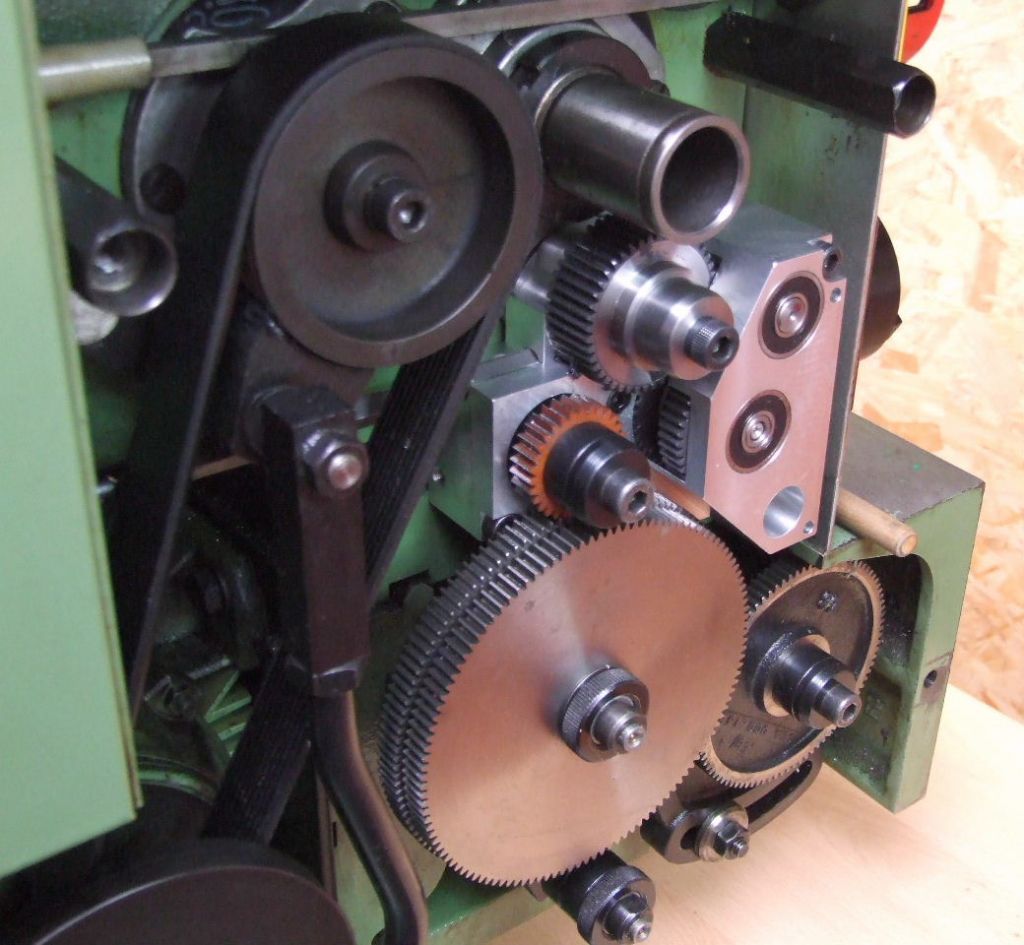
                                The screw cutting change gears cover should fit on without dramas. The "banjo" that the gear spindles fit into can be rotated to engage the gears with the spindle and then locked up with two nuts at the base where it rotates. In that position the cover should fit, unless you have some collection of oversized gears in place. For regular fine feed while turning, you want the small 20 tooth headstock spindle to drive the largest gear – about a 65 or 70 — coupled to the smallest gear available, which in turn drives the biggest gear left in your set, again coupled with the smallest you have left, finally driving the largest gear left on the lead screw. The Myford ML7 Users Manual PDF is available free all over the net and gives details and pics. Othewise, post pics of the gear train here if the cover won't fit on, plus pics of the cover and we will soon figure something out.

                                #540366

                                In reply to: ML7 tight saddle

                                Nigel Graham 2
                                Participant
                                  @nigelgraham2

                                  A carriage trip would be desirable, but I don't think they were all that common even on larger lathes.

                                  My Harrison L5 has no trip, though it has a spring-clutch on the feed-shaft that disengages once it's noticed the extra grunt necessary to continue the cut into the chuck.

                                  On the other hand its feed-release trigger is very simple and much more responsive than its Myford equivalent.

                                  My thought (for the ML7) would for a bar with an block set along it, that simply engages a pin protruding down from the boss on the half-nut handle.

                                  #536612
                                  Dr_GMJN
                                  Participant
                                    @dr_gmjn
                                    Posted by Nigel Graham 2 on 27/03/2021 22:06:04:

                                    If you use a mandrel crank, as I do very occasionally (and find it usually slips), the obvious precaution is switching off at the mains.

                                    As a using aid though it's also worth slacking the belt from the countershaft, to reduce the drag given by trying to rotate the motor as well as lathe.

                                    (I've done that to use my Meddings bench-drill as a tapping-device.)

                                    '

                                    (I've a mischievous mental image of a certain car with a small tiller stamped 'Myford', in place of its steering-wheel…)

                                    Ha ha no, the car has it’s original wheel fitted at the moment.

                                    My ML7 has a clutch, so there’s no motor drag, just a bit from the belts, but that’s no issue.

                                    Having cobbled together a crank temporarily, I think a wheel is much better solution, at least for threading, for a number of reasons:

                                    1) The part you need to grab hold of to turn (ie the rim) is always in the same place, and is always visible from the front of the lathe.

                                    2) You’re not stretching to get a complete revolution because you can increment the rim round.

                                    3) Your body is naturally closer to the centre of the lathe because there’s no handle projecting away from where you’re working.

                                    4) It’s far better balanced for rapid turning with a finger when reversing the leadscrew.

                                    5) If you accidentally turn the lathe on, theres virtually no vibration due to imbalance.

                                    In addition, a wooden rim, to me, has a much nicer feel than a piece of metal bar. So I’ll be sticking with my version.

                                    #527516
                                    Graham Meek
                                    Participant
                                      @grahammeek88282

                                      Hi Clive,

                                      Over the years I have found that each lathe has to be approached as an individual case. The Myford S7 was the very first lathe I did, and one would think that fitting this clutch to the ML7 and Big Bore would be straight forward. Alas it was not, both needed a different approach, the Big Bore for instance uses a different Headstock casting to the S7. While the ML 7 has a different Tumbler Shaft arrangement

                                      It might be a good time to list the clutches so far designed.

                                      Myford S7, ML7 & Big Bore.

                                      Emco Maximat Super 11 & Compact 8

                                      Boxford STS

                                      Sieg & Warco Mini Lathes

                                      South Bend

                                      Wabeco D6000

                                      Clausing

                                      Atlas 618

                                      This last lathe has many similarities with the Myford ML7 dimensionally, but because of the peculiar use of the Tumbler output gear as part of one range of the screw cutting gear train. Made this one of the most difficult lathes to do. Yet at first look it seemed to be a walk in the park.

                                      This Boxford clutch was the first to be fitted externally to the Tumbler reverse gears, (these are contained with in the headstock like the Emco Maximat). Unlike the Maximat there is a good deal more room available with the Boxford STS.

                                      clutch fitted.jpg

                                      I am however thankful that others are rising to the challenge of fitting a clutch to their lathes. The Atlas will be my last version.

                                      Regards

                                      Gray,

                                      PS Fine adjustment is always handy to have and a means of Personalising the design.

                                      Edited By Graham Meek on 15/02/2021 16:11:24

                                      #525351
                                      Chris Crew
                                      Participant
                                        @chriscrew66644

                                        I have four lathes, a Myford ML7-R which was bought new in 1979 and has since had a Super 7 cross-slide and top-slide fitted, so it's a Super 7 less gearbox and clutch. Then there is a Colchester Student, ex-St. Thomas' Hospital medical engineering department and still in superb condition. I also acquired a Colchester Bantam 2000 which I have repaired since some clown, not me!, managed to topple it off a pallet. I have never used it but have repaired it over the last few years although I think it has had a hard life given the excessive wear on the slide screws that I replaced. I also have a Myford ML10 which came from a late colleague's estate, again I have never used it and have no wish to as I consider it a very poor design and wouldn't recommend this British made machine to anyone having examined its constructional features.

                                        I have to say that as a lathe the Student walks all over the Myford, but only as a lathe. The Myford is a complete machining centre upon which I have accomplished many operations from milling, gear-cutting and slotting key-ways etc. before I acquired other machines for the workshop. It is a complete machining centre within itself and has had many accessories and attachments designed for it by some very clever people over the years, many of which I have made, and I would not part with it for all the tea in China! The Student does all the 'heavy lifting' in the workshop and with an Ainjest rapid threading attachment makes screw-cutting a doddle and I screw-cut every thread whenever practicable.

                                        However, all that being said, if I were to be starting all over again I would probably be tempted to start with a Myford Super 7 or ML-7R because there are some good examples to be had in pristine condition having been owned by very fastidious people and little used, but there is obviously a lot of junk out there. I would never consider a Colchester or Harrison etc. unless I could be certain it had been very lightly used by a private owner. The rational being that as these machines pass from owner to owner over the years they can only wear and deteriorate so I think I would rather buy a new Far Eastern machine. Again, only a personal opinion, but I think there is lot of xenophobic nonsense spoken about 'Cheap Chinese crap'. Everything that I have of far eastern origin has performed perfectly satisfactorily, from a Nu-Tool pillar drill which has given good and accurate service for almost 40 years to a Vertex dividing head and rotary table which have proved to be indispensable. Not everything that was made in this country was of the highest quality, i.e. the ML10, and not everything that is made in China is crap.

                                        Anyway, those are my thoughts on the matter for what it's worth. In the end you pays your money and you takes your choice!

                                        Edited By Chris Crew on 06/02/2021 23:18:29

                                        Edited By Chris Crew on 06/02/2021 23:24:35

                                        #517555
                                        Hopper
                                        Participant
                                          @hopper
                                          Posted by John Stucks on 03/01/2021 20:34:27:

                                          Thanks again for all the suggestions. I’ve not yet got my 8mm tools (on order) so am not messing around with it all until ive got those, set the height and test cut.

                                          Lots of people mention possible bend countershaft, but not sure how I can test for this. Same with a worn clutch plate, how is this tested.

                                          Gib strip set up, is this just making sure they’re correctly right to allow movement of slides but no slack?

                                          Thanks,

                                          John

                                          Yes, set gibs for free movement but no slack.

                                          Bent countershaft? Maybe. Maybe not. There is not much of a wobble there. My flogged out fixed ML7 pulley wobbles more than that, with no noticeable effect on finish of the job. Rubber belts, if new, are very flexible and forgiving if not run guitar-string tight.

                                          And there is a pushrod up a hole in the middle of that counter shaft so if it were bent very much the pushrod would be binding.

                                          You may just have a slack countershaft bearing. This is very common. To test that, loosen the belts and leave clutch engaged, grab the pulley and see if you can feel any up and down movement of the shaft in the shaft bearing on the H frame behind the clutch. Put your finger in there and feel for movement. Should be a thou or three there. If excessive, like 10 thou or more, you can press in a new Oilite standard sized sintered bushing with a nut and bolt and flat washers.

                                          To check for bent shaft you would have to pull off the clutch then rotate the countershaft by hand with belts slack and observe the end of the shaft or clock it with a dial gauge. Myfords website has parts drawings of the clutch. Not sure, but it looks like you undo the small bolts and pull the actuator off the end of the clutch, and the spring/s and then maybe a circlip and the clutch body should slide off the shaft. Should be self evident from looking at it. Not particularly complex. Maybe someone on here with a S7 has done this job and can elucidate?

                                          Edited By Hopper on 05/01/2021 02:12:44

                                          #510641
                                          T.B
                                          Participant
                                            @t-b-2

                                            Hi

                                            As other have said , its a Myford ML7

                                            It also has a clutch which is quite desireable , this was an additional extra on the ML7 and they only ever offered one type of clutch for the ML7

                                            I would also say it appears to be a relatively late model unless parts have been changed , I say this because it has the later type ML7 tailstock and later type apron more similar to a Super 7 apron.

                                            #510605
                                            Howard Lewis
                                            Participant
                                              @howardlewis46836

                                              Rushing in where angels fear to tread, to me, it looks like a ML7 with a clutch, sitting on riser blocks on a Myford stand.

                                              Howard

                                              #504106
                                              Steviegtr
                                              Participant
                                                @steviegtr
                                                Posted by Hopper on 29/10/2020 04:31:47:

                                                Posted by Steviegtr on 28/10/2020 23:16:39:

                                                Posted by Hopper on 28/10/2020 11:29:19:

                                                Posted by Steviegtr on 26/10/2020 14:10:51:

                                                …. Not sure if i saw somewhere that someone had made one from a Moped front drum brake.

                                                Steve.

                                                That was Myford themselves! The MK1 clutch was reputedly the brake off a Raleigh moped. Dickiest operating mechanism ever but it must have worked.

                                                Hopper the Mk 1 clutch was a cast iron split ring. that grabbed onto a drum. Or did it push out on to a drum , cannot remember. The ring can snap as a friends did. The mod i saw was using a moped front drum brake. With the brake shoes acting on a outer type drum. Wish i could find it. Maybe some others have seen it done.

                                                Steve.

                                                That's the first clutch on the MK1 Super 7. The very first Myford clutch, fitted to the ML7 before the Super 7 was invented, was a factory modified and fitted Raleigh moped brake whose shoes gripped the outer drum when the moped brake arm was operated by a djcky linkage from the central shaft.

                                                Edited By Hopper on 29/10/2020 04:37:35

                                                Ah right Hopper got it. I knew i had seen it somewhere.

                                                Steve.

                                                #504015
                                                Hopper
                                                Participant
                                                  @hopper
                                                  Posted by Steviegtr on 28/10/2020 23:16:39:

                                                  Posted by Hopper on 28/10/2020 11:29:19:

                                                  Posted by Steviegtr on 26/10/2020 14:10:51:

                                                  …. Not sure if i saw somewhere that someone had made one from a Moped front drum brake.

                                                  Steve.

                                                  That was Myford themselves! The MK1 clutch was reputedly the brake off a Raleigh moped. Dickiest operating mechanism ever but it must have worked.

                                                  Hopper the Mk 1 clutch was a cast iron split ring. that grabbed onto a drum. Or did it push out on to a drum , cannot remember. The ring can snap as a friends did. The mod i saw was using a moped front drum brake. With the brake shoes acting on a outer type drum. Wish i could find it. Maybe some others have seen it done.

                                                  Steve.

                                                  That's the first clutch on the MK1 Super 7. The very first Myford clutch, fitted to the ML7 before the Super 7 was invented, was a factory modified and fitted Raleigh moped brake whose shoes gripped the outer drum when the moped brake arm was operated by a djcky linkage from the central shaft.

                                                  Edited By Hopper on 29/10/2020 04:37:35

                                                  #485123

                                                  In reply to: Stringer EW lathe

                                                  Nigel Graham 2
                                                  Participant
                                                    @nigelgraham2

                                                    My EW is the plain-bed version, was second-hand when my Dad bought it for my 18th birthday-present, ooh, err, last century; but I was delighted to learn many years later, from 'lathes.co', that its has all the original fittings and extras except the change-wheel guard, which the photos suggest was a casting.

                                                    The EW lathes were not fitted with clutches on the drives, and the lead-screw was permanently engaged for both feed and screw-cutting. NB: the change-wheel set supplied is not suitable or intended for power-feed, only screw-cutting.

                                                    I don't find screw-cutting to a shoulder to be too much of a problem – though I might baulk at large batches. I simply turn the machine by hand, using the big pulley on the countershaft as a (rather mucky) handle. With the motor unplugged of course! (And the motor belt loosened to reduce the effort needed.)

                                                    '

                                                    I do have a budget QCTP that just about fits but long before such things were available made a set of little tool-holders from short lengths of rectangular BMS bar, to hold tool bits ground from worn-out centre-drills and the like. The tool-holes are inclined, giving easy though limited height adjustment.

                                                    '

                                                    Watch out for the T-slots. They are thin, and one on my vertical slide, for which I made a rather crude but effective vice, came complete with a piece broken out. Rather than separate T- nuts I made T-strips to distribute the load along the slot.

                                                    Another point regarding the vertical slide. It is meant to fit on the boring-table, of course, but its single central bolt is not conducive to keeping square-ness of setting, nor to fair stresses on the T-slots. Not believing in modifications to the original metalwork other than for repairs, I made two L-shaped steel blocks each clamped by two T-bolts to the table, forming a 3-sided "nest" abutting against the (OEM) machined body of the slide.

                                                    '

                                                    Presently my EW is resting – a Myford ML7 does most of the work, a Harrison L5 is there for the bigger stuff; an Axminster "Micro-lathe" awaits a suitable bench.

                                                    It is resting though because the spindle and headstock castings are worn to the extent you can see the chuck "jump" when applying a cut, and it reveals what if anything is the weak point of this otherwise fine little lathe – others might find this too.

                                                    The spindle runs directly in the castings; and they are not very thick-walled.

                                                    The "obvious" solution is to bore out the castings, turn the spindle down, and insert a thin-walled bush, split to match the original adjustment, Unfortunately there is very little metal available for removal from either without weakening the headstock or compromising the spindle's fine-pitch thread for its retaining/ adjusting nuts. I investigated commercially-made bearing-bushes, but found none thin-walled enough to use without creating serious problems.

                                                    I think all I can do is combine line-boring the headstocks with skimming the spindle, but removing only just enough for very thin-walled bushes turned from leaded gun-metal – that material as the spindle is not hardened. I would have to rebore and sleeve the heftier tailstock casting too, to ensure concentricity as much as to correct its own wear.

                                                    Thinking how to bore two castings with slots cut along them, I realised I would have to make cast-iron – or possibly aluminium – shims to fill the slots and give nearly-uninterrupted cuts.

                                                    The spindle's thrust-flange had also worn a recess in the headstock-face, but I made a thrust-washer with a tiny anti-rotation pin locating in the adjustment slot, to overcome that.

                                                    '

                                                    Chromed handles, as mentioned right back several pages ago? The handles on my example show no sign of ever having been plated, even allowing for years of wear. I don't deny they might have been at least on some of these lathes, though, and the 1940s-50s were a great time for finishing all sort of machines in black-crackle paint and chrome.

                                                    SMF

                                                    At least yours came with the original countershaft!

                                                    Pity someone thought fit to put that hole in the bed, and I wonder why whoever did it, wanted the vertical-slide in a fixed location anyway.

                                                    I did not know Stringer made a gap-bed version of this lathe.

                                                    #484314

                                                    In reply to: ML7 refurbishment

                                                    SillyOldDuffer
                                                    Moderator
                                                      @sillyoldduffer
                                                      Posted by fastdave on 06/07/2020 16:45:17:

                                                      Next question is perhaps rendered rhetorical by my 'suck it and see (Electronics background) – I have installed 1 hp motor with a VFD – connected up and ran beautifully – altered motor mounting plate slightly, and running off a 65mm pulle, rather than 50mm original. runs beautifully, and people talk about the danger of using too great H.P. – As long as I am careful, I can only see that a jamming disaster would cause as much trouble with high or low H.P. – any comments? Dave from Fife.

                                                      1 HP on an ML7 isn't insanely powerful, just over-the-top for a machine not designed for that much oomph.

                                                      The first problem with it is the 'As long as I am careful' statement. Nothing matters when being careful, it's accidents that do the damage! For example, if lubrication fails a big motor will rip more metal off the bearing than a small one. Whatever the accident it does more damage all round simply because there's more energy in the system, whether running the saddle into the chuck or ripping a ring finger off.

                                                      Second problem is the slow temptation to use the extra power. Satan whispers every day. Because all seems OK, the operator will gradually start taking faster deeper cuts than the lathe is happy with. It's unlikely to fail spectacularly. Rather a bearing that would have lasted 15 years only lasts 3 whilst the extra stress quietly wears the bed prematurely, twists the frame, and fatigues the keyways etc.

                                                      Generally not smart to up the power of machines without considering the whole system. For example, putting a sports engine with Nox into my bog-standard Corsa wouldn't be a good idea unless I also uprated the clutch, brakes, tyres, suspension and cooling system. Plus a roll-bar if I'm driving it!

                                                      There are reasons why Myford didn't put huge motors on their lathes. It's not because their engineers lacked imagination or cojones!

                                                      Dave

                                                      Edited By SillyOldDuffer on 06/07/2020 19:02:50

                                                    Viewing 25 results - 26 through 50 (of 134 total)

                                                    Latest Replies

                                                    Home Forums Search Search Results for 'MyFord ml7 clutch'

                                                    Viewing 25 topics - 1 through 25 (of 25 total)
                                                    Viewing 25 topics - 1 through 25 (of 25 total)

                                                    View full reply list.