Vacuum Chamber – Design and Build Advice

Vacuum Chamber – Design and Build Advice

Home Forums Clocks and Scientific Instruments Vacuum Chamber – Design and Build Advice

Viewing 25 posts - 1 through 25 (of 128 total)
  • Author
    Posts
  • #824387
    SillyOldDuffer
    Moderator
      @sillyoldduffer

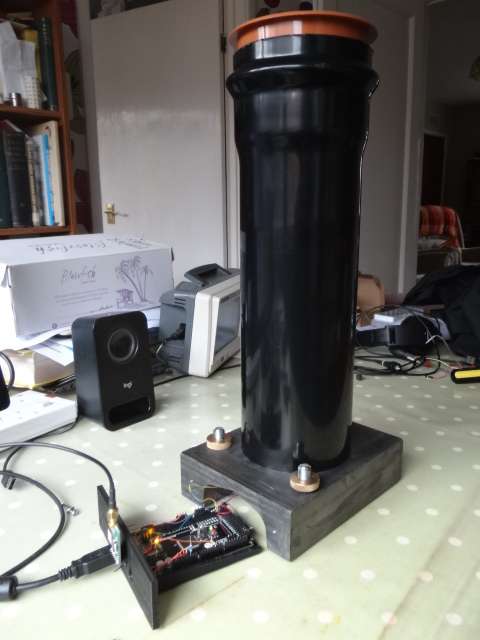
      I’m building a clock in which the pendulum swings inside a vacuum chamber.  Results in many problems akin to boiler design, except the cylinder is an evacuated PVC pipe being crushed rather than ballooned, plus sealing problems.

      My first attempt is based on a 4.5″ (114mm) diameter PVC Soil pipe, 350mm long, not much different from some model loco boilers.

      DSC06955

      Ideally the pipe will be evacuated to a hard vacuum, less than 100mb, but this is very difficult. I have an ancient Edwards EB3A roughing pump, specified to reach 133mb in brand-new condition. On test, it managed about 500mb, but the set-up was slightly leaky, and it might do better.

      Other factors suggest a practical working pressure of between 300 and 800mb, say 500mb (half an atmosphere or -7.25psi).

      H&S.  I assess impact of an implosion on human health to be LOW.   However, impact of a crush failure on the clock is  HIGH – the delicate internal structure will be damaged by the equivalent of a 12 stone (75kg) man standing on it.

      Answers confirming or improving on my existing design are most welcome.  However, I recognise that the PVC pipe approach may be flawed, making it necessary to switch to metal, or something else.  Alternative suggestions welcome.  To reduce leaks it is important to avoid penetrating the chamber with extra holes, so nut and bolt answers should be avoided!

      Is the pipe strong enough? First raised by blowlamp in a related Topic.  My unverified calculation suggests a 3.7mm thick PVC will fail by buckling. Estimates for a 3.7mm thick PVC pipe at 300mB: Axial 8.16bar; Hoop 3.7bar; Buckling 2.97bar.  That is air-pressure would have to rise to 3x atmospheric to buckle the pipe.  Same calculation applied to a 3.2mm thick walled pipe would buckle at about 170mb. FAIL! a safety factor of 3 is recommended for vacuum containers.  I am famously bad at maths, so grateful for independent verification.

      Next problem.  The calculation assumes the ends are as strong as the walls. True of the cast-iron base, not of the end-cap. This is a brown PVC plastic cap to BS EN 1401, intended to prevent stink escapes rather than resist pressure. The end is 3.25mm thick, weaker than the pipe. I intend reinforcing it on the outside with a 5mm thick Aluminium disc super-glued to the PVC. Concern is that air-pressure will break the joint by bowing – glued joints do not resist delaminating forces well.

      Is there a better way of reinforcing the end?

      More questions queuing.

      Thanks,

      Dave


      #824392
      Robert Atkinson 2
      Participant
        @robertatkinson2

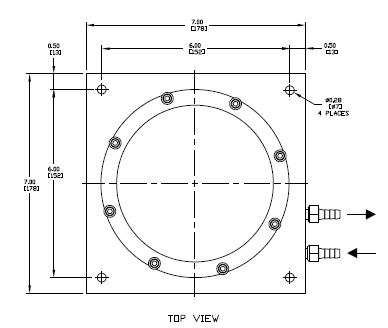
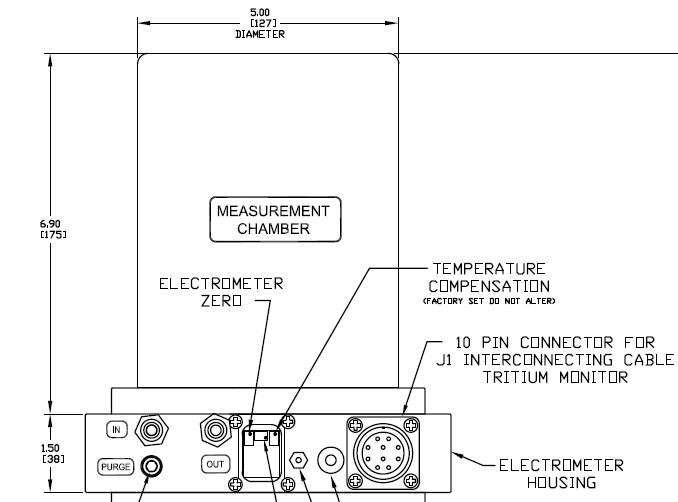
        Further to my offer of a hermetic connector I could provide it still attached to it’s orginal strucure. That’s a 7″ square by 1.5″ aluminium block. It has fixings and seals for a 5″ diameter cylindrical cover, space for electronics and comes with air fittings. black anodised Looks almost made for the job..h31H32

        I have the “chamber” cover too made from stainless steel.

        h33

        The aluminium block has a mostly solid flat top with  couple of holes. below that ss a cavity sealed by a flush cover and O ring about 4″ dia. on the bottom of the block.

        #824395
        Robert Atkinson 2
        Participant
          @robertatkinson2

          On strengthing the plasitic cap with a metal disk. Stick the metal disk to the cap with a flexible sealant like Sikaflex EBT+ or RTV silcone. Then there will be no air presssure on the cap to make it bow…
          If the disk is at least as big as the pipe OD and the plastic cap is fully seated forces will go vertically into the pipe wall.

          Robert.

          #824396
          Dave S
          Participant
            @daves59043

            I acquired a vacuum box from somewhere. No idea of the ratings, but it’s made from 1″ thick acrylic blocks.

            Not sure that helps, but it’s a data point at least.

            Dave

            #824399
            not done it yet
            Participant
              @notdoneityet

              My only comment, initially, is that 500mb is only ‘low pressure’ – certainly not anywhere near what I would call a vacuum.

              #824404
              Michael Gilligan
              Participant
                @michaelgilligan61133

                Whatever you choose to do, Dave

                Avoid the use of brittle materials, and

                Avoid any design details that risk sudden failure

                I know, from bitter personal experience, that ‘catastrophic failure’ of a vacuum chamber is ‘non trivial

                MichaelG.

                #824405
                Nicholas Farr
                Participant
                  @nicholasfarr14254

                  Hi, years ago myself and a workmate, had to replace a 6 meter length of 12″ I/D x 1/2″ wall thickness PVC pipe, which was crushed flat for most of its length, just by atmospheric pressure. This was in a pipeline about half to three quarters of a mile long, in which water was being pumped through, and this length was at the highest point. The pump failed for some reason, and there was nothing to stop the water running back through the pump, and the other end was open, and so the volume of water flowing both ways created a vacuum inside this length of pipe. These PVC pipes can stand quite a fair bit of internal pressure, but not very much external pressure. We had to in put a one way valve to atmosphere, into the pipeline at this point, which would allow air to be sucked in, in the event of the pump stopping again.

                  Regards Nick.

                  #824408
                  Bazyle
                  Participant
                    @bazyle

                    Are you really only getting down to -7psi? Can’t do mb. It seemed that when I used to wind my Mamod backwards I got to a point where the piston just wouldn’t pull out which I assumed was down to zero.
                    In about 1980 when I worked on satellites we had a chamber about 6ft long and 4ft diameter. Took a few hours to pump down to ‘sod all’ then several hours of an ion beam with liquid nitrogen target to get down to deep space. As the junior I got the night shift looking for arcing in the waveguide as the pressure dropped.
                    I think we just used waterproof D-types for the connections and sealed with a silicon free sealant. Metal to metal flanges had a special grease that looked like Vaseline but wasn’t.

                    #824414
                    Michael Gilligan
                    Participant
                      @michaelgilligan61133

                      A useful table here … cross-referencing the various units:

                      https://www.sensorsone.com/altitude-pressure-units-conversion/

                      MichaelG.

                      #824417
                      Michael Gilligan
                      Participant
                        @michaelgilligan61133

                        From Wikipedia [with my emboldening]

                        https://en.wikipedia.org/wiki/Shortt–Synchronome_clock


                        The vacuum tank was evacuated by a hand-operated pump to a pressure of around 30 mmHg (40 hPa)[14] to prevent changes in atmospheric pressure from affecting the rate of the pendulum, and also to greatly reduce aerodynamic drag on the pendulum, which increased its Q factor from 25,000 to 110,000,[15] thus increasing its accuracy by a factor of four. Experiments by Shortt showed that at 30 mmHg the energy consumed by the flexing of the suspension spring just equalled the energy consumed by deflecting the residual air molecules and therefore a higher vacuum was not required.[14]

                        MichaelG.

                        #824418
                        duncan webster 1
                        Participant
                          @duncanwebster1

                          If you use a piece of pipe with no collar you could replicate the bottom flange at the top, thick ally plate with a groove in it for location and o ring, 4 external tie bars to clamp it down.

                          Buckling due to external pressure can be prevented by attaching hoops either internal or external, I’ll need to dig out some text books to find out how close pitched, watch this space

                          Thd pipe used fir underground water and gas mains is a lot thicker, but I’ve no idea where you’d get short lengths.

                          #824421
                          Wade Beatty
                          Participant
                            @wadebeatty78296

                            I agree with Duncans suggestion but, I would leave out the tie bars and let the vacuum do the work. The higher the vacuum the better the seal.

                            #824423
                            peak4
                            Participant
                              @peak4

                              An alternative approach might be to investigate how knife makers (amongst others) stabilise wood.
                              Some do make their chambers out of clear plastic tube.
                              Essentially submerge wood in resin in a vacuum chamber and use the slow release of vacuum to suck the resin into the wood pores.
                              This is just a commercial example
                              Companies like this will supply clear tube with up to 5mm wall thickness, and can probably advise as to suitability.
                              https://www.clearplastictube.co.uk/

                              I’ve not watched all this video

                              Another random video, middle one of three

                              Bill

                              #824429
                              noel shelley
                              Participant
                                @noelshelley55608

                                I would advise against using PVC, in failure it may well shatter. A better choice is ABS pipe and for sealing a product called CT1 . Noel.

                                #824442
                                duncan webster 1
                                Participant
                                  @duncanwebster1
                                  On Wade Beatty Said:

                                  I agree with Duncans suggestion but, I would leave out the tie bars and let the vacuum do the work. The higher the vacuum the better the seal.

                                  The tie bars are to get an initial nip on the orings, in an ideal world you don’t need them, but with a weedy pump it might never get a seal without them

                                  #824456
                                  blowlamp
                                  Participant
                                    @blowlamp

                                    Whatever design you eventually choose, I think it would make sense to incorporate substantial external mounting points attached to and close to the pendulum suspension point, so as to reduce the possiblity of the structure rocking.

                                    My child-like maths gives me a surface area of about 196 square inches (14″ X 14″) of your PVC pipe, so when evacuated to -7.25 PSI, it seems that it is subject to 1421 pounds of pressure over the area. I’m not saying the pipe will implode, but if it’s not quite circular in cross section, then it might be vulnerable to further distortion over time or with a change in temperature.

                                    From the above, I think it follows that if you mount your clock purely on its base and some distortion does take place, it’s going to adversely affect performance.


                                    Martin.

                                    #824463
                                    John Haine
                                    Participant
                                      @johnhaine32865

                                      Atmospheric pressure near enough 1000 mBar = 1000 hPa.  So 7 psi is about half atmospheric or ~1000 hPa.

                                      OOPS!  500 hPa

                                      #824477
                                      Michael Gilligan
                                      Participant
                                        @michaelgilligan61133
                                        On peak4 Said:


                                        I’ve not watched all this video

                                        It’s a bit laboured … but he makes some useful points.

                                        MichaelG.

                                        #824478
                                        duncan webster 1
                                        Participant
                                          @duncanwebster1

                                          So whilst waiting for the doctor to ring I’ve done some sums. external pressure of 0.7 bar as per SOD, I get hoop=1.08MPa, axial 0.54MPa.

                                          It then gets complicated, as the tube is subject to external radial and longitudinal pressure. The equation is very long

                                          I’ve just ignored the longitudinal. If it were a long pipe it would collapse at 2.77 bar, but Roark suggests that as it can be treated as a short tube, and so it would withstand 5.47 bar. Again, if anyone wants the sums just shout

                                          #824487
                                          duncan webster 1
                                          Participant
                                            @duncanwebster1

                                            Short tube with ends held circular

                                            #824488
                                            Michael Gilligan
                                            Participant
                                              @michaelgilligan61133

                                              That seems a comfortable margin over atmospheric pressure, Duncan.

                                              From the link that Bill provided : https://www.clearplastictube.co.uk/clear-acrylic-tube-extruded-80mm-5mm-500mm

                                              I see that this item is extruded … So does anyone know how the mechanical properties of cast and extruded Acrylic compare ?

                                              MichaelG.

                                              #824497
                                              duncan webster 1
                                              Participant
                                                @duncanwebster1

                                                I used values for PVC from Wikepedia, E=3.4 GPa. Another source (engineers toolbox) I’ve just found suggests 2.4-4.1 GPa and ABS 1.4-3.1 GPa. For comparison steel is 207 GPa, aluminium is 69 GPa

                                                lower value of E reduces safety margin pro rata. I doubt the tube manufacturer will even understand the question, as most customers won’t care.

                                                #824513
                                                SillyOldDuffer
                                                Moderator
                                                  @sillyoldduffer
                                                  On Wade Beatty Said:

                                                  … The higher the vacuum the better the seal.

                                                  I hadn’t realised that!  Presumably because external pressure tends to force the joints together.  Helpful, ta.

                                                  Dave

                                                  #824517
                                                  peak4
                                                  Participant
                                                    @peak4
                                                    On Michael Gilligan Said:

                                                    That seems a comfortable margin over atmospheric pressure, Duncan.

                                                    From the link that Bill provided : https://www.clearplastictube.co.uk/clear-acrylic-tube-extruded-80mm-5mm-500mm

                                                    I see that this item is extruded … So does anyone know how the mechanical properties of cast and extruded Acrylic compare ?

                                                    MichaelG.

                                                    They also do offcuts, which may work out cheaper
                                                    https://www.clearplastictube.co.uk/off-cuts/off-cut-clear-acrylic-tube-extruded-110mm-5mm-700mm-1

                                                    Bill

                                                    #824518
                                                    SillyOldDuffer
                                                    Moderator
                                                      @sillyoldduffer
                                                      On Robert Atkinson 2 Said:

                                                      Further to my offer of a hermetic connector I could provide it still attached to it’s orginal strucure. That’s a 7″ square by 1.5″ aluminium block.

                                                      I have the “chamber” cover too made from stainless steel.

                                                      I like the idea, but how big is the connector?   As there’s not much space inside the vacuum chamber I’m working to an 8mm diameter hole carrying 6 wires and a 4mm diameter pipe.

                                                      The hole leads to an open cavity under the block that’s occupied by the microcontroller, so the MIL-STD socket has to fit inside the chamber.

                                                      I may have to build a bigger clock!  And the existing tube is on the large side for my lathe.

                                                      Dave

                                                    Viewing 25 posts - 1 through 25 (of 128 total)
                                                    • Please log in to reply to this topic. Registering is free and easy using the links on the menu at the top of this page.

                                                    Latest Replies

                                                    Viewing 25 topics - 1 through 25 (of 25 total)
                                                    Viewing 25 topics - 1 through 25 (of 25 total)

                                                    View full reply list.