Milling 90 degree groove, cutter set 45 degrees in vice. How to locate Z?

Milling 90 degree groove, cutter set 45 degrees in vice. How to locate Z?

Home Forums Workshop Techniques Milling 90 degree groove, cutter set 45 degrees in vice. How to locate Z?

Viewing 25 posts - 1 through 25 (of 29 total)
  • Author
    Posts
  • #822086
    He Who Dares Wins
    Participant
      @jameswilkinson3

      I need to cut a 90 degree Vee groove in a block. The part set at 45 degrees in the vice since I don’t have a 45 degree cutter big enough for the Vee groove size.

      Problem is that I have blocked everything up accurately and need to find the theoretical point of the top of the workpiece to set my cutter datum zero point. I can locate center on X and Y easy enough, it’s the cutter height I struggle with.

      To make things even more difficult I have a tolerance of 0.02mm. How do I accurately set the Z axis cutter height?

      #822088
      Emgee
      Participant
        @emgee

        A picture of the setup would help.


        Emgee

        #822090
        He Who Dares Wins
        Participant
          @jameswilkinson3

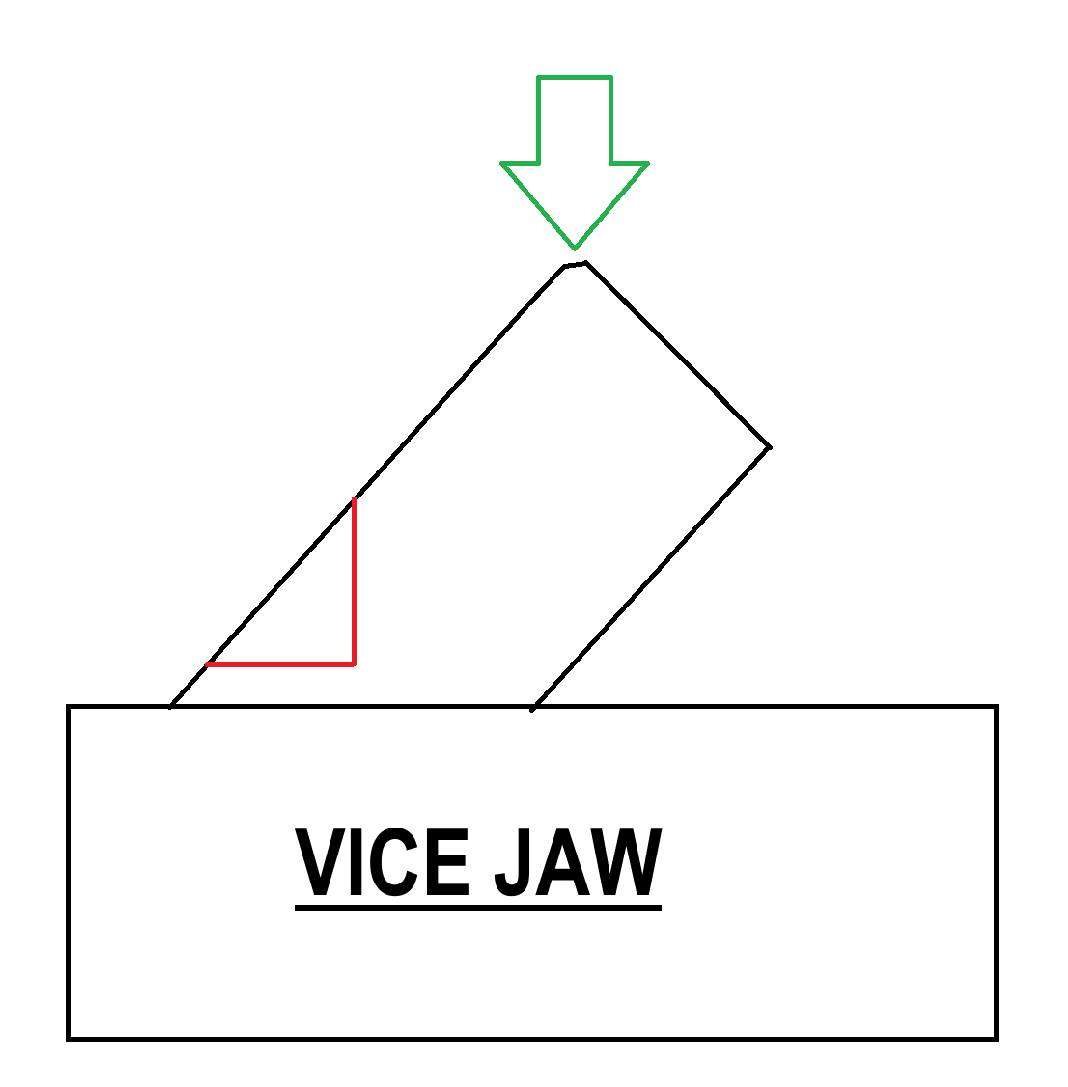
          Hi Emgee, here is a picture, note that it is deburred at the point. Sure I can use trig to calculate the theoretical point, but that don’t help to actually set the tool height zero (as far as I know)

          The red is what I need to machine, the arrow shows that I simply can’t touch off due to the part being deburred already

          558857587_3974651796088838_3228240899448639747_n

          #822092
          peter1972
          Participant
            @peter1972
            • Mill a small chamfer to replace the deburred edge.
            • Measure the width of the chamfer using a travelling microscope (to give required accuracy).
            • Multiply the width by 0.7071 to give the cutter height correction needed.
            #822098
            JasonB
            Moderator
              @jasonb

              On a job like this it is often better to start with oversize stock, cut the difficult feature, in this case the Vee and then bring the overall down to size.

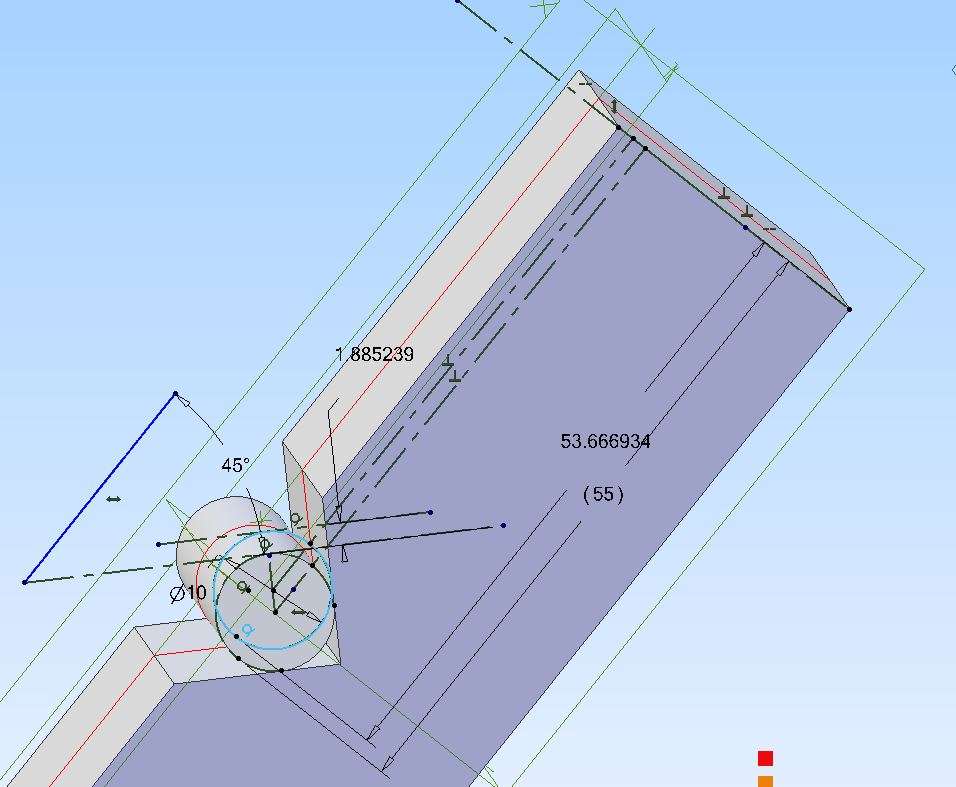
              As you have it set up already I would say rough out the Vee to give a decent size notch. Place a ground rod (cutter shank) onto the horizontal cut & touch off on the top of that. Then with a bit of additional trig you should be able to work out how much lower the cut needs to go in relation to the short edge of the block.

              In the example below the finished position of the rod is 55mm from the end, as you say you can set X then with the rod resting against the finished X face and roughed Z face measure the length, subtract from desired and the cut should be 1.414 x the difference between measured and desired. You can use more decimal places if you want teh accuracy such as 1.4142136

              height

              #822101
              David Senior
              Participant
                @davidsenior29320

                How do you intend to check the final position? Assuming that you have a means of doing that, can you make sure that the location in the vice is repeatable (in at least height and angle), then take a smaller cut, remove and measure, and adjust accordingly?

                Dave

                Edit: Crossed with Jason’s reply. His answer is the same principle but much more practical than mine.

                #822104
                Kiwi Bloke
                Participant
                  @kiwibloke62605

                  An alternative – I’m not suggesting it’s better than Jason’s method, but might be easier…

                  If you have a Vee block, you could sit the Vee on the rounded-over/deburred upper corner, and clock its upper surface (its base), for use as a Z datum. (Also another way of setting the block’s angle.) A bit of trig., and knowing the Vee-block’s dimensions then allows you to work out the vertical distance to the machined feature’s horizontal surface.

                  #822108
                  JasonB
                  Moderator
                    @jasonb

                    I did think about an upturned vee block but mine are a bit wider than a 90deg so tend to rock on a corner.

                    #822112
                    Andrew Crow
                    Participant
                      @andrewcrow91475

                      If the position of the V is the most important measurement I would sit the piece in a vee block and clamp to an angle plate. Then by taking a cut only on the end of the cutter to a fixed depth, the job could then be reversed in the  vee block and the same cut taken on the other side of the vee, it should at least be central.

                      Perhaps the bottom of the vee could have slot rather than a sharp corner, this would make the whole thing easier to produce.

                      Andy.

                      #822117
                      Martin Kyte
                      Participant
                        @martinkyte99762

                        Cant you use the vice jaws as a datum. Set the work with the groove horizontally at a known distance.

                        #822125
                        JasonB
                        Moderator
                          @jasonb
                          On He Who Dares Wins Said:


                          Problem is that I have blocked everything up accurately…………….

                          I thought the issue was locating the vee in the ALREADY set up work

                          #822133
                          Nicholas Farr
                          Participant
                            @nicholasfarr14254

                            Hi, it depends on how accurate you need the position to be, but using a combination square, just scribe a line down from the top, half the distance of the width of your Vee, away from the centre of the Vee groove, you can either then set your cutter to the scribed line, or just creep up to it, then set that as your datum point.

                            Regards Nick.


                            #822146
                            Tony Pratt 1
                            Participant
                              @tonypratt1

                              Not the best way of doing things but start to cut the vee and once deep enough put a dowel in the vee use a depth micrometer to see how close you are to the desired position, adjust z and x to arrive at the correct positional dimension but not deep enough. Once that’s done you can move z and x the same amount and the actual vee position will not move.

                              Tony

                              #822149
                              Tony Pratt 1
                              Participant
                                @tonypratt1
                                On Andrew Crow Said:

                                If the position of the V is the most important measurement I would sit the piece in a vee block and clamp to an angle plate. Then by taking a cut only on the end of the cutter to a fixed depth, the job could then be reversed in the  vee block and the same cut taken on the other side of the vee, it should at least be central.

                                Perhaps the bottom of the vee could have slot rather than a sharp corner, this would make the whole thing easier to produce.

                                Andy.

                                He doesn’t mention central? But good idea.

                                Tony

                                #822161
                                Graham Meek
                                Participant
                                  @grahammeek88282

                                  By far the easiest route would be to drill and ream a dowel hole, or tooling hole at the Vee location. The dowel hole would assure centrality and using coordinates to locate the hole it can be sited a known distance from the Vee faces.


                                  Using an edge finder against the dowel the vertical centreline can be found. With feeler gauges, the end of the cutter can be set to the top of the dowel and this will give the horizontal centreline. Then machining the Vee faces becomes a breeze.


                                  Regards

                                  Gray,

                                  #822168
                                  blowlamp
                                  Participant
                                    @blowlamp

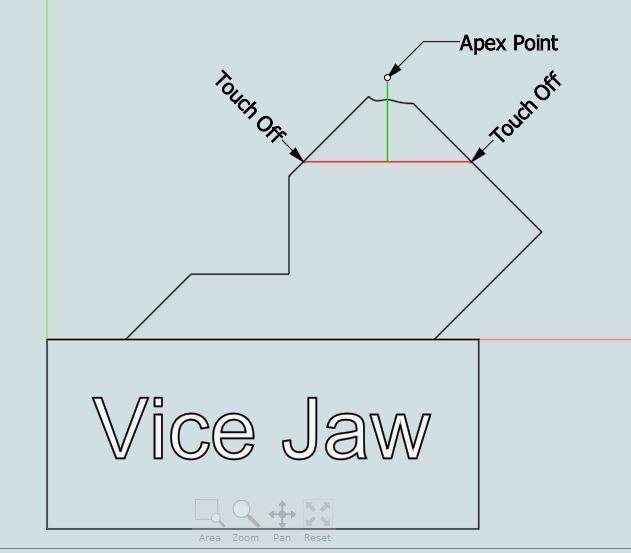
                                    If you mount a tool in your mill chuck and ‘touch off’ from any depth along the end face and the top face, then half that distance will provide the centre distance between the two faces. If you then raise the tool by the same amount it will be precisely positioned over the missing apex point.


                                    Martin.


                                    Capture

                                    #822180
                                    renardiere7
                                    Participant
                                      @renardiere7

                                      Blowlamp’s suggestion is excellent. A machinist’s chair type edge-finder would be another way to go about it but of course you need to have one, or make one.

                                      #822184
                                      He Who Dares Wins
                                      Participant
                                        @jameswilkinson3

                                        I like Blowlamps suggestion due to it’s simplicity. However, I have just thought … what if the block was to be set at 30 degrees? how would the center be found and the theoretical point be found?


                                        Thanks for all the suggestions soo far. Good to see different solutions to the same problem

                                        #822188
                                        JasonB
                                        Moderator
                                          @jasonb

                                          That is where my method would still work, just a bit of different trig to get the amount you need to lower the tool whatever the angle of the work.

                                          I dare say Blowlamp’s could also be made to work if the trig was altered, though if the angle became very shallow you may loose accuracy touching off on the shallower sloping edge.

                                          #822192
                                          duncan webster 1
                                          Participant
                                            @duncanwebster1

                                            Jason’s way is the better, measures where the groove is directly. The trig isn’t difficult

                                            #822196
                                            He Who Dares Wins
                                            Participant
                                              @jameswilkinson3

                                              JasonB I just tried blowlamps suggestion on a 30 degree block. I drew it in CAD. Using blowlamps suggestion I cannot find any way to locate the center, even using trig?

                                              Yes, The red Vee groove is what’s needed to be machined, it’s not a feature already there.

                                              Sorry to throw a spanner in the works with the 30 degree angle, lol


                                              #822201
                                              JasonB
                                              Moderator
                                                @jasonb

                                                30deg works out quite easily.

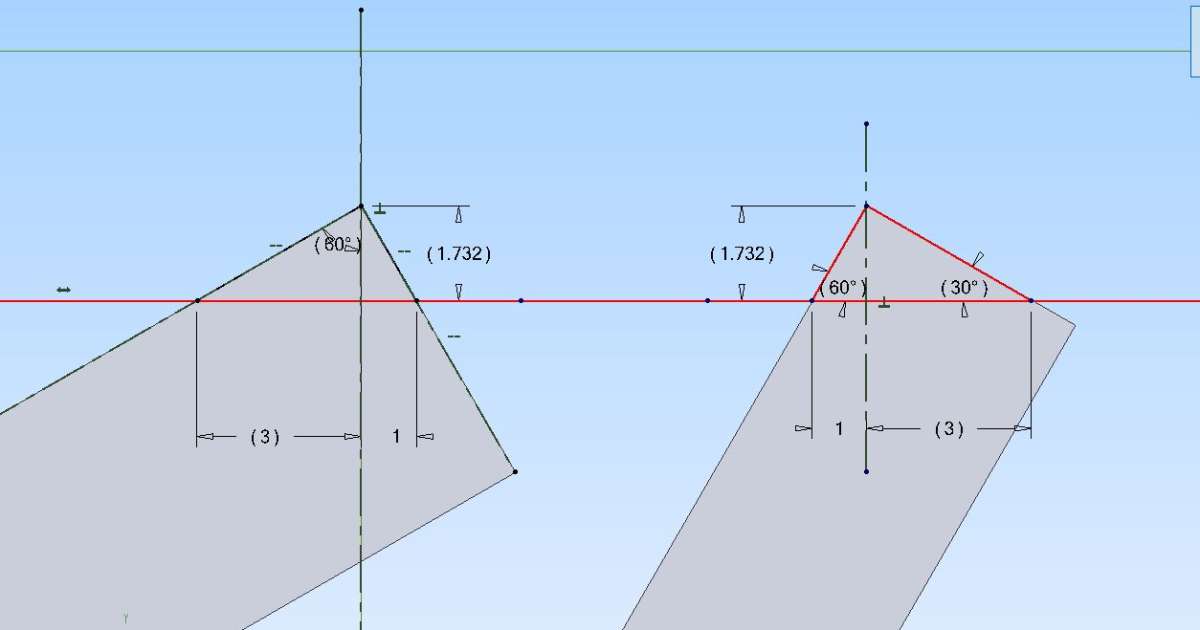
                                                Take the triangle formed by the two toch off points and the missing tip and split that into two right angled triangles.

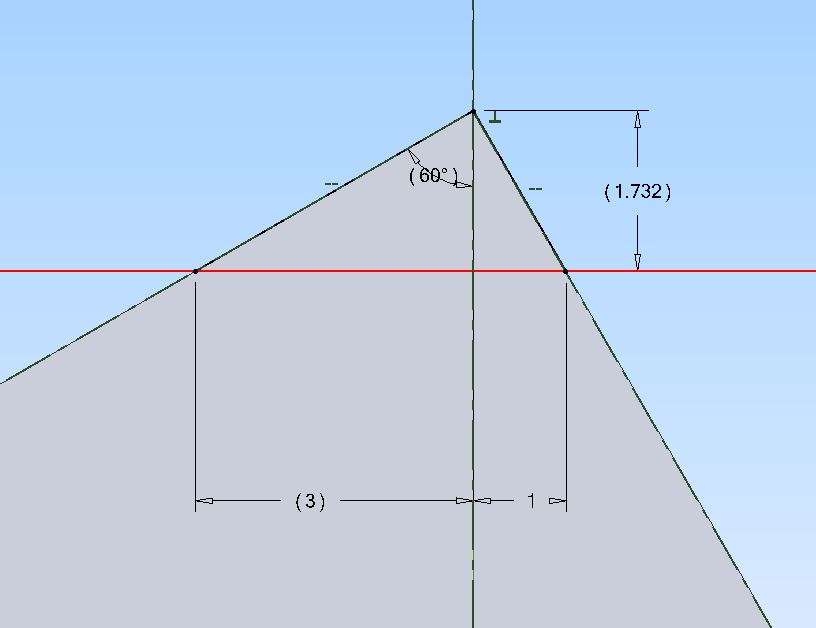
                                                The proportions horizontally will always be 1/4 and 3/4 for 30deg so move the tool over 1/4 the actual metal to metal distance plus half it’s diameter to put the spindle over the imaginary corner.

                                                Trig of the smaller right side 30/60/90 triangle will give the height to the corner, you know the bottom edge length is 1/4 of the total and you know the opposite and adjacent angles so that is more than enough but will always be 1.732 x (distance/4) as the Tan of 60 deg is 1.732 x 1

                                                You could also work the height from the larger left side triangle using tan 30  x 3 which equals the same height

                                                30deg

                                                #822206
                                                He Who Dares Wins
                                                Participant
                                                  @jameswilkinson3

                                                  Thanks JasonB.

                                                  Would it be ok to have a couple more examples please? How can you tell the proportions will always be 1/4 and 3/4 on the 30 degree?

                                                  1) What if the distance was say 20.45 on the touch off points?

                                                  2) Just for another exercise to help me understand the calculations, how would this work with a angle set at 28.44 degrees?

                                                  I know it may seem like I am being a pain, but more examples will help me fully understand in real world situations.

                                                  Thank you all for taking the effort and time to help 🙂

                                                  #822209
                                                  JasonB
                                                  Moderator
                                                    @jasonb

                                                    Edit I posted this before seeing your reply, will add a bit more in a minute.


                                                    I should say that the same trig applies if the work is 30deg from vertical or Horizontal just reverse it round.

                                                    corner 2

                                                    For angles other than 30/60 draw it out as I have and set one of the horizontals a 1unit long, the CAD should work out what the other horizontal is and this will give you how far to move the tool horizontally (X axis)

                                                    #822215
                                                    Bazyle
                                                    Participant
                                                      @bazyle

                                                      Try this: Clamp a flat to the under edge that is sloping up to the right in your diagram. Sit a clean good square block (or other known shape) between that and the uppermost surface. Actually a round might be best. This gives you an new good top point with an offset that is easy to calculate from the size of the workpiece and the size/shape of the block.

                                                    Viewing 25 posts - 1 through 25 (of 29 total)
                                                    • Please log in to reply to this topic. Registering is free and easy using the links on the menu at the top of this page.

                                                    Latest Replies

                                                    Home Forums Workshop Techniques Topics

                                                    Viewing 25 topics - 1 through 25 (of 25 total)
                                                    Viewing 25 topics - 1 through 25 (of 25 total)

                                                    View full reply list.