Measuring Clocks

Measuring Clocks

Home Forums Clocks and Scientific Instruments Measuring Clocks

Viewing 25 posts - 201 through 225 (of 283 total)
  • Author
    Posts
  • #824058
    Michael Gilligan
    Participant
      @michaelgilligan61133

      Keep up the good work … and the underpants !

      MichaelG.

      #824065
      SillyOldDuffer
      Moderator
        @sillyoldduffer

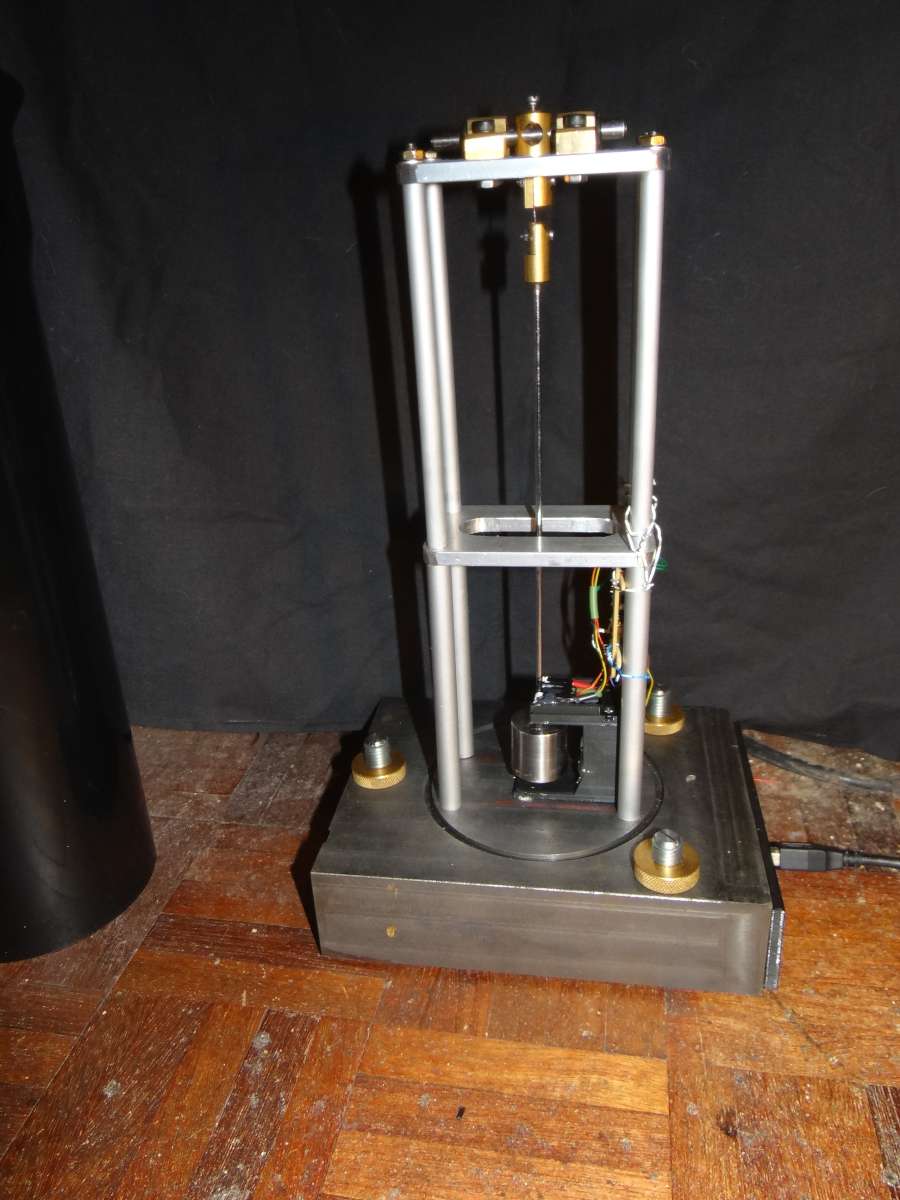
        The stand:

        DSC06987

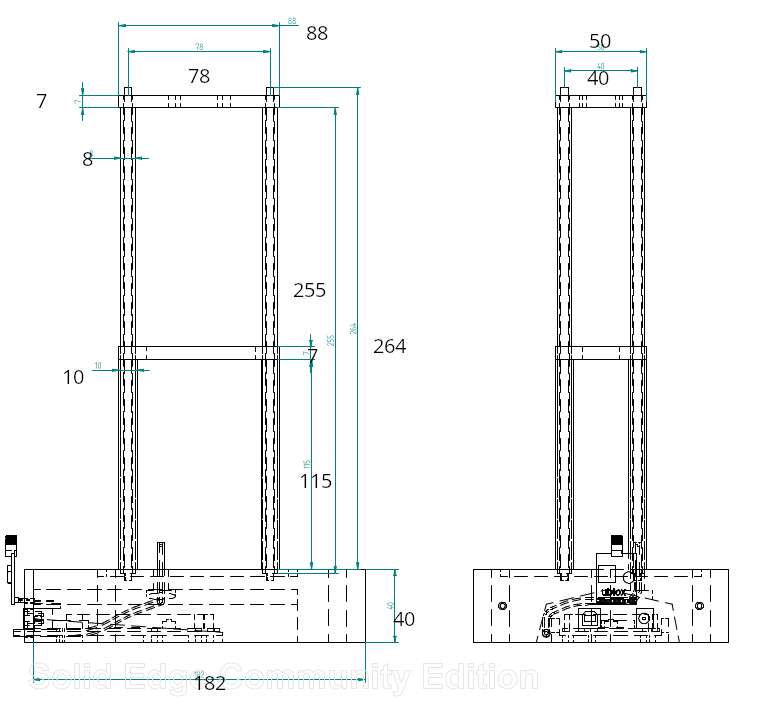
        Drawing:

        Screenshot From 2025-11-11 21-51-31

        Description.

        Four 264mm long M4 studs are screwed into the base, in a 70x40mm rectangle.

        The studs are sleeved by four 8mm diameter tubes, forming the inner pillars.

        The inner pillars are recessed 2mm into the upper platform and the cast iron base.

        The 8mm pillars are sleeved by sliding fit 10mm diameter tubes, the outer pillars, up to middle platform level.

        The top platform is pulled hard down on to the inner pillars by the studding.  The M4 studs are under strong tension and the inner pillars are strongly compressed.

        The outer pillars are loose.  They and the mid-platform resist bowing.  The middle platform is a tight fit on the inner pillars, but not otherwise fixed.

        The top platform carries the pendulum suspense.  An axle allows the pendulum to hang straight, and the spring holder can be slid along the axle to align the rod with the photo-interrupter at BDC.

        Ta,

        Dave


        #824070
        duncan webster 1
        Participant
          @duncanwebster1

          What’s the bore of the 8mm tubes

          #824076
          SillyOldDuffer
          Moderator
            @sillyoldduffer
            On duncan webster 1 Said:

            What’s the bore of the 8mm tubes

            Whoops, 1mm

            And it’s seamless Aluminium.  Alloy unknown, not soft, and it machines OK.

            Ta,

            Dave

            #824090
            Michael Gilligan
            Participant
              @michaelgilligan61133

              May we presume that 1mm is the wall thickness, not the bore ?

              … or have I completely lost the plot ?

              MichaelG.

              #824095
              John Haine
              Participant
                @johnhaine32865

                Dave I know that it would be a major change but I wonder if there could be an opportunity here?  Yes it’s difficult to make a rigid “tower” mount but one way to solve the problem of the force of the clock moving the mount is to apply a precise opposite force.  This could be done by having a second identical pendulum from the same beam at the top and swinging in antiphase.  The finite compliance of the mounting helps you here as it encourages the pendulums to couple and swing in antiphase.  You can even get away with impulsing only one of them.  I can put together a few relevant papers if you wanted to consider this approach.  Michael referred earlier to a clock by Jim Arnfield with 2 coupled pendulums in a vacuum enclosure and using the “falling ball gravity escapement”.  Or you could have 2 iron bobs, like your current one, with a coil symmetrically in between which will attract them when it’s energised.  As well as solving the rigidity problem the configuration is largely insensitive to lateral support vibration in the plane of swing.

                #824099
                duncan webster 1
                Participant
                  @duncanwebster1

                  Michael, it could be both (only joking)

                  #824103
                  SillyOldDuffer
                  Moderator
                    @sillyoldduffer
                    On Michael Gilligan Said:

                    May we presume that 1mm is the wall thickness, not the bore ?

                    … or have I completely lost the plot ?

                    MichaelG.

                    Thickness!

                    And speaking of being thick, I’m wading through this topic to make sure all the sugary goodness is extracted, and it’s exhausting.  My brain being reduced to mush explains the mistake.  Either that or the weather.

                    Dave

                    #824106
                    SillyOldDuffer
                    Moderator
                      @sillyoldduffer

                      More aggro, as if I don’t have enough already.

                      The clock counts UTC and is set to that by information from the GPS Module.

                      • If GPSAvailable and SetClock commanded:
                        • wait for GNRMC on Serial2 (the GPS Module)
                        • extract DD/MM/YYYY HH:MM:SS
                        • convert to UNIXTIME (seconds since 00:00:00 January 1, 1970) + 1
                        • on next GPSTick set seconds counter and zero microseconds

                      Unsolved Problem
                      Setting seconds is easy, setting microseconds isn’t.

                      The pendulum is asynchronous, part way through a swing – between ticks – when the clock is set. The pendulum will be ‘out’ in the microsecond part by up to 1 second and I don’t know how to correct this.

                      What should the microsecond part of UNIXTIME be set to when GPS UTC is exactly 1762946125.000000 and the pendulum’s last tick was, say, ‘n.071156’?  If period is 919748μS, the pendulum’s next tick occurs in 848592μS. How should UNIXTIME μS be set to allow for that?

                      I’m stuck.

                      We might discuss how clocks are set accurately in general.  Moving the hands is hopeless when we’re talking microseconds.   Unlocking a dial is better, but only within tens of milliseconds. My Victorian astronomy book (actually all about time, which is what observatories were set up for), says set the pendulum clock by releasing the dial when the star transits, and notes this introduces error.  The spider web used to make the telescope’s cross-hairs is too thick, plus human reactions are unreliably sluggish. Thereafter they don’t touch the pendulum clock, instead they find the error by taking more transit observations.   The clock is wrong, but they know by how much.   Read the dials, apply corrections, and then noon will be when the dials reach that position.

                      Anyone know how the Shortt-Synchronome was operated?  Not just by looking at it I think!

                      How do others set their clocks, and how accurately?  But please solve my microseconds problem first.   Failing to comprehend is annoying me.

                      Ta

                      Dave


                      #824111
                      duncan webster 1
                      Participant
                        @duncanwebster1

                        Assuming

                        1. 8mm tubes are rigidly fixed to top and bottom plates
                        2. 8mm tubes are rigidly fixed to centre plate
                        3. tie bar is rigidly fixed to top and bottom plates
                        4. 10mm tube is a tight fit on 8mm tube so it adopts the same shape, but slippage occurs at interface
                        5. top centre and bottom plates are rigid

                        I make the overall stiffness to be ~600N/mm. For comparison, a 75 OD 1mm wall tube would be ~5300 N/mm. I don’t think I can readily post a SMath document here, if anyone wants a copy send your email via pm.

                        Assumption 1 is reasonable, the others less so. I’d expect the real stiffness to be lower

                        The actual side load is (mass of bob) * g * tan(half angle of swing), so pretty low

                        If I were to set about something like this, I’d have 4 big squat pillars at the base to allow access to the gubbins at the bottom and a tube with a flange top and bottom to support the top gubbins. You then need a cellar to put it in (fairly constant temperature) and a foundation taken down to bedrock. Don’t hold your breath

                        #824115
                        Michael Gilligan
                        Participant
                          @michaelgilligan61133

                          Good to have some baseline figures, Duncan … Thank you

                          I note, and respect, the inevitable raft of assumptions.

                          MichaelG.

                          #824116
                          blowlamp
                          Participant
                            @blowlamp

                            Whilst thinking about alternative ways to impulse a ‘free pendulum’, the thought crossed my mind to replace a conventional suspension spring with a bimetallic strip. If it could be quickly heated at the right time by a few degrees using an induction coil or laser etc, then would enough energy be imparted to maintain oscillation? In fact, would it impart any energy at all as it cools back to ambient between impulses?

                            It’s not a suggestion for Dave or anyone else as I can imagine that (if it worked) it wouldn’t make the best timekeeper, but just an alternative way to sustain movement without direct mechanical intervention.


                            Martin.

                            #824118
                            John Haine
                            Participant
                              @johnhaine32865

                              Regarding your setting problem Dave, if you get a time stamp for each pendulum pulse wrt a local uS clock, and also a time stamp for the GPS seconds stamp shouldn’t that allow you to compute the offset?  Details of the algorithm are “an exercise for the reader”…

                              #824127
                              duncan webster 1
                              Participant
                                @duncanwebster1
                                On blowlamp Said:

                                Whilst thinking about alternative ways to impulse a ‘free pendulum’, the thought crossed my mind to replace a conventional suspension spring with a bimetallic strip. If it could be quickly heated at the right time by a few degrees using an induction coil or laser etc, then would enough energy be imparted to maintain oscillation? In fact, would it impart any energy at all as it cools back to ambient between impulses?

                                It’s not a suggestion for Dave or anyone else as I can imagine that (if it worked) it wouldn’t make the best timekeeper, but just an alternative way to sustain movement without direct mechanical intervention.


                                Martin.

                                Bit like https://en.wikipedia.org/wiki/Riefler_escapement

                                #824128
                                SillyOldDuffer
                                Moderator
                                  @sillyoldduffer
                                  On John Haine Said:

                                  Regarding your setting problem Dave, if you get a time stamp for each pendulum pulse wrt a local uS clock, and also a time stamp for the GPS seconds stamp shouldn’t that allow you to compute the offset?  Details of the algorithm are “an exercise for the reader”…

                                  It’s the exercise for the reader part I’m struggling with!   Working with the offset might be the answer, two difference of two counters.   Might be easier to suck it and see – confirm the output makes sense rather than think it through from first principles.

                                  Thanks for the suggestion, I’ll play with it later.   Still catching up with the paperwork, losing the earlier notes is a disaster.

                                  Thanks,
                                  Dave

                                  #824161
                                  SillyOldDuffer
                                  Moderator
                                    @sillyoldduffer

                                    Hard slog today, mostly bringing the Design Overview up-to-date, whilst trying to get the micro-controller to measure Q correctly.  Nearly finished, 27 pages…

                                    Q now working on the microcontroller so I was able to make a few impromptu tests.  In short:

                                    • Putting the clock on the floor doubles Q provided I sit very still and don’t touch the table.
                                    • Touching the table, typing etc, reduces Q by about 10%.  I guess force travels down the table legs into the floor. The nearest leg is only 600mm from the clock.

                                    The floor is teak panels on concrete.   Other parts of the house show the concrete was smoothed with scrim, to which thin vinyl tiles are glued.  The teak panels are on top, probably with a thin underlay, so not unambiguously solid.  Maybe leaning on the table tilts the teak panel underneath slightly and the clock moves.

                                    Need to write a Python program to graph the log.

                                    Decided my house is no good:

                                    • Utility room: Quarry tiles, but full of vibrating white goods and a pesky cat.
                                    • Downstairs bog:  carpet. too close to hall
                                    • Hall: carpet.  too busy
                                    • Kitchen.  Laminate floor on concrete with thick underlay.  Flexes when walked on.  Busy.
                                    • Dining Room:  I’m set up on the dining table.  Busy
                                    • Front room:  Busy. Maybe behind the telly.  Busy
                                    • Garden shed:  maybe – would have to be cleared out.  No power, but could run on a battery.  Might be in wifi range.
                                    • Upstairs, bendy wooden floors and carpets

                                    Next, look at Duncan’s maths, and have a go at how to set the clock.

                                    Dave


                                    #824167
                                    duncan webster 1
                                    Participant
                                      @duncanwebster1

                                      Screw a substantial bracket to a wall, or even better a strong triangular shelf in a corner sat on 2 bearers screwed to the wall. That is assuming you have brick or block walls

                                      #824174
                                      Michael Gilligan
                                      Participant
                                        @michaelgilligan61133

                                        Alternatively … Sacrifice the dining table [or maybe just one chair]

                                        https://bluemolds.com/concrete-lego-blocks/

                                        MichaelG.

                                        #824249
                                        SillyOldDuffer
                                        Moderator
                                          @sillyoldduffer

                                          Too much to do, so little time!

                                          Been round the house looking for substantial bracket locations, a good idea.   The answer is a lemon.   Doors, windows, furniture, all in the way.   The upstairs internal walls are all plasterboard on studding.

                                          The need to find a good location was reinforced by finding the clock stopped this morning. About to rip it apart. when I noticed it had moved.  Must have bashed it with my office chair last night.

                                          Looked at Duncan’s Smaths sums.  They quantify how much the pendulum’s support will flex due to swinging the bob.   Though the answer is ‘not much’, tiny movements cause trouble.  I will have to look at ways of stiffening the support structure.  Won’t be easy in the space available.

                                          Reviewing suggestions made is highlighting design compromises:

                                          • Blowlamp suggests a heavier bob, but, as above, that would flex the support more.   I need a heavier bob and a stiffer support, and there’s not much room for either.   A bigger clock is needed, but that worsens the “where put it” problem.
                                          • John Haine alerted that the photo-interrupter’s IR LED ages, and that would affect the clock’s long-term stability.  He suggested turning the LED off when not needed, which would at least halve the age decay.   Not difficult to implement, except it needs another wire through the bulkhead penetrator, making it more likely to leak.   There’s a trade-off between the vacuum failing and the LED ageing.

                                          Looking again at the vacuum, I own an ancient Edwards EB3A vacuum pump. This is a large noisy beast, intended for rough vacuum work, in top condition down to 133mB.  I expected to disconnect it after pulling a vacuum and rely on good seals, some hope! Might do better to permanently connect a small aquarium vacuum pump and have the clock run it as necessary to keep the vacuum in good condition.  I’ve ordered a Jadeshay pump, £6.99.   It claims to pull 420mB, a reasonable match with the BME280 sensor (lower limir 300mB)   Pumping on demand may reduce the need for really good sealing.  Unfortunately, pumping is intrusive, the EB3A shakes the whole house!

                                          Most of the stuff needed to build the vacuum system has arrived. Sealing wax recommended by Robert, Presta valve, tap and die to make the threads etc. Soon have no excuse not to tackle it.  Don’t have a convincing design for the bulkhead penetrator yet,

                                          Dave


                                          #824255
                                          Michael Gilligan
                                          Participant
                                            @michaelgilligan61133
                                            On SillyOldDuffer Said:

                                            […]

                                            Looked at Duncan’s Smaths sums.  They quantify how much the pendulum’s support will flex due to swinging the bob.   Though the answer is ‘not much’, tiny movements cause trouble.  I will have to look at ways of stiffening the support structure.  Won’t be easy in the space available. […]

                                            Dave … I regret to say that ^^^ probably underestimates the scale of your challenge.

                                            Duncan’s stiffness figures [and caveats] seem entirely reasonable, but they are orders of magnitude too small for your intended purpose !

                                            I have no doubt that motion of the pendulum support needs to be limited to a few tens of microns if significant interference with your control system is to be avoided.

                                            Ref. The Huygens experiment !

                                            Although domestically difficult, I suggest you seriously consider finding space for a 400mm cube ‘Concrete Lego Block’ to be placed on a solid floor, with a truncated pyramid framework atop.

                                            MichaelG.

                                            #824309
                                            Michael Gilligan
                                            Participant
                                              @michaelgilligan61133

                                              Unfortunately , I have yet to find anyone who stocks a 400mm cube

                                              🙁

                                              MichaelG.

                                              #824318
                                              SillyOldDuffer
                                              Moderator
                                                @sillyoldduffer
                                                On Michael Gilligan Said:
                                                On SillyOldDuffer Said:

                                                […]

                                                Looked at Duncan’s Smaths sums.  They quantify how much the pendulum’s support will flex due to swinging the bob.   Though the answer is ‘not much’, tiny movements cause trouble.  I will have to look at ways of stiffening the support structure.  Won’t be easy in the space available. […]

                                                Dave … I regret to say that ^^^ probably underestimates the scale of your challenge.

                                                Duncan’s stiffness figures [and caveats] seem entirely reasonable, but they are orders of magnitude too small for your intended purpose !

                                                I have no doubt that motion of the pendulum support needs to be limited to a few tens of microns if significant interference with your control system is to be avoided.

                                                Ref. The Huygens experiment !

                                                Although domestically difficult, I suggest you seriously consider finding space for a 400mm cube ‘Concrete Lego Block’ to be placed on a solid floor, with a truncated pyramid framework atop.

                                                MichaelG.

                                                We’re agree!  But, with respect, I’m not underestimating the challenge.  The issue is acknowledged.

                                                I’m not rushing to tackle pendulum support because so many other aspects of this clock are still under investigation.  The physical clock is designed to fit into a small space as an experimental platform.  I’m deploying technologies and techniques not available to Shortt, notably deep statistical analysis of clock performance and their application  to a novel method of compensating  pendulum defects that might deliver significantly better accuracy.

                                                As the approach won’t fix gross mechanical errors,  it’s necessary to address them.  Not my main priority though.  At this stage I’m more targetted on running experiments, which is why this thread is about measurement, though thread drift is welcome – loads of good ideas coming in.  There is no actual evidence that the pendulum support significantly interferes with the control system, therefore fixing it is low priority.  When the clock is fully loaded with software, located safely on a rigid platform and evacuated, I’ll do a learning run.  Like as not that will reveal errors attributable to structural wobble.

                                                This clock isn’t a one-off.  There was a prototype, followed by the Mk1.  The Mk2 is a work in progress, still on the launch pad.  Pretty sure there will be a Mk3, but it won’t happen until I’ve thoroughly milked Mk2, good bad and ugly,

                                                Unless!  I’ve nearly finished the Mk2 Clock Overview, about 30 pages of description.  Should be ready for publication tomorrow.  John and Duncan commented on the draft, causing several upgrades, plus changes due to this Topic.  Lego blocks are listed in Annex E.  More comment is welcome.

                                                I’d be delighted if someone else used the Mk2 Overview as a springboard to an improved clock incorporating their ideas.  For example, if Duncan or John saw any value in Arduino code that takes commands from a PC, maybe telling their clock to measure Q, then they can have it.

                                                Can’t claim the Overview is an easy read!

                                                🙁

                                                Dave


                                                #824336
                                                Robert Atkinson 2
                                                Participant
                                                  @robertatkinson2
                                                  On SillyOldDuffer Said:

                                                  <SNIP>
                                                  He suggested turning the LED off when not needed, which would at least halve the age decay.   Not difficult to implement, except it needs another wire through the bulkhead penetrator, making it more likely to leak.   There’s a trade-off between the vacuum failing and the LED ageing.

                                                  Looking again at the vacuum, I own an ancient Edwards EB3A vacuum pump. This is a large noisy beast, intended for rough vacuum work, in top condition down to 133mB.  I expected to disconnect it after pulling a vacuum and rely on good seals, some hope! Might do better to permanently connect a small aquarium vacuum pump and have the clock run it as necessary to keep the vacuum in good condition.  I’ve ordered a Jadeshay pump, £6.99.   It claims to pull 420mB, a reasonable match with the BME280 sensor (lower limir 300mB)   Pumping on demand may reduce the need for really good sealing.  Unfortunately, pumping is intrusive, the EB3A shakes the whole house!

                                                  Most of the stuff needed to build the vacuum system has arrived. Sealing wax recommended by Robert, Presta valve, tap and die to make the threads etc. Soon have no excuse not to tackle it.  Don’t have a convincing design for the bulkhead penetrator yet,

                                                  Dave

                                                  Hi Dave,
                                                  Another option for getting wires out of a vacuum enclosure is a hermetic connector. I just happen to have a bit of surplus of 10 pin ones (MIL-DTL-5015 style). They are from submarine radiation detectors. The fixed, male, part has a plated steel body with fired glass insulation for the pins. They are fully hermetic in themselves. The flange can be soft soldered to make that joint hermetic too. The mating half is aluminium bodied with solder pins. Threaded section is 1 1/8″ diameter flange about 1 3/8″ square.
                                                  You are welcome to a pair.

                                                  Robert.

                                                  #824337
                                                  Michael Gilligan
                                                  Participant
                                                    @michaelgilligan61133

                                                    Duly noted, Dave

                                                    I’m not clever enough to help with the monitoring/control systems, so I’ve commented on the vibration aspects … because I have a pretty-good gut feel for those, having spent 11 years doing practical testing.

                                                    Happy to leave prioritisation to you.

                                                    … I shall continue to observe, with great interest.

                                                    MichaelG.

                                                    #824343
                                                    duncan webster 1
                                                    Participant
                                                      @duncanwebster1

                                                      Just to make it even more complicated you could just have 2 pin connector for power and do everything else by wireless / Bluetooth. Might put delays into it, beyond my pay grade

                                                    Viewing 25 posts - 201 through 225 (of 283 total)
                                                    • Please log in to reply to this topic. Registering is free and easy using the links on the menu at the top of this page.

                                                    Latest Replies

                                                    Viewing 25 topics - 1 through 25 (of 25 total)
                                                    Viewing 25 topics - 1 through 25 (of 25 total)

                                                    View full reply list.