Indexing Plate

Indexing Plate

Home Forums General Questions Indexing Plate

Viewing 23 posts - 1 through 23 (of 23 total)
  • Author
    Posts
  • #28368
    Vic
    Participant
      @vic
      #564733
      Vic
      Participant
        @vic

        I’ve ordered an indexing plate for my wood lathe. It has four sets of holes up to 60. I’d ideally like to go up to 72. Fortunately one of the rings of 5mm holes has 36 and there is space between them to add another hole. I did think it would be a good idea to make a small jig for drilling the holes accurately with a couple of 5mm pins and a hole in between. The problem is the new holes won’t be at the same radius as the existing ones if I use this. I don’t have a DRO on my mill and there is some backlash on the table. It’s not a deal breaker but do any of you have any ideas around this? I don’t have a rotary table.

        #564736
        Tony Pratt 1
        Participant
          @tonypratt1

          Two pins to fit into existing holes & the 'new' hole in the middle of your jig plate central in X direction & slightly higher in Y direction to give you the same radius as you already have. What is the radius of your existing 36 hole circle?

          Tony

          #564748
          Bazyle
          Participant
            @bazyle

            With the plate mounted on some axle scribe the true required radius, Make your pin plate but with the centre hole very small like 1mm. Use it to spot the plate and measure the offset to your scribed line. (you could do this by calculation if you are into maths) Drill a new small hole knowing the offset and test it. Then open it out or use it to spot starter holes all round.

            #564749
            Emgee
            Participant
              @emgee

              Vic

              Measure the PCD of the 36 hole circle and the chordal distance between hole centres, the dimensions obtained will allow you to calculate the exact hole position for the additional hole, make a jig to use when drilling the additional holes.

              Emgee

              Edited By Emgee on 29/09/2021 14:15:59

              #564750
              duncan webster 1
              Participant
                @duncanwebster1

                Arrange a second pin so that it is at half space, then use them alternately, no drilling needed

                #564755
                DC31k
                Participant
                  @dc31k
                  Posted by Emgee on 29/09/2021 14:14:47:

                  Measure the PCD of the 36 hole circle and the chordal distance between hole centres, the dimensions obtained will allow you to calculate the exact hole position for the additional hole

                  On a 200mm PCD (i.e.100mm radius), the difference between the midpoint of the chord and the correct position on the PCD is a little under 0.4mm.

                  A smaller PCD will have a proportionately smaller error (i.e. 50mm radius is under 0.2mm error).

                  Is it worth worrying about considering how the hole might be marked out and formed and the likely tolerance and fit of the indexing pin?

                  The value of the error can be calculated from e= 0.0038 * PCD/2. (i.e. 0.2% of the PCD).

                  The 0.038 is 1-cos(5 degrees), 5 degrees being the half angle between holes.

                  #564758
                  Calum
                  Participant
                    @calumgalleitch87969

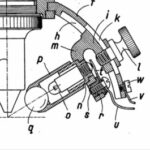
                    The photo and drawing linked on this page show pretty clearly how a forked detent works in principle:

                    http://homews.co.uk/page541.html

                    You can apply the same logic to your plate.

                    #564763
                    Bazyle
                    Participant
                      @bazyle
                      Posted by duncan webster on 29/09/2021 14:15:58:

                      Arrange a second pin so that it is at half space, then use them alternately, no drilling needed

                      I give this man the prize for lateral thinking. (once I realised what he was on about. it's the detent pin that is duplicated.

                      #564767
                      Adrian R2
                      Participant
                        @adrianr2

                        Or even a single pin with the tip offset by a quarter of the existing hole pitch, so it can be rotated through 180 degrees to half step?

                        #564769
                        Vic
                        Participant
                          @vic

                          Thanks for your ideas folks. The second detent pin idea would have some merit but it would need to be adjustable and easy to set to different hole pitches. Once the disk arrives I’ll take some measurements. The difference may be so small as not worth bothering about as DC31k suggests. wink I forgot to mention but I’m also thinking it might be useful to make the intermediate holes a different diameter to instantly differentiate 36/72 setup. A dual diameter detent pin would be easy to implement and use.

                          Thanks again.

                          #564770
                          Vic
                          Participant
                            @vic

                            If anyone’s interested the plate is here:

                            **LINK**

                            #564785
                            Martin Connelly
                            Participant
                              @martinconnelly55370

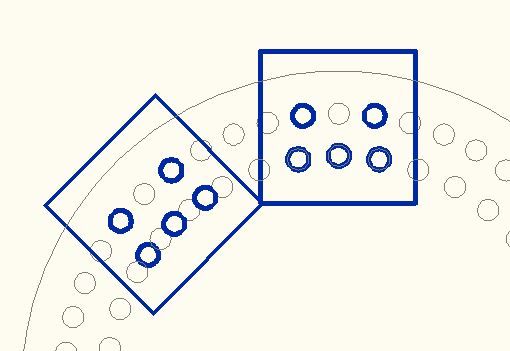
                              2 of the 48 hole spacing is 15°. Use the existing 36 hole ring (10° spacing) to make a drilling jig for two of its holes and two of the 48 hole ring. Rotate the jig around 2 of the 48 holes and you should find the drilling jig is now in the midpoint between the holes and so can be drilled through in the intermediate positions you want. You now have a jig to drill the intermediate holes in the plate. Try it with a piece of card to understand this. It will require some pins to locate the drill jig on the plate.

                              Martin C

                              #564790
                              Michael Gilligan
                              Participant
                                @michaelgilligan61133

                                Clever stuff, Martin yes

                                MichaelG.

                                #564802
                                Vic
                                Participant
                                  @vic

                                  Thanks Martin I’ll have a look at that. The only thing that bothers me about the idea is that the plate is fairly thin alloy so extreme care would be needed to avoid damaging it if I use it to spot through.

                                  #564804
                                  Martin Connelly
                                  Participant
                                    @martinconnelly55370

                                    Transfer punch.

                                    Martin C

                                    #564827
                                    Martin Connelly
                                    Participant
                                      @martinconnelly55370

                                      I've drawn up the concept of a drilling jig to show how this idea works.

                                      division plate.jpg

                                      I've shown the drilling jig rotated 4 holes on the 48 hole ring to separate the two positions of the jig (I obviously made the pcd of the holes too small to give space between the Ø5 holes). I said in the previous post that a transfer punch could be used to avoid drilling in the existing holes but there are alternatives, depends on what equipment you have. If you have a metal lathe it is easy to knock up a small drilling bush to fit in the Ø5 holes with a Ø3 bore for a 3mm drill to do the initial holes. You would be able to drill one hole anywhere on the plate for a starting hole and then pin that to the plate to drill the other holes, pinning each hole as you go to avoid slipping between the plate and the jig as it is made. Note that you only need to use the existing holes once for spotting through so there will not be excessive wear on them anyway.

                                      I would suggest though that buying a few Ø5 ground dowel pins would be a good idea and a set of transfer punches will be of use in the future for other things.

                                      Martin C

                                      PS. It occurs to me you may need a Ø5 reamer in this process to make the jig holes hold the pins nicely.

                                      Edited By Martin Connelly on 30/09/2021 10:09:45

                                      #564829
                                      Michael Gilligan
                                      Participant
                                        @michaelgilligan61133
                                        Posted by Martin Connelly on 30/09/2021 10:06:15:

                                        I've drawn up the concept of a drilling jig to show how this idea works.

                                        […]

                                        I've shown the drilling jig rotated 4 holes on the 48 hole ring to separate the two positions of the jig (I obviously made the pcd of the holes too small to give space between the Ø5 holes).

                                        .

                                        Although not explicitly stated on the drawing that Vic shared … elsewhere on the supplier’s site, it is quoted as been 250mm diameter : so it does look like there is room.

                                        MichaelG.

                                        #564836
                                        Journeyman
                                        Participant
                                          @journeyman

                                          Looking at the drawing (** LINK **) I get the impression that this isn't a particularly high-tech device. How about just making a second indexing arm pivoting on top of the original but with suitably different length and a slightly longer pin. In use it would be use arm 1, arm 2, etc. the difficult bit would be keeping the sequence.

                                          John

                                          #564839
                                          Vic
                                          Participant
                                            @vic

                                            Thank you very much for your post Martin, and in particular for taking the time to do the drawing, its much appreciated. I did think of a transfer punch but I think the disk is too thin for that. I did also think of a bushing as I’d like the intermediate holes to be smaller anyway. I’m pretty sure I have a 5mm reamer. Once the disc arrives I’ll have a play on the computer to check things out.

                                            I knew it was a good idea to post this question on here because there are some very clever people on here! laugh

                                            The biggest problem when working with wood lathe related things like this is that nothing seems to be made to metal lathe standards as it’s not really needed.

                                            #565372
                                            Vic
                                            Participant
                                              @vic

                                              Update: The disc is indeed 250mm dia and 2mm thick. As they say “discretion is the better part of valour” I’ve decided to actual wait until I’ve actually used the thing before carrying out any modifications. laugh

                                              #567804
                                              Vic
                                              Participant
                                                @vic

                                                Ok, final update. I found a scrap of alloy and made up a jig plate using Martin’s idea and it seems to have worked out fine. Thank you again for that Martin, I certainly would never have thought of it!

                                                #567820
                                                Michael Gilligan
                                                Participant
                                                  @michaelgilligan61133

                                                  Well done, Vic yes

                                                  … and compliments to Martin

                                                  MichaelG.

                                                Viewing 23 posts - 1 through 23 (of 23 total)
                                                • Please log in to reply to this topic. Registering is free and easy using the links on the menu at the top of this page.

                                                Latest Replies

                                                Home Forums General Questions Topics

                                                Viewing 25 topics - 1 through 25 (of 25 total)
                                                Viewing 25 topics - 1 through 25 (of 25 total)

                                                View full reply list.