Search Results for 'arc euro'

Search Results for 'arc euro'

Home Forums Search Search Results for 'arc euro'

Viewing 25 results - 2,376 through 2,400 (of 4,844 total)
  • Author
    Search Results
  • #376176

    In reply to: Needle thrust bearings

    John Hinkley
    Participant
      @johnhinkley26699

      I'm not totally familiar with the ML7, but it appears that there is some confusion in terms here. Thrust bearings are used to resist thrust on a shaft axially, whereas needle bearings act on rotational forces in the same way as ball and roller bearings do. See the arcticle on Arc Euro Trades site for clarification and explanation of the ML7 moification.

      **LINK**

      John

      Edit: spelling error

      Edited By John Hinkley on 16/10/2018 12:22:04

      #375884
      Philip Powell
      Participant
        @philippowell34749
        Posted by JasonB on 13/10/2018 09:15:32:

        Sorry its the "versatile" not universal as I called it.

        I can vouch for those Arc vices, I've had mine a couple of years now and very pleased with it too. I first baulked at buying it because it seemed too cheep, not quite up to Kurt standards but for the home workshop a great vice.

        First thing I did with it was to remove the swivel base which gives a bit of weight to the stand and gave the machine a bit more headroom under the quill.

        Phil.

        #375869

        In reply to: Cleaning with Parafin?

        SillyOldDuffer
        Moderator
          @sillyoldduffer
          Posted by Russell Eberhardt on 14/10/2018 10:01:55:

          Paraffin is sold in all supermarkets in France in winter as "Combustible pour poêle à pétrole" at about €20 for a 20 litre plastic bottle. It burns virtually odour free.

          So why is it so difficult to get in the U.K?

          Russell

          Only because there's not much call for it. When I was a lad Pink Paraffin, Esso Blue and other brands were sold in large quantities and easily available. Paraffin heaters were common in houses, where they caused fires, condensation and occasional monoxide poisonings. Been almost totally replaced by electric heaters and central heating systems, perhaps more thoroughly here because Britain is less rural than France. At the same time gas cartridges replaced paraffin for camp lighting & cooking, and also in the workshop. Paraffin's main domestic purpose today is heating greenhouses. Unless someone knows different!

          Worth mentioning that 'Paraffin' and 'Kerosene' both describe a range of light-hydrocarbon mixtures, that may or may not include additives and contaminants like Sulphur. They're similar mixtures rather than guaranteed identical. If it matters, check the specification. For example, Pink Paraffin and Esso Blue both contain dyes that might stain the item being cleaned if that's a concern. All the green-house paraffin I've bought has been White, which is a good thing for cleaning.

          Bunch of other hydrocarbons and mixtures like Petrol, Naptha, Thinners, Benzine, & Toluene also have excellent cleaning properties. They all need careful handling due to being more-or-less highly inflammable explosion risks, carcinogenic and/or toxic.

          Rule of thumb, the lighter the hydrocarbon the better it will be at degreasing. Liquid Butane is good stuff, though not very practical. I'm not recommending any of these – the advantage of Kerosene/Paraffin & White Spirit is they do a good job cheap and are relatively safe to handle. Anything heavier than diesel becomes part of the mess.

          Dave

          #375755

          In reply to: Quick change toolpost

          Neil Wyatt
          Moderator
            @neilwyatt
            Posted by petro1head on 13/10/2018 12:55:42:

            I currently have one of these **LINK**

            Following on from my parting off woes, I have concluded that it’s not the best. I have noticed that I often have to keep re tightening the tool holder to the post, the slightest jar loosens it.

            I have read up a bit and the consensus seem that wedge type holder are better than piston type.

            Therefore I am considering one of these **LINK**

            Anyone use one and are they any good

            Edited By petro1head on 13/10/2018 12:56:04

            The 222 is blooming enormous!

            I've used the somewhat smaller 100 (piston) and 111 (wedge) on a 4" centre height lathe and they are both excellent, and beautifully finished too.

            You might want to consider the smaller size.

            Neil

            #375741

            In reply to: Quick change toolpost

            petro1head
            Participant
              @petro1head

              I currently have one of these **LINK**

              Following on from my parting off woes, I have concluded that it’s not the best. I have noticed that I often have to keep re tightening the tool holder to the post, the slightest jar loosens it.

              I have read up a bit and the consensus seem that wedge type holder are better than piston type.

              Therefore I am considering one of these **LINK**

              Anyone use one and are they any good

              Edited By petro1head on 13/10/2018 12:56:04

              #375709
              JasonB
              Moderator
                @jasonb

                Sorry its the "versatile" not universal as I called it.

                #375489
                Martin of Wick
                Participant
                  @martinofwick

                  James,

                  To put it in context, I use the 220W motor to drive a Peatol and it is more than enough (1/3 HP on a 2.5 in lathe!).

                  From what I can tell, your lathe is a clone of the ubiquitous Chinese Mini Lathe (I have one of these too)

                  If it were for me, a 500W motor should be more than adequate for the CML (looking at the motor picture, it is actually rated at 3.6A which if true means the maxpower may be 30% higher&nbsp Without having one on the bench, I think it is as good as anything currently supplied with this class of lathe.

                  Check the motor size to be sure it will fit in the tight space

                  Check the no load RPM x 0.85 or so against the ratios on the drive train to be sure it gives you the desired range of speeds.

                  The controller supplied is OK but simple, you can get better ones – did see some being sold as plain boards with options for ramp and torque and electronic reverse for about £20, but cant find these anymore, or you can fork out £100+ for an American made KB controller (but from what I have read, these aren't much more reliable than bog basic controllers from china)

                  If suitable either get the 500W motor and PWM drive package or a more powerful motor if it will fit and you really think you need it, but beware of over motoring the lathe. To make life simple make sure to get a permanent magnet type brushed motor with a suitable speed range. Find whatever controller suits.

                  Rip out all of the old electronics from the lathe control box.

                  Check the remaining switch gear – does the mains on off/e stop switch function and more importantly, does it incorporate a latching servo (ie is of no volt release type)

                  Secondly, does the rotary switch rev-off-on look butch enough to handle about 10 A and is it at least 3 pole? – you will need to check carefully it can be used in a dual pole dual throw manner by working out the connections with a multimeter (or a battery, bulb and some wire as a simple continuity test)

                  Because on my CML, all of the switching functions are latched electronically, I suspect the answer is no to both of the above. You then have a choice – If the switchgear is still functional from checking with a multimeter, visual inspection etc use them anyway and devil take the hindmost until they fail or the fuses blow (but remember to always switch everything off after use and check that everything is always off before plugging in) Remember also that you will be wiring the DC motor feed of 240V via the rotary switch so make sure you are content with mounting, isolation, robustness etc)

                  Alternatively, if in doubt, or unable to make a judgement, go to the usual outlets and get….

                  **LINK**

                  and

                  **LINK**

                  or search for 10 amp DPDT toggle switch

                  and because you never know when you might need it, a cheap BIG RED BUTTON type E stop switch, all together new switchgear should cost less than £20

                  and wire as follows – Estop – NVR on off – controller – DC out to Rotary motor run reverse switch – DC motor

                  remember this will be a manually switched system, so you will have to remember to avoid casually flipping from forward to reverse without letting the motor stop and also avoid starting with PWM drive set at maximum speed – just to be kind to the motor and drive!

                  If all that is too daunting, then try UK lathe suppliers that carry spares such as Amadeal, ARC eurotrade and purchase a complete motor and control board set up but you will be looking at well over £200 outlay

                  #375282
                  Phil Grant
                  Participant
                    @philgrant54580
                    Posted by John Haine on 09/10/2018 22:22:17:

                    The Z feed for my Super7 CNC conversion uses a type AC5707645251 size 23 stepper motor that came from Arc Euro Trade (I think they no longer stock these). Googling it says that it's rated torque is 180Ncm – what a ragbag of units! But that's 1.8 Nm. There's a 2:1 toothed belt reduction between motor and leadscrew. I have never had a problem with inadequate torque either surfacing or screwcutting. The leadscrew pitch is 1/8" so slightly larger than yours. I can't see why more torque would be a problem? The driver is the ubiquitous 2m541 type, also from Arc, supply ~40V and probably running peak current of 2.5A or so.

                    Thanks for the info.

                    #375271
                    John Haine
                    Participant
                      @johnhaine32865

                      The Z feed for my Super7 CNC conversion uses a type AC5707645251 size 23 stepper motor that came from Arc Euro Trade (I think they no longer stock these). Googling it says that it's rated torque is 180Ncm – what a ragbag of units! But that's 1.8 Nm. There's a 2:1 toothed belt reduction between motor and leadscrew. I have never had a problem with inadequate torque either surfacing or screwcutting. The leadscrew pitch is 1/8" so slightly larger than yours. I can't see why more torque would be a problem? The driver is the ubiquitous 2m541 type, also from Arc, supply ~40V and probably running peak current of 2.5A or so.

                      #375257
                      Neil Wyatt
                      Moderator
                        @neilwyatt
                        Posted by Peter G. Shaw on 09/10/2018 19:08:02:

                        I have an X2 type milling machine. It has not been used much yet two sets of bellows on the Y axis have failed. They have split along the folds. The first set were those supplied by the manufacturer, whilst the second set were a set of dip moulded rubber concertina bellows supplied by Arc Euro Trade. I have tried, with limited success, gluing some cycle inner tube pieces over the splits, but in reality it is a lose-lose situation.

                        Strange, My X2 was, I think, number 3 in the first ever batch Arc sold. The Y-bellows is still fine.

                        So I don't know – do you use coolant?

                        #375243
                        Peter G. Shaw
                        Participant
                          @peterg-shaw75338

                          I have an X2 type milling machine. It has not been used much yet two sets of bellows on the Y axis have failed. They have split along the folds. The first set were those supplied by the manufacturer, whilst the second set were a set of dip moulded rubber concertina bellows supplied by Arc Euro Trade. I have tried, with limited success, gluing some cycle inner tube pieces over the splits, but in reality it is a lose-lose situation.

                          So, the first question is why are they splitting? Are they affected by cold, my workshop being a cold & draughty garage? Similarly, are they affected by heat – it gets very warm in the summer?

                          Secondly, can they be protected against splitting? Here I am thinking of perhaps something like olive oil. (Apparently vegetable oils can be used to lubricate the (rubber?) lipseal on caravan toilets.)

                          Thirdly. What about replacement with something totally different? I believe Harold Hall once mentioned using old cereal boxes, cut, folded and varnished. Anyone tried it? What about a piece cut off a large, eg car or wagon, inner tube? Apparently someone on another forum has done that and says that the curvature of the tube helps to throw off the chips. Again, has anyone here tried it?

                          Of course, I can always go back to Arc and order up another set of bellows, in which context, would the bellows made of laminated fabric be any better?

                          Thoughts?

                          Peter G. Shaw

                          #375096
                          Vic
                          Participant
                            @vic

                            If you want to use milling cutters on your Lathe then this type of collet chuck may be better.

                            **LINK**

                            It doesn’t use a draw bar and you can also use it for holding stock as you can pass material through the head stock.

                            You could use finger collets in the headstock but it’s not so convenient having to unscrew the draw bar and knock the collet out.

                            Historically they used to use collet chucks like the Clarkson Autolock designed specifically to hold milling cutters in a mill but they have lost favour. You can still buy them though, plenty on the second hand market. Google Clarkson Autolock chuck for more info.

                            #375086
                            JasonB
                            Moderator
                              @jasonb

                              Upto 6mm the FC-3 cutters are quite common. You can also get them to 10mm in some ranges but a 3-flute cutter in a non FC-3 form would be fine.

                              I tend to get my smaller ones from MSC when they are on special offer which is most of the time though not in this months sales flyer. Cutwel do them at a similar price. In the larger sizes the 3-flute from Arc are not a bad price

                              Edited By JasonB on 08/10/2018 16:25:40

                              #374904
                              derek hall 1
                              Participant
                                @derekhall1

                                Hi all, sorry to resurrect an old thread but…

                                The original design of locating wheels as seen on many bench grinders, including my new 8 inch arc Euro trade Allwin is a poor design.

                                Does the modified design improve things as shown by Rik in the original post I.e. side to side wobble?

                                In passing how come so many grinding wheel have holes that are non standard. Does this mean that you have to buy or make a bush to suit and what sort of "fit" to wheel and shaft should we be looking for?

                                Finally! Should all new grinders/wheels to dressed before use and for the standard wheels is a single point diamond suitable?

                                Regards to all

                                Del

                                #374836
                                Vic
                                Participant
                                  @vic

                                  Fly cutters are also very useful and give a good finish.

                                  **LINK**

                                  A roughing mill may also come in handy.

                                  **LINK**

                                  #374736
                                  Howard Lewis
                                  Participant
                                    @howardlewis46836

                                    Good to know that all's well that ends well.

                                    Thanks for telling us the conclusion to the story!

                                    If anyone else is concerned about Chuck Blackplate, registers, fixing hole PCDs, etc; take a look at Arc Euro Trade Catalogue No. 10. The dimensions for the chucks that they supply are on Page 9.

                                    Probably the same data can be accessed on their website.

                                    Howard

                                    Edited By Howard Lewis on 05/10/2018 21:11:43  TWO fat fingers!

                                    Edited By Howard Lewis on 05/10/2018 21:12:12

                                    #374623
                                    SillyOldDuffer
                                    Moderator
                                      @sillyoldduffer

                                      I'll be interested to see if anyone else agrees, but I'd question the value of a clamping set. I have one, it is useful, but I don't use it very much. Instead, most of what I do is held in a vice, or a rotary table, or bolted direct to the table. Home-made T-nuts and studding to fit are used more than the clamping set, which is most used on the rare occasions I bolt something big, heavy &/or oddly shaped to the table.

                                      I'd say an edge finder is essential, with a DTI a close second for tramming and setting the vice accurately. Not all edge finders are equally useful, and a set may be waste of money. My preferred edge finder is Type C on this page.

                                      You probably need some 2-flute as well as 4-flute end-mills and a set of twist drills.

                                      In the 'might be essential depending on what you do' class:

                                      • A collet set with a wider range (2mm to 22mm) is good because it reduces tool changes, for example it takes most twist drills without having to stop and swap the collet chuck for a drill chuck and back again.
                                      • Metric twist-drills in 0.1mm steps
                                      • Boring head and boring bar (for making wide diameter and non-standard holes)
                                      • Fly-cutter for flattening large areas.
                                      • Rotary table ( I use mine about 30% of the time.)

                                      Not essential, but highly desirable is a DRO on each scale. I fitted Warco's cheapest and most basic model to mine and it makes using the mill an order of magnitude easier to use than the dials. The problem with mechanical dials is remembering how far you've got, remembering which way you're going, and remembering to allow for backlash. And there are three of them on a mill!

                                      In the 'most likely to be a waste of money' group, a flood cooling system (unless you are going to munch a lot of steel in every session). Also, for general purpose work angle vices not such a good idea because they're bendy and finicky to set up.

                                      Dave

                                      #374550
                                      JasonB
                                      Moderator
                                        @jasonb

                                        Might be worth giving Ketan a call and see if he will hold one for you on a deposit.

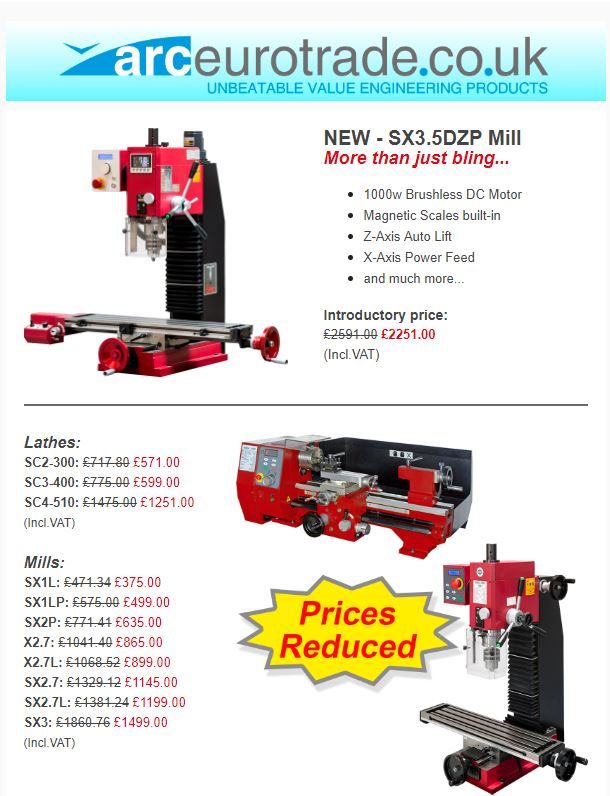
                                        For those who are not on ARC Euro Trade's e-mail list this is the latest list of reductions.

                                        arcbargain.jpg

                                        #374524

                                        In reply to: hi

                                        rich simmons
                                        Participant
                                          @richsimmons63485
                                          Posted by Howard Lewis on 03/10/2018 22:36:55:

                                          Since you seem to have no Change wheels, you could use 20DP gears from a Myford 7 Series (These use keyways, the earlier ML Series used pins – AVOID), or spares from the current oriental machines, although they will be metric (Module) gears, and will certainly need sleeving / boring to suit. Keyways will be either 3mm or 4mm.

                                          If you choose that route, among the UK suppliers would be Warco, Axminster, Chester or ArcEuroTrade. Look at their websites. If you tell them what you are doing, some may be more helpful than others

                                          You have the banjo, but will need to make up Studs to carry the gears on it. It would be useful if you could make up a tumbler reverse, whilst you are about it.

                                          There will be a LOT of satisfaction, once you have it up and running.

                                          Howard

                                          thanks howard

                                          once its properly running ill look into some gears for it

                                          #374488
                                          SillyOldDuffer
                                          Moderator
                                            @sillyoldduffer

                                            Um, not come across Dave M before; I think this is the YouTube advice you mean Tom. (Dave M gets to the mini-lathe towards the end of the video.)

                                            A general concern is that Dave has an immaculate workshop. Nothing wrong with that except it can be a hobby in itself, which isn't for everybody! Personally I'm more impressed by visible signs of work.

                                            Anyway Dave's top 10 mods (with slight confusion in the telling) were:

                                            1. Smooth operation of the compound (Tom's starting point)
                                            2. Vibration
                                            3. Quick-change toolpost
                                            4. 3/8" set of carbide insert tool-holders
                                            5. TCMT for aluminium
                                            6. A work-light
                                            7. Collets
                                            8. Tailstock adjustment (apparently everyone else does it wrong)
                                            9. I heard Spine Drills, I think he means 'use spotting drills rather than centre drills to start a hole'
                                            10. Good boring bars

                                            I'd agree with 1,2 and making sure the tail-stock is aligned, also a well lit workshop is a good thing. The rest of the top 10 are much more dubious, and I wouldn't take them too seriously.

                                            In the case of the compound Dave M mentions a friend pointing out it was loose. This is a bad thing, but fixing it is an adjusment. Thereafter, it may be possible to improve smoothness by polishing the gibs, and some llike to switch to brass gibs. Whether any of it is necessary depends on the lathe. Early Chinese lathes came in for a lot of stick for poor finish; recent ones seem a lot better.

                                            When I a new minilathe owner, I too read on the web that gib polishing would be an improvement. Some said it was essential, others that it was highly worthwhile. So, even though the lathe worked OK I stripped her down, agreed the gibs looked a little rough, and polished them up. As far as I could tell the effort was a complete waste of time – as the lathe was OK before, any improvement was miniscule. Lesson learned: if it ain't bust, don't fix it!

                                            Now my advice to beginners with a new machine is to use it comprehensively for at least a month before jumping to any conclusions. Drill holes, face off, turn, thread and taper. Find out about tool profiles, depth of cut, feed rates and different materials. Gross faults apart, in the early stages disappointing results are as likely to be down to the operator as they are to a maladjusted machine. It's quite easy to confuse yourself and proceed unwisely.

                                            Once you've given yourself and the machine a thorough test drive, it's much easier to diagnose faults with yourself or the machine, ask for advice, and then to fix it.

                                            To answer the indent question, as far as I know fitting the cones into dimples is common practice. You don't want the gibs moving on their own. The ArcEuro method uses the lathe as a template to put the dimples in the right place; it's just an easy way to line them up.

                                            Neil Wyatt of this forum has published a book on the mini-lathe. I feel it's more trustworthy than some YouTube advice, and you can always ask the author a direct question on here.

                                            Dave

                                            #374477
                                            Tom S.
                                            Participant
                                              @toms

                                              Hello all,

                                              Having purchased a mini lathe of Theseus from China, I decided to get started by replacing the original gib strips (top and cross slide). As Arceurotrade had a fairly handy set available for under 20 quid, this leads to my perhaps beginner question (and hopefully not an unholy war on correct adjustment! laugh&nbsp.

                                              The instructions with said kit are fairly straightforward, but suggest that the conical tip screws should be used to form a dimple in the brass by tightening (once the brass strips are in the correct place). This seems a little odd to me, but as I'm a beginner, I thought it'd be worthwhile to get other's opinions.

                                              In particular, watching Dave M's channel on YouTube, he was talking about how the original mini lathe strips don't allow any sideways movement (with the original screws, there's just three drilled holes in the original gib), and to fix this via filing a concave cutout in the opposite side and flipping the gib (or similar methods).

                                              Do we want the gib strip held in a specific location (i.e. via the indenting approach with conical screws), or is this a poor approach?

                                              The kit's gib surfaces that face the dovetails are also rather rough, instead of smooth (machining mark pattern, but easy to feel with a fingernail and causes a dti to vibrate around a few thousandths). Should this be smoothed, or left for oil retention?

                                              And lastly (phew!), I've also read that gibs should be slightly high in the centre (facing the interior of the dovetail) – unfortunately, these strips are low on one end only (by about 1/1000th). I could work on wet/dry on a surface plate to get them flat, unless there's a better reason to get them high in the centre? If so, by how much?

                                              And there's probably going to be many opinions on this one – apologies for the length of post. I'd rather take the right approach before shaving metal bits off!

                                              Many thanks

                                              #374447
                                              TiddlerTad
                                              Participant
                                                @tiddlertad

                                                Hi All

                                                For now I have decided to go with the Sieg 'dixon-like' version supplied by Arc as this doesn't require any modification. It's not a massive investment, so I will give it a try. If other options come onto the market at a later date, I might consider changing. I ordered the toolpost yesterday, together with a Sieg SC4 and other bits and bobs. Delivery scheduled for tomorrow! smiley

                                                I must say that ArcEuroTrade are very good people to deal with, with excellent customer service.

                                                Thanks again for the comments/suggestions. Very much appreciated.

                                                Cheers, Andrew

                                                #374429

                                                In reply to: hi

                                                Howard Lewis
                                                Participant
                                                  @howardlewis46836

                                                  Since you seem to have no Change wheels, you could use 20DP gears from a Myford 7 Series (These use keyways, the earlier ML Series used pins – AVOID), or spares from the current oriental machines, although they will be metric (Module) gears, and will certainly need sleeving / boring to suit. Keyways will be either 3mm or 4mm.

                                                  If you choose that route, among the UK suppliers would be Warco, Axminster, Chester or ArcEuroTrade. Look at their websites. If you tell them what you are doing, some may be more helpful than others

                                                  You have the banjo, but will need to make up Studs to carry the gears on it. It would be useful if you could make up a tumbler reverse, whilst you are about it.

                                                  There will be a LOT of satisfaction, once you have it up and running.

                                                  Howard

                                                  #374428

                                                  In reply to: hi

                                                  Howard Lewis
                                                  Participant
                                                    @howardlewis46836

                                                    Since you seem to have no Change wheels, you could use 20DP gears from a Myford 7 Series (These use keyways, the earlier ML Series used pins – AVOID), or spares from the current oriental machines, although they will be metric (Module) gears, and will certainly need sleeving / boring to suit. Keyways will be either 3mm or 4mm.

                                                    If you choose that route, among the UK suppliers would be Warco, Axminster, Chester or ArcEuroTrade. Look at their websites. If you tell them what you are doing, some may be more helpful than others

                                                    You have the banjo, but will need to make up Studs to carry the gears on it. It would be useful if you could make up a tumbler reverse, whilst you are about it.

                                                    There will be a LOT of satisfaction, once you have it up and running.

                                                    Howard

                                                    #374298
                                                    IanT
                                                    Participant
                                                      @iant

                                                      I don't use ER11 collets Ronan – but it seems to me that you could fit one of these into an R8 16mm collet – would that suit your needs?

                                                      https://www.arceurotrade.co.uk/Catalogue/Collets/ER-Milling-Collet-Chucks-Straight-Shank/ER11-Collet-Chuck-16mm-ShankJT1-Taper

                                                      Regards,

                                                      IanT

                                                      Edited By IanT on 02/10/2018 22:54:23

                                                    Viewing 25 results - 2,376 through 2,400 (of 4,844 total)

                                                    Latest Replies

                                                    Home Forums Search Search Results for 'arc euro'

                                                    Viewing 25 topics - 1 through 25 (of 25 total)
                                                    Viewing 25 topics - 1 through 25 (of 25 total)

                                                    View full reply list.