Search Results for 'Myford 7 CNC conversion'

Search Results for 'Myford 7 CNC conversion'

Home Forums Search Search Results for 'Myford 7 CNC conversion'

Viewing 25 results - 1 through 25 (of 36 total)
  • Author
    Search Results
  • #789323
    Nigel Graham 2
    Participant
      @nigelgraham2

      You worry about the gaps around the doors. Not much sound will escape through those. Lining the garage will be worthwhile but from experience with my single-thickness concrete-block workshop, might be problematical due to condensation and damp.


      My Myford ML7 was noisy on its cabinet until I converted it to 3-phase: the noise was the cabinet resonating with the original single-phase motor. The noisiest part now is the gears and then only if I am using a high spindle speed (for self-acting feeds). I may try using grease rather than oil on the teeth to reduce the noise.

      I gave my Harrison L5 a similar conversion set, and put oil in its geared headstock I found was nearly dry when I acquired it! In moderately low gear, with the motor still running fast as it should do, those two actions make it remarkably quiet for its size even with the self-acting feed on via the change-wheels. It is loud if I run it in high gear – but I rarely do that.

      The cutting itself should be quiet – I tend to use that as something of a guide as well as looking at the finish.

      What is crucial though is what the machine stands on. If properly resting on a solid concrete floor it will be a lot smoother and quieter than if on timber.


      [None of my lathes have electronic lead-screws and the like. The 3ph conversions and a second-hand gearbox on the Myford are their real improvements. Besides, I am not on piece-work, and I lack the need, time, expertise and cash to turn a 1950s BGSC centre-lathe into a 2020s CNC machining-centre for no practical gain!]

      #655572
      Samuel Langley
      Participant
        @samuellangley71728

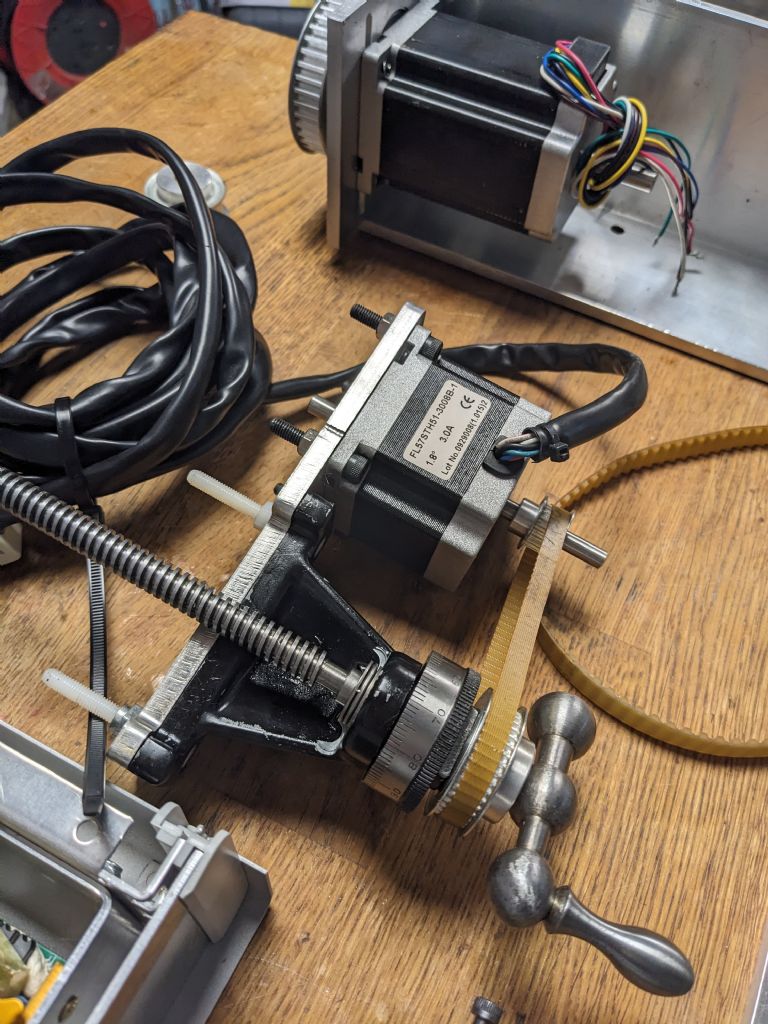
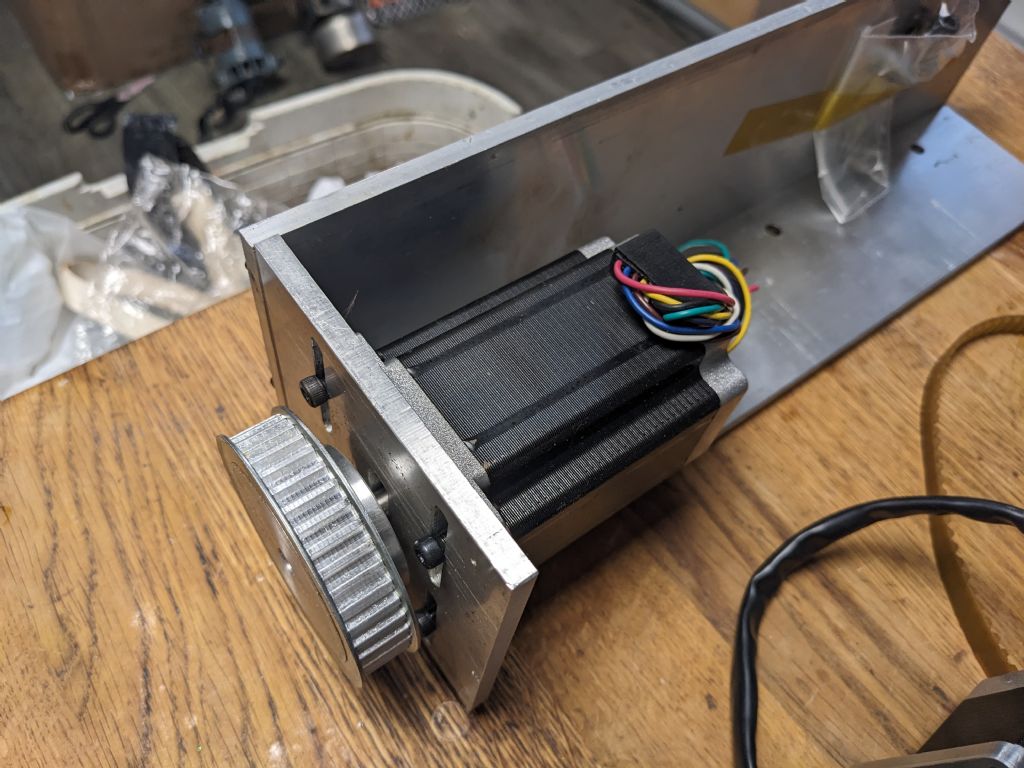
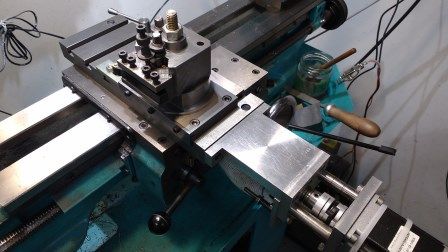
        I've recently acquired a Myford ML7/Super 7 CNC conversion kit from Tony Jeffree's design. From what I can tell, it's partially completed and only needs the actual leadscrew modifications ('part 1&#39 and Mach3 setup, of which the pulleys and belts are there. The cross slide pulley, leadscrew motor box, and controller are complete.
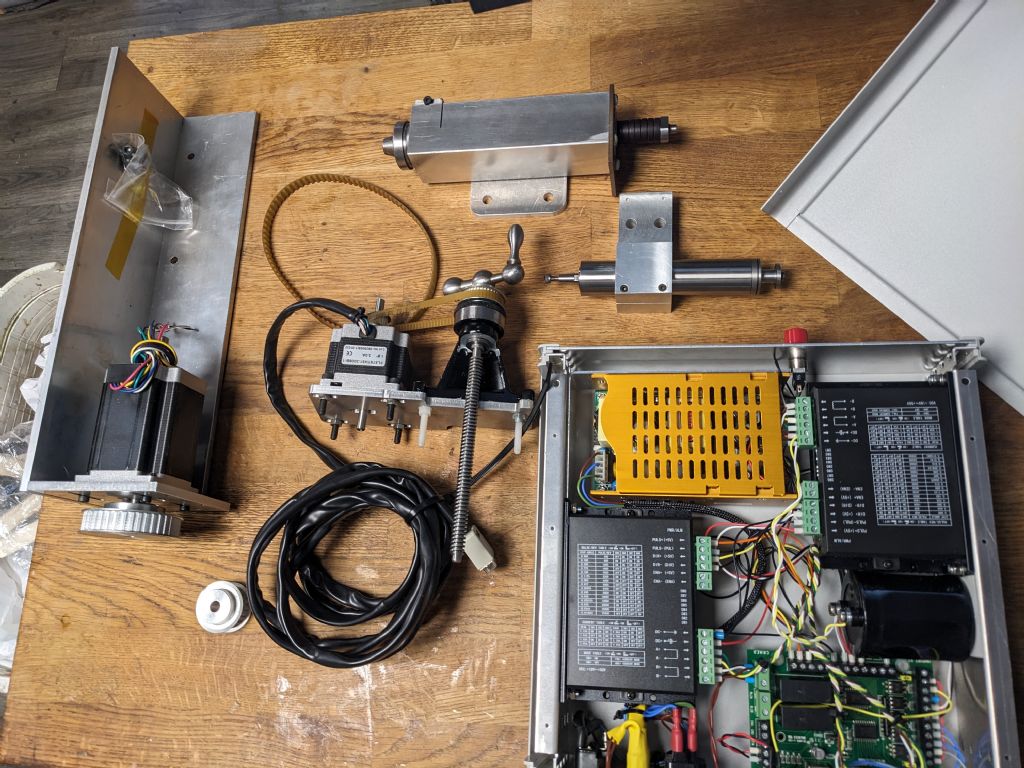
        The CNC control box is from DIYCNC.co.uk and within is their Uniport V2 controller. I couldn't tell you much else about the full controller setup. There are two other parts contained, top right in the pictures, which are internal grinding spindles placed into a housing with bolt fixing locations on the Myford cross slide. My guess is that the original user was going to convert it into a 2 axis milling setup, well capable with this Uniport controller.

        I was wondering if there's still demand for this sort of thing to be sold on as currently I've not got any interest in converting my ML7.

        http://www.jeffree.co.uk/pages/ml7-cnc/part-1-files/myfordcncpt1.htm
        http://www.jeffree.co.uk/pages/ml7-cnc/part-2-files/myfordcncpt2.htm
        http://www.jeffree.co.uk/pages/ml7-cnc/part-3-files/myfordcncpt3.htm
        http://www.jeffree.co.uk/pages/ml7-cnc/part-4-files/myfordcncpt4.htm

        pxl_20230807_193606519.jpgpxl_20230807_193619070.jpgpxl_20230807_193622887.jpg

        #642958
        Jelly
        Participant
          @jelly

          Forked from the "Worth It" thread.

          Posted by Robert Atkinson 2 on 28/04/2023 15:57:42:

          Jelly said:

          "… For me there's a real gap in the market for Myford to undertake some meaningful product development to offer a lathe the size and quality of the Super-7, but refreshed with the features of the 254, and geared to offer speeds appropriate to modern tooling on the size of parts you'd expect to use a 3.5" centre height lathe for; that would actually differentiate them from the competition from abroad. "

          I could not agree more. They have the name to charge a premium price. It would be so good if they re-engineered it keeping the style but integrating (not scabbing adding on) a 3 phase motor and VFD, deleting the clutch (not needed with VFD), camloc chuck (with adaptor for the old threaded kit), primatic bed etc. Options could be DRO (again properly engineered into the design), ELS (instead of gearbox) and powered cross-slide (possibly leading to CNC).
          I recon they would make money on a bit of investment and possibly set the standard for the next generation of small lathes.

          Robert.

          It's funny you should say that…

          I currently have a stack of lathe beds in the workshop which were originally destined to become the ways for my Horizontal Boring Mill project… Having now filled both the space and niche it would have occupied with a very large turret mill, I've been mulling over what to do with them.

          Attempting to develop something that fills the niche described would be an interesting project on a par with the HBM, although I doubt I'd be in a position to commercialise it past the stock of beds I have.

          I broadly agree with your list of requirements, but if I put a manufacturing hat on it potentially makes more sense for some of the options to be default features.

          I suspect that for serial or volume production offering an ELS would actually be far cheaper than a proper screw-cutting gearbox these days, similarly electronically powered cross-feed is going to be cheaper than the machining time for feed-shafts and gearbox.

          That would then allow the DRO to operate from the encoders on the servos (an idea I'm not mad about, but would save a lot of cost, separate linear encoders would be an easy add-on though) and enable an almost "plug-and-play" conversion to CNC with a dedicated kit of ball-screws and controller.

          It also occurs to me that in a CNC scenario the quintessential Myford accessory, the vertical slide, would actually take on a whole new dimension in that sort of scenario, equipped with a servo-drive one need only add a 40mm standard powered spindle mount, it turns the lathe into a tiny Mill-Turn​.

          The requirement I have in my head as most challenging would be to engineer a headstock which could truly provide a range of speeds allowing hobbyists to take full advantage of modern tooling, which would probably require a max speed of 10,000-15,000 rpm (assuming it's optimised for a minimum workpiece in the region of 1/4" to 10mm, and non-ferrous materials).

          Assuming that for drilling, out-of-balance turning and the like, a more normal range of speeds would also be desired, that probably requires either a specially specified Inverter-Duty Motor suitable for very high frequencies, or a permanently tensioned flat-belt system, the former being perfectly reasonable for volume production, but rather pricy for the first prototypes, and the latter adding the kind of complexity more associated with Schaublin, Monarch, Holbrook, and Hardinge than with a Myford.

          15,000 RPM also requires a lot more of the bearings, although if you're completely eliminating belt-changes there's more leaway to provide for that, it also pretty much demands a collet-chuck as a default option, and possibly an interlock to prevent using a 3/4 Jaw at full speed (it's scary enough swinging a 10" steel-body 4-jaw at 3,200 rpm, let alone a 6" one at 15,000!).

          Any opinions on the future development trajectory of the small lathe welcome.

          #639561

          In reply to: New member

          Simon Marks
          Participant
            @simonmarks43050

            Hello to you all.

            I am a semi-retired electrical/electronics engineer with a secret passion for oily fingers.

            I have a small (16' by 8&#39 workshop at the bottom of my garden where I run an old Myford ML7 and Warco WM18B along with various other bits and pieces.

            Currently I am installing servo motors to the mill to provide power feeds but with an eye on full CNC capability sometime in the future. Once this part is complete I plan to turn my attention to updating the lathe.

            I would love to get a gear head machine but the size and weight would make this a mammoth task as access is severely limited. Short of getting a crane to swing it over my house I will have to settle for something more manageable hence I have been looking at the Warco WM290V which seems to be quite popular on here. I was wondering if anyone owning this machine had done an electronic lead screw conversion such as the one developed by James Clough.

            My reasons for this are that, other than routine maintenance, it would limit the necessity to access the change gear end of the machine so I could position it tighter to a wall. Longer stock would be dealt with by a strategically positioned hole.

            I would love to hear from anyone who runs this machine and anyone who has done a leadscrew conversion.

            regards

            Simon

            Jelly
            Participant
              @jelly
              Posted by John P on 12/09/2022 19:21:05:

              Seeing the Harrison that is described in "lathes UK" the vertical heads
              don't seem have a specification that would be of much use these days.

              It would be a simple job to make a bolt on head similar to
              this seen here that i made for my Dore Westbury cnc conversion.
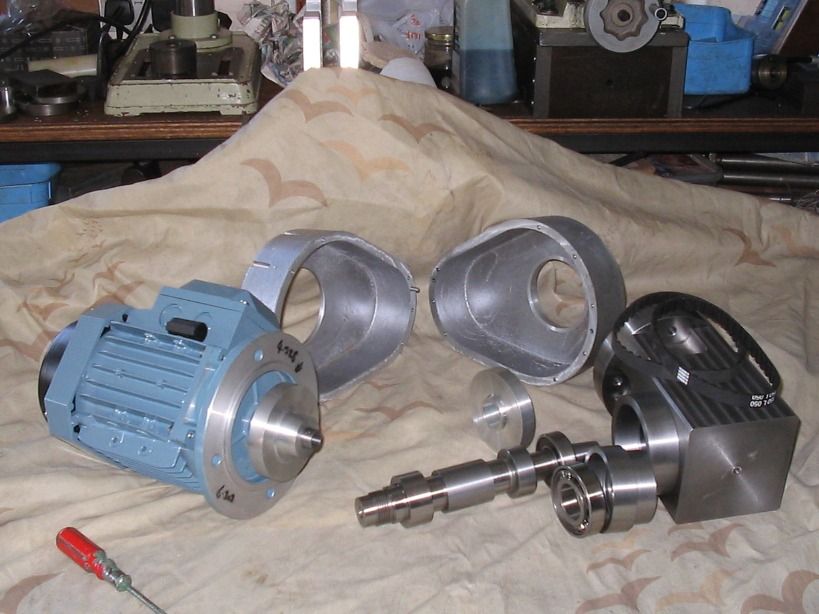
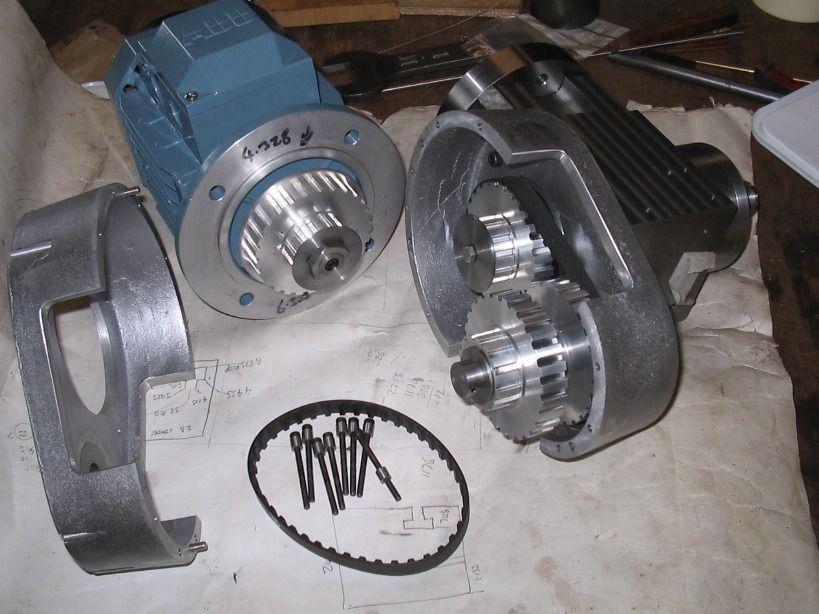
              Entirely fabricated from steel and cast iron and 2 simple castings,the 4 main
              parts are the mounting plate in steel bolted on to the the main body of
              cast iron , the quill assembly is eventually loctited into the main body
              The 3 bearing spindle has the taper for the er collet bored in directly
              and uses a Myford 7 nose thread so all Myford accessories fit.
              The aluminium castings made from 1 pattern hold the motor on top
              and through 8 toothed belt pulleys and the inverter the head has a speed
              range from 100 rpm to 10,000 rpm . I don't have any drawings, something like this
              you can draw up on the back of an envelope ,i did ,its just a matter of working
              out what you need.

              I agree that the Harrison's 1:1 ratio and 22-1000 or 63-1500 speed range isn't particularly well suited to vertical milling with modern cutters, when a 10mm carbide endmill will happily run at 4000 rpm in EN1/EN3 and 2000rpm in 709M40T, which is a big part of why building rather than buying makes sense…

              "Why pay over the odds for an attachment which would ultimately be unsuitable for a good proportion of my existing tooling anyway?"

              The assembly you're showing for the spindle of your vertical head mirrors the way I planned to assemble the spindle if I make one myself.

              However as with my comments to Clive there's a consideration as to how hard translating horizontal to vertical rotation would be and how that compares to the inconvenience of storing/lifting a much heavier assembly with a motor mounted on it; the approach you've taken is definitely simpler to execute from a manufacturing perspective than having mitre gears and a power-take off from the main spindle.

              John P
              Participant
                @johnp77052

                Seeing the Harrison that is described in "lathes UK" the vertical heads
                don't seem have a specification that would be of much use these days.

                It would be a simple job to make a bolt on head similar to
                this seen here that i made for my Dore Westbury cnc conversion.
                Entirely fabricated from steel and cast iron and 2 simple castings,the 4 main
                parts are the mounting plate in steel bolted on to the the main body of
                cast iron , the quill assembly is eventually loctited into the main body
                The 3 bearing spindle has the taper for the er collet bored in directly
                and uses a Myford 7 nose thread so all Myford accessories fit.
                The aluminium castings made from 1 pattern hold the motor on top
                and through 8 toothed belt pulleys and the inverter the head has a speed
                range from 100 rpm to 10,000 rpm . I don't have any drawings, something like this
                you can draw up on the back of an envelope ,i did ,its just a matter of working
                out what you need.

                There may be a more recent published design for a bolt on vertical milling head in
                MEW but i cant find it ,there was one published in MEW 34 for a Tom senior
                that used parts of a Dore Westbury milling machine .

                Johndore west 5.jpg

                dore west 6.jpg

                #613110

                In reply to: French model Engineers

                Rolster
                Participant
                  @rolster

                  Hi Simon yep not to far away so would be good to do a meet up.

                  My sausage fingers and eyesight are just not good enough for clocks, but have a great respect for those that have the accuracy and patience to make them.

                  I have never managed to do any proper CNC work myself, I just have an old school manual Myford super 7 and a manual Warco milling machine as my main machine tools, but I have allot of tooling and hand tools and quite enjoy the challenge of conversion from drawing to surface plate to machine. Not to say I don’t get envious watching the CNC machines cut out drill and tap in thirty minutes what it would take me a week to do.

                  I am trying to sort out my workshop and get my tooling out of their crates, but hope to complete that in the next two weeks.

                  BR Roland

                  #584150
                  Hopper
                  Participant
                    @hopper
                    Posted by Martin Connelly on 06/02/2022 08:32:03:

                    For short lengths of thread keeping the half nuts closed is not too bad. For a long length of thread you can release the half nuts and move the carriage back in multiples of 5" (127mm) to pick up the correct position on the leadscrew. Your thread dial indicator engagement point will be different for each successive pass. There is a risk of getting the distance wrong if you do not have a good method of ensuring you move the correct distance. Best if the leadscrew is stopped before the half nuts are disengaged otherwise you have to reverse just enough to go back to the thread dial mark that was being used then make the 5" move. A DRO will help as you can set the zero point before moving back. These issues are why, for people who regularly do both metric and TPI threads, the electronic lead screw (ELS) projects are so popular or even going the small extra step of making the lathe CNC at which point thread dial indicators and gear changing for different threads no longer takes place.

                    Martin C

                    Now that's a new one one me, but seems blindingly obvious when you think about it, the 127 tooth conversion gear and all. Although, I can't quite visualise exactly why. I shall have to give it a try.

                    In the absence of a DRO, could one use the imperial thread indicator dial to measure carriage movement in inches? On the Myford with its 8TPI leadscrew, and its 16 tooth gear on the TDI, one full turn of the thread dial equals 2 inches of carriage movement when cranking the carriage traverse handle and the leadscrew is stationary. So 5 inches would be two and a half turns of the dial.

                    Personally I liked screwcutting on the old DSG toolroom lathes. They had a combined clutch and brake lever on the carriage so you could screwcut up to a shoulder at 400rpm. Just start slipping the clutch and slow down as the tool approaches the shoulder. Then slam the brake on just as the tool is about to crash into the shoulder. Retract the tool and reverse flat out at 400rpm back to the start and reset tool depth and repeat process. Not for the feint hearted but no apprentice was going to admit to that.

                    #538118
                    John P
                    Participant
                      @johnp77052

                      Hi Chris

                      Looked at the linked site seems to be a complete package to do what you wish.
                      I suppose the real problems is fitting it to the Warco WM 280 lathe ,the Emco
                      from the 2nd poster Hubertus Fischer is much the
                      same as a changwheel Myford 7 lathe where direct access to the leadscrew is
                      possible ,with the Warco the leadscrew is connected though the gearbox.
                      I fitted a cnc system to my GH 1000 warco lathe and faced similar problems
                      it was featured as an article in MEW 207 to 212 i got around the leadscrew/gearbox
                      by fitting a removable second leadscrew ,the whole conversion only needed the
                      fitting of about 5 additional screw holes and still retained the full manual machine
                      operation.
                      There was some criticism about the article in this thread

                      https://www.model-engineer.co.uk/forums/postings.asp?th=88623

                      mostly by people who had not bothered to read the article properly ,one even
                      claimed that i had some complicated , " the gears, helical planetary ones" ,
                      of which there were none.

                      It would be worth looking at the mechanical connections needed before
                      committing yourself to proceeding with this type of conversion.

                      John

                      #537521
                      John Haine
                      Participant
                        @johnhaine32865

                        I started thinking about an ELS system for my lathe and looked at the online project that was going on. After a bit I realised that if you were going to go to all that trouble just to cut a thread you might as well add full CNC, so after a small amount of cogitation (and inspired by Tony Jeffree's articles on his ML7 conversion) I converted my S7, using Mach 3 to drive it. This was back in 2010.

                        Once I'd discovered how easy it was I realised it would be much easier to avoid twiddling handles on the mill and thought about adding CNC to my VMB, but I didn't fancy doing major violence to it to add ballscrews, plus would need a mill anyway to do the work! I flirted with the idea of converting an X1 and actually bought one, but realised after a short while that it needed a lot of work just to make it an adequate mill (like machining the mating face for the column flat!) let alone converting it, so I sold it on.

                        I was keeping an eye on eBay and scored a Denford Novamill mechanics for a modest sum without the electronics. But who wanted an old DOS PC anyway? Since I'd already built the drive box for my lathe I did the same for the mill.

                        At some point I converted a Myford dividing head with a stepper to use as a 4th axis and built a "Ward" controller as well, and actually I've not yet used it as a 4th axis only straight dividing.

                        For software I use Mach 3 which was the obvious choice in 2010. I got a reconditioned Dell desktop to run it using the parallel port. I suspect the time is coming to change from M3 to something else before the PC disc drive crashes on me. At the time I didn't fancy the Linux learning curve as well. I have some special purpose macros I've written for Mach3 and it's harder to do these things in LinuxCNC I think, and the choice of motion control boards seems more limited – so not sure where to go next.

                        I don't yet use CAD/CAM but ought to learn. The Mach 3 wizards are very useful and do loads of common tasks for both turn and mill. I use a free CAM program called G-Simple which is good for shapes beyond the wizards (but no longer supported and hard to find a copy). F-Engrave is great for nameplates – have a look at my album called Nameplates. Also it's free. I also make G code for specialist things like cams, ratchets, and pallets, and wheel crossing-out. That's done in Excel (or could use Open Office Sheet). I've got some special purpose stuff like a program for thread milling that someone kindly supplied.

                        When you get into CNC technology you can use it for other things. When I wanted an X power feed for my VMB I used a stepper controlled by GRBL on an Arduino, just because it was easy – my phone provides the user interface. The controller will support 3 axes, so currently I'm building a CNC coil winder that will use the same box with an extra axis enabled. I will be able to use the same box to also drive the dividing head on the VMB so I'm thinking about whether I can do some helical gear cutting…

                        You might gather from this that I find the CNC technology as interesting as what I make, and you wouldn't be wrong…

                        #439352
                        Zan
                        Participant
                          @zan


                          I will be mounting the motor at the tailstock end Drawings available from Jeffrey.co.uk. Just select the below n google it ……Im not sure doing the modification to the leadscrew bracket or putting the thrust bearings in will be really required as I intend to leave the gearbox in position. At some time in the distant future, the electronics may fail and all the units will be obsolete. I may buy a second processor and led&key board and program both when the whole system is up and running

                          Myford ML-7 lathe CNC conversion – Part 1: Leadscrew


                          david, any rotary encoder will only be fitted to a servo motor, otherwise the clough42 system is open loop if a stepper is used.  The encoder in the system is for synchronising the leadscrew and spindle, it’s mounted at the headstock

                          i am also considering adding a separate arduino system to stop the saddle ar two exact points, at the start an end of its movement and linked to the encoder z to give spindle sync.  This will be similar in principal to the meek and cleve leadscrew dog clutch system


                          Edited By Zan on 29/11/2019 09:48:19

                          Edited By Zan on 29/11/2019 10:02:54

                          #420219
                          Gray62
                          Participant
                            @gray62

                            Chester Cobra combi machine

                            Chester Model B – regretted from day 1

                            Myford ML7, never used bought, refurbished and sold to fund other projects

                            Warco WMT300/2 (the one without the mill head, good machine and often regretted selling on

                            Warco GH1330, 15 years old and still giving good service

                            Warco WM250V – 4 years old and still waiting for its CNC or ELS conversion (not decided which yet)

                            #378340
                            John Haine
                            Participant
                              @johnhaine32865

                              As the owner of a late model S7 bought with PXF and converted to CNC, a few thoughts that may be helpful.

                              1. PXF is invaluable both for facing and parting. GHT recommended using PXF for parting and apparently used to give demos at MEX. My experience using a modern parting tool is that generally I can part at 200 rpm and slow feed with much less drama because the tool is working in its preferred regime, rather than the work going too slow in backgear and the nervous operator applying jerky feed.
                              2. I believe that converting to PXF is a bit more involved than you might think. First you need the keyed XF screw. This is larger diameter than standard. It may be that the old cross slide won't accommodate it – I base this comment on the fact that "CNCyourmyford" has to use an expensive 8mm ballscrew to fit the hole in the ML7 slide whereas I have been able to use a 12mm screw on my conversion. Also the OD of the feednut is larger and it's made of hard steel too. So it may be necessary to fit a new cross slide or at least drill out the hole.
                              3. Then you need the mechanism in the apron to pick up the feed from the key in the leadscrew and apply it to the keyed gear that drives the XF feedscrew – I think this will be a new apron or some complicated machining.
                              4. So if one wants to convert it seems to me it makes much more sense to use a DC or stepper motor to drive the feedscrew. In any case doing it mechanically is only a century or so out of date. A DC motor is probably preferred unless you have thoughts of converting to CNC or ELS later, since it's easier to preserve a manual drive as well. I'm sure there have been suitable designs in the mags.
                              John Haine
                              Participant
                                @johnhaine32865

                                By top and bottom slides I suppose you mean the cross and top (or compound) slide? For CNC you have no need of a topslide any more. You can then make a properly rigid tool post that fits the cross slide. This makes it possible to used indexed tool holders and properly apply tool offsets.

                                toolpost2.jpg

                                The cross slide screw is best replaced with a ballscrew, it is very hard to get rid of backlash with a normal nut, and backlash on the X slide is a real pain – for example when cutting tapers. Depending which S7 you have you may need to find a small diameter ballscrew for the X slide to fit the available hole – my conversion was of a power X feed 9pxf) machine that uses a larger feedscrew so I was able to use a 12mm screw supported only at the outboard end. It isn't essential to have a ballscrew on the main Z feed ("leadscrew&quot and I haven't fitted one (it's on the to-do-one-day list). If you do use standard nut, the Myford non-pxf nuts are made of mazak alloy as standard and you'd need to make or have made a bronze one – even then you'd be lucky to get a low enough level of backlash. My ballscrew gives about 0.02 mm IIRC. The Myford pxf nuts are hardened steel, but even with those the as-new backlash is ~0.2 mm.

                                Why are you fitting a servo to the spindle? Normal practice is to have a spindle sensor, either 1 per rev for Mach 3 or a multi-slot sensor for better systems such as LinuxCNC, but to use a standard drive system. As long as the controller knows where the spindle is it can control the tool position to suit at least for screw cutting. If you are thinking of using this for dividing, I think you're better off having a separate digital division head. Most readily available CNC controllers expect a standard drive spindle, not a servo positioned one.

                                These days it is recommended to have a separate motion controller between the controlling PC and the servos/steppers (by the way please note that you DON'T use an apostrophe when an "s" is indicating a plural). This interfaces to the PC using USB or Ethernet, and actually generates the real-time control signals – I can't recall exactly but I assume that's what cncyourmyford does. With this approach you can use a laptop because all the real-time stuff happens in the controller.

                                Hope this helps – I first converted my S7 nearly 10 years ago and have made a number of improvements since and it works very well.

                                #372647
                                Neil Wyatt
                                Moderator
                                  @neilwyatt
                                  Posted by Mike Donnerstag 1 on 21/09/2018 17:47:31:

                                  I have been offered a Myford Super 7 with a 'big bore conversion', from a chap who modifies Super 7s to give a 32mm spindle bore. Also, instead of a morse taper, the new spindle has an ER40 collet taper.

                                  I have several concerns which I invite your comments on:

                                  1) The headstock has some modifications to accept the new spindle, including a change from the original plain bronze bearing to tapered roller bearings. The Amateur Lathe book suggests that roller/ball bearings generally lead to chatter at the tool. What do people think?

                                  2) Do you think the boring of the spindle may leave it with walls that are too thin?

                                  3) Are there any significant disadvantages to having a spindle without a morse taper?

                                  4) Do you think that having a non-standard spindle leaves me open to spindle problems, since a replacement would not be able to be sourced and would need to be re-made, probably at a high cost?

                                  Many thanks,

                                  Mike

                                  The taper=chatter is a myth from the early days when taper rollers were in their infancy and many lathe users didn't have a clue how to adjust them. Probably every CNC manufacturing lathe on the planet uses taper rollers and how many turned items do you see with chatter marks?

                                  British Timken wrote a three-page letter to Model Engineer debunking LBSC's complaints about taper rollers in the 1940s.

                                  As for wall thickness, what is it? It would depend on the bearings used as well as the bore. Nils gives you a good idea how to judge.

                                  Significant advantages to having an ER taper, how much MT tooling do you want to use in the headstock? You can always make up a dead centre to be held in a collet.

                                  Spindle is unlikely to wear out and they are not difficult things for a decent machine shop (or anyone with a decent lathe) to make – you can finish turn the nose register and ER taper in situ.

                                  My feeling is why not bring a 70-year old design up to date and give a good lathe a new lease of life?

                                  Neil

                                  #348836
                                  John Haine
                                  Participant
                                    @johnhaine32865
                                    Posted by jimmy b on 01/04/2018 10:24:00:

                                    I finally, after 6 years, got to grips with the DRO on Crusader!

                                    I've only ever used it on one tool at a time, because when you power off and move things, the position is lost. I can now just use tool 1 and set the size, the tool library then updates.

                                    I even made a setting tool, its just a bit of sleeve with bearings inside. I can just touch the O/D or bore, when the sleeve stops rotating. The size is then just inputted. I may have to buy some more tool holders to take advantage of this!! Its got a 200 tool library after all!

                                    Jimmy, that's nice. I'm having adventures with tool offsets at the moment too, though on my CNC conversion. Same reason as you, so I can work with multiple tools to get known diameter without having to individually adjust them. My setting aid is different though. How do you deal with run-out of the OD of your sleeve? Does the DRO also work with Z offsets as well as X?

                                    I also learned the perils of top slide and tool post movement! My top slide gib screws are now locked solid, and I've installed a dowel between the Dixon tool post and the top slide. I have a big lump of cast iron arriving too to make a base for the Dixon and eliminate the rather unsatisfactory mounting of the Myford S7 topslide, which can also shift under heavy cuts.

                                    #279859

                                    In reply to: Super 7 Leadscrew

                                    John Haine
                                    Participant
                                      @johnhaine32865

                                      When I had a problem with the saddle alignment on my new S7, Mr. Townsend of Myford described the process that Robbo mentioned above, with the addition that to do this you should move the saddle to the extreme RH end of the bed.

                                      The leadscrew brackets are simply bolted to the bed with capscrews, but there's also a couple of alignment dowels that need to be removed. To get these out you need a long 4 BA (I think) bolt with a small weight made from a scrap of steel bar with a clearance hole drilled through. You thread this on the bolt, screw the sharp end into the threaded hole in a dowel, and slide the weight sharpish against the bolt head a few times. Then you need to remove the handle, make sure the halfnut is open, and pull the leadscrew out through the hole in the LH belt cover. As I recall it was easy to remove – I did this to mill a flat on the RH end to fit a timing pulley when I did my CNC conversion.

                                      Shimming the brackets shouldn't cause a problem with the change gear as it's the leadscrew that sets the position and there's lots of adjustment in the banjos to take up any slack.  (Later edit – at least small shims!)

                                      Edited By John Haine on 24/01/2017 11:24:25

                                      #276725
                                      John Haine
                                      Participant
                                        @johnhaine32865

                                        Just as a benchmark my Super 7 conversion uses a pair of NEMA 23 steppers. I'll have to check the torque spec, but they were the larger size that ARC supplied a few years back, with 1/4" shafts. It uses the standard 8 TPI leadscrew driven through a 2:1 reduction by toothed belt. I started using a standard screw on the cross-slide with 2:1 reduction but replaced that with a 12mm dia / 5mm pitch ballscrew with direct drive as I was getting small cyclical feed errors from slight eccentricity in the pulleys. I've never had any problems of not having enough torque on either axis.

                                        I assume that you want to motorise the headstock to use it as an A-axis with a rotary tool in the saddle? You may want to have a higher reduction to get a force on the workpiece equivalent to that exerted by the Z and Z axis drives – it needs some calcs.

                                        If you fit a ballscrew for the Z axis you'll want to keep the swarf off it. Dyson vac hoses are reputed to be good for this – as used by cncyourmyford.com.

                                        I'd shop around for the lathe – similar machines are sold by various suppliers but in different levels of finish. I suggest visiting an exhibition and looking at least at Warco and Chester. When I've looked at Clarke machines in Machine Mart, frankly I've not been very impressed.

                                        A final thought, given it sounds like you have a gantry router, and presumably an A axis already, have you considered getting a proper CNC mill rather than a lathe? I picked up a Denford Novamill chassis, without electronics, on eBay for ~£600 and fitted modern stepper drivers, and I'm delighted with the machine. If you look at the Denford forum, there is an A axis someone has made for it – one day I'm going to use up the spare stepper drive I built into my electroncs and fit my stepper-controlled dividing head.

                                        #259154
                                        Jelly
                                        Participant
                                          @jelly

                                          You’re entirely correct, an existing hydraulic grinder would be a lot easier to start from and I had an opportunity to get a Norton grinder, which simply needed the hydraulic cylinder reconditioned, and some new piping…

                                          The issue that stopped me is twofold, this ision loan in a communal workshop by agreement with the other users, so to take it back to a mill and bring in a purpose built for see would need quite a lot of non-engineering effort to build consensus (and I don’t quite have it in me to do all that right now). Secondly we’re tight on both space and floor load (with a Bridgeport Mill, Myford Super 7, Warco Engine Lathe, jig borer, Another small lather, Denford Novaturn, CNC mill, donkey saw, Vertical and horizontal bandsaws, plus three welders and a Layout table, all on a concrete slab support ed by RSJ’s over a basement we’re really wary of additional floor loading), so the aim is to make the Pallas conversion both smaller and lighter than a conventional grinder would be,accepting that it involves possibly sacrificing some accuracy when using the full 18″ of the chuck.

                                          #226323
                                          John P
                                          Participant
                                            @johnp77052


                                            Hi Murray

                                            I thought it best to start a new thread to show some
                                            photo's of the Dore Westbury mill as a cnc machine.
                                            Some of these photo's have been seen in a short
                                            Mew article in 2011 (MEW 179).

                                            Hopefully some others may wish also to post some
                                            small cnc machine conversions as i am sure these will
                                            be of interest to many.

                                            Photo's in album "Dore westbury cnc".

                                            Photo 1. a general view of the machine ,the lower part
                                            is still the Dore Westbury the Y axis slideway has been
                                            reinforced and has a little extra travel now.The main
                                            modifications are the head and column. The column is
                                            made from 5 inch square tube welded to a large steel
                                            block for the base, a cast iron slideway is bolted to the
                                            column.A counterbalance weight fits inside the column
                                            to hold the weight of the head assembly.
                                            The machine uses Compucut one of the earliest
                                            hobby cnc systems, as a unipolar system does not
                                            have the speed of more modern cnc systems .The
                                            machine uses pumped neat cutting oil ,side and front
                                            screens contain any oil spray,as can be seen a deep
                                            oil tray covers the full movement of both axis.

                                            Photo 2. A view of the rotary table ,the machine and
                                            rotary table has a Myford nose along with many other
                                            machine parts that i have. Chucks are fixed to the table
                                            with a faceplate, to prevent unscrewing
                                            the split collar clamps the faceplate to the table spindle .
                                            The rotary table is a fabricated unit made from a steel
                                            block,it uses preloaded bearings on the output shaft
                                            and the worm and is sealed and filled with oil.As far as
                                            i can remember it is a 72 tooth gear inside driven by
                                            a toothed belt brings the total ratio to 90 to 1.

                                            Photo's 3 and 4 some of the castings that i made for
                                            the conversion,in 3 the stepper motor mountings and
                                            bearing housings ,three of these made one can be
                                            seen on the end of the table, the Y axis motor is at the
                                            back of the column out of the way and the Z at the top
                                            of the column.The machine has been operational for
                                            11 years now the conversion of the machine started 5
                                            years before that some problems with the castings
                                            (failures) meant some delays during the build as i do the
                                            casting outside winter is not a good time for this.
                                            The castings for the head the pattern here in photo 4 i
                                            had similar problems with but eventually ended up with
                                            a pair of good castings.

                                            Photo 5. Some of the head parts the two castings
                                            ,the spindle is supported in 3 bearings 2 angular
                                            contacts at the nose and 1 plain ballrace at the top.
                                            An ER 16 collet fixing is direct in the spindle and
                                            fixes the maximum shank size at 10 mm.

                                            Photo 6. The head part at a more complete stage ,the
                                            motor is 1450 rpm 550 watt 3 phase driven from an
                                            inverter in conjunction with the belt drive which gives
                                            3 ratios the speed range is from 100 rpm to 10,000 rpm.

                                            Photo 7. Another view of the rotary table ,this underside
                                            view gives a clue on how it is constructed ,it is probably a
                                            little over engineered but is very solid.The part rotary
                                            table on the right is for another project.

                                            Photo 8. When a machine is converted in this way you
                                            have to accept the loss of a machine as a result ,something
                                            that many do not consider when doing this .
                                            Something that you learn along the way all of the other
                                            cnc conversions i have done have left machines as part
                                            cnc and manual usage .

                                            I eventually resurrected My Dore Westbury,
                                            well part of it with this Axminster table and a few parts
                                            and has been a very useful little machine over the years.

                                            Some brief specification of my Cnc Dore westbury
                                            X traverse 9.900 inches
                                            y traverse 7.400 inches
                                            Spindle nose to table max 18 inches min 1 .000 inch
                                            Throat 7 inches
                                            Resolution 0.0005 inch.
                                            4th axis rotary table 18000 steps per rev.

                                            Hope that you find the photo's of interest.

                                            John


                                            Edited By John Pace on 21/02/2016 14:34:16

                                            John Haine
                                            Participant
                                              @johnhaine32865

                                              I am fairly certain that Myford Ltd. supply metric feedscrews and nuts as well as new dials, and fitting is a doddle. Look at http://www.myford.co.uk/acatalog/Myford_Super_7_Carriage_Assembly.html to see part numbers and also on the site there is a history page that may help to check exactly what parts you need for your model. Or give them a ring. They are quite pricey, so an alternative would be to make your own as trapezoidal feed screw stock and nuts are available e.g. from Zapp Automation or Marchant Dyce. I've made a total of 3 cross slide feedscrews in my cnc conversion, the last one being a ballscrew. (I don't bother with a topslide except for tool setting.)

                                              Alternatively you could keep the imperial screws and fit a cheap DRO system based on capacitive scales, for example from Allandale Electronics.

                                              As for the main leadscrew, as someone said even on the metric version this stayed at 8 tpi which confused me at first. If you have a metric gearbox it won't be an issue for you, but anyway most fixing threads can be cut to an acceptable approximation using the standard imperial gears. I've kept the leadscrew for the moment but I don't care as the computer sorts out the conversion!

                                              #176372
                                              Viv Watts
                                              Participant
                                                @vivwatts

                                                Thought this may be of interest to other members who might have a Myford VMB milling machine and how I converted it to CNC.

                                                The machine has developed over time. Here is its current state of play…

                                                The Blue bits are mostly the added items

                                                20150117_184805.jpg

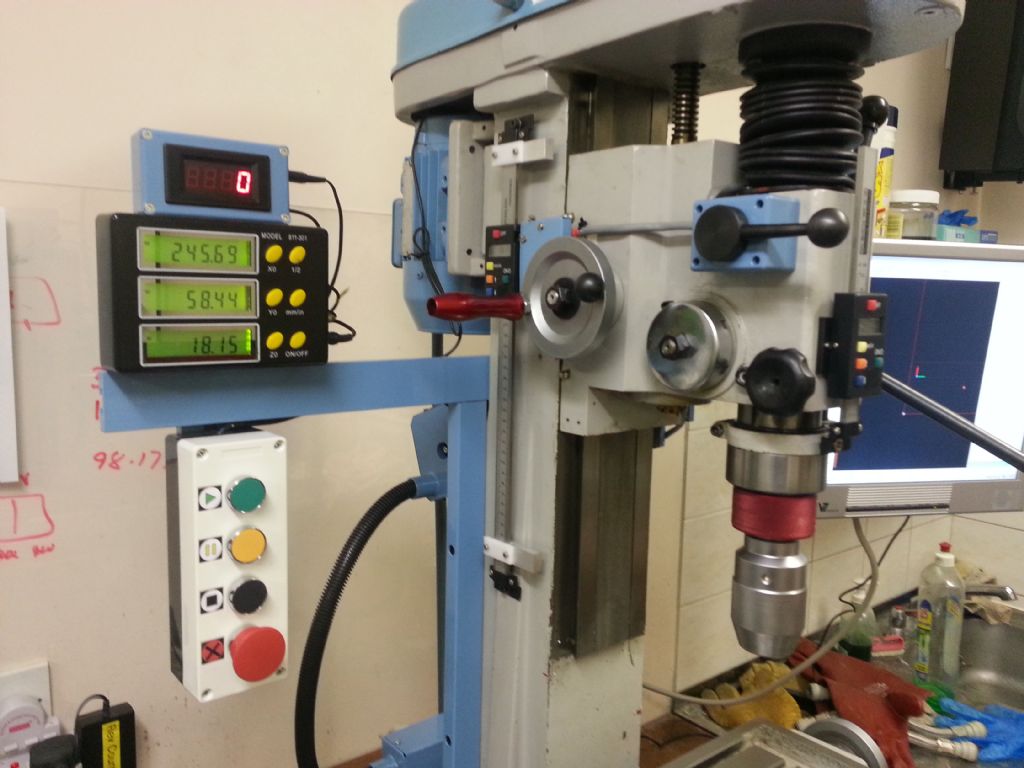
                                                It has digital readouts for X Y and Z1 and Z2. This was the original task. They are all of the chinese scale variety. The X, Z1 and Z2 being commercial designed for the job scales. The Y axis was a modified LIDL scale which works fine.

                                                The next task was to monitor spindle speed. The Myford variable speed control was fine but looking up the conversion chart was tedious. A chinese digital frequency readout (£8) was purchased and with little modification could display RPM. A segemented disc on the top main drive pulley provided the pulses.

                                                The next task was to power the Z axis as the gear ratio o nthe hand whell was very high. I actually used a motor for a bread maker which worked fine but was later replace by a stepper drive for CNC (see later).

                                                20150117_184814.jpg

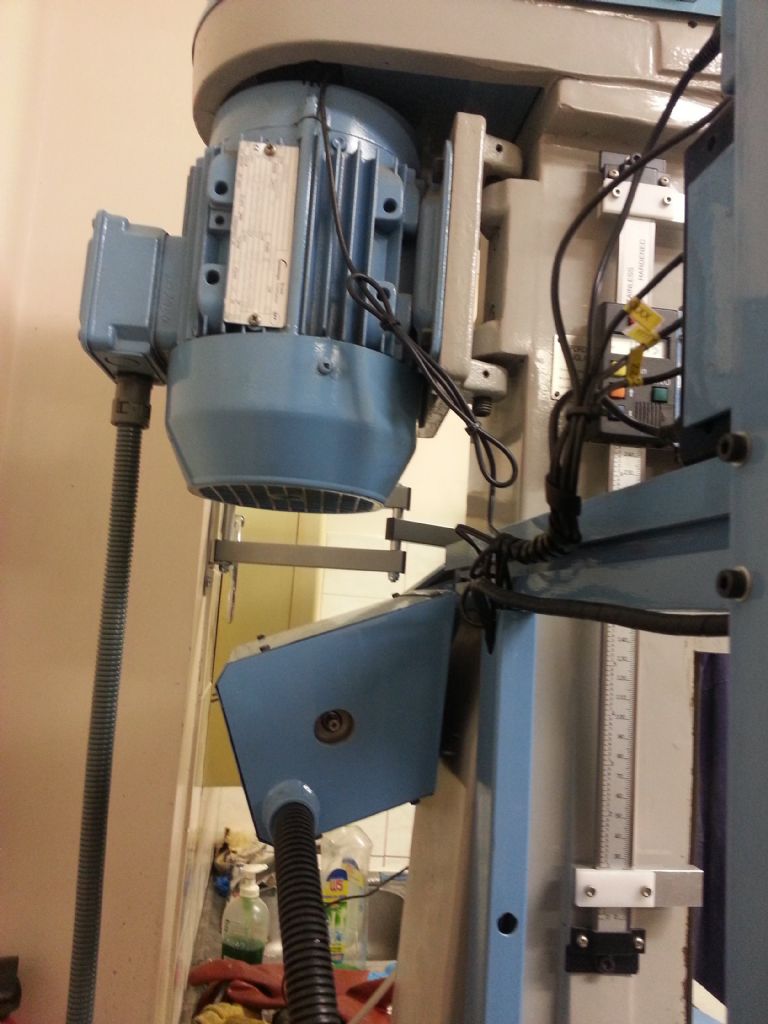
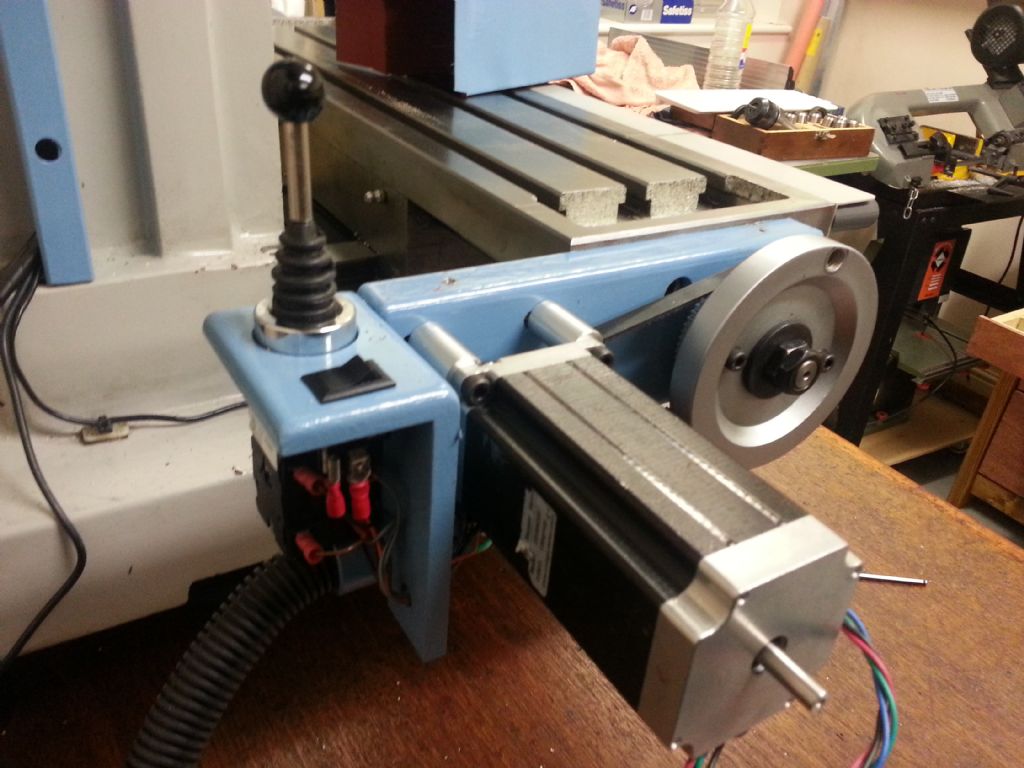
                                                You can see above modifications to the hand wheel (Red) and a counter balance ball (when it spins fast it will shake without it). Nexit is a home made Z axis jog/drive control knob (black on blue box). Make to look like normal machine tool knob. It seem natuaral to reach up to drive the z axis.

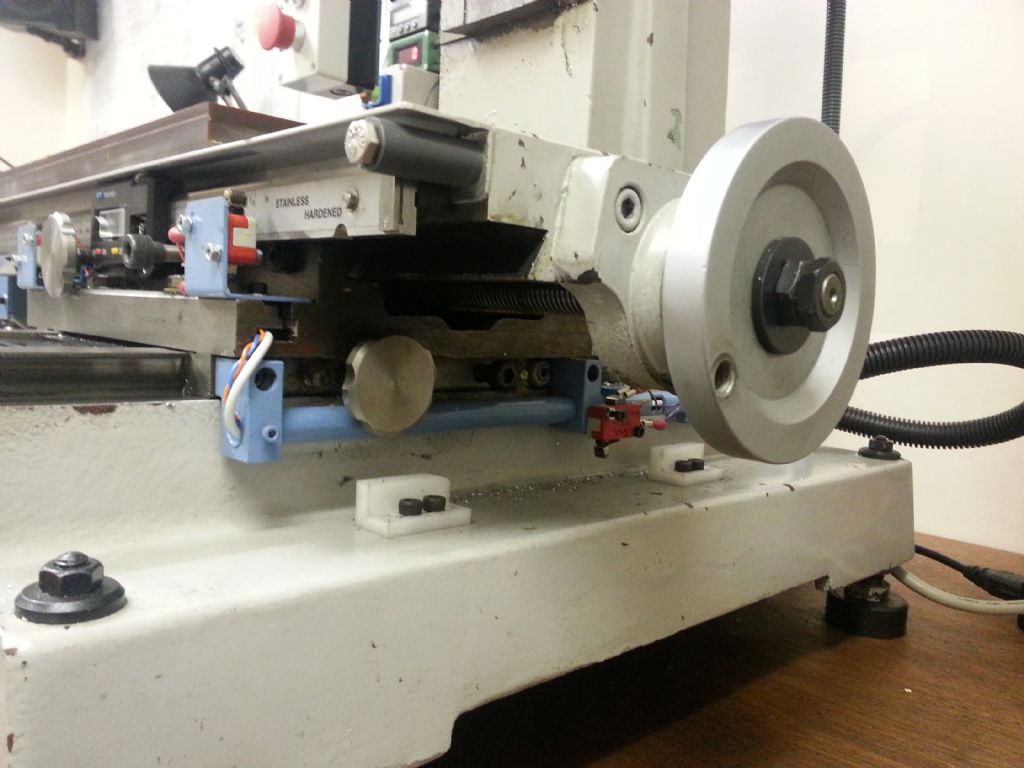
                                                Of interest may be the red aluminium ring around the drive spindle to aid gripping to tighten chucks etc. Just behind the z axis hand wheel is a blue cover for the Z axis micro switches which use the z axis DRO to hold slidable limits for up and down but rearly used.

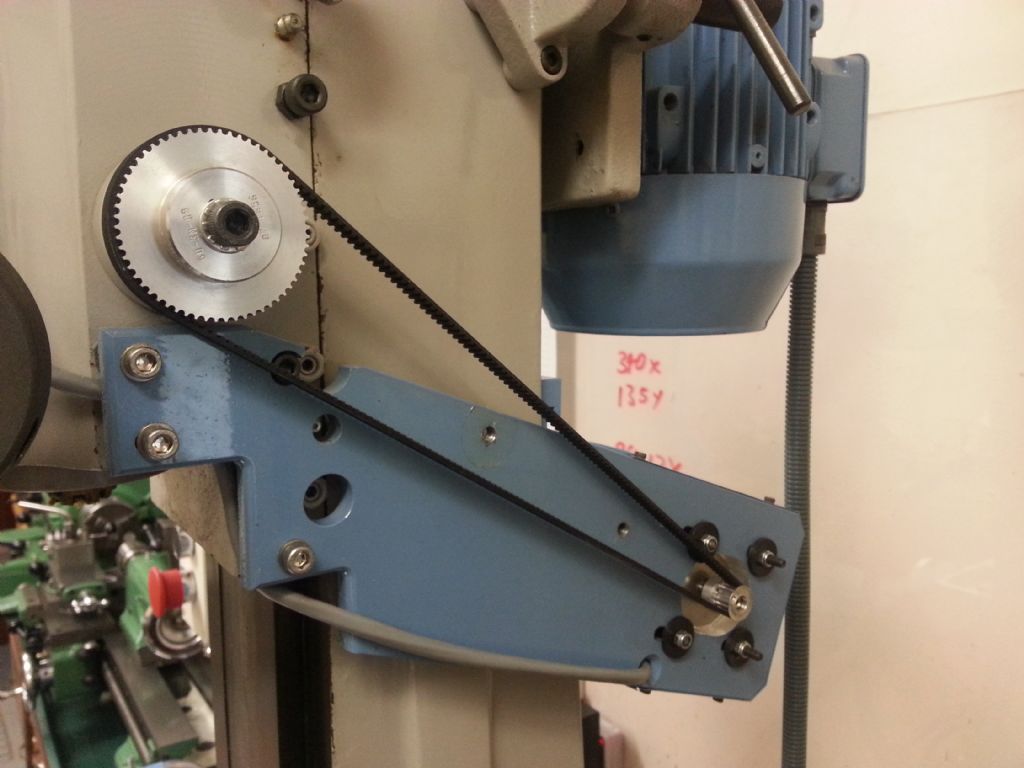
                                                20150117_191917.jpg

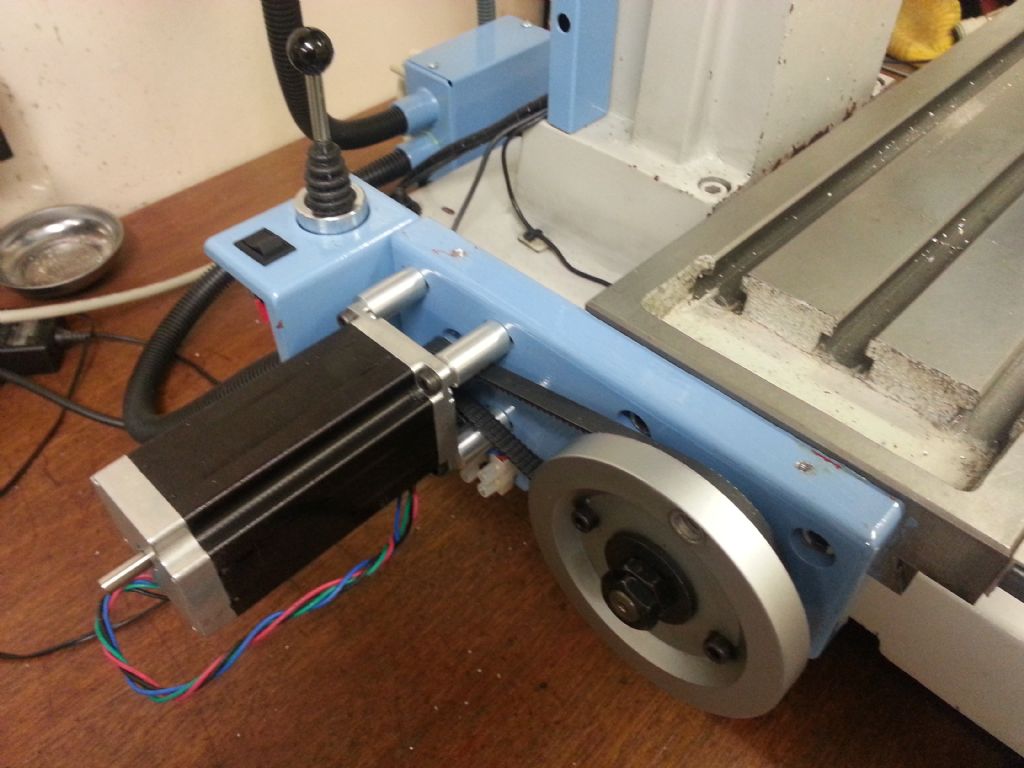
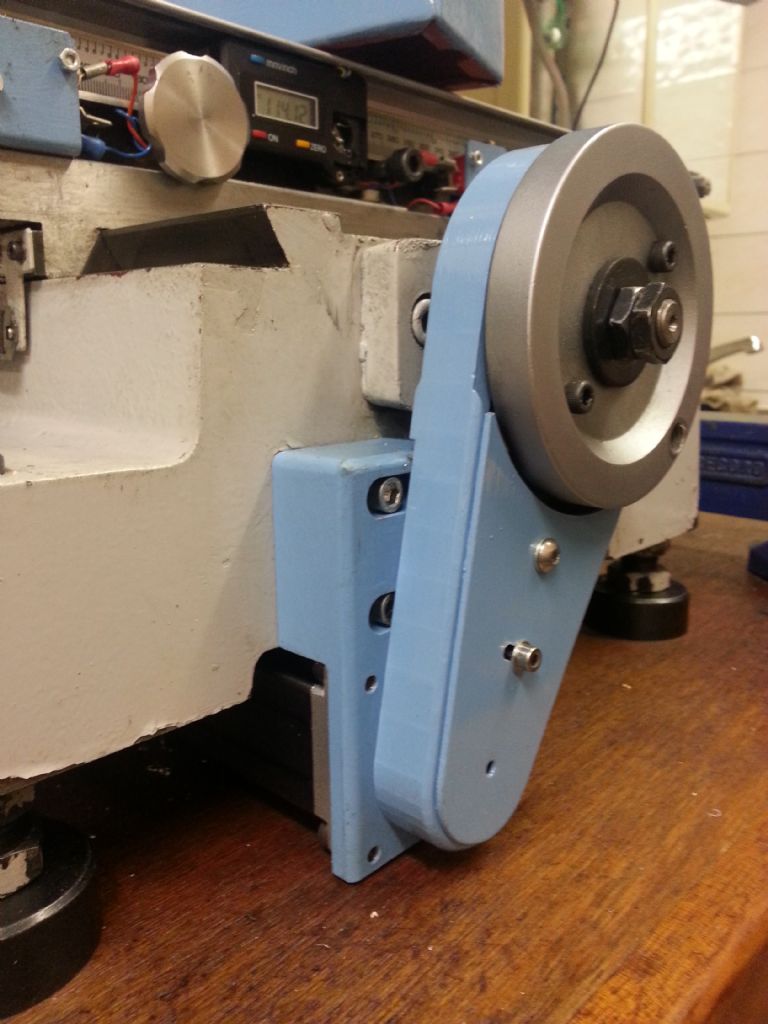
                                                Above is the Z axis drive mechanism. A pulley is fitted directly on the hand wheel shaft. The motor is mounted at the rear.

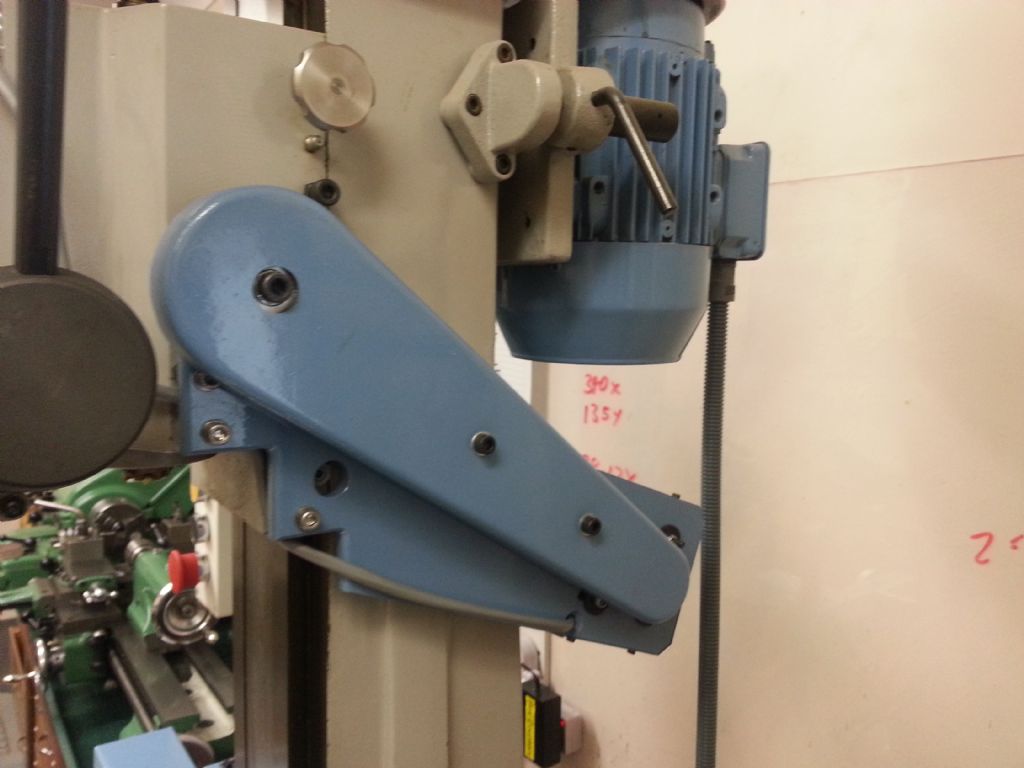
                                                20150117_185344.jpg

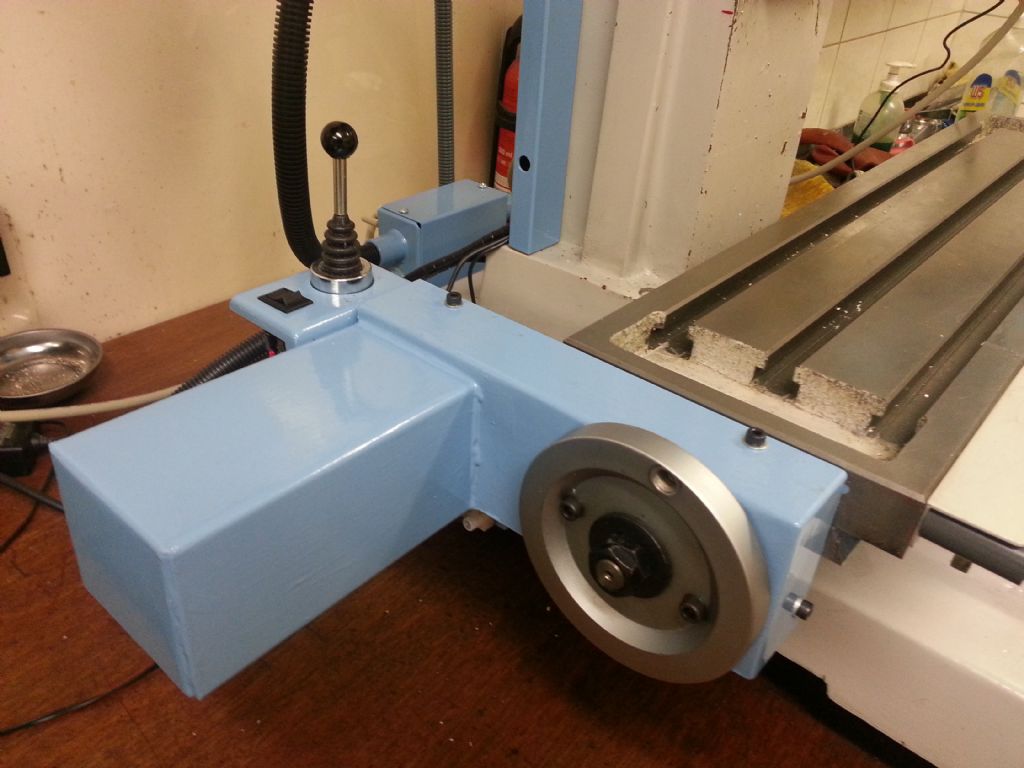
                                                Above is Z drive belt cover fitted (made out of MDF).

                                                20150117_185027.jpg

                                                And a rear view of the z axis motor cover with drive cable.

                                                20150117_184943.jpg

                                                Above is X axis drive assembly. The original bearing casting is replace with an aluminium plate. A oilite bearing is added. Picture shows stepper and to the rear the X and Y jog joystick. Drive to the hand wheel is through the two screews which engage into a drive pulley. The hand wheel knob is removed for safety.

                                                20150117_185011.jpg

                                                20150117_184842.jpg

                                                A cover keeps the muck out.20150117_185053.jpg

                                                The Y axis drive is achieved with a stepper mounted under the bed (just enough clearance with the raising feet. Again a cover to keep the muck out which was CNC'ed on the machine itself.

                                                20150117_185018.jpg

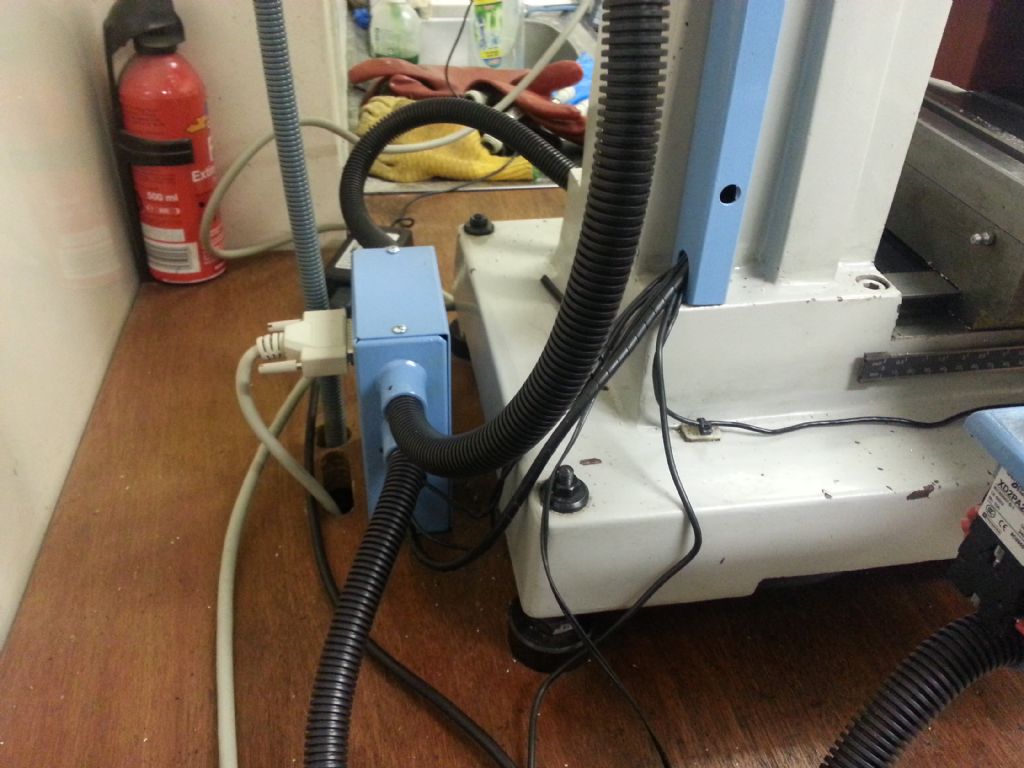
                                                Rear view of the machine showing jucntion box for all X Y and Z cables20150117_184654.jpg

                                                X axis limit switches, X axis scale signals, Y axis limit switch cable routing.

                                                20150117_192045.jpg

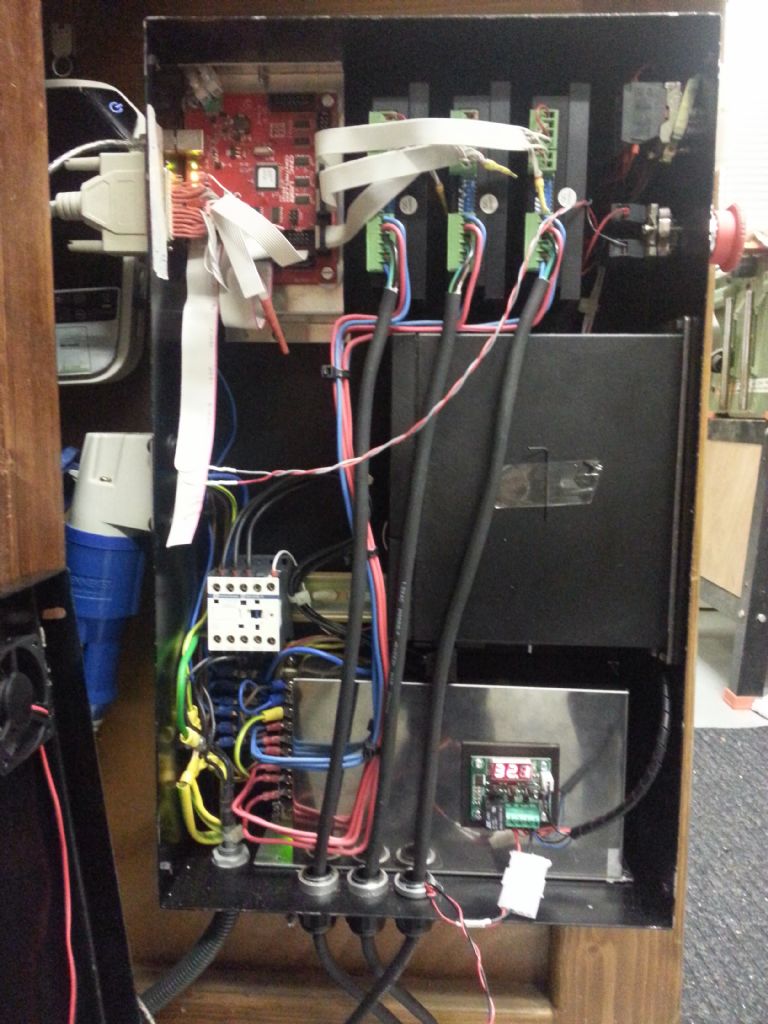
                                                The above shows the original myford VFD motor drive (center right black box) cabinet.

                                                The CNC controller board from planet CNC top left. Three stepper motor driver units top right. Bottom is stepper power supply with temperature sensing board added to control fan in supply an two mounted on cabinet door.

                                                Viv

                                                #155364
                                                Dean Jeffery 1
                                                Participant
                                                  @deanjeffery1

                                                  I need a CNC mill and lathe, i no this has prob been covered many times but i'm limited in getting the right machine down the side of my house, i have just 790mm but this opens up to 1300mm after just 10ich or so.

                                                  I have recently sold a myford ML7 after i made some parts, but these parts are now wanted on a large scale. These are for RC hobby use, but the market seems good and people like what i've made.

                                                  The size of the product in stock billet form is 75mm dia 70 long for the lathe to turn, i need CNC for speed and repeatability. It will also be cutting Titanium mainly but also aluminium.

                                                  Converting a manual is not really an option, unless i pay somebody to do the conversions.

                                                  I need to know what CNC mill and lathe would be best for my needs, tolerance +- 0.05 on both machines max.

                                                  I don't want to import an machine due to the cost of importing, max budget for both would be 8-10k this would need to include CAD/CAM that can do both 2D and 3D milling, basic for turning and could program this myself on Fanuc.

                                                  The CAD/CAM also needs to be user friendly because never used it before.

                                                  Thanks

                                                  #146714

                                                  In reply to: MEW 214

                                                  John Stevenson 1
                                                  Participant
                                                    @johnstevenson1

                                                    I fully agree with Brian's post above. The secret is balance.

                                                    Too many starter projects and you loose the more experienced and even after a while the beginner will be more advanced and want more challenging work.

                                                    perhaps in every issue a simple starter project aimed at just the beginner ? Then the other projects can carry on from that ?

                                                    Even a marking system of skill ? Much like the AA do with the spanners although I have always wondered when a garage gets one spanner what happens when the bolt spins ? Anyway i digress. Perhaps a little row of micrometers ?

                                                    The other thing is the great unwashed out there that don't use this site. Perhaps a simple poll in the mag but answers have to be registered on line as a first option, then post for anyone still using a 286.

                                                    Not having held the job and knowing what it entails I often wonder what amount of editing goes off. I know some does because Tony had his whippet head part edited from his article, a classic in it's own right, only to be put back in letters later.

                                                    OTOH there have been articles that just don't make sense, the Myford DRO top slide which never mentioned the scale or showed a picture of it. So basically un-buildable from the readers point. Others as also mentioned that are so machine specific like the recent CNC conversion that used very complex helical gearboxes just so the writer could use an obsolete controller. That one missed the mark on many counts.

                                                    Tony Jeffree did one on the ML7 [ no I'm not married to him ] that was simple, used off the shelf components and was for a popular machine. This one has been followed and built many times.

                                                    #132118
                                                    Tony Jeffree
                                                    Participant
                                                      @tonyjeffree56510
                                                      Posted by Clive Hartland on 08/10/2013 22:25:09:

                                                      I have carried this mod out on my ML10 and one trick is that as you have to machine the bracket is that you take the bracket off a Myford Vert slide and machine it. Then swop onto the lathe, the one on the lathe then goes onto the vertical slide.

                                                      Otherwise you have to buy a spare one or do it on another lathe. It does smooth out the movement of the spindle and reduces the backlash. I also fitted a new nut.

                                                      I would also like to do something about the right hand end of the leadscrew, it is difficult to eliminate backlash there. Also I would like to modify the leadscrew graduated collar to a slipping scale. Any ideas ?

                                                      Clive

                                                      Edited By Clive Hartland on 08/10/2013 22:28:12

                                                      I would second your approach of modifying a spare bracket and then swapping it for the cross-slide bracket – its really the only practical approach. In my case, I replaced the bracket with one that I had fabricated, because it was also acting as a stepper mount for my CNC conversion, but the principle is the same. The improvement in the "feel" of the cross-slide movement is significant, and it eliminates all backlash except for play in the screw and nut.

                                                      Hemmingway do a kit for sorting out the RH leadscrew bracket – see:

                                                      **LINK**

                                                      I fitted this to my ML7, also as part of my CNC conversion, and it works a treat.

                                                      Regards,

                                                      Tony

                                                    Viewing 25 results - 1 through 25 (of 36 total)

                                                    Latest Replies

                                                    Home Forums Search Search Results for 'Myford 7 CNC conversion'

                                                    Viewing 25 topics - 1 through 25 (of 25 total)
                                                    Viewing 25 topics - 1 through 25 (of 25 total)

                                                    View full reply list.