Four Index Thread Indicator

Four Index Thread Indicator

Home Forums General Questions Four Index Thread Indicator

Viewing 25 posts - 1 through 25 (of 45 total)
  • Author
    Posts
  • #584018
    Franco Convertini
    Participant
      @francoconvertini28916

      On my super 7 when I do imperial threads the Four Index Threads Indicator works well, I can unhook the carriage from the lead srew and start re-reading again.
      This system does not work for metric threads. For each metric thread I waste a lot of time because for each pass I have to stop the lathe motor, make it turn backwards until the thread begins and start a new pass.
      I wanted to know if there is a dial indicator for metric threads?

      Edited By Franco Convertini on 05/02/2022 17:49:11

      #28562
      Franco Convertini
      Participant
        @francoconvertini28916
        #584019
        Thor 🇳🇴
        Participant
          @thor

          On a lathe with Imperial leadscrew the Thread Dial Indicator only works for Imperial threads. When cutting metric threads on a lathe with Imperial leadscrew, keep the half-nut closed all the time. You can of course, make a screwcutting clutch, to make it easier.

          Thor

          #584026
          Martin Kyte
          Participant
            @martinkyte99762

            I wanted to know if there is a dial indicator for metric threads?

            Yes but only for lathes with a metric lead screw.

            regards Martin

            #584030
            Franco Convertini
            Participant
              @francoconvertini28916

              I think my lathe is metric because it has a cross slide and a top slide with a 2mm pitch but the lead screw has a pitch of 3.15 mm

              Edited By Franco Convertini on 05/02/2022 19:30:16

              #584035
              old mart
              Participant
                @oldmart

                That leadscrew pitch of 3.15mm looks a lot like 8tpi which is 3.175mm.

                I have seen dial indicators with changable gearing between the leadscrew and the indicator, but have never known what their function is.

                During the last couple of weeks, I have been making internal threads of 2.5mm pitch and have to leave the leadscrew engaged. I find that it is just as easy that way, stopping and reversing the spindle as it gives me time to think about the next setting, backing off and making the next depth of cut. The Smart & Brown model A has proved very easy to change spindle direction, and quicker than when I was cutting 40tpi today and waiting for the threading indicator to turn through 24, not 4 divisions as on Myfords. If I was doing lots of threading, I would bother to learn the proper way to use the threading indicator.

                #584038
                Martin Kyte
                Participant
                  @martinkyte99762
                  Posted by Franco Convertini on 05/02/2022 19:26:38:

                  I think my lathe is metric because it has a cross slide and a top slide with a 2mm pitch but the lead screw has a pitch of 3.15 mm

                  Edited By Franco Convertini on 05/02/2022 19:30:16

                  Top and cross slide are irrelevant. The leadscrew needs to be metric for dial indicators to work for metric threads. You cannot drop the half nuts in anywhere else on an imperial lead screw when cutting metric threads. Even for imperial threads if you are doing strange TPI's it is sometime neccessary to keep the half nuts engaged.

                  regards Martin

                  #584040
                  Franco Convertini
                  Participant
                    @francoconvertini28916

                    What you say is true but it is cool to be able to unhook the screw and resume the thread. Here in Italy someone has managed to make a metric dial on a Ceriani lathe https://youtu.be/kk5oWnAkVoI.
                    I thought some Myfordists had created something like this.
                    Thank you all for the time you have dedicated to me.
                    Greetings, Franco

                    #584042
                    Pete Rimmer
                    Participant
                      @peterimmer30576

                      That Ceriani has a metric leadscrew. You can tell because in the comments he mentions two different gears for the dial according to what pitch he is cutting. You cannot do it with a non-metric screw it just isn't possible without either reversing or using a single tooth dog clutch. Or using ELS.

                      #584058
                      John Haine
                      Participant
                        @johnhaine32865

                        Yes, the metric Super 7 has metric cross and topslide feedscrews but the main leadscrew is 8 tpi. British engineering at its best.

                        #584060
                        ega
                        Participant
                          @ega
                          Posted by old mart on 05/02/2022 20:12:45:…I was cutting 40tpi today and waiting for the threading indicator to turn through 24, not 4 divisions as on Myfords….

                          When cutting any multiple of 8TPI on the Myford you can engage the leadscrew at any point – no need to wait.

                          Edited By ega on 05/02/2022 21:59:43

                          #584062
                          John P
                          Participant
                            @johnp77052

                            Posted by Franco Convertini 05/02/2022 17:48:34

                            On my super 7 when I do imperial threads the Four Index Threads Indicator works well, I can
                            unhook the carriage from the lead srew and start re-reading again.
                            This system does not work for metric threads. For each metric thread I
                            waste a lot of time because for each pass I have to stop the lathe motor, make it
                            turn backwards until the thread begins and start a new pass.
                            I wanted to know if there is a dial indicator for metric threads?

                            Edited By Franco Convertini on 05/02/2022 17:49:11

                            Yes it can be done,

                            In MEW 149 an article by Richard Bartlett on
                            page 36 through to 40 describes a method
                            for metric screwcutting on a Myford with an 8 Tpi
                            leadscrew and by dis-engaging the leadscrew.

                            John

                            #584063
                            Franco Convertini
                            Participant
                              @francoconvertini28916

                              Very interesting John, where can I see? is there a link to this?

                              Edited By Franco Convertini on 05/02/2022 22:27:42

                              #584064
                              Pete Rimmer
                              Participant
                                @peterimmer30576

                                It CAN be done but you still have to stop the motor and reverse it. The advantage is that you can stop at a shoulder by disengaging the half-nut. Then you reverse the motor, traverse the table back to your start, switch the motor back to forwards and pick up the same index on the threading dial on the same turn. It's no quicker than simply reversing the motor with the half-nuts closed.

                                #584066
                                Franco Convertini
                                Participant
                                  @francoconvertini28916

                                  When I make fine threads and go back and forth with the engine it goes away so long that I grow a beard. 😉

                                  #584095
                                  Martin Connelly
                                  Participant
                                    @martinconnelly55370

                                    For short lengths of thread keeping the half nuts closed is not too bad. For a long length of thread you can release the half nuts and move the carriage back in multiples of 5" (127mm) to pick up the correct position on the leadscrew. Your thread dial indicator engagement point will be different for each successive pass. There is a risk of getting the distance wrong if you do not have a good method of ensuring you move the correct distance. Best if the leadscrew is stopped before the half nuts are disengaged otherwise you have to reverse just enough to go back to the thread dial mark that was being used then make the 5" move. A DRO will help as you can set the zero point before moving back. These issues are why, for people who regularly do both metric and TPI threads, the electronic lead screw (ELS) projects are so popular or even going the small extra step of making the lathe CNC at which point thread dial indicators and gear changing for different threads no longer takes place.

                                    Martin C

                                    #584104
                                    Franco Convertini
                                    Participant
                                      @francoconvertini28916

                                      Hi Martin,
                                      is a good suggestion.
                                      I have to decide as soon as possible to buy a good DRO. I did a search but the ones I've seen cost a lot.

                                      Franco

                                      #584125
                                      Oldiron
                                      Participant
                                        @oldiron
                                        Posted by Franco Convertini on 05/02/2022 17:48:34:

                                        On my super 7 when I do imperial threads the Four Index Threads Indicator works well, I can unhook the carriage from the lead srew and start re-reading again.
                                        This system does not work for metric threads. For each metric thread I waste a lot of time because for each pass I have to stop the lathe motor, make it turn backwards until the thread begins and start a new pass.
                                        I wanted to know if there is a dial indicator for metric threads?

                                        Edited By Franco Convertini on 05/02/2022 17:49:11

                                        Have a look at this video on Youtube. Oxtools I have used this method a lot. I get a bit dismayed when people post that you CANNOT disconect the half nuts during metric threading on an imperial lathe. They should really take time to research a subject before commenting. Things change over time & new discoveries are made that make things easier to do. As long as you have an imperial threading dial the method shown in the video works perfectly. If you have a screw on chuck only do this at slow speed as I do on my Boxford.

                                        IHTH regards

                                        #584131
                                        Anonymous
                                          Posted by Oldiron on 06/02/2022 10:18:10:

                                          Have a look at this video….

                                          That was interesting and obviously works; but seems more of a faff than just withdrawing the tool and throwing the lathe into reverse? It wouldn't work for me anyway, as I removed my imperial thread dial indicator to fit an Ainjest unit.

                                          Andrew

                                          #584134
                                          SillyOldDuffer
                                          Moderator
                                            @sillyoldduffer

                                            Thread Dial Indicators (TDI) not working cleanly is one of the few disadvantages of the Metric System.

                                            Imperial threads are specified in terms of Threads Per Inch, which relates directly to the gear ratios on a lathe. As the relative positions of the spindle and lead-screw have a simple relationship determined by the change gears, a simple gear driven by the lead-screw turns a dial showing when they are correctly aligned for screw-cutting. It's simple.

                                            Metric threads are different. They're specified in terms of Pitch, which is the reciprocal of Threads per. The pitch convention breaks the simple relationship between spindle, lead-screw and the TDI. Not completely, but if a metric TDI is provided, it will only cover a certain number of pitches, or will come with a selection of drive wheels that have to be changed to suit the metric pitch in hand. It's messy!

                                            As Imperial TDIs won't indicate pitches correctly, and Metric TDIs are more complicated to use, a different technique is mostly used to cut metric threads. Basically, the lathe is worked forward and reversed without ever disengaging the lead-screw so the spindle/lead-screw position is never lost. The method is slow, but has some advantages:

                                            • Removes the possibility of the operator misreading the TDI, or mistiming half-nut engagements.
                                            • Works on metric, imperial and non-standard threads
                                            • Better suited to automatics, and reduces the need for skilled operators. (Manual machines depend on expensive people skills, which businesses hate paying for!)

                                            I don't know why Metric threads standardised on Pitch rather than Turns per. On the face of it, pitch makes life more complicated. My guess is pitch suits Engineers thinking in terms of strength, friction and turning forces, whereas TPI met practical needs at a time before thread theory was understood. Might also be because metric threads were defined just as industry was switching to rolling threads rather than lathe cutting them. Thread rolling machines don't need TDIs or lead-screws and they make better threads faster!

                                            Dave

                                            #584144
                                            Franco Convertini
                                            Participant
                                              @francoconvertini28916

                                              Interesting an Ainjest unit. Are there any photos?
                                              Any video showing how it works on Myford?

                                              Edited By Franco Convertini on 06/02/2022 11:21:21

                                              #584145
                                              Hopper
                                              Participant
                                                @hopper
                                                Posted by Oldiron on 06/02/2022 10:18:10:

                                                Posted by Franco Convertini on 05/02/2022 17:48:34:

                                                On my super 7 when I do imperial threads the Four Index Threads Indicator works well, I can unhook the carriage from the lead srew and start re-reading again.
                                                This system does not work for metric threads. For each metric thread I waste a lot of time because for each pass I have to stop the lathe motor, make it turn backwards until the thread begins and start a new pass.
                                                I wanted to know if there is a dial indicator for metric threads?

                                                Edited By Franco Convertini on 05/02/2022 17:49:11

                                                Have a look at this video on Youtube. Oxtools I have used this method a lot. I get a bit dismayed when people post that you CANNOT disconect the half nuts during metric threading on an imperial lathe. They should really take time to research a subject before commenting. Things change over time & new discoveries are made that make things easier to do. As long as you have an imperial threading dial the method shown in the video works perfectly. If you have a screw on chuck only do this at slow speed as I do on my Boxford.

                                                IHTH regards

                                                It's not the same thing the OP is asking. Oxtools is still reversing the lathe and engaging the halfnuts to move the carriage back to the starting point. He just uses the indicator dial to facilitate this. Simples, and been around for years, at least since 1986 in Martin Cleeve's book Screwcutting in the Lathe. But Franco wants to avoid using reverse and simply and quickly wind the carriage back by hand.

                                                Franco, that same book by Martin Cleeve describes the gearing required to make your own geared indicator dial, but it does not sound simple. It also describes a way of using a carriage stop in conjunction with the English indicator dial to cut metric threads, but only shorter ones of 2 inches or less in a Myford lathe with 8tpi leadscrew. So not a great advantage because it is the longer threads that take so much time to reverse back to the start!

                                                #584150
                                                Hopper
                                                Participant
                                                  @hopper
                                                  Posted by Martin Connelly on 06/02/2022 08:32:03:

                                                  For short lengths of thread keeping the half nuts closed is not too bad. For a long length of thread you can release the half nuts and move the carriage back in multiples of 5" (127mm) to pick up the correct position on the leadscrew. Your thread dial indicator engagement point will be different for each successive pass. There is a risk of getting the distance wrong if you do not have a good method of ensuring you move the correct distance. Best if the leadscrew is stopped before the half nuts are disengaged otherwise you have to reverse just enough to go back to the thread dial mark that was being used then make the 5" move. A DRO will help as you can set the zero point before moving back. These issues are why, for people who regularly do both metric and TPI threads, the electronic lead screw (ELS) projects are so popular or even going the small extra step of making the lathe CNC at which point thread dial indicators and gear changing for different threads no longer takes place.

                                                  Martin C

                                                  Now that's a new one one me, but seems blindingly obvious when you think about it, the 127 tooth conversion gear and all. Although, I can't quite visualise exactly why. I shall have to give it a try.

                                                  In the absence of a DRO, could one use the imperial thread indicator dial to measure carriage movement in inches? On the Myford with its 8TPI leadscrew, and its 16 tooth gear on the TDI, one full turn of the thread dial equals 2 inches of carriage movement when cranking the carriage traverse handle and the leadscrew is stationary. So 5 inches would be two and a half turns of the dial.

                                                  Personally I liked screwcutting on the old DSG toolroom lathes. They had a combined clutch and brake lever on the carriage so you could screwcut up to a shoulder at 400rpm. Just start slipping the clutch and slow down as the tool approaches the shoulder. Then slam the brake on just as the tool is about to crash into the shoulder. Retract the tool and reverse flat out at 400rpm back to the start and reset tool depth and repeat process. Not for the feint hearted but no apprentice was going to admit to that.

                                                  #584243
                                                  John P
                                                  Participant
                                                    @johnp77052

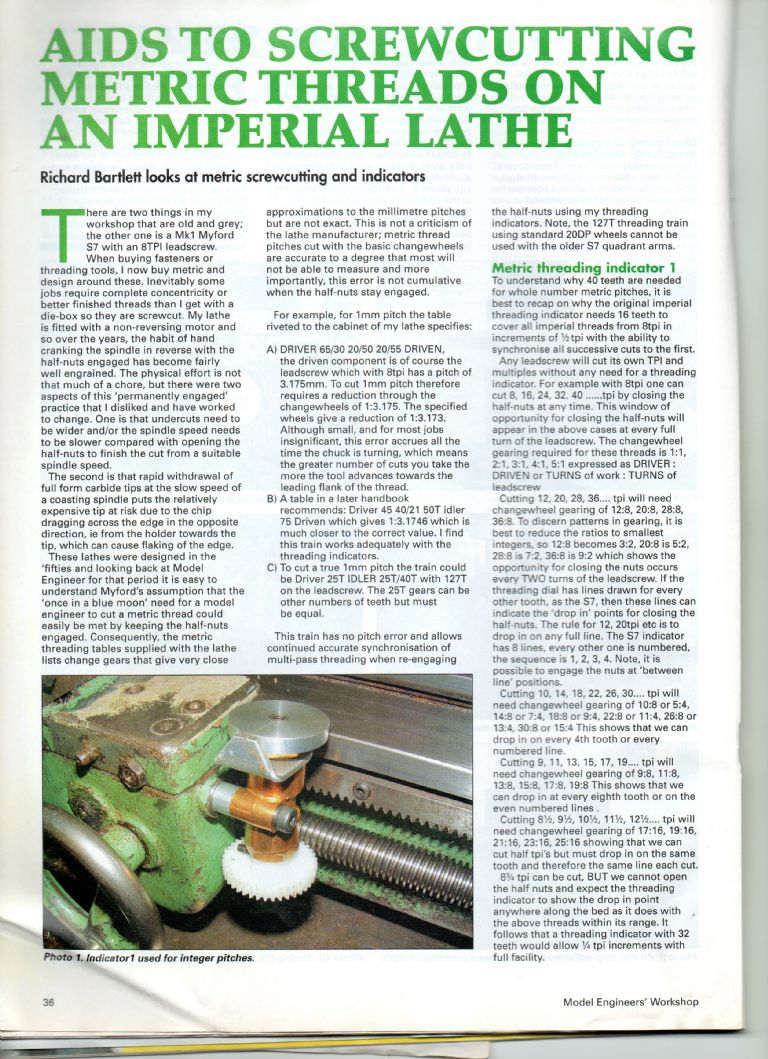
                                                    This is the article i referred to in the the posting at 05/02/2022 22:11:28.

                                                    mew 149.jpg

                                                    Using this method allows the motor to remain running ,the spindle
                                                    can be left turning ,the half nut are dis-engaged at the end of the
                                                    pass the carriage returned to the start position ready for the next pass.

                                                    To get the best use from this a true 127 gear for metric conversion
                                                    must be used.
                                                    The article is worth reading and covers all of the points the OP
                                                    asked for.

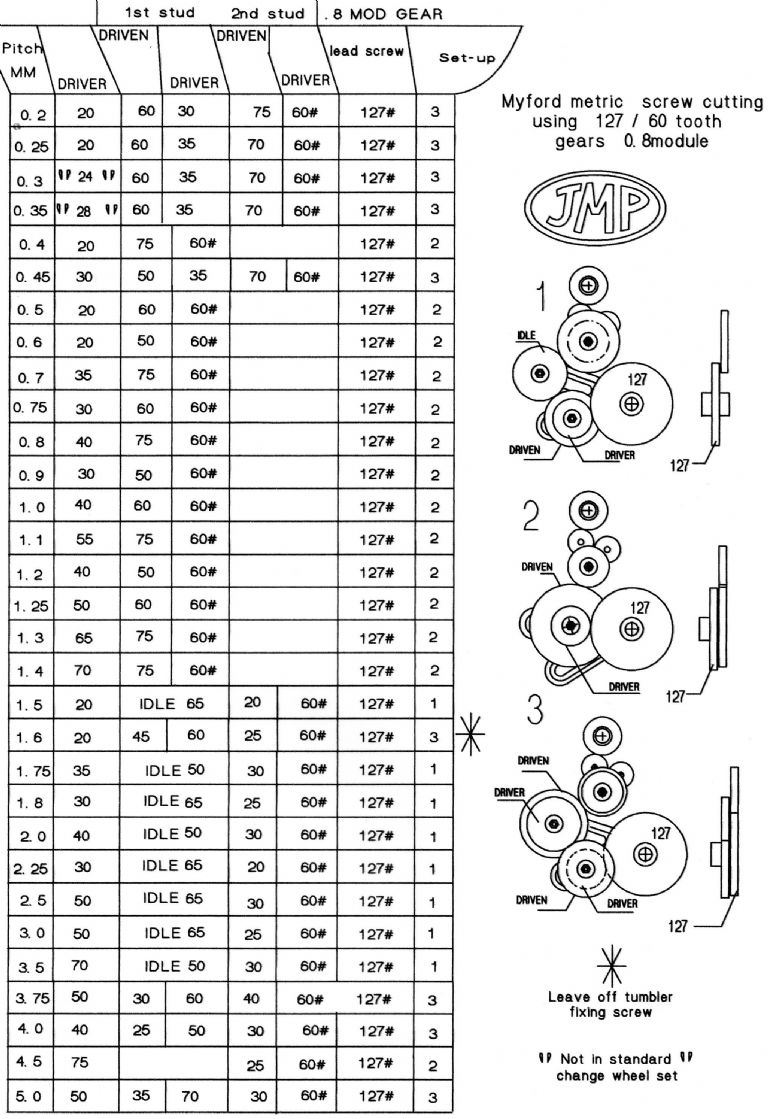
                                                    I use the same 127/60 tooth gears as in the article,here is
                                                    the change wheel list for all the metric pitches.

                                                    127 myford metric .jpg

                                                    John

                                                    #584269
                                                    Franco Convertini
                                                    Participant
                                                      @francoconvertini28916

                                                      Hello John,
                                                      I was blown away when I read your message. This was exactly what I was looking for. With the engine always running, disengage the lead screw at the end of the thread, return the carriage quickly backwards and engage the lead screw again. Two things remain to be clarified:
                                                      1 the number of teeth that the thread dial indicator gear has and how many notches it has on the dial; Also what module does it have for milling teeth.
                                                      2 I have the Norton box on the lathe; how should i adjust it?

                                                      Regards, Franco

                                                      Edited By Franco Convertini on 06/02/2022 19:11:31

                                                    Viewing 25 posts - 1 through 25 (of 45 total)
                                                    • Please log in to reply to this topic. Registering is free and easy using the links on the menu at the top of this page.

                                                    Latest Replies

                                                    Home Forums General Questions Topics

                                                    Viewing 25 topics - 1 through 25 (of 25 total)
                                                    Viewing 25 topics - 1 through 25 (of 25 total)

                                                    View full reply list.