Recommendation sought: Precision grinding wheel

Recommendation sought: Precision grinding wheel

Home Forums Workshop Tools and Tooling Recommendation sought: Precision grinding wheel

Viewing 23 posts - 1 through 23 (of 23 total)
  • Author
    Posts
  • #822634
    richard3267
    Participant
      @richardrogalewski21509

      Hi. Total beginner sourcing cutting tools, or any tool for that matter. I want to grind flats on a 3.2mm silver steel bar. I need a grinding wheel that will travel cross-wise to the length of the bar and in doing so will produce the flat – with the face of the wheel.The wheel needs to be around 10mm thick, thus producing a flat 10mm long along the length of the bar. Guessing wheel diameter: anything from 10mm to 30mm I think. The arbour holding the wheel is to be (provisionally) 3.2mm Copilot tells me I’ll need to source something like that from a specialist in CNC grinding. Can anyone here give a heads-up on who might likely sell such a grinding wheel I describe? Thanks.

      EDIT: Actually, would I find it better to use a milling tool bit? A router.

      #822638
      Tony Pratt 1
      Participant
        @tonypratt1

        Ok taking a step back what equipment have you got?

        Tony


        #822639
        richard3267
        Participant
          @richardrogalewski21509

          I’m messing about with an old Flexispeed “Major” lathe.  Thinking about bolting on the cross slide a motor whose axis is parallel to the lathe spindle. holding the work stationary in a clutch. Whether I use a grinding wheel, or router, cutting flats cross-wise to the bar.

          #822641
          Peter Cook 6
          Participant
            @petercook6

            How long is the bar? How long do you want the flats to be (full length?). How precise do you need the flats to be? Just one flat on the bar, one each side or more?

            10-20mm long bar/flats would be one problem 600mm long bar a somewhat different issue!

            #822652
            Robert Atkinson 2
            Participant
              @robertatkinson2

              Your idea of using a grinder on the cross-slide is sound. Search on here for “tool-post grinder”. The problem is that you will need some means of adjusting the vertical height. For example a vertical slide.
              Any small high speed “dremel” style grinder can be used. The wheel does not have to be precise. You can use a narrower wheel than the 10mm width of flat moving the carriage allong as you grind.

              Robert.

              #822654
              Charles Lamont
              Participant
                @charleslamont71117

                As you say you are a total beginner, could you take another step back and tell us what you want to make?  You want one or more flats on a silver steel bar, but what is it for? Then we can suggest how to do it. Grinding might or might not be the best method.

                #822684
                richard3267
                Participant
                  @richardrogalewski21509

                  I think I need a CNC ER11 spindle motor kit. And probably a router bit.  Or a cheaper 775 motor. I’m trying to make a 2 bladed cutting tool (would look like a screwdriver). Blade of 1mm width, length 10mm, and 0.5mm thick. A bit like a 2 sided router or a cuttter having two cutting surfaces. So, it woud cut into wood to a depth of 10mm and 1mm across as it passes through the wood. The main problem is how to engineer the lowering of the cutter to get the result one requres. A few passes required to cut each flat I think. I’d be cutting to a depth of 1.1mm for the first two flats required. Then another set of two flats needed orthogonal to the first set. When used cutting tool might be turning at 12000 RPM. Obviously I’d be making a pretty fragile cutter.  Cutting wood mght just about be doable, if I proceed slowly.

                  #822693
                  SillyOldDuffer
                  Moderator
                    @sillyoldduffer

                    Can you manage a drawing or a photo please?

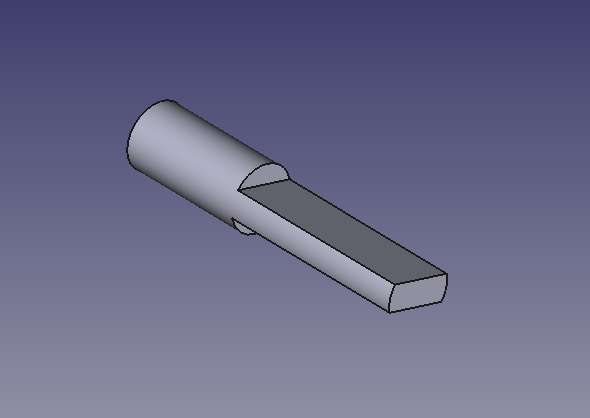
                    Is it like this, which wouldn’t cut very well?

                    cutter1

                    Usually better to start with the object you want to make rather than the tool needed to make it.    Grinding might well be the answer, but there are many ways to skin a cat.

                    For example, how many are you making?   If only a few, then hand-filing and a Dremel might do,  if hundreds, a milling machine, tool-post grinder, CNC, or grinding machine.  If millions, a production machine…  Maybe an ordinary bench grinding wheel with a jig, and the actual question is ‘how do I make a jig?’

                    With luck they can be bought from a shop, or made by adapting a shop item.

                    Dave


                    #822699
                    JasonB
                    Moderator
                      @jasonb

                      Why the need to grind silver steel? As supplied it can be machined relatively easily and hardened after machining.

                      If I just had a lathe and wanted to make a part like Dave shows in his picture I would hold the 1/8″ SS rod in the tool post at right angles to the lathe axis and feed into the cutter with the cros sslide. Rotate work 180deg in the tool post and cut the other side. Cutter only needs to be say a 6mm dia 3 or 4 flute milling cutter held in the lathe chuck.

                      However your mention of a second set of flats does not add up to any screwdriver I have seen? so a sketch of the tool or the type of cut you want to make in the wood would help.

                      #822701
                      Julie Ann
                      Participant
                        @julieann

                        My immediate thought was Rube Goldberg. Grinding is the wrong solution; use a milling cutter and the job will be done in one pass per side.

                        I’ve just finished milling 1/8″ wide keyways in silver steel, as Jason says it machines beautifully in the soft state. It is possible to machine silver steel in the hardened state but requires carbide tooling.

                        Grinding is traditionally a finishing process aimed at dimensional accuracy and fine surface finish for both soft and hard materials.

                        Julie

                        #822703
                        JasonB
                        Moderator
                          @jasonb

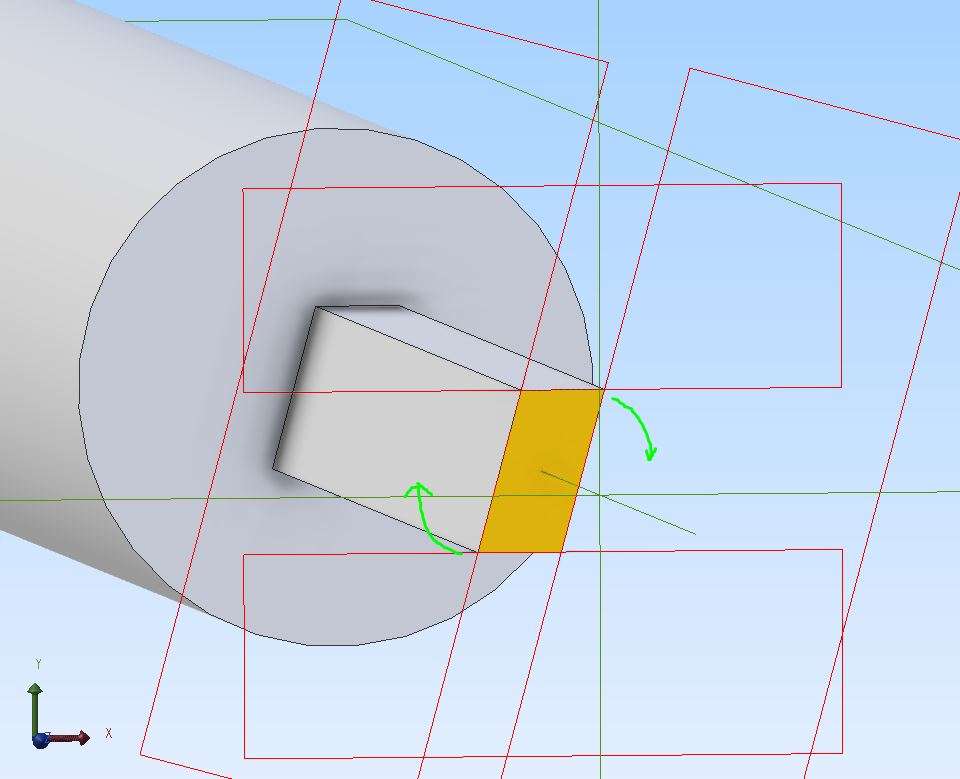
                          Or does the second set of cuts get made at an angle to the first so that you have a “blade” with relief and two cutting edges that will when rotated act like a 1mm dia x 10mm long router bit.

                          cutter

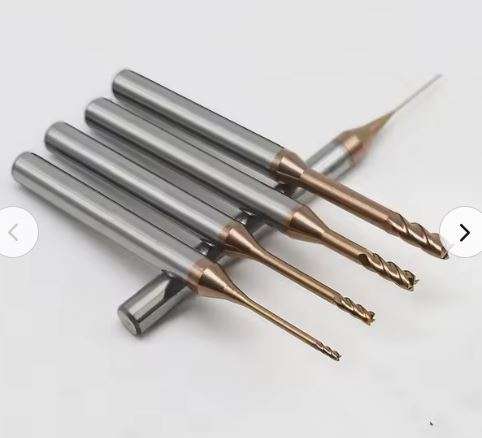
                          If that is the intension then it will indeed be a fragile cutter. Any reason for not buying an off the self cuttre? Although still fragile a long neck 1mm milling cutter would cut wood easily enough and if taken in several passes shoudl be OK. These can be had for about £3 and would give the 10mm depth that standard 1mm cutter s won’t

                          1mm bit

                          #822706
                          Ian P
                          Participant
                            @ianp

                            I understand your description you are looking to make a cutter that will cut a slot 1mm wide and 10mm deep.

                            This is one hell of a ‘length to diameter’ ratio and its unlikely that anything anywhere near that is available ready made.

                            I suppose it might work if the wood was very soft like Balsa and the cutter was carbide and single flute, 12,000 RPM seems quite slow too

                            Ian P

                            Oops, Jason was quicker

                            #822719
                            Bazyle
                            Participant
                              @bazyle

                              Actually ‘back in the day’ that kind of cut, in steel, was done. There was an article in ME probably 30 years ago by a toolmaker making a toy car (corgi?) casting mould the only time an Alexander 3A die sinker has been mentioned in the magazine.

                              A bit more complex than you are ready for but the reason Prof Chaddock designed the Quorn tool and cutter grinder was to make small milling cutters about that size.

                              #822722
                              Charles Lamont
                              Participant
                                @charleslamont71117

                                Sorry, Richard (I assume), but I think it might be a good idea to go yet another step back.

                                Making a cutter for this 10mm deep, 1 mm wide slit would be bloody difficult for someone really experienced (and, by the way, grinding would probably come into it). And it would very likely snap anyway.

                                But Jason has shown a commercial cutter that might do the job.

                                However, making a slit of those dimensions seems a strange requirement. What’s it for?

                                #822747
                                not done it yet
                                Participant
                                  @notdoneityet

                                  I may be wrong but a slitting saw might be the simple option to cut narrow slots in wood?

                                  #822753
                                  JasonB
                                  Moderator
                                    @jasonb

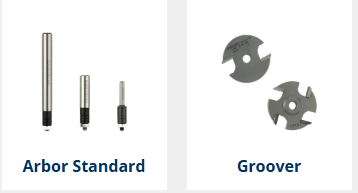
                                    Why I asked for details of the type of cut, if it is a stopped slot or has to follow a curve then a saw won’t work.

                                    We tend to call them grooves when used on wood and only really work on a edge or close to an edge if face grooving when used with routers.

                                    groovers

                                    #822756
                                    JasonB
                                    Moderator
                                      @jasonb

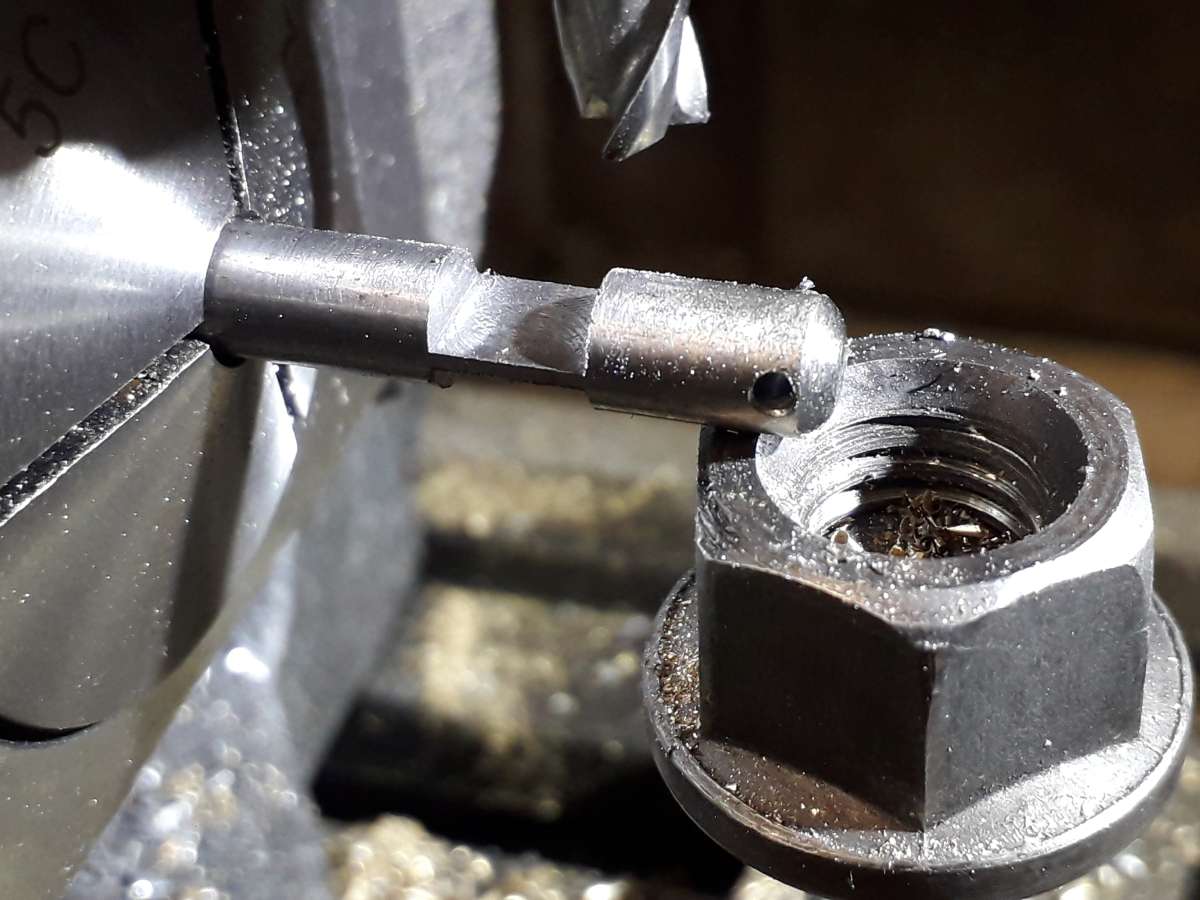
                                      Here is a similar job I did with a milling cutter, yes it is on a milling machine but easy enough on just a lathe.

                                      That is 1.2mm thickness in the middle. Although I needed the round bit at the end it may be worth doing similar whan making your cutter as it will support the slender piece you want and prevent it from deflecting away from the cutter. It can be trimmed off after the main work.

                                      20191106_171728


                                      #822759
                                      SillyOldDuffer
                                      Moderator
                                        @sillyoldduffer
                                        On not done it yet Said:

                                        I may be wrong but a slitting saw might be the simple option to cut narrow slots in wood?

                                        Blast it, NDIY got in first.  I thought of slitting whilst getting into bed last night.  A good answer unless Richard needs to cut curved slits, where a rotary cutter is more agile.

                                        Based on the limited information provided, Jason’s suggestion (buy off-the-shelf’ milling cutters) seems best so far.  Inexpensive,  ground to cut on the base and flutes, and twisted to eject swarf (aka sawdust).  Difficult to get the same performance out of a DIY cutter.  Buy a box – there will be breakages!

                                        Spin the cutter as fast as possible.    A Dremel held in a clamp should should be “good enough” for cutting a few slots, taking it gently.  If many long slots are needed, a CNC spindle is far more powerful, but more trouble to mount.

                                        Not stated yet is the length, position, and geometry of the curve.  Positioning a cutter to cut a straight slot close to the edge of the workpiece is straightforward.   Much harder to position and steer the cutter if the slot is a 100mm diameter circle in the middle of a metre wide kitchen worktop.

                                        I’m sure better advice will come if the requirement is explained in more detail.  Note we’ve moved from ‘precision grinding wheel’ and  Silver Steel to shop bought milling cutters on a Dremel vs CNC spindle, and how to position the cutter on the job.

                                        Also mentioned is the Quorn.  This is famous as the most unfinished tool project in Model Engineering!  It’s a precision grinder, quite difficult to make, many started, few finished.  I think because people who need to sharpen lots of cutters generally don’t have the time needed to make a Quorn.   Quicker to buy new cutters, to sharpen them less effectively with a simpler tool, or have them resharpened by a service.    Look for the easiest, quickest and cheapest way of meet the requirement, because not doing so often results in complicated, expensive and time-wasting solutions – overkill!

                                        How to cut deep thin slots isn’t usual beginner territory, so well done for tackling it!

                                        Dave


                                        #822768
                                        JasonB
                                        Moderator
                                          @jasonb

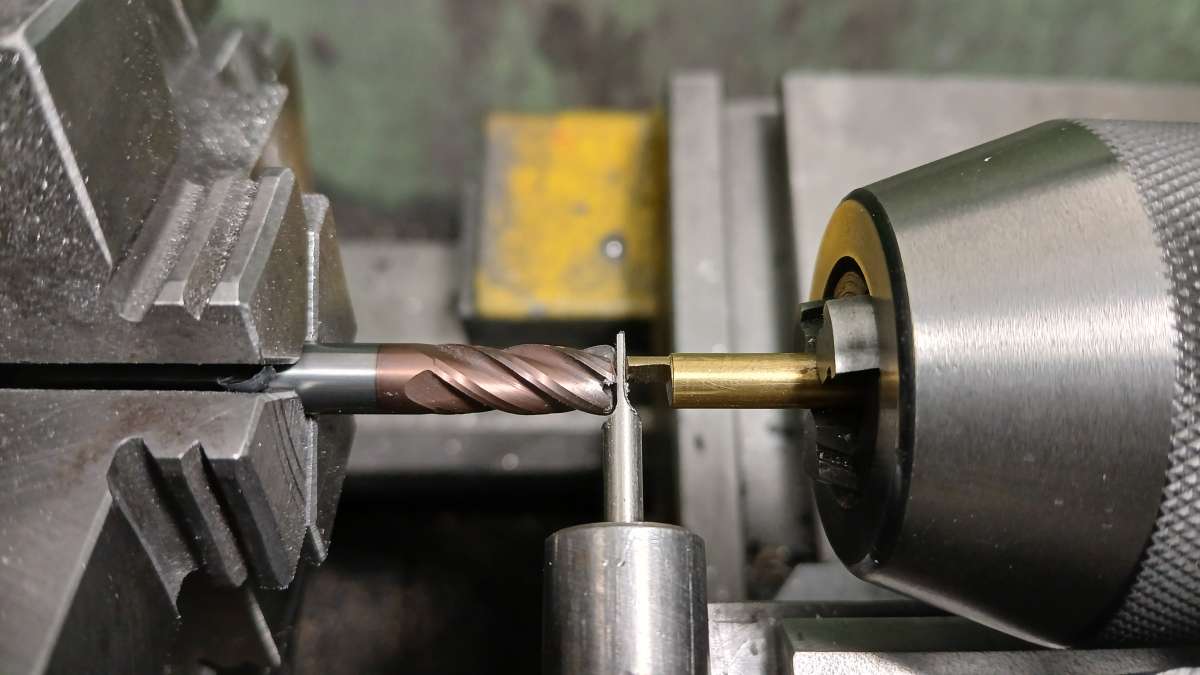
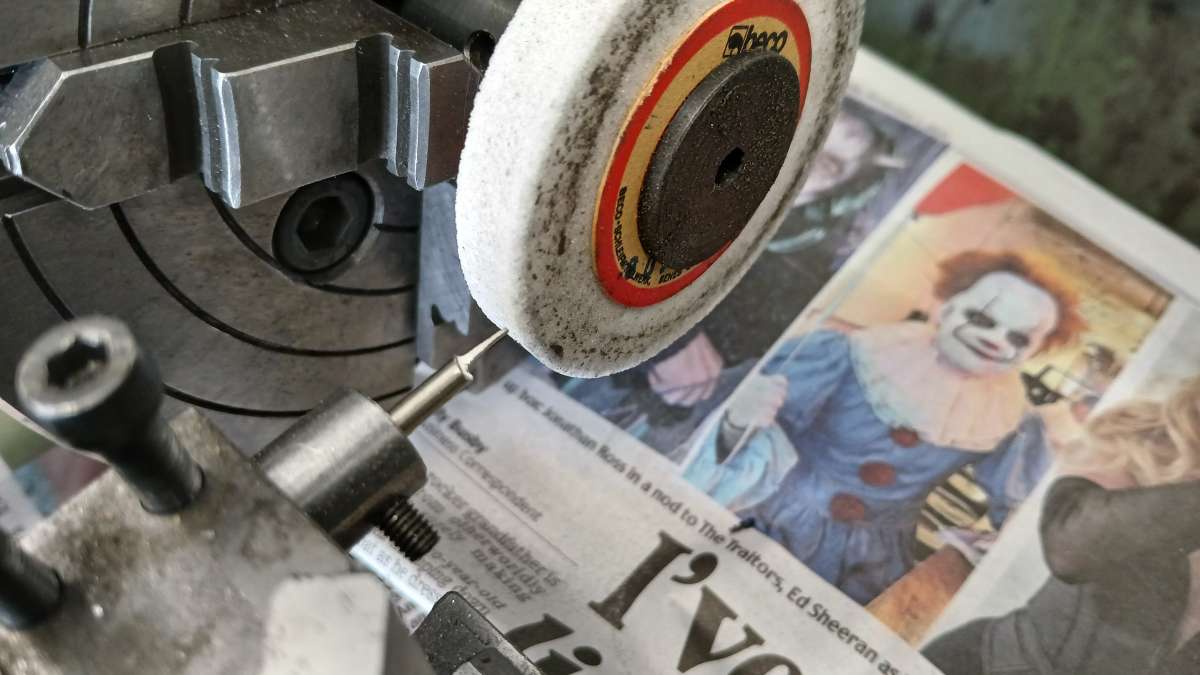
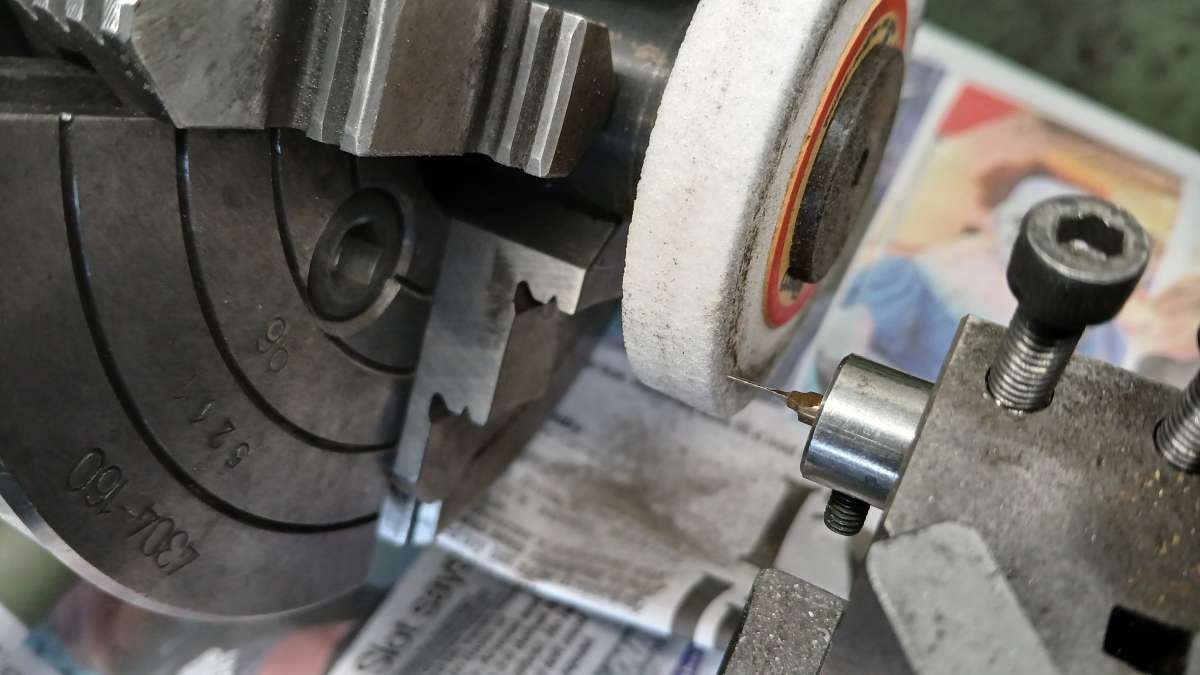
                                          Simple setup to do the flats, just rotate to do the other sides. A 3-jaw will do to hold the cutter, I just had the 4-jaw on the lathe. Bit of brass stops the work deflecting away from the tool.


                                          20251102_093836

                                          If you really wanted to grind the last little bit than the same setup can be used with a decent sized grinding wheel so no need for fancy high speed spindles to get the periferal speed up, the old Flexspeed will spin a 4″ wheel fast enough.

                                          #822789
                                          richard3267
                                          Participant
                                            @richardrogalewski21509

                                            Hi. Thanks for the comments. Yes, indeed, I am cutting out a hole from a piece of chipboard.  I need the board with the hole in it and the cut-out part (which will be a circulat plate). I’ve been led (by Copilot) to believe I cannot buy a tool for the job, so that’s why I came on here seeking advice how to make a tool that can make a groove 1mm wide. From what I see, given what is commercially available. I’d need to cut a 10mm deep groove in a series of passes. That means a tool that can be plunged into the wood, a bit further in for each pass. I think that is how it must / could be done.  Jason posted a picture of some cutters that look like what I’m after. Looks like I may need a 1mm long neck cutter.  Not sure if “long neck cutter” is the official description of wjhat I may need. Looks then like I won’t need to make myself a cutting tool. Pity in a way, cutting flats sounded like quite an interesting task to accomplish. 🙂

                                            #822799
                                            John Haine
                                            Participant
                                              @johnhaine32865

                                              Don’t expect an AI system to give an answer based on real technical feasibility outside what it has been trained on (and not even if it has!).

                                              If you found a way to cut the flats you would probably then find that the tool didn’t cut, got too hot and lost its temper, broke, and was generally a pain.

                                              Though you can buy long 1mm milling cutters, usually designed for metal or composite cutting (e.g. PCB), they are very fragile even  used in a CNC mill where the feed can be carefully controlled.  And you would need a very high spindle speed, and expect to break a few cutters while you learn how to do it.

                                              Why do you need the cut out piece?  Wouldn’t be much easier to use an ordinary router with say a 1/4″ cutter to make the hole, and separately make a circular piece the required diameter, as you have a lathe?  If you don’t have a router it might be possible to use a trepanning tool to make the hole.

                                              #822803
                                              JasonB
                                              Moderator
                                                @jasonb

                                                Even with the cutters I posted you would not really want to be hand feeding those in a plunge router even if guided by a template or using a router compass. If you could go a bit wider with the kerf then a trepaning tool may be an option but depends on the diameter of the required hold. If you can come at it from both sides then that would only mean a 5mm cutter length which stands a better chance of staying in one piece.

                                                Unless you are trying to keep the grain pattern on veneered of melamine faced board I would cut the hole with something more suitable an dthen make a disc from separate material.

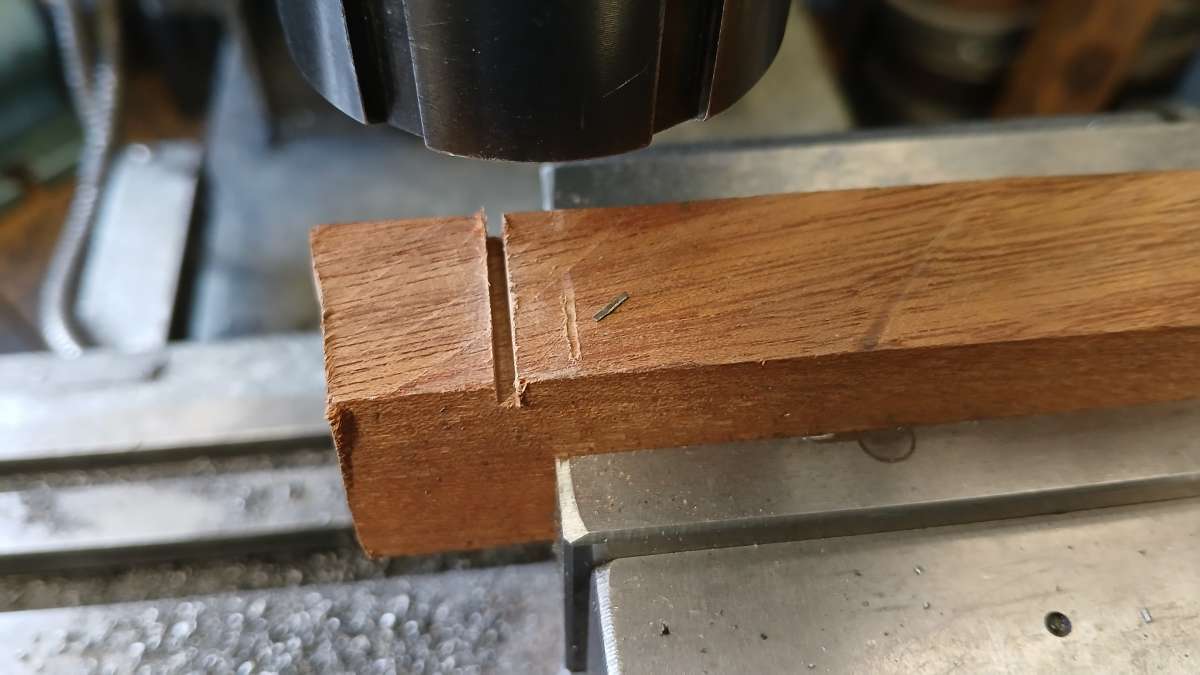
                                                I made one that cut a 1.6mm groove OK in hardwood but the “blade” was only 6mm long. A narrower one did not last very long. I was feding these with a milling machine and only going down 0.2mm per pass.

                                                20251102_121606

                                                Two possible setups to grind the final size after roughing out with a milling cutter

                                                20251102_114448

                                                20251102_121328

                                                #822806
                                                Bazyle
                                                Participant
                                                  @bazyle

                                                  Rather than mill the whole slot I hope you planned to start by drilling a series of holes along the route spaced to leave just 0.5 mm material between them. Is it chipboard (very course) MDF much finer, or the special engraving versions of MDF finer still. For a start the resin in chipboard is no friend even of large router cutters.

                                                Viewing 23 posts - 1 through 23 (of 23 total)
                                                • Please log in to reply to this topic. Registering is free and easy using the links on the menu at the top of this page.

                                                Latest Replies

                                                Viewing 25 topics - 1 through 25 (of 25 total)
                                                Viewing 25 topics - 1 through 25 (of 25 total)

                                                View full reply list.