Mystery measuring gauge

Mystery measuring gauge

Home Forums Workshop Tools and Tooling Mystery measuring gauge

Viewing 25 posts - 1 through 25 (of 26 total)
  • Author
    Posts
  • #817507
    Graeme Seed
    Participant
      @graemeseed34272

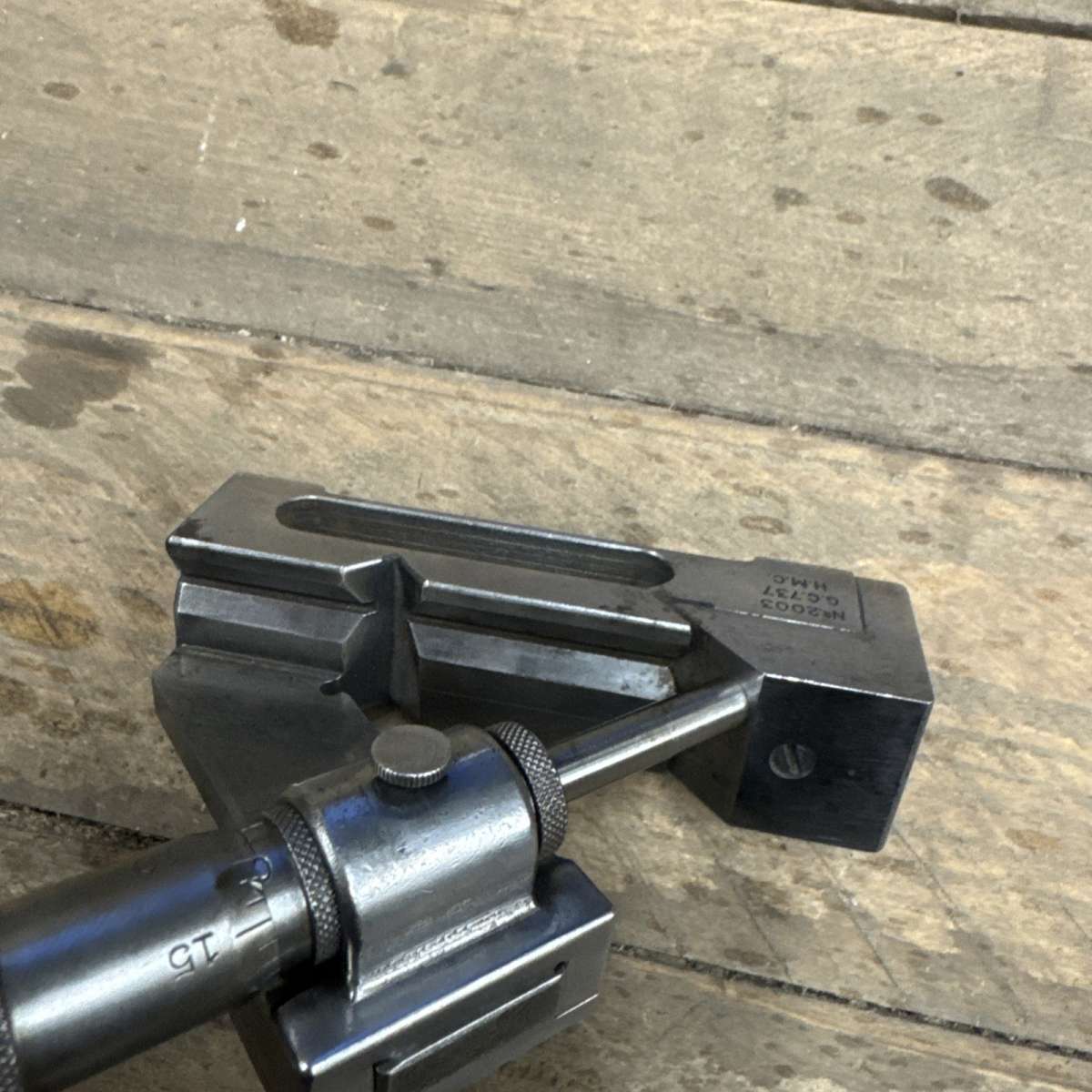
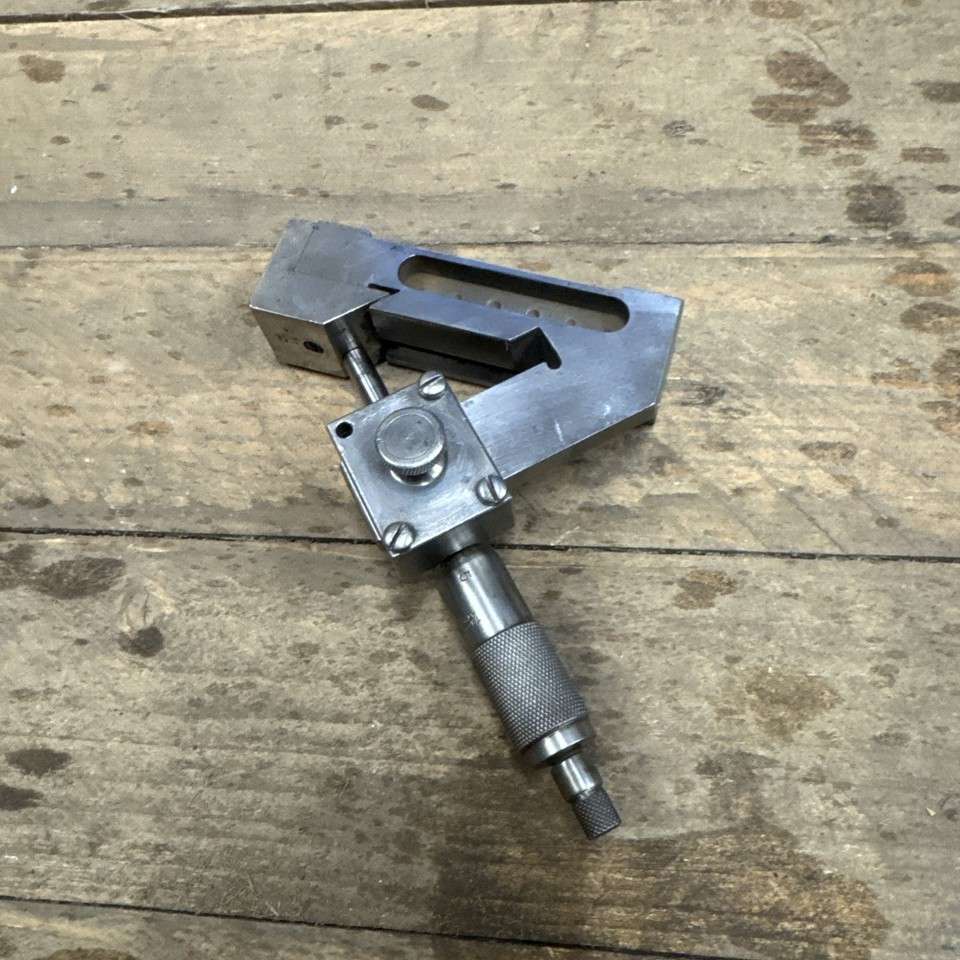
      Hi All, just bought this tool off Ebay to compliment my collection. I can’t figure out what it measures, can anyone out there?

      It can move up and down, side to side and also has a Starrett 0-1 stick mic attached. There is a 90 degree channel and 2 small cross channels at its rear end. It’s all angled at 45 degrees. Searched Starrett catagologs with no success. There are stamped letters and numbers on it, as follows.

      No 2003

      G.C. 737

      H.M.C.

      micrometer measuring tool1micrometer measuring tool2


      A well made tool but a total mystery to me!

      Thanks for any enlightenment, Graeme.

      #817511
      Nigel Graham 2
      Participant
        @nigelgraham2

        Not for testing drills or milling-cutter tips, after grinding, perhaps?

        #817528
        DC31k
        Participant
          @dc31k
          On Graeme Seed Said:

          Searched Starrett catalogs with no success

          Starret sold their micrometer heads as a separate item, for incorporation into any device that needed its functionality.

          If you had a vehicle with a bolt in it with GKN stamped on the head, would you search the GKN cataloge to find the vehicle?

          #817530
          Diogenes
          Participant
            @diogenes

            The ‘widthways’ short channel looks simply to be so that the corner of the saddle has somewhere to go when it gets to that end, so a bit of a red-herring as to purpose.

            What’s the angle between the anvil and the sloping guide surface that meets it?

            #817534
            Nigel Graham 2
            Participant
              @nigelgraham2

              Note too that the anvil appears easily removeable, as if to be exchanged with others of different sizes.

              #817550
              Robert Atkinson 2
              Participant
                @robertatkinson2

                Looks like a custom job. Judging from the dimples at the bottom the slot in the side was drilled before milling. It says HMC on the side. A web search brings up this:

                Welcome

                Robert.

                #817553
                Tony Pratt 1
                Participant
                  @tonypratt1

                  Definitely a custom tool made to check a specific component feature, these sort of gauges are common in mass production machine shops.

                  Tony

                  #817582
                  Nigel Graham 2
                  Participant
                    @nigelgraham2

                    If so at least part of the identifier stamped on it could be that of the component being inspected, not this tool itself.

                    #817594
                    Graeme Seed
                    Participant
                      @graemeseed34272

                      Hi , cant see it measuring these as its angled at 45

                      #817596
                      Graeme Seed
                      Participant
                        @graemeseed34272

                        Hi, I’m only asking the forum for identification, not condemnation. Your comment is noted.

                        #817598
                        Graeme Seed
                        Participant
                          @graemeseed34272

                          Hi, the small channels are 60, with slightly different lengths. The longer channel V shape is 120.

                          #817600
                          Graeme Seed
                          Participant
                            @graemeseed34272

                            Hi, could be interchangable anvils. It’s extremely well made.

                            #817602
                            Graeme Seed
                            Participant
                              @graemeseed34272

                              Hi after stripping and cleaning its a beatiful shiney example. Tight tolerences and mic reading true.

                              #817604
                              Graeme Seed
                              Participant
                                @graemeseed34272

                                Hi, its too small to measure anythjing on massive gearboxes. it’s got a v trough and a 45 degree flat anvil and a mic pointing at 45. the component it measures must have a base circle and a 45 degree angled flat square or rectangle attached, machined or ground on front and back and thickness evaluated with the mic. I haven’t come across anything shaped like this.

                                #817606
                                Graeme Seed
                                Participant
                                  @graemeseed34272

                                  Hi, if we can find out the industry, we are sure to get an answer.

                                  #817608
                                  Graeme Seed
                                  Participant
                                    @graemeseed34272

                                    Hi very true, thanks.

                                    #817612
                                    SillyOldDuffer
                                    Moderator
                                      @sillyoldduffer

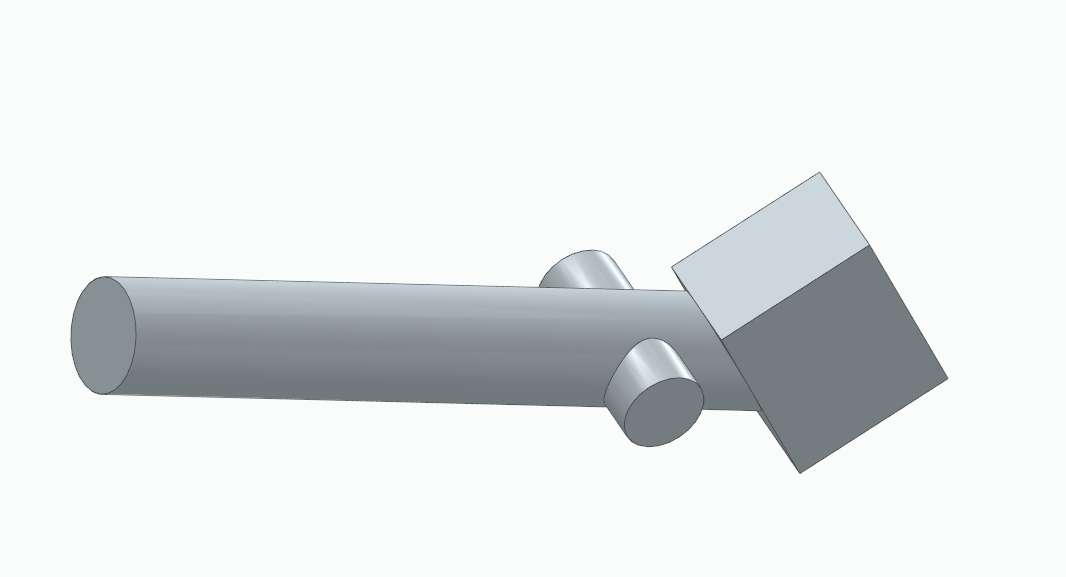
                                      Had a go at modelling the object being measured based on the V guides and micrometer angle and got this:

                                      Screenshot 2025-09-27 164228

                                      Grace’s Guide list a firm called H.M.C Wheels, who made castors.  Mobile steps usually lock the castors when weight is applied so that the steps won’t move with anyone on them.  The item I modelledabove might be part of the brake.  The trunnions connect to the wheel, whilst the square end presses on a brake lever.   It’s part of a more complex assembly.

                                      As brakes are safety critical, an inspector might well need to check tolerances.  The gauge suits the old sampling method of quality control, where an item is selected randomly from each batch.  The method has many disadvantages and though once very common is, I believe, almost completely obsolete now.  But huge numbers of special QA gauges were needed back in the day.  I think this is an example: made specifically to check part of one part only, not general purpose.

                                      I guess the markings identify the company, the tool-room’s gauge reference number, and the part number of the item being measured.

                                      I’m joining the dots again and might be completely wrong.  Feel free to suggest other shapes and what they might be for!

                                      Dave


                                      #817624
                                      peter1972
                                      Participant
                                        @peter1972

                                        The small U-shape slot near the transverse V-channel has to be important.

                                        I doubt the long slot is just to reduce weight: is this designed to be clamped down to a table?

                                        I expect the anvil has two screws into the end of the object to firmly locate it but not visible in the photos.

                                        #817679
                                        Nigel Graham 2
                                        Participant
                                          @nigelgraham2

                                          Not just clamped to a table: it could even have been part of a more comprehensive tool-room or inspection-room assembly.

                                          Dave’s suggestion of measuring castor parts, makes me suggest perhaps not their components directly but the press-tools needed to make them. They are normally stamped and folded from sheet-steel, at least on the smaller sizes.

                                          #817697
                                          cogdobbler
                                          Participant
                                            @cogdobbler

                                            Seems unlikely that run-of-the-mill steel pressings or other mass production parts such as castors would be measured with a micrometer to such a precision level. Never saw it done with stamped automotive components when I worked in that industry, including safety-critical parts. Simple go-no go gauges perhaps, but not mikes. And the press tooling would be measured on a surface table etc , not with a specially made jig (yes I know it’s technically a fixture!) like this one. This one looks a bit special. More the likes of aerospace, fuel injectors, engine parts, turbine blades, medical or similar high precision, low volume production parts where tolerances are fine, QC is critical and probably done on every part produced.

                                            Or it might be for setting up cutters on some kind of production machinery. Or any one of countless other things!

                                            Still, it’s a nice bit of kit to have and admire, and certainly a conversation piece. You will be able to confound the experts with it for many a year methinks.


                                            #817729
                                            old mart
                                            Participant
                                              @oldmart

                                              Normally, any special tool would have an inspection or job related number or code marked on it.

                                              GC might be a firms initials.

                                              Trouble is that so many companys both sides of the pond have fallen by the wayside since WW2.

                                              #817802
                                              Pete
                                              Participant
                                                @pete41194

                                                H.M.C. might even be the initials of whoever made it if it was for there own tool box. And it looks old enough and if that was anything to do with the company name, it might be long gone by now. It looks either built by a tool maker, or Starrett would custom build whatever the customer needed and even a full design by them to do what you wanted. But I’m sure if they made it, there name would have been engraved or stamped on it somewhere. The letters and numbers, possibly an inventory identifier or linked to a specific part, larger assembly, etc. Lots of possibilities.The inside corner relief cut is much larger and far deeper than usual, plus an additional radius on one end of the slot, there had to be a very good reason to have that.

                                                I’d guess it was properly hardened, tempered and surface ground after the initial machining.Too many different industries, uses, widgets and special requirements to guess what it might have been required for in my opinion and without more information. And tools travel, there’s nothing saying it started life in the UK, but nothing saying it didn’t. The working face opposite the micrometer anvil looks to be removable in an L shape piece for regrinding it maybe. So that was thought important. Or maybe different anvil faces could be used. Could be something for measuring in an abrasive environment or the parts were? It may not even be for individual parts, setting or checking adjustments inside a complex machine might be another. Then there’s military, aircraft or almost anything else.

                                                #818016
                                                Graeme Seed
                                                Participant
                                                  @graemeseed34272

                                                  Hi All, many  thanks for all your contributions. I’ve been measuring things on this tool and here’s a few of them plus some thoughts.

                                                  The micrometeter can riise and fall some 1/4″. The mic spindle is centered with the V groove. The cross V’s are 2 1/2″ from the bottom of the 45 degree anvil block, this is held in position with 3 screws. The mic reads true and is adjustable by pushing it in and out of it clamping holder. I’m using a 0.1″ slip gauge and raise the mic up a bit to allow a 3/16 rod to go up to the slip. The slip would need to be drilled [or something softer] but the square end of the tip of the rod can”t go into a 3/16 hole as its halfway down below the bottom of the slip because of the slips 45 angle. So a larger diameter rod id needed, say 3/8. This size has the same problem albeit not as much as the smaller one. I would turn a smaller dia to 3/16 and it will sit in the slip. With a thicker slip, say 1/4, the rod could be a press fit or a running fit. If a cross round piece was centred on the 3/8 rod and drilled and fitted, anything turning this small rod will tilt the slip piece up and down, but the slip must not be allowed to fall off.Welding or riveting or screwing the tip into the slip is a no no unless the slip is thicker and the rod can be screwed in but part of the thread will protrude on the other side of the slip???? destroying the measuring. Using a thicker and thicker slip block tends to bring its face towards the cross pin. A max of 5/16 is possible for a cross pin. The radiused cut out can utilise a small insert, radiused at its top to jamb the cross pin in position, every different size of cross pin would need a different jambing piece?????? Wierd. Which industry? I keep thinking of guns and rifles and those precision parts but haven’t a clue as I know nothing of these items.

                                                  Bye for now, my heads banging! Graeme.

                                                  #818043
                                                  SillyOldDuffer
                                                  Moderator
                                                    @sillyoldduffer
                                                    On Graeme Seed Said:

                                                    …I’ve been measuring things on this tool and here’s a few of them plus some thoughts.

                                                    The radiused cut out can utilise a small insert, radiused at its top to jamb the cross pin in position, every different size of cross pin would need a different jambing piece??????

                                                    Wierd. Which industry? I keep thinking of guns and rifles and those precision parts but haven’t a clue as I know nothing of these items.

                                                    Bye for now, my heads banging! Graeme.

                                                    Best not to think of it as a ordinary workshop tool.   We’re pretty confident it’s a special gauge made to measure one particular part, and nothing else.  Or as Pete suggests, used to set a part within a machine.

                                                    Such gauges make sense within the context of the “American System of Manufacture“.  This replaced skilled craftsmen using general-purpose methods with machine tools making interchangeable parts to tolerances.  The method is for mass production, where time is of the essence, and most of the workers are unskilled or semi-skilled, with quality assured by a hierarchy of inspectors.

                                                    A multitude of special precision made jigs, fixtures and gauges are required.  Typically made to high-accuracy in the tool-room.   And, because, jigs, fixtures and gauges are subject to wear and tear, they too have to be checked, creating a major need for gauges to check gauges!   Though quite a lot of checking can be done with off-the-shelf measuring kit, bespoke gauges are much faster in operation and more reliable on a production line.  A factory knocking out millions of widgets can’t afford to waste time measuring them with bog-standard micrometers.

                                                    Mass producing anything other than the simplest machine might require hundreds of special gauges.   So bespoke jigs, fixtures and gauges were beautifully made in huge numbers, but rarely survive because they’re mostly useless for anything else.    This example may have survived because the micrometer head is easily repurposed, unlike the body!

                                                    Could be from any sphere of manufacturing, UK or abroad: engines, guns, textiles, machine tools, telephone exchanges, marine, aeronautical, mining, printing etc, etc, etc.   And Pete’s setting tool suggestion widens the field enormously.

                                                    Unless someone recognises it, best hope is the markings.   Grace’s guide list a few possibles for HMC: H.M.C Wheels, Harrison McGregor & Co (Harvesting & Food preparation), and the Hepworth Manufacturing Co (Cinema equipment).   Less likely: Hushabye Manufacturing Co (baby stuff); Hart (Melbourne) & Co (Cigars);  Hatch Mansfield & Co (Cigars & Spirits); Heath Mackin & Co (Leather goods);  Hence M & Co (Cotton); Hicks Meake & Co (Exporter), and the Hollins Mill Co (a major cotton spinner).    Grace’s Guide is very interesting, but not complete.

                                                    G,C might be the inventory abbreviation for GAUGE, CHECKER or some such.

                                                    It’s a curio.  I wouldn’t waste any time trying to use it!

                                                    Dave


                                                    #818109
                                                    Graeme Seed
                                                    Participant
                                                      @graemeseed34272

                                                      Hi All, a great responce for this unusual shaped jig, many thanks. I asked the ebay seller some questions, like, where did he get it from, a workshop clearance, car boot, etc. He obtained it from a antique trade fare in  Malvern, cannot remember the companies name. A brilliant try with identification. Bye for now, Graeme.

                                                    Viewing 25 posts - 1 through 25 (of 26 total)
                                                    • Please log in to reply to this topic. Registering is free and easy using the links on the menu at the top of this page.

                                                    Latest Replies

                                                    Viewing 25 topics - 1 through 25 (of 25 total)
                                                    Viewing 25 topics - 1 through 25 (of 25 total)

                                                    View full reply list.