Larger tools for quick release toolpost

Larger tools for quick release toolpost

Home Forums Manual machine tools Larger tools for quick release toolpost

Viewing 18 posts - 1 through 18 (of 18 total)
  • Author
    Posts
  • #817617
    Rowan Sylvester-Bradley
    Participant
      @rowansylvester-bradley37244

      I bought a 250-000 quick release toolpost for my small lathe (a Portass PD5). Fron what I can see, the tool holders only accommodate tools up to 12mm thick. Does anyone make a tool holder for this system that will take a larger tool?

      Thank you – Rowan

      #817620
      DC31k
      Participant
        @dc31k

        The challenges with using a larger tool than that for which the system is designed are:

        (1) it may be difficult to get it low enough so the tip is on centre height;

        (2) the tool holder may have to be lowered below the height where it would hit the top slide;

        (3) the base of the tool holder may be so thin it does not support the tool well.

        The shanks of most insert tooling are not very hard, just a bit tough. It can be easier to reduce that part of the shank that sits in a standard holder, leaving the part that overhangs the holder full depth (with a nice radius, not a sharp corner at the transition).

        Measure how much you have from top of top slide to centre of rotation and assess what would fit.

        #817636
        dk0
        Participant
          @dk0
          On DC31k Said:

          The challenges with using a larger tool than that for which the system is designed are:

          (1) it may be difficult to get it low enough so the tip is on centre height;

          (2) the tool holder may have to be lowered below the height where it would hit the top slide;

          (3) the base of the tool holder may be so thin it does not support the tool well.

          The shanks of most insert tooling are not very hard, just a bit tough. It can be easier to reduce that part of the shank that sits in a standard holder, leaving the part that overhangs the holder full depth (with a nice radius, not a sharp corner at the transition).

          Measure how much you have from top of top slide to centre of rotation and assess what would fit.

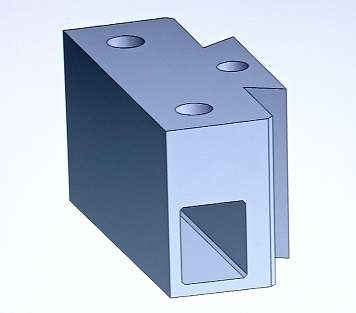
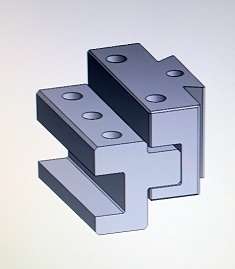
          To solve the problem of the tool height, I created a tool holder with a square seat

          and the lower part 2.5 mm thick.

          20250927_224121

          #817643
          Charles Lamont
          Participant
            @charleslamont71117

            Neat idea, but not so easy to make. Anyway, why do you want to use such large tools?

            #817652
            duncan webster 1
            Participant
              @duncanwebster1

              8mm high speed steel is plenty big enough for a Portas lathe, I did a lot of work on my ML7 (similar size) with 1/4 square

              #817654
              cogdobbler
              Participant
                @cogdobbler

                Machine down the shank of your large tool holder with a milling cutter held in the lathe chuck and the tool holder held In  your old conventional 4 way tool post.

                #817663
                DC31k
                Participant
                  @dc31k
                  On dk0 Said:

                  I created a tool holder with a square seat and the lower part 2.5 mm thick.

                  How would you make one from solid material?

                  What methods exist in a home workshop to create the square hole in a cost-effective manner?

                  How does it solve the problem of the bottom of the holder needing to be below the top of the top slide in order to put the tip on centre height?

                  Any design needs to take account of the surrounding physical objects, for which measurements of an actual machine are required.

                  #817667
                  noel shelley
                  Participant
                    @noelshelley55608

                    I had this trouble on the Myford,  where the centre height in the 4 way tool post is 5/16ths above the holder slot. The smallest tipped holder I could get from the supplier was 10mm. Mounted the new holder across the the 3 jaw chuck and took 2.5mm off most of the bottom. Worked like a charm. Noel.

                    #817670
                    David George 1
                    Participant
                      @davidgeorge1

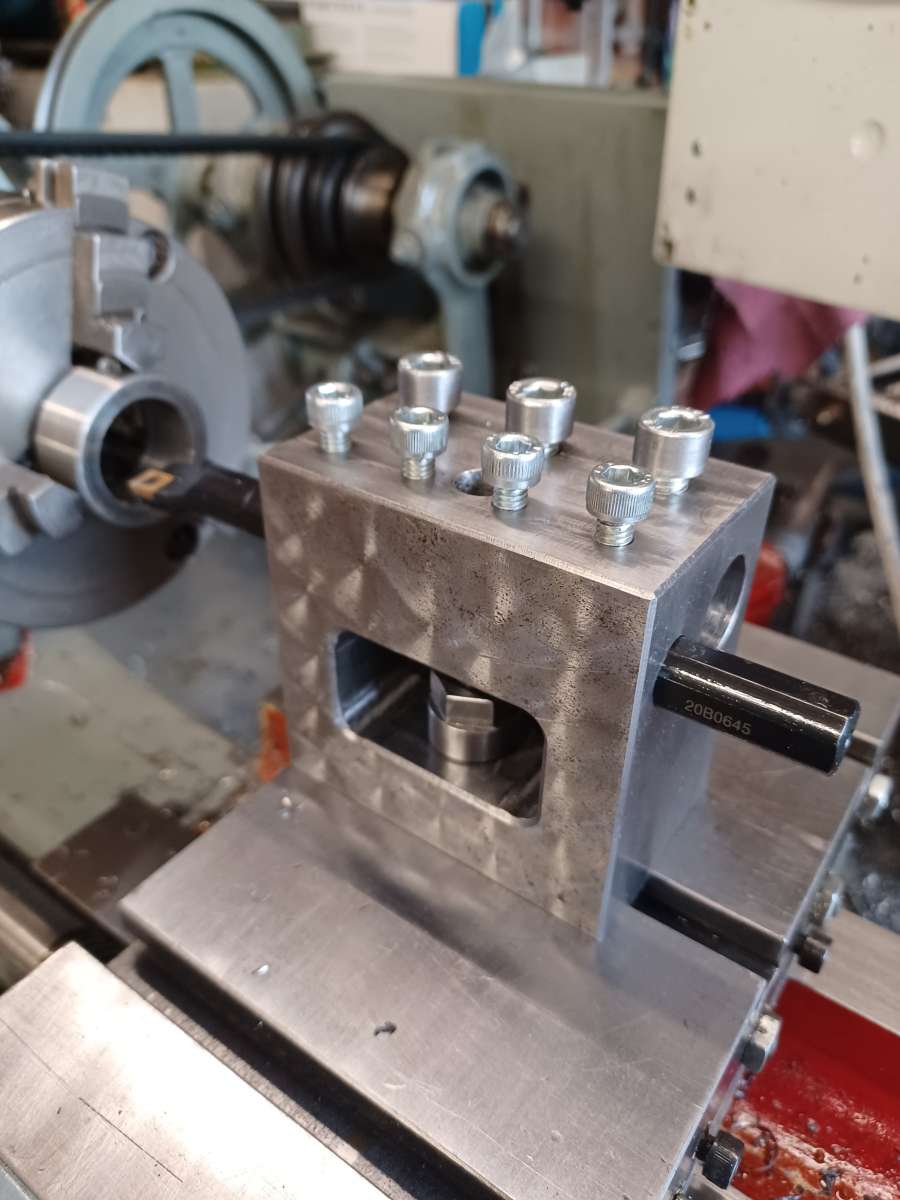
                      I had a problem with larger tools like screw cutting holders for the full form tip tools were unable to fit in the toolholder so i made a solid block with the bore on the center height of the spindle to hold these.

                      20230702_201308

                      20230910_171836

                      20230811_161359

                      David

                      #817672
                      SillyOldDuffer
                      Moderator
                        @sillyoldduffer
                        On Charles Lamont Said:

                        …  Anyway, why do you want to use such large tools?

                        I wondered that too!   Could Rowen explain please?  Might be my lack of imagination or ignorance, but I can’t think of a good reason for using oversized HSS in a lathe.  I’m ready to be educated!

                        I know of a bad reason.  It’s buying some 12mm HSS cheap and then discovering it doesn’t fit.  As HSS is extremely hard, it’s not practical to grind large lumps down to size.   So rather than waste money, let’s modify the lathe or tool-holder instead! Hope that’s not Rowen’s reason!  Unfortunately the modification reduces rigidity, which is the main advantage 12mm tools have over 10.  Small lathe, rigidity reduced by a QCTP, and then modified to take oversized cutters…

                        My lathe is considerably bigger than Rowen’s.   For what it’s worth, though it happily takes 1/2″ / 12mm tools, I only use them about 10% of the time.   I find 10mm tooling more comfortable on my lathe because next size down gives better access to the work and are rigid enough for most purposes.  The relative sizes of the job, tool, tool-post, and saddle are “about right” for 10mm.  In contrast, though 12mm tools work well, especially roughing out, they feel agricultural, like wearing muddy welly boots to a wedding!   I have 8mm tools too; occasionally useful, they feel too delicate for most jobs.  They were just right on my mini-lathe.

                        As always, much depends on what the lathe is used for.  Rowen may have a good reason that I don’t understand yet!   I could modify my 12mm capable lathe to take 16mm tooling.  Could be done, but lots of bother for no obvious return.  Am I missing something?

                        Dave


                        #817687
                        cogdobbler
                        Participant
                          @cogdobbler
                          On cogdobbler Said:

                          Machine down the shank of your large tool holder with a milling cutter held in the lathe chuck and the tool holder held In  your old conventional 4 way tool post.

                          Sorry, by tool holder in that post I meant the shank of your oversized indexable tool, ie the insert holder. It was late!

                          If you are wanting to accommodate 12mm HSS, it’s not worth the effort to grind them down. But the shanks of indexable carbide tooling can usually be machined thusly.

                          #817705
                          JasonB
                          Moderator
                            @jasonb

                            Two reasons that spring to mind why someone may want to use large shank tool.


                            1. Stickout, if access means you can’t get in close with the tool post or you are boring a deep hole then a thicker tool will be the best option. My lathe is the same size as Dave’s yet I sometimes use 25mm shank and 28mm shank boring bars.

                            2. Wanting to use a specific insert that does not come in a small inscribed circle size such as for threading a reasonably coarse thread with a full form insert. One of my threading tools was bought with a rectangular section shank, this enables me to use larger inserts but still keep the tip height below ctr, similar if you machine down the bottom of the insert holder.

                            Otherwise 12mm or considerably less wil be fine for most other work.

                            As has been said measure from the top of the top slide to a ctr in the spindle. That will be your max cutting tool height for tools clamped directly to the top slide like the lathe was originally intended to. Deduct a sensible amount for the bottom lip of any QCTP holder from that say 4-5mm and that will be the max height for any tools held in the QCTP less a bit for grinding if HSS.

                            #817735
                            dk0
                            Participant
                              @dk0

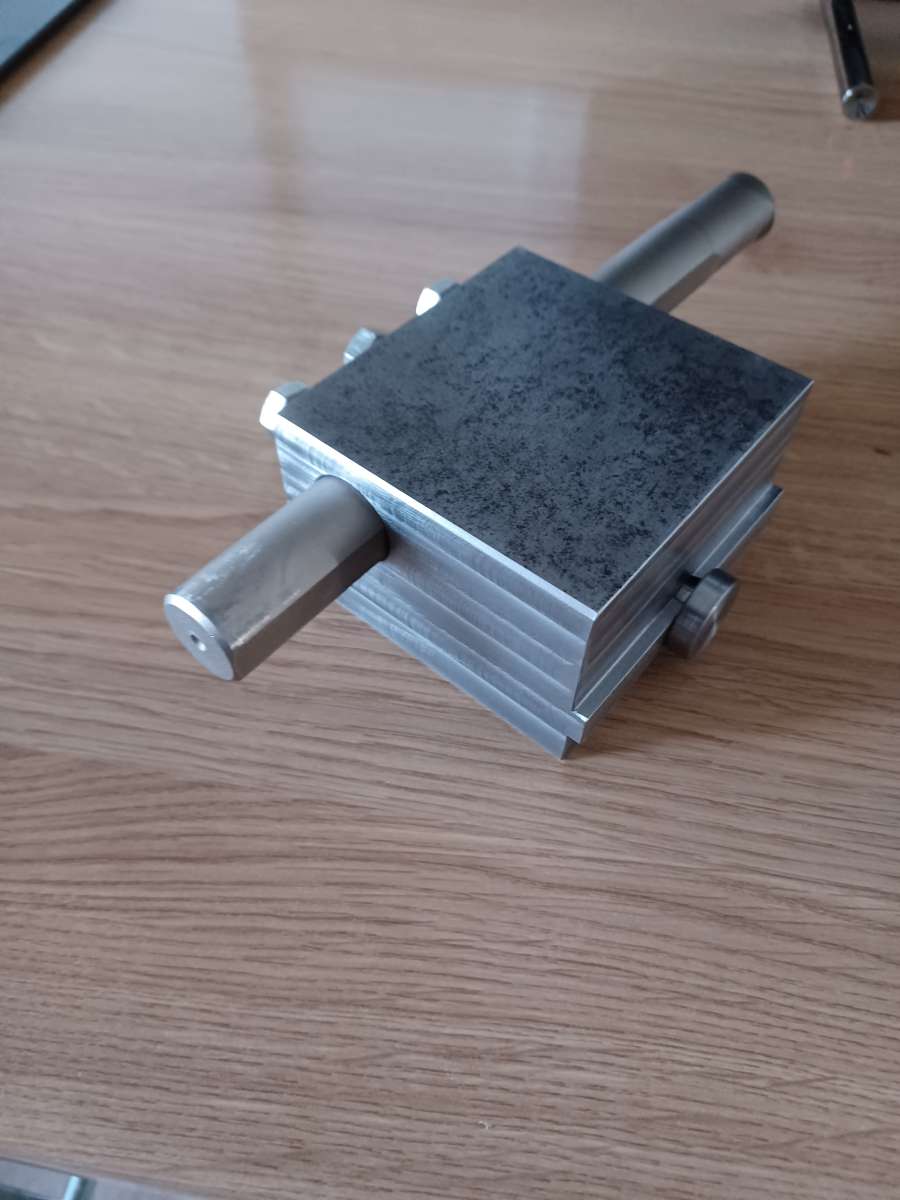
                              This could be an alternative solution for any home workshop !


                              20250928_153829

                              #817737
                              old mart
                              Participant
                                @oldmart

                                12mm tool sizes is an excellent size for this class of lathe. It would have been suitable for the museums Atlas 12 x 24 lathe too, but I couldn’t resist making a much longer cross slide for it and factored in height for toolposts able to accept tools set at 17.53mm to directly share tools with the Smart & Brown model A.

                                Another method which I have used with four way toolposts to hold larger boring bars is to reduce the thickness of the top where the clamp screws go through. This is only applied to one side of a four way, but could be done to a couple of QC holders. Perhaps a compromise with a little taken of both top and bottom of the holder.

                                #817743
                                Clive Foster
                                Participant
                                  @clivefoster55965

                                  Further to Jasons points about stickout issues and the corresponding reduction in tool stiffness. Which can absolutely be a major problem when needing the best finish on bores or recessed components such as crankshafts.

                                  When it comes to external turning with HSS tools running a second length of 6mm tool steel underneath the actual cutting tool nearly double the stiffness in vertical bending. Usefully better than the plain 6mm square. Sometimes the two parts effectively damp out chatter too. A plain bar support doesn’t work as well as a second piece of HSS. The high polish on HSS giving more contact area. Maybe consider gluing together with Loctite et al for a bit more stiffness.

                                  Concerning boring tools by the time the necessary flats have been added to support the bar at the bottom, provide something for the holding down bolts to grip and move the bar inwards a bit to get the bolts on centre line 12 mm tool capacity translates to a bar approaching what could be called “ex 30 mm” size to borrow terminology from the timber suppliers. Much differ than simple projection from a 12 mm square shank.

                                  However (engages stuck record mode!) its arguable that now insert tooling costs have dropped enough for “insert first” working to be financially viable the conventional QC toolpost is on its way to being obsolescent for home workshop folk. Being fixed height in the holders, with no variation due to sharpening to accommodate, insert systems do just fine in block style posts. Whether 1, 2 (my favourite), 3 or 4 slot breed. Insert parting blades are pretty much invariably in open sided holders with a block on the side for clamping which also do just fine in block type posts.

                                  Traditionally HSS tooling used in block holders is shimmed to height after sharpening, something of a pain. Alternatively short bits can be carried in Armstrong / J&S et al holders at an up tilt angle for easy eating to height. But such holder which to be a bit cumbersome and burn up space on a small machine unless the never to be sufficiently cursed American lantern toolholder is used.

                                  In principle there is no reason why square tooling should not be carried on an offset open sided toolholder with side block mount of the same stye as the insert parting blade holder. Obviously incorporating up tilt as on the Armstrong style for height adjustment. No great problem to incorporate side tilt as well so the two upper surface clearance angles are baked in to the holder making sharpening vastly simpler for ordinary folk.

                                  All it needs is some form of quick release mechanism and accurate replacement indexing to be an effective, cheaper, substitute for conventional QC systems.

                                  Clive

                                  #817899
                                  Andrew Crow
                                  Participant
                                    @andrewcrow91475

                                    As most turning jobs don’t require use of compound slide take it off and use a larger QTP bolted either directly or preferably via an adapter plate to the cross slide. This could give you up to another 12mm tool depth(or more) ie possibly up to 25mm tool shank even on a Myford 7

                                    Andy.

                                    #817914
                                    Nigel Graham 2
                                    Participant
                                      @nigelgraham2

                                      Trying to grind an HSS tool down to height accurately is highly likely to fail.

                                      A point that seems some here have missed with a QCTP is that of the tool block grounding on the top-slide, so making attempting to use over-size tools fruitless. Work-rounds to miss the slide edge will add extra overhang that is not desirable.

                                      dk0‘s block with its square hole may well help, but as DC31k replies, is tricky to make without suitable slotting equipment  – or considerable filing skill. It could be as two parts with the lower, outer part an angle fitted to the rest with countersunk screws, or welded / brazed before finish-machining. As he also points out, you still need consider the grounding problem.


                                      If the lathe has a T-slotted cross-slide, once could make an adaptor plate that holds the QCTP at the desired height directly from that slide, and that gives a potentially more rigid system, although with two significant disadvantages:

                                      a) It will not let you turn tapers or use half-angle feed for screw-cutting;

                                      b) You lose fine longitudinal feed unless the leadscrew is fitted with a handwheel and dial (or the saddle has a DRO). Though you can often overcome this problem with a saddle-stop set by suitable distance-gauging. Usually but by no means always, the critical dimension is the diameter, not length, within reason.


                                      #817957
                                      Macolm
                                      Participant
                                        @macolm

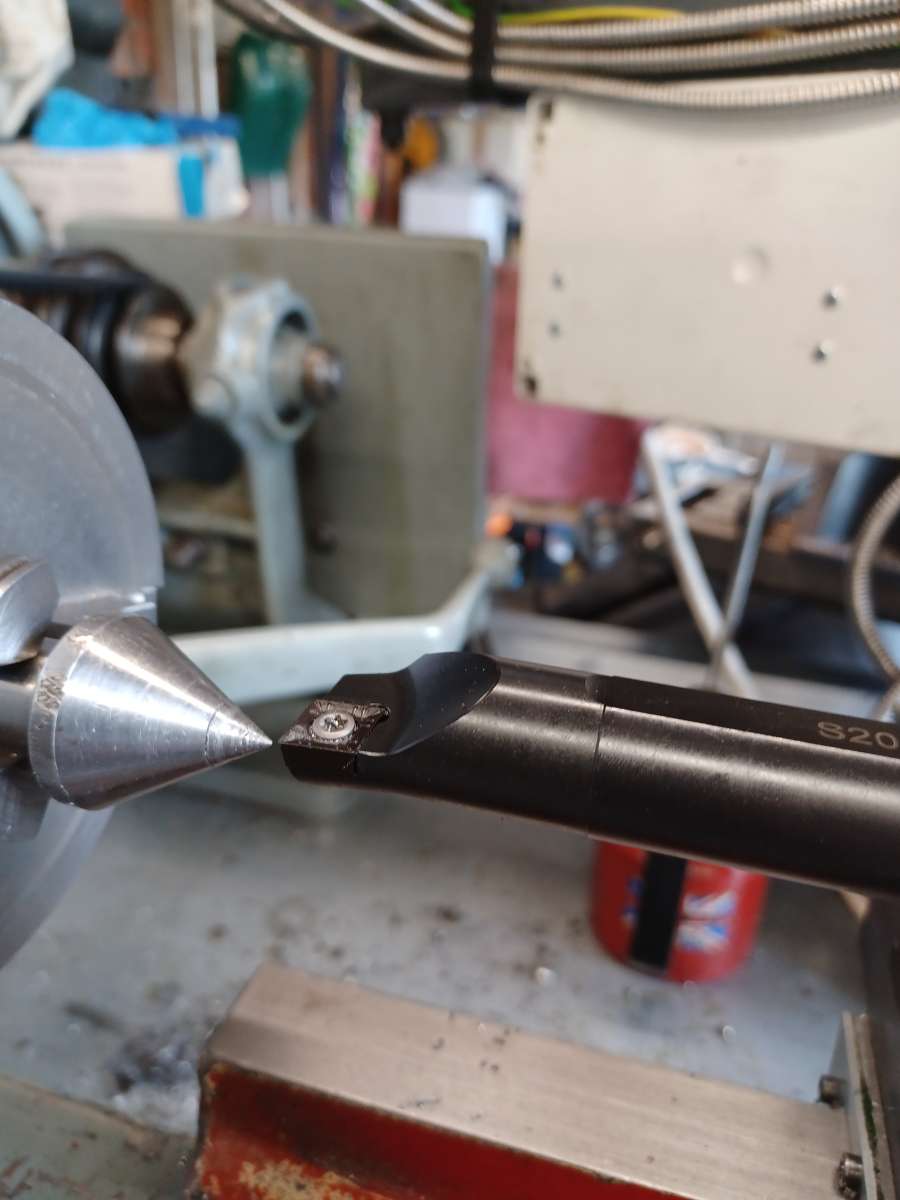
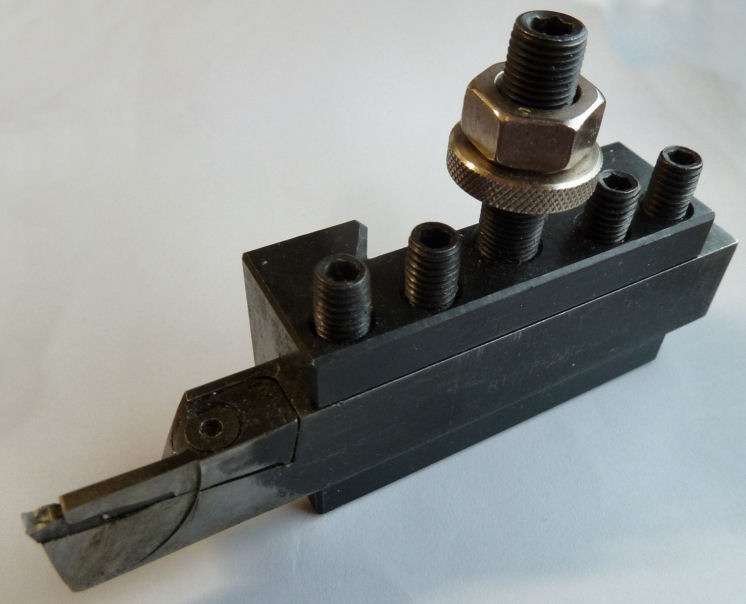
                                        I spotted this as I passed, a toolholder widened by milling with a carbide bit. This allows use of the Mircona grooving tool (cuts on all 3 faces). It is scarcely strong enough for parting anything harder than plastics, but excellent for the intended use.

                                        MirconaV

                                      Viewing 18 posts - 1 through 18 (of 18 total)
                                      • Please log in to reply to this topic. Registering is free and easy using the links on the menu at the top of this page.

                                      Latest Replies

                                      Home Forums Manual machine tools Topics

                                      Viewing 25 topics - 1 through 25 (of 25 total)
                                      Viewing 25 topics - 1 through 25 (of 25 total)

                                      View full reply list.