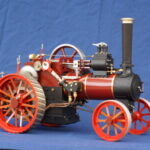
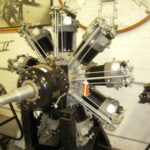
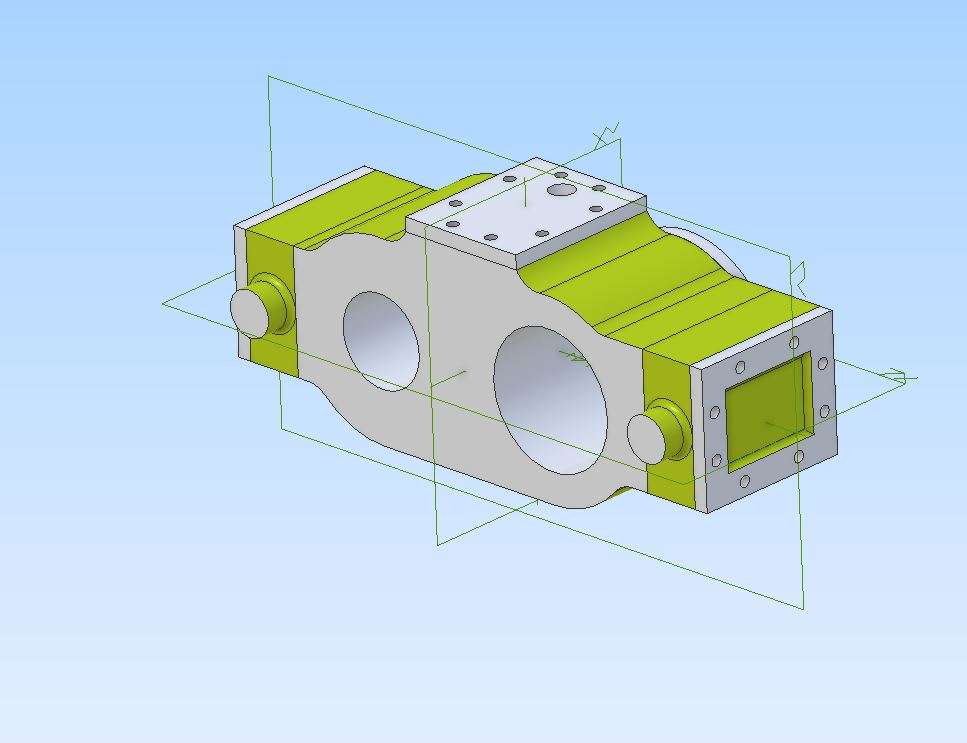
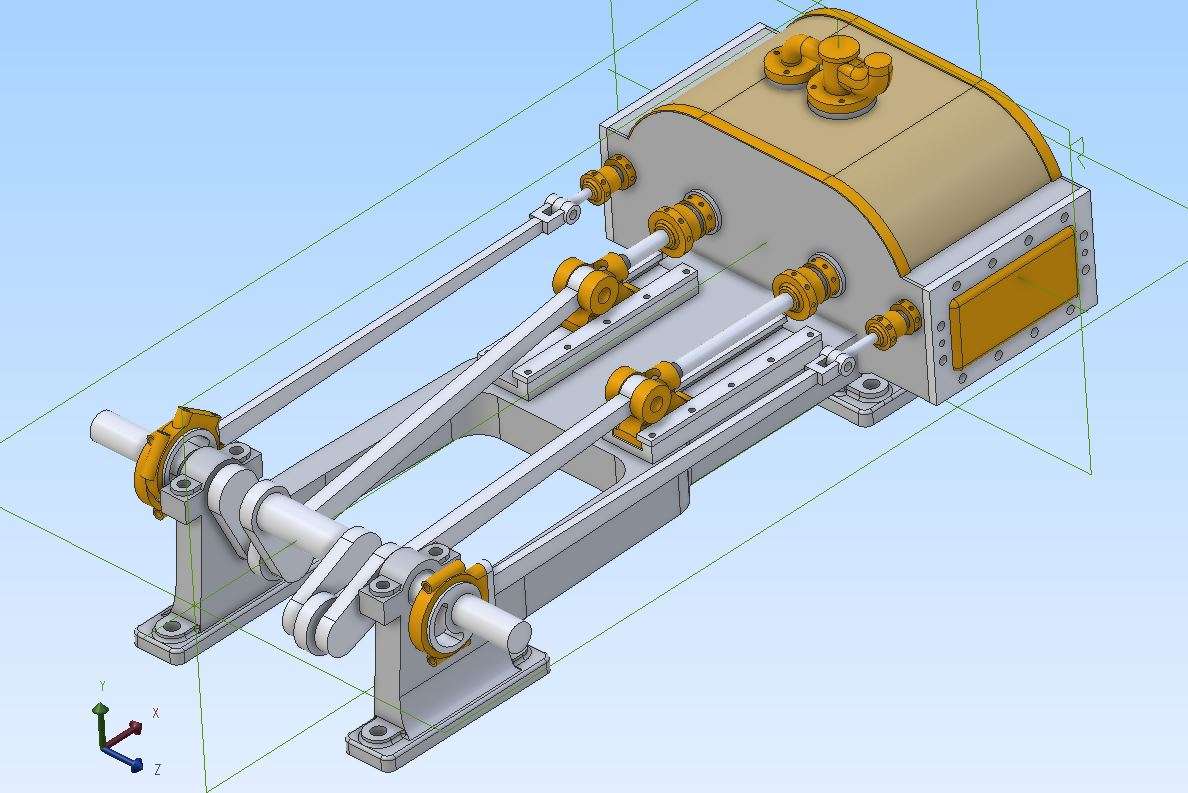
Is anyone interested in developping a new series of model engines?

Is anyone interested in developping a new series of model engines?

Home Forums General Questions Is anyone interested in developping a new series of model engines?

Viewing 19 posts - 1 through 19 (of 19 total)
  • Author
    Posts
  • #856832
    [email protected]
    Participant
      @paulmichael1084gmail-com

      A slightly unusual one this, but would any engineers out there be interested in calaborating to design a new series of model engine kits?

      I have the idea, CAD skills, and resources to refine a design and manufacture it but I lack the knowledge and time to produce designs from scratch.

      if anyone is interested I’d be very happy to hear from you.

      If nothing else I think the venture would be fun!

      #856839
      JasonB
      Moderator
        @jasonb

        Might help if you gave an idea of the type of engines you have ideas for.


        Are they Steam, air, IC, hot air, sterling cycle, other?

        Will they be casting kits, ones that can be made from a pile of supplied barstock, 3D metal printed, ready to assemble as you mention manufacture?

        Scale models of original prototypes or freelance?

        What level of builder will they be aimed at from beginner to advanced?

        Do you have  aprice point and what is your intended market?

        #856842
        [email protected]
        Participant
          @paulmichael1084gmail-com

          Good questions

          The genus of the idea is for a set that would be bought as a kit of parts to be machined, painted and assembled. I would imagine the parts to be a mix of cast parts and cut blanks. Also to supply with fixings etc, maybe even paint. The idea being to be a single kit to make the project accesible.

          As for the type of model, I was thinking of starting with something small (IE shoe boxed size), static and aimed at either beginners to the hobby, or someone more experianced who wants a simple project.
          The idea has formed in my head as a result of wanting to make small working models as gifts. I have experiance of machining, but I’m new to model engineering.

          My initial idea is for a model to run on compressed air but, like every other aspect of this venture I’m open to suggestions.

          My idea is for an entirely new design, made from the ground up in metric. (Yes I am an unashamed ‘metric-o-phile’)

          I don’t have a target price in mind but I’m thinking sub £500.

          #856845
          Baz
          Participant
            @baz89810

            Something on the lines of what Stuart Turner and Hemingway / Reeves offer at present then?

            #856848
            [email protected]
            Participant
              @paulmichael1084gmail-com

              Along those lines yes.

              I confess I was unfamiliar with Reeves, but after digging through their website it would seem all their models are imperial, as I believe the case is with Stuarts. I will do some more research to verify this assertion.

              What I have in mind is metric.
              As someone born in 1979, and having lived and worked my whole life in metric, as well as having all metric tools and machines, imperial is a barrier to these projects.
              And I don’t believe I am alone in that.

              #856849
              duncan webster 1
              Participant
                @duncanwebster1

                <p style=”text-align: left;”>You might do better just doing metric drawings to fit the available castings. I don’t just mean converting 1″ to 25.4mm, but re-doing fully round numbers metric (you might need the odd 0.5mm). You’d need to go into the IPR issues if there are any, perhaps do a deal with Reeves/Stuart so you get a slice every time they sell a set of metric drawings.</p>

                #856858
                howardb
                Participant
                  @howardb

                  Having worked with the whitworth system, the ba system and the metric system since the 1960’s, my opinion is that the current metric fastener system is logical, easier to understand and less confusing than the previous aforementioned.


                  #856872
                  Diogenes
                  Participant
                    @diogenes

                    ..so something more like this then?

                    https://www.bengs-modellbau.de/en/Horizontal-steam-engine-Danni/2171

                    I’m impressed at the price point and wondering how anyone entering the existing market is going to compete with that..

                    #856876
                    JasonB
                    Moderator
                      @jasonb

                      To me “shoebox” size is quite large for a beginner’s model. The typically suggested beginner’s casting kits like a Stuart S50, 10V or 10H, Clarkson, Reeves sould be smaller and you could get two or three of those in a shoebox. Though with modern CAd and pattern making methods it would not be a lot of additional work to offer engines in different sizes. I see this now in other types of kit where you can buy the same subject in several different scale sas all the supplier ha sto do is click a couple of buttons.

                      Likewise your price point of £500 is a lot compared to the above mentioned engines at just over £150each. Beginners will be wary of spending large amounts as they would not want to risk mucking up proportionally expensive castings.

                      I have written a lot here and in my build articles in the magazine about metric being the best bet for anyone new coming into the hobby so agree with that. However if you also want to market your kits at the experienced model engineer, then consider offering just a bar castings package as they will likely have barstock and can use whatever fixings and threads they already have tools for. Yes Reeves and Stuarts only do imperial designs.

                      What Duncan mentions about working with existing designs and suppliers is something I have already done, see my recent article about the Blackgates Clarkson Horizontal where I completely redrew it to suit metric including adding all the detail missed off the old drawings that a beginner would have found difficult to work out. They can now supply metric drawings and due to my article an build thread got several additional sales.

                      To attract a beginner you will also have to give them suitable guidance. All the established kits have many build threads and articles as well as a growing choice of instructional You-tube videos. At the very least a full build description with many photos would be needed and could be included with the kit in the form of a USB stick. You also need to get your designs out there just an advert is unlikely to attract beginners they want to see others have made it and are available to help with questions.

                      Having been involved with other kit suppliers designing new engines, drawings, pattern making and developing the build the main hurdle at the moment is finding suitable foundries that will do good quality small batch or even one off castings. The sure way to put anyone off is to sell them poor castings with defects. I assume you already have a foundry in mind as that would have been one of the factors in working out what your price point would be. I would keep castings to a minimum. Also don’t just design the first engine without thinking ahead, if future additions to the range can make use of the same or slightly modified castings like flywheels and cylinders then that reduces your costs.

                      Along with that do you have experience designing patterns? Things like Draft angle, minimum thickness that wil reliably pour, shrinkage, etc. Then there is the need to make master patterns from which aluminium or PU working patterns can be made and ideally all mounted onto match plates complete with gates etc as that will keep your costs down – loose patterns cost more to cast due to the labour involved.

                      You also need consider what equipment a typical beginner has and allow for that in your design. Will you assume they just have a lathe as old designs do. Or with benchtop mills being a lot more common will you assume they have the use of a mill and then what tooling to go with it.

                      Lastly from delalings with a few kit suppliers ther eis not a lot to be made out of it. If you start having to share your profits with another designer be that a one off payment or royalties with each kit sold then that is going to reduce what you get to keep for yourself. Out of that needs to come advertising, web site, stock, etc.

                      #856879
                      JasonB
                      Moderator
                        @jasonb

                        As for Bengs pricing, once you have bought the CNC then it is probably easier(therfore cheaper) to run batches of the milled parts than it is to cast them. You just need to do enough to cover the capital of the CNC. Even Stuarts have taken to supplying some of the parts that were once hot brass pressings and partly CNC machined items for the builder to complete.

                        Their kits also appeal to the beginner who only has a lathe and no milling facilities, the drilling and turning they can cope with.

                        #856882
                        Robert Atkinson 2
                        Participant
                          @robertatkinson2

                          Maybe I’m just old and cynical, but what struck me is that this is an odd first post on the forum.
                          The poster has provided no information about themselves in the post or their profile. Not even what country they are in.

                          Robert.

                          #856897
                          JasonB
                          Moderator
                            @jasonb

                            I this day and age of electronic communication does it really matter where someone is located. If it means a bigger choice of kits and something for the under 60s in metric then I think that can only be a good thing for the hobby.

                            I don’t just buy models or drawings from the UK. I have built from the US, Europe, Canada, Australia. I also swap designs or do the odd bit of CAD for people around the world. If the Chinese would pull their ready to run engines off the production line earlier and just supply what would be in effect CNCd raw “castings” then I would buy those too. I’m also happy to use 3D metal printed parts on my engines, again sourced from China. Lets face it most beginners will have machines and tooling from overseas so why not the model kits too.

                            #856900
                            JA
                            Participant
                              @ja

                              Why re-invent the wheel? The models are already out there. It is a nice idea but I think you are talking to the wrong people. Most of us are stuck in our ways and while believing that going metric may be a good idea ……

                              It is very difficult the see the future but the good suppliers’ castings are generally sufficiently oversize to accommodate the required small changes in dimensions. It is quite possible to make a true metric model from some imperial casting kits. One of my two projects is a metric Stuart two cylinder compound engine withe metric fasteners and basic dimensions (i.e. whole number of millimetres). The only problem I have encountered is what do you do with a 1/4″ dimension.

                              Eventually the suppliers will have to go metric so it should be more fruitful to talk to them than a lot of old model engineers.

                              JA

                              #856904
                              JasonB
                              Moderator
                                @jasonb

                                He is talking to me so at least one right person.

                                1/4 inch is no problem, just work to 1″ = 24mm.

                                You must be getting your castings from suppliers I don’t know of as most seem to be tight on dimensions with it being hard to get the imperial sizes out of the undersize castings, another reason for the 1″:24mm


                                Interested to see your Compound, I have drawn up a compound cylinder for the score that would only use the sole plate casting and maybe a flywheel from a No7 but not sure if I will make it as I have a more interesting compound on the ‘puter

                                compound score

                                library

                                #856907
                                noel shelley
                                Participant
                                  @noelshelley55608

                                  If the builder is unable to work to 25.4mm on a metric machine with fair accuracy then the whole project is doomed. Just because the the dimensions are metric will not make it much easier to build and as many imperial drawing give fractional sizes even these have to be converted to decimal. A machinist given a drawing will work to the numbers, what ever they are ?  Noel.

                                  #856913
                                  JA
                                  Participant
                                    @ja
                                    On noel shelley Said:

                                    If the builder is unable to work to 25.4mm on a metric machine with fair accuracy then the whole project is doomed. Just because the the dimensions are metric will not make it much easier to build and as many imperial drawing give fractional sizes even these have to be converted to decimal. A machinist given a drawing will work to the numbers, what ever they are ?  Noel.

                                    Noel

                                    I agree with you completely but part of the exercise is to work to a set of rules.

                                    Jason

                                    I am using Stuart castings and bought in bar stock. Stuart’s design uses five 1/4″ diameter pillars to support the cylinder block which I thought was inconvenient when going to metric. My way round is to use three 6mm pillars and two 7mm. I have a half built solid model.

                                    However I am aware that this is someone else’s topic so I will leave it there and may give an update in my own time.

                                    JA

                                    #856918
                                    JasonB
                                    Moderator
                                      @jasonb
                                      On noel shelley Said:

                                      A machinist given a drawing will work to the numbers, what ever they are ?  Noel.

                                      The problem is that most people now coming into the hobby are not machinists, lucky if they did a bit of metalwork and technical drawing at school. What they may have encountered doing DIY or fiddling with cars, etc is also likely to have been metric and any tools they have aquired therfore metric. Many of out suppliers are now only supplying machines with metric handwheel graduations so a lot easier to use those than risk errors converting things they don’t fully understand. Plus metric materials are often cheaper than the imperial ones, same goes for tooling.

                                      #856922
                                      duncan webster 1
                                      Participant
                                        @duncanwebster1

                                        My youngest son, who is in his 30s and did an engineering apprenticeship, simply does not understand inches. I’m in my late 70s and grew up with both systems, I have a metric lathe and an imperial milling machine, but after fitting DRO to milling machine I find metric much simpler. It is time that imperialists got their heads out of the sand and accepted reality.

                                        #856925
                                        John Haine
                                        Participant
                                          @johnhaine32865
                                          On JA Said:

                                          ……The only problem I have encountered is what do you do with a 1/4″ dimension.

                                          …..

                                          JA

                                          How about making it 6.35 mm?  Good practice in working to reasonable tolerance.

                                        Viewing 19 posts - 1 through 19 (of 19 total)
                                        • Please log in to reply to this topic. Registering is free and easy using the links on the menu at the top of this page.

                                        Latest Replies

                                        Home Forums General Questions Topics

                                        Viewing 25 topics - 1 through 25 (of 25 total)
                                        Viewing 25 topics - 1 through 25 (of 25 total)

                                        View full reply list.