Pre-War Myford Leadscrew clasp nuts

Pre-War Myford Leadscrew clasp nuts

Home Forums Manual machine tools Pre-War Myford Leadscrew clasp nuts

Viewing 11 posts - 1 through 11 (of 11 total)
  • Author
    Posts
  • #825783
    milesincam
    Participant
      @milesincam

      Hi all,

      I am restoring a 1935-ish ML1/2 which is generally in very nice condition except for one, rather important and awkward part – the leadscrew clasp nuts are badly worn. The leadscrew on this lathe is the same diameter and pitch as the ML7 (5/8″ 8TPI LH) but unlike the ML7 it is a square thread with essentially zero angle on the flanks of the threads.

      I want to source a suitable tap.  Does anyone know of a supplier in the UK that has even a small chance of being able to match this thread?  All the leadscrew/nut manufacturers here seem to do metric only.  Rempco in the USA do make square thread lead screws / drive screws (for CNCs and similar, square threads are still better in some ways).  I’ve asked Rempco but it would be lovely to find someone in the UK who could source this.

      Worst case I will have to cut a section of thread in some steel, grind it into a rough tap form, try to ensure it is sharp, and then harden it.  That is more work and risk of poor results than I have time for…  the clasp nuts are cast iron so if I’m not careful I’ll crack them. So a nice sharp and accurately made tap would be nice.

      cheers all,

      Miles

      #825793
      noel shelley
      Participant
        @noelshelley55608

        Try Tracy tools down in Devon.

        #825795
        cedric 1
        Participant
          @cedric

          Good luck tapping a 5/8 square thread by hand. A lot of torque required!

          Can you not screwcut the thread in the lathe, making up a stepped repair sleeve , splitting it in twain and soldering the halves into recesses machined into the original half nuts?

          This is commonly done on M_Type Drummond/Myfords. Details are in the Files section of the Drummond/Myford groups on groups.io and FB.

          #825802
          David George 1
          Participant
            @davidgeorge1

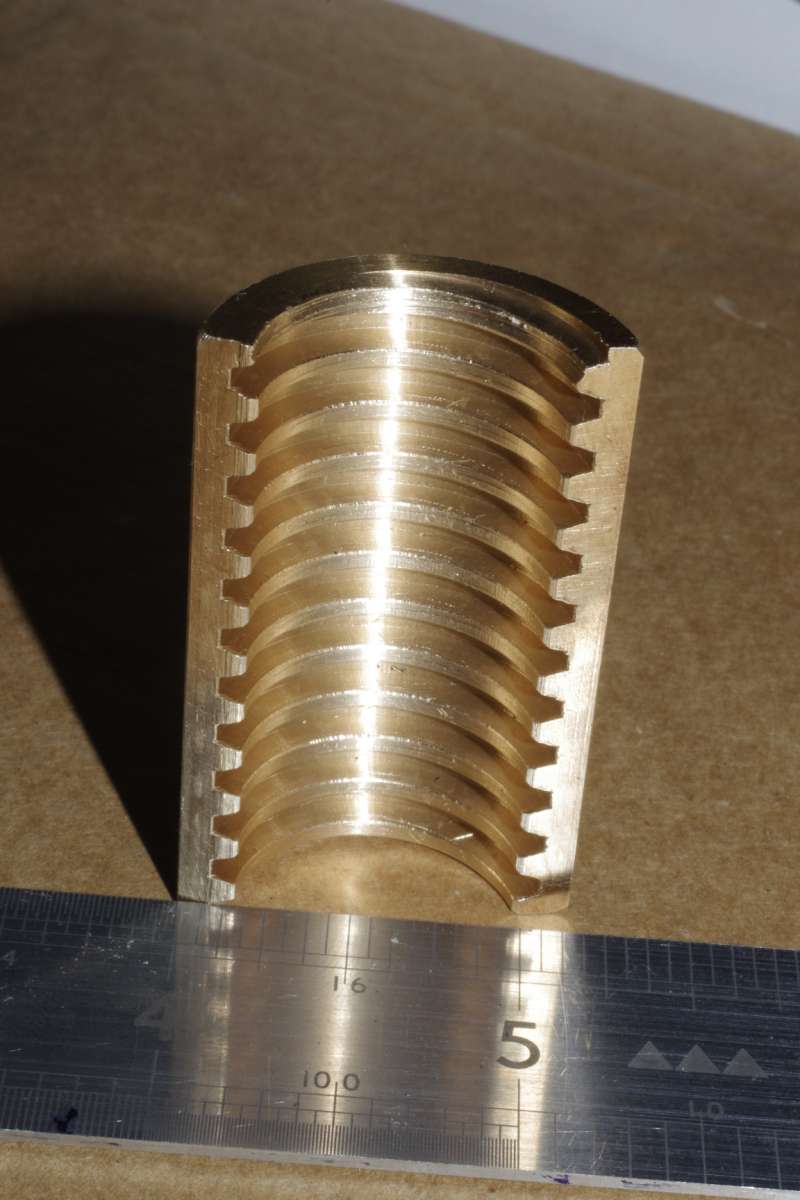
            Hi Miles I from time to time make leadscrew nuts for the M type lathe And they are the same square  thread as your lathe. The M type has only one side threaded and a blank top piece which stops the leadscrew lifting up away from the bottom threaded half. I have a jig to hold the threaded half and a boring bar which fits between the chuck and a tailstock centre and just traverse the saddle over bit by bit till the  thread is correct depth.

            20230818_154647 2

            23 finnished thread

            20230309_144745


            The boring bar Has a cutting piece which is the correct width of the thread and correct depth plus a few thou for clearance on outside diameter of leadscrew. the thread is correct depth when the core diameter touches the nut as it is the same diameter as  core diameter of the nut.

            I have the drawings of half nuts and tools I use for the M Type lathe I think you could use a similar item but you would have to move one half along to allow for  the pitch difference as it rotates around.

            Message me if you want any further info.

            David

            #825804
            SillyOldDuffer
            Moderator
              @sillyoldduffer

              Unlikely to find an off-the-shelf tap.  40tpi square lead-screws were going out of fashion in the 1930s and Myford switched to 8tpi ACME after WW2.

              I’d ask the usual tap/die suppliers to see if they will do a special.  No idea what the cost might be: in my young day, specials were “if you have to ask you can’t afford it“.  These days CNC makes small production runs much cheaper, maybe!   RDG first because of their Myford connection.

              I’d take Cedric’s advice,  maybe varied because I find it easier to accurately cut external threads than internal:

              • remove most of the metal by screw-cutting in the lathe and leave somewhat oversize.
              • make a tap out of Silver-steel.   The tap, being external, is easier to measure accurately.  It need not be particularly strong and sharp because the lathe does all the hard work and ensures 40tpi is cut straight and accurate.  The tap is only required to finish to size.  Only needs to be good enough for one job.

              The tap step is unnecessary if the internal thread is easily tested for fit by offering up it’s external mate.   Often awkward – in this case the lead-screw would have to be removed from the lathe, and may be an inconveniently long pattern.

              Dave

              #825807
              DC31k
              Participant
                @dc31k
                On SillyOldDuffer Said:

                …40tpi square lead-screws


                …ensures 40tpi is cut straight and accurate.

                Please compare and contrast above to what has been asked:

                “The leadscrew on this lathe is the same diameter and pitch as the ML7 (5/8″ 8TPI LH) “

                #825819
                cedric 1
                Participant
                  @cedric

                  Never heard of a lathe with a 40tpi leadscrew. That’s a micrometer thread. Far too fine for a leadscrew on anything but a micro jewellers lathe perhaps?

                  I have screwcut 8tpi square thread halfnuts with no need for a die to finish it off with. The joy of square threads vs Acme or BSW etc is there is no angle to mate up between male and female .

                  So you grind the cutting tool to exactly the width you want the groove in the thread to be. IE say nominal plus one thou for clearance. For 8tpi grind it, and finish with an oilstone   to about .063″ . Then make your depth of cut a few thou deeper. Extra clearance on the oD makes no problem at all. It is a non contact surface. Likewise bore the hole to start with a few thou oversize for clearance.

                  I cut my thread like this in a bobbin -shaped piece of brass then split it lengthways with a hacksaw, cleaned it up with a file, dropped it on the leadscrew of the lathe used to cut it, and perfect fit. With a square thread it can’t be otherwise if you machine to the dimensions as described. I never trial fitted the nut on the leadscrew before hacksawing it in half and all was well.


                  #825941
                  old mart
                  Participant
                    @oldmart

                    I refurbished the leadscrew nut on the museums Smart & Brown model A by making an inlay that was soft soldered in place. The single nut is a massive block of bronze which would have been very expensive to make new, and I needed the existing one to be able to make the thread as we only had one lathe at the time. Doubling the leadscrew speed allowed the necessary 6tpi and a bronze tube was threaded, I had to take the end bearing off the lathe to try the finished nut for size and it was tight. Re chucking and picking up the thread afterwards was quite easy after bringing the threading bar close to the work after taking up the backlash first. The tool tip was fitted into the cut thread before tightening the toolpost screws and it was close enough to take a couple of skim cuts for finishing. The OD of the threaded tube was reduced to give a wall thickness about 0.080″ and measured. The tube was cut into two lengths each about 140 degrees.

                    The original bronze nut was not worn enough to have lost the original flat thread core and I clamped it to a faceplate and used the core to get it lined up with the spindle axis before securing it to the faceplate. A steel bar in the tailstock had been made to match the thread core to help with the alignment. Then the old thread was bored out to match the radius of the new thread inlay which was soft soldered in place. There was enough room to make the inlay longer than the original nut. Since making the new nut I have fitted spring leadscrew covers to the lathe to keep all the swarf off and the nut will last without any wear from now on. The spare nut inlay was sold_IGP2132 on ebay for the cost of the bronze, and these photos were used at the time.

                    #825977
                    milesincam
                    Participant
                      @milesincam

                      Dear David, thanks for the idea of swapping the tool and part positions – setting up the half nuts on the carriage and traversing them over a cutting tool as you illustrate solves my other issue of how to hold the awkward shaped half nuts in the chuck / on a faceplate to allow a conventional single point threading tool to be used.  (I do have a most unusual “fractal jaw” chuck that is actually able to directly clamp around them as a workpiece, but centering it is the devil’s work).

                      Your proposed method might actually allow me to mount the two half nuts in the apron assembly, and very carefully and with rather tight gibs to set the half nut spacing and then do a traverse, and progressively close them until a nearly full new thread is cut.  There is quite a bit of metal left.  I will see how close I can get, it does not need 100% depth all around to be good enough.   Jan Haugjord (who restores lots of ML7s) shows an example of hand tapping a ML7 half nut pair by doing this, using the apron itself as the means of holding them in position.   Along with your method, this looks by far the best way for me to keep everything aligned and do the progressive cutting.


                      I will have a look at this next and will report on progress.   Thanks to you and to all the others who replied with their encouraging tales of success, and suggestions for tool width etc.  All very helpful.  The Boxford castings look way harder to replace than Myford’s little cast iron ones – what an odd shape to have to hold!

                      cheers,

                      Miles

                      #825983
                      milesincam
                      Participant
                        @milesincam
                        On cedric 1 Said:

                        Good luck tapping a 5/8 square thread by hand. A lot of torque required!

                        Can you not screwcut the thread in the lathe, making up a stepped repair sleeve , splitting it in twain and soldering the halves into recesses machined into the original half nuts?

                        This is commonly done on M_Type Drummond/Myfords. Details are in the Files section of the Drummond/Myford groups on groups.io and FB.

                        On noel shelley Said:

                        Try Tracy tools down in Devon.

                        Thanks – I emailed them yesterday, and it looked like they might well have one of everything – and I got a reply on Sunday afternoon (!) from one of their team.  Unfortunately it was to explain that they didn’t have what I needed, although there was a memory of cutting similar threads some time ago and a passing reference to WW1 gun sight adjusters…  it is really extraordinary that such an ordinary thread is not catered for, given the thousands of odd sizes that do have tools. I suppose the LH-ness does make it quite a bit more odd.   Anyway, a great suggestion and definitely one for the bookmarks.  C

                        Cheers, Miles

                        #826123
                        Georgineer
                        Participant
                          @georgineer

                          Miles,

                          Many people have found that heat-formed half-nuts made from delrin (acetal) perform well and are not too difficult to make. The idea was put forward by a guy named Evan on the Home Shop Machinist forum, so they have become known as Evan nuts. I’ve never needed to try making them, but it could be worth investigating.

                          Here’s a link: https://bbs.homeshopmachinist.net/forum/general/2012856-please-tell-me-about-the-evan-nut

                          George


                        Viewing 11 posts - 1 through 11 (of 11 total)
                        • Please log in to reply to this topic. Registering is free and easy using the links on the menu at the top of this page.

                        Latest Replies

                        Home Forums Manual machine tools Topics

                        Viewing 25 topics - 1 through 25 (of 25 total)
                        Viewing 25 topics - 1 through 25 (of 25 total)

                        View full reply list.